Enzymes
Definition, Classification- IUBMB, Factors affecting
Enzyme activity, Enzyme kinetics, Inhibition of
activity, Regulation of activity, Measurement of
Enzyme activity, Isoenzymes, Enzymology in medicine
MBBSI, 024
Arun Pandeya
Definition
• biological catalysts that increase the velocity of
chemical reactions
• no change in overall process
• protein in nature. [except- Ribozymes]
• having the suffix –‘ase’ (exception- pepsin, trypsin, etc.)
• more than 3000 enzymes
Energy of Activation
(EA)
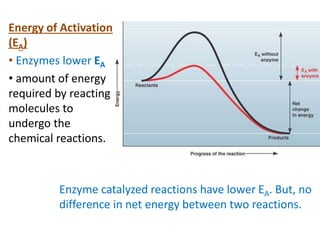
• Enzymes lower EA
• amount of energy
required by reacting
molecules to
undergo the
chemical reactions.
Enzyme catalyzed reactions have lower EA. But, no
difference in net energy between two reactions.
Nomenclature
1. Recommended name:
• Most of the enzymes are named by adding the suffix-
ase on the substrate of the reaction, eg.
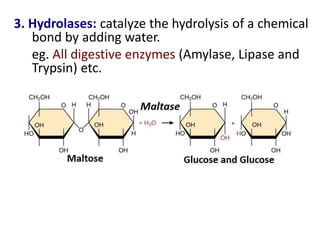
• Maltase: changes Maltose into Glc and Glc
• Urease: converts urea into NH3 & CO2
• Pyruvate carboxylase
• Trivial names: gives no hints on the enzymic reactions.
– eg. pepsin and trypsin, etc.
2. Systemic name: six major classes-
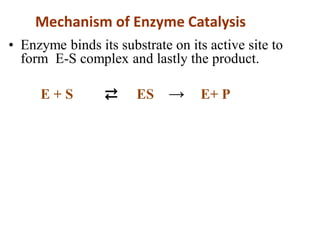
• Enzyme binds its substrate on its active site to
form E-S complex and lastly the product.
E + S ⇄ ES → E+ P
Mechanism of Enzyme Catalysis
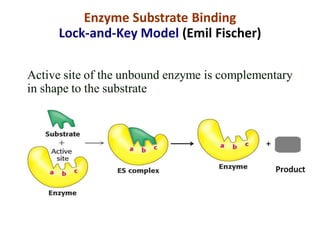
Enzyme Substrate Binding
Lock-and-Key Model (Emil Fischer)
Active site of the unbound enzyme is complementary
in shape to the substrate
Enzyme Substrate Binding
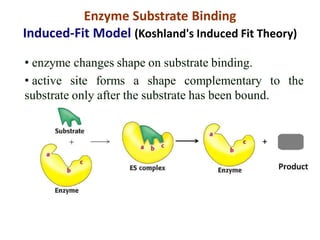
Induced-Fit Model (Koshland's Induced Fit Theory)
• enzyme changes shape on substrate binding.
• active site forms a shape complementary to the
substrate only after the substrate has been bound.
Properties of Enzyme
• Enzymes are biological catalysts and are protein in nature
• Enzyme molecules contain active site, which bind the
substrate to form product.
• Efficiency- Enzyme catalyzed reactions are million times
faster than uncatalyzed reactions.
[turn over number= 102–104s-1 (substrate transformed/sec]
• Specificity- Enzymes are highly specific catalyzing only one
type of chemical reactions.
• Regulations- Enzyme activity can be regulated, i.e.
Enzymes can be activated or inhibited.
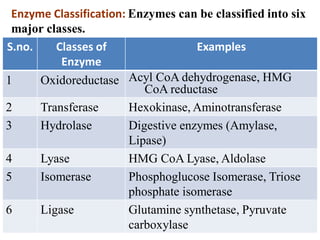
Enzyme Classification: Enzymes can be classified into six
major classes.
S.no. Classes of
Enzyme
Examples
1 Oxidoreductase Acyl CoA dehydrogenase, HMG
CoA reductase
2 Transferase Hexokinase, Aminotransferase
3 Hydrolase Digestive enzymes (Amylase,
Lipase)
4 Lyase HMG CoA Lyase, Aldolase
5 Isomerase Phosphoglucose Isomerase, Triose
phosphate isomerase
6 Ligase Glutamine synthetase, Pyruvate
carboxylase
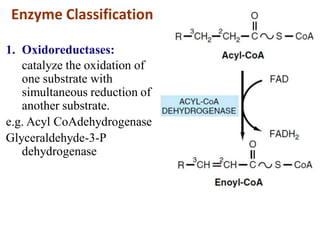
Enzyme Classification
1. Oxidoreductases:
catalyze the oxidation of
one substrate with
simultaneous reduction of
another substrate.
e.g. Acyl CoAdehydrogenase
Glyceraldehyde-3-P
dehydrogenase
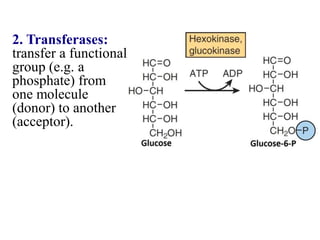
2. Transferases:
transfer a functional
group (e.g. a
phosphate) from
one molecule
(donor) to another
(acceptor).
3. Hydrolases: catalyze the hydrolysis of a chemical
bond by adding water.
eg. All digestive enzymes (Amylase, Lipase and
Trypsin) etc.
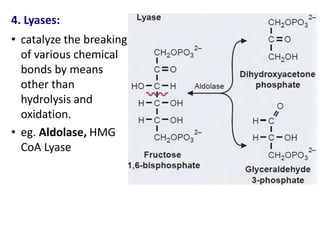
4. Lyases:
• catalyze the breaking
of various chemical
bonds by means
other than
hydrolysis and
oxidation.
• eg. Aldolase, HMG
CoA Lyase
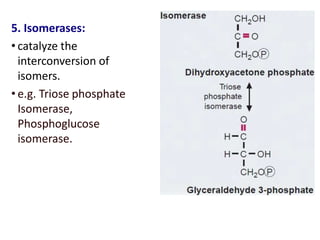
5. Isomerases:
• catalyze the
interconversion of
isomers.
• e.g. Triose phosphate
Isomerase,
Phosphoglucose
isomerase.
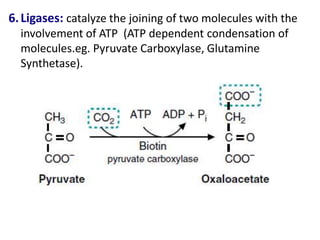
6.Ligases: catalyze the joining of two molecules with the
involvement of ATP (ATP dependent condensation of
molecules.eg. Pyruvate Carboxylase, Glutamine
Synthetase).
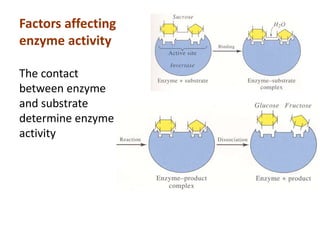
Factors affecting
enzyme activity
The contact
between enzyme
and substrate
determine enzyme
activity
The important factors that influence the velocity
of the enzyme reaction are
1. Concentration of enzyme
2. Concentration of substrate
3. Effect of temperature
4. Effect of pH
5. Effect of product concentration
6. Effect of activators
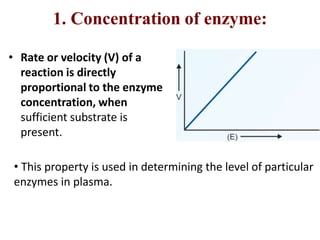
1. Concentration of enzyme:
• Rate or velocity (V) of a
reaction is directly
proportional to the enzyme
concentration, when
sufficient substrate is
present.
• This property is used in determining the level of particular
enzymes in plasma.
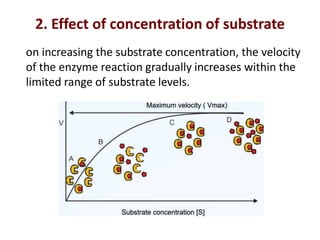
2. Effect of concentration of substrate
on increasing the substrate concentration, the velocity
of the enzyme reaction gradually increases within the
limited range of substrate levels.
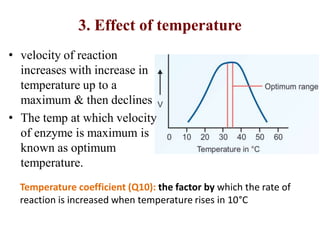
3. Effect of temperature
• velocity of reaction
increases with increase in
temperature up to a
maximum & then declines
• The temp at which velocity
of enzyme is maximum is
known as optimum
temperature.
Temperature coefficient (Q10): the factor by which the rate of
reaction is increased when temperature rises in 10°C
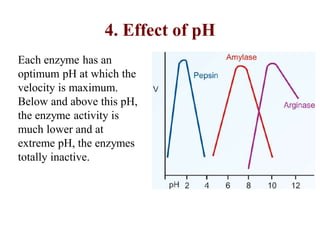
4. Effect of pH
Each enzyme has an
optimum pH at which the
velocity is maximum.
Below and above this pH,
the enzyme activity is
much lower and at
extreme pH, the enzymes
totally inactive.
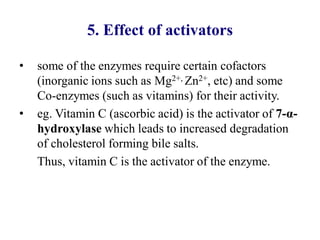
5. Effect of activators
• some of the enzymes require certain cofactors
(inorganic ions such as Mg2+, Zn2+, etc) and some
Co-enzymes (such as vitamins) for their activity.
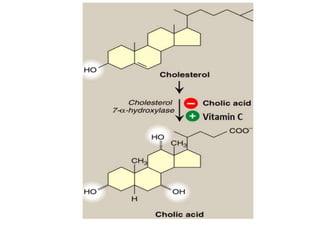
• eg. Vitamin C (ascorbic acid) is the activator of 7-α-
hydroxylase which leads to increased degradation
of cholesterol forming bile salts.
Thus, vitamin C is the activator of the enzyme.
5. Effect of product concentration
• Accumulation of products generally decreases the
enzyme velocity.
• eg. Accumulation of bile salts inhibits 7-α-
hydroxylase which leads to decreased synthesis of
bile salts.
Terminologies
• Holoenzyme: functional enzyme having protein part
(Apoenzyme) and non-protein (Cofactor or Coenzyme).
• Coenzyme: small, additional factor which assists enzyme
activity. These are the organic compound and mainly are
derived from B group of vitamins.
• eg. Vitamin C is the coenzyme for 7-α-Hydroxylase
• Cofactor: these assist enzyme activity and are derived
from minerals. These are metal ions such as Zn, Cu etc.
• eg. Cu is the cofactor for Tyrosine hydroxylase
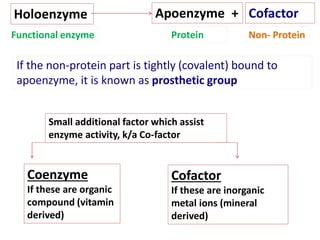
Holoenzyme
Small additional factor which assist
enzyme activity, k/a Co-factor
Cofactor
If these are inorganic
metal ions (mineral
derived)
Apoenzyme +
Functional enzyme Protein
Cofactor
Non- Protein
Coenzyme
If these are organic
compound (vitamin
derived)
If the non-protein part is tightly (covalent) bound to
apoenzyme, it is known as prosthetic group
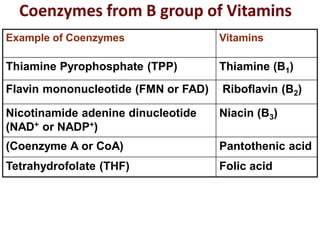
Coenzymes from B group of Vitamins
Example of Coenzymes Vitamins
Thiamine Pyrophosphate (TPP) Thiamine (B1)
Flavin mononucleotide (FMN or FAD) Riboflavin (B2)
Nicotinamide adenine dinucleotide
(NAD+ or NADP+)
Niacin (B3)
(Coenzyme A or CoA) Pantothenic acid
Tetrahydrofolate (THF) Folic acid
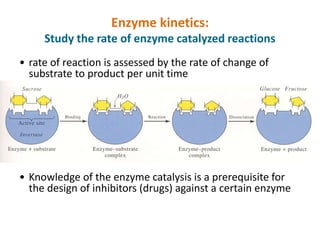
Enzyme kinetics:
Study the rate of enzyme catalyzed reactions
• rate of reaction is assessed by the rate of change of
substrate to product per unit time
• Knowledge of the enzyme catalysis is a prerequisite for
the design of inhibitors (drugs) against a certain enzyme
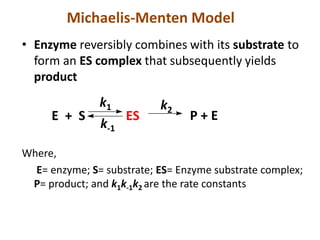
Michaelis-Menten Model
• Enzyme reversibly combines with its substrate to
form an ES complex that subsequently yields
product
Where,
E= enzyme; S= substrate; ES= Enzyme substrate complex;
P= product; and k1k-1k2 are the rate constants
E + S ES P + E
k2
k-1
k1
Michaelis-Menten Equation (simplified form)
v =
vmax [S]
[S] + KM
if [S] >> KM then v = vmax
if [S] = KM,then v =
vmax
2
Therefore KM can be viewed as the substrate concentration
with half-maximal velocity.
Michaelis-Menten Equation- Conclusion
• describes how reaction velocity varies with
substrate concentration.
• reflects the affinity of the enzyme for that substrate.
• KM is numerically equal to the substrate
concentration at which the reaction velocity is
equal to 1⁄2 Vmax.
Km does not vary with the [E]
• Large Km: reflects a low affinity of enzyme for
substrate [↑S is needed to half-saturate the
enzyme].
• Small Km: reflects a high affinity of enzyme for
substrate, [↓S is needed to half-saturate the
enzyme].
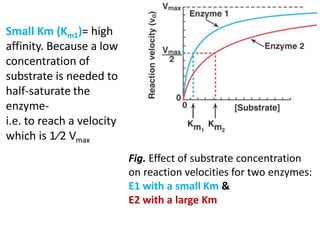
Fig. Effect of substrate concentration
on reaction velocities for two enzymes:
E1 with a small Km &
E2 with a large Km
Small Km (Km1)= high
affinity. Because a low
concentration of
substrate is needed to
half-saturate the
enzyme-
i.e. to reach a velocity
which is 1⁄2 Vmax
Relationship of velocity to [S]
• [S] is much less than Km, the velocity of the reaction
is approximately proportional to the substrate
concentration [first order].
• [S] is much greater than Km, the velocity is constant
and equal to Vmax.
[rate of reaction is then independent of substrate
concentration, and is said to be zero order].
Michaelis-Menten plot
v
[S]
vmax
KM
vmax
2
Effect of substrate concentration
on reaction velocity
At Low [S], velocity
of reaction is
proportional to [S]
At high [S], velocity is
independent of [S]
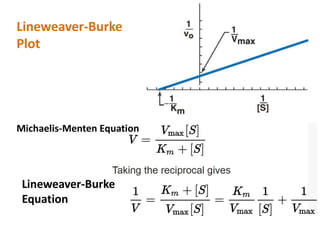
Lineweaver-Burk plot
• When v is plotted against [S], it is not always
possible to determine when Vmax has been achieved
• However, if 1/v is plotted versus 1/[S], a straight line
is obtained.
• This, a double-reciprocal plot can be used to
calculate Km and Vmax, as well as to determine the
mechanism of action of enzyme inhibitors.
Lineweaver-Burke
Plot
Michaelis-Menten Equation
Lineweaver-Burke
Equation
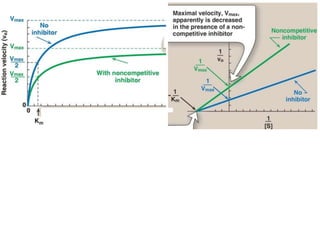
Use of Lineweaver–Burk plot
• widely used to determine Km and Vmax in
enzyme kinetics
• gives a quick, visual impression of the
different forms of enzyme inhibition.
• competitive
• non-competitive
Inhibition of Enzyme activity
Inhibitor:
Any substance that can diminish the velocity of
an enzyme-catalyzed reaction.
Two types:
i. Irreversible inhibitors &
ii. reversible inhibitors
Irreversible inhibitor
 Binds tightly (mostly covalently) at or near the active
site of an enzyme, & form a stable complex
 No dissociation of enzyme and I & enzyme is
permanently inactivated. (or slowly reactivated- hrs or
days for reversal)
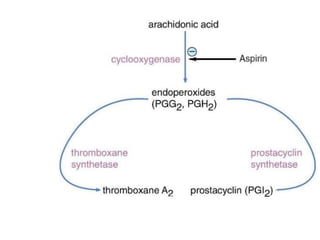
• eg. Aspirin covalently modifies the enzyme cyclo-
oxygenase, thus, reduces the synthesis of inflammatory
signals
• Penicillin covalently binds at active site of transpeptidase
and modifies it thereby preventing the synthesis of bacterial
cell walls
Inhibitor may or may not resemble the substrate
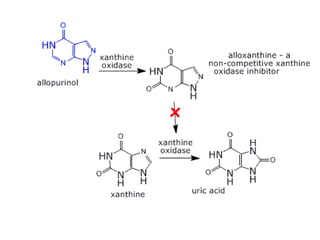
Suicide inhibition
• Irreversible inhibition of enzyme by a substrate
analogue that form reactive species upon enzyme
catalyzed reaction
• eg. Allopurinol, the suicide inhibitor of xanthine
oxidase
Reversible inhibitor
• The inhibitor forms a loose, dissociable complex (EI)
with the enzyme
• Catalytic activity of EI complex is lower than that of
the enzyme alone.
• Hence, substrate transformation decreases after
addition of the inhibitor.
• Reversible inhibitor may be:
i. Competitive
ii. Non-competitive
iii. Uncompetetive
Competitive inhibition
1. inhibitor resembles
structurally with the actual
substrate.
2. inhibitor binds reversibly
to the substrate binding
site & competes with the
substrate for that site
eg.
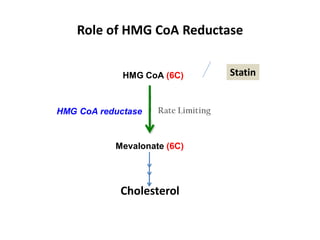
• Inhibition of HMG CoA
reductase by statins
• Inhibition of the succinate
dehydrogenase by
malonate
Role of HMG CoA Reductase
HMG CoA (6C)
Mevalonate (6C)
HMG CoA reductase Rate Limiting
Cholesterol
Statin
Competitive inhibition: Effect on Vmax and on Km
Effect on Vmax:
• The effect of a competitive inhibitor is reversed by
increasing [S].
• At a sufficiently high substrate concentration, the
reaction velocity reaches the ‘Vmax’
Effect on Km
• in the presence of a competitive inhibitor, more
substrate is needed to achieve 1⁄2 Vmax.
Vmax is the same in the
presence of a
competitive inhibitor
Km is increased in
presence of
competitive inhibitor
↑[S]- velocity becomes Vmax
↑[S]- required to achieve Vmax/2
Km- increased by competitive inhibitor
Competitive inhibition
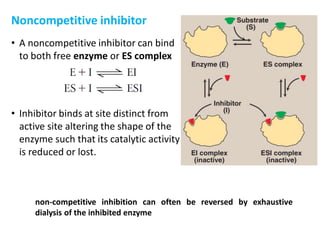
Noncompetitive inhibitor
• A noncompetitive inhibitor can bind
to both free enzyme or ES complex
• Inhibitor binds at site distinct from
active site altering the shape of the
enzyme such that its catalytic activity
is reduced or lost.
non-competitive inhibition can often be reversed by exhaustive
dialysis of the inhibited enzyme
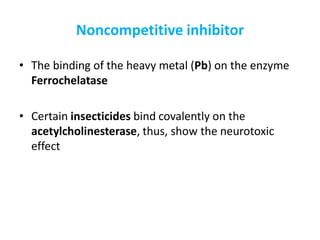
Noncompetitive inhibitor
• The binding of the heavy metal (Pb) on the enzyme
Ferrochelatase
• Certain insecticides bind covalently on the
acetylcholinesterase, thus, show the neurotoxic
effect
Regulation of Enzyme Activity
• Enzyme activity can be regulated by
i. Allosteric effectors
ii. Covalent modification
iii. Altered rates of enzyme synthesis or
degradation
Allosteric Effectors
• bind noncovalently to the enzyme
• can alter the affinity of the enzyme for its substrate or
modify the catalytic activity of the enzyme, or both.
• Effectors my be- Positive or Negative
• Effectors are of two types:
– Homotropic & heterotropic effectors
• Act on the committed step of the metabolic pathway.
Homotropic effectors
• the substrate itself serves as an effector
• Presence of a substrate molecule at one site on the
enzyme enhances the catalytic properties of the
substrate-binding sites (co-operativity).
• Activation of Aspartate transcarbamoylase by ATP
(pyrimidine biosynthesis).
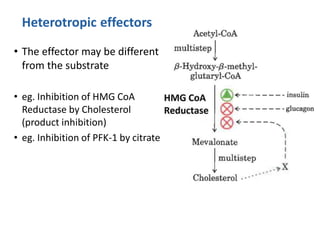
Heterotropic effectors
• The effector may be different
from the substrate
• eg. Inhibition of HMG CoA
Reductase by Cholesterol
(product inhibition)
• eg. Inhibition of PFK-1 by citrate
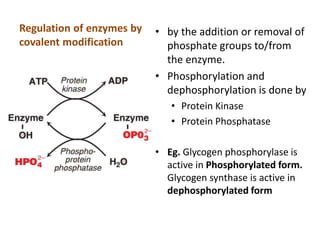
Regulation of enzymes by
covalent modification
• by the addition or removal of
phosphate groups to/from
the enzyme.
• Phosphorylation and
dephosphorylation is done by
• Protein Kinase
• Protein Phosphatase
• Eg. Glycogen phosphorylase is
active in Phosphorylated form.
Glycogen synthase is active in
dephosphorylated form
Induction and repression of enzyme synthesis
• cells can also regulate the amount of enzyme
by either increasing (induction) or decreasing
(repression) the enzyme synthesis, leading to
an alteration in the total population of active
sites. eg.
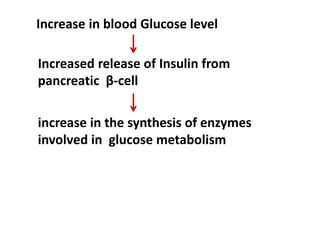
Increase in blood Glucose level
Increased release of Insulin from
pancreatic β-cell
increase in the synthesis of enzymes
involved in glucose metabolism
Enzymes In Clinical Diagnosis
• Enzymology in medicine
• Measurement of Enzyme activity
• Isoenzymes
Enzymology in Medicine
• Some enzymes which are present in blood/plasma of
normal individuals at a very low levels, they have no any
known function in plasma are known as non-functional
plasma enzymes.
• Presence of these enzymes in plasma is due to cell
turnover.
• However, increased levels of such enzymes in plasma
suggest an increased rate of tissue destruction, thus can
provide diagnostic information.
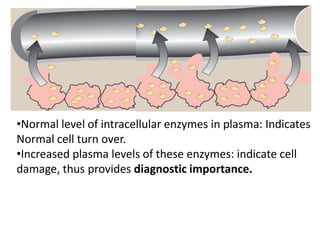
•Normal level of intracellular enzymes in plasma: Indicates
Normal cell turn over.
•Increased plasma levels of these enzymes: indicate cell
damage, thus provides diagnostic importance.
Sources of enzymes
• Enzymes are generally synthesized by cells and are
released into circulation.
• eg. ALT- synthesized by liver cells.
AST- synthesized by cardiac cells.
Amylase- synthesized by pancreas and
salivary gland.
Trypsin and Chymotrypsin- by pancreas.
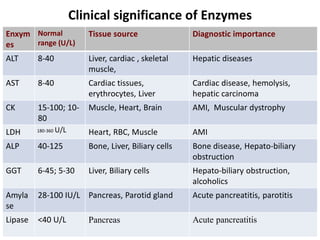
Clinical significance of Enzymes
Enxym
es
Normal
range (U/L)
Tissue source Diagnostic importance
ALT 8-40 Liver, cardiac , skeletal
muscle,
Hepatic diseases
AST 8-40 Cardiac tissues,
erythrocytes, Liver
Cardiac disease, hemolysis,
hepatic carcinoma
CK 15-100; 10-
80
Muscle, Heart, Brain AMI, Muscular dystrophy
LDH 180-360 U/L Heart, RBC, Muscle AMI
ALP 40-125 Bone, Liver, Biliary cells Bone disease, Hepato-biliary
obstruction
GGT 6-45; 5-30 Liver, Biliary cells Hepato-biliary obstruction,
alcoholics
Amyla
se
28-100 IU/L Pancreas, Parotid gland Acute pancreatitis, parotitis
Lipase <40 U/L Pancreas Acute pancreatitis
Isoenzymes
• Different forms of the same enzymes catalyze similar
type of reactions but present on different tissue
locations.
• Differ in amino acid sequence, hence, differ in physical
properties
Example:
• Isoenzymes of Creatine Kinase (CK):- CK1, CK2 and CK3
• Isoenzymes of Lactate Dehydrogenase (LDH ):- LDH1-
LDH5
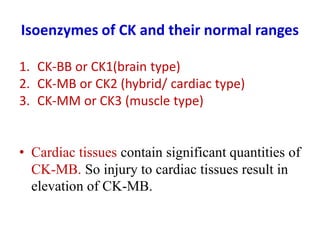
Isoenzymes of CK and their normal ranges
1. CK-BB or CK1(brain type)
2. CK-MB or CK2 (hybrid/ cardiac type)
3. CK-MM or CK3 (muscle type)
• Cardiac tissues contain significant quantities of
CK-MB. So injury to cardiac tissues result in
elevation of CK-MB.
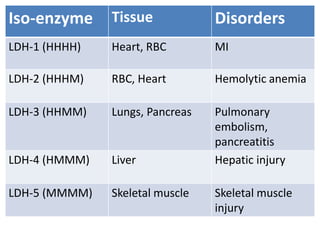
Iso-enzyme Tissue Disorders
LDH-1 (HHHH) Heart, RBC MI
LDH-2 (HHHM) RBC, Heart Hemolytic anemia
LDH-3 (HHMM) Lungs, Pancreas Pulmonary
embolism,
pancreatitis
LDH-4 (HMMM) Liver Hepatic injury
LDH-5 (MMMM) Skeletal muscle Skeletal muscle
injury
Enzyme notes biochemistry Satyanarayan.pdf

Enzyme notes biochemistry Satyanarayan.pdf

  • 1.
    Enzymes Definition, Classification- IUBMB,Factors affecting Enzyme activity, Enzyme kinetics, Inhibition of activity, Regulation of activity, Measurement of Enzyme activity, Isoenzymes, Enzymology in medicine MBBSI, 024 Arun Pandeya
  • 2.
    Definition • biological catalyststhat increase the velocity of chemical reactions • no change in overall process • protein in nature. [except- Ribozymes] • having the suffix –‘ase’ (exception- pepsin, trypsin, etc.) • more than 3000 enzymes
  • 3.
    Energy of Activation (EA) •Enzymes lower EA • amount of energy required by reacting molecules to undergo the chemical reactions. Enzyme catalyzed reactions have lower EA. But, no difference in net energy between two reactions.
  • 4.
    Nomenclature 1. Recommended name: •Most of the enzymes are named by adding the suffix- ase on the substrate of the reaction, eg. • Maltase: changes Maltose into Glc and Glc • Urease: converts urea into NH3 & CO2 • Pyruvate carboxylase • Trivial names: gives no hints on the enzymic reactions. – eg. pepsin and trypsin, etc. 2. Systemic name: six major classes-
  • 5.
    • Enzyme bindsits substrate on its active site to form E-S complex and lastly the product. E + S ⇄ ES → E+ P Mechanism of Enzyme Catalysis
  • 6.
    Enzyme Substrate Binding Lock-and-KeyModel (Emil Fischer) Active site of the unbound enzyme is complementary in shape to the substrate
  • 7.
    Enzyme Substrate Binding Induced-FitModel (Koshland's Induced Fit Theory) • enzyme changes shape on substrate binding. • active site forms a shape complementary to the substrate only after the substrate has been bound.
  • 8.
    Properties of Enzyme •Enzymes are biological catalysts and are protein in nature • Enzyme molecules contain active site, which bind the substrate to form product. • Efficiency- Enzyme catalyzed reactions are million times faster than uncatalyzed reactions. [turn over number= 102–104s-1 (substrate transformed/sec] • Specificity- Enzymes are highly specific catalyzing only one type of chemical reactions. • Regulations- Enzyme activity can be regulated, i.e. Enzymes can be activated or inhibited.
  • 9.
    Enzyme Classification: Enzymescan be classified into six major classes. S.no. Classes of Enzyme Examples 1 Oxidoreductase Acyl CoA dehydrogenase, HMG CoA reductase 2 Transferase Hexokinase, Aminotransferase 3 Hydrolase Digestive enzymes (Amylase, Lipase) 4 Lyase HMG CoA Lyase, Aldolase 5 Isomerase Phosphoglucose Isomerase, Triose phosphate isomerase 6 Ligase Glutamine synthetase, Pyruvate carboxylase
  • 10.
    Enzyme Classification 1. Oxidoreductases: catalyzethe oxidation of one substrate with simultaneous reduction of another substrate. e.g. Acyl CoAdehydrogenase Glyceraldehyde-3-P dehydrogenase
  • 11.
    2. Transferases: transfer afunctional group (e.g. a phosphate) from one molecule (donor) to another (acceptor).
  • 12.
    3. Hydrolases: catalyzethe hydrolysis of a chemical bond by adding water. eg. All digestive enzymes (Amylase, Lipase and Trypsin) etc.
  • 13.
    4. Lyases: • catalyzethe breaking of various chemical bonds by means other than hydrolysis and oxidation. • eg. Aldolase, HMG CoA Lyase
  • 14.
    5. Isomerases: • catalyzethe interconversion of isomers. • e.g. Triose phosphate Isomerase, Phosphoglucose isomerase.
  • 15.
    6.Ligases: catalyze thejoining of two molecules with the involvement of ATP (ATP dependent condensation of molecules.eg. Pyruvate Carboxylase, Glutamine Synthetase).
  • 16.
    Factors affecting enzyme activity Thecontact between enzyme and substrate determine enzyme activity
  • 17.
    The important factorsthat influence the velocity of the enzyme reaction are 1. Concentration of enzyme 2. Concentration of substrate 3. Effect of temperature 4. Effect of pH 5. Effect of product concentration 6. Effect of activators
  • 18.
    1. Concentration ofenzyme: • Rate or velocity (V) of a reaction is directly proportional to the enzyme concentration, when sufficient substrate is present. • This property is used in determining the level of particular enzymes in plasma.
  • 19.
    2. Effect ofconcentration of substrate on increasing the substrate concentration, the velocity of the enzyme reaction gradually increases within the limited range of substrate levels.
  • 20.
    3. Effect oftemperature • velocity of reaction increases with increase in temperature up to a maximum & then declines • The temp at which velocity of enzyme is maximum is known as optimum temperature. Temperature coefficient (Q10): the factor by which the rate of reaction is increased when temperature rises in 10°C
  • 21.
    4. Effect ofpH Each enzyme has an optimum pH at which the velocity is maximum. Below and above this pH, the enzyme activity is much lower and at extreme pH, the enzymes totally inactive.
  • 22.
    5. Effect ofactivators • some of the enzymes require certain cofactors (inorganic ions such as Mg2+, Zn2+, etc) and some Co-enzymes (such as vitamins) for their activity. • eg. Vitamin C (ascorbic acid) is the activator of 7-α- hydroxylase which leads to increased degradation of cholesterol forming bile salts. Thus, vitamin C is the activator of the enzyme.
  • 24.
    5. Effect ofproduct concentration • Accumulation of products generally decreases the enzyme velocity. • eg. Accumulation of bile salts inhibits 7-α- hydroxylase which leads to decreased synthesis of bile salts.
  • 25.
    Terminologies • Holoenzyme: functionalenzyme having protein part (Apoenzyme) and non-protein (Cofactor or Coenzyme). • Coenzyme: small, additional factor which assists enzyme activity. These are the organic compound and mainly are derived from B group of vitamins. • eg. Vitamin C is the coenzyme for 7-α-Hydroxylase • Cofactor: these assist enzyme activity and are derived from minerals. These are metal ions such as Zn, Cu etc. • eg. Cu is the cofactor for Tyrosine hydroxylase
  • 26.
    Holoenzyme Small additional factorwhich assist enzyme activity, k/a Co-factor Cofactor If these are inorganic metal ions (mineral derived) Apoenzyme + Functional enzyme Protein Cofactor Non- Protein Coenzyme If these are organic compound (vitamin derived) If the non-protein part is tightly (covalent) bound to apoenzyme, it is known as prosthetic group
  • 27.
    Coenzymes from Bgroup of Vitamins Example of Coenzymes Vitamins Thiamine Pyrophosphate (TPP) Thiamine (B1) Flavin mononucleotide (FMN or FAD) Riboflavin (B2) Nicotinamide adenine dinucleotide (NAD+ or NADP+) Niacin (B3) (Coenzyme A or CoA) Pantothenic acid Tetrahydrofolate (THF) Folic acid
  • 28.
    Enzyme kinetics: Study therate of enzyme catalyzed reactions • rate of reaction is assessed by the rate of change of substrate to product per unit time • Knowledge of the enzyme catalysis is a prerequisite for the design of inhibitors (drugs) against a certain enzyme
  • 29.
    Michaelis-Menten Model • Enzymereversibly combines with its substrate to form an ES complex that subsequently yields product Where, E= enzyme; S= substrate; ES= Enzyme substrate complex; P= product; and k1k-1k2 are the rate constants E + S ES P + E k2 k-1 k1
  • 30.
    Michaelis-Menten Equation (simplifiedform) v = vmax [S] [S] + KM if [S] >> KM then v = vmax if [S] = KM,then v = vmax 2 Therefore KM can be viewed as the substrate concentration with half-maximal velocity.
  • 31.
    Michaelis-Menten Equation- Conclusion •describes how reaction velocity varies with substrate concentration. • reflects the affinity of the enzyme for that substrate. • KM is numerically equal to the substrate concentration at which the reaction velocity is equal to 1⁄2 Vmax.
  • 32.
    Km does notvary with the [E] • Large Km: reflects a low affinity of enzyme for substrate [↑S is needed to half-saturate the enzyme]. • Small Km: reflects a high affinity of enzyme for substrate, [↓S is needed to half-saturate the enzyme].
  • 33.
    Fig. Effect ofsubstrate concentration on reaction velocities for two enzymes: E1 with a small Km & E2 with a large Km Small Km (Km1)= high affinity. Because a low concentration of substrate is needed to half-saturate the enzyme- i.e. to reach a velocity which is 1⁄2 Vmax
  • 34.
    Relationship of velocityto [S] • [S] is much less than Km, the velocity of the reaction is approximately proportional to the substrate concentration [first order]. • [S] is much greater than Km, the velocity is constant and equal to Vmax. [rate of reaction is then independent of substrate concentration, and is said to be zero order].
  • 35.
    Michaelis-Menten plot v [S] vmax KM vmax 2 Effect ofsubstrate concentration on reaction velocity At Low [S], velocity of reaction is proportional to [S] At high [S], velocity is independent of [S]
  • 36.
    Lineweaver-Burk plot • Whenv is plotted against [S], it is not always possible to determine when Vmax has been achieved • However, if 1/v is plotted versus 1/[S], a straight line is obtained. • This, a double-reciprocal plot can be used to calculate Km and Vmax, as well as to determine the mechanism of action of enzyme inhibitors.
  • 37.
  • 38.
    Use of Lineweaver–Burkplot • widely used to determine Km and Vmax in enzyme kinetics • gives a quick, visual impression of the different forms of enzyme inhibition. • competitive • non-competitive
  • 39.
    Inhibition of Enzymeactivity Inhibitor: Any substance that can diminish the velocity of an enzyme-catalyzed reaction. Two types: i. Irreversible inhibitors & ii. reversible inhibitors
  • 40.
    Irreversible inhibitor  Bindstightly (mostly covalently) at or near the active site of an enzyme, & form a stable complex  No dissociation of enzyme and I & enzyme is permanently inactivated. (or slowly reactivated- hrs or days for reversal) • eg. Aspirin covalently modifies the enzyme cyclo- oxygenase, thus, reduces the synthesis of inflammatory signals • Penicillin covalently binds at active site of transpeptidase and modifies it thereby preventing the synthesis of bacterial cell walls Inhibitor may or may not resemble the substrate
  • 42.
    Suicide inhibition • Irreversibleinhibition of enzyme by a substrate analogue that form reactive species upon enzyme catalyzed reaction • eg. Allopurinol, the suicide inhibitor of xanthine oxidase
  • 44.
    Reversible inhibitor • Theinhibitor forms a loose, dissociable complex (EI) with the enzyme • Catalytic activity of EI complex is lower than that of the enzyme alone. • Hence, substrate transformation decreases after addition of the inhibitor. • Reversible inhibitor may be: i. Competitive ii. Non-competitive iii. Uncompetetive
  • 45.
    Competitive inhibition 1. inhibitorresembles structurally with the actual substrate. 2. inhibitor binds reversibly to the substrate binding site & competes with the substrate for that site eg. • Inhibition of HMG CoA reductase by statins • Inhibition of the succinate dehydrogenase by malonate
  • 46.
    Role of HMGCoA Reductase HMG CoA (6C) Mevalonate (6C) HMG CoA reductase Rate Limiting Cholesterol Statin
  • 47.
    Competitive inhibition: Effecton Vmax and on Km Effect on Vmax: • The effect of a competitive inhibitor is reversed by increasing [S]. • At a sufficiently high substrate concentration, the reaction velocity reaches the ‘Vmax’ Effect on Km • in the presence of a competitive inhibitor, more substrate is needed to achieve 1⁄2 Vmax.
  • 48.
    Vmax is thesame in the presence of a competitive inhibitor Km is increased in presence of competitive inhibitor ↑[S]- velocity becomes Vmax ↑[S]- required to achieve Vmax/2 Km- increased by competitive inhibitor Competitive inhibition
  • 49.
    Noncompetitive inhibitor • Anoncompetitive inhibitor can bind to both free enzyme or ES complex • Inhibitor binds at site distinct from active site altering the shape of the enzyme such that its catalytic activity is reduced or lost. non-competitive inhibition can often be reversed by exhaustive dialysis of the inhibited enzyme
  • 50.
    Noncompetitive inhibitor • Thebinding of the heavy metal (Pb) on the enzyme Ferrochelatase • Certain insecticides bind covalently on the acetylcholinesterase, thus, show the neurotoxic effect
  • 52.
    Regulation of EnzymeActivity • Enzyme activity can be regulated by i. Allosteric effectors ii. Covalent modification iii. Altered rates of enzyme synthesis or degradation
  • 53.
    Allosteric Effectors • bindnoncovalently to the enzyme • can alter the affinity of the enzyme for its substrate or modify the catalytic activity of the enzyme, or both. • Effectors my be- Positive or Negative • Effectors are of two types: – Homotropic & heterotropic effectors • Act on the committed step of the metabolic pathway.
  • 54.
    Homotropic effectors • thesubstrate itself serves as an effector • Presence of a substrate molecule at one site on the enzyme enhances the catalytic properties of the substrate-binding sites (co-operativity). • Activation of Aspartate transcarbamoylase by ATP (pyrimidine biosynthesis).
  • 55.
    Heterotropic effectors • Theeffector may be different from the substrate • eg. Inhibition of HMG CoA Reductase by Cholesterol (product inhibition) • eg. Inhibition of PFK-1 by citrate
  • 56.
    Regulation of enzymesby covalent modification • by the addition or removal of phosphate groups to/from the enzyme. • Phosphorylation and dephosphorylation is done by • Protein Kinase • Protein Phosphatase • Eg. Glycogen phosphorylase is active in Phosphorylated form. Glycogen synthase is active in dephosphorylated form
  • 57.
    Induction and repressionof enzyme synthesis • cells can also regulate the amount of enzyme by either increasing (induction) or decreasing (repression) the enzyme synthesis, leading to an alteration in the total population of active sites. eg.
  • 58.
    Increase in bloodGlucose level Increased release of Insulin from pancreatic β-cell increase in the synthesis of enzymes involved in glucose metabolism
  • 59.
    Enzymes In ClinicalDiagnosis • Enzymology in medicine • Measurement of Enzyme activity • Isoenzymes
  • 60.
    Enzymology in Medicine •Some enzymes which are present in blood/plasma of normal individuals at a very low levels, they have no any known function in plasma are known as non-functional plasma enzymes. • Presence of these enzymes in plasma is due to cell turnover. • However, increased levels of such enzymes in plasma suggest an increased rate of tissue destruction, thus can provide diagnostic information.
  • 61.
    •Normal level ofintracellular enzymes in plasma: Indicates Normal cell turn over. •Increased plasma levels of these enzymes: indicate cell damage, thus provides diagnostic importance.
  • 62.
    Sources of enzymes •Enzymes are generally synthesized by cells and are released into circulation. • eg. ALT- synthesized by liver cells. AST- synthesized by cardiac cells. Amylase- synthesized by pancreas and salivary gland. Trypsin and Chymotrypsin- by pancreas.
  • 63.
    Clinical significance ofEnzymes Enxym es Normal range (U/L) Tissue source Diagnostic importance ALT 8-40 Liver, cardiac , skeletal muscle, Hepatic diseases AST 8-40 Cardiac tissues, erythrocytes, Liver Cardiac disease, hemolysis, hepatic carcinoma CK 15-100; 10- 80 Muscle, Heart, Brain AMI, Muscular dystrophy LDH 180-360 U/L Heart, RBC, Muscle AMI ALP 40-125 Bone, Liver, Biliary cells Bone disease, Hepato-biliary obstruction GGT 6-45; 5-30 Liver, Biliary cells Hepato-biliary obstruction, alcoholics Amyla se 28-100 IU/L Pancreas, Parotid gland Acute pancreatitis, parotitis Lipase <40 U/L Pancreas Acute pancreatitis
  • 64.
    Isoenzymes • Different formsof the same enzymes catalyze similar type of reactions but present on different tissue locations. • Differ in amino acid sequence, hence, differ in physical properties Example: • Isoenzymes of Creatine Kinase (CK):- CK1, CK2 and CK3 • Isoenzymes of Lactate Dehydrogenase (LDH ):- LDH1- LDH5
  • 65.
    Isoenzymes of CKand their normal ranges 1. CK-BB or CK1(brain type) 2. CK-MB or CK2 (hybrid/ cardiac type) 3. CK-MM or CK3 (muscle type) • Cardiac tissues contain significant quantities of CK-MB. So injury to cardiac tissues result in elevation of CK-MB.
  • 66.
    Iso-enzyme Tissue Disorders LDH-1(HHHH) Heart, RBC MI LDH-2 (HHHM) RBC, Heart Hemolytic anemia LDH-3 (HHMM) Lungs, Pancreas Pulmonary embolism, pancreatitis LDH-4 (HMMM) Liver Hepatic injury LDH-5 (MMMM) Skeletal muscle Skeletal muscle injury