Group 1
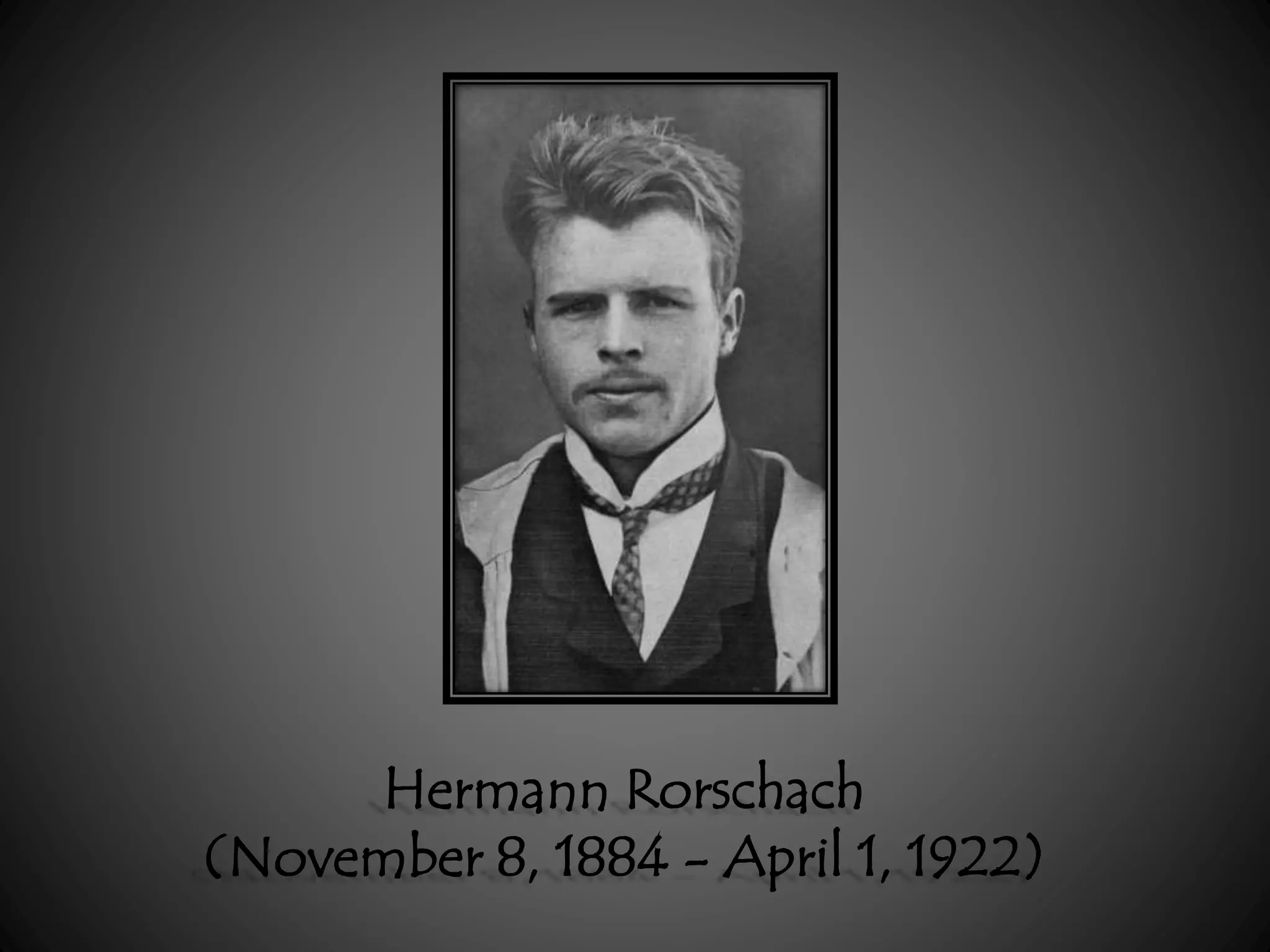
Hermann Rorschach 
(November 8, 1884 - April 1, 1922)
Popular game 
Eugen Bleuler coined the term 'Schizophrenia' 
Rorschach used 40 inkblots out of which he regularly used 15 of 
them with his patients 
Publisher for his inkblots- The House of Bircher 
Rorschach died in 1922 
Some facts 
Exner's scoring system 
Contributors of Rorschach
Performance based task 
Personality, Perceptual, and Problem 
solving characteristics : 
i. Thought organization 
ii. Perceptual accuracy and conventionality 
iii. Self-image and understanding of others 
iv. Psychological resources and schemas
Contents : 
1.Stimulus cards (10) 
2.Response sheet 
3.Location chart 
4.Manual 
Materials Required For Administration : 
1.All the test contents 
2.Stopwatch 
3.Different colored pencils 
4.Good seating arrangement
 Among clinical psychologists in practice, the 
Rorschach is typically the Third or Fourth 
most commonly used assessment 
instrument, following the WAIS and MMPI 
(Camara, Nathan, & Puente, 2000; Watkins, 
Campbell, Nieberding, & Hallmark,1995) 
 With respect to its research base, the Rorschach 
has been the second most investigated 
personality assessment instrument 
(following the MMPI), with about 7,000 
citations in the literature as of the mid-1990s 
(Butcher & Rouse, 1996)
 A complete system by Holtzman 
 A series by Behn-Eschenberg that was initially hoped to 
parallel Rorschach’s blots 
 A short 3-card series by Zulliger, 
 An infrequently researched set of Somatic inkblots by 
Roemer, which are a set of stimuli that were deliberately 
created to elicit responses containing somatic content or 
themes.
The development of the Rorschach CS included the compilation of 
descriptive statistics for each of its codes and summary scores for a sample 
of 600 nonpatient adults age 19 to 69 (Mean of 31.7) 
The sample was stratified to include an equal number of males and females 
and 120 persons from each of five geographic areas across the United 
States (Northeast, South, Midwest, Southwest, and West) 
Additional reference data are available for 1,390 nonpatient young people, 
ages 5 to 16, and for three groups of adult psychiatric patients: 328 first 
admission inpatients with schizophrenia, 279 patients hospitalized for 
depression, and 535 outpatients presenting a diversity of symptoms 
A further source of concern about the current adequacy of the CS norms 
emerged from a 12-country collaborative international study of Rorschach 
structural data in nonpatient samples.
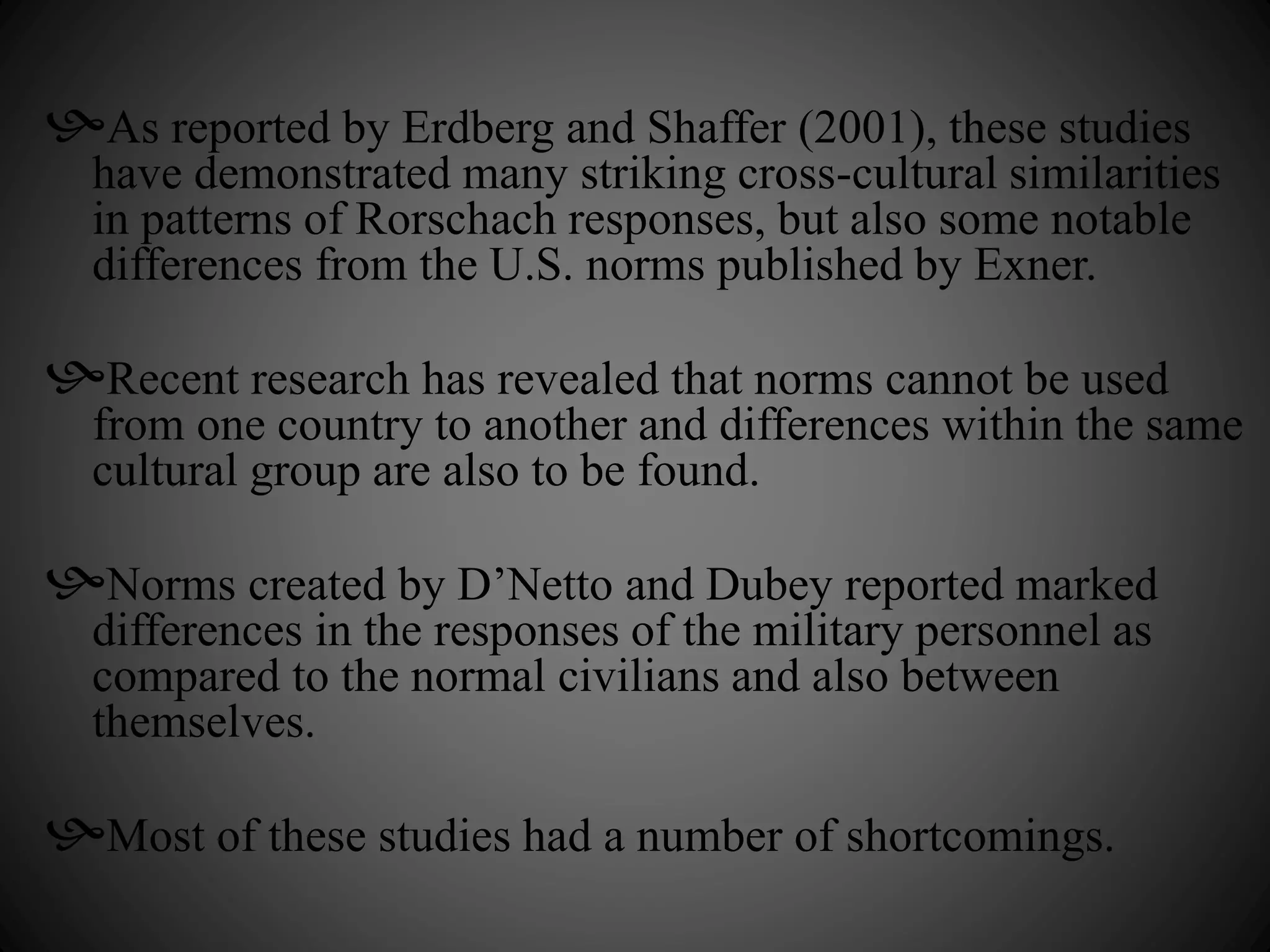
As reported by Erdberg and Shaffer (2001), these studies 
have demonstrated many striking cross-cultural similarities 
in patterns of Rorschach responses, but also some notable 
differences from the U.S. norms published by Exner. 
Recent research has revealed that norms cannot be used 
from one country to another and differences within the same 
cultural group are also to be found. 
Norms created by D’Netto and Dubey reported marked 
differences in the responses of the military personnel as 
compared to the normal civilians and also between 
themselves. 
Most of these studies had a number of shortcomings.
 Lack of standardized rules for administration 
and scoring. 
 Poor inter-rater reliability. 
 Lack of adequate norms. 
 Unknown or weak validity.
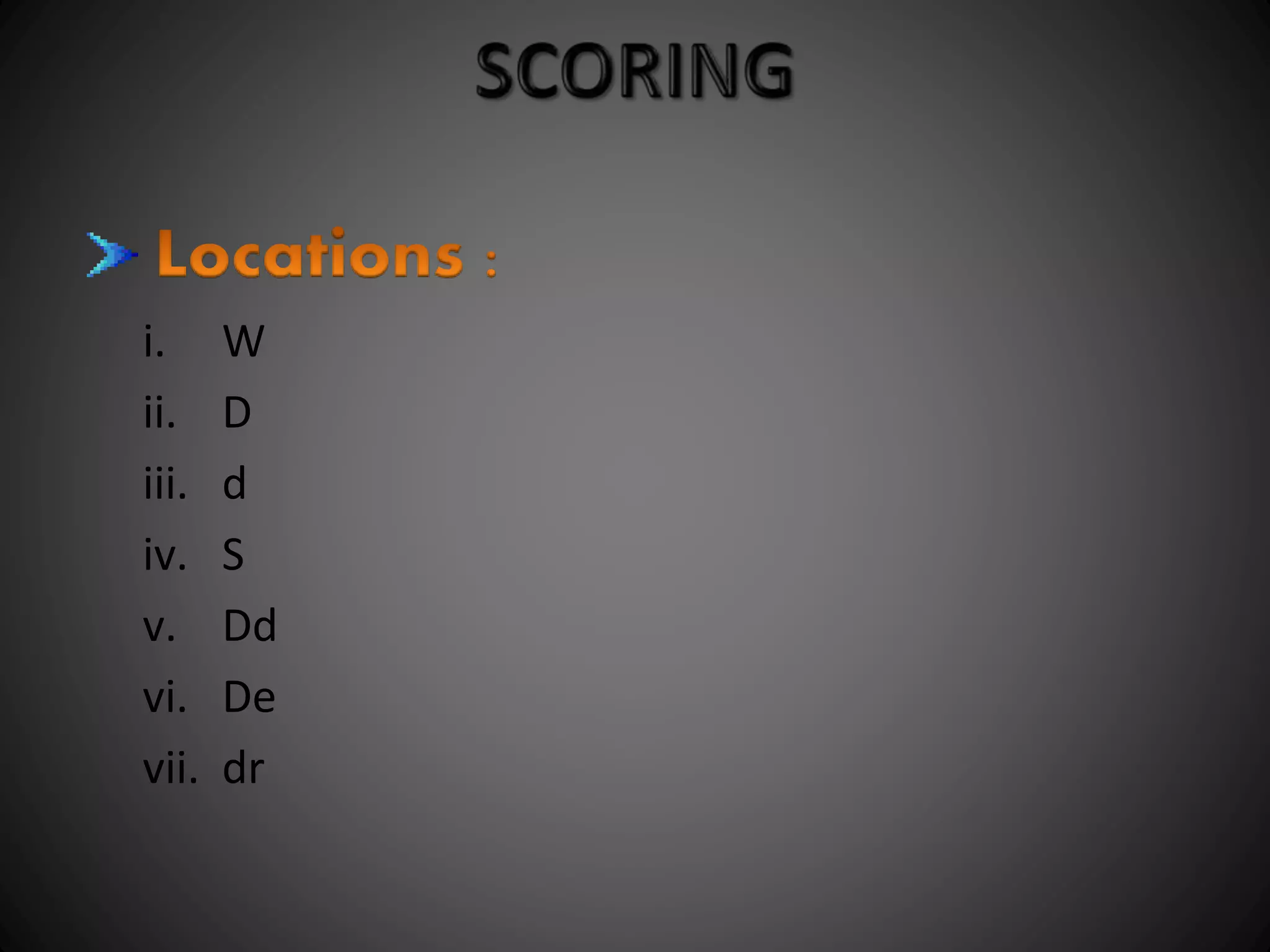
i. W 
ii. D 
iii. d 
iv. S 
v. Dd 
vi. De 
vii. dr
• H 
• (H) 
• Hd 
• (Hd) 
• A-I 
• At 
• Sex 
• A 
• (A) 
• Ad 
• (Ad)
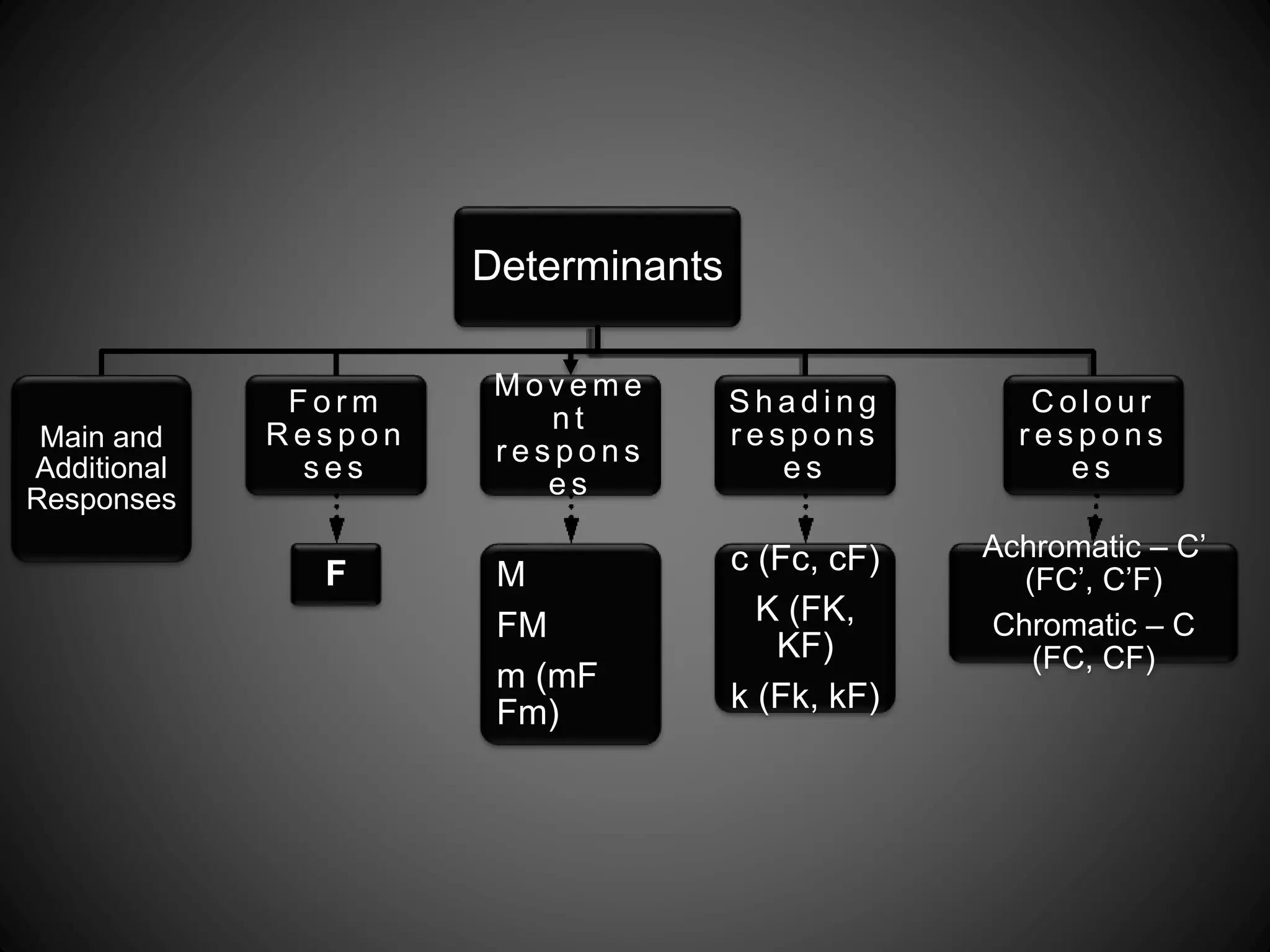
Determinants 
Main and 
Additional 
Responses 
F o rm 
Re s p o n 
s e s 
F 
Mo v eme 
n t 
r e s p o n s 
es 
M 
FM 
m (mF 
Fm) 
Sh a d i n g 
r e s p o n s 
es 
c (Fc, cF) 
K (FK, 
KF) 
k (Fk, kF) 
Co l o u r 
r e s p o n s 
es 
Achromatic – C’ 
(FC’, C’F) 
Chromatic – C 
(FC, CF)
Psychogram
Interpretation of M, FM, m 
Interpretation of K, KF, FK 
Interpretation of F 
Interpretation of c, Fc, cF 
Interpretation of Colour responses 
Interpretation of C, FC, CF
Chromatic – Achromatic 
I. Achromatic + 2x chromatic 
II. Achromatic + ½ Chromatic 
III. Achromatic < ½ Chromatic 
F%, N%, D%, S%, dd% 
No. of responses & Average response time 
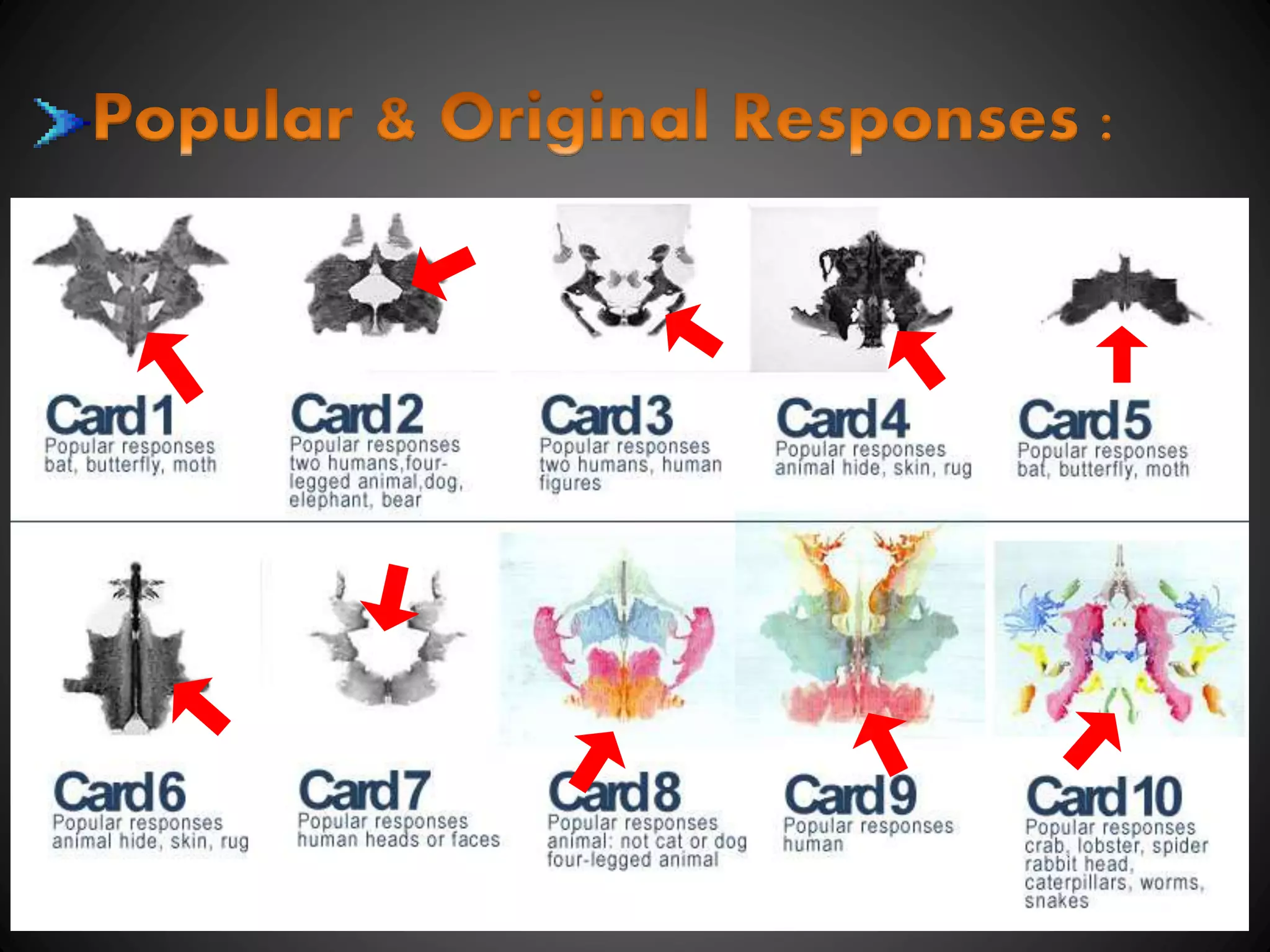
Popular responses 
Sequence analysis 
Content analysis 
Evaluation
1.) Intellectual Level: 
• Form Level Rating 
• Quantity and Quality of M responses 
• Quantity and Quality of W responses 
• Variety of Responses 
• Succession
2.) The Evaluation of control: 
The individual should have control over his impulses as well as overt 
expressions in order to protect from the dangers of reality situations 
and to successfully satisfy one’s needs: 
Outer Control 
Inner control 
Constrictive or Repressive Control 
3.) Evaluation of Creative potential: 
Creativity in Rorschach indicates maturity and this creativity is based 
on two aspects which are as follows: 
Imaginal Resources 
Object Relations
4.) The Introversive-Extroversive Relationship: 
It differs from commonly used words as introverts or extroverts. 
An Introversive person has a well-developed imagination in terms of 
fantasy, impulses of long term goals. He tends to modify the 
environment in terms of his own personal needs and values. Either that 
person could have distorted reality or at the other hand he may be self-sufficient. 
An Extroversive person responds more towards the environment. He 
easily gets stimulated. A passive extroversive take the things as they 
come to him without making any changes with reference to his needs. 
The difference between introversive and extroversive is that 
introversive have personal developmental goals while the extroversive 
has goals related to the external world.
Rorschach is considered to be excellent at 
bypassing a person’s conscious resistance 
The Rorschach’s purported high resistance to 
faking 
Ease of administration. The cards can be easily 
handled, and the total administration time 
(including inquiry) is typically 50 minutes
Validity is often quite variable across different scoring 
categories and formulas. 
Typically, multiple scores and formulas are derived from 
the Rorschach responses, some of which have relatively 
good validity and some of which are moderate, 
controversial, or even nonexistent.
Error can potentially be introduced from many different directions, 
like censorship by the subject, scoring errors, poor handling of the 
subtleties of interpretation, incorrect incorporation of the 
implications of age or education, or possible examiner bias 
Previous lack of a single, standardized administration and scoring 
system. This is particularly important because numerous studies have 
clearly indicated that slight alterations in wording, rapport, and 
encouragement can significantly alter the numbers and types of 
responses. 
In summary, the Rorschach is difficult to evaluate because of its 
complexity, its frequent controversy, and considerable variability 
related to the validity of its variables.
The Rorschach Ink Blot Test

The Rorschach Ink Blot Test

  • 1.
  • 2.
    Hermann Rorschach (November8, 1884 - April 1, 1922)
  • 3.
    Popular game EugenBleuler coined the term 'Schizophrenia' Rorschach used 40 inkblots out of which he regularly used 15 of them with his patients Publisher for his inkblots- The House of Bircher Rorschach died in 1922 Some facts Exner's scoring system Contributors of Rorschach
  • 4.
    Performance based task Personality, Perceptual, and Problem solving characteristics : i. Thought organization ii. Perceptual accuracy and conventionality iii. Self-image and understanding of others iv. Psychological resources and schemas
  • 5.
    Contents : 1.Stimuluscards (10) 2.Response sheet 3.Location chart 4.Manual Materials Required For Administration : 1.All the test contents 2.Stopwatch 3.Different colored pencils 4.Good seating arrangement
  • 8.
     Among clinicalpsychologists in practice, the Rorschach is typically the Third or Fourth most commonly used assessment instrument, following the WAIS and MMPI (Camara, Nathan, & Puente, 2000; Watkins, Campbell, Nieberding, & Hallmark,1995)  With respect to its research base, the Rorschach has been the second most investigated personality assessment instrument (following the MMPI), with about 7,000 citations in the literature as of the mid-1990s (Butcher & Rouse, 1996)
  • 9.
     A completesystem by Holtzman  A series by Behn-Eschenberg that was initially hoped to parallel Rorschach’s blots  A short 3-card series by Zulliger,  An infrequently researched set of Somatic inkblots by Roemer, which are a set of stimuli that were deliberately created to elicit responses containing somatic content or themes.
  • 15.
    The development ofthe Rorschach CS included the compilation of descriptive statistics for each of its codes and summary scores for a sample of 600 nonpatient adults age 19 to 69 (Mean of 31.7) The sample was stratified to include an equal number of males and females and 120 persons from each of five geographic areas across the United States (Northeast, South, Midwest, Southwest, and West) Additional reference data are available for 1,390 nonpatient young people, ages 5 to 16, and for three groups of adult psychiatric patients: 328 first admission inpatients with schizophrenia, 279 patients hospitalized for depression, and 535 outpatients presenting a diversity of symptoms A further source of concern about the current adequacy of the CS norms emerged from a 12-country collaborative international study of Rorschach structural data in nonpatient samples.
  • 16.
    As reported byErdberg and Shaffer (2001), these studies have demonstrated many striking cross-cultural similarities in patterns of Rorschach responses, but also some notable differences from the U.S. norms published by Exner. Recent research has revealed that norms cannot be used from one country to another and differences within the same cultural group are also to be found. Norms created by D’Netto and Dubey reported marked differences in the responses of the military personnel as compared to the normal civilians and also between themselves. Most of these studies had a number of shortcomings.
  • 17.
     Lack ofstandardized rules for administration and scoring.  Poor inter-rater reliability.  Lack of adequate norms.  Unknown or weak validity.
  • 18.
    i. W ii.D iii. d iv. S v. Dd vi. De vii. dr
  • 19.
    • H •(H) • Hd • (Hd) • A-I • At • Sex • A • (A) • Ad • (Ad)
  • 20.
    Determinants Main and Additional Responses F o rm Re s p o n s e s F Mo v eme n t r e s p o n s es M FM m (mF Fm) Sh a d i n g r e s p o n s es c (Fc, cF) K (FK, KF) k (Fk, kF) Co l o u r r e s p o n s es Achromatic – C’ (FC’, C’F) Chromatic – C (FC, CF)
  • 23.
  • 24.
    Interpretation of M,FM, m Interpretation of K, KF, FK Interpretation of F Interpretation of c, Fc, cF Interpretation of Colour responses Interpretation of C, FC, CF
  • 25.
    Chromatic – Achromatic I. Achromatic + 2x chromatic II. Achromatic + ½ Chromatic III. Achromatic < ½ Chromatic F%, N%, D%, S%, dd% No. of responses & Average response time Popular responses Sequence analysis Content analysis Evaluation
  • 26.
    1.) Intellectual Level: • Form Level Rating • Quantity and Quality of M responses • Quantity and Quality of W responses • Variety of Responses • Succession
  • 27.
    2.) The Evaluationof control: The individual should have control over his impulses as well as overt expressions in order to protect from the dangers of reality situations and to successfully satisfy one’s needs: Outer Control Inner control Constrictive or Repressive Control 3.) Evaluation of Creative potential: Creativity in Rorschach indicates maturity and this creativity is based on two aspects which are as follows: Imaginal Resources Object Relations
  • 28.
    4.) The Introversive-ExtroversiveRelationship: It differs from commonly used words as introverts or extroverts. An Introversive person has a well-developed imagination in terms of fantasy, impulses of long term goals. He tends to modify the environment in terms of his own personal needs and values. Either that person could have distorted reality or at the other hand he may be self-sufficient. An Extroversive person responds more towards the environment. He easily gets stimulated. A passive extroversive take the things as they come to him without making any changes with reference to his needs. The difference between introversive and extroversive is that introversive have personal developmental goals while the extroversive has goals related to the external world.
  • 29.
    Rorschach is consideredto be excellent at bypassing a person’s conscious resistance The Rorschach’s purported high resistance to faking Ease of administration. The cards can be easily handled, and the total administration time (including inquiry) is typically 50 minutes
  • 30.
    Validity is oftenquite variable across different scoring categories and formulas. Typically, multiple scores and formulas are derived from the Rorschach responses, some of which have relatively good validity and some of which are moderate, controversial, or even nonexistent.
  • 31.
    Error can potentiallybe introduced from many different directions, like censorship by the subject, scoring errors, poor handling of the subtleties of interpretation, incorrect incorporation of the implications of age or education, or possible examiner bias Previous lack of a single, standardized administration and scoring system. This is particularly important because numerous studies have clearly indicated that slight alterations in wording, rapport, and encouragement can significantly alter the numbers and types of responses. In summary, the Rorschach is difficult to evaluate because of its complexity, its frequent controversy, and considerable variability related to the validity of its variables.