Cognitive Bases of Behavior
Introduction and Historical
Background
August 22, 2007
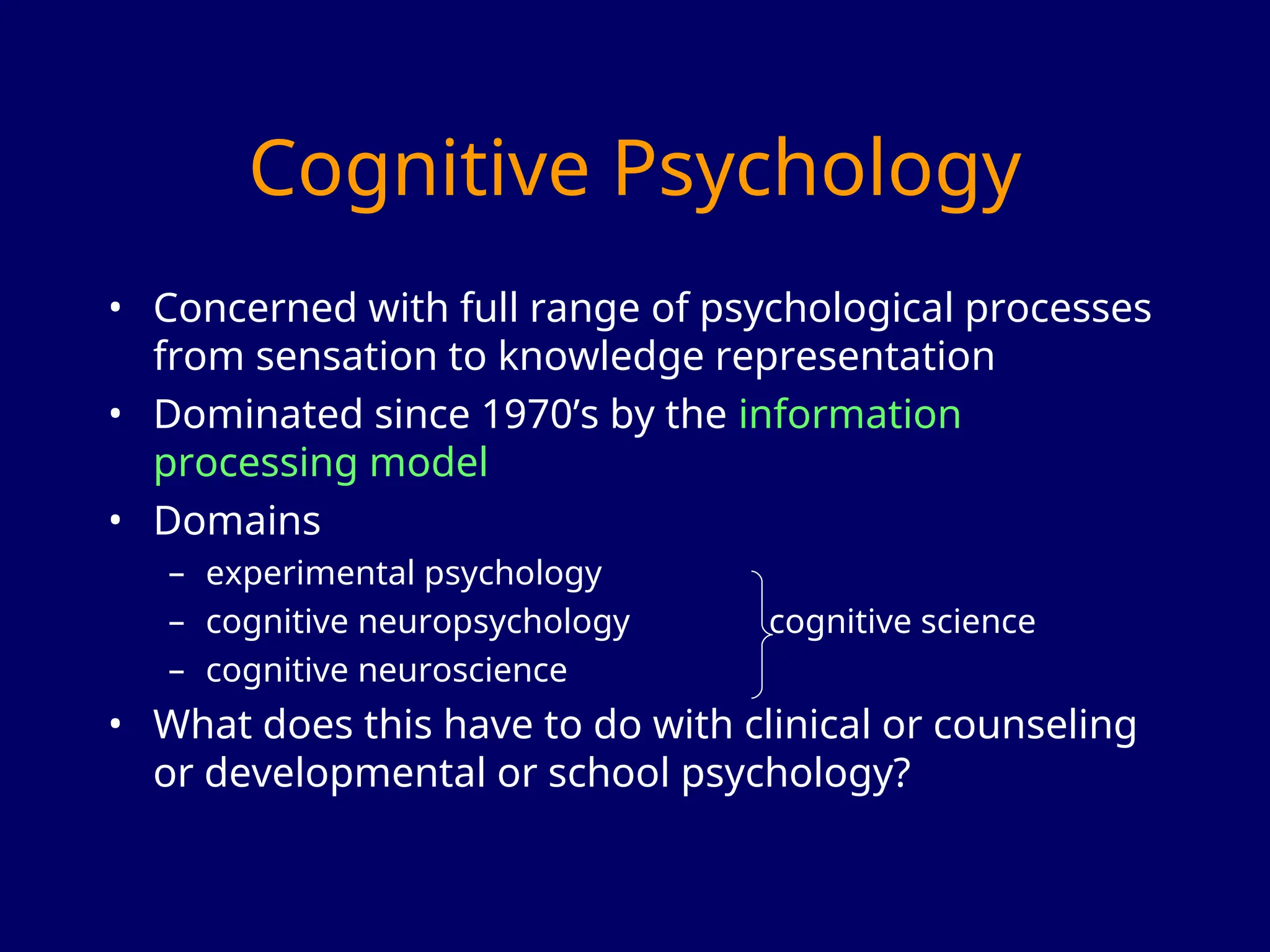
Cognitive Psychology
• Concerned with full range of psychological processes
from sensation to knowledge representation
• Dominated since 1970’s by the information
processing model
• Domains
– experimental psychology
– cognitive neuropsychology cognitive science
– cognitive neuroscience
• What does this have to do with clinical or counseling
or developmental or school psychology?
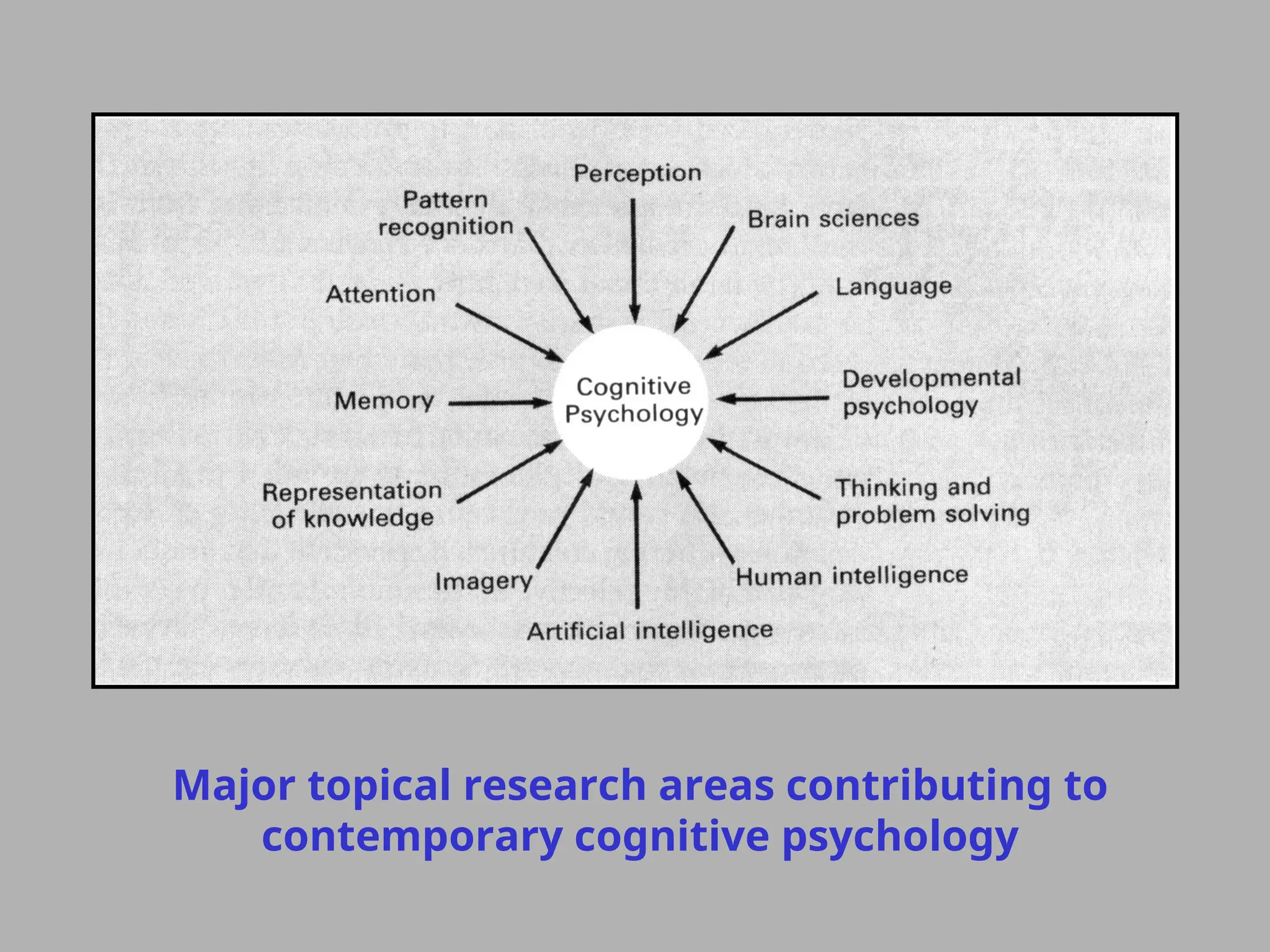
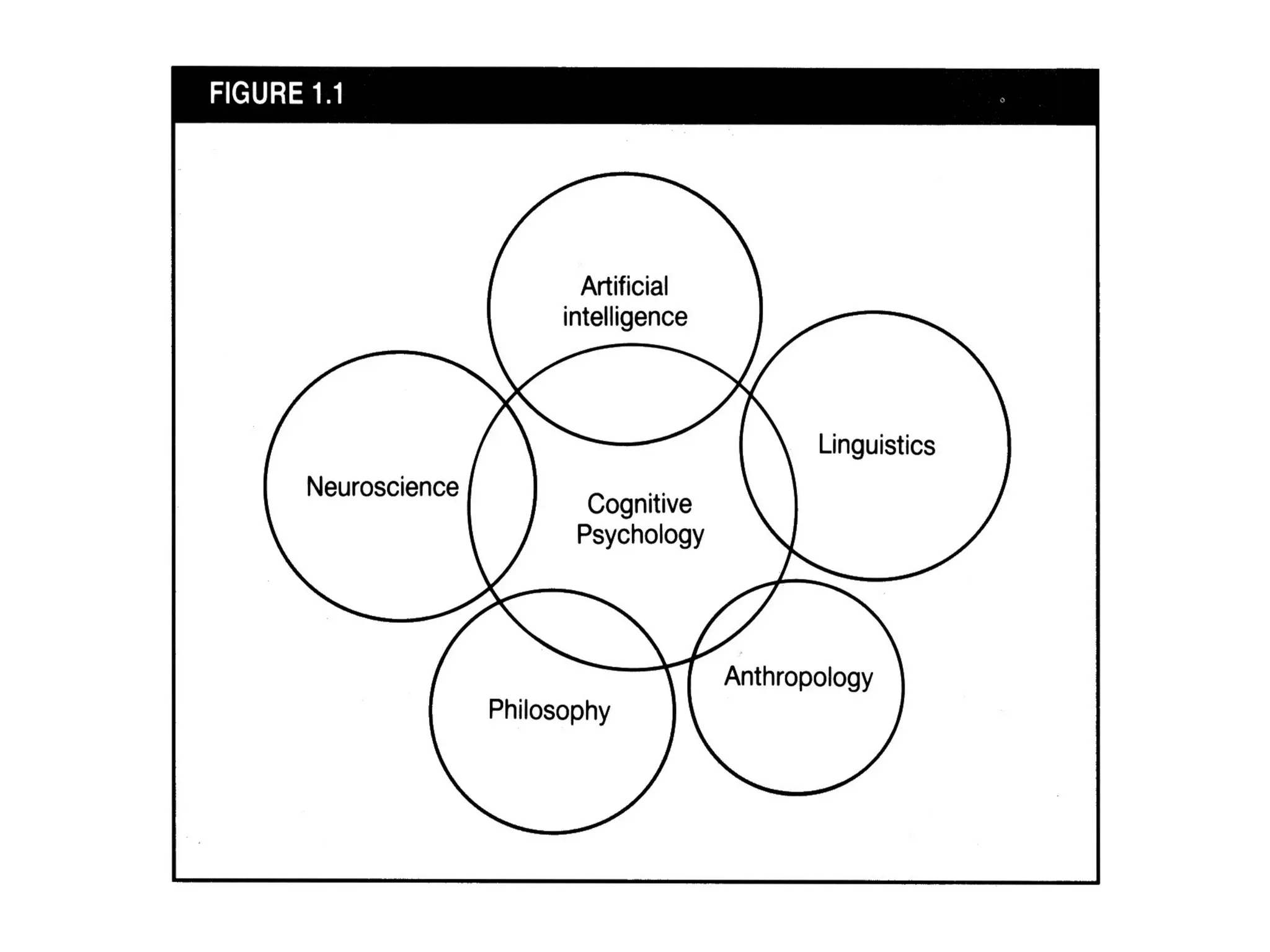
Major topical research areas contributing to
contemporary cognitive psychology
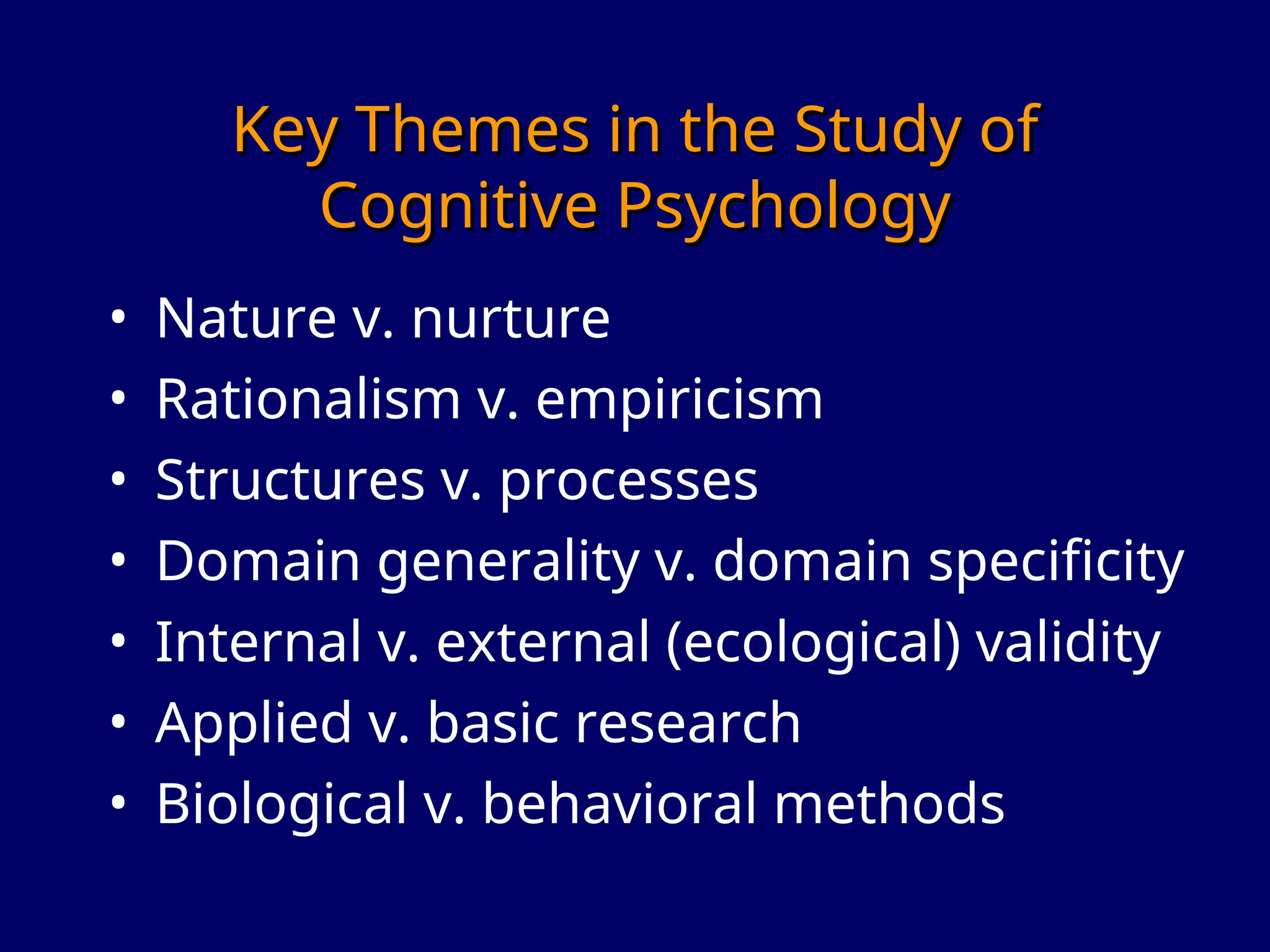
Key Themes in the Study of
Cognitive Psychology
• Nature v. nurture
• Rationalism v. empiricism
• Structures v. processes
• Domain generality v. domain specificity
• Internal v. external (ecological) validity
• Applied v. basic research
• Biological v. behavioral methods
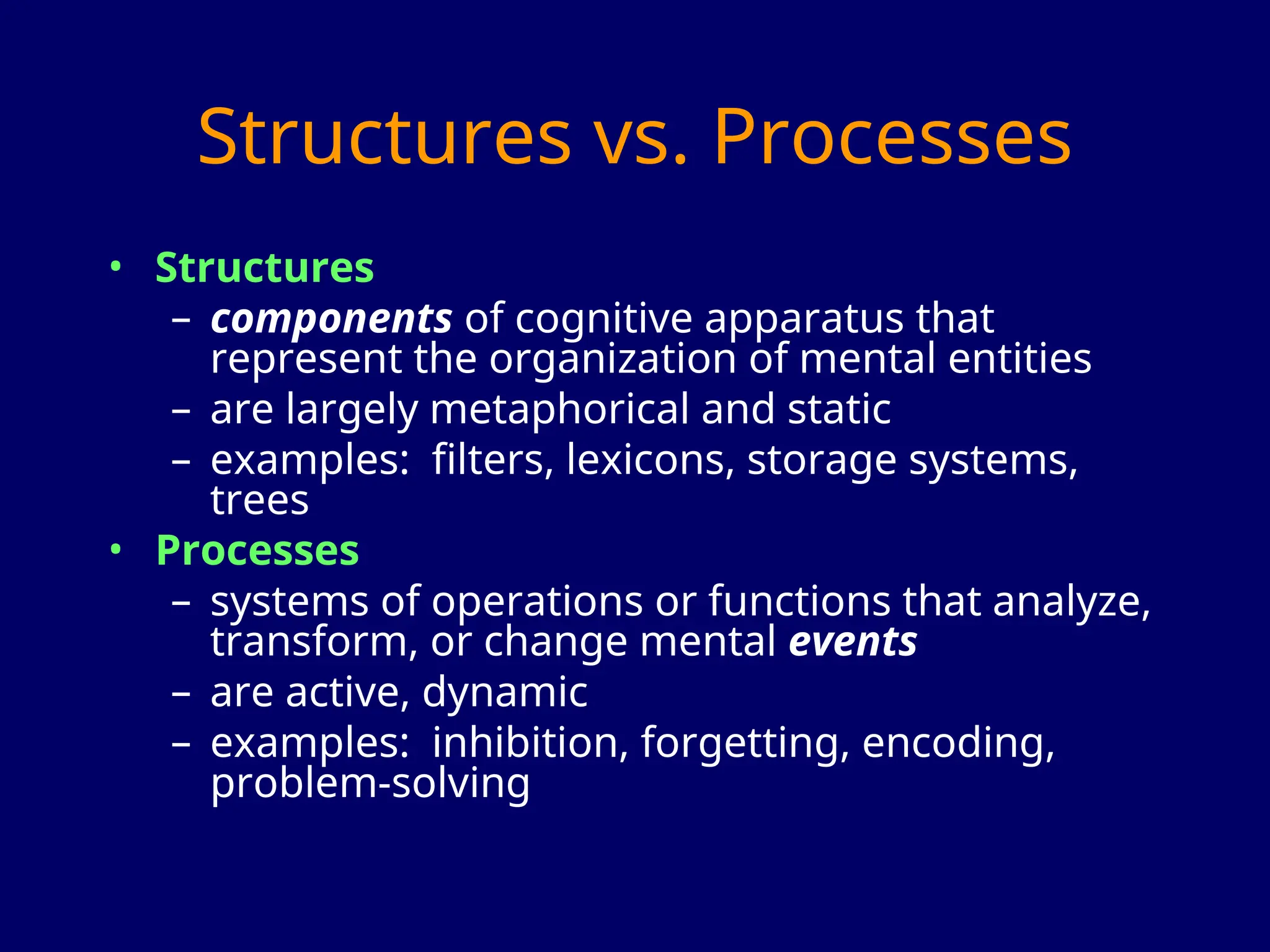
Structures vs. Processes
• Structures
– components of cognitive apparatus that
represent the organization of mental entities
– are largely metaphorical and static
– examples: filters, lexicons, storage systems,
trees
• Processes
– systems of operations or functions that analyze,
transform, or change mental events
– are active, dynamic
– examples: inhibition, forgetting, encoding,
problem-solving
Historical Antecedents
• Philosophy: concerned with
understanding experience through
introspection - rational
• Physiology: scientific understanding
of life-sustaining processes in living
matter - empirical
Rationalism vs. Empiricism
• Plato: theory of forms, reality resides not in
concrete objects, but in the abstract forms (ideas)
they represent - forerunner of rationalism; this
idea picked up again by Descartes in 17th
century; idea of innate knowledge
• Aristotle: reality resides only in concrete world
of objects, abstract ideas are a derivation -
forerunner of empiricism; this idea picked up
again by Locke; humans born without knowledge,
experience writes on the mind
Structuralism vs. Functionalism
• Structuralism: understand basic parts
(akin to anatomy) of the mind (e.g.,
Wundt)
• Functionalism: understand basic
processes (akin to physiology) of the
mind (e.g., James)
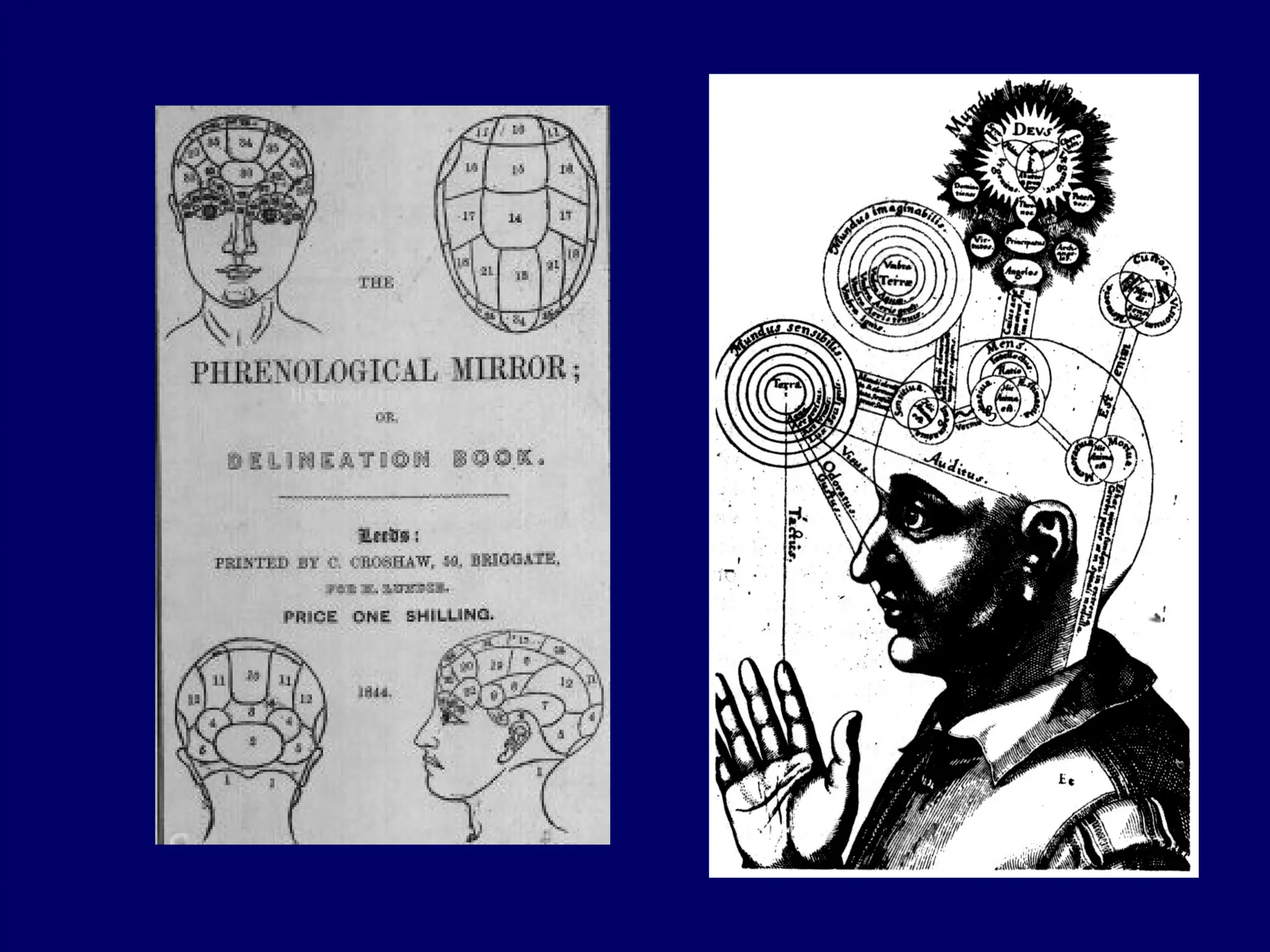
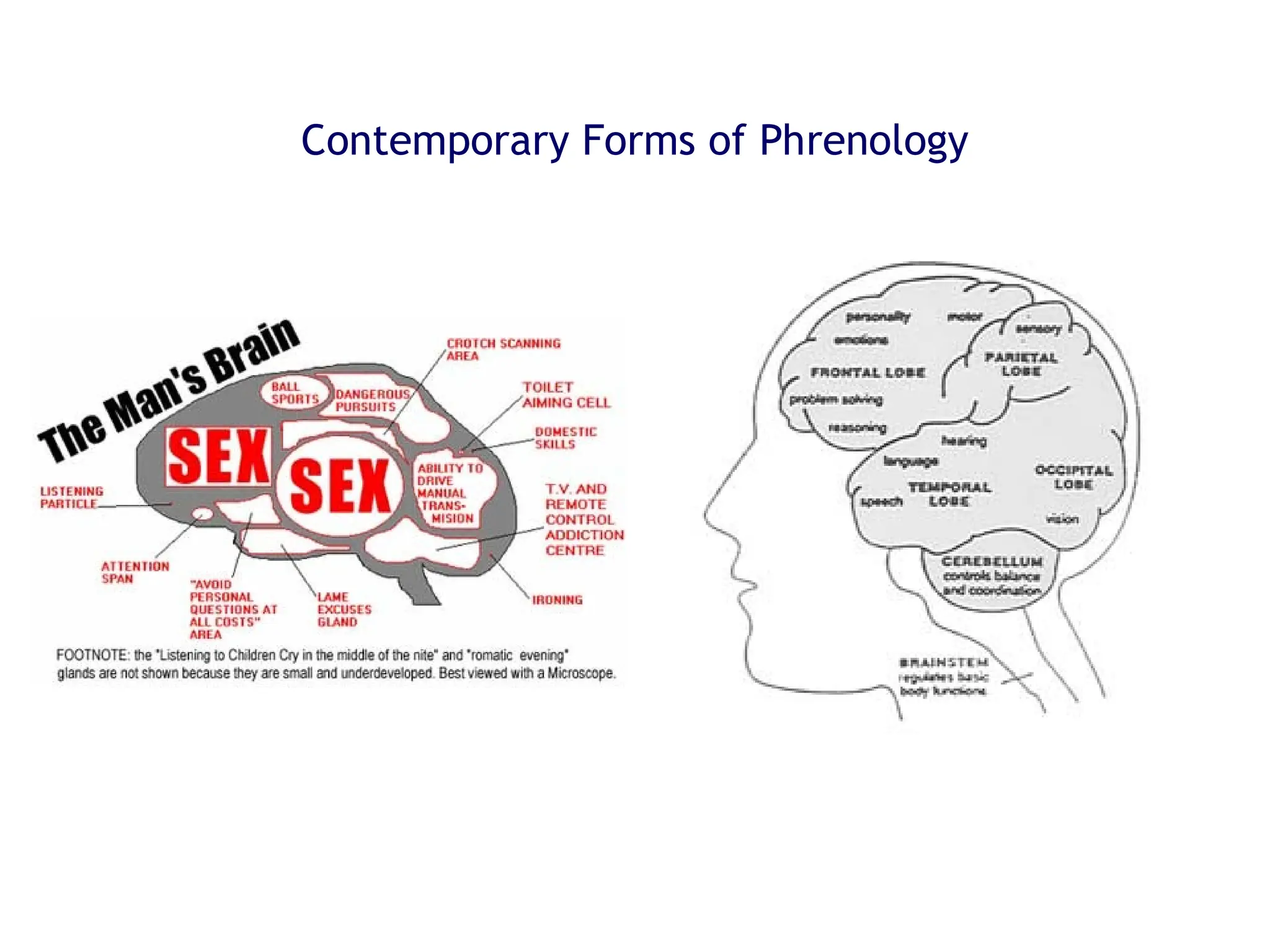
Contemporary Forms of Phrenology
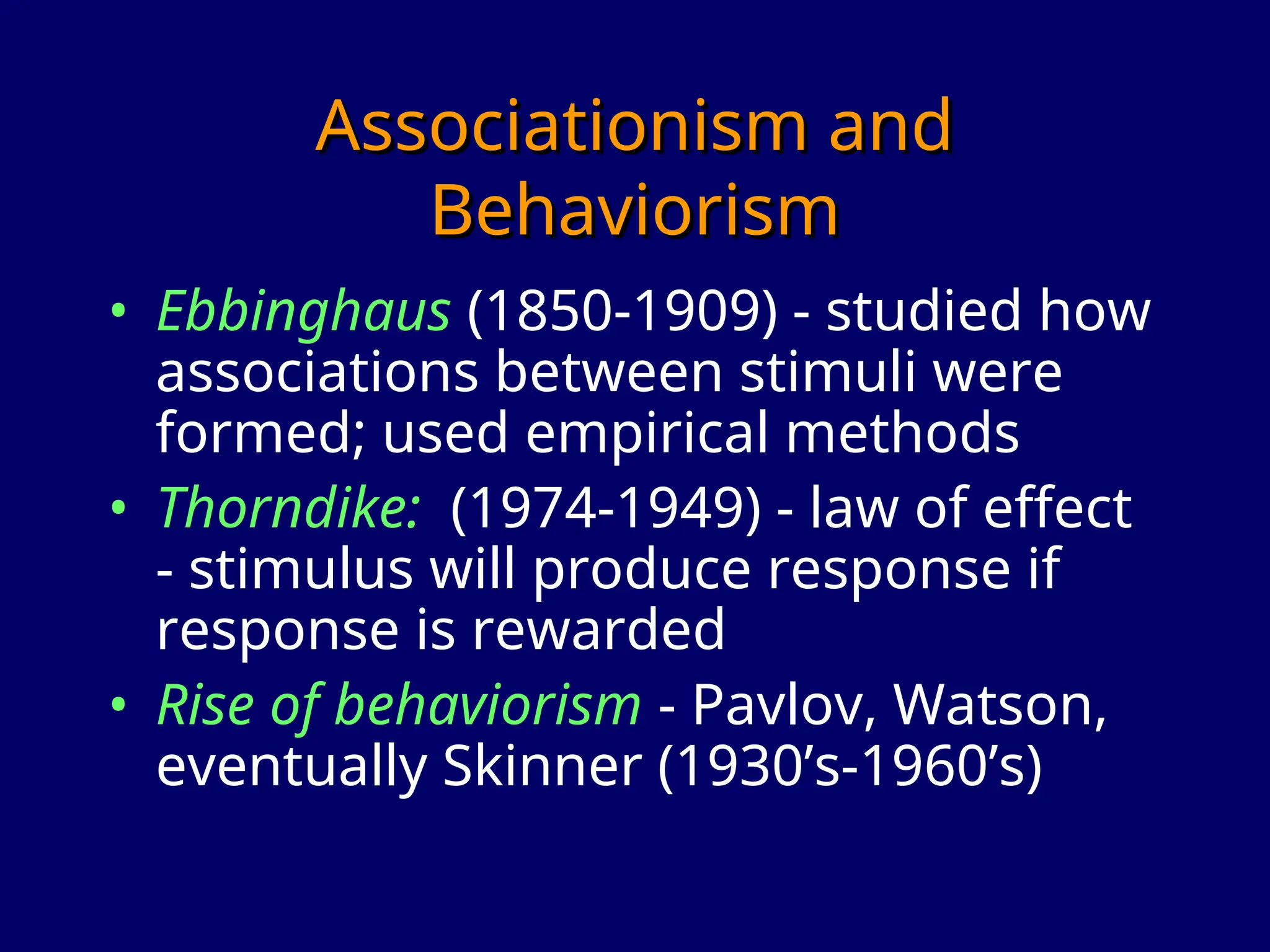
Associationism and
Associationism and
Behaviorism
Behaviorism
• Ebbinghaus (1850-1909) - studied how
associations between stimuli were
formed; used empirical methods
• Thorndike: (1974-1949) - law of effect
- stimulus will produce response if
response is rewarded
• Rise of behaviorism - Pavlov, Watson,
eventually Skinner (1930’s-1960’s)
http://nobelprize.org/medicine/educational/pavlov/
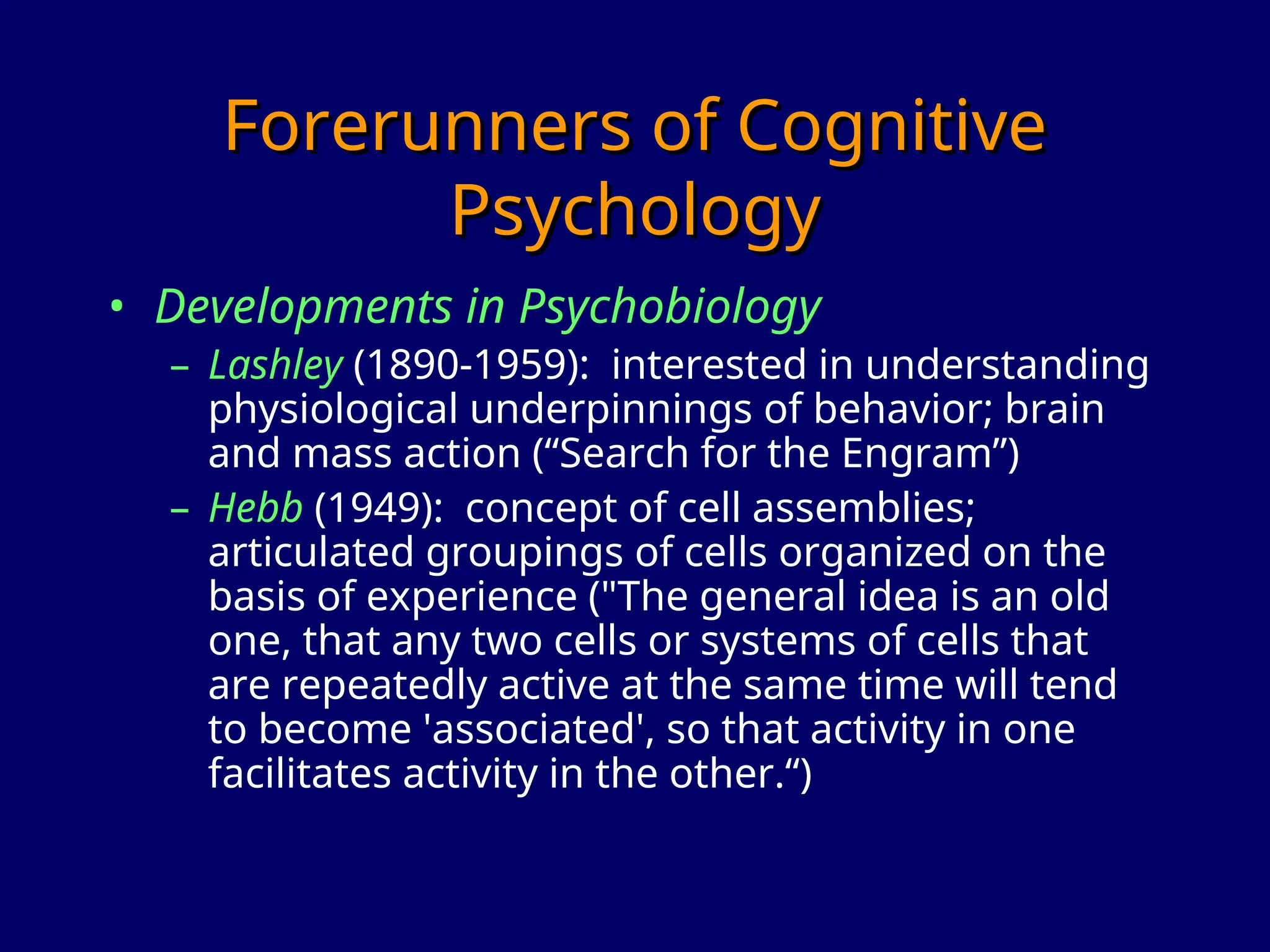
Forerunners of Cognitive
Psychology
Psychology
• Developments in Psychobiology
– Lashley (1890-1959): interested in understanding
physiological underpinnings of behavior; brain
and mass action (“Search for the Engram”)
– Hebb (1949): concept of cell assemblies;
articulated groupings of cells organized on the
basis of experience ("The general idea is an old
one, that any two cells or systems of cells that
are repeatedly active at the same time will tend
to become 'associated', so that activity in one
facilitates activity in the other.“)
Cognitive Revolution
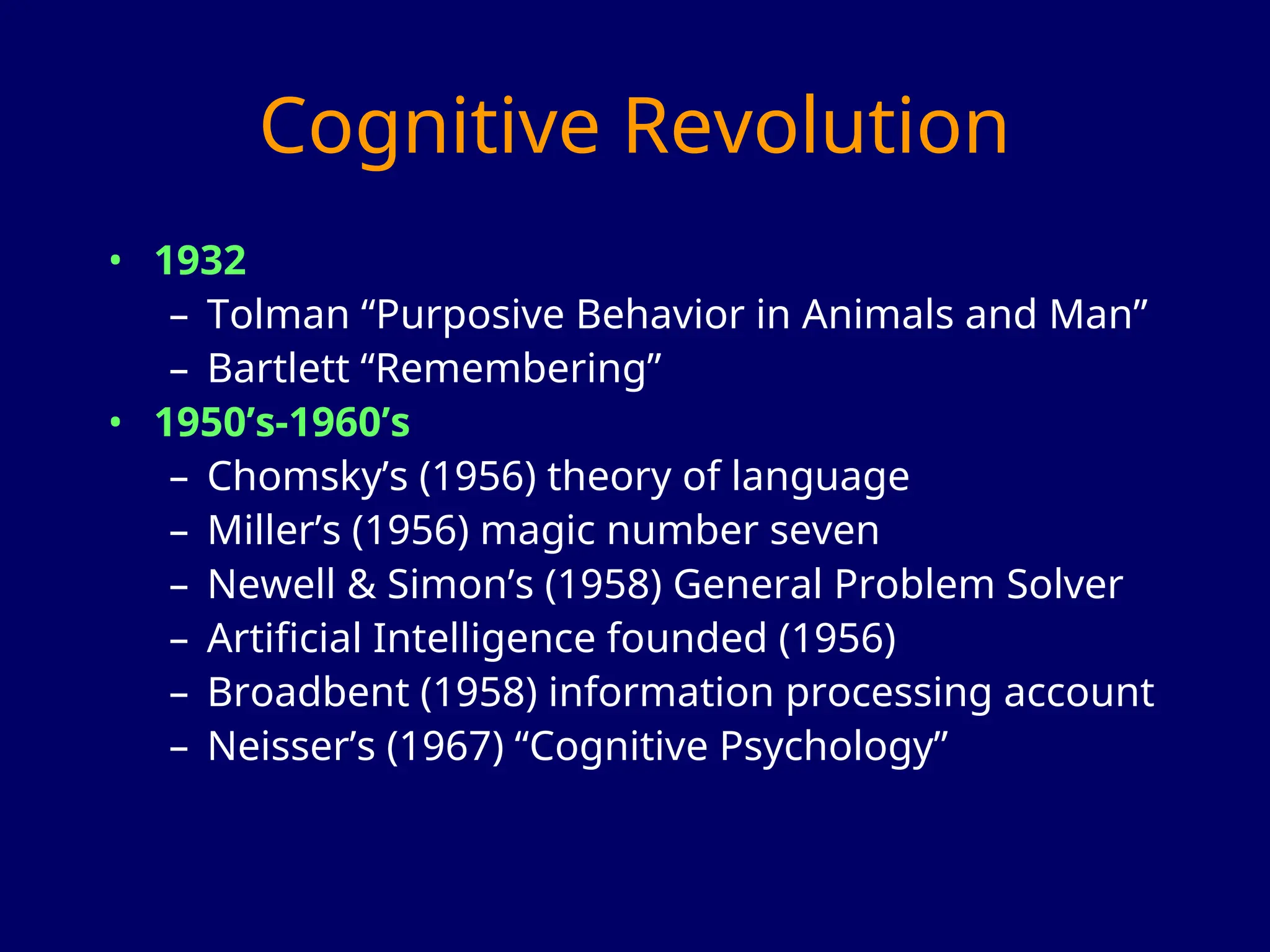
• 1932
– Tolman “Purposive Behavior in Animals and Man”
– Bartlett “Remembering”
• 1950’s-1960’s
– Chomsky’s (1956) theory of language
– Miller’s (1956) magic number seven
– Newell & Simon’s (1958) General Problem Solver
– Artificial Intelligence founded (1956)
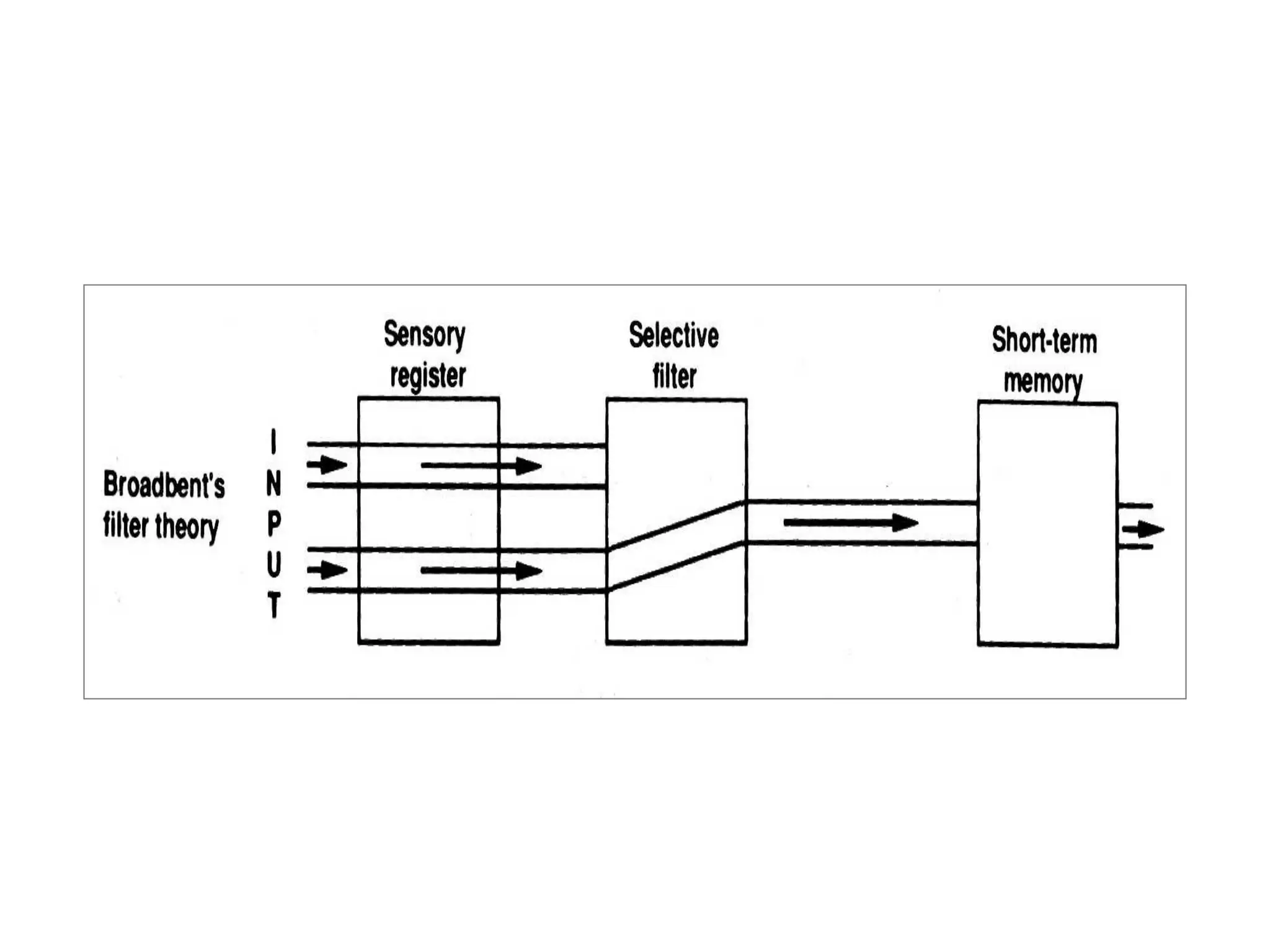
– Broadbent (1958) information processing account
– Neisser’s (1967) “Cognitive Psychology”
Rise of Cognitive Theory
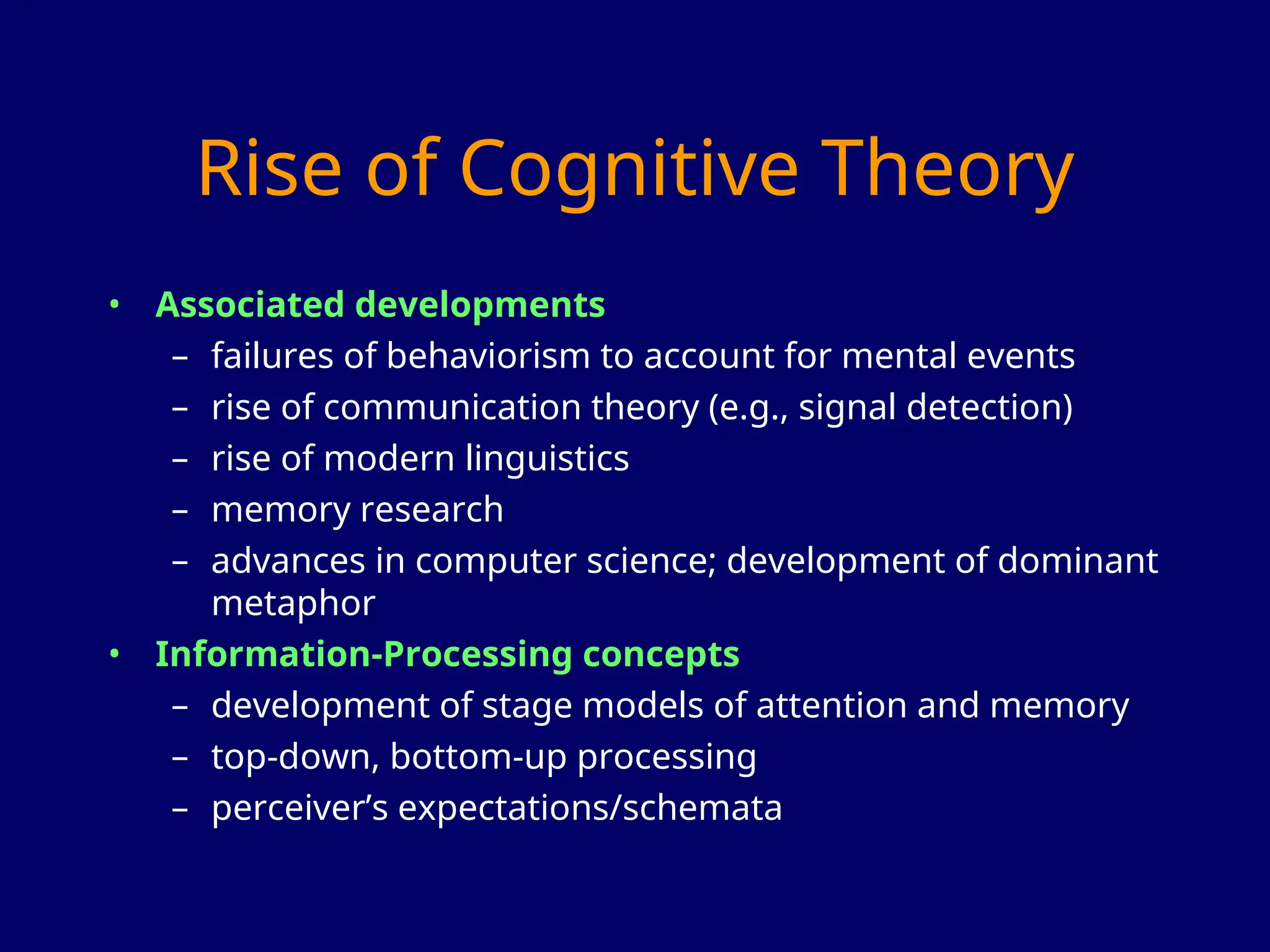
• Associated developments
– failures of behaviorism to account for mental events
– rise of communication theory (e.g., signal detection)
– rise of modern linguistics
– memory research
– advances in computer science; development of dominant
metaphor
• Information-Processing concepts
– development of stage models of attention and memory
– top-down, bottom-up processing
– perceiver’s expectations/schemata
Information-Processing
Paradigm
Paradigm
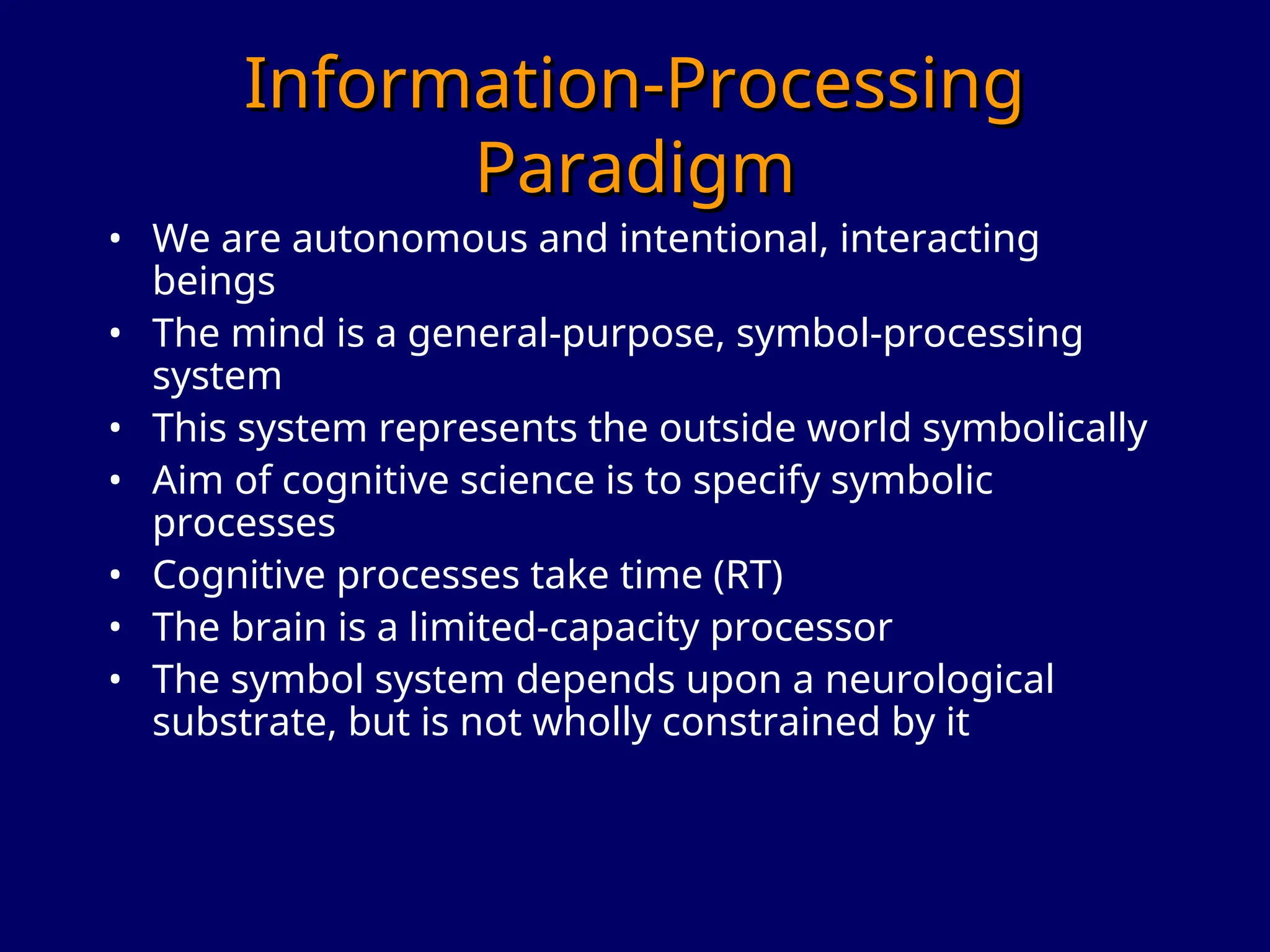
• We are autonomous and intentional, interacting
beings
• The mind is a general-purpose, symbol-processing
system
• This system represents the outside world symbolically
• Aim of cognitive science is to specify symbolic
processes
• Cognitive processes take time (RT)
• The brain is a limited-capacity processor
• The symbol system depends upon a neurological
substrate, but is not wholly constrained by it
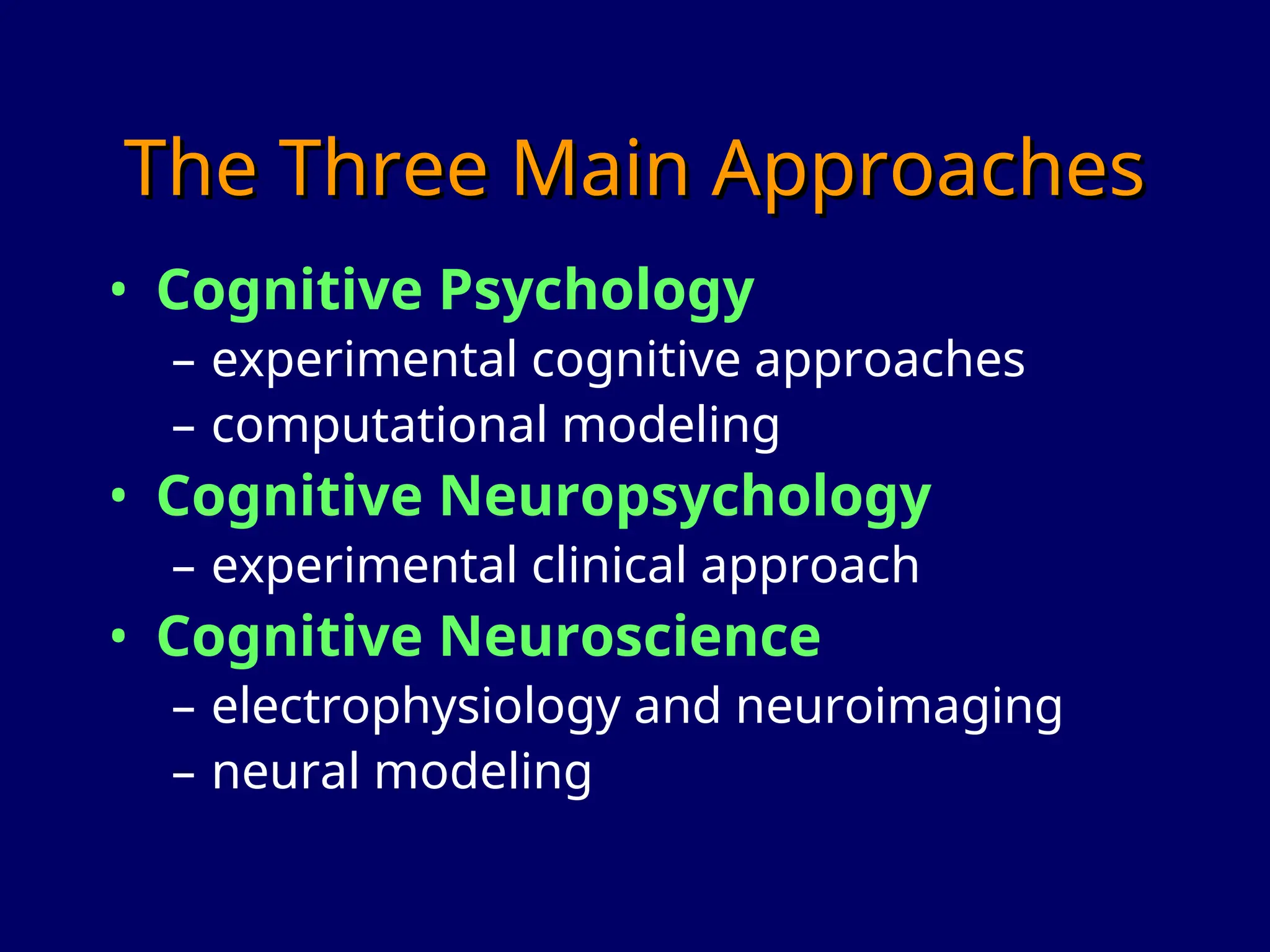
The Three Main Approaches
• Cognitive Psychology
– experimental cognitive approaches
– computational modeling
• Cognitive Neuropsychology
– experimental clinical approach
• Cognitive Neuroscience
– electrophysiology and neuroimaging
– neural modeling
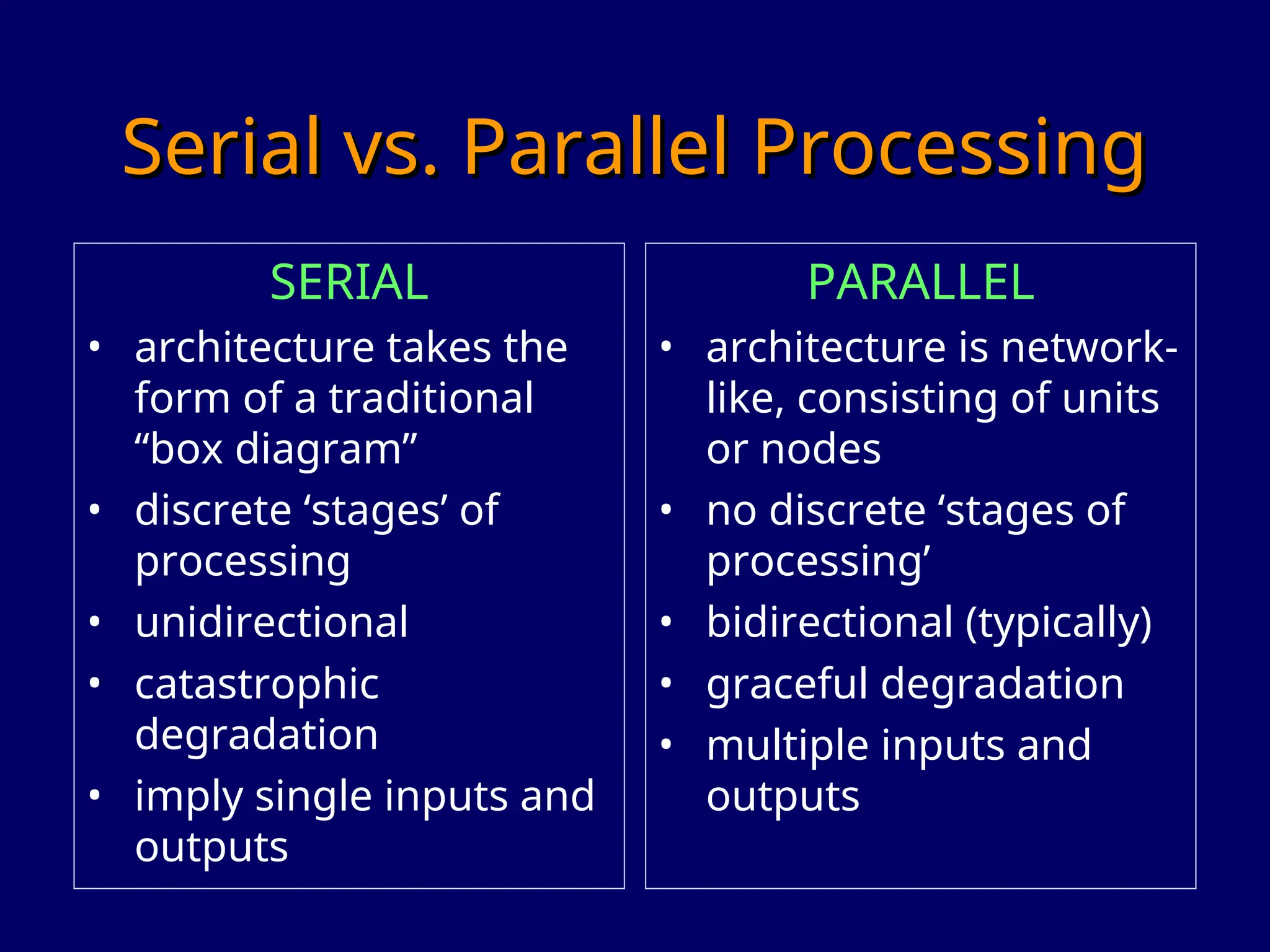
Serial vs. Parallel Processing
SERIAL
• architecture takes the
form of a traditional
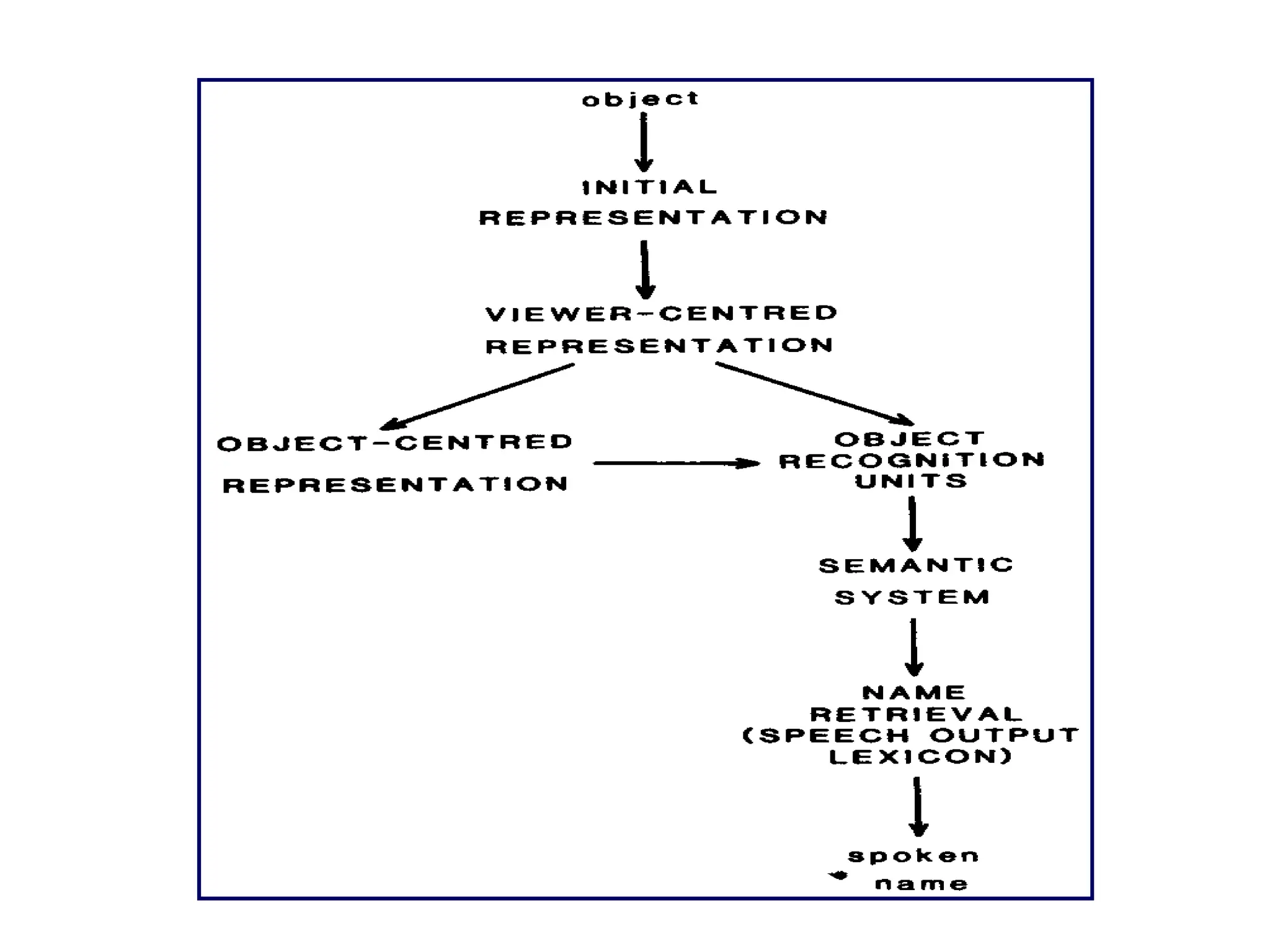
“box diagram”
• discrete ‘stages’ of
processing
• unidirectional
• catastrophic
degradation
• imply single inputs and
outputs
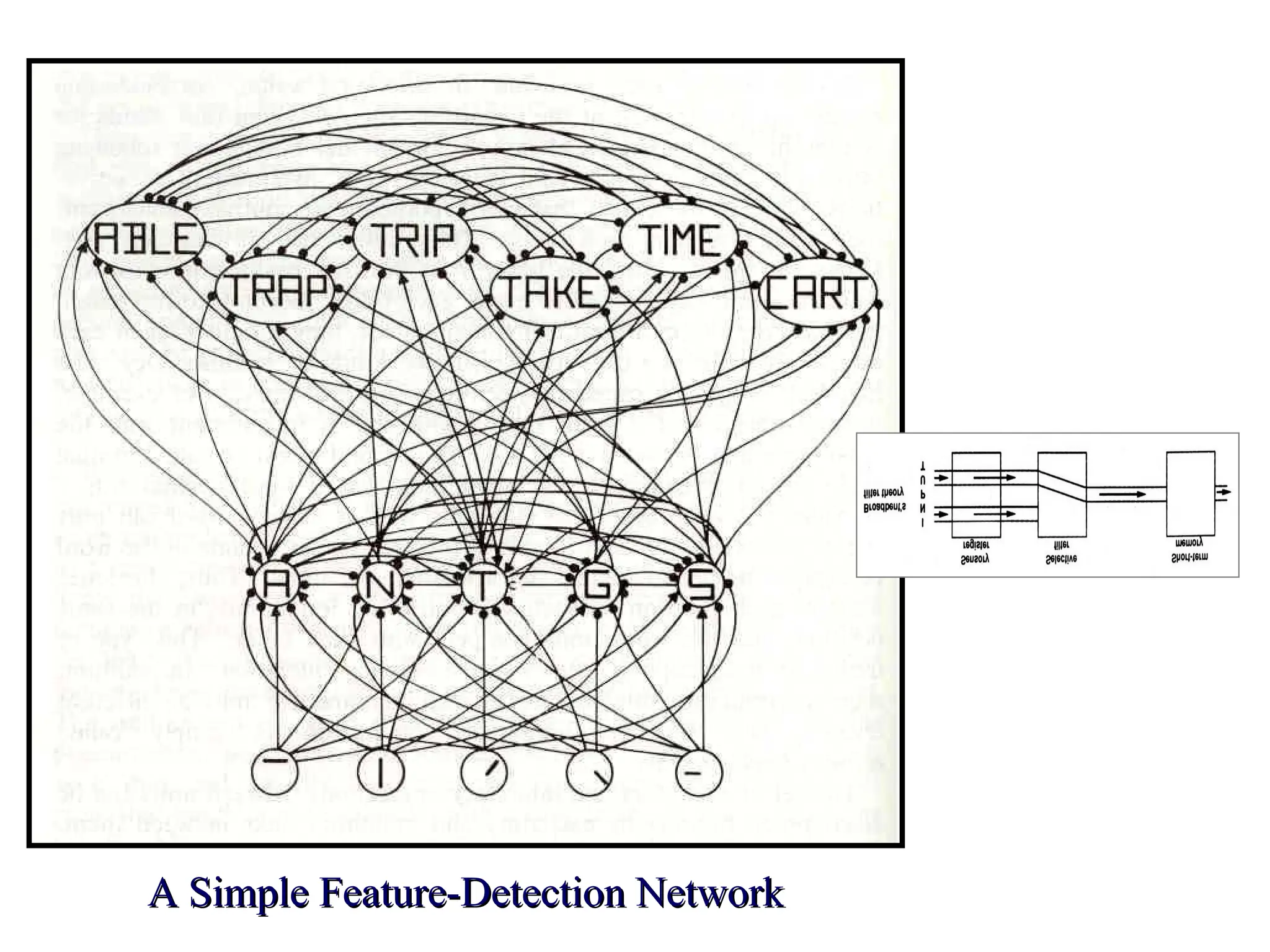
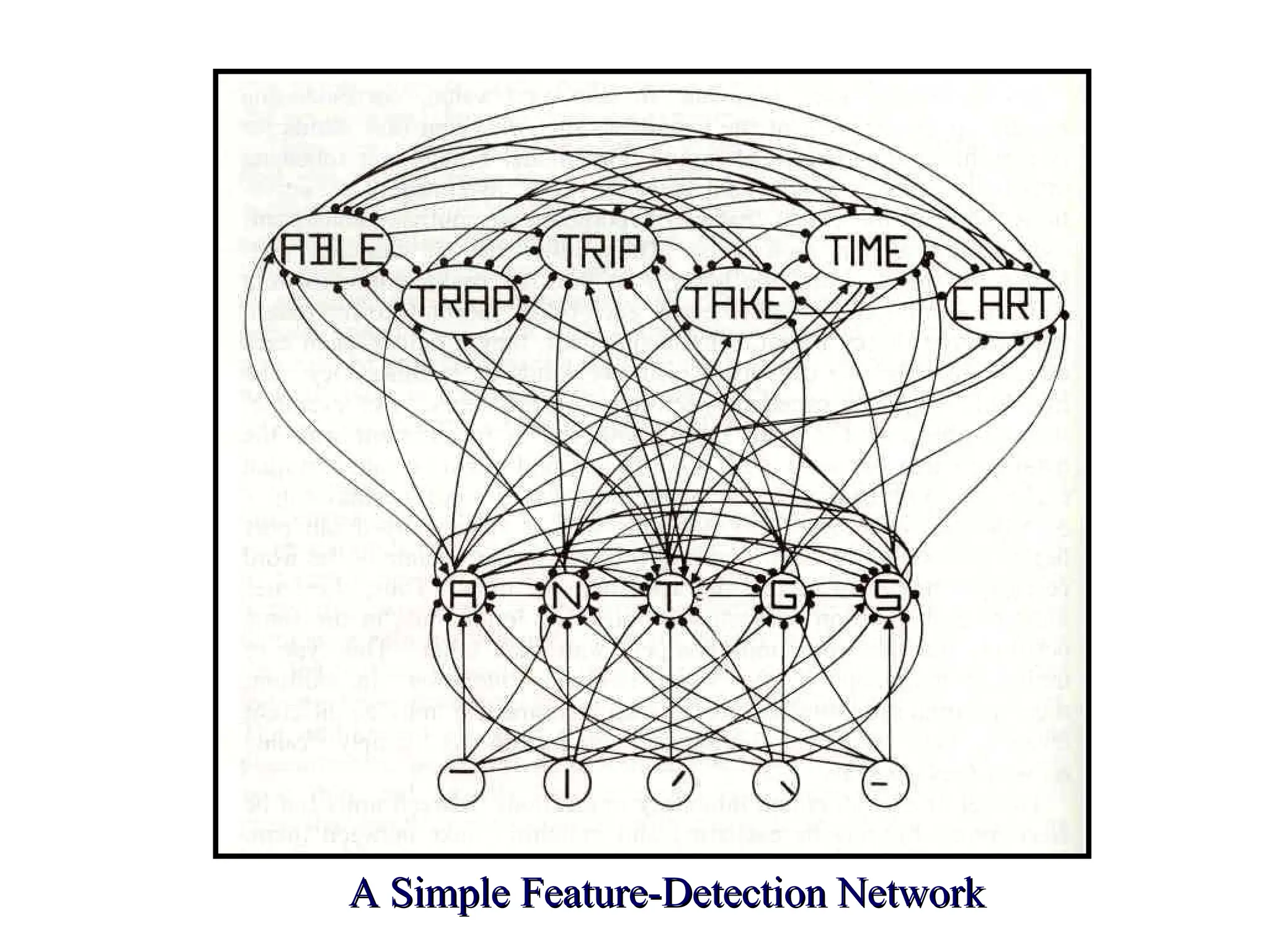
PARALLEL
• architecture is network-
like, consisting of units
or nodes
• no discrete ‘stages of
processing’
• bidirectional (typically)
• graceful degradation
• multiple inputs and
outputs
A Simple Feature-Detection Network
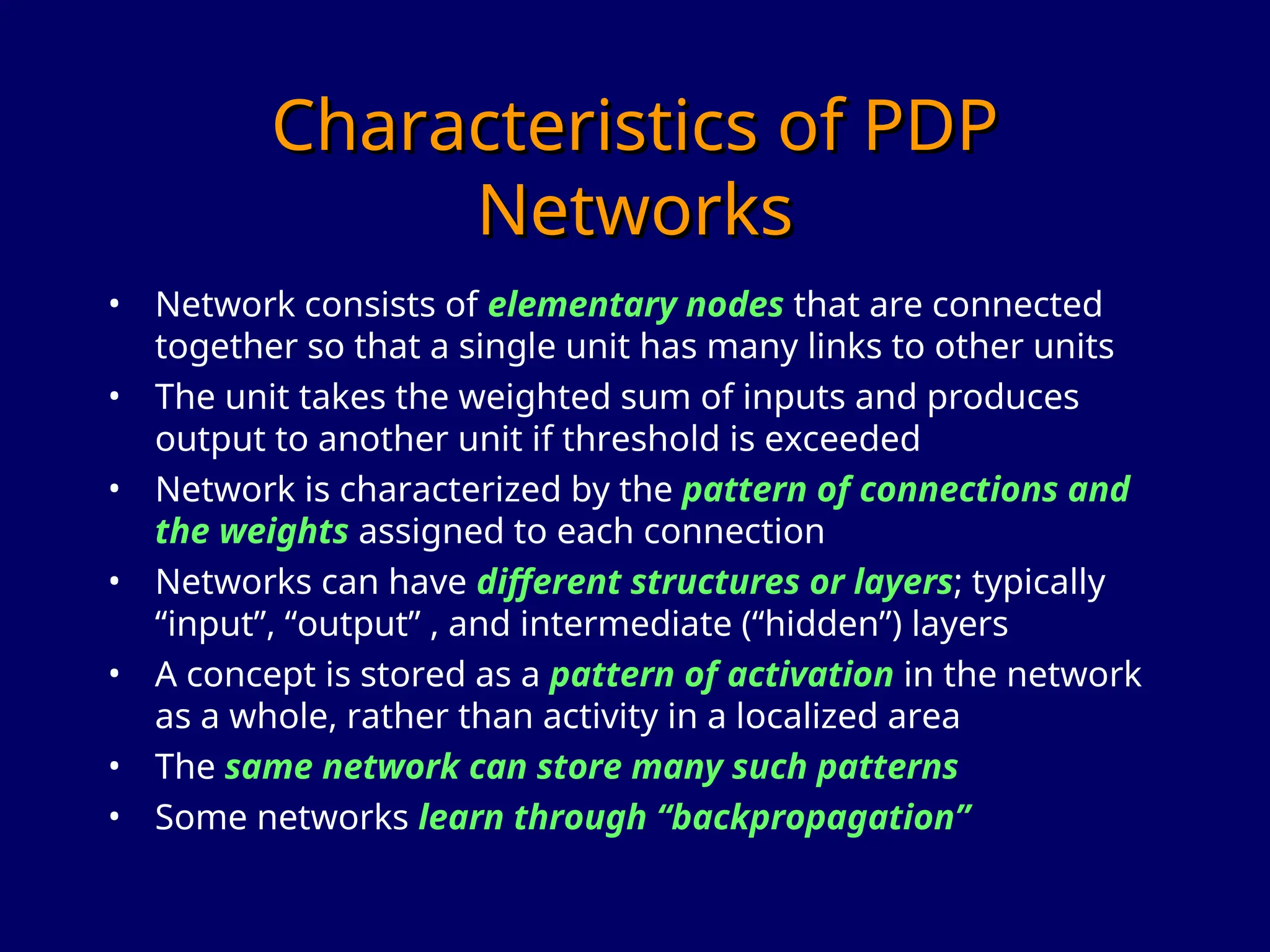
Characteristics of PDP
Networks
Networks
• Network consists of elementary nodes that are connected
together so that a single unit has many links to other units
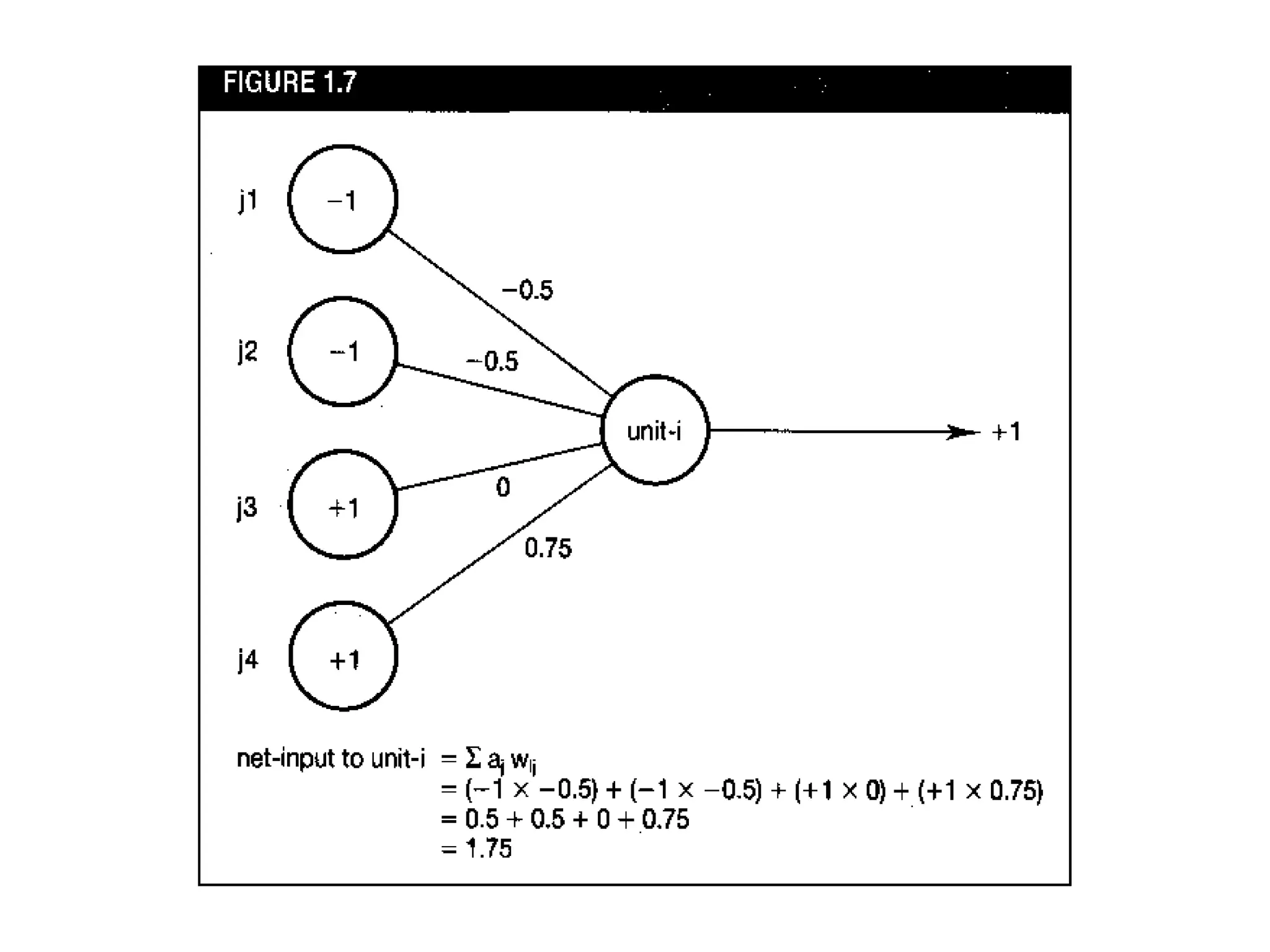
• The unit takes the weighted sum of inputs and produces
output to another unit if threshold is exceeded
• Network is characterized by the pattern of connections and
the weights assigned to each connection
• Networks can have different structures or layers; typically
“input”, “output” , and intermediate (“hidden”) layers
• A concept is stored as a pattern of activation in the network
as a whole, rather than activity in a localized area
• The same network can store many such patterns
• Some networks learn through “backpropagation”
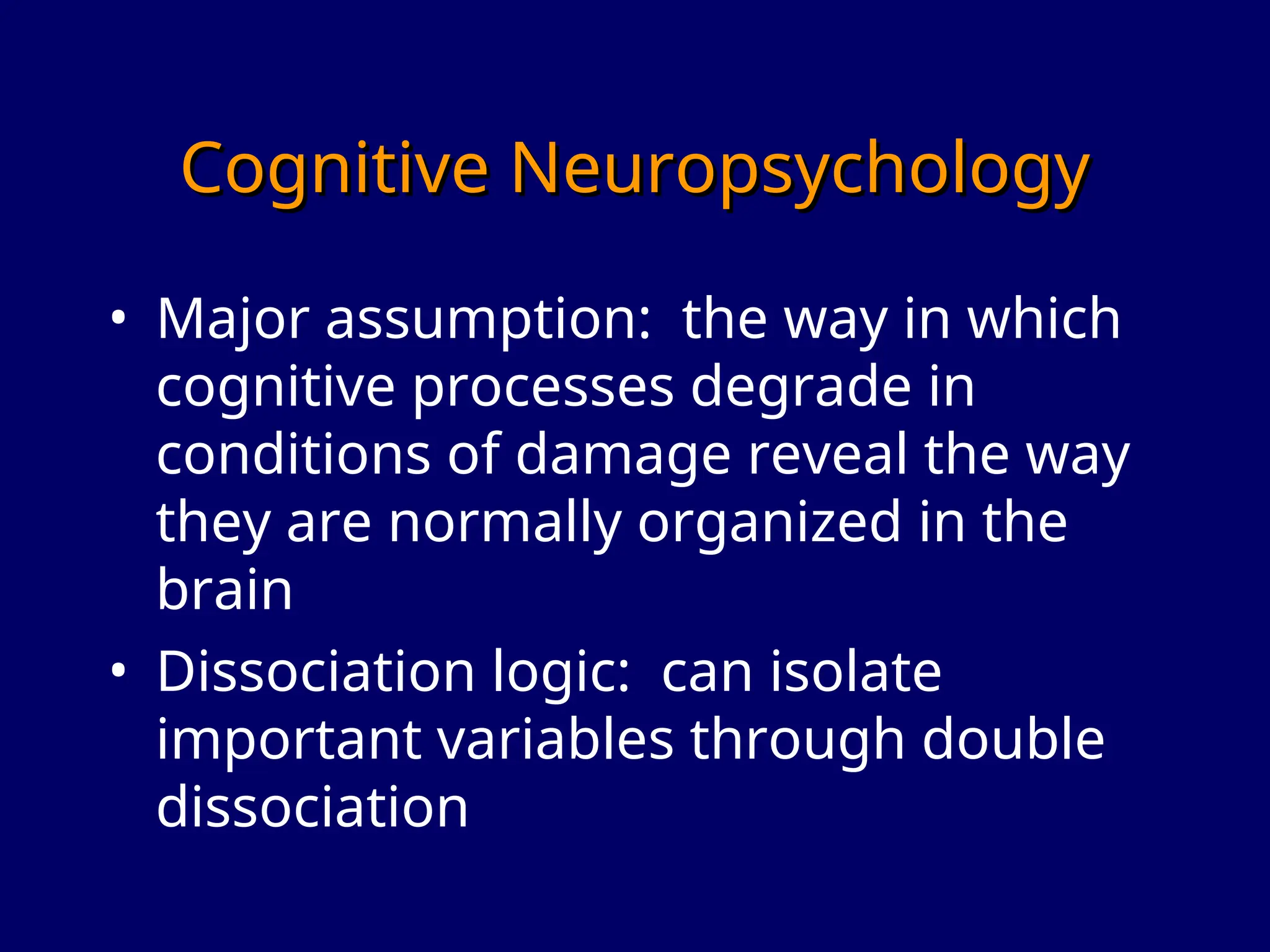
Cognitive Neuropsychology
• Major assumption: the way in which
cognitive processes degrade in
conditions of damage reveal the way
they are normally organized in the
brain
• Dissociation logic: can isolate
important variables through double
dissociation
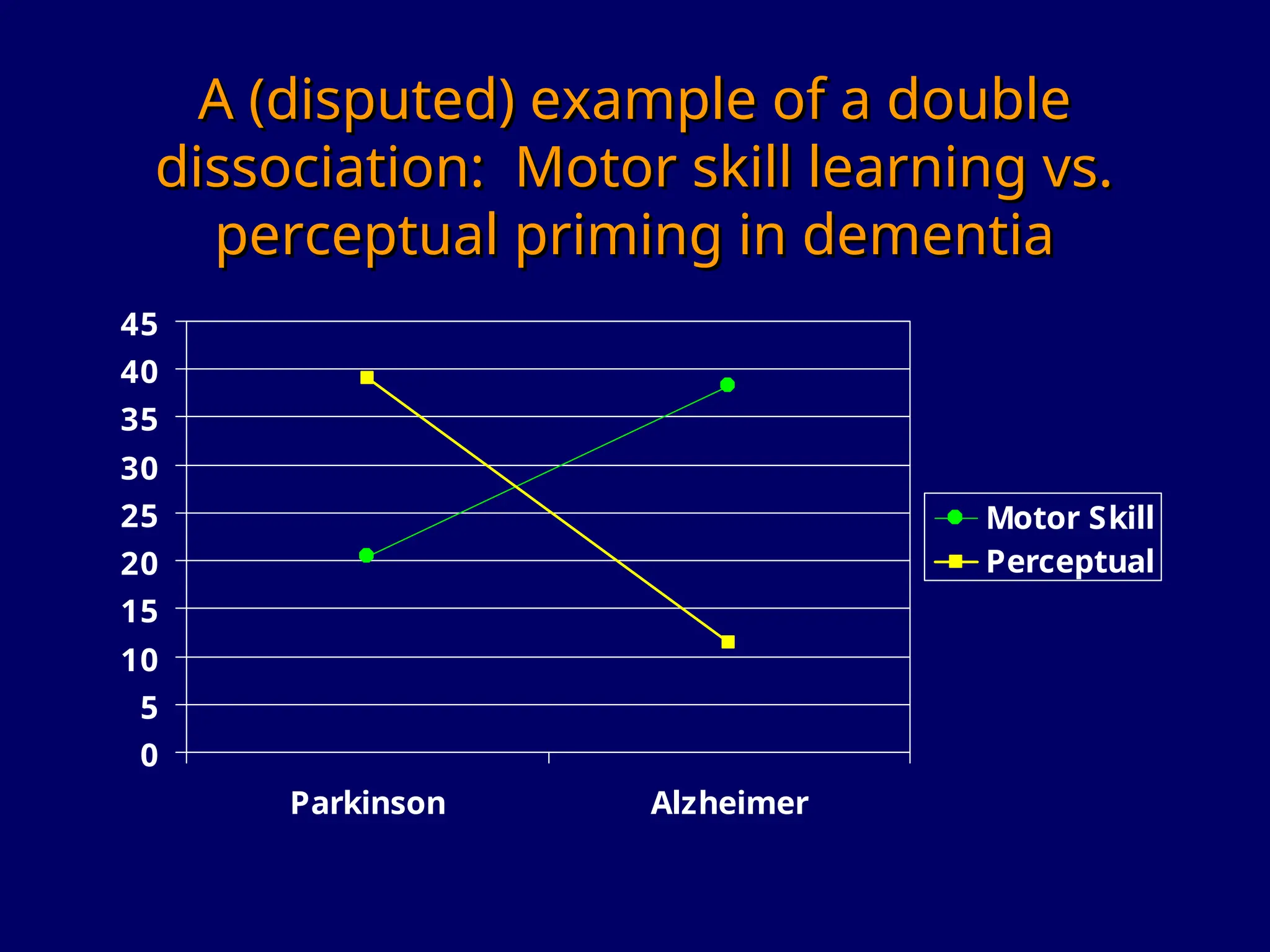
A (disputed) example of a double
dissociation: Motor skill learning vs.
perceptual priming in dementia
0
5
10
15
20
25
30
35
40
45
Parkinson Alzheimer
Motor Skill
Perceptual
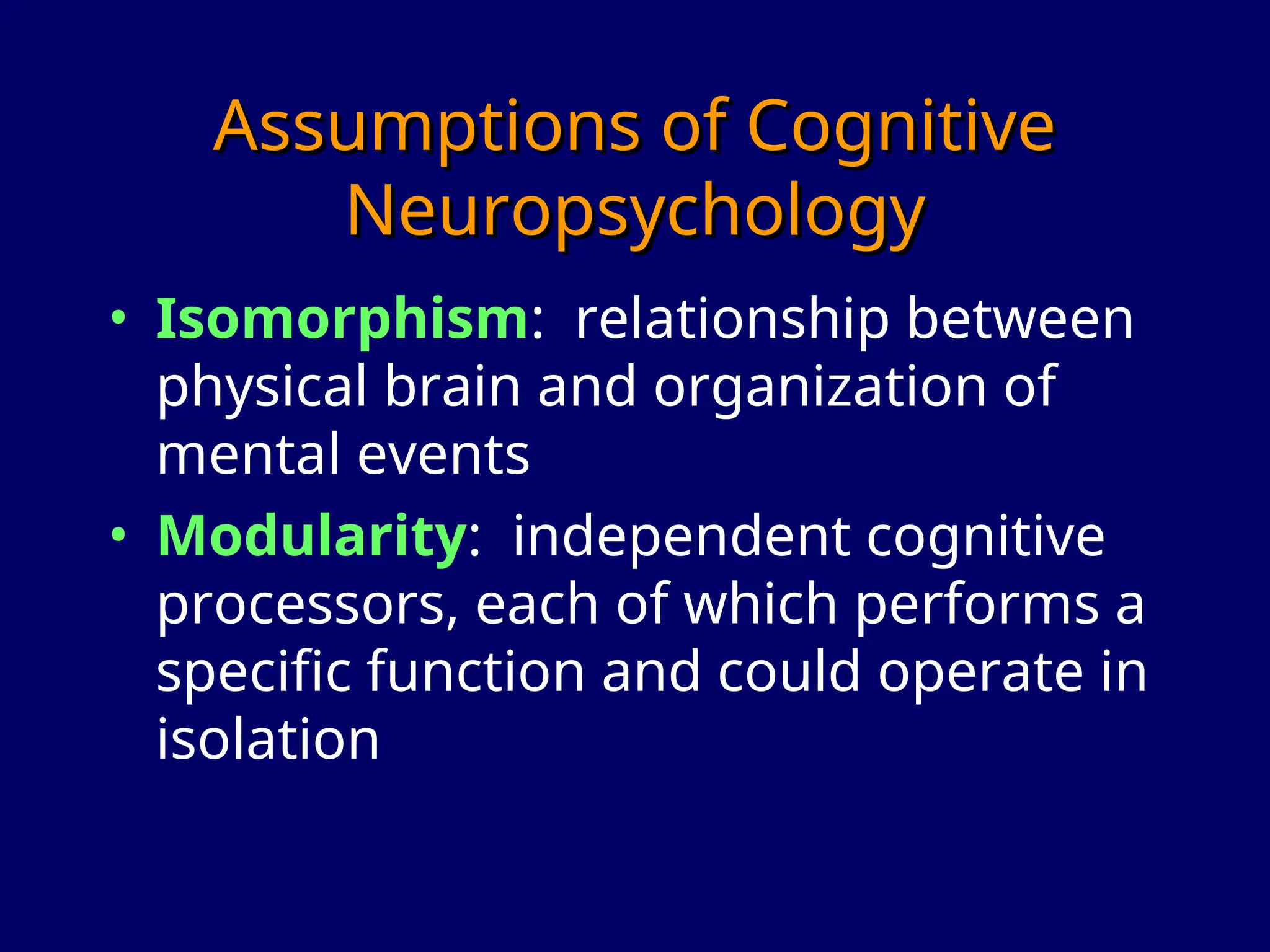
Assumptions of Cognitive
Neuropsychology
Neuropsychology
• Isomorphism: relationship between
physical brain and organization of
mental events
• Modularity: independent cognitive
processors, each of which performs a
specific function and could operate in
isolation
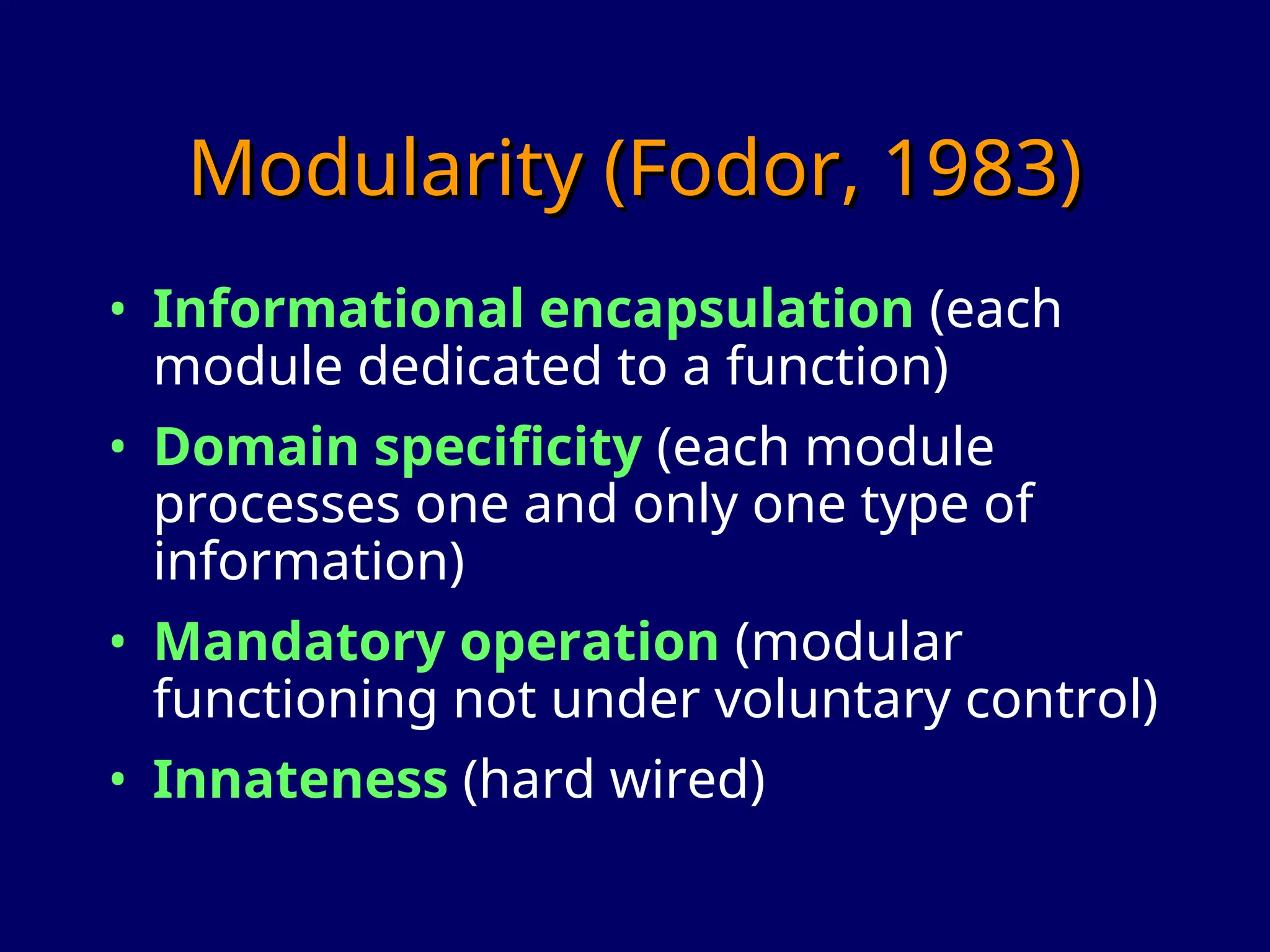
Modularity (Fodor, 1983)
• Informational encapsulation (each
module dedicated to a function)
• Domain specificity (each module
processes one and only one type of
information)
• Mandatory operation (modular
functioning not under voluntary control)
• Innateness (hard wired)
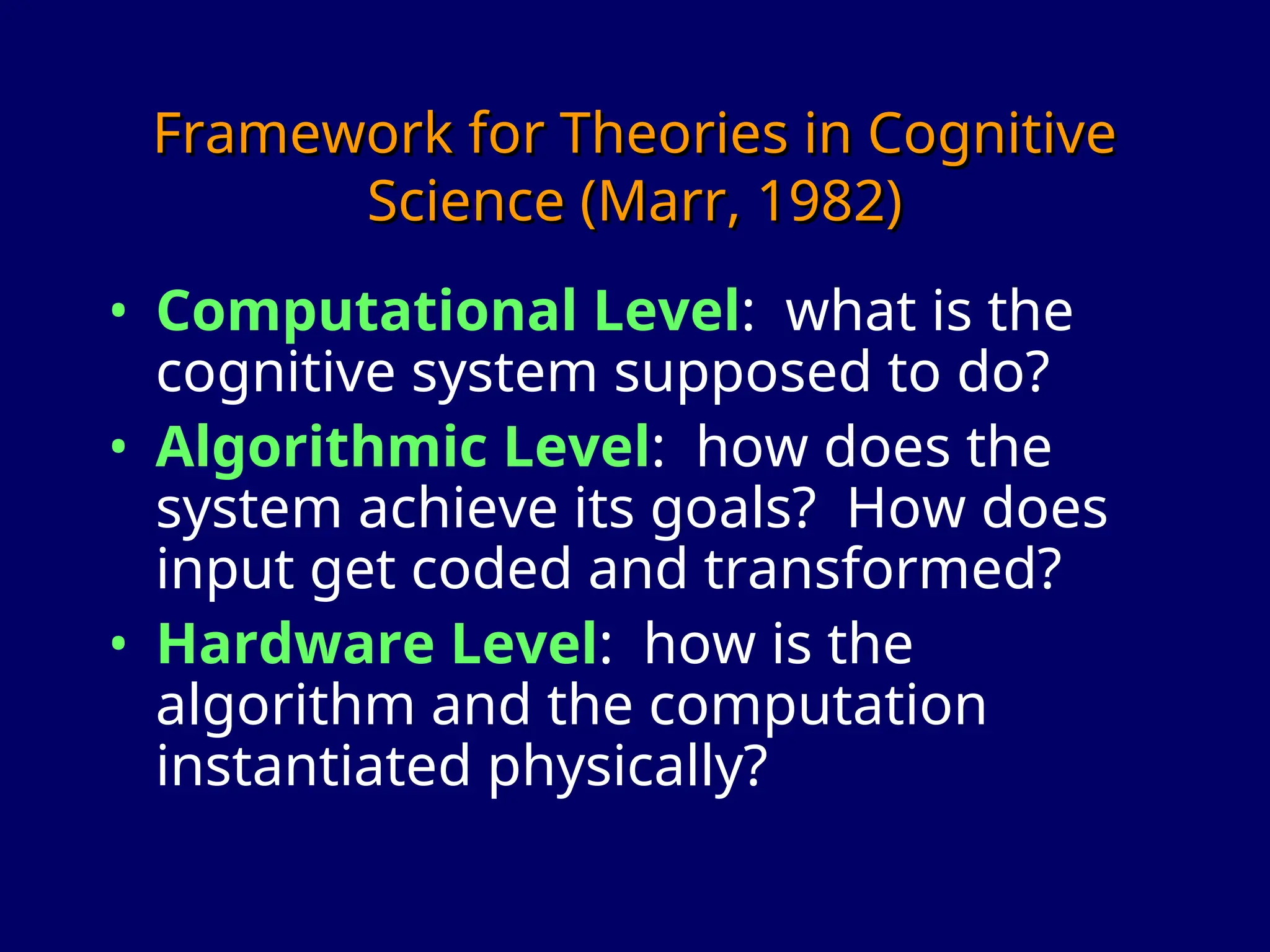
Framework for Theories in Cognitive
Science (Marr, 1982)
• Computational Level: what is the
cognitive system supposed to do?
• Algorithmic Level: how does the
system achieve its goals? How does
input get coded and transformed?
• Hardware Level: how is the
algorithm and the computation
instantiated physically?
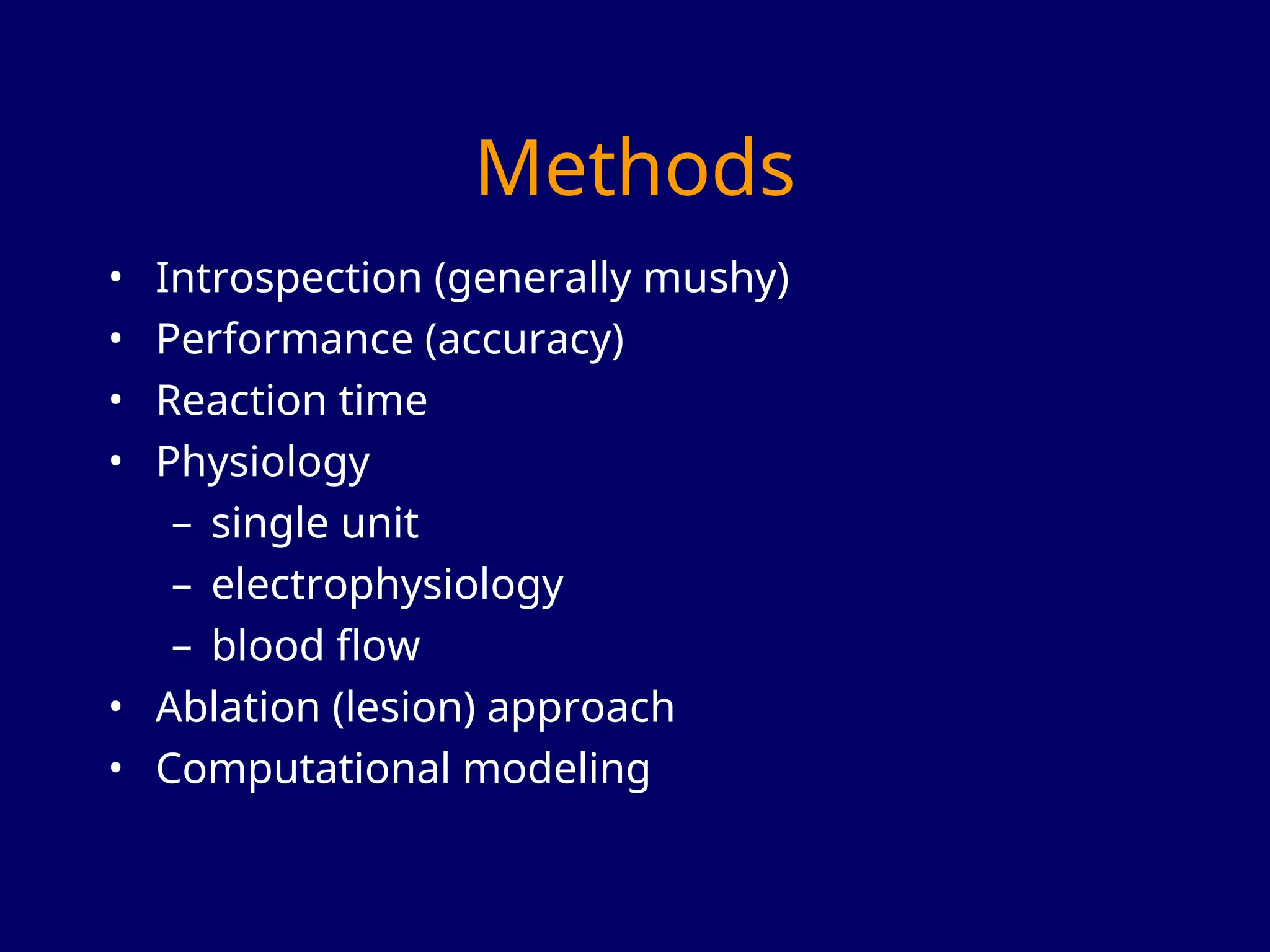
Methods
• Introspection (generally mushy)
• Performance (accuracy)
• Reaction time
• Physiology
– single unit
– electrophysiology
– blood flow
• Ablation (lesion) approach
• Computational modeling
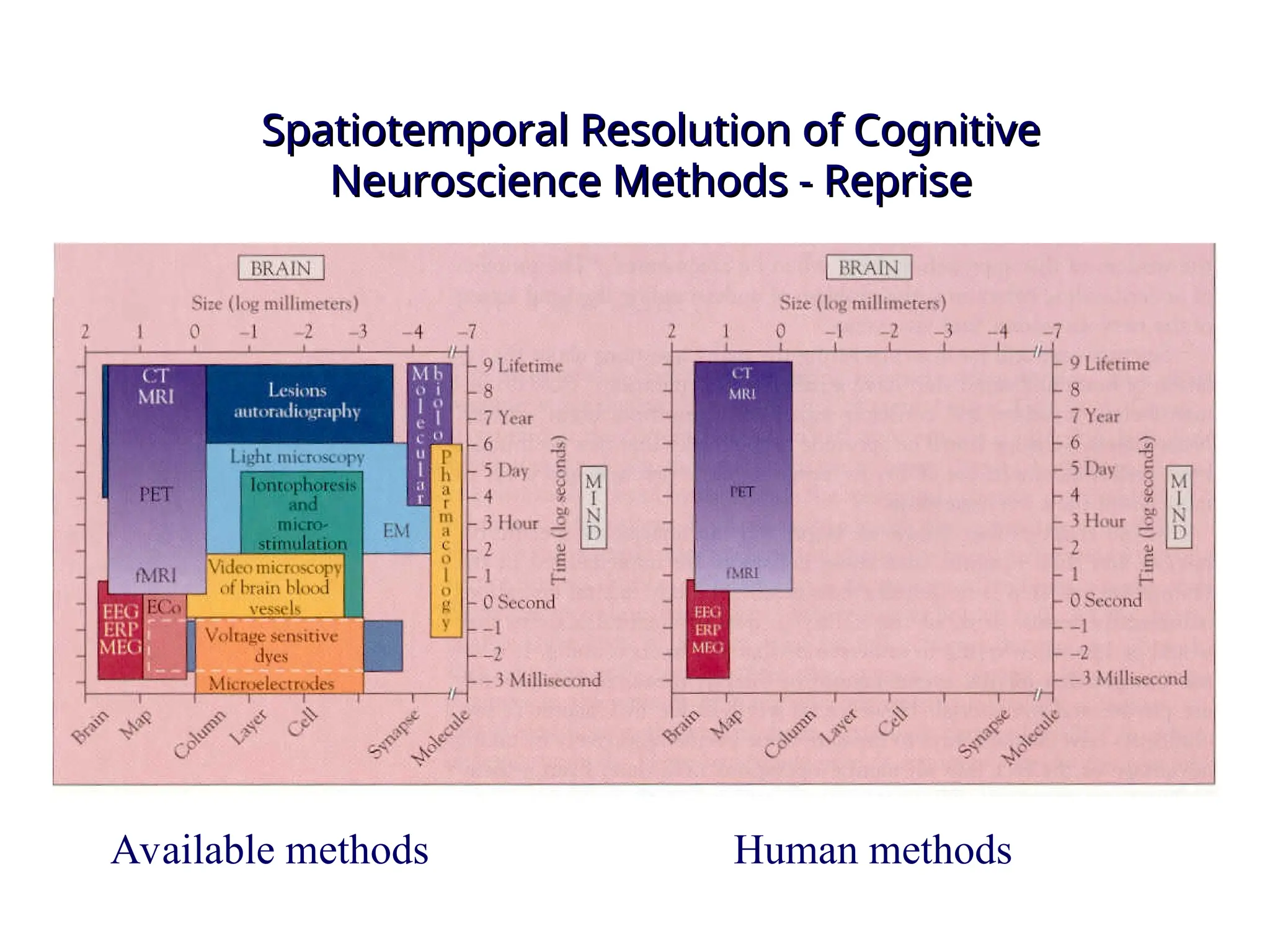
Spatiotemporal Resolution of Cognitive
Neuroscience Methods - Reprise
Available methods Human methods
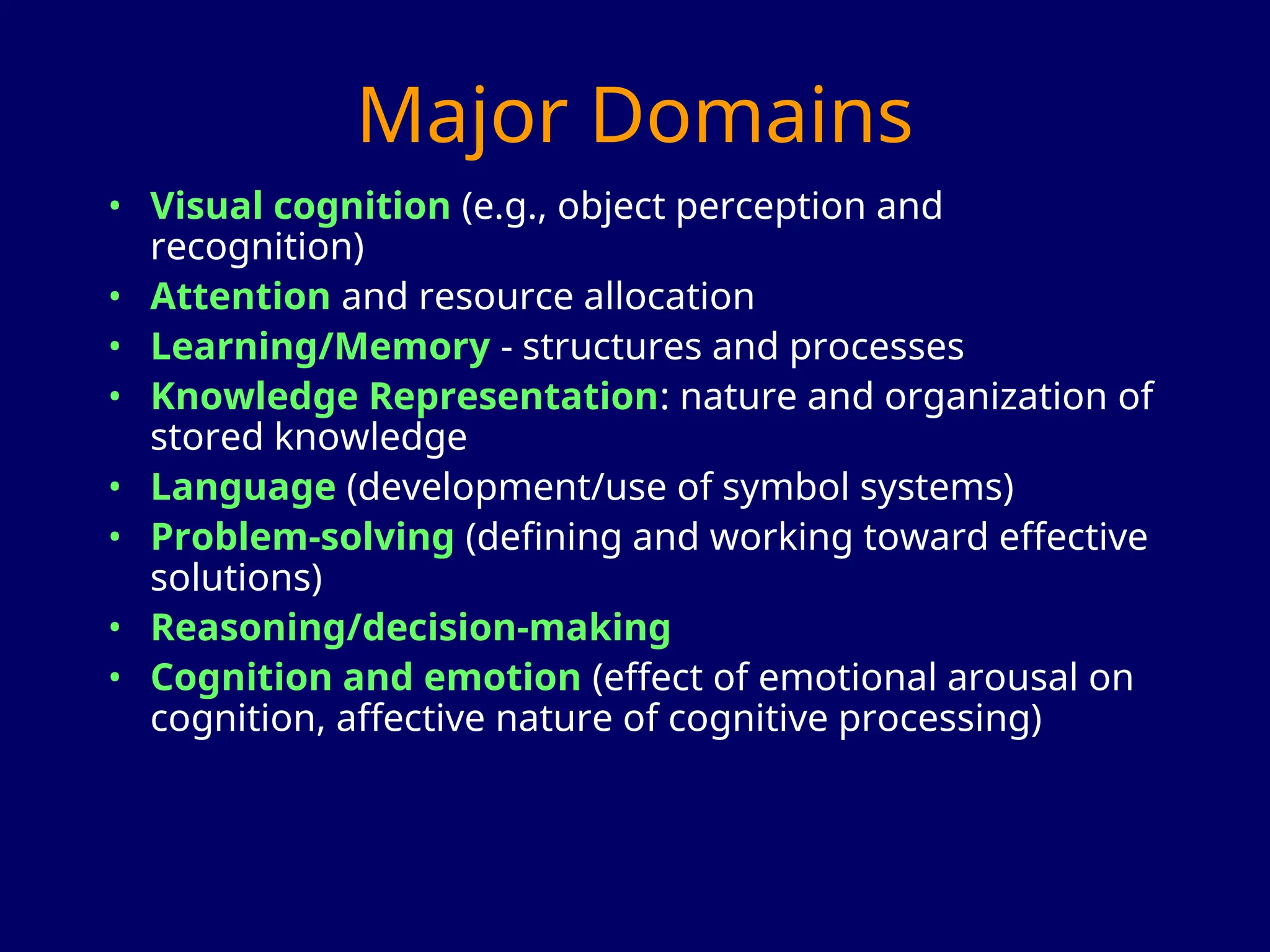
Major Domains
• Visual cognition (e.g., object perception and
recognition)
• Attention and resource allocation
• Learning/Memory - structures and processes
• Knowledge Representation: nature and organization of
stored knowledge
• Language (development/use of symbol systems)
• Problem-solving (defining and working toward effective
solutions)
• Reasoning/decision-making
• Cognition and emotion (effect of emotional arousal on
cognition, affective nature of cognitive processing)
Relevance to Clinical/Counseling
Issues: Some examples
• Selective attention
• Nature of reconstructive memory (e.g.,
trauma-based memories)
• Nature of categorization (relevance to clinical
diagnosis)
• Problem-solving (how people generate novel
solutions to ambiguous problems)
• Emotion-cognition interface (e.g., attentional
bias in anxiety; interpretive biases in
depression)

Cognitive Bases of Behavior Introduction and Historical Background

  • 1.
    Cognitive Bases ofBehavior Introduction and Historical Background August 22, 2007
  • 2.
    Cognitive Psychology • Concernedwith full range of psychological processes from sensation to knowledge representation • Dominated since 1970’s by the information processing model • Domains – experimental psychology – cognitive neuropsychology cognitive science – cognitive neuroscience • What does this have to do with clinical or counseling or developmental or school psychology?
  • 3.
    Major topical researchareas contributing to contemporary cognitive psychology
  • 4.
    Key Themes inthe Study of Key Themes in the Study of Cognitive Psychology Cognitive Psychology • Nature v. nurture • Rationalism v. empiricism • Structures v. processes • Domain generality v. domain specificity • Internal v. external (ecological) validity • Applied v. basic research • Biological v. behavioral methods
  • 5.
    Structures vs. Processes •Structures – components of cognitive apparatus that represent the organization of mental entities – are largely metaphorical and static – examples: filters, lexicons, storage systems, trees • Processes – systems of operations or functions that analyze, transform, or change mental events – are active, dynamic – examples: inhibition, forgetting, encoding, problem-solving
  • 6.
    Historical Antecedents Historical Antecedents •Philosophy: concerned with understanding experience through introspection - rational • Physiology: scientific understanding of life-sustaining processes in living matter - empirical
  • 7.
    Rationalism vs. Empiricism •Plato: theory of forms, reality resides not in concrete objects, but in the abstract forms (ideas) they represent - forerunner of rationalism; this idea picked up again by Descartes in 17th century; idea of innate knowledge • Aristotle: reality resides only in concrete world of objects, abstract ideas are a derivation - forerunner of empiricism; this idea picked up again by Locke; humans born without knowledge, experience writes on the mind
  • 8.
    Structuralism vs. Functionalism •Structuralism: understand basic parts (akin to anatomy) of the mind (e.g., Wundt) • Functionalism: understand basic processes (akin to physiology) of the mind (e.g., James)
  • 10.
  • 11.
    Associationism and Associationism and Behaviorism Behaviorism •Ebbinghaus (1850-1909) - studied how associations between stimuli were formed; used empirical methods • Thorndike: (1974-1949) - law of effect - stimulus will produce response if response is rewarded • Rise of behaviorism - Pavlov, Watson, eventually Skinner (1930’s-1960’s)
  • 12.
  • 13.
    Forerunners of Cognitive Forerunnersof Cognitive Psychology Psychology • Developments in Psychobiology – Lashley (1890-1959): interested in understanding physiological underpinnings of behavior; brain and mass action (“Search for the Engram”) – Hebb (1949): concept of cell assemblies; articulated groupings of cells organized on the basis of experience ("The general idea is an old one, that any two cells or systems of cells that are repeatedly active at the same time will tend to become 'associated', so that activity in one facilitates activity in the other.“)
  • 14.
    Cognitive Revolution • 1932 –Tolman “Purposive Behavior in Animals and Man” – Bartlett “Remembering” • 1950’s-1960’s – Chomsky’s (1956) theory of language – Miller’s (1956) magic number seven – Newell & Simon’s (1958) General Problem Solver – Artificial Intelligence founded (1956) – Broadbent (1958) information processing account – Neisser’s (1967) “Cognitive Psychology”
  • 16.
    Rise of CognitiveTheory • Associated developments – failures of behaviorism to account for mental events – rise of communication theory (e.g., signal detection) – rise of modern linguistics – memory research – advances in computer science; development of dominant metaphor • Information-Processing concepts – development of stage models of attention and memory – top-down, bottom-up processing – perceiver’s expectations/schemata
  • 17.
    Information-Processing Information-Processing Paradigm Paradigm • We areautonomous and intentional, interacting beings • The mind is a general-purpose, symbol-processing system • This system represents the outside world symbolically • Aim of cognitive science is to specify symbolic processes • Cognitive processes take time (RT) • The brain is a limited-capacity processor • The symbol system depends upon a neurological substrate, but is not wholly constrained by it
  • 18.
    The Three MainApproaches The Three Main Approaches • Cognitive Psychology – experimental cognitive approaches – computational modeling • Cognitive Neuropsychology – experimental clinical approach • Cognitive Neuroscience – electrophysiology and neuroimaging – neural modeling
  • 20.
    Serial vs. ParallelProcessing Serial vs. Parallel Processing SERIAL • architecture takes the form of a traditional “box diagram” • discrete ‘stages’ of processing • unidirectional • catastrophic degradation • imply single inputs and outputs PARALLEL • architecture is network- like, consisting of units or nodes • no discrete ‘stages of processing’ • bidirectional (typically) • graceful degradation • multiple inputs and outputs
  • 22.
    A Simple Feature-DetectionNetwork A Simple Feature-Detection Network
  • 23.
    A Simple Feature-DetectionNetwork A Simple Feature-Detection Network
  • 24.
    Characteristics of PDP Characteristicsof PDP Networks Networks • Network consists of elementary nodes that are connected together so that a single unit has many links to other units • The unit takes the weighted sum of inputs and produces output to another unit if threshold is exceeded • Network is characterized by the pattern of connections and the weights assigned to each connection • Networks can have different structures or layers; typically “input”, “output” , and intermediate (“hidden”) layers • A concept is stored as a pattern of activation in the network as a whole, rather than activity in a localized area • The same network can store many such patterns • Some networks learn through “backpropagation”
  • 26.
    Cognitive Neuropsychology Cognitive Neuropsychology •Major assumption: the way in which cognitive processes degrade in conditions of damage reveal the way they are normally organized in the brain • Dissociation logic: can isolate important variables through double dissociation
  • 27.
    A (disputed) exampleof a double A (disputed) example of a double dissociation: Motor skill learning vs. dissociation: Motor skill learning vs. perceptual priming in dementia perceptual priming in dementia 0 5 10 15 20 25 30 35 40 45 Parkinson Alzheimer Motor Skill Perceptual
  • 28.
    Assumptions of Cognitive Assumptionsof Cognitive Neuropsychology Neuropsychology • Isomorphism: relationship between physical brain and organization of mental events • Modularity: independent cognitive processors, each of which performs a specific function and could operate in isolation
  • 29.
    Modularity (Fodor, 1983) Modularity(Fodor, 1983) • Informational encapsulation (each module dedicated to a function) • Domain specificity (each module processes one and only one type of information) • Mandatory operation (modular functioning not under voluntary control) • Innateness (hard wired)
  • 30.
    Framework for Theoriesin Cognitive Framework for Theories in Cognitive Science (Marr, 1982) Science (Marr, 1982) • Computational Level: what is the cognitive system supposed to do? • Algorithmic Level: how does the system achieve its goals? How does input get coded and transformed? • Hardware Level: how is the algorithm and the computation instantiated physically?
  • 31.
    Methods • Introspection (generallymushy) • Performance (accuracy) • Reaction time • Physiology – single unit – electrophysiology – blood flow • Ablation (lesion) approach • Computational modeling
  • 32.
    Spatiotemporal Resolution ofCognitive Spatiotemporal Resolution of Cognitive Neuroscience Methods - Reprise Neuroscience Methods - Reprise Available methods Human methods
  • 33.
    Major Domains • Visualcognition (e.g., object perception and recognition) • Attention and resource allocation • Learning/Memory - structures and processes • Knowledge Representation: nature and organization of stored knowledge • Language (development/use of symbol systems) • Problem-solving (defining and working toward effective solutions) • Reasoning/decision-making • Cognition and emotion (effect of emotional arousal on cognition, affective nature of cognitive processing)
  • 34.
    Relevance to Clinical/Counseling Relevanceto Clinical/Counseling Issues: Some examples Issues: Some examples • Selective attention • Nature of reconstructive memory (e.g., trauma-based memories) • Nature of categorization (relevance to clinical diagnosis) • Problem-solving (how people generate novel solutions to ambiguous problems) • Emotion-cognition interface (e.g., attentional bias in anxiety; interpretive biases in depression)