SEMINAR ON
“COGNITIVE NEUROSCIENCE”
UNDER THE GUIDANCE OF
Mr. NARENDRA BABU C R
Asst. Prof Dept of CSE, RGIT
SUBMITTED BY
PRASOON GANESH 1RG11CS088
1
AGENDA
 INTRODUCTION
 THE BRAIN
 BASIC UNIT of BRAIN
 COGNITION
 NEUROCOGNITION
 HIPPOCAMPUS and FUNCTIONAL TRADEOFFS
 PREFRONTAL CORTEX and BASAL GANGLIA
 DECISION MAKING
 HOW COGNITION IS STUDIED
 CONCLUSION
 REFERENCES
INTRODUCTION
 Cognitive neuroscience is an academic field concerned with the
scientific study of biological substrates underlying cognition
with a specific focus on the neural substrate of mental process.
 It addresses the questions of how psychological/cognitive
functions are produced by neural circuits in the brain.
 Cognitive neuroscience is a branch of both psycology and
neuroscience, overlapping with disciplines such physiological
psycology, cognitive psycology and neuropsycology.
5
The Brain ...
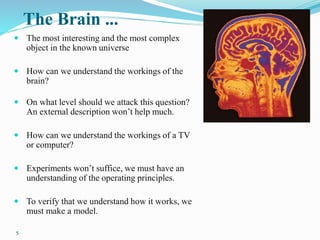
 The most interesting and the most complex
object in the known universe
 How can we understand the workings of the
brain?
 On what level should we attack this question?
An external description won’t help much.
 How can we understand the workings of a TV
or computer?
 Experiments won’t suffice, we must have an
understanding of the operating principles.
 To verify that we understand how it works, we
must make a model.
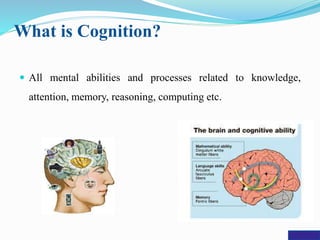
What is Cognition?
 All mental abilities and processes related to knowledge,
attention, memory, reasoning, computing etc.
Why study Cognition?
 can provide insight into areas of cognition
 can help distinguish between different theories relating to how
that process is performed.
 can help guide the design of artificial intelligence systems
intended to mimic human abilities
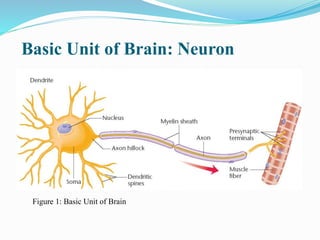
Basic Unit of Brain: Neuron
Figure 1: Basic Unit of Brain
Neurons - Structure
 Basic building block of nervous system
 soma - cell body; contact site for other neurons
 dendrites - contact site for other neurons
 axon - conducts action potential away from cell body &
dendrites towards other neurons
 terminal buttons - at end of axon; site of connection to other
neurons
 myelin sheath - electrical insulation (optional)
Neuronal functioning
 Action potential - how neurons convey information; an
electrochemical transmission along length of neuron
 Synapse - site of “connection” between adjacent neurons or
between neurons and muscle fibers
 Terminal buttons of presynaptic neuron @ dendrites/soma of
postsynaptic neuron (or muscle fibres)
Neurocognition OR
Cognitive Neuroscience
 All cognition is the result of neurological activity
 Most closely linked to cerebral cortex
 The study of the relationships between neuroscience and
cognitive psychology, especially those theories of the mind
dealing with memory, sensation and perception, problem
solving, language processing, motor functions and cognition.
The relationship between brain and
cognition
 Cognition is a product of the brain.
 Understanding the brain and its organization is useful for
assessing the plausibility of cognitive theories
Hippocampus and Functional Tradeoffs
in Memory
 Explicit Memory
 Complementary Learning Systems
 Functional Tradeoffs
Prefrontal Cortex and Basal Ganglia
 Dendtate gyrus
 NDMA
 Functional significance
 Basal Ganglia
 GATE
Decision Making
 Threshold
 Speed-accuracy tradeoffs
 Human imaging studies
How Cognition is studied?
 Psychophysics
 Electroencephalography(EEG)
 fMRI
 Electrocorticography
 Transcranial magnetic stimulation
Psychophysics
 the scientific study of the relation between stimulus and
sensation
 experiments seek to determine whether the subject can detect a
stimulus, identify it, differentiate between it and another
stimulus, or describe the magnitude or nature of this difference
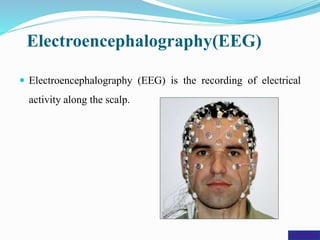
Electroencephalography(EEG)
 Electroencephalography (EEG) is the recording of electrical
activity along the scalp.
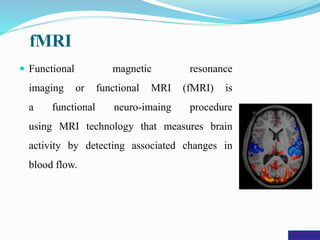
fMRI
 Functional magnetic resonance
imaging or functional MRI (fMRI) is
a functional neuro-imaing procedure
using MRI technology that measures brain
activity by detecting associated changes in
blood flow.
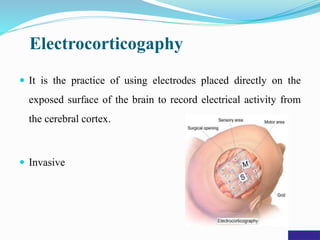
Electrocorticogaphy
 It is the practice of using electrodes placed directly on the
exposed surface of the brain to record electrical activity from
the cerebral cortex.
 Invasive
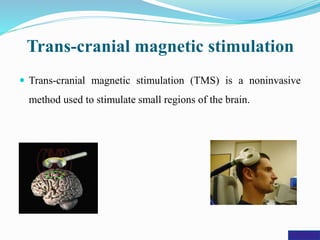
Trans-cranial magnetic stimulation
 Trans-cranial magnetic stimulation (TMS) is a noninvasive
method used to stimulate small regions of the brain.
 These examples also highlight some potential routes by
which cognitive theory is most easily elaborated in order to
have an influence on neural data.
 We emphasize that cognitive science makes many valuable
contributions without a demand to constrain or influence
neuroscience.
CONCLUSION
REFERENCES
 [1] Alexander, G. E., DeLong, M. R., & Strick, P. L. (1986). Parallel
organizationof functionally segregated circuits linking basal
ganglia and cortex.Annual Review of Neuroscience, 9, 357–381.
 Frank, M. J. (2015). Linking across levels of computation in
model-basedcognitive neuroscience. In B. U. Forstmann & E.
Wagenmakers (Eds.),An introduction to model-based cognitive
neuroscience. New York:Springer (in press).
 [3] Badre, D., & Frank, M. J. (2012). Mechanisms of hierarchical
reinforcementlearning in cortico-striatal circuits 2: Evidence from
fMRI. CerebralCortex, 22(3), 527–536.
 [4] O’Reilly, R. C., & McClelland, J. L. (1994). Hippocampal
conjunctiveencoding, storage, and recall: Avoiding a tradeoff.
Hippocampus, 4,661–682.
Final prasoon

Final prasoon

  • 1.
    SEMINAR ON “COGNITIVE NEUROSCIENCE” UNDERTHE GUIDANCE OF Mr. NARENDRA BABU C R Asst. Prof Dept of CSE, RGIT SUBMITTED BY PRASOON GANESH 1RG11CS088 1
  • 3.
    AGENDA  INTRODUCTION  THEBRAIN  BASIC UNIT of BRAIN  COGNITION  NEUROCOGNITION  HIPPOCAMPUS and FUNCTIONAL TRADEOFFS  PREFRONTAL CORTEX and BASAL GANGLIA  DECISION MAKING  HOW COGNITION IS STUDIED  CONCLUSION  REFERENCES
  • 4.
    INTRODUCTION  Cognitive neuroscienceis an academic field concerned with the scientific study of biological substrates underlying cognition with a specific focus on the neural substrate of mental process.  It addresses the questions of how psychological/cognitive functions are produced by neural circuits in the brain.  Cognitive neuroscience is a branch of both psycology and neuroscience, overlapping with disciplines such physiological psycology, cognitive psycology and neuropsycology.
  • 5.
    5 The Brain ... The most interesting and the most complex object in the known universe  How can we understand the workings of the brain?  On what level should we attack this question? An external description won’t help much.  How can we understand the workings of a TV or computer?  Experiments won’t suffice, we must have an understanding of the operating principles.  To verify that we understand how it works, we must make a model.
  • 6.
    What is Cognition? All mental abilities and processes related to knowledge, attention, memory, reasoning, computing etc.
  • 7.
    Why study Cognition? can provide insight into areas of cognition  can help distinguish between different theories relating to how that process is performed.  can help guide the design of artificial intelligence systems intended to mimic human abilities
  • 8.
    Basic Unit ofBrain: Neuron Figure 1: Basic Unit of Brain
  • 9.
    Neurons - Structure Basic building block of nervous system  soma - cell body; contact site for other neurons  dendrites - contact site for other neurons  axon - conducts action potential away from cell body & dendrites towards other neurons  terminal buttons - at end of axon; site of connection to other neurons  myelin sheath - electrical insulation (optional)
  • 10.
    Neuronal functioning  Actionpotential - how neurons convey information; an electrochemical transmission along length of neuron  Synapse - site of “connection” between adjacent neurons or between neurons and muscle fibers  Terminal buttons of presynaptic neuron @ dendrites/soma of postsynaptic neuron (or muscle fibres)
  • 11.
    Neurocognition OR Cognitive Neuroscience All cognition is the result of neurological activity  Most closely linked to cerebral cortex  The study of the relationships between neuroscience and cognitive psychology, especially those theories of the mind dealing with memory, sensation and perception, problem solving, language processing, motor functions and cognition.
  • 12.
    The relationship betweenbrain and cognition  Cognition is a product of the brain.  Understanding the brain and its organization is useful for assessing the plausibility of cognitive theories
  • 13.
    Hippocampus and FunctionalTradeoffs in Memory  Explicit Memory  Complementary Learning Systems  Functional Tradeoffs
  • 14.
    Prefrontal Cortex andBasal Ganglia  Dendtate gyrus  NDMA  Functional significance  Basal Ganglia  GATE
  • 15.
    Decision Making  Threshold Speed-accuracy tradeoffs  Human imaging studies
  • 16.
    How Cognition isstudied?  Psychophysics  Electroencephalography(EEG)  fMRI  Electrocorticography  Transcranial magnetic stimulation
  • 17.
    Psychophysics  the scientificstudy of the relation between stimulus and sensation  experiments seek to determine whether the subject can detect a stimulus, identify it, differentiate between it and another stimulus, or describe the magnitude or nature of this difference
  • 18.
    Electroencephalography(EEG)  Electroencephalography (EEG)is the recording of electrical activity along the scalp.
  • 19.
    fMRI  Functional magneticresonance imaging or functional MRI (fMRI) is a functional neuro-imaing procedure using MRI technology that measures brain activity by detecting associated changes in blood flow.
  • 20.
    Electrocorticogaphy  It isthe practice of using electrodes placed directly on the exposed surface of the brain to record electrical activity from the cerebral cortex.  Invasive
  • 21.
    Trans-cranial magnetic stimulation Trans-cranial magnetic stimulation (TMS) is a noninvasive method used to stimulate small regions of the brain.
  • 22.
     These examplesalso highlight some potential routes by which cognitive theory is most easily elaborated in order to have an influence on neural data.  We emphasize that cognitive science makes many valuable contributions without a demand to constrain or influence neuroscience. CONCLUSION
  • 23.
    REFERENCES  [1] Alexander,G. E., DeLong, M. R., & Strick, P. L. (1986). Parallel organizationof functionally segregated circuits linking basal ganglia and cortex.Annual Review of Neuroscience, 9, 357–381.  Frank, M. J. (2015). Linking across levels of computation in model-basedcognitive neuroscience. In B. U. Forstmann & E. Wagenmakers (Eds.),An introduction to model-based cognitive neuroscience. New York:Springer (in press).  [3] Badre, D., & Frank, M. J. (2012). Mechanisms of hierarchical reinforcementlearning in cortico-striatal circuits 2: Evidence from fMRI. CerebralCortex, 22(3), 527–536.  [4] O’Reilly, R. C., & McClelland, J. L. (1994). Hippocampal conjunctiveencoding, storage, and recall: Avoiding a tradeoff. Hippocampus, 4,661–682.