Psychodiagnosis
Dr. Garima Gupta
Assistant Professor
Department Of Psychology
Arya Mahila PG College (Admitted To The Privileges
Of BHU)
Varanasi
According to Atkinson, Berne, and Woodworth (1987)
diagnosis is the process which includes both
determination of the nature of the abnormality or disease
and the classification of an individual on the basis of a
disease or abnormality
Henceforth, diagnosis can be referred to as a process of
classification and labeling of abnormality or
psychological disorder.
In conclusion, Diagnosis is a classificatory process
Diagnosis
Psycho-diagnosis
Berzonsky (1994) “ psycho-diagnosis refers to the process of
classifying information of an individual’s emotional and
behavioral state, and the name assigned to the state, generally
based on the commonly accepted classification system.
Psychodiagnosis is not limited to recognition and classification of
symptoms or the classification of disease its more of taking the
Psychological diagnosis is not limited to the recognition and
classification of symptoms or the classification of a disease (as in
the medical field) but considering more of the complexity and
uniqueness of each individual.
It aims to arrive at a psychological understanding of emotional
and cognitive sharing of individuals. In nutshell, it is considered as
a science or art of making a personality evaluation.
The psycho-diagnostic present the global functioning of
individual provides assessment.
The process of psychodiagnosis is
generally understood in terms of
classification, labeling, and
understanding of the psychopathological
condition of the patient. It is generally a
systematic study of the patient by
applying various clinical assessment
tools such as interviews, observations,
behavioural assessment, and
psychological tests at different stages.
The term diagnosis has been used in two ways:
•Symptomatic or categorical diagnosis: A process of
categorizing the person in terms of any existing
psychiatric classification system. It reflects the narrow
sense.
•Characterological diagnosis: A process which involves
understanding the person as whole (personality). It
intends at describing the person’s personality structure
and dynamics, his strengths and weaknesses, and their
coping resources. It emphasizes understanding how and
by what factors the given psychopathological symptoms
and syndrome appeared. It indicates a broader sense of
diagnosis.
Researches have showed that the individual’s mental health and illness is
influenced by a multitude factors that’s why it is essential to understand the
behavior, emotions, thinking, personality, social situations and stressful life
events that are concomitant with a given psychopathology.
While considering symptomatic diagnostic all patients with a given diagnosis
are assumed to be fall at same and homogeneous level. Though, the fact lies
that within a given diagnostic category patients differs a lot in respect to
their symptomatic manifestation and related condition. Therefore, the
uniqueness of the individual is lost with classificatory diagnostic process.
That’s how the characterological assessment came into emergence that
while planning the specific treatment the uniqueness of the individual
must be considered.
Reasons for The shift towards Characterological assessment
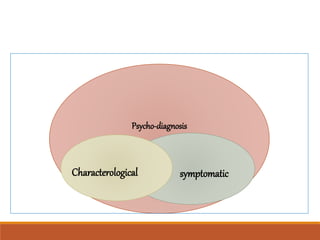
Psycho-diagnosis
symptomatic
Characterological
NatureofPsycho-Diagnosis
An assessment process: It aimed at gaining the
understanding of the nature of the abnormality and the
behavioral and emotional problems of the client.
A process of classification and labeling: In the process,
classification can be understood as assigning objects or
people to the respective categories on the basis of their
shared attributes or relations. The symptomatic
diagnosis is a complete classificatory process and
involves collecting information about the signs and
symptoms of the problem and organizing it in a whole- in
syndromes or disorder. The presenting symptoms are
then matched with the diagnostic categories of any
preestablished psychiatric classification system and a
label is assigned to the syndrome.
NatureofPsycho-Diagnosis..Conti…
A process of developing the working image of the client:
Working image means setting the hypothesis about the person and
their situation in which they presently or potentially operates. In
this, the clinician attempted to understand the situations in which
the client reflect problems and can not function up to the normal
level.
Idiographic versus nomothetic nature: The symptomatic or
classificatory diagnosis is based on a nomothetic approach, where we
make an effort to classify or name the problem. While, the
characterological diagnosis follows the idiographic approach. The
idiographic approach aims to explore towards detailed investigation
of the single case or person. The characterological diagnosis makes
an attempt to examine each individual client in detail to determine
what is unique about the individual’s personality, cultural
background, and/or circumstances.
NatureofPsycho-Diagnosis..Conti…
Diagnosis is an inferential and decision making process: The diagnosis, whether, symptomatic
or characterological involves drawing inferences and decision about the client’s condition and
psychopathology. During, assessment procedure, the clinician collects clinical information about
the client and make several hypothesis about the nature, class (diagnostic category), and etiology of
the presenting problem. In this process, the clinician collects further information to rule out some
of the hypothesis and to retain one to go further.
Monothetic Versus Polythetic: Diagnosis includes both monothetic and polythetic approach. In
monothetic classification, we categorize the objects or people on the basis of a small number of
singly essential and jointly ample characteristics. Any object that poses these characteristics is
considered a member of the category but the people who fail to poses closely these characteristics
are not member of the category. However, in polythetic class a set of criteria that are neither
necessary nor sufficient is included. It assumes that each member of a category must have a certain
minimum number of the defining features to be a part of the category (but it is not necessary that
each member must have all the defining features).
NatureofPsycho-Diagnosis..Conti…
Descriptive versus theoretical: The current diagnostic
systems are descriptive in nature because they give
emphasis on descriptions of specific symptoms that
cluster together and follow a predictable course over
time.
Categorical versus dimensional versus prototypical:
In dimensional classification, an attempt is made to
differentiate the clients in terms of several dimensions
such as mood, cognition, behavior etc. However, in
categorical classification assessment is done whether the
person has or does not have the given property. In
prototypical classification disorders are identified by the
existence of presence of certain essential characteristics
but it also allow for some non-essential variations that do
not necessarily change the classification.
•To present the description of personality and psychopathology
•To provide diagnosis (classification and labeling of disorder)
•To formulate and plan a Case study (Explanatory diagnosis) The cause of the
client’s problem is tried to understand. In other words the purpose of psycho-
diagnosis is to develop a causal model of the client’s problem. During the
explanations, particular theory of psychotherapy or psychopathology is taken
into consideration.
•For behavioral predictions and prognosis.
•To provide base line information of the client and the psychopathology
•To evaluate the client’s status after treatment
•To plan and guide therapeutic interventions
Objectives of diagnosis
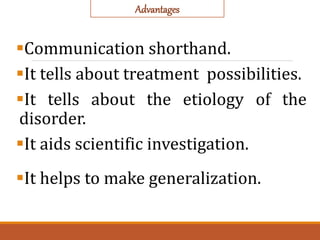
Communication shorthand.
It tells about treatment possibilities.
It tells about the etiology of the
disorder.
It aids scientific investigation.
It helps to make generalization.
Advantages
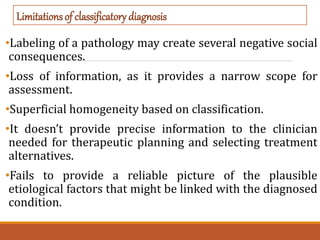
•Labeling of a pathology may create several negative social
consequences.
•Loss of information, as it provides a narrow scope for
assessment.
•Superficial homogeneity based on classification.
•It doesn’t provide precise information to the clinician
needed for therapeutic planning and selecting treatment
alternatives.
•Fails to provide a reliable picture of the plausible
etiological factors that might be linked with the diagnosed
condition.
Limitationsof classificatory diagnosis
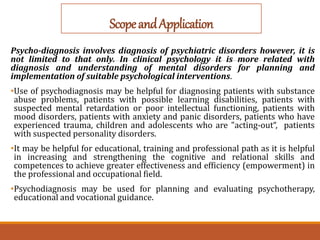
ScopeandApplication
Psycho-diagnosis involves diagnosis of psychiatric disorders however, it is
not limited to that only. In clinical psychology it is more related with
diagnosis and understanding of mental disorders for planning and
implementation of suitable psychological interventions.
•Use of psychodiagnosis may be helpful for diagnosing patients with substance
abuse problems, patients with possible learning disabilities, patients with
suspected mental retardation or poor intellectual functioning, patients with
mood disorders, patients with anxiety and panic disorders, patients who have
experienced trauma, children and adolescents who are "acting-out“, patients
with suspected personality disorders.
•It may be helpful for educational, training and professional path as it is helpful
in increasing and strengthening the cognitive and relational skills and
competences to achieve greater effectiveness and efficiency (empowerment) in
the professional and occupational field.
•Psychodiagnosis may be used for planning and evaluating psychotherapy,
educational and vocational guidance.

Psychodiagnosis

  • 1.
    Psychodiagnosis Dr. Garima Gupta AssistantProfessor Department Of Psychology Arya Mahila PG College (Admitted To The Privileges Of BHU) Varanasi
  • 2.
    According to Atkinson,Berne, and Woodworth (1987) diagnosis is the process which includes both determination of the nature of the abnormality or disease and the classification of an individual on the basis of a disease or abnormality Henceforth, diagnosis can be referred to as a process of classification and labeling of abnormality or psychological disorder. In conclusion, Diagnosis is a classificatory process Diagnosis
  • 3.
    Psycho-diagnosis Berzonsky (1994) “psycho-diagnosis refers to the process of classifying information of an individual’s emotional and behavioral state, and the name assigned to the state, generally based on the commonly accepted classification system. Psychodiagnosis is not limited to recognition and classification of symptoms or the classification of disease its more of taking the Psychological diagnosis is not limited to the recognition and classification of symptoms or the classification of a disease (as in the medical field) but considering more of the complexity and uniqueness of each individual. It aims to arrive at a psychological understanding of emotional and cognitive sharing of individuals. In nutshell, it is considered as a science or art of making a personality evaluation. The psycho-diagnostic present the global functioning of individual provides assessment.
  • 4.
    The process ofpsychodiagnosis is generally understood in terms of classification, labeling, and understanding of the psychopathological condition of the patient. It is generally a systematic study of the patient by applying various clinical assessment tools such as interviews, observations, behavioural assessment, and psychological tests at different stages.
  • 5.
    The term diagnosishas been used in two ways: •Symptomatic or categorical diagnosis: A process of categorizing the person in terms of any existing psychiatric classification system. It reflects the narrow sense. •Characterological diagnosis: A process which involves understanding the person as whole (personality). It intends at describing the person’s personality structure and dynamics, his strengths and weaknesses, and their coping resources. It emphasizes understanding how and by what factors the given psychopathological symptoms and syndrome appeared. It indicates a broader sense of diagnosis.
  • 6.
    Researches have showedthat the individual’s mental health and illness is influenced by a multitude factors that’s why it is essential to understand the behavior, emotions, thinking, personality, social situations and stressful life events that are concomitant with a given psychopathology. While considering symptomatic diagnostic all patients with a given diagnosis are assumed to be fall at same and homogeneous level. Though, the fact lies that within a given diagnostic category patients differs a lot in respect to their symptomatic manifestation and related condition. Therefore, the uniqueness of the individual is lost with classificatory diagnostic process. That’s how the characterological assessment came into emergence that while planning the specific treatment the uniqueness of the individual must be considered. Reasons for The shift towards Characterological assessment
  • 7.
  • 8.
    NatureofPsycho-Diagnosis An assessment process:It aimed at gaining the understanding of the nature of the abnormality and the behavioral and emotional problems of the client. A process of classification and labeling: In the process, classification can be understood as assigning objects or people to the respective categories on the basis of their shared attributes or relations. The symptomatic diagnosis is a complete classificatory process and involves collecting information about the signs and symptoms of the problem and organizing it in a whole- in syndromes or disorder. The presenting symptoms are then matched with the diagnostic categories of any preestablished psychiatric classification system and a label is assigned to the syndrome.
  • 9.
    NatureofPsycho-Diagnosis..Conti… A process ofdeveloping the working image of the client: Working image means setting the hypothesis about the person and their situation in which they presently or potentially operates. In this, the clinician attempted to understand the situations in which the client reflect problems and can not function up to the normal level. Idiographic versus nomothetic nature: The symptomatic or classificatory diagnosis is based on a nomothetic approach, where we make an effort to classify or name the problem. While, the characterological diagnosis follows the idiographic approach. The idiographic approach aims to explore towards detailed investigation of the single case or person. The characterological diagnosis makes an attempt to examine each individual client in detail to determine what is unique about the individual’s personality, cultural background, and/or circumstances.
  • 10.
    NatureofPsycho-Diagnosis..Conti… Diagnosis is aninferential and decision making process: The diagnosis, whether, symptomatic or characterological involves drawing inferences and decision about the client’s condition and psychopathology. During, assessment procedure, the clinician collects clinical information about the client and make several hypothesis about the nature, class (diagnostic category), and etiology of the presenting problem. In this process, the clinician collects further information to rule out some of the hypothesis and to retain one to go further. Monothetic Versus Polythetic: Diagnosis includes both monothetic and polythetic approach. In monothetic classification, we categorize the objects or people on the basis of a small number of singly essential and jointly ample characteristics. Any object that poses these characteristics is considered a member of the category but the people who fail to poses closely these characteristics are not member of the category. However, in polythetic class a set of criteria that are neither necessary nor sufficient is included. It assumes that each member of a category must have a certain minimum number of the defining features to be a part of the category (but it is not necessary that each member must have all the defining features).
  • 11.
    NatureofPsycho-Diagnosis..Conti… Descriptive versus theoretical:The current diagnostic systems are descriptive in nature because they give emphasis on descriptions of specific symptoms that cluster together and follow a predictable course over time. Categorical versus dimensional versus prototypical: In dimensional classification, an attempt is made to differentiate the clients in terms of several dimensions such as mood, cognition, behavior etc. However, in categorical classification assessment is done whether the person has or does not have the given property. In prototypical classification disorders are identified by the existence of presence of certain essential characteristics but it also allow for some non-essential variations that do not necessarily change the classification.
  • 12.
    •To present thedescription of personality and psychopathology •To provide diagnosis (classification and labeling of disorder) •To formulate and plan a Case study (Explanatory diagnosis) The cause of the client’s problem is tried to understand. In other words the purpose of psycho- diagnosis is to develop a causal model of the client’s problem. During the explanations, particular theory of psychotherapy or psychopathology is taken into consideration. •For behavioral predictions and prognosis. •To provide base line information of the client and the psychopathology •To evaluate the client’s status after treatment •To plan and guide therapeutic interventions Objectives of diagnosis
  • 13.
    Communication shorthand. It tellsabout treatment possibilities. It tells about the etiology of the disorder. It aids scientific investigation. It helps to make generalization. Advantages
  • 14.
    •Labeling of apathology may create several negative social consequences. •Loss of information, as it provides a narrow scope for assessment. •Superficial homogeneity based on classification. •It doesn’t provide precise information to the clinician needed for therapeutic planning and selecting treatment alternatives. •Fails to provide a reliable picture of the plausible etiological factors that might be linked with the diagnosed condition. Limitationsof classificatory diagnosis
  • 15.
    ScopeandApplication Psycho-diagnosis involves diagnosisof psychiatric disorders however, it is not limited to that only. In clinical psychology it is more related with diagnosis and understanding of mental disorders for planning and implementation of suitable psychological interventions. •Use of psychodiagnosis may be helpful for diagnosing patients with substance abuse problems, patients with possible learning disabilities, patients with suspected mental retardation or poor intellectual functioning, patients with mood disorders, patients with anxiety and panic disorders, patients who have experienced trauma, children and adolescents who are "acting-out“, patients with suspected personality disorders. •It may be helpful for educational, training and professional path as it is helpful in increasing and strengthening the cognitive and relational skills and competences to achieve greater effectiveness and efficiency (empowerment) in the professional and occupational field. •Psychodiagnosis may be used for planning and evaluating psychotherapy, educational and vocational guidance.