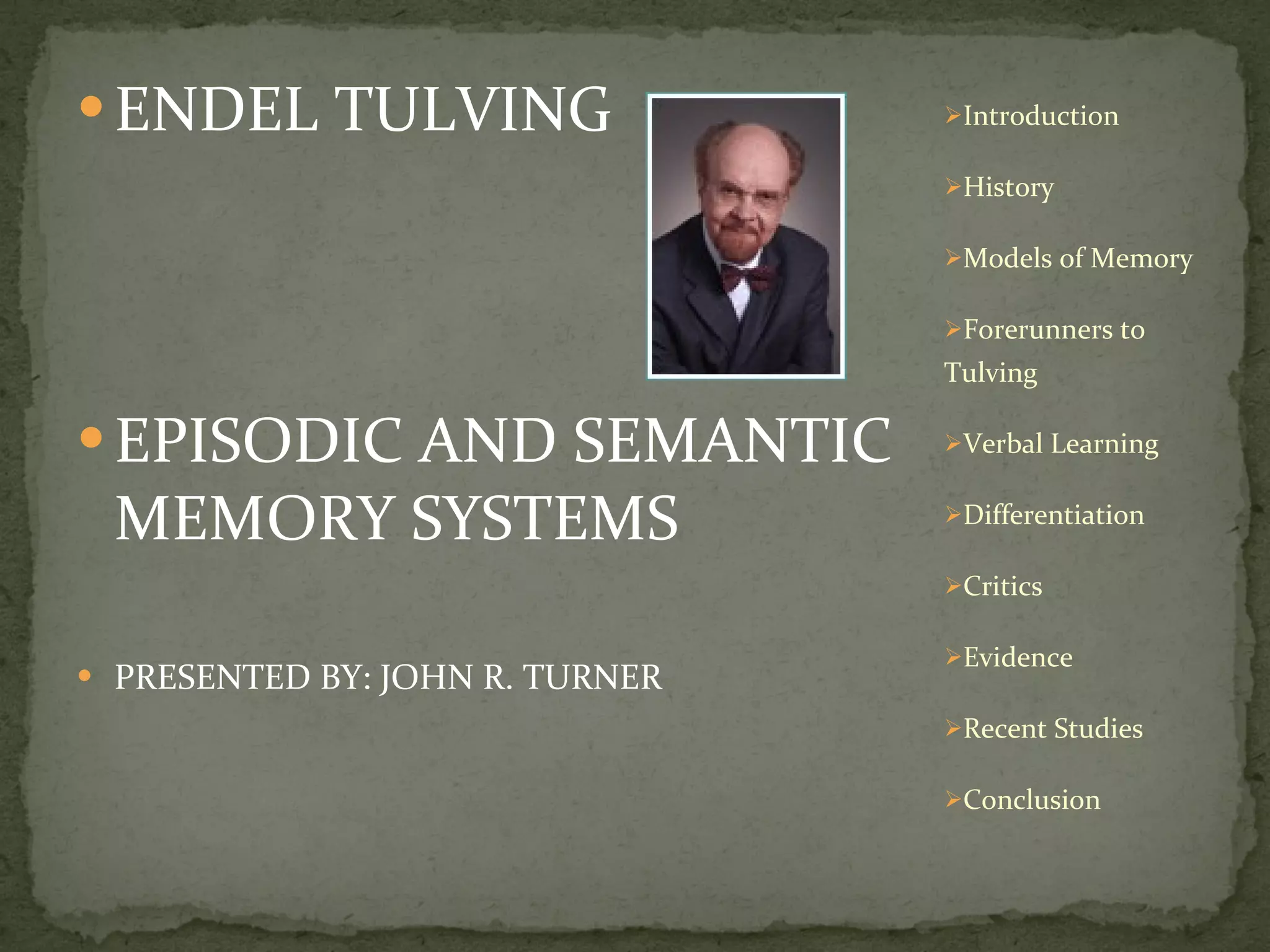
ENDEL TULVING EPISODIC AND SEMANTIC MEMORY SYSTEMS PRESENTED BY: JOHN R. TURNER Introduction History Models of Memory Forerunners to Tulving Verbal Learning  Differentiation Critics Evidence Recent Studies Conclusion
Introduction Endel Tulving is most famous for introducing two separate types of memory systems: Episodic Memory and Semantic Memory 1953  BA – Psychology from the University of Toronto 1954  MA – Psychology from the University of Toronto 1957  PhD – Experimental Psychology from Harvard University Returned to University of Toronto where he currently teaches Introduction Models of Memory Forerunners to Tulving Verbal Learning  Differentiation Critics Evidence Recent Studies Conclusion
Models of Memory Atkinson and Shiffrin ’s information-processing model Information is separated into three main system: Sensory Memory Short-Term Memory (Working Memory) Long-Term Memory One of the first models to separate short-term from long-term Introduction Models of Memory Forerunners to Tulving Verbal Learning  Differentiation Critics Evidence Recent Studies Conclusion
Models of Memory –cont- Long-term Memory has been divided into two separate domains: Procedural Memories Propositional Memories Tulving thought it was necessary to differentiate propositional memories into two separate systems: Episodic Memories Semantic Memories Introduction Models of Memory Forerunners to Tulving Verbal Learning  Differentiation Critics Evidence Recent Studies Conclusion
Forerunners to Tulving Early Dichotomous Classification of Memory Aristotle Experience / Wisdom Henri Bergson (1911) Habit / True Memory Claparede (around 1911) Those established between connections / those established between connections and the self Furlong (1948) Retrospective Memory / Non-Retrospective Memory Introduction Models of Memory Forerunners to Tulving Verbal Learning  Differentiation Critics Evidence Recent Studies Conclusion
Verbal Learning Experiments Tulving conducted experiments in verbal learning while at Harvard Verbal Learning Experiments  Subjects are given words to study, retain, and recall over a number of trials Tulving found that test subjects were remembering the occurrence of the word events rather than learning or recalling them Tulving began studying event-memory tests rather than verbal learning tests These event-memory tests began the preliminary phases of two memory systems, episodic and semantic Introduction Models of Memory Forerunners to Tulving Verbal Learning  Differentiation Critics Evidence Recent Studies Conclusion
Differences between Episodic and Semantic Memories Retrieval Episodic involves autonoetic awareness (time stamped events) and the mental re-experience of a previous moment in the past Semantic has no autonoesis, no mental time travel Storage Episodic has temporal co-occurrence of two words, A and B Semantic entails a meaningful relation between two words, the A-B association Introduction Models of Memory Forerunners to Tulving Verbal Learning  Differentiation Critics Evidence Recent Studies Conclusion
Differences between Episodic and Semantic Memories –cont- Vulnerability to Interference Episodic is more vulnerable to interference Interference Theory Interdependence Episodic and Semantic memory systems often interact closely to one another. However, they still have interdependent functions Eagle-BIRD Pair Introduction Models of Memory Forerunners to Tulving Verbal Learning  Differentiation Critics Evidence Recent Studies Conclusion
Critics to Episodic / Semantic Differentiation The idea of episodic was vague Tulving ’s episodic theory did not follow established scientific research No reason to distinguish memory into two systems Lack of evidence Unitary memory system Introduction Models of Memory Forerunners to Tulving Verbal Learning  Differentiation Critics Evidence Recent Studies Conclusion
Scientific Evidence Differentiating Episodic from Semantic Neurological Patients with Brain Damage Brain Damage (accident or disease) Research has shown that two memory systems, episodic and semantic, are present Functional Neuroimaging Techniques Examine brain activity One empirical regularity: Left prefrontal cortex is differentially more involve than right in encoding information into the episodic memory Right prefrontal cortex is differentially more involved than left in episodic retrieval Semantic retrieval is seldom observed in the right hemisphere Introduction Models of Memory Forerunners to Tulving Verbal Learning  Differentiation Critics Evidence Recent Studies Conclusion
Scientific Evidence Differentiating Episodic from Semantic –cont- Semantic retrieval is localized to the left hemisphere Episodic retrieval involves right hemisphere Introduction Models of Memory Forerunners to Tulving Verbal Learning  Differentiation Critics Evidence Recent Studies Conclusion
Recent Studies Involving Episodic and Semantic Memory Herbert & Burt (2004) Early learning – episodic Transformation to semantic  Knowledge is schematized Semb & Ellis (1994) Instructional content vs. Qualitative changes in memory structure (schemas)  Long-term retention MacKenzie & White (1982) Qualitative differences in episodic experiences Long-term retention Introduction Models of Memory Forerunners to Tulving Verbal Learning  Differentiation Critics Evidence Recent Studies Conclusion
Recent Studies Involving Episodic and Semantic Memory –cont- Herbert & Burt (2004) Groups with episodic rich material vs. groups without  Semb & Ellis (1994) Levels of original learning & students with high ability Introduction History Models of Memory Forerunners to Tulving Verbal Learning  Differentiation Critics Evidence Recent Studies Conclusion
Conclusion Empirical Research has validated claims of two memory systems: episodic and semantic Learning has been shown to increase when knowledge is schematized Instructional material and student ’s (employees) ability matter Match training / job tasks to employees original knowledge and ability Introduction History Models of Memory Forerunners to Tulving Verbal Learning  Differentiation Critics Evidence Recent Studies Conclusion
Bergson, H. (1911).  Matter and memory.  London, England: Allen & Unwin. Claparede, E. (1911).  Arch Psychol. 11, 79-90.  [Translated in organization and pathology of thought (ed. D. Rapaport0. Colombia University Press, New York (1951)]. Furlong, E. J. (1948). Memory.  Mind, No. 224, 57, 16-24. Herbert, D. M. B. & Burt, J. S. (2004).  What do students remember?  Episodic memory and the development of schematization.  Applied Cognitive Psychology, 18, 77-88. MacKenzie, A. A. & White, R. T. (1981).  Fieldwork in geography and long-term memory.  American Educational Research Journal, 19, 623-632. Semb, G. B., & Ellis, J. A. (1994).  Knowledge taught in school: what is remembered.  Review of educational research, 64, 253-286.

Tulving episodic semantic

  • 1.
    ENDEL TULVING EPISODICAND SEMANTIC MEMORY SYSTEMS PRESENTED BY: JOHN R. TURNER Introduction History Models of Memory Forerunners to Tulving Verbal Learning Differentiation Critics Evidence Recent Studies Conclusion
  • 2.
    Introduction Endel Tulvingis most famous for introducing two separate types of memory systems: Episodic Memory and Semantic Memory 1953 BA – Psychology from the University of Toronto 1954 MA – Psychology from the University of Toronto 1957 PhD – Experimental Psychology from Harvard University Returned to University of Toronto where he currently teaches Introduction Models of Memory Forerunners to Tulving Verbal Learning Differentiation Critics Evidence Recent Studies Conclusion
  • 3.
    Models of MemoryAtkinson and Shiffrin ’s information-processing model Information is separated into three main system: Sensory Memory Short-Term Memory (Working Memory) Long-Term Memory One of the first models to separate short-term from long-term Introduction Models of Memory Forerunners to Tulving Verbal Learning Differentiation Critics Evidence Recent Studies Conclusion
  • 4.
    Models of Memory–cont- Long-term Memory has been divided into two separate domains: Procedural Memories Propositional Memories Tulving thought it was necessary to differentiate propositional memories into two separate systems: Episodic Memories Semantic Memories Introduction Models of Memory Forerunners to Tulving Verbal Learning Differentiation Critics Evidence Recent Studies Conclusion
  • 5.
    Forerunners to TulvingEarly Dichotomous Classification of Memory Aristotle Experience / Wisdom Henri Bergson (1911) Habit / True Memory Claparede (around 1911) Those established between connections / those established between connections and the self Furlong (1948) Retrospective Memory / Non-Retrospective Memory Introduction Models of Memory Forerunners to Tulving Verbal Learning Differentiation Critics Evidence Recent Studies Conclusion
  • 6.
    Verbal Learning ExperimentsTulving conducted experiments in verbal learning while at Harvard Verbal Learning Experiments Subjects are given words to study, retain, and recall over a number of trials Tulving found that test subjects were remembering the occurrence of the word events rather than learning or recalling them Tulving began studying event-memory tests rather than verbal learning tests These event-memory tests began the preliminary phases of two memory systems, episodic and semantic Introduction Models of Memory Forerunners to Tulving Verbal Learning Differentiation Critics Evidence Recent Studies Conclusion
  • 7.
    Differences between Episodicand Semantic Memories Retrieval Episodic involves autonoetic awareness (time stamped events) and the mental re-experience of a previous moment in the past Semantic has no autonoesis, no mental time travel Storage Episodic has temporal co-occurrence of two words, A and B Semantic entails a meaningful relation between two words, the A-B association Introduction Models of Memory Forerunners to Tulving Verbal Learning Differentiation Critics Evidence Recent Studies Conclusion
  • 8.
    Differences between Episodicand Semantic Memories –cont- Vulnerability to Interference Episodic is more vulnerable to interference Interference Theory Interdependence Episodic and Semantic memory systems often interact closely to one another. However, they still have interdependent functions Eagle-BIRD Pair Introduction Models of Memory Forerunners to Tulving Verbal Learning Differentiation Critics Evidence Recent Studies Conclusion
  • 9.
    Critics to Episodic/ Semantic Differentiation The idea of episodic was vague Tulving ’s episodic theory did not follow established scientific research No reason to distinguish memory into two systems Lack of evidence Unitary memory system Introduction Models of Memory Forerunners to Tulving Verbal Learning Differentiation Critics Evidence Recent Studies Conclusion
  • 10.
    Scientific Evidence DifferentiatingEpisodic from Semantic Neurological Patients with Brain Damage Brain Damage (accident or disease) Research has shown that two memory systems, episodic and semantic, are present Functional Neuroimaging Techniques Examine brain activity One empirical regularity: Left prefrontal cortex is differentially more involve than right in encoding information into the episodic memory Right prefrontal cortex is differentially more involved than left in episodic retrieval Semantic retrieval is seldom observed in the right hemisphere Introduction Models of Memory Forerunners to Tulving Verbal Learning Differentiation Critics Evidence Recent Studies Conclusion
  • 11.
    Scientific Evidence DifferentiatingEpisodic from Semantic –cont- Semantic retrieval is localized to the left hemisphere Episodic retrieval involves right hemisphere Introduction Models of Memory Forerunners to Tulving Verbal Learning Differentiation Critics Evidence Recent Studies Conclusion
  • 12.
    Recent Studies InvolvingEpisodic and Semantic Memory Herbert & Burt (2004) Early learning – episodic Transformation to semantic Knowledge is schematized Semb & Ellis (1994) Instructional content vs. Qualitative changes in memory structure (schemas) Long-term retention MacKenzie & White (1982) Qualitative differences in episodic experiences Long-term retention Introduction Models of Memory Forerunners to Tulving Verbal Learning Differentiation Critics Evidence Recent Studies Conclusion
  • 13.
    Recent Studies InvolvingEpisodic and Semantic Memory –cont- Herbert & Burt (2004) Groups with episodic rich material vs. groups without Semb & Ellis (1994) Levels of original learning & students with high ability Introduction History Models of Memory Forerunners to Tulving Verbal Learning Differentiation Critics Evidence Recent Studies Conclusion
  • 14.
    Conclusion Empirical Researchhas validated claims of two memory systems: episodic and semantic Learning has been shown to increase when knowledge is schematized Instructional material and student ’s (employees) ability matter Match training / job tasks to employees original knowledge and ability Introduction History Models of Memory Forerunners to Tulving Verbal Learning Differentiation Critics Evidence Recent Studies Conclusion
  • 15.
    Bergson, H. (1911). Matter and memory. London, England: Allen & Unwin. Claparede, E. (1911). Arch Psychol. 11, 79-90. [Translated in organization and pathology of thought (ed. D. Rapaport0. Colombia University Press, New York (1951)]. Furlong, E. J. (1948). Memory. Mind, No. 224, 57, 16-24. Herbert, D. M. B. & Burt, J. S. (2004). What do students remember? Episodic memory and the development of schematization. Applied Cognitive Psychology, 18, 77-88. MacKenzie, A. A. & White, R. T. (1981). Fieldwork in geography and long-term memory. American Educational Research Journal, 19, 623-632. Semb, G. B., & Ellis, J. A. (1994). Knowledge taught in school: what is remembered. Review of educational research, 64, 253-286.