MMPI (Minnesota Multiphasic
Personality Inventory)
Sahar Nawaz
MMPI: Development
Since its original development by Hathaway and
McKinley in 1940, the MMPI has become the most
widely used clinical personality inventory, with more
than 10,000 published research references.
Rationale
 The Minnesota Multiphasic Personality Inventory (MMPI ) is
a standardized questionnaire that elicits a wide range of self-
descriptions scored to give a quantitative measurement of an
individual’s level of emotional adjustment and attitude toward
test taking.
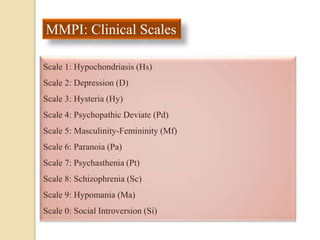
MMPI: Clinical Scales
Scale 1: Hypochondriasis (Hs)
Scale 2: Depression (D)
Scale 3: Hysteria (Hy)
Scale 4: Psychopathic Deviate (Pd)
Scale 5: Masculinity-Femininity (Mf)
Scale 6: Paranoia (Pa)
Scale 7: Psychasthenia (Pt)
Scale 8: Schizophrenia (Sc)
Scale 9: Hypomania (Ma)
Scale 0: Social Introversion (Si)
Scale 1. Hypochondriasis (Hs)
Scale 1 had 33 items & it was originally designed to distinguish
hypochondriacs from other types of psychiatric patients.
High scorers on this scale show not only a high concern with illness
and disease, but also are likely to be egocentric, immature, pessimistic,
sour, whiny, and passive-aggressive.
Low scores suggest an absence of physical complaints and health-related
concerns.
CLINICAL SCALES
Scale 2: Depression (D)
Scale 2 comprises 60 items on the MMPI. these items are organized around
the areas of brooding, physical slowness, subjective feelings of depression,
mental apathy, and physical malfunctioning.
Moderate elevations on 2 might suggest a depression,
Low scores generally indicate not only an absence of depression, but that
the person is likely to be cheerful, optimistic, alert, active, and
spontaneous.
Scale 3 : Hysteria (Hy)
Scale 3 had 60 items was originally designed to identify patients who
had developed a psychogenically based sensory or motor disorder.
High scorers are likely to have specific functionally related somatic
complaints. They usually experience low levels of anxiety, tension,
Low scores might be consistent with persons who are narrow-minded, c
socially isolated, conventional, constricted, and controlled.
Scale 4: Psychopathic Deviate (Pd)
The purpose of Scale 4 (50 items) is to assess the person’s general level
of social adjustment.
High scorers typically have problems with persons in authority,
frequent marital and work difficulties, and poor tolerance for boredom..
Extremely high scorers might be aggressive or even assaultive .
Scores below 45 reflect persons who are over controlled, self-critical,
rigid, conventional, and over identified with social status..
Scale 5: Masculinity-Femininity (Mf)
This scale consist of 55 items & it was originally designed to identify
males who were having difficulty with homosexual feelings and gender-
identity confusion.
High scores for males have traditionally been interpreted as suggesting
that they are likely to be undemanding, shy, emotional, curious, and
creative, with a wide range of intellectual interests.
Low-scoring males will be domineering and impersonal. Their interests
might be somewhat narrow, and they will lack originality.
High-scoring females would be endorsing traditionally masculine
interests and activities.
Females with low scores on 5 scale will be tender; emotional; have
a balanced view of gender-role behavior; express aesthetic
interests; and be capable, competent.
Continue……….
Scale 6: Paranoia(Pa)
Scale 6 had 40 items was designed to identify persons with paranoid
conditions or paranoid states. It measures areas such as ideas of reference,
delusional beliefs, pervasive suspiciousness, feelings of persecution,
grandiose self-beliefs, and interpersonal rigidity.
Extremely high scores on Scale 6 indicate persons who are highly
suspicious, brooding, resentful, and angry.
Most persons with low scores on 6 are described as being quite balanced,
lacking in a sense of conscience, self-centered, effectively in control of
their emotions, and have a narrow range of interests.
Scale 7 : Psychasthenia (Pt)
.
The 48 items on Scale 7 were originally designed to measure the
syndrome of psychasthenia. It consisted of compulsions,
obsessions, unreasonable fears, and excessive doubts .
Elevations on Scale 7 suggest persons who are apprehensive,
worrying, perfectionistic, and tense, and who may have a wide
variety of superstitious fears.
Low scorers are likely to be relaxed, warm, cheerful, friendly,
alert, and self-confident.
Scale 8: Schizophrenia (Sc)
Scale 8 had 78 items & it was originally designed to identify persons
who were experiencing schizophrenic or schizophrenic-like conditions.
A high score suggests persons who have unusual beliefs, are
unconventional, and may experience difficulties concentrating and
focusing their attention.
Persons scoring low are likely to be cheerful, good-natured, friendly,
trustful, and adaptable.
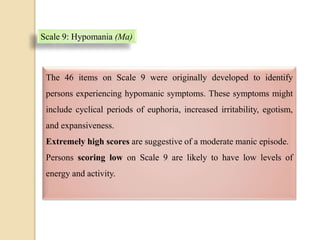
Scale 9: Hypomania (Ma)
The 46 items on Scale 9 were originally developed to identify
persons experiencing hypomanic symptoms. These symptoms might
include cyclical periods of euphoria, increased irritability, egotism,
and expansiveness.
Extremely high scores are suggestive of a moderate manic episode.
Persons scoring low on Scale 9 are likely to have low levels of
energy and activity.
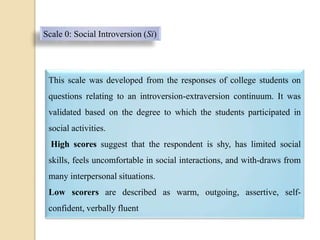
Scale 0: Social Introversion (Si)
This scale was developed from the responses of college students on
questions relating to an introversion-extraversion continuum. It was
validated based on the degree to which the students participated in
social activities.
High scores suggest that the respondent is shy, has limited social
skills, feels uncomfortable in social interactions, and with-draws from
many interpersonal situations.
Low scorers are described as warm, outgoing, assertive, self-
confident, verbally fluent
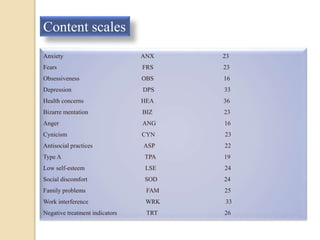
Anxiety ANX 23
Fears FRS 23
Obsessiveness OBS 16
Depression DPS 33
Health concerns HEA 36
Bizarre mentation BIZ 23
Anger ANG 16
Cynicism CYN 23
Antisocial practices ASP 22
Type A TPA 19
Low self-esteem LSE 24
Social discomfort SOD 24
Family problems FAM 25
Work interference WRK 33
Negative treatment indicators TRT 26
Content scales
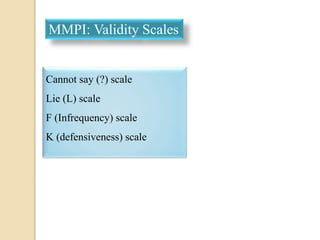
MMPI: Validity Scales
Cannot say (?) scale
Lie (L) scale
F (Infrequency) scale
K (defensiveness) scale
The L or lie scale consists of 15 items that indicate the extent to
which a client is attempting to describe himself or herself in an
unrealistically positive manner.
Thus, high scorers describe themselves in an overly perfectionistic
and idealized manner.
Low scores suggest that clients were frank and open regarding their
responses to the
items.
Validity Scales…..
The K scale was designed to detect clients who are describing themselves
in overly positive terms.
High Scores on K
Scores that are much higher than would be expected (generally above
T=65 or 70) given the person’s history suggest that clients are attempting
to describe themselves in an overly favorable light or deny their
difficulties, or that they answered false to all items (nay-saying).
Low scores suggest a fake bad profile in which the person exaggerates his
or her pathology
Continue …..
Continue …..
The F score is not a personality scale but serves as a check on the
validity of the whole record.
If the F score is high, the other scales are likely to be invalid either
because the subject was careless or unable to comprehend the items.
A low F score is a reliable indication that the subject’s responses were
rational.
Administration and Scoring
Administered individually or in groups
 not a “take home” test
 computerized version available
Administration time is approximately 1 to 1.5 hours
Scored by hand or computer
Must be interpreted by qualified professionals
For use with individuals 16 years and six years of schooling.
Can break test session up into shorter segments
Administration and Scoring (cont.)
If only standard scales are required - administer first 399
items many supplementary scales are not available unless
you give all 566 items
If hand scoring use scoring key appropriate to
individual’s gender. Use the K correction for this class
Interpretation is configural in nature and not dependent on
any one scale
References:
Basham, R. B. (1992). Clinical utility of the MMPI research
scales
in the assessment of adolescent acting out.
Psychological
assessment, 4,483-492.
Thank
You

mmpi

  • 1.
  • 2.
    MMPI: Development Since itsoriginal development by Hathaway and McKinley in 1940, the MMPI has become the most widely used clinical personality inventory, with more than 10,000 published research references.
  • 3.
    Rationale  The MinnesotaMultiphasic Personality Inventory (MMPI ) is a standardized questionnaire that elicits a wide range of self- descriptions scored to give a quantitative measurement of an individual’s level of emotional adjustment and attitude toward test taking.
  • 4.
    MMPI: Clinical Scales Scale1: Hypochondriasis (Hs) Scale 2: Depression (D) Scale 3: Hysteria (Hy) Scale 4: Psychopathic Deviate (Pd) Scale 5: Masculinity-Femininity (Mf) Scale 6: Paranoia (Pa) Scale 7: Psychasthenia (Pt) Scale 8: Schizophrenia (Sc) Scale 9: Hypomania (Ma) Scale 0: Social Introversion (Si)
  • 5.
    Scale 1. Hypochondriasis(Hs) Scale 1 had 33 items & it was originally designed to distinguish hypochondriacs from other types of psychiatric patients. High scorers on this scale show not only a high concern with illness and disease, but also are likely to be egocentric, immature, pessimistic, sour, whiny, and passive-aggressive. Low scores suggest an absence of physical complaints and health-related concerns. CLINICAL SCALES
  • 6.
    Scale 2: Depression(D) Scale 2 comprises 60 items on the MMPI. these items are organized around the areas of brooding, physical slowness, subjective feelings of depression, mental apathy, and physical malfunctioning. Moderate elevations on 2 might suggest a depression, Low scores generally indicate not only an absence of depression, but that the person is likely to be cheerful, optimistic, alert, active, and spontaneous.
  • 7.
    Scale 3 :Hysteria (Hy) Scale 3 had 60 items was originally designed to identify patients who had developed a psychogenically based sensory or motor disorder. High scorers are likely to have specific functionally related somatic complaints. They usually experience low levels of anxiety, tension, Low scores might be consistent with persons who are narrow-minded, c socially isolated, conventional, constricted, and controlled.
  • 8.
    Scale 4: PsychopathicDeviate (Pd) The purpose of Scale 4 (50 items) is to assess the person’s general level of social adjustment. High scorers typically have problems with persons in authority, frequent marital and work difficulties, and poor tolerance for boredom.. Extremely high scorers might be aggressive or even assaultive . Scores below 45 reflect persons who are over controlled, self-critical, rigid, conventional, and over identified with social status..
  • 9.
    Scale 5: Masculinity-Femininity(Mf) This scale consist of 55 items & it was originally designed to identify males who were having difficulty with homosexual feelings and gender- identity confusion. High scores for males have traditionally been interpreted as suggesting that they are likely to be undemanding, shy, emotional, curious, and creative, with a wide range of intellectual interests. Low-scoring males will be domineering and impersonal. Their interests might be somewhat narrow, and they will lack originality.
  • 10.
    High-scoring females wouldbe endorsing traditionally masculine interests and activities. Females with low scores on 5 scale will be tender; emotional; have a balanced view of gender-role behavior; express aesthetic interests; and be capable, competent. Continue……….
  • 11.
    Scale 6: Paranoia(Pa) Scale6 had 40 items was designed to identify persons with paranoid conditions or paranoid states. It measures areas such as ideas of reference, delusional beliefs, pervasive suspiciousness, feelings of persecution, grandiose self-beliefs, and interpersonal rigidity. Extremely high scores on Scale 6 indicate persons who are highly suspicious, brooding, resentful, and angry. Most persons with low scores on 6 are described as being quite balanced, lacking in a sense of conscience, self-centered, effectively in control of their emotions, and have a narrow range of interests.
  • 12.
    Scale 7 :Psychasthenia (Pt) . The 48 items on Scale 7 were originally designed to measure the syndrome of psychasthenia. It consisted of compulsions, obsessions, unreasonable fears, and excessive doubts . Elevations on Scale 7 suggest persons who are apprehensive, worrying, perfectionistic, and tense, and who may have a wide variety of superstitious fears. Low scorers are likely to be relaxed, warm, cheerful, friendly, alert, and self-confident.
  • 13.
    Scale 8: Schizophrenia(Sc) Scale 8 had 78 items & it was originally designed to identify persons who were experiencing schizophrenic or schizophrenic-like conditions. A high score suggests persons who have unusual beliefs, are unconventional, and may experience difficulties concentrating and focusing their attention. Persons scoring low are likely to be cheerful, good-natured, friendly, trustful, and adaptable.
  • 14.
    Scale 9: Hypomania(Ma) The 46 items on Scale 9 were originally developed to identify persons experiencing hypomanic symptoms. These symptoms might include cyclical periods of euphoria, increased irritability, egotism, and expansiveness. Extremely high scores are suggestive of a moderate manic episode. Persons scoring low on Scale 9 are likely to have low levels of energy and activity.
  • 15.
    Scale 0: SocialIntroversion (Si) This scale was developed from the responses of college students on questions relating to an introversion-extraversion continuum. It was validated based on the degree to which the students participated in social activities. High scores suggest that the respondent is shy, has limited social skills, feels uncomfortable in social interactions, and with-draws from many interpersonal situations. Low scorers are described as warm, outgoing, assertive, self- confident, verbally fluent
  • 16.
    Anxiety ANX 23 FearsFRS 23 Obsessiveness OBS 16 Depression DPS 33 Health concerns HEA 36 Bizarre mentation BIZ 23 Anger ANG 16 Cynicism CYN 23 Antisocial practices ASP 22 Type A TPA 19 Low self-esteem LSE 24 Social discomfort SOD 24 Family problems FAM 25 Work interference WRK 33 Negative treatment indicators TRT 26 Content scales
  • 17.
    MMPI: Validity Scales Cannotsay (?) scale Lie (L) scale F (Infrequency) scale K (defensiveness) scale
  • 18.
    The L orlie scale consists of 15 items that indicate the extent to which a client is attempting to describe himself or herself in an unrealistically positive manner. Thus, high scorers describe themselves in an overly perfectionistic and idealized manner. Low scores suggest that clients were frank and open regarding their responses to the items. Validity Scales…..
  • 19.
    The K scalewas designed to detect clients who are describing themselves in overly positive terms. High Scores on K Scores that are much higher than would be expected (generally above T=65 or 70) given the person’s history suggest that clients are attempting to describe themselves in an overly favorable light or deny their difficulties, or that they answered false to all items (nay-saying). Low scores suggest a fake bad profile in which the person exaggerates his or her pathology Continue …..
  • 20.
    Continue ….. The Fscore is not a personality scale but serves as a check on the validity of the whole record. If the F score is high, the other scales are likely to be invalid either because the subject was careless or unable to comprehend the items. A low F score is a reliable indication that the subject’s responses were rational.
  • 21.
    Administration and Scoring Administeredindividually or in groups  not a “take home” test  computerized version available Administration time is approximately 1 to 1.5 hours Scored by hand or computer Must be interpreted by qualified professionals For use with individuals 16 years and six years of schooling. Can break test session up into shorter segments
  • 22.
    Administration and Scoring(cont.) If only standard scales are required - administer first 399 items many supplementary scales are not available unless you give all 566 items If hand scoring use scoring key appropriate to individual’s gender. Use the K correction for this class Interpretation is configural in nature and not dependent on any one scale
  • 23.
    References: Basham, R. B.(1992). Clinical utility of the MMPI research scales in the assessment of adolescent acting out. Psychological assessment, 4,483-492.
  • 24.