Gliezel L. Cabaltican
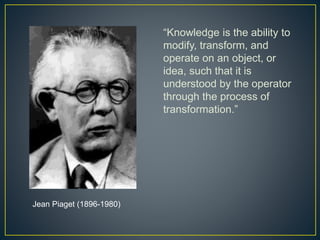
“Knowledge is the ability to
modify, transform, and
operate on an object, or
idea, such that it is
understood by the operator
through the process of
transformation.”
Jean Piaget (1896-1980)
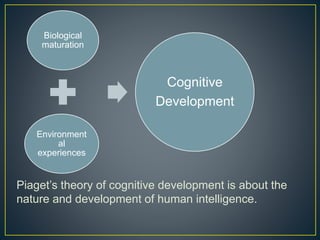
Piaget’s theory of cognitive development is about the
nature and development of human intelligence.
Biological
maturation
Environment
al
experiences
Cognitive
Development
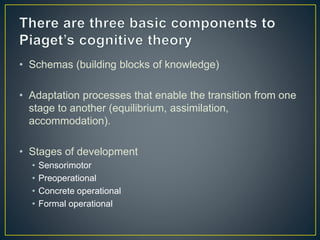
• Schemas (building blocks of knowledge)
• Adaptation processes that enable the transition from one
stage to another (equilibrium, assimilation,
accommodation).
• Stages of development
• Sensorimotor
• Preoperational
• Concrete operational
• Formal operational
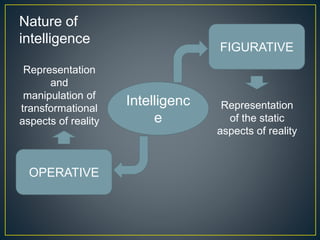
Intelligenc
e
OPERATIVE
FIGURATIVE
Representation
and
manipulation of
transformational
aspects of reality
Representation
of the static
aspects of reality
Nature of
intelligence
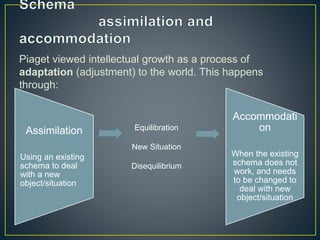
Piaget viewed intellectual growth as a process of
adaptation (adjustment) to the world. This happens
through:
Assimilation
Using an existing
schema to deal
with a new
object/situation
Accommodati
on
When the existing
schema does not
work, and needs
to be changed to
deal with new
object/situation
Equilibration
New Situation
Disequilibrium
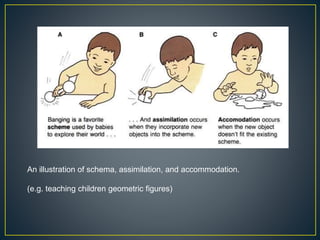
An illustration of schema, assimilation, and accommodation.
(e.g. teaching children geometric figures)
According to Piaget, assimilation and accommodation
require an active learner, not a passive one, because
problem-solving skills cannot be taught, they must be
discovered.
Teachers should facilitate learning and encourage the
following within the classroom:
• Focus on the process of learning, rather than the end
product of it.
• Using active methods that require rediscovering or
reconstructing “truths”.
• Using collaborative, as well as individual activities.
• Devising situations that present useful problems, and
create disequilibrium in the child.
• Evaluate the level of the child’s development, so suitable
tasks can be set.
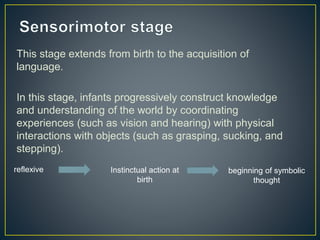
This stage extends from birth to the acquisition of
language.
In this stage, infants progressively construct knowledge
and understanding of the world by coordinating
experiences (such as vision and hearing) with physical
interactions with objects (such as grasping, sucking, and
stepping).
reflexive Instinctual action at
birth
beginning of symbolic
thought
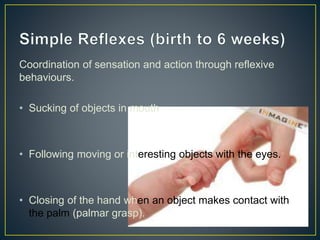
Coordination of sensation and action through reflexive
behaviours.
• Sucking of objects in mouth
• Following moving or interesting objects with the eyes.
• Closing of the hand when an object makes contact with
the palm (palmar grasp).
Coordination of sensation and two types of schema: habits
(reflex) and primary circular reactions (reproduction of an
event that initially occurred by chance).
At this phase, passive reactions, caused by classical or
operant conditioning, can begin.
Development of habits. Infants become more object-
oriented, moving beyond self-preoccupation; repeat actions
that bring interesting or pleasurable results. (vision and
prehension)
Intentional grasping for a desired object.
Repetition of an act involving external objects.
Differentiation between means and ends.
Coordination of vision and touch – hand-eye coordination;
coordination of schemas and intentionality.
Development of logic
First proper intelligence
Goal orientation
Infants become intrigued by the many properties of objects
and by the many things they can make happen to objects;
they experiment with new behaviour.
Discovery of new means to meet goals.
Infants develop the ability to use primitive symbols and
form enduring mental representations.
Beginning of insight, or true creativity.
By the end of the sensorimotor period, the child sees
objects as both separate from the self, and permanent.
This stage starts when the child begins to learn to speak at
age two and lasts up until the age of seven.
Symbolic
function
substage
Intuitive
thought
substage
Symbolic play Egocentrism
Cannot
understand
concrete logic
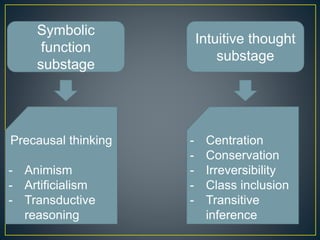
Symbolic
function
substage
Precausal thinking
- Animism
- Artificialism
- Transductive
reasoning
Intuitive thought
substage
- Centration
- Conservation
- Irreversibility
- Class inclusion
- Transitive
inference
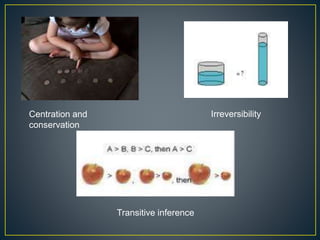
Centration and
conservation
Irreversibility
Transitive inference
This stage occurs between the ages of seven to eleven
years, and is characterized by the appropriate use of logic.
• Ability to distinguish between their own thoughts and the
thoughts of others.
• Increased classification skills.
• Ability to think logically about objects and events.
• Ability to fluently perform mathematical problems in both
addition and subtraction.
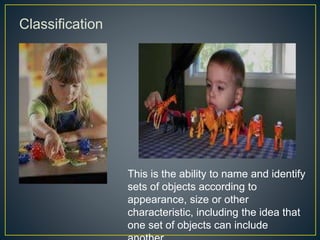
Classification
This is the ability to name and identify
sets of objects according to
appearance, size or other
characteristic, including the idea that
one set of objects can include
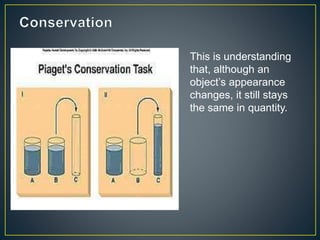
This is understanding
that, although an
object’s appearance
changes, it still stays
the same in quantity.
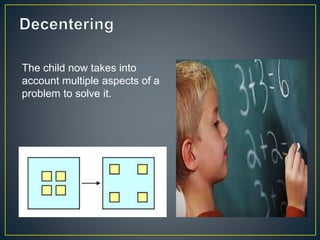
The child now takes into
account multiple aspects of a
problem to solve it.
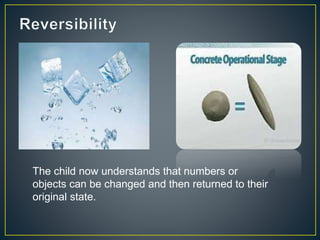
The child now understands that numbers or
objects can be changed and then returned to their
original state.
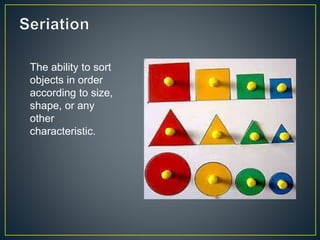
The ability to sort
objects in order
according to size,
shape, or any
other
characteristic.
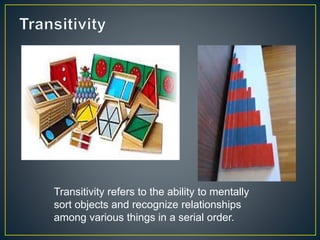
Transitivity refers to the ability to mentally
sort objects and recognize relationships
among various things in a serial order.
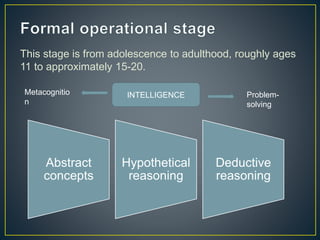
This stage is from adolescence to adulthood, roughly ages
11 to approximately 15-20.
INTELLIGENCE
Abstract
concepts
Hypothetical
reasoning
Deductive
reasoning
Metacognitio
n
Problem-
solving
Piaget believed in two basic principles relating to moral
education:
• Children develop moral ideas in stages
• Children create their conceptions of the world
• It is concerned with children, rather than all learners.
• It focuses on development, rather than learning per se,
so it does not address learning of information or specific
behaviors.
• Teachers can use Piaget’s theory when discussing
whether the syllabus subjects are suitable for the level of
students or not.
• Teachers can adopt appropriate academic expectations
with regard to children’s cognitive developmental abilities.
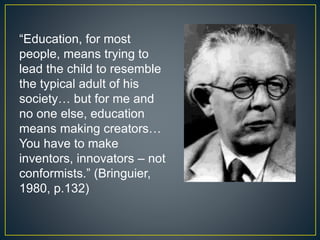
“Education, for most
people, means trying to
lead the child to resemble
the typical adult of his
society… but for me and
no one else, education
means making creators…
You have to make
inventors, innovators – not
conformists.” (Bringuier,
1980, p.132)

Jean piaget

  • 1.
  • 2.
    “Knowledge is theability to modify, transform, and operate on an object, or idea, such that it is understood by the operator through the process of transformation.” Jean Piaget (1896-1980)
  • 3.
    Piaget’s theory ofcognitive development is about the nature and development of human intelligence. Biological maturation Environment al experiences Cognitive Development
  • 4.
    • Schemas (buildingblocks of knowledge) • Adaptation processes that enable the transition from one stage to another (equilibrium, assimilation, accommodation). • Stages of development • Sensorimotor • Preoperational • Concrete operational • Formal operational
  • 5.
    Intelligenc e OPERATIVE FIGURATIVE Representation and manipulation of transformational aspects ofreality Representation of the static aspects of reality Nature of intelligence
  • 6.
    Piaget viewed intellectualgrowth as a process of adaptation (adjustment) to the world. This happens through: Assimilation Using an existing schema to deal with a new object/situation Accommodati on When the existing schema does not work, and needs to be changed to deal with new object/situation Equilibration New Situation Disequilibrium
  • 7.
    An illustration ofschema, assimilation, and accommodation. (e.g. teaching children geometric figures)
  • 8.
    According to Piaget,assimilation and accommodation require an active learner, not a passive one, because problem-solving skills cannot be taught, they must be discovered. Teachers should facilitate learning and encourage the following within the classroom: • Focus on the process of learning, rather than the end product of it. • Using active methods that require rediscovering or reconstructing “truths”.
  • 9.
    • Using collaborative,as well as individual activities. • Devising situations that present useful problems, and create disequilibrium in the child. • Evaluate the level of the child’s development, so suitable tasks can be set.
  • 11.
    This stage extendsfrom birth to the acquisition of language. In this stage, infants progressively construct knowledge and understanding of the world by coordinating experiences (such as vision and hearing) with physical interactions with objects (such as grasping, sucking, and stepping). reflexive Instinctual action at birth beginning of symbolic thought
  • 12.
    Coordination of sensationand action through reflexive behaviours. • Sucking of objects in mouth • Following moving or interesting objects with the eyes. • Closing of the hand when an object makes contact with the palm (palmar grasp).
  • 13.
    Coordination of sensationand two types of schema: habits (reflex) and primary circular reactions (reproduction of an event that initially occurred by chance). At this phase, passive reactions, caused by classical or operant conditioning, can begin.
  • 14.
    Development of habits.Infants become more object- oriented, moving beyond self-preoccupation; repeat actions that bring interesting or pleasurable results. (vision and prehension) Intentional grasping for a desired object. Repetition of an act involving external objects. Differentiation between means and ends.
  • 15.
    Coordination of visionand touch – hand-eye coordination; coordination of schemas and intentionality. Development of logic First proper intelligence Goal orientation
  • 16.
    Infants become intriguedby the many properties of objects and by the many things they can make happen to objects; they experiment with new behaviour. Discovery of new means to meet goals.
  • 17.
    Infants develop theability to use primitive symbols and form enduring mental representations. Beginning of insight, or true creativity. By the end of the sensorimotor period, the child sees objects as both separate from the self, and permanent.
  • 18.
    This stage startswhen the child begins to learn to speak at age two and lasts up until the age of seven. Symbolic function substage Intuitive thought substage Symbolic play Egocentrism Cannot understand concrete logic
  • 19.
    Symbolic function substage Precausal thinking - Animism -Artificialism - Transductive reasoning Intuitive thought substage - Centration - Conservation - Irreversibility - Class inclusion - Transitive inference
  • 20.
  • 21.
    This stage occursbetween the ages of seven to eleven years, and is characterized by the appropriate use of logic. • Ability to distinguish between their own thoughts and the thoughts of others. • Increased classification skills. • Ability to think logically about objects and events. • Ability to fluently perform mathematical problems in both addition and subtraction.
  • 22.
    Classification This is theability to name and identify sets of objects according to appearance, size or other characteristic, including the idea that one set of objects can include
  • 23.
    This is understanding that,although an object’s appearance changes, it still stays the same in quantity.
  • 24.
    The child nowtakes into account multiple aspects of a problem to solve it.
  • 25.
    The child nowunderstands that numbers or objects can be changed and then returned to their original state.
  • 26.
    The ability tosort objects in order according to size, shape, or any other characteristic.
  • 27.
    Transitivity refers tothe ability to mentally sort objects and recognize relationships among various things in a serial order.
  • 28.
    This stage isfrom adolescence to adulthood, roughly ages 11 to approximately 15-20. INTELLIGENCE Abstract concepts Hypothetical reasoning Deductive reasoning Metacognitio n Problem- solving
  • 29.
    Piaget believed intwo basic principles relating to moral education: • Children develop moral ideas in stages • Children create their conceptions of the world
  • 30.
    • It isconcerned with children, rather than all learners. • It focuses on development, rather than learning per se, so it does not address learning of information or specific behaviors.
  • 31.
    • Teachers canuse Piaget’s theory when discussing whether the syllabus subjects are suitable for the level of students or not. • Teachers can adopt appropriate academic expectations with regard to children’s cognitive developmental abilities.
  • 32.
    “Education, for most people,means trying to lead the child to resemble the typical adult of his society… but for me and no one else, education means making creators… You have to make inventors, innovators – not conformists.” (Bringuier, 1980, p.132)