1


COGNITIVE BEHAVIOR
MODIFICATION-
BY DONALD MEICHENBAUM   MRS. ANUJA   10/04/12
                        DESHPANDE
2

                              MRS. ANUJA CHAVAN   10/04/12


PRINCIPLES OF COGNITIVE THERAPY
It is based on the cognitive model of emotional
 disorders.
It is brief and time-limited.
A sound therapeutic relationship is necessary
 condition for effective CT.
Therapy is collaborative effort between therapist
 and patient.
It uses primarily the Socratic Method.
3

                              MRS. ANUJA CHAVAN   10/04/12


CONTD:-
 It is structured & directive.
 It is problem oriented.
 It is based on an educational model.
 The theory & techniques of CT rely on the
  inductive method.
 Homework is a central feature of cognitive
  therapy.
4

                  MRS. ANUJA CHAVAN   10/04/12


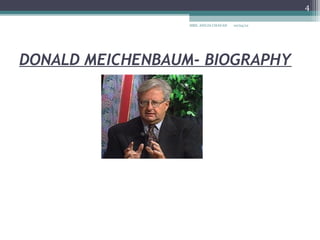
DONALD MEICHENBAUM- BIOGRAPHY
5

                               MRS. ANUJA CHAVAN   10/04/12


BIOGRAPHY:
Born in 1940 in New York city and completed his
 early education there.
In 1962 completed B.A from City College.
Completed M.A in 1963 from University of Illinois.
In 1965,obtained Ph.d in Clonical Psychology.
1966- appointed as Asst,Professor at Waterloo
 University.
Associate Professor in 1970
In 1977- published CBM
1988- retired.
6

                             MRS. ANUJA CHAVAN   10/04/12


Basic Premise:

Understand Thoughts, Feelings and Behavior
 and their impact on others.
It focuses on creating more awareness on self-
 talk.( Self-Instructional Therapy).
Shares the same assumption as REBT & CBT.
7

                             MRS. ANUJA CHAVAN   10/04/12


ASSUMPTIONS &CONCEPTS
SELF-INSTRUCTIONAL TRAINING is based on
 assumption that the things people say to
 themselves determine the rest of things they do.
Behavior is influenced by following constructs:
   1.physiological responses.
   2.Affective Reactions.
    3.Cognitions.
    4.Interpersonal Interactions
8

                              MRS. ANUJA CHAVAN   10/04/12


FUNCTIONS OF INTERNAL DIALOGUE:
 Interpersonal instructions
Cognitive factors in stress.
Instructional set &physiological effects.
9

                  MRS. ANUJA CHAVAN   10/04/12


Assumptions of CBM:
10

                              MRS. ANUJA CHAVAN   10/04/12


PROCESS
• The client must recognize / become aware of
  his/her inadequate behavior,
• The awareness is a cue that produces a certain
  internal dialogue.
• There is change in the nature of internal
  dialogue from that which client engaged in prior
  to therapy.
11

          MRS. ANUJA CHAVAN   10/04/12


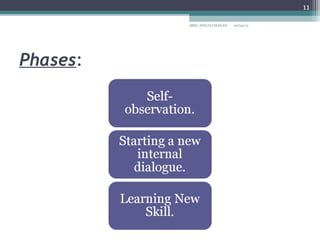
Phases:
12

                              MRS. ANUJA CHAVAN   10/04/12


Coping Skills Program:

• Exposing client to situation by imagery & role
  playing.
• Evaluate
• Teach .
• Helping.
• Re-evaluation.

Success has been seen in anxiety, phobias, anger,
 addiction, social-incompetence, social
 withdrawn.
13

                               MRS. ANUJA CHAVAN   10/04/12


STRESS INNOCULATION
TRAINING:
• Extension of coping skill prgm.
• Modifying thoughts in stressful situations.
• Prepare to deal with stress and prevent relapse.
• Combination of intervention strategies of
  cognitive & behavioral.
• Can be applied to present problems & future
  difficulties.
• Sessions are 12-15.
14

                       MRS. ANUJA CHAVAN   10/04/12


PHASES OF SIT:
• CONCEPTUALIZE/EDICATIONAL PHASE.
• SKILL ACQUISTION & REHEARSAL PHASE.
• APPLICATION & FOLLOW-THROUGH

__________________________________

Cognitive behavior modification

  • 1.
    1 COGNITIVE BEHAVIOR MODIFICATION- BY DONALDMEICHENBAUM MRS. ANUJA 10/04/12 DESHPANDE
  • 2.
    2 MRS. ANUJA CHAVAN 10/04/12 PRINCIPLES OF COGNITIVE THERAPY It is based on the cognitive model of emotional disorders. It is brief and time-limited. A sound therapeutic relationship is necessary condition for effective CT. Therapy is collaborative effort between therapist and patient. It uses primarily the Socratic Method.
  • 3.
    3 MRS. ANUJA CHAVAN 10/04/12 CONTD:- It is structured & directive. It is problem oriented. It is based on an educational model. The theory & techniques of CT rely on the inductive method. Homework is a central feature of cognitive therapy.
  • 4.
    4 MRS. ANUJA CHAVAN 10/04/12 DONALD MEICHENBAUM- BIOGRAPHY
  • 5.
    5 MRS. ANUJA CHAVAN 10/04/12 BIOGRAPHY: Born in 1940 in New York city and completed his early education there. In 1962 completed B.A from City College. Completed M.A in 1963 from University of Illinois. In 1965,obtained Ph.d in Clonical Psychology. 1966- appointed as Asst,Professor at Waterloo University. Associate Professor in 1970 In 1977- published CBM 1988- retired.
  • 6.
    6 MRS. ANUJA CHAVAN 10/04/12 Basic Premise: Understand Thoughts, Feelings and Behavior and their impact on others. It focuses on creating more awareness on self- talk.( Self-Instructional Therapy). Shares the same assumption as REBT & CBT.
  • 7.
    7 MRS. ANUJA CHAVAN 10/04/12 ASSUMPTIONS &CONCEPTS SELF-INSTRUCTIONAL TRAINING is based on assumption that the things people say to themselves determine the rest of things they do. Behavior is influenced by following constructs: 1.physiological responses. 2.Affective Reactions. 3.Cognitions. 4.Interpersonal Interactions
  • 8.
    8 MRS. ANUJA CHAVAN 10/04/12 FUNCTIONS OF INTERNAL DIALOGUE:  Interpersonal instructions Cognitive factors in stress. Instructional set &physiological effects.
  • 9.
    9 MRS. ANUJA CHAVAN 10/04/12 Assumptions of CBM:
  • 10.
    10 MRS. ANUJA CHAVAN 10/04/12 PROCESS • The client must recognize / become aware of his/her inadequate behavior, • The awareness is a cue that produces a certain internal dialogue. • There is change in the nature of internal dialogue from that which client engaged in prior to therapy.
  • 11.
    11 MRS. ANUJA CHAVAN 10/04/12 Phases:
  • 12.
    12 MRS. ANUJA CHAVAN 10/04/12 Coping Skills Program: • Exposing client to situation by imagery & role playing. • Evaluate • Teach . • Helping. • Re-evaluation. Success has been seen in anxiety, phobias, anger, addiction, social-incompetence, social withdrawn.
  • 13.
    13 MRS. ANUJA CHAVAN 10/04/12 STRESS INNOCULATION TRAINING: • Extension of coping skill prgm. • Modifying thoughts in stressful situations. • Prepare to deal with stress and prevent relapse. • Combination of intervention strategies of cognitive & behavioral. • Can be applied to present problems & future difficulties. • Sessions are 12-15.
  • 14.
    14 MRS. ANUJA CHAVAN 10/04/12 PHASES OF SIT: • CONCEPTUALIZE/EDICATIONAL PHASE. • SKILL ACQUISTION & REHEARSAL PHASE. • APPLICATION & FOLLOW-THROUGH __________________________________