




COGNITIVE BEHAVIORAL THERAPY
What is Cognition? Cognition is the scientific term for "the process of thought".
“ Big” Names associated with Cognitive Behavioral Therapy Epictetus, Greek philosopher.  Observed that people are not disturbed by things that happen but by the  view  they take of things that happen. Albert Ellis, Ph.D. “grandfather of cognitive behavioral therapy.”
COGNITIVE MODEL OF DEPRESSION  
 
Definitons of Terms Psychotherapy  - set of clinical techniques use to improve mental health. Cognitive Therapy  - psychotherapy aimed at changing way of thinking.
Characteristics of  Cognitive-Behavioral Therapies: CBT is based on changing the thoughts and feelings of people internally rather than depending on external surroundings, like people, events or circumstances. CBT is considered as on of the fastest forms of therapies meant for treating mental disorders. A positive relationship is essential between therapist and client for the effectiveness of CBT. The efforts are collaborative.
CBT is a collaborative effort between the therapist and the client. Client role - define goals, express concerns,  learn & implement learning Therapist role - help client define goals, listen, teach, encourage.  CBT is a structured and directive approach towards treatment. CBT theory is based on model of induction: The inductive method is adopted to encourage people to distinguish myths and assumptions from reality and practicalities of life. This helps the individual to accept the real and discard the unreal negative thoughts which pull him down.
Homework for clients: The clients are asked to implement the skills and techniques which are taught to them during the therapy sessions. Without practicing them the client cannot overcome his/her problem.
GOALS To monitor his or her own automatic thoughts. To recognize the connection between cognition, behavior and affect. To examine evidence for and against distorted automatic thoughts. To substitute more realistic interpretations for these biased cognitions. To assist the client in identify and alter the dysfunctional beliefs that causes distorted behavior.
PRINCIPLES   Cognitive Therapy is a highly structured and short term lasting from 12 to 16 weeks. The principles of CBT are given by Beck 1995, are as follows. Cognitive Therapy is based on ever evolving formulation of the client and his or her problems in cognitive terms. CT requires a sound therapeutic alliance.
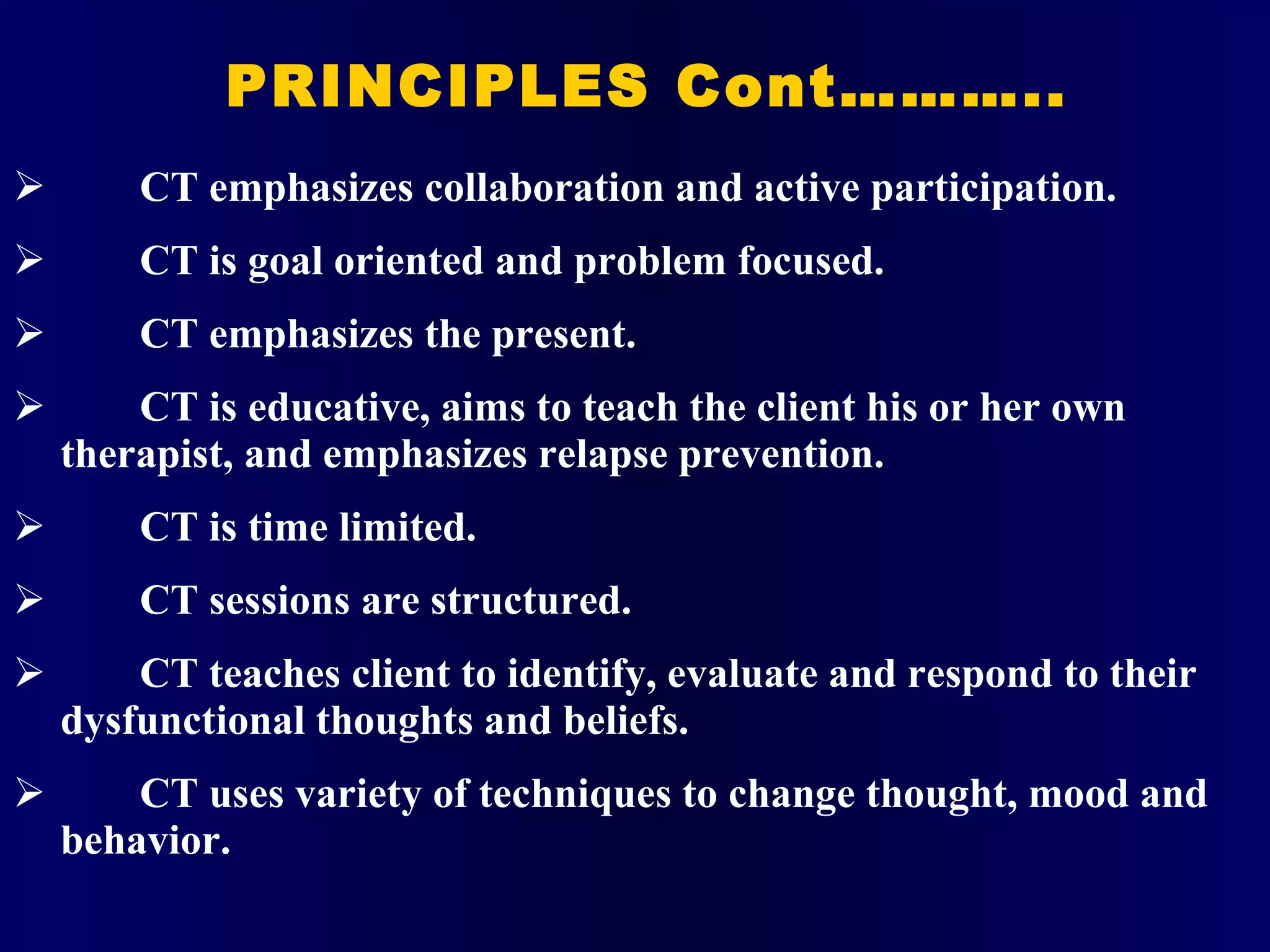
PRINCIPLES Cont……….. CT emphasizes collaboration and active participation. CT is goal oriented and problem focused. CT emphasizes the present. CT is educative, aims to teach the client his or her own therapist, and emphasizes relapse prevention. CT is time limited. CT sessions are structured. CT teaches client to identify, evaluate and respond to their dysfunctional thoughts and beliefs. CT uses variety of techniques to change thought, mood and behavior.
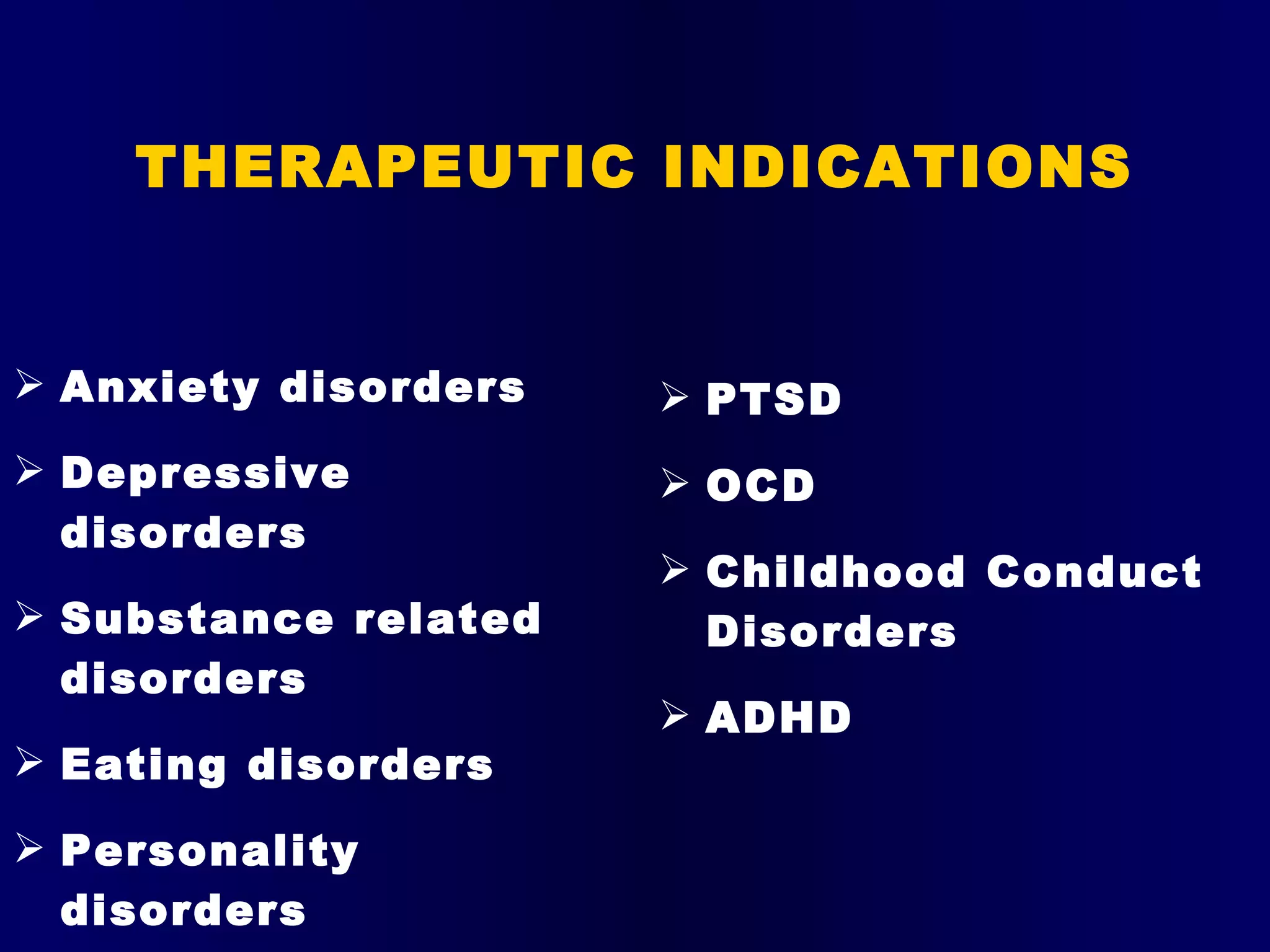
THERAPEUTIC INDICATIONS Anxiety disorders Depressive disorders Substance related disorders Eating disorders Personality disorders Panic disorders PTSD OCD Childhood Conduct Disorders ADHD
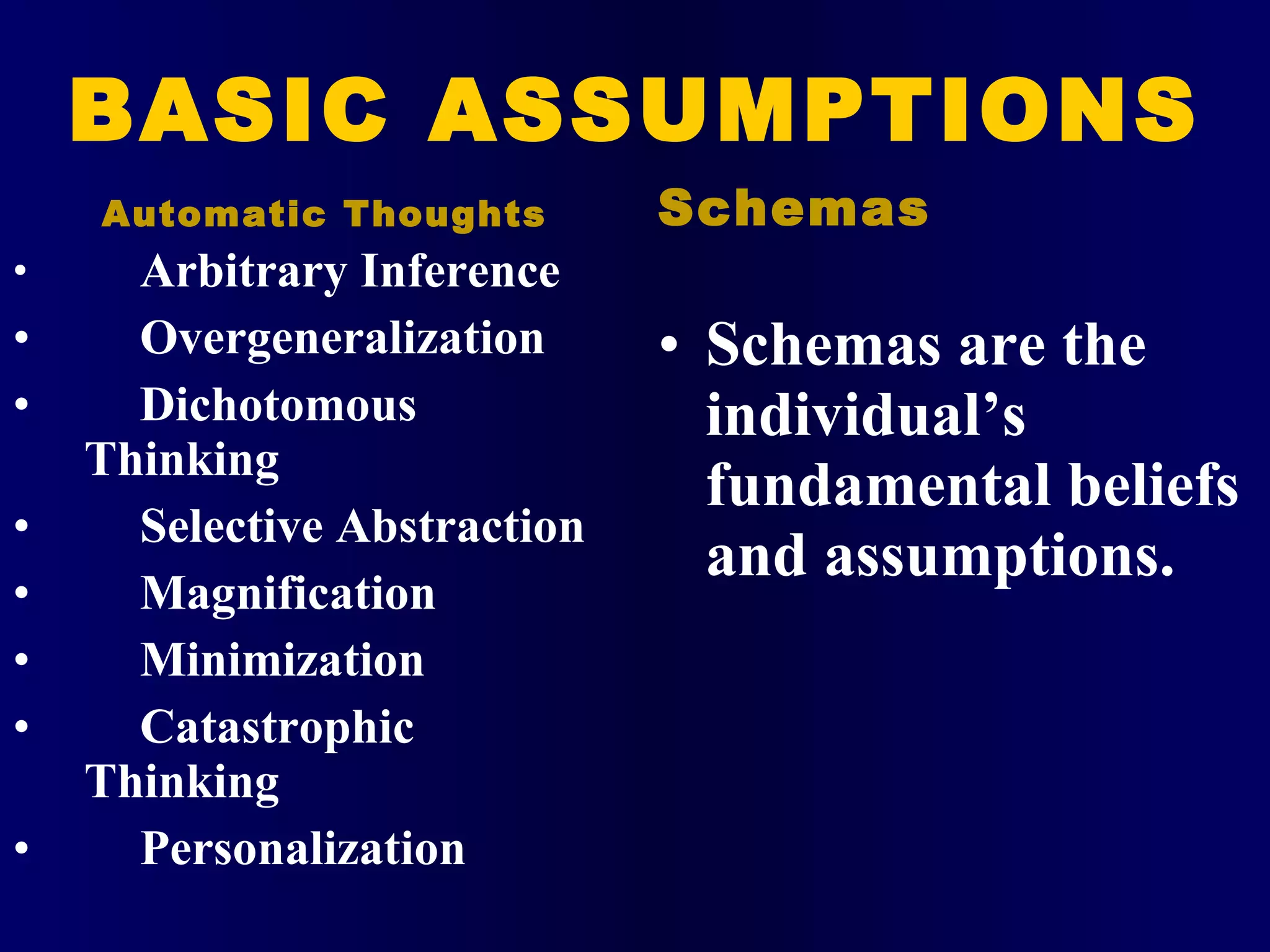
BASIC ASSUMPTIONS Arbitrary Inference Overgeneralization Dichotomous Thinking Selective Abstraction Magnification Minimization Catastrophic Thinking Personalization Schemas Schemas are the individual’s fundamental beliefs and assumptions. Automatic Thoughts
AUTOMATIC THOUGHTS Automatic thoughts are those that occurs rapidly in response to a situation and without rational analysis. These thoughts are often negative and has no logic.
Arbitrary Inference This is a type of thinking error, the individual comes to a conclusion about an incident without the facts to support it.
Over Generalization Sweeping Conclusions are known as over generalization.
Dichotomous Thinking Individual views situation in terms of all – or – nothing, Black or White, and Good or Bad.
Selective Abstraction It is also referred to as “ mental filter ”. It is a conclusion made by considering only a selected portions of evidence.
Magnification Exaggerating the negative significance of an event.
Minimization Undervaluing the positive significance of an event.
Catastrophic Thinking Always thinking that worst will happen without considering the possibility of more likely positive outcomes.
Personalization The person takes complete responsibility for situations with out considering that other circumstances may have contributed to the outcome.
CBT TECHNIQUES Cognitive Rehearsal Validity Testing Writing in a Journal Guided Imagery Modeling Home Work Aversive Conditioning Systematic Positive Reinforcement
Cognitive Rehearsal In this technique, the patient is asked to recall a problematic situation of the past. The therapist and patient work together to find out the solution to the problem or a way in which the different situation if occurs in the future may be sorted out.
Validity Testing Therapist tests the validity of beliefs or thoughts of the patients.
Writing in a Journal It is the practice of maintaining a diary to keep an account of the situations that arise in day – to – day life. The therapist along with the patient reviews the diary/journal and finds out the maladaptive thought pattern and how they actually affect the behavior of an individual.
Guided Discovery The objective/purpose behind using this technique is to help the patient and enable him understand his cognitive distortions.
Modeling Therapists performs role – playing exercises, which are aimed at responding in an appropriate way to overcome difficult situations. The patient makes use of this behavior of the therapist as a model to solve the problem he comes across.
Home Work This is actually a set of assignments given by therapists to patients. The patient may have to take notes while a session is being conducted.
Aversive Conditioning The patient while being engaged in a particular behavior or thought for which he has to be treated, is exposed to an unpleasant stimulus.
Systematic Positive Reinforcement Here certain positive behaviors of a patient are rewarded with a positive reinforcement. Just like positive reinforcement helps in encouraging a particular behavior, withholding the reinforcement deliberately is useful in eradicating a maladaptive behavior.
CBT effective for use with   ● Self / Personal Growth ● Individual Clients ● Groups ● Marriage / relationships ● Family ● Workplace ● Varying Intellectual ability/learning impairments   CAUTION :  Cognitive therapies do not appear to work as well with those who are cognitively impaired.

Cbt

  • 1.
  • 2.
    What is Cognition?Cognition is the scientific term for "the process of thought".
  • 3.
    “ Big” Namesassociated with Cognitive Behavioral Therapy Epictetus, Greek philosopher. Observed that people are not disturbed by things that happen but by the view they take of things that happen. Albert Ellis, Ph.D. “grandfather of cognitive behavioral therapy.”
  • 4.
    COGNITIVE MODEL OFDEPRESSION  
  • 5.
  • 6.
    Definitons of TermsPsychotherapy - set of clinical techniques use to improve mental health. Cognitive Therapy - psychotherapy aimed at changing way of thinking.
  • 7.
    Characteristics of Cognitive-Behavioral Therapies: CBT is based on changing the thoughts and feelings of people internally rather than depending on external surroundings, like people, events or circumstances. CBT is considered as on of the fastest forms of therapies meant for treating mental disorders. A positive relationship is essential between therapist and client for the effectiveness of CBT. The efforts are collaborative.
  • 8.
    CBT is acollaborative effort between the therapist and the client. Client role - define goals, express concerns, learn & implement learning Therapist role - help client define goals, listen, teach, encourage. CBT is a structured and directive approach towards treatment. CBT theory is based on model of induction: The inductive method is adopted to encourage people to distinguish myths and assumptions from reality and practicalities of life. This helps the individual to accept the real and discard the unreal negative thoughts which pull him down.
  • 9.
    Homework for clients:The clients are asked to implement the skills and techniques which are taught to them during the therapy sessions. Without practicing them the client cannot overcome his/her problem.
  • 10.
    GOALS To monitorhis or her own automatic thoughts. To recognize the connection between cognition, behavior and affect. To examine evidence for and against distorted automatic thoughts. To substitute more realistic interpretations for these biased cognitions. To assist the client in identify and alter the dysfunctional beliefs that causes distorted behavior.
  • 11.
    PRINCIPLES Cognitive Therapy is a highly structured and short term lasting from 12 to 16 weeks. The principles of CBT are given by Beck 1995, are as follows. Cognitive Therapy is based on ever evolving formulation of the client and his or her problems in cognitive terms. CT requires a sound therapeutic alliance.
  • 12.
    PRINCIPLES Cont……….. CTemphasizes collaboration and active participation. CT is goal oriented and problem focused. CT emphasizes the present. CT is educative, aims to teach the client his or her own therapist, and emphasizes relapse prevention. CT is time limited. CT sessions are structured. CT teaches client to identify, evaluate and respond to their dysfunctional thoughts and beliefs. CT uses variety of techniques to change thought, mood and behavior.
  • 13.
    THERAPEUTIC INDICATIONS Anxietydisorders Depressive disorders Substance related disorders Eating disorders Personality disorders Panic disorders PTSD OCD Childhood Conduct Disorders ADHD
  • 14.
    BASIC ASSUMPTIONS ArbitraryInference Overgeneralization Dichotomous Thinking Selective Abstraction Magnification Minimization Catastrophic Thinking Personalization Schemas Schemas are the individual’s fundamental beliefs and assumptions. Automatic Thoughts
  • 15.
    AUTOMATIC THOUGHTS Automaticthoughts are those that occurs rapidly in response to a situation and without rational analysis. These thoughts are often negative and has no logic.
  • 16.
    Arbitrary Inference Thisis a type of thinking error, the individual comes to a conclusion about an incident without the facts to support it.
  • 17.
    Over Generalization SweepingConclusions are known as over generalization.
  • 18.
    Dichotomous Thinking Individualviews situation in terms of all – or – nothing, Black or White, and Good or Bad.
  • 19.
    Selective Abstraction Itis also referred to as “ mental filter ”. It is a conclusion made by considering only a selected portions of evidence.
  • 20.
    Magnification Exaggerating thenegative significance of an event.
  • 21.
    Minimization Undervaluing thepositive significance of an event.
  • 22.
    Catastrophic Thinking Alwaysthinking that worst will happen without considering the possibility of more likely positive outcomes.
  • 23.
    Personalization The persontakes complete responsibility for situations with out considering that other circumstances may have contributed to the outcome.
  • 24.
    CBT TECHNIQUES CognitiveRehearsal Validity Testing Writing in a Journal Guided Imagery Modeling Home Work Aversive Conditioning Systematic Positive Reinforcement
  • 25.
    Cognitive Rehearsal Inthis technique, the patient is asked to recall a problematic situation of the past. The therapist and patient work together to find out the solution to the problem or a way in which the different situation if occurs in the future may be sorted out.
  • 26.
    Validity Testing Therapisttests the validity of beliefs or thoughts of the patients.
  • 27.
    Writing in aJournal It is the practice of maintaining a diary to keep an account of the situations that arise in day – to – day life. The therapist along with the patient reviews the diary/journal and finds out the maladaptive thought pattern and how they actually affect the behavior of an individual.
  • 28.
    Guided Discovery Theobjective/purpose behind using this technique is to help the patient and enable him understand his cognitive distortions.
  • 29.
    Modeling Therapists performsrole – playing exercises, which are aimed at responding in an appropriate way to overcome difficult situations. The patient makes use of this behavior of the therapist as a model to solve the problem he comes across.
  • 30.
    Home Work Thisis actually a set of assignments given by therapists to patients. The patient may have to take notes while a session is being conducted.
  • 31.
    Aversive Conditioning Thepatient while being engaged in a particular behavior or thought for which he has to be treated, is exposed to an unpleasant stimulus.
  • 32.
    Systematic Positive ReinforcementHere certain positive behaviors of a patient are rewarded with a positive reinforcement. Just like positive reinforcement helps in encouraging a particular behavior, withholding the reinforcement deliberately is useful in eradicating a maladaptive behavior.
  • 33.
    CBT effective foruse with   ● Self / Personal Growth ● Individual Clients ● Groups ● Marriage / relationships ● Family ● Workplace ● Varying Intellectual ability/learning impairments   CAUTION : Cognitive therapies do not appear to work as well with those who are cognitively impaired.