
Donald Meichenbaum
By Andy Crosier, Jenny Underwood & Julia Chapman
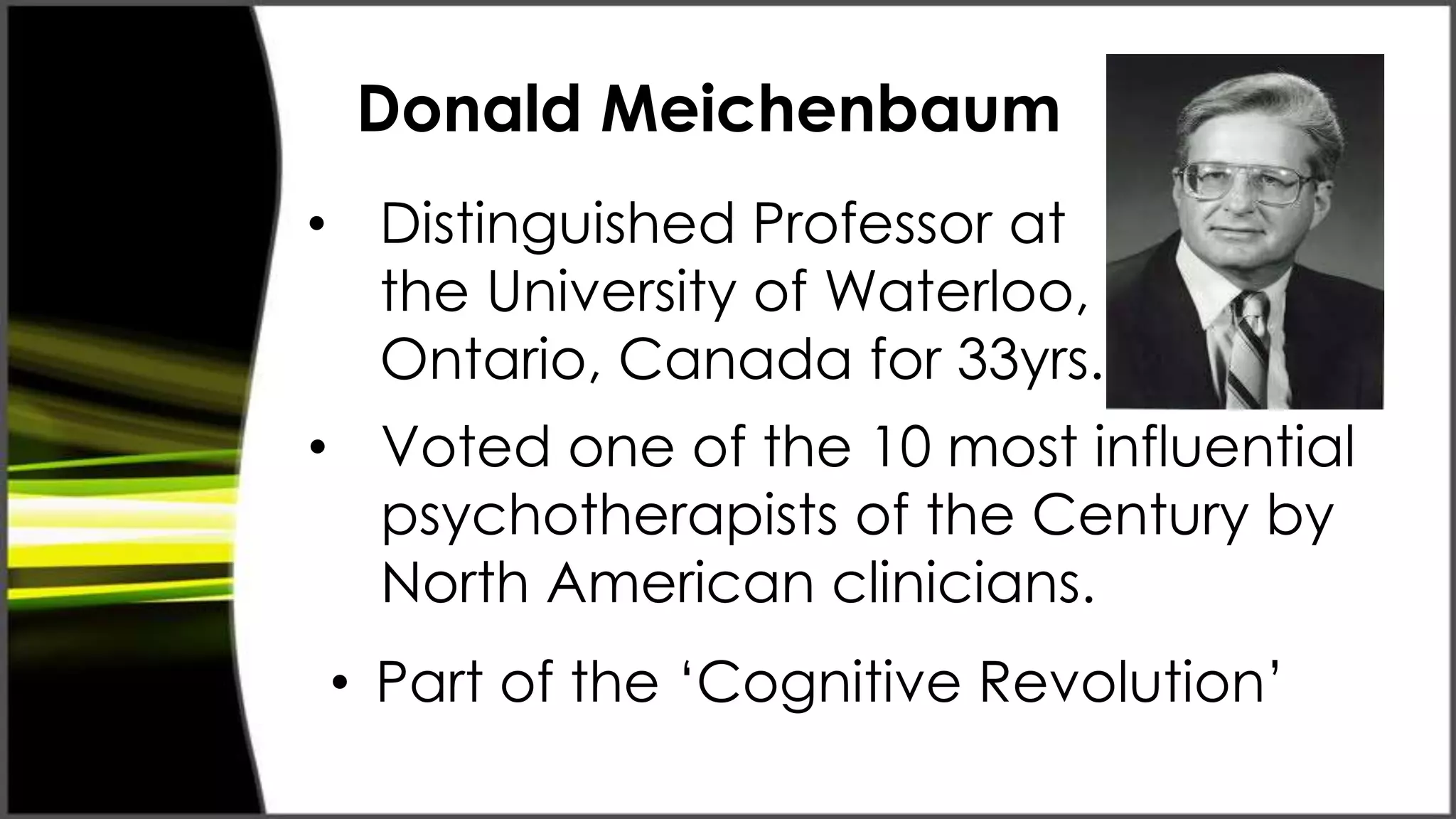
Donald Meichenbaum
• Distinguished Professor at
  the University of Waterloo,
  Ontario, Canada for 33yrs.
• Voted one of the 10 most influential
  psychotherapists of the Century by
  North American clinicians.
• Part of the „Cognitive Revolution‟
Donald Meichenbaum
• Founder of Cognitive-Behavioral Modification
• In 1977 he published Cognitive-behavior
  Modification: An Integrative Approach.
• As an expert in the treatment of PTSD, as a
  clinician and researcher, he has treated all
  age groups for traumas suffered from
  violence, abuse, accidents, and illness
Cognitive Behavioral Modification

A technique which puts patients in
charge of their own psychotherapy by
modifying what they say to themselves -
their so-called 'inner dialogue'
Cognitive Behavioral Modification
According to Meichenbaum (1980),
the premise of CBM is that individuals
must develop the ability to notice (a)
how they feel, think, and behave and
(b) the impact their behavior has on
others as a prerequisite to behavior
change.
Cognitive Behavioral Modification

• In Cognitive Therapy a therapist teaches a
  client to question his or her inferences but
  in CBM the therapist teaches a client to
  change them.
• CBM is less direct then REBT and utilises „self
  instructional training‟ to help the client
  become more self aware of their self talk.
Self-Instructional Training
• Meichenbaum believed that
  learning to control behavior begins
  in childhood, based on parental
  instruction
• This helped him create the idea of
  „Self-Instructional Training‟(SIT), which
  remains today as a major part of self-
  control strategies.
Self-Instructional Training
Meichenbaum 's SIT was originally developed to help impulsive
children:
1. Adult performs the task while speaking to the child (cognitive
   modelling)
2. Child performs the task with adult supervision (external guidance)
3. Child performs on his/her own while verbalizing the directions out
   load
4. Child performs on his/her own while whispering to his/her self (self-
   guidance)
5. Child uses inside voice while performing the task (self-instruction)
Self-Instructional Training

In a therapy setting Self-instructional training is
a cognitive technique which aims to give
clients control over their behavior through
guided self talk that gradually becomes
covert and self generated.
Self-Instructional Training
3 phases of behavior change:
•   self-observation
•   starting a new internal dialogue
•   learning new skills
SIT in therapy
• The client identifies the internal feelings and the
  negative self-statements that are produced by a
  stressful situation.
• The client uses this a cue to initiate self-instruction
• A therapist rehearses with the client self-talk to
  counteract the negative self statements.
• The client is then taught to self-instruct a range of
  coping skills that help to alleviate the stress-
  (breathing, relaxation techniques, imagery etc)
• Finally the client is instructed to make self
  reinforcing statements- (“I‟m doing it”)
Cognitive Behavioral Modification
• CBM emphasises modifying thinking as a
  means of changing feelings and behavior
• Combines cognitive and behavioral
  learning principles to shape and
  encourage desired behaviors
• CBM in essence: You are what you think!
Cognitive Behavioral Modification
According to Kaplan and Carter (1995), five characteristics distinguish
cognitive behavior modification from other types of behavior
management systems:
• Participants themselves rather than external agents are the primary
  change agents.
• Verbalization is on an overt level, then a self-monitor level, and
  then a covert level.
• Participants are taught to identify and use a series of problem-
  solving steps.
• Modelling is used for instructional purposes.
• Cognitive behavior modification facilitates self-control.
Stress Inoculation Training

Stress Inoculation Training is a form of CBM.

It is based on the assumption that knowledge alone is often not
sufficient in helping people to deal with stressful situations. Stress
inoculation training can be used to teach a variety of physical
and cognitive coping skills that will increase an individual‟s ability
to function under pressure, and „inoculate‟ them against future
stressors.
Stress Inoculation Training
• Helpful for a wide range of issues –
        Managing anxiety reactions
        Coping with physiological pain
        Phobias
        Anger management
• Used as a treatment to help people deal with the
  aftermath of traumatic events
• Used as a preventative measure, to equip people
  for the future
Stress inoculation – 3 phases


1. The conceptual stage

2. The skills acquisition and rehearsal phase

3. Application and follow through
Stress inoculation training
    Phase 1 - Conceptualisation
•    Collaborative therapeutic relationship is established in which the
     client and therapist get an overview of the client‟s issues

•    Client is taught the nature and impact of stress, e.g. the fight or
     flight response, and the vicious circle that they may have
     unknowingly entered in to

•    Client learns to identify their helpful/unhelpful responses to stressors.
     These could be any self-defeating behaviours or internal dialogue
Stress inoculation training
Phase 2 - Acquisition of skills and rehearsal

•   Skills are tailored to specific stressors, e.g. work pressure,
    physical pain, relationship problems, military combat,
    surgery etc

•   Practical coping skills are taught in the clinic or training
    setting at first, and are then rehearsed gradually using
    role-play and modelling with support and guidance from
    the therapist
Coping skills include:

•   Self-instructional training
•   Self-soothing and relaxation techniques
•   Cognitive restructuring
•   Problem-solving
•   Emotional self-regulation
•   Attention diversion procedures
•   Training in interpersonal communication skills
•   Using support systems
•   Doing activities that are meaningful to the
    individual
Stress inoculation training
Phase 3 -       Application and follow through

• Client practises using their new coping skills in increasingly
  stressful situations
• Clients do experiments in the form of graded exposure,
  which reinforce their ability to cope
• Client implements relapse prevention measures, e.g.
  identifying warning signs and ways to cope with lapses
• Booster sessions
Disorders Treated by CBM
• Aggression        • Bipolar depression

• Anxiety           • Borderline personality

• Panic disorders   • Depression

• Substance abuse   • Limited self-control

• Schizophrenia     • Eating Disorders
Treatment of Eating Disorders
• CBM is at the root of treatment for anorexia and other eating
  disorders.
• These behaviour modification techniques were first developed by
  Donald Meichenbaum.
• Through behaviour modification techniques, therapists are able to
  help change attitudes about ideal body shape and weight,
  replace unhealthy eating habits with normalized eating patterns,
  and teach patients how they can resist the urge to binge and
  purge.
• Many eating disorder patients also experience anxiety and
  depression and a combination of behaviour therapy and cognitive
  therapy is also commonly used in the treatment of anxiety disorders
  so treatment by way of these techniques becomes even more
  powerful.
Advantages of CBM

•   Cognitive behavior modification can be performed
    individually or in group therapy sessions.
•   High success rate of therapy.
•   In many instances, the complete elimination of the
    undesirable behavior is achieved.
•   Even when a complete cure is not achieved, in the
    majority of cases, dramatic improvements can be
    seen.
Advantages of CBM (cont)
•   The results often last longer than therapy or medication
    alone.
•   Deeply ingrained behaviors may require a longer
    course of treatment, along with medication. However,
    most CBM programs can be completed in several
    weeks or months, where conventional talk therapy can
    require several years.
•   Because the course of treatment is shorter than that of
    conventional talk therapy, CBM can be a less expensive
    means of obtaining mental health treatment.
•   The self-help element also means that patients can
    work to maintain their own treatment even after formal
    therapy has ended.
Disadvantages of CBM
• Extensive training required.
• Can be exhausting for some people because they
  have to constantly verbalize instead of just thinking.
• Therapist may misuse power by imposing their ideas of
  "rational" thinking on a client.
• Therapists must take special care to encourage clients
  to act rationally within the framework of their own value
  system and cultural context.
• Minimal attention to client's past experiences.
Questions?

Donald meichenbaum

  • 1.
    Donald Meichenbaum By AndyCrosier, Jenny Underwood & Julia Chapman
  • 2.
    Donald Meichenbaum • DistinguishedProfessor at the University of Waterloo, Ontario, Canada for 33yrs. • Voted one of the 10 most influential psychotherapists of the Century by North American clinicians. • Part of the „Cognitive Revolution‟
  • 3.
    Donald Meichenbaum • Founderof Cognitive-Behavioral Modification • In 1977 he published Cognitive-behavior Modification: An Integrative Approach. • As an expert in the treatment of PTSD, as a clinician and researcher, he has treated all age groups for traumas suffered from violence, abuse, accidents, and illness
  • 4.
    Cognitive Behavioral Modification Atechnique which puts patients in charge of their own psychotherapy by modifying what they say to themselves - their so-called 'inner dialogue'
  • 5.
    Cognitive Behavioral Modification Accordingto Meichenbaum (1980), the premise of CBM is that individuals must develop the ability to notice (a) how they feel, think, and behave and (b) the impact their behavior has on others as a prerequisite to behavior change.
  • 6.
    Cognitive Behavioral Modification •In Cognitive Therapy a therapist teaches a client to question his or her inferences but in CBM the therapist teaches a client to change them. • CBM is less direct then REBT and utilises „self instructional training‟ to help the client become more self aware of their self talk.
  • 7.
    Self-Instructional Training • Meichenbaumbelieved that learning to control behavior begins in childhood, based on parental instruction • This helped him create the idea of „Self-Instructional Training‟(SIT), which remains today as a major part of self- control strategies.
  • 8.
    Self-Instructional Training Meichenbaum 'sSIT was originally developed to help impulsive children: 1. Adult performs the task while speaking to the child (cognitive modelling) 2. Child performs the task with adult supervision (external guidance) 3. Child performs on his/her own while verbalizing the directions out load 4. Child performs on his/her own while whispering to his/her self (self- guidance) 5. Child uses inside voice while performing the task (self-instruction)
  • 9.
    Self-Instructional Training In atherapy setting Self-instructional training is a cognitive technique which aims to give clients control over their behavior through guided self talk that gradually becomes covert and self generated.
  • 10.
    Self-Instructional Training 3 phasesof behavior change: • self-observation • starting a new internal dialogue • learning new skills
  • 11.
    SIT in therapy •The client identifies the internal feelings and the negative self-statements that are produced by a stressful situation. • The client uses this a cue to initiate self-instruction • A therapist rehearses with the client self-talk to counteract the negative self statements. • The client is then taught to self-instruct a range of coping skills that help to alleviate the stress- (breathing, relaxation techniques, imagery etc) • Finally the client is instructed to make self reinforcing statements- (“I‟m doing it”)
  • 12.
    Cognitive Behavioral Modification •CBM emphasises modifying thinking as a means of changing feelings and behavior • Combines cognitive and behavioral learning principles to shape and encourage desired behaviors • CBM in essence: You are what you think!
  • 13.
    Cognitive Behavioral Modification Accordingto Kaplan and Carter (1995), five characteristics distinguish cognitive behavior modification from other types of behavior management systems: • Participants themselves rather than external agents are the primary change agents. • Verbalization is on an overt level, then a self-monitor level, and then a covert level. • Participants are taught to identify and use a series of problem- solving steps. • Modelling is used for instructional purposes. • Cognitive behavior modification facilitates self-control.
  • 14.
    Stress Inoculation Training StressInoculation Training is a form of CBM. It is based on the assumption that knowledge alone is often not sufficient in helping people to deal with stressful situations. Stress inoculation training can be used to teach a variety of physical and cognitive coping skills that will increase an individual‟s ability to function under pressure, and „inoculate‟ them against future stressors.
  • 15.
    Stress Inoculation Training •Helpful for a wide range of issues – Managing anxiety reactions Coping with physiological pain Phobias Anger management • Used as a treatment to help people deal with the aftermath of traumatic events • Used as a preventative measure, to equip people for the future
  • 16.
    Stress inoculation –3 phases 1. The conceptual stage 2. The skills acquisition and rehearsal phase 3. Application and follow through
  • 17.
    Stress inoculation training Phase 1 - Conceptualisation • Collaborative therapeutic relationship is established in which the client and therapist get an overview of the client‟s issues • Client is taught the nature and impact of stress, e.g. the fight or flight response, and the vicious circle that they may have unknowingly entered in to • Client learns to identify their helpful/unhelpful responses to stressors. These could be any self-defeating behaviours or internal dialogue
  • 18.
    Stress inoculation training Phase2 - Acquisition of skills and rehearsal • Skills are tailored to specific stressors, e.g. work pressure, physical pain, relationship problems, military combat, surgery etc • Practical coping skills are taught in the clinic or training setting at first, and are then rehearsed gradually using role-play and modelling with support and guidance from the therapist
  • 19.
    Coping skills include: • Self-instructional training • Self-soothing and relaxation techniques • Cognitive restructuring • Problem-solving • Emotional self-regulation • Attention diversion procedures • Training in interpersonal communication skills • Using support systems • Doing activities that are meaningful to the individual
  • 20.
    Stress inoculation training Phase3 - Application and follow through • Client practises using their new coping skills in increasingly stressful situations • Clients do experiments in the form of graded exposure, which reinforce their ability to cope • Client implements relapse prevention measures, e.g. identifying warning signs and ways to cope with lapses • Booster sessions
  • 21.
    Disorders Treated byCBM • Aggression • Bipolar depression • Anxiety • Borderline personality • Panic disorders • Depression • Substance abuse • Limited self-control • Schizophrenia • Eating Disorders
  • 22.
    Treatment of EatingDisorders • CBM is at the root of treatment for anorexia and other eating disorders. • These behaviour modification techniques were first developed by Donald Meichenbaum. • Through behaviour modification techniques, therapists are able to help change attitudes about ideal body shape and weight, replace unhealthy eating habits with normalized eating patterns, and teach patients how they can resist the urge to binge and purge. • Many eating disorder patients also experience anxiety and depression and a combination of behaviour therapy and cognitive therapy is also commonly used in the treatment of anxiety disorders so treatment by way of these techniques becomes even more powerful.
  • 23.
    Advantages of CBM • Cognitive behavior modification can be performed individually or in group therapy sessions. • High success rate of therapy. • In many instances, the complete elimination of the undesirable behavior is achieved. • Even when a complete cure is not achieved, in the majority of cases, dramatic improvements can be seen.
  • 24.
    Advantages of CBM(cont) • The results often last longer than therapy or medication alone. • Deeply ingrained behaviors may require a longer course of treatment, along with medication. However, most CBM programs can be completed in several weeks or months, where conventional talk therapy can require several years. • Because the course of treatment is shorter than that of conventional talk therapy, CBM can be a less expensive means of obtaining mental health treatment. • The self-help element also means that patients can work to maintain their own treatment even after formal therapy has ended.
  • 25.
    Disadvantages of CBM •Extensive training required. • Can be exhausting for some people because they have to constantly verbalize instead of just thinking. • Therapist may misuse power by imposing their ideas of "rational" thinking on a client. • Therapists must take special care to encourage clients to act rationally within the framework of their own value system and cultural context. • Minimal attention to client's past experiences.
  • 26.