Brief CBT
An overview
and
Case presentation
By:-
Aastha Dhingra
Director & Co-Founder
AD Executive Training & Coaching (P) Ltd
aastha@adtrainingncoaching.edu.in
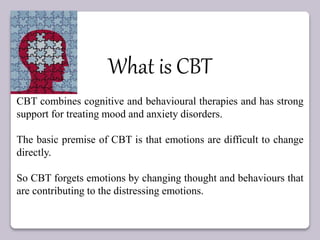
What is CBT
CBT combines cognitive and behavioural therapies and has strong
support for treating mood and anxiety disorders.
The basic premise of CBT is that emotions are difficult to change
directly.
So CBT forgets emotions by changing thought and behaviours that
are contributing to the distressing emotions.
 Brief CBT is the compression of CBT material and the
reduction of the average 12-20 sessions into four to eight sessions.
 In Brief CBT the concentration is on specific treatments for a
limited number of the patient’s problems.
 Specificity of the treatment is required because of the limited
number of sessions and because the patient is required to be
diligent in using extra reading materials and homework to assist in
his or her therapeutic growth.
Not only is this a pragmatic response to external pressures
such as the rise of managed care , but it also reflects the
underlying assumption that effectiveness of brief CBT results
from identifying and changing specific cognitions and
behaviors that are responsible for presenting problems.
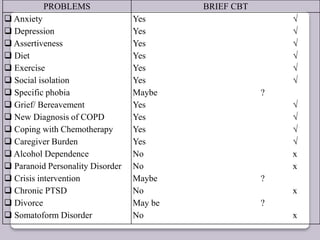
PROBLEMS BRIEF CBT
 Anxiety
 Depression
 Assertiveness
 Diet
 Exercise
 Social isolation
 Specific phobia
 Grief/ Bereavement
 New Diagnosis of COPD
 Coping with Chemotherapy
 Caregiver Burden
 Alcohol Dependence
 Paranoid Personality Disorder
 Crisis intervention
 Chronic PTSD
 Divorce
 Somatoform Disorder
Yes 
Yes 
Yes 
Yes 
Yes 
Yes 
Maybe ?
Yes 
Yes 
Yes 
Yes 
No x
No x
Maybe ?
No x
May be ?
No x
The following are general therapist skills and abilities required for
Brief CBT
 Capability to establish a strong working relationship quickly
 Through knowledge of the treatment used
 Skill in structuring sessions and homework material to address
all problems
 Skill in presenting material clearly and concisely with specific
examples for each of the patient’s issues
 Therapist interpersonal personality variables; ability to be
assertive, directive, nonjudgmental and collaborative.
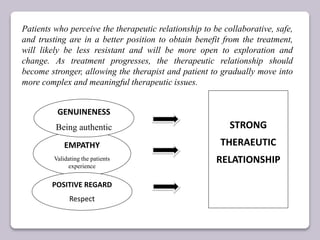
EMPATHY
Validating the patients
experience
GENUINENESS
Being authentic
POSITIVE REGARD
Respect
STRONG
THERAEUTIC
RELATIONSHIP
Patients who perceive the therapeutic relationship to be collaborative, safe,
and trusting are in a better position to obtain benefit from the treatment,
will likely be less resistant and will be more open to exploration and
change. As treatment progresses, the therapeutic relationship should
become stronger, allowing the therapist and patient to gradually move into
more complex and meaningful therapeutic issues.
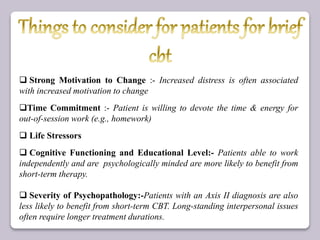
 Strong Motivation to Change :- Increased distress is often associated
with increased motivation to change
Time Commitment :- Patient is willing to devote the time & energy for
out-of-session work (e.g., homework)
 Life Stressors
 Cognitive Functioning and Educational Level:- Patients able to work
independently and are psychologically minded are more likely to benefit from
short-term therapy.
 Severity of Psychopathology:-Patients with an Axis II diagnosis are also
less likely to benefit from short-term CBT. Long-standing interpersonal issues
often require longer treatment durations.
Patient Description:
Mr. X is a 24-year-old college student on a full academic
scholarship. He belongs to a middle- socio economic status. He
called the therapist to discuss his feelings of anxiety and whether
there is anything that can help him “calm his nerves.” He said that
he is used to getting anxious in certain situations, but that it is
starting to affect all areas of his life. He says that he doesn’t have
a girlfriend because he gets “too freaked out” to ask anyone on a
date. He also says that his anxiety is starting to affect his grades
because he gets so nervous during exams that he breaks into a
cold sweat and cannot concentrate. He wants to be able to control
his anxiety but feels there is no hope.
Case Conceptualization:
Mr. X is experiencing cognitive and physiological anxiety in
response to evaluative situations.
Therapy will focus on stress-management skills for his
physiological symptoms and identifying dysfunctional thoughts or
worries about his performance in academic and social situations.
Specifically, therapy will identify catastrophic thoughts he has
about failure.
Goals:
Relaxation
Identifying Maladaptive Thoughts/Beliefs
Challenging Maladaptive Thoughts/Beliefs
Session 1
1. Establish relationship.
2. Identify the presenting problem.
3. Introduce cognitive behavioral therapy.
4. Introduce the cognitive-behavioral model.
5. Describe problem in context of mode.
6. Set goals.
7. Receive feedback from him.
Session 2
1. Check mood.
2. Introduce and practice progressive muscle relaxation.
3. Set homework: Plan two times during week to practice
progressive muscle relaxation.
4. Receive feedback from him.
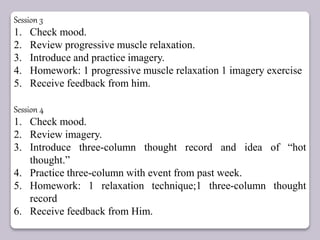
Session 3
1. Check mood.
2. Review progressive muscle relaxation.
3. Introduce and practice imagery.
4. Homework: 1 progressive muscle relaxation 1 imagery exercise
5. Receive feedback from him.
Session 4
1. Check mood.
2. Review imagery.
3. Introduce three-column thought record and idea of “hot
thought.”
4. Practice three-column with event from past week.
5. Homework: 1 relaxation technique;1 three-column thought
record
6. Receive feedback from Him.
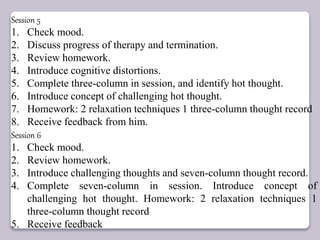
Session 5
1. Check mood.
2. Discuss progress of therapy and termination.
3. Review homework.
4. Introduce cognitive distortions.
5. Complete three-column in session, and identify hot thought.
6. Introduce concept of challenging hot thought.
7. Homework: 2 relaxation techniques 1 three-column thought record
8. Receive feedback from him.
Session 6
1. Check mood.
2. Review homework.
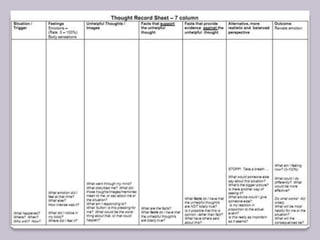
3. Introduce challenging thoughts and seven-column thought record.
4. Complete seven-column in session. Introduce concept of
challenging hot thought. Homework: 2 relaxation techniques 1
three-column thought record
5. Receive feedback
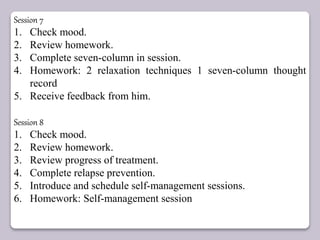
Session 7
1. Check mood.
2. Review homework.
3. Complete seven-column in session.
4. Homework: 2 relaxation techniques 1 seven-column thought
record
5. Receive feedback from him.
Session 8
1. Check mood.
2. Review homework.
3. Review progress of treatment.
4. Complete relapse prevention.
5. Introduce and schedule self-management sessions.
6. Homework: Self-management session
Allsop, S. & Saunders, B. (1991). Reinforcing robust resolutions:
Motivation in relapse prevention with severely dependent problem
drinkers. In Miller, W.R. & Rollnick, S. (Eds.) Motivational interviewing:
Preparing people to change addictive behavior. New York: Guilford
Press; pp. 236-247.
Beck, J. S. (1995). Cognitive therapy: Basics and beyond. New York:
Guilford Press.
 Bernard, J. M., & Goodyear, R. G. (2003). Fundamentals of clinical
supervision (3nd ed.). Needham Heights, MA: Allyn & Bacon.
 Bond F. W. & Dryden W. (2002). Handbook of brief cognitive
behaviour therapy. San Francisco: Wiley.
 Burns, D. D. (1999). Feeling good handbook. New York: Plume
(Penguin).
 Cormier, W. H., & Cormier, L. S. (1991). Interviewing strategies for
helpers: Fundamental skills and cognitive behavioral interventions (3rd
Edition). Pacific Grove: Brooks/Cole Publishing Company.
 Greenberg, D. & Padesky, C. A. (1995). Mind over mood: Change
the way you feel by changing the way you think. New York: Guilford
Press.
 Hopko, Lejuez, Ruggiero, et al. (2003). Contemporary behavioral
activation treatments for depression: procedures, principles, and
prognosis. Clin Psychol Rev 23 (5): 699-717.
 Jacobson, Martell, Dimidjian (2001). Behavioral activation treatment
for depression: returning to contextual roots. Clin Psychol Sci Prac 8:
255-270.
 Liese, B.S., & Beck, J. S. (1997). Cognitive therapy supervision. In
Watkins, C.E., Jr. (Ed.), Handbook of psychotherapy supervision. New
York: John Wiley & Sons; pp. 114-133.
 Miller, W. R., & Rollnick, S. (1991). Motivational interviewing:
Preparing people to change addictive behavior. New York: Guilford
Press.
Miller, W.R. & Rollnick, S. (2002). Motivational Interviewing:
Preparing people for change. Second Edition New York: Guilford
Press.
 Persons J. B. & Tompkins M. A. (1999). Cognitive-behavioral case
formulation. In Ells, T. (Ed.). Handbook of psychotherapy and case
formulation. New York: Guilford Press; pp. 314-339
 Rollnick, S., Mason, P. & Butler, C. (1999). Health behavior change.
A guide for practitioners. New York: Churchill Livingstone.
 Safran, J. D., & Greenberg, L. S. (1982). Eliciting “hot cognitions”
in cognitive behavioral therapy: Rationale and procedural guidelines.
Canadian Psychology, 23, 83-86.
Brief CBT & Case Presentation

Brief CBT & Case Presentation

  • 1.
    Brief CBT An overview and Casepresentation By:- Aastha Dhingra Director & Co-Founder AD Executive Training & Coaching (P) Ltd aastha@adtrainingncoaching.edu.in
  • 2.
    What is CBT CBTcombines cognitive and behavioural therapies and has strong support for treating mood and anxiety disorders. The basic premise of CBT is that emotions are difficult to change directly. So CBT forgets emotions by changing thought and behaviours that are contributing to the distressing emotions.
  • 3.
     Brief CBTis the compression of CBT material and the reduction of the average 12-20 sessions into four to eight sessions.  In Brief CBT the concentration is on specific treatments for a limited number of the patient’s problems.  Specificity of the treatment is required because of the limited number of sessions and because the patient is required to be diligent in using extra reading materials and homework to assist in his or her therapeutic growth.
  • 4.
    Not only isthis a pragmatic response to external pressures such as the rise of managed care , but it also reflects the underlying assumption that effectiveness of brief CBT results from identifying and changing specific cognitions and behaviors that are responsible for presenting problems.
  • 6.
    PROBLEMS BRIEF CBT Anxiety  Depression  Assertiveness  Diet  Exercise  Social isolation  Specific phobia  Grief/ Bereavement  New Diagnosis of COPD  Coping with Chemotherapy  Caregiver Burden  Alcohol Dependence  Paranoid Personality Disorder  Crisis intervention  Chronic PTSD  Divorce  Somatoform Disorder Yes  Yes  Yes  Yes  Yes  Yes  Maybe ? Yes  Yes  Yes  Yes  No x No x Maybe ? No x May be ? No x
  • 7.
    The following aregeneral therapist skills and abilities required for Brief CBT  Capability to establish a strong working relationship quickly  Through knowledge of the treatment used  Skill in structuring sessions and homework material to address all problems  Skill in presenting material clearly and concisely with specific examples for each of the patient’s issues  Therapist interpersonal personality variables; ability to be assertive, directive, nonjudgmental and collaborative.
  • 9.
    EMPATHY Validating the patients experience GENUINENESS Beingauthentic POSITIVE REGARD Respect STRONG THERAEUTIC RELATIONSHIP Patients who perceive the therapeutic relationship to be collaborative, safe, and trusting are in a better position to obtain benefit from the treatment, will likely be less resistant and will be more open to exploration and change. As treatment progresses, the therapeutic relationship should become stronger, allowing the therapist and patient to gradually move into more complex and meaningful therapeutic issues.
  • 10.
     Strong Motivationto Change :- Increased distress is often associated with increased motivation to change Time Commitment :- Patient is willing to devote the time & energy for out-of-session work (e.g., homework)  Life Stressors  Cognitive Functioning and Educational Level:- Patients able to work independently and are psychologically minded are more likely to benefit from short-term therapy.  Severity of Psychopathology:-Patients with an Axis II diagnosis are also less likely to benefit from short-term CBT. Long-standing interpersonal issues often require longer treatment durations.
  • 11.
    Patient Description: Mr. Xis a 24-year-old college student on a full academic scholarship. He belongs to a middle- socio economic status. He called the therapist to discuss his feelings of anxiety and whether there is anything that can help him “calm his nerves.” He said that he is used to getting anxious in certain situations, but that it is starting to affect all areas of his life. He says that he doesn’t have a girlfriend because he gets “too freaked out” to ask anyone on a date. He also says that his anxiety is starting to affect his grades because he gets so nervous during exams that he breaks into a cold sweat and cannot concentrate. He wants to be able to control his anxiety but feels there is no hope.
  • 12.
    Case Conceptualization: Mr. Xis experiencing cognitive and physiological anxiety in response to evaluative situations. Therapy will focus on stress-management skills for his physiological symptoms and identifying dysfunctional thoughts or worries about his performance in academic and social situations. Specifically, therapy will identify catastrophic thoughts he has about failure. Goals: Relaxation Identifying Maladaptive Thoughts/Beliefs Challenging Maladaptive Thoughts/Beliefs
  • 13.
    Session 1 1. Establishrelationship. 2. Identify the presenting problem. 3. Introduce cognitive behavioral therapy. 4. Introduce the cognitive-behavioral model. 5. Describe problem in context of mode. 6. Set goals. 7. Receive feedback from him. Session 2 1. Check mood. 2. Introduce and practice progressive muscle relaxation. 3. Set homework: Plan two times during week to practice progressive muscle relaxation. 4. Receive feedback from him.
  • 14.
    Session 3 1. Checkmood. 2. Review progressive muscle relaxation. 3. Introduce and practice imagery. 4. Homework: 1 progressive muscle relaxation 1 imagery exercise 5. Receive feedback from him. Session 4 1. Check mood. 2. Review imagery. 3. Introduce three-column thought record and idea of “hot thought.” 4. Practice three-column with event from past week. 5. Homework: 1 relaxation technique;1 three-column thought record 6. Receive feedback from Him.
  • 15.
    Session 5 1. Checkmood. 2. Discuss progress of therapy and termination. 3. Review homework. 4. Introduce cognitive distortions. 5. Complete three-column in session, and identify hot thought. 6. Introduce concept of challenging hot thought. 7. Homework: 2 relaxation techniques 1 three-column thought record 8. Receive feedback from him. Session 6 1. Check mood. 2. Review homework. 3. Introduce challenging thoughts and seven-column thought record. 4. Complete seven-column in session. Introduce concept of challenging hot thought. Homework: 2 relaxation techniques 1 three-column thought record 5. Receive feedback
  • 16.
    Session 7 1. Checkmood. 2. Review homework. 3. Complete seven-column in session. 4. Homework: 2 relaxation techniques 1 seven-column thought record 5. Receive feedback from him. Session 8 1. Check mood. 2. Review homework. 3. Review progress of treatment. 4. Complete relapse prevention. 5. Introduce and schedule self-management sessions. 6. Homework: Self-management session
  • 20.
    Allsop, S. &Saunders, B. (1991). Reinforcing robust resolutions: Motivation in relapse prevention with severely dependent problem drinkers. In Miller, W.R. & Rollnick, S. (Eds.) Motivational interviewing: Preparing people to change addictive behavior. New York: Guilford Press; pp. 236-247. Beck, J. S. (1995). Cognitive therapy: Basics and beyond. New York: Guilford Press.  Bernard, J. M., & Goodyear, R. G. (2003). Fundamentals of clinical supervision (3nd ed.). Needham Heights, MA: Allyn & Bacon.  Bond F. W. & Dryden W. (2002). Handbook of brief cognitive behaviour therapy. San Francisco: Wiley.  Burns, D. D. (1999). Feeling good handbook. New York: Plume (Penguin).  Cormier, W. H., & Cormier, L. S. (1991). Interviewing strategies for helpers: Fundamental skills and cognitive behavioral interventions (3rd Edition). Pacific Grove: Brooks/Cole Publishing Company.
  • 21.
     Greenberg, D.& Padesky, C. A. (1995). Mind over mood: Change the way you feel by changing the way you think. New York: Guilford Press.  Hopko, Lejuez, Ruggiero, et al. (2003). Contemporary behavioral activation treatments for depression: procedures, principles, and prognosis. Clin Psychol Rev 23 (5): 699-717.  Jacobson, Martell, Dimidjian (2001). Behavioral activation treatment for depression: returning to contextual roots. Clin Psychol Sci Prac 8: 255-270.  Liese, B.S., & Beck, J. S. (1997). Cognitive therapy supervision. In Watkins, C.E., Jr. (Ed.), Handbook of psychotherapy supervision. New York: John Wiley & Sons; pp. 114-133.  Miller, W. R., & Rollnick, S. (1991). Motivational interviewing: Preparing people to change addictive behavior. New York: Guilford Press.
  • 22.
    Miller, W.R. &Rollnick, S. (2002). Motivational Interviewing: Preparing people for change. Second Edition New York: Guilford Press.  Persons J. B. & Tompkins M. A. (1999). Cognitive-behavioral case formulation. In Ells, T. (Ed.). Handbook of psychotherapy and case formulation. New York: Guilford Press; pp. 314-339  Rollnick, S., Mason, P. & Butler, C. (1999). Health behavior change. A guide for practitioners. New York: Churchill Livingstone.  Safran, J. D., & Greenberg, L. S. (1982). Eliciting “hot cognitions” in cognitive behavioral therapy: Rationale and procedural guidelines. Canadian Psychology, 23, 83-86.