
Cognitive Behavior Modification Prepared by: Maria Frances D. Dalluay Anna Marissa R. Nerida
Outline Proponent Definition Characteristics Purpose Example References
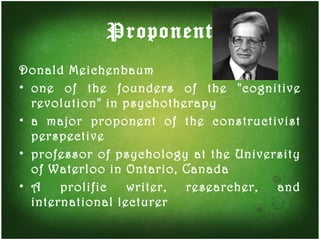
Proponent Donald Meichenbaum one of the founders of the "cognitive revolution" in psychotherapy a major proponent of the constructivist perspective professor of psychology at the University of Waterloo in Ontario, Canada A prolific writer, researcher, and international lecturer
Definition It is an intervention that combines cognitive and behavioral learning principles that shape and encourage desired behaviors. It refers to three underlying assumptions: an individual’s behavior is interceded by cognitive events a change in mediating events results in a change in behavior An individual is an active participant in his learning.
Characteristics Participants themselves rather than external agents are the primary change agents. Verbalization is on an overt level, then a self-monitor level, and then a covert level. Participants are taught to identify and use a series of problem-solving steps. Modeling is used for instructional purposes. Cognitive behavior modification facilitates self-control.
Purpose To teach individuals monitor their behavior, pace or performance and to appropriately dispense self-reinforcements. To address aggression, anxiety, panic disorders, substance abuse, schizophrenia, bipolar disorder, borderline personality disorder, depression, limited self-control, poor social problem solving and other related problems.
Example Norton, a 15-year-old student with Asperger Syndrome who has difficulty with social limits and understanding subtle social rules. He often makes mistakes in social judgment that make others uncomfortable. For example, he oversteps traditional greeting protocol by hugging and kissing people.
Example Norton’s teacher, Ms. Williams, decided to introduce a problem-solving scale to him with various ways to greet friends, parents, etc. Ms. Williams and Norton matched greetings to individuals, such as saying “Hi” to friends and shaking hands with or giving a high five to his baseball coach after a game. Ms. Williams also taught Norton to use a daily diary to rate his greeting with others.
References Ankrom, S. (2009, May 4). Cognitive behavior modifcation. Retrieved January 14, 2012, from About.com: http://panicdisorder.about.com/od/treatments/a/cbm.htm Bank, C. (n.d.). Cognitive behvaior modification. Retrieved January 16, 2012, from eHow.com: http://www.ehow.com/about_5042206_definition-cognitive-behavior-modification.html Changing behavior by changing thoughts. (2011). Retrieved January 14, 2012, from Easy Stress Management: http://www.stressaffect.com/cognitive-behavior-modification.html Cognitibe behavior modification. (2011). Retrieved January 16, 2012, from Thoughtful Self Improvement: http://www.thoughtful-self-improvement.com/cognitive-behavior-modification.html#TOP Cognitive behavior modification. (2009). Texas Guide for Effective Teaching , 1-9. Donald Meichenbaum, Ph.D (2010). Retrieved January 14, 2011 from  http://www.behavior.net/column/meichenbaum/bio.html
That in All Things, God May be Glorified!

Cognitive behavior modification report

  • 1.
    Cognitive Behavior ModificationPrepared by: Maria Frances D. Dalluay Anna Marissa R. Nerida
  • 2.
    Outline Proponent DefinitionCharacteristics Purpose Example References
  • 3.
    Proponent Donald Meichenbaumone of the founders of the "cognitive revolution" in psychotherapy a major proponent of the constructivist perspective professor of psychology at the University of Waterloo in Ontario, Canada A prolific writer, researcher, and international lecturer
  • 4.
    Definition It isan intervention that combines cognitive and behavioral learning principles that shape and encourage desired behaviors. It refers to three underlying assumptions: an individual’s behavior is interceded by cognitive events a change in mediating events results in a change in behavior An individual is an active participant in his learning.
  • 5.
    Characteristics Participants themselvesrather than external agents are the primary change agents. Verbalization is on an overt level, then a self-monitor level, and then a covert level. Participants are taught to identify and use a series of problem-solving steps. Modeling is used for instructional purposes. Cognitive behavior modification facilitates self-control.
  • 6.
    Purpose To teachindividuals monitor their behavior, pace or performance and to appropriately dispense self-reinforcements. To address aggression, anxiety, panic disorders, substance abuse, schizophrenia, bipolar disorder, borderline personality disorder, depression, limited self-control, poor social problem solving and other related problems.
  • 7.
    Example Norton, a15-year-old student with Asperger Syndrome who has difficulty with social limits and understanding subtle social rules. He often makes mistakes in social judgment that make others uncomfortable. For example, he oversteps traditional greeting protocol by hugging and kissing people.
  • 8.
    Example Norton’s teacher,Ms. Williams, decided to introduce a problem-solving scale to him with various ways to greet friends, parents, etc. Ms. Williams and Norton matched greetings to individuals, such as saying “Hi” to friends and shaking hands with or giving a high five to his baseball coach after a game. Ms. Williams also taught Norton to use a daily diary to rate his greeting with others.
  • 9.
    References Ankrom, S.(2009, May 4). Cognitive behavior modifcation. Retrieved January 14, 2012, from About.com: http://panicdisorder.about.com/od/treatments/a/cbm.htm Bank, C. (n.d.). Cognitive behvaior modification. Retrieved January 16, 2012, from eHow.com: http://www.ehow.com/about_5042206_definition-cognitive-behavior-modification.html Changing behavior by changing thoughts. (2011). Retrieved January 14, 2012, from Easy Stress Management: http://www.stressaffect.com/cognitive-behavior-modification.html Cognitibe behavior modification. (2011). Retrieved January 16, 2012, from Thoughtful Self Improvement: http://www.thoughtful-self-improvement.com/cognitive-behavior-modification.html#TOP Cognitive behavior modification. (2009). Texas Guide for Effective Teaching , 1-9. Donald Meichenbaum, Ph.D (2010). Retrieved January 14, 2011 from http://www.behavior.net/column/meichenbaum/bio.html
  • 10.
    That in AllThings, God May be Glorified!