Shaping
Shaping
• Shaping is a procedure used to establish a behavior that is not
presently performed by an individual
• The method used is differential reinforcement of successive
approximations (Peneguhan berbeza-beza pada anggaran
berturut-turut). It was introduced by B.F. Skinner
• Shaping assists in "discrimination", which is the ability to tell
the difference between stimuli that are and are not reinforced,
and in "generalization", which is the application of a response
learned in one situation to a different but similar situation.
Definition of shaping
The development of a new behavior by the
reinforcement of successive approximations of of
closer approximation and the extinguishing of
preceding approximation of the bahavior
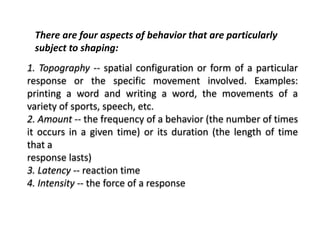
1. Topography -- spatial configuration or form of a particular
response or the specific movement involved. Examples:
printing a word and writing a word, the movements of a
variety of sports, speech, etc.
2. Amount -- the frequency of a behavior (the number of times
it occurs in a given time) or its duration (the length of time
that a
response lasts)
3. Latency -- reaction time
4. Intensity -- the force of a response
There are four aspects of behavior that are particularly
subject to shaping:
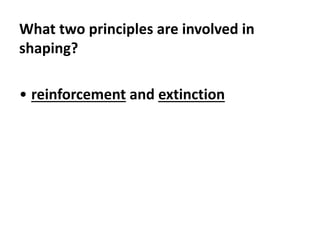
What two principles are involved in
shaping?
• reinforcement and extinction
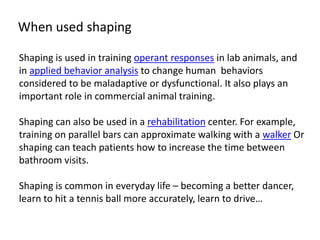
Shaping is used in training operant responses in lab animals, and
in applied behavior analysis to change human behaviors
considered to be maladaptive or dysfunctional. It also plays an
important role in commercial animal training.
Shaping can also be used in a rehabilitation center. For example,
training on parallel bars can approximate walking with a walker Or
shaping can teach patients how to increase the time between
bathroom visits.
Shaping is common in everyday life – becoming a better dancer,
learn to hit a tennis ball more accurately, learn to drive…
When used shaping
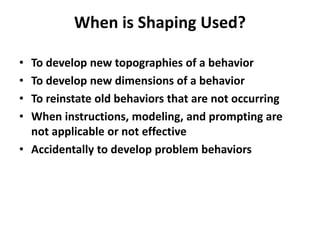
When is Shaping Used?
• To develop new topographies of a behavior
• To develop new dimensions of a behavior
• To reinstate old behaviors that are not occurring
• When instructions, modeling, and prompting are
not applicable or not effective
• Accidentally to develop problem behaviors
Examples of Shaping
• Language development
• Getting a rat to press a lever
• Animal training
• Rehabilitation (O’Neill & Gardner, 1983)
• Voice volume (Jackson & Wallace, 1974)
• Self-injurious behavior (Schaeffer, 1970)
Shaping Problem Behaviors
• Child tantrums or other problem behaviors
• Parents yelling/nagging
• Showing off
• Dog begging for food
• SIB (self-Injurious behavior) or other problems
from individuals with MR /DD
(developmental disabilities)
Using Shaping
1. Define the target behavior
- Final behavior should be stated in way that all the relevant
characteristic of behavior ( topography, amount, latency
and intensity
2. Is shaping the preferred procedure?
- Use instructions/modeling/prompting if possible
3. Identify the starting behavior
- The person must already exhibit the behavior
- Choose a behavior you can build on to achieve the
target behavior
4. Choose the shaping steps
- Each step is a closer approximation to the target
behavior
- Steps are not too bi
- No specific guidelines for identifying the ideal
step size.
Using shaping - con’t
5. Choose the reinforcer
- Must function as a reinforcer for the individual
- Consider the effects of satiation during shaping (use
conditioned reinforcers)
6. Reinforce each successive approximation
- Reinforce first approximation until it occurs a number of
times
- Stop reinforcing first approximation and reinforce next
approximation until it occurs a number of times
- Continue until the target behavior occurs
7. Move at the proper pace
- Do not move to soon
- Proceed in sufficiently small steps
- Return to earlier approximation if you lose a behavior
because you moving too fast.
- It is also important not to progress too slowly
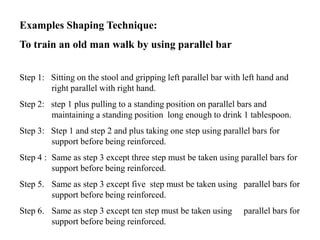
Examples Shaping Technique:
To train an old man walk by using parallel bar
Step 1: Sitting on the stool and gripping left parallel bar with left hand and
right parallel with right hand.
Step 2: step 1 plus pulling to a standing position on parallel bars and
maintaining a standing position long enough to drink 1 tablespoon.
Step 3: Step 1 and step 2 and plus taking one step using parallel bars for
support before being reinforced.
Step 4 : Same as step 3 except three step must be taken using parallel bars for
support before being reinforced.
Step 5. Same as step 3 except five step must be taken using parallel bars for
support before being reinforced.
Step 6. Same as step 3 except ten step must be taken using parallel bars for
support before being reinforced.
Be careful not to inadvertently shape an undesirable or harmful
behavior.
Self-destructive behaviors are often inadvertently shaped in
developmentally disabled children or temper tantrums in “normal”
children.
(Note, it is often more so the intensity of the behavior which is
undesirably shaped.)
Significantly abnormal behaviors can be brought about by failure to
apply shaping when it should be applied, either through
indiscriminately reinforcing or failure to give any reinforcement.
Pitfalls and Cautions:
Select the desired final behavior.
Select an appropriate reinforcer.
List successive approximations of the terminal behavior, beginning with one
that is already in the learner’s behavioral repertoire and resembles the
terminal.
Implement the plan
Tell the learner about the plan before starting
Begin reinforcing immediately following each occurrence of the starting
behavior
Never move to a new approximation until the learner has mastered the
previous one
Summary: Guidelines for Effective Shaping:
Move to the next step when the learner performs the current step correctly in six
of ten trials
Do not reinforce too many times at one step and avoid under-reinforcement at any
step
If the learner is inattentive or bored you may have moved too slow or too fast.
Return to the previous step for a few more trials.
If the learner is inattentive or bored you may have moved too slow or too
fast. Return to the previous step for a few more trials.
if the learner continues to have difficulty, despite retraining at previous
steps, add more steps at the point of difficulty.
if the learner continues to have difficulty, despite retraining at previous
steps, add moresteps at the point of difficulty.
Behavior modification shaping

Behavior modification shaping

  • 1.
  • 2.
    Shaping • Shaping isa procedure used to establish a behavior that is not presently performed by an individual • The method used is differential reinforcement of successive approximations (Peneguhan berbeza-beza pada anggaran berturut-turut). It was introduced by B.F. Skinner • Shaping assists in "discrimination", which is the ability to tell the difference between stimuli that are and are not reinforced, and in "generalization", which is the application of a response learned in one situation to a different but similar situation.
  • 3.
    Definition of shaping Thedevelopment of a new behavior by the reinforcement of successive approximations of of closer approximation and the extinguishing of preceding approximation of the bahavior
  • 4.
    1. Topography --spatial configuration or form of a particular response or the specific movement involved. Examples: printing a word and writing a word, the movements of a variety of sports, speech, etc. 2. Amount -- the frequency of a behavior (the number of times it occurs in a given time) or its duration (the length of time that a response lasts) 3. Latency -- reaction time 4. Intensity -- the force of a response There are four aspects of behavior that are particularly subject to shaping:
  • 5.
    What two principlesare involved in shaping? • reinforcement and extinction
  • 6.
    Shaping is usedin training operant responses in lab animals, and in applied behavior analysis to change human behaviors considered to be maladaptive or dysfunctional. It also plays an important role in commercial animal training. Shaping can also be used in a rehabilitation center. For example, training on parallel bars can approximate walking with a walker Or shaping can teach patients how to increase the time between bathroom visits. Shaping is common in everyday life – becoming a better dancer, learn to hit a tennis ball more accurately, learn to drive… When used shaping
  • 7.
    When is ShapingUsed? • To develop new topographies of a behavior • To develop new dimensions of a behavior • To reinstate old behaviors that are not occurring • When instructions, modeling, and prompting are not applicable or not effective • Accidentally to develop problem behaviors
  • 8.
    Examples of Shaping •Language development • Getting a rat to press a lever • Animal training • Rehabilitation (O’Neill & Gardner, 1983) • Voice volume (Jackson & Wallace, 1974) • Self-injurious behavior (Schaeffer, 1970)
  • 9.
    Shaping Problem Behaviors •Child tantrums or other problem behaviors • Parents yelling/nagging • Showing off • Dog begging for food • SIB (self-Injurious behavior) or other problems from individuals with MR /DD (developmental disabilities)
  • 10.
    Using Shaping 1. Definethe target behavior - Final behavior should be stated in way that all the relevant characteristic of behavior ( topography, amount, latency and intensity 2. Is shaping the preferred procedure? - Use instructions/modeling/prompting if possible 3. Identify the starting behavior - The person must already exhibit the behavior - Choose a behavior you can build on to achieve the target behavior 4. Choose the shaping steps - Each step is a closer approximation to the target behavior - Steps are not too bi - No specific guidelines for identifying the ideal step size.
  • 11.
    Using shaping -con’t 5. Choose the reinforcer - Must function as a reinforcer for the individual - Consider the effects of satiation during shaping (use conditioned reinforcers) 6. Reinforce each successive approximation - Reinforce first approximation until it occurs a number of times - Stop reinforcing first approximation and reinforce next approximation until it occurs a number of times - Continue until the target behavior occurs 7. Move at the proper pace - Do not move to soon - Proceed in sufficiently small steps - Return to earlier approximation if you lose a behavior because you moving too fast. - It is also important not to progress too slowly
  • 12.
    Examples Shaping Technique: Totrain an old man walk by using parallel bar Step 1: Sitting on the stool and gripping left parallel bar with left hand and right parallel with right hand. Step 2: step 1 plus pulling to a standing position on parallel bars and maintaining a standing position long enough to drink 1 tablespoon. Step 3: Step 1 and step 2 and plus taking one step using parallel bars for support before being reinforced. Step 4 : Same as step 3 except three step must be taken using parallel bars for support before being reinforced. Step 5. Same as step 3 except five step must be taken using parallel bars for support before being reinforced. Step 6. Same as step 3 except ten step must be taken using parallel bars for support before being reinforced.
  • 17.
    Be careful notto inadvertently shape an undesirable or harmful behavior. Self-destructive behaviors are often inadvertently shaped in developmentally disabled children or temper tantrums in “normal” children. (Note, it is often more so the intensity of the behavior which is undesirably shaped.) Significantly abnormal behaviors can be brought about by failure to apply shaping when it should be applied, either through indiscriminately reinforcing or failure to give any reinforcement. Pitfalls and Cautions:
  • 18.
    Select the desiredfinal behavior. Select an appropriate reinforcer. List successive approximations of the terminal behavior, beginning with one that is already in the learner’s behavioral repertoire and resembles the terminal. Implement the plan Tell the learner about the plan before starting Begin reinforcing immediately following each occurrence of the starting behavior Never move to a new approximation until the learner has mastered the previous one Summary: Guidelines for Effective Shaping:
  • 19.
    Move to thenext step when the learner performs the current step correctly in six of ten trials Do not reinforce too many times at one step and avoid under-reinforcement at any step If the learner is inattentive or bored you may have moved too slow or too fast. Return to the previous step for a few more trials. If the learner is inattentive or bored you may have moved too slow or too fast. Return to the previous step for a few more trials. if the learner continues to have difficulty, despite retraining at previous steps, add more steps at the point of difficulty. if the learner continues to have difficulty, despite retraining at previous steps, add moresteps at the point of difficulty.