Cardiology MCQ
Dr Praveen Gupta
JIPMER
Pondicherry
India
24/12/2016
Based on
Harrison's, 18TH Edition, Chapter 229. Noninvasive Cardiac Imaging:
Echocardiography, Nuclear Cardiology, and MRI/CT Imaging
Harrison 18th edition, Chapter-230, Diagnostic Cardiac Catheterization and
Coronary Angiography: Introduction
Question 1
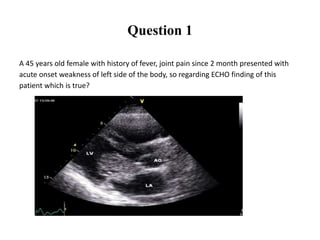
A 45 years old female with history of fever, joint pain since 2 month presented with
acute onset weakness of left side of the body, so regarding ECHO finding of this
patient which is true?
Option
A)Large vegetation attached to anterior mitral leaflet of the mitral valve
B)Benign tumor of the heart
C)Malignant tumor of the heart
D)Calcification on the anterior mitral leaflet in a patient of mitral stenosis
Answer
B)Benign tumor of the heart
Harrison's, 18TH Edition, Chapter 229. Noninvasive Cardiac Imaging:
Echocardiography, Nuclear Cardiology, and MRI/CT Imaging
The image is showing Left atrial myxoma
Question 2
Regarding Fractional flow reserve, which of the following is not true?
A) Measurement of the fractional flow reserve provides a functional assessment of the stenosis.
B) The fractional flow reserve is the ratio of the pressure in the coronary artery distal to the stenosis
divided by the pressure in the artery proximal to the stenosis at maximal vasodilation.
C) Fractional flow reserve is measured using a coronary pressure–sensor guidewire at rest and at
maximal hyperemia following the injection of adenosine.
D) A fractional flow reserve of >0.75 indicates a hemodynamically significant stenosis that would
benefit from intervention
Answer
D) A fractional flow reserve of >0.75 indicates a hemodynamically
significant stenosis that would benefit from intervention
Harrison 18th edition, Chapter-230, Diagnostic Cardiac Catheterization and
Coronary Angiography: Introduction
Question-3
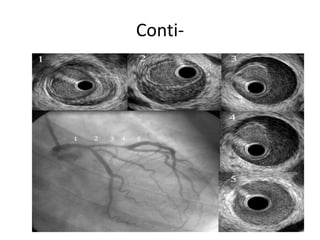
36-year-old woman with no cardiovascular risk factors or other relevant history who
consulted for chest pain of 1 h duration. An electrocardiogram done by an out-of-hospital
emergency service showed ST elevation in I and aVL, a reciprocal decrease in the inferior
leads, and hyperacute T-waves at V4 through V6. After antiplatelet, anticoagulant, and nitrate
therapy, the elevated ST normalized and the patient arrived at the hospital asymptomatic. The
left ventricular ejection fraction (LVEF) was severely depressed (30%) due to extensive
anterolateral akinesia. Scheduled coronary angiography 48 h later showed coronary arteries
with no atherosclerosis, and a slight loss of diameter in the proximal and middle segments of
the left anterior descending artery (LAD). Following which patient underwent a new invasive
imaging for diagnosis so which of the following regarding this new imaging modaility is NOT
TRUE?
Conti.-
Conti-
Conti-
A) Provides a more accurate anatomic assessment of the coronary artery and
the degree of coronary atherosclerosis
B) Performed using a small flexible catheter with a 40-mHz transducer at its
tip that is advanced into the coronary artery over a guidewire
C) May be used to image atherosclerotic plaque precisely, determine luminal
cross-sectional area, and measure vessel size
D) Not useul during or following percutaneous coronary intervention to assess
the stenosis and determine the adequacy of stent placement
Answer
D) Not useul during or following percutaneous coronary intervention to
assess the stenosis and determine the adequacy of stent placement
Image is showing intravascular ultrasound
Harrison 18th edition, Chapter-230, Diagnostic Cardiac Catheterization and
Coronary Angiography: Introduction
Question-4
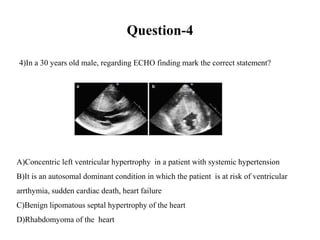
4) In a 30 years old male, regarding ECHO finding mark the correct statement?
A)Concentric left ventricular hypertrophy in a patient with systemic hypertension
B)It is an autosomal dominant condition in which the patient is at risk of ventricular
arrthymia, sudden cardiac death, heart failure
C)Benign lipomatous septal hypertrophy of the heart
D)Rhabdomyoma of the heart
Answer
B) It is an autosomal dominant condition in which the patient is at risk of
ventricular arrthymia, sudden cardiac death, heart failure
This is the ECHO image of HOCM patient
Harrison's, Chapter 229. Noninvasive Cardiac Imaging: Echocardiography,
Nuclear Cardiology, and MRI/CT Imaging
Question-5
A 26 years old male with past history of old treated pulmonary tuberculosis
present with history of pedal edema,ascites along with dyspnoea on
exertion for the past one month. On blood investigation he was found to be
HIV ELISA positive. CECT chest of the patient done so which of the
following is NOT true?
Conti..
Conti.
A) Surgery is the treatment of choice for this patient
B) ECHO cardiography is the best modality to diagnose above medical
condition
C) A diastolic dip and plateau or "square root sign," in the ventricular
waveforms during cardiac catheterization
D) Pressure changes in the right and left ventricles with inspiration are
observed
Answer
B) ECHO cardiography is the best modality to diagnose above medical
condition
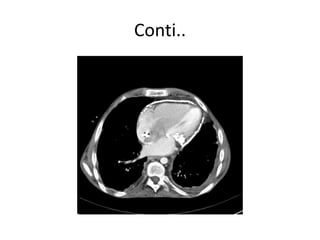
Image is showing pericardial thickening along with pericardial calcification
which is the characteristics feature of constrictive pericarditis which is best
diagnosed by CECT chest
Harrison's, Chapter 229. Noninvasive Cardiac Imaging: Echocardiography,
Nuclear Cardiology, and MRI/CT Imaging
Question-6
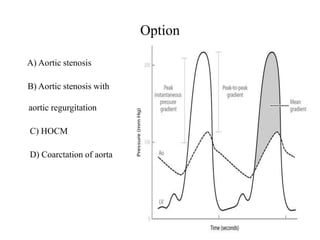
A patient present with history of dyspnoea on exertion, his pressure tracing
during simultaneously recording of cardiac and aortic pressure is given
below so what is your diagnosis?
Option
A) Aortic stenosis
B) Aortic stenosis with
aortic regurgitation
C) HOCM
D) Coarctation of aorta
Answer
A) Aortic stenosis
Pressure tracing is suggestive of pulsus parvus et tardus which is the
characteristic feature found in a patient with aortic stenosis
Harrison 18th edition, Chapter-230, Diagnostic Cardiac Catheterization and
Coronary Angiography: Introduction, Figure-230/2
Question-7
Brockenbrough-Braunwald sign is present in?
A) Aortic stenosis
B) HOCM
C) Pulmonary stenosis
D) Mitral stenosis
Answer
Answer- B)HOCM
Harrison 18th edition, Chapter-230, Diagnostic Cardiac Catheterization and
Coronary Angiography: Introduction, Hemodynamics
Question-8
Regarding intracardiac shunt determination during cardiac catheterization, which
of the following is NOT TRUE?
A) Intra cardiac shunt should be suspected when there is unexplained arterial
saturation or desaturation of oxygen saturation of venous blood
B) A "step up" in oxygen content indicates the presence of a right-to-left shunt
while a "step down" indicates a left-to-right shunt
C) The shunt is localized by detecting a difference in oxygen saturation levels of
5–7% between adjacent cardiac chambers
D) The severity of the shunt is determined by the ratio of systemic blood flow (Qp)
to the pulmonary blood flow
Answer
Answer- B) A "step up" in oxygen content indicates the presence of a right-
to-left shunt while a "step down" indicates a left-to-right shunt.
Harrison 18th edition, Chapter-230, Diagnostic Cardiac Catheterization and
Coronary Angiography: Introduction
Question-9
All of the following are true about High-risk SPECT MPI findings except?
A) Severe resting or poststress LV systolic dysfunction
B) Large or multiple stress-induced defects
C) Large fixed defect with LV dilation
D) Decreased 201Tl lung uptake
Answer
D)Decreased 201Tl lung uptake
Harrison's, Chapter 229. Noninvasive Cardiac Imaging:
Echocardiography, Nuclear Cardiology, and MRI/CT Imaging
Question-10
Regarding PET to determine myocardial viability, which of the following is NOT
TRUE ?
A) Regarded as the gold standard technique for the assessment of myocardial viability.
B) The positron-emitting tracer F-18 fluorodeoxyglucose (FDG) assesses myocardial
glucose metabolism and is an indicator of myocardial viability.
C)With reduced myocardial blood flow and ischemia, substrate utilization switches
from fatty acids and lactate toward glucose
D)Decreased FDG uptake in regions of decreased perfusion identifies areas of ischemic
or hibernating myocardium
Answer
D) Decreased FDG uptake in regions of decreased perfusion identifies areas
of ischemic or hibernating myocardium
Harrison's, Chapter 229. Noninvasive Cardiac Imaging: Echocardiography,
Nuclear Cardiology, and MRI/CT Imaging
Question-11
A patient with a known case of bicuspid aortic valve present with acute
onset retrosternal chest pain radiating to back since two hours, on
examination blood pressure in the right arm was 180/110 mmhg and in the
left arm was 110/70 mmhg, so which of the following is the imaging
modality of choice to detect this condition?
A) Transthoracic echocardiography
B)Transesophageal echocardiography
C)CECT Chest
D)Chest X-ray
Answer
C)CECT Chest
The clinical feature is suggestive of acute aortic dissection which is best
diagnosed by CECT Chest
Harrison's, Chapter 229. Noninvasive Cardiac Imaging: Echocardiography,
Nuclear Cardiology, and MRI/CT Imaging
Question-12
Patient at risk of developing nephrogenic systemic fibrosis have impaired?
A) Liver function
B) Renal function
C) Left ventricular function
D) Diffusion lung capacity
Answer
B) Renal function
Harrison's, Chapter 229. Noninvasive Cardiac Imaging: Echocardiography,
Nuclear Cardiology, and MRI/CT Imaging
Question-13
Which of the following statement regarding coronary angiography is not true?
A) Right dominant circulation is found in 85% of individuals
B) Myocardial bridge most commonly involves the left anterior descending
artery
C) Presence of TIMI grade 3 flow suggests presence of significant coronary
artery stenosis
D) Coronary artery anomalies occur in 1–2% of patients
Answer
C) Presence of TIMI grade 3 flow suggests presence of significant coronary
artery stenosis
Harrison 18th edition, Chapter-230, Diagnostic Cardiac Catheterization and
Coronary Angiography: Introduction
Question-14
Regarding hemodynamic measurement of heart in various pathological condition
which of the following is NOT TRUE?
A) In cardiac tamponade, there is decreased "y" descent
B) In constrictive pericarditis, there is prominent "y" descent
C) Concordant pressure changes in the right and left ventricles with inspiration is the
most specific hemodynamic phenomenon for constriction
D) Restrictive cardiomyopathy may be distinguished from constrictive pericarditis by a
marked increase in right ventricular and pulmonary artery systolic pressures
(usually >60 mmHg)
Answer
C) Concordant pressure changes in the right and left ventricles with inspiration
is the most specific hemodynamic phenomenon for constriction
Harrison 18th edition, Chapter-230, Diagnostic Cardiac Catheterization and
Coronary Angiography: Introduction
Question-15
Normal Values for Hemodynamic Measurements include all of the following
except?
A) Systemic vascular resistance 900–1400 (dyn-s)/cm5
B) Pulmonary vascular resistance 40–120 (dyn-s)/cm5
C) Cardiac index [(L-min)/m2] 2.8–4.2
D) Pulmonary capillary wedge (mean) 4-6 mmhg
Answer
D) Pulmonary capillary wedge (mean) 4-6 mmhg
Harrison 18th edition, Chapter-230, Diagnostic Cardiac Catheterization
and Coronary Angiography: Introduction, Table 230/2
Cardiology exam MCQ

Cardiology exam MCQ

  • 1.
    Cardiology MCQ Dr PraveenGupta JIPMER Pondicherry India 24/12/2016
  • 2.
    Based on Harrison's, 18THEdition, Chapter 229. Noninvasive Cardiac Imaging: Echocardiography, Nuclear Cardiology, and MRI/CT Imaging Harrison 18th edition, Chapter-230, Diagnostic Cardiac Catheterization and Coronary Angiography: Introduction
  • 3.
    Question 1 A 45years old female with history of fever, joint pain since 2 month presented with acute onset weakness of left side of the body, so regarding ECHO finding of this patient which is true?
  • 4.
    Option A)Large vegetation attachedto anterior mitral leaflet of the mitral valve B)Benign tumor of the heart C)Malignant tumor of the heart D)Calcification on the anterior mitral leaflet in a patient of mitral stenosis
  • 5.
    Answer B)Benign tumor ofthe heart Harrison's, 18TH Edition, Chapter 229. Noninvasive Cardiac Imaging: Echocardiography, Nuclear Cardiology, and MRI/CT Imaging The image is showing Left atrial myxoma
  • 6.
    Question 2 Regarding Fractionalflow reserve, which of the following is not true? A) Measurement of the fractional flow reserve provides a functional assessment of the stenosis. B) The fractional flow reserve is the ratio of the pressure in the coronary artery distal to the stenosis divided by the pressure in the artery proximal to the stenosis at maximal vasodilation. C) Fractional flow reserve is measured using a coronary pressure–sensor guidewire at rest and at maximal hyperemia following the injection of adenosine. D) A fractional flow reserve of >0.75 indicates a hemodynamically significant stenosis that would benefit from intervention
  • 7.
    Answer D) A fractionalflow reserve of >0.75 indicates a hemodynamically significant stenosis that would benefit from intervention Harrison 18th edition, Chapter-230, Diagnostic Cardiac Catheterization and Coronary Angiography: Introduction
  • 8.
    Question-3 36-year-old woman withno cardiovascular risk factors or other relevant history who consulted for chest pain of 1 h duration. An electrocardiogram done by an out-of-hospital emergency service showed ST elevation in I and aVL, a reciprocal decrease in the inferior leads, and hyperacute T-waves at V4 through V6. After antiplatelet, anticoagulant, and nitrate therapy, the elevated ST normalized and the patient arrived at the hospital asymptomatic. The left ventricular ejection fraction (LVEF) was severely depressed (30%) due to extensive anterolateral akinesia. Scheduled coronary angiography 48 h later showed coronary arteries with no atherosclerosis, and a slight loss of diameter in the proximal and middle segments of the left anterior descending artery (LAD). Following which patient underwent a new invasive imaging for diagnosis so which of the following regarding this new imaging modaility is NOT TRUE? Conti.-
  • 9.
  • 10.
    Conti- A) Provides amore accurate anatomic assessment of the coronary artery and the degree of coronary atherosclerosis B) Performed using a small flexible catheter with a 40-mHz transducer at its tip that is advanced into the coronary artery over a guidewire C) May be used to image atherosclerotic plaque precisely, determine luminal cross-sectional area, and measure vessel size D) Not useul during or following percutaneous coronary intervention to assess the stenosis and determine the adequacy of stent placement
  • 11.
    Answer D) Not useulduring or following percutaneous coronary intervention to assess the stenosis and determine the adequacy of stent placement Image is showing intravascular ultrasound Harrison 18th edition, Chapter-230, Diagnostic Cardiac Catheterization and Coronary Angiography: Introduction
  • 12.
    Question-4 4) In a30 years old male, regarding ECHO finding mark the correct statement? A)Concentric left ventricular hypertrophy in a patient with systemic hypertension B)It is an autosomal dominant condition in which the patient is at risk of ventricular arrthymia, sudden cardiac death, heart failure C)Benign lipomatous septal hypertrophy of the heart D)Rhabdomyoma of the heart
  • 13.
    Answer B) It isan autosomal dominant condition in which the patient is at risk of ventricular arrthymia, sudden cardiac death, heart failure This is the ECHO image of HOCM patient Harrison's, Chapter 229. Noninvasive Cardiac Imaging: Echocardiography, Nuclear Cardiology, and MRI/CT Imaging
  • 14.
    Question-5 A 26 yearsold male with past history of old treated pulmonary tuberculosis present with history of pedal edema,ascites along with dyspnoea on exertion for the past one month. On blood investigation he was found to be HIV ELISA positive. CECT chest of the patient done so which of the following is NOT true?
  • 15.
  • 16.
    Conti. A) Surgery isthe treatment of choice for this patient B) ECHO cardiography is the best modality to diagnose above medical condition C) A diastolic dip and plateau or "square root sign," in the ventricular waveforms during cardiac catheterization D) Pressure changes in the right and left ventricles with inspiration are observed
  • 17.
    Answer B) ECHO cardiographyis the best modality to diagnose above medical condition Image is showing pericardial thickening along with pericardial calcification which is the characteristics feature of constrictive pericarditis which is best diagnosed by CECT chest Harrison's, Chapter 229. Noninvasive Cardiac Imaging: Echocardiography, Nuclear Cardiology, and MRI/CT Imaging
  • 18.
    Question-6 A patient presentwith history of dyspnoea on exertion, his pressure tracing during simultaneously recording of cardiac and aortic pressure is given below so what is your diagnosis?
  • 19.
    Option A) Aortic stenosis B)Aortic stenosis with aortic regurgitation C) HOCM D) Coarctation of aorta
  • 20.
    Answer A) Aortic stenosis Pressuretracing is suggestive of pulsus parvus et tardus which is the characteristic feature found in a patient with aortic stenosis Harrison 18th edition, Chapter-230, Diagnostic Cardiac Catheterization and Coronary Angiography: Introduction, Figure-230/2
  • 21.
    Question-7 Brockenbrough-Braunwald sign ispresent in? A) Aortic stenosis B) HOCM C) Pulmonary stenosis D) Mitral stenosis
  • 22.
    Answer Answer- B)HOCM Harrison 18thedition, Chapter-230, Diagnostic Cardiac Catheterization and Coronary Angiography: Introduction, Hemodynamics
  • 23.
    Question-8 Regarding intracardiac shuntdetermination during cardiac catheterization, which of the following is NOT TRUE? A) Intra cardiac shunt should be suspected when there is unexplained arterial saturation or desaturation of oxygen saturation of venous blood B) A "step up" in oxygen content indicates the presence of a right-to-left shunt while a "step down" indicates a left-to-right shunt C) The shunt is localized by detecting a difference in oxygen saturation levels of 5–7% between adjacent cardiac chambers D) The severity of the shunt is determined by the ratio of systemic blood flow (Qp) to the pulmonary blood flow
  • 24.
    Answer Answer- B) A"step up" in oxygen content indicates the presence of a right- to-left shunt while a "step down" indicates a left-to-right shunt. Harrison 18th edition, Chapter-230, Diagnostic Cardiac Catheterization and Coronary Angiography: Introduction
  • 25.
    Question-9 All of thefollowing are true about High-risk SPECT MPI findings except? A) Severe resting or poststress LV systolic dysfunction B) Large or multiple stress-induced defects C) Large fixed defect with LV dilation D) Decreased 201Tl lung uptake
  • 26.
    Answer D)Decreased 201Tl lunguptake Harrison's, Chapter 229. Noninvasive Cardiac Imaging: Echocardiography, Nuclear Cardiology, and MRI/CT Imaging
  • 27.
    Question-10 Regarding PET todetermine myocardial viability, which of the following is NOT TRUE ? A) Regarded as the gold standard technique for the assessment of myocardial viability. B) The positron-emitting tracer F-18 fluorodeoxyglucose (FDG) assesses myocardial glucose metabolism and is an indicator of myocardial viability. C)With reduced myocardial blood flow and ischemia, substrate utilization switches from fatty acids and lactate toward glucose D)Decreased FDG uptake in regions of decreased perfusion identifies areas of ischemic or hibernating myocardium
  • 28.
    Answer D) Decreased FDGuptake in regions of decreased perfusion identifies areas of ischemic or hibernating myocardium Harrison's, Chapter 229. Noninvasive Cardiac Imaging: Echocardiography, Nuclear Cardiology, and MRI/CT Imaging
  • 29.
    Question-11 A patient witha known case of bicuspid aortic valve present with acute onset retrosternal chest pain radiating to back since two hours, on examination blood pressure in the right arm was 180/110 mmhg and in the left arm was 110/70 mmhg, so which of the following is the imaging modality of choice to detect this condition? A) Transthoracic echocardiography B)Transesophageal echocardiography C)CECT Chest D)Chest X-ray
  • 30.
    Answer C)CECT Chest The clinicalfeature is suggestive of acute aortic dissection which is best diagnosed by CECT Chest Harrison's, Chapter 229. Noninvasive Cardiac Imaging: Echocardiography, Nuclear Cardiology, and MRI/CT Imaging
  • 31.
    Question-12 Patient at riskof developing nephrogenic systemic fibrosis have impaired? A) Liver function B) Renal function C) Left ventricular function D) Diffusion lung capacity
  • 32.
    Answer B) Renal function Harrison's,Chapter 229. Noninvasive Cardiac Imaging: Echocardiography, Nuclear Cardiology, and MRI/CT Imaging
  • 33.
    Question-13 Which of thefollowing statement regarding coronary angiography is not true? A) Right dominant circulation is found in 85% of individuals B) Myocardial bridge most commonly involves the left anterior descending artery C) Presence of TIMI grade 3 flow suggests presence of significant coronary artery stenosis D) Coronary artery anomalies occur in 1–2% of patients
  • 34.
    Answer C) Presence ofTIMI grade 3 flow suggests presence of significant coronary artery stenosis Harrison 18th edition, Chapter-230, Diagnostic Cardiac Catheterization and Coronary Angiography: Introduction
  • 35.
    Question-14 Regarding hemodynamic measurementof heart in various pathological condition which of the following is NOT TRUE? A) In cardiac tamponade, there is decreased "y" descent B) In constrictive pericarditis, there is prominent "y" descent C) Concordant pressure changes in the right and left ventricles with inspiration is the most specific hemodynamic phenomenon for constriction D) Restrictive cardiomyopathy may be distinguished from constrictive pericarditis by a marked increase in right ventricular and pulmonary artery systolic pressures (usually >60 mmHg)
  • 36.
    Answer C) Concordant pressurechanges in the right and left ventricles with inspiration is the most specific hemodynamic phenomenon for constriction Harrison 18th edition, Chapter-230, Diagnostic Cardiac Catheterization and Coronary Angiography: Introduction
  • 37.
    Question-15 Normal Values forHemodynamic Measurements include all of the following except? A) Systemic vascular resistance 900–1400 (dyn-s)/cm5 B) Pulmonary vascular resistance 40–120 (dyn-s)/cm5 C) Cardiac index [(L-min)/m2] 2.8–4.2 D) Pulmonary capillary wedge (mean) 4-6 mmhg
  • 38.
    Answer D) Pulmonary capillarywedge (mean) 4-6 mmhg Harrison 18th edition, Chapter-230, Diagnostic Cardiac Catheterization and Coronary Angiography: Introduction, Table 230/2