A Qwizdom PPT by S.Rackley (FEHS 2011) for OCR-B Geog GCSE
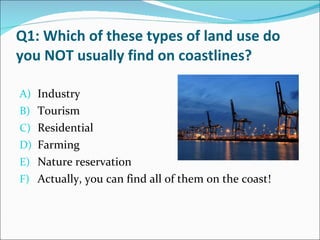
Q1: Which of these types of land use do you NOT usually find on coastlines? Industry Tourism Residential Farming Nature reservation Actually, you can find all of them on the coast!
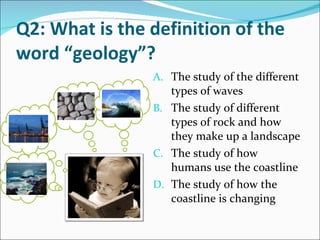
Q2: What is the definition of the word “geology”? The study of the different types of waves The study of different types of rock and how they make up a landscape The study of how humans use the coastline The study of how the coastline is changing
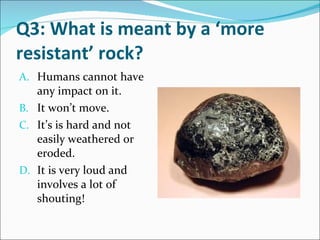
Q3: What is meant by a ‘more resistant’ rock? Humans cannot have any impact on it. It won’t move. It’s is hard and not easily weathered or eroded. It is very loud and involves a lot of shouting!
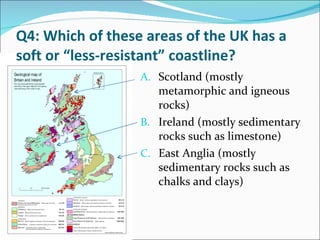
Q4: Which of these areas of the UK has a soft or “less-resistant” coastline? Scotland (mostly metamorphic and igneous rocks) Ireland (mostly sedimentary rocks such as limestone) East Anglia (mostly sedimentary rocks such as chalks and clays)
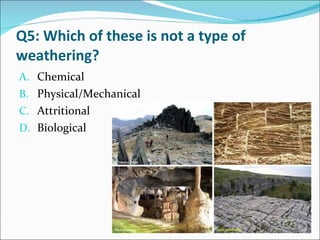
Q5: Which of these is not a type of weathering? Chemical Physical/Mechanical Attritional Biological
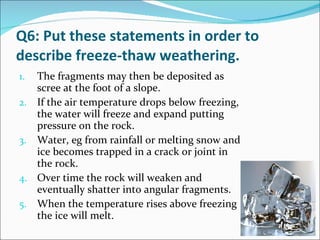
Q6: Put these statements in order to describe freeze-thaw weathering. The fragments may then be deposited as scree at the foot of a slope. If the air temperature drops below freezing, the water will freeze and expand putting pressure on the rock. Water, eg from rainfall or melting snow and ice becomes trapped in a crack or joint in the rock. Over time the rock will weaken and eventually shatter into angular fragments. When the temperature rises above freezing the ice will melt.
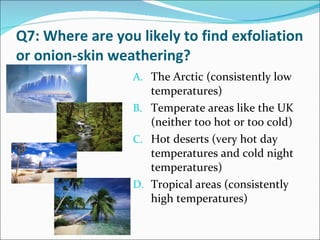
Q7: Where are you likely to find exfoliation or onion-skin weathering? The Arctic (consistently low temperatures) Temperate areas like the UK (neither too hot or too cold) Hot deserts (very hot day temperatures and cold night temperatures) Tropical areas (consistently high temperatures)
Q8: Rainwater is a weak carbonic acid, and is also called ‘acid rain’. TRUE or FALSE
Q9: Match the type of erosion to the correct definition. Attrition   Hydraulic Action  Abrasion  Solution Rocks and sediment hit each other and wear down Chemicals in the water dissolve the cliff Waves force air into cracks in the cliff and opens them up Rocks are thrown at the cliff by the waves
Q9: Match the type of erosion to the correct definition. Attrition   Hydraulic Action   Abrasion  Solution Rocks and sediment hit each other and wear down Chemicals in the water dissolve the cliff Waves force air into cracks in the cliff and opens them up Rocks are thrown at the cliff by the waves
Q9: Match the type of erosion to the correct definition. Attrition   Hydraulic Action  Abrasion   Solution Rocks and sediment hit each other and wear down Chemicals in the water dissolve the cliff Waves force air into cracks in the cliff and opens them up Rocks are thrown at the cliff by the waves
Q9: Match the type of erosion to the correct definition. Attrition   Hydraulic Action  Abrasion  Solution Rocks and sediment hit each other and wear down Chemicals in the water dissolve the cliff Waves force air into cracks in the cliff and opens them up Rocks are thrown at the cliff by the waves
Q10: Select the correct option in each sentence and add up their numbers to give you the ingredients for strong waves. The  stronger(1)/weaker(2)  the wind; The  longer(3)/shorter(4)  it blows for; The  longer(5)/shorter(6)  the fetch... ...then the  stronger  the waves will be!
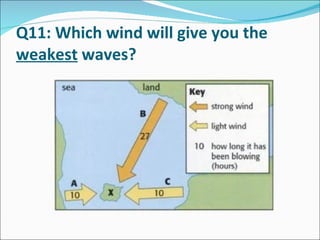
Q11: Which wind will give you the  weakest  waves?
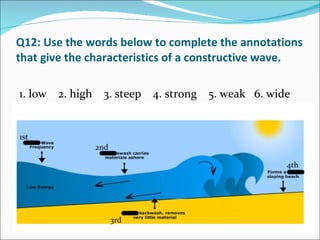
Q12: Use the words below to complete the annotations that give the characteristics of a constructive wave. 1. low  2. high  3. steep  4. strong  5. weak  6. wide 1st 2nd 3rd 4th
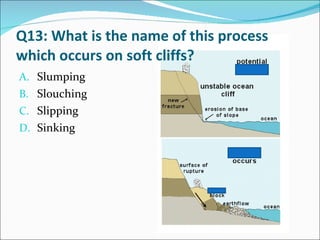
Q13: What is the name of this process which occurs on soft cliffs? Slumping Slouching Slipping Sinking
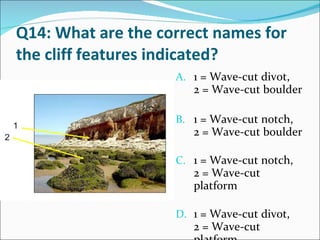
Q14: What are the correct names for the cliff features indicated?  1 = Wave-cut divot,  2 = Wave-cut boulder 1 = Wave-cut notch, 2 = Wave-cut boulder 1 = Wave-cut notch, 2 = Wave-cut platform 1 = Wave-cut divot, 2 = Wave-cut platform
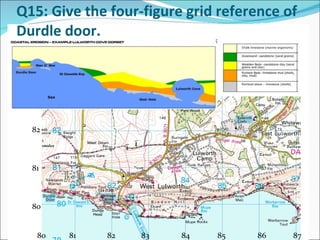
Q15: Give the four-figure grid reference of Durdle door. 80 81   82   83   84   85   86 87 82 81 80
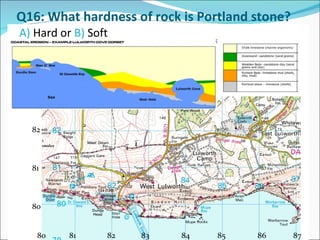
Q16: What hardness of rock is Portland stone?  A)  Hard or  B)  Soft  80 81   82   83   84   85   86 87 82 81 80
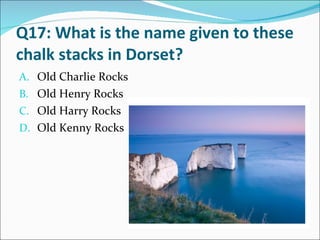
Q17: What is the name given to these chalk stacks in Dorset? Old Charlie Rocks Old Henry Rocks Old Harry Rocks Old Kenny Rocks
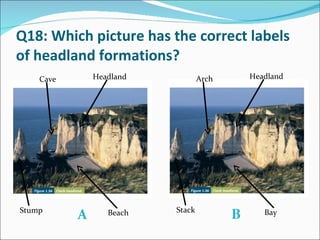
Q18: Which picture has the correct labels of headland formations? Stump Cave Headland Beach Stack Arch Headland Bay A B
Q19: Fill in the missing gaps that will give you a possible 6 mark answer to the question below. Using an example, describe and explain the coastal formations found on a headland. [6] The Foreland, a chalk headland on the _____Coast has all of the features of an eroded headland (caves, arches, stacks and stumps). Old Harry, is a particularly famous example of a _____ and Old Harry's Wife is an example of a stump. These features are formed when a headland is eroded by the waves - by _______________ and solution, particularly along lines of weakness in the rock. The erosion of a headland begins as erosion exploits a weakness in a rock forming a ____. If the weakness runs through the headland, two caves may form back to back, eventually forming an ____, an opening which passes right through the headland. Wave attack continues at the base of the arch, whilst weathering processes such as _________ attack the roof of the arch until it eventually collapses leaving a stack (an isolated column of rock). Again this is attacked by weathering and erosion processes until it collapses leaving the base, which forms a ______. 1. arch  2. cave  3. Dorset  4. freeze-thaw  5. hydraulic action  6. Norfolk  7. stump  8. stack
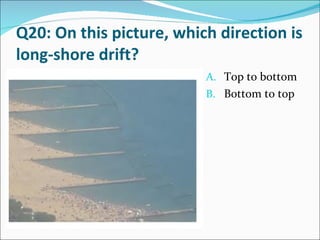
Q20: On this picture, which direction is long-shore drift? Top to bottom Bottom to top
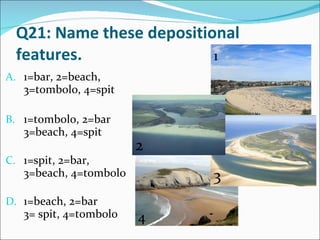
Q21: Name these depositional features. 1=bar, 2=beach,  3=tombolo, 4=spit 1=tombolo, 2=bar 3=beach, 4=spit 1=spit, 2=bar,  3=beach, 4=tombolo 1=beach, 2=bar  3= spit, 4=tombolo 1 2 3 4
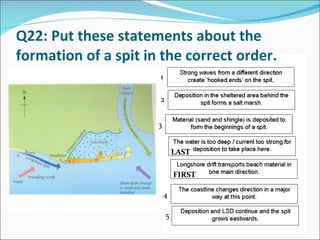
Q22: Put these statements about the formation of a spit in the correct order. 1 2 3 FIRST 4 5 LAST
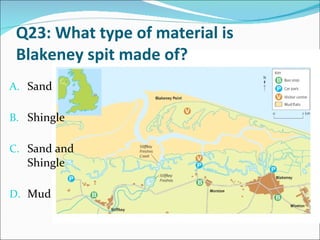
Q23: What type of material is Blakeney spit made of? Sand Shingle Sand and Shingle Mud
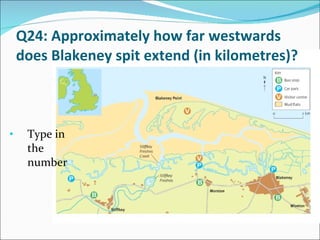
Q24: Approximately how far westwards does Blakeney spit extend (in kilometres)? Type in the number
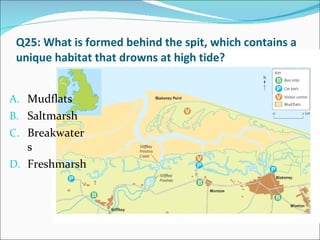
Q25: What is formed behind the spit, which contains a unique habitat that drowns at high tide? Mudflats Saltmarsh Breakwaters Freshmarsh
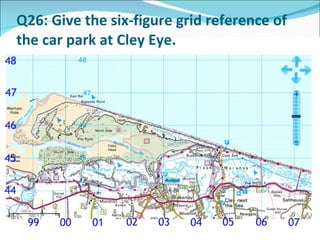
Q26: Give the six-figure grid reference of the car park at Cley Eye.
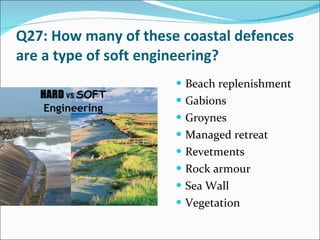
Q27: How many of these coastal defences are a type of soft engineering?  Beach replenishment Gabions Groynes Managed retreat Revetments Rock armour Sea Wall Vegetation
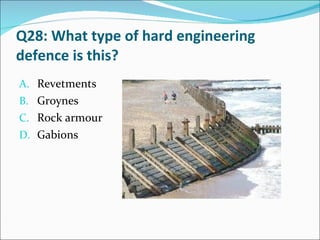
Q28: What type of hard engineering defence is this? Revetments Groynes Rock armour Gabions
Q29: Work out the total cost of these proposed coastal defences.  1000 metres of sea wall at £5000 a metre 10 groynes at £100,000 each 50000 m-sq of beach replenishment at £10 per m-sq Type in the answer in millions, e.g. 1 and a half million pounds (£1,500,000), type in “1.5”
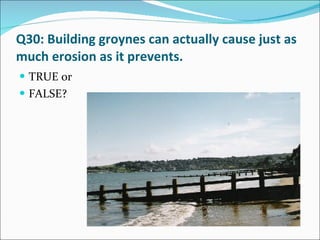
Q30: Building groynes can actually cause just as much erosion as it prevents.  TRUE or FALSE?
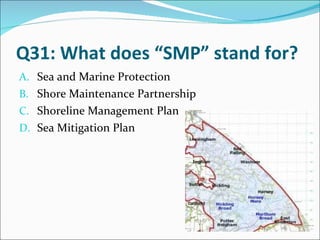
Q31: What does “SMP” stand for? Sea and Marine Protection Shore Maintenance Partnership Shoreline Management Plan Sea Mitigation Plan
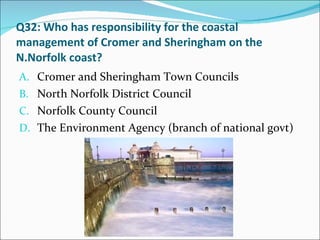
Q32: Who has responsibility for the coastal management of Cromer and Sheringham on the N.Norfolk coast? Cromer and Sheringham Town Councils North Norfolk District Council Norfolk County Council The Environment Agency (branch of national govt)
Q33: The four different policies of SMPs are given the following categories: Hold the line Advanced the line Managed realignment Managed retreat (leave to the sea) TRUE or FALSE?
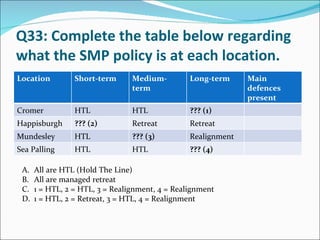
Q33: Complete the table below regarding what the SMP policy is at each location. All are HTL (Hold The Line) All are managed retreat 1 = HTL, 2 = HTL, 3 = Realignment, 4 = Realignment 1 = HTL, 2 = Retreat, 3 = HTL, 4 = Realignment Location Short-term Medium-term Long-term Main defences present Cromer HTL HTL ??? (1) Happisburgh ??? (2) Retreat Retreat Mundesley HTL ??? (3) Realignment Sea Palling HTL HTL ??? (4)
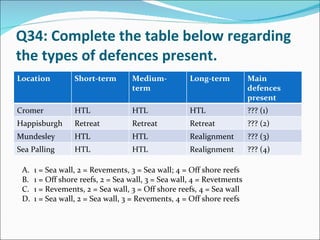
Q34: Complete the table below regarding the types of defences present. 1 = Sea wall, 2 = Revements, 3 = Sea wall; 4 = Off shore reefs 1 = Off shore reefs, 2 = Sea wall, 3 = Sea wall, 4 = Revetments 1 = Revements, 2 = Sea wall, 3 = Off shore reefs, 4 = Sea wall 1 = Sea wall, 2 = Sea wall, 3 = Revements, 4 = Off shore reefs Location Short-term Medium-term Long-term Main defences present Cromer HTL HTL HTL ??? (1) Happisburgh Retreat Retreat Retreat ??? (2) Mundesley HTL HTL Realignment ??? (3) Sea Palling HTL HTL Realignment ??? (4)
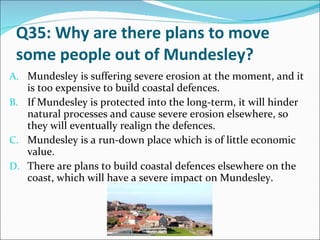
Q35: Why are there plans to move some people out of Mundesley? Mundesley is suffering severe erosion at the moment, and it is too expensive to build coastal defences. If Mundesley is protected into the long-term, it will hinder natural processes and cause severe erosion elsewhere, so they will eventually realign the defences. Mundesley is a run-down place which is of little economic value. There are plans to build coastal defences elsewhere on the coast, which will have a severe impact on Mundesley.
Q36: The SMPs for North Norfolk are generally sustainable environmentally and economically, but not so much socially. TRUE or FALSE

GCSE Geog OCR-B Theme 1 Coasts review

  • 1.
    A Qwizdom PPTby S.Rackley (FEHS 2011) for OCR-B Geog GCSE
  • 2.
    Q1: Which ofthese types of land use do you NOT usually find on coastlines? Industry Tourism Residential Farming Nature reservation Actually, you can find all of them on the coast!
  • 3.
    Q2: What isthe definition of the word “geology”? The study of the different types of waves The study of different types of rock and how they make up a landscape The study of how humans use the coastline The study of how the coastline is changing
  • 4.
    Q3: What ismeant by a ‘more resistant’ rock? Humans cannot have any impact on it. It won’t move. It’s is hard and not easily weathered or eroded. It is very loud and involves a lot of shouting!
  • 5.
    Q4: Which ofthese areas of the UK has a soft or “less-resistant” coastline? Scotland (mostly metamorphic and igneous rocks) Ireland (mostly sedimentary rocks such as limestone) East Anglia (mostly sedimentary rocks such as chalks and clays)
  • 6.
    Q5: Which ofthese is not a type of weathering? Chemical Physical/Mechanical Attritional Biological
  • 7.
    Q6: Put thesestatements in order to describe freeze-thaw weathering. The fragments may then be deposited as scree at the foot of a slope. If the air temperature drops below freezing, the water will freeze and expand putting pressure on the rock. Water, eg from rainfall or melting snow and ice becomes trapped in a crack or joint in the rock. Over time the rock will weaken and eventually shatter into angular fragments. When the temperature rises above freezing the ice will melt.
  • 8.
    Q7: Where areyou likely to find exfoliation or onion-skin weathering? The Arctic (consistently low temperatures) Temperate areas like the UK (neither too hot or too cold) Hot deserts (very hot day temperatures and cold night temperatures) Tropical areas (consistently high temperatures)
  • 9.
    Q8: Rainwater isa weak carbonic acid, and is also called ‘acid rain’. TRUE or FALSE
  • 10.
    Q9: Match thetype of erosion to the correct definition. Attrition Hydraulic Action Abrasion Solution Rocks and sediment hit each other and wear down Chemicals in the water dissolve the cliff Waves force air into cracks in the cliff and opens them up Rocks are thrown at the cliff by the waves
  • 11.
    Q9: Match thetype of erosion to the correct definition. Attrition Hydraulic Action Abrasion Solution Rocks and sediment hit each other and wear down Chemicals in the water dissolve the cliff Waves force air into cracks in the cliff and opens them up Rocks are thrown at the cliff by the waves
  • 12.
    Q9: Match thetype of erosion to the correct definition. Attrition Hydraulic Action Abrasion Solution Rocks and sediment hit each other and wear down Chemicals in the water dissolve the cliff Waves force air into cracks in the cliff and opens them up Rocks are thrown at the cliff by the waves
  • 13.
    Q9: Match thetype of erosion to the correct definition. Attrition Hydraulic Action Abrasion Solution Rocks and sediment hit each other and wear down Chemicals in the water dissolve the cliff Waves force air into cracks in the cliff and opens them up Rocks are thrown at the cliff by the waves
  • 14.
    Q10: Select thecorrect option in each sentence and add up their numbers to give you the ingredients for strong waves. The stronger(1)/weaker(2) the wind; The longer(3)/shorter(4) it blows for; The longer(5)/shorter(6) the fetch... ...then the stronger the waves will be!
  • 15.
    Q11: Which windwill give you the weakest waves?
  • 16.
    Q12: Use thewords below to complete the annotations that give the characteristics of a constructive wave. 1. low 2. high 3. steep 4. strong 5. weak 6. wide 1st 2nd 3rd 4th
  • 17.
    Q13: What isthe name of this process which occurs on soft cliffs? Slumping Slouching Slipping Sinking
  • 18.
    Q14: What arethe correct names for the cliff features indicated? 1 = Wave-cut divot, 2 = Wave-cut boulder 1 = Wave-cut notch, 2 = Wave-cut boulder 1 = Wave-cut notch, 2 = Wave-cut platform 1 = Wave-cut divot, 2 = Wave-cut platform
  • 19.
    Q15: Give thefour-figure grid reference of Durdle door. 80 81 82 83 84 85 86 87 82 81 80
  • 20.
    Q16: What hardnessof rock is Portland stone? A) Hard or B) Soft 80 81 82 83 84 85 86 87 82 81 80
  • 21.
    Q17: What isthe name given to these chalk stacks in Dorset? Old Charlie Rocks Old Henry Rocks Old Harry Rocks Old Kenny Rocks
  • 22.
    Q18: Which picturehas the correct labels of headland formations? Stump Cave Headland Beach Stack Arch Headland Bay A B
  • 23.
    Q19: Fill inthe missing gaps that will give you a possible 6 mark answer to the question below. Using an example, describe and explain the coastal formations found on a headland. [6] The Foreland, a chalk headland on the _____Coast has all of the features of an eroded headland (caves, arches, stacks and stumps). Old Harry, is a particularly famous example of a _____ and Old Harry's Wife is an example of a stump. These features are formed when a headland is eroded by the waves - by _______________ and solution, particularly along lines of weakness in the rock. The erosion of a headland begins as erosion exploits a weakness in a rock forming a ____. If the weakness runs through the headland, two caves may form back to back, eventually forming an ____, an opening which passes right through the headland. Wave attack continues at the base of the arch, whilst weathering processes such as _________ attack the roof of the arch until it eventually collapses leaving a stack (an isolated column of rock). Again this is attacked by weathering and erosion processes until it collapses leaving the base, which forms a ______. 1. arch 2. cave 3. Dorset 4. freeze-thaw 5. hydraulic action 6. Norfolk 7. stump 8. stack
  • 24.
    Q20: On thispicture, which direction is long-shore drift? Top to bottom Bottom to top
  • 25.
    Q21: Name thesedepositional features. 1=bar, 2=beach, 3=tombolo, 4=spit 1=tombolo, 2=bar 3=beach, 4=spit 1=spit, 2=bar, 3=beach, 4=tombolo 1=beach, 2=bar 3= spit, 4=tombolo 1 2 3 4
  • 26.
    Q22: Put thesestatements about the formation of a spit in the correct order. 1 2 3 FIRST 4 5 LAST
  • 27.
    Q23: What typeof material is Blakeney spit made of? Sand Shingle Sand and Shingle Mud
  • 28.
    Q24: Approximately howfar westwards does Blakeney spit extend (in kilometres)? Type in the number
  • 29.
    Q25: What isformed behind the spit, which contains a unique habitat that drowns at high tide? Mudflats Saltmarsh Breakwaters Freshmarsh
  • 30.
    Q26: Give thesix-figure grid reference of the car park at Cley Eye.
  • 31.
    Q27: How manyof these coastal defences are a type of soft engineering? Beach replenishment Gabions Groynes Managed retreat Revetments Rock armour Sea Wall Vegetation
  • 32.
    Q28: What typeof hard engineering defence is this? Revetments Groynes Rock armour Gabions
  • 33.
    Q29: Work outthe total cost of these proposed coastal defences. 1000 metres of sea wall at £5000 a metre 10 groynes at £100,000 each 50000 m-sq of beach replenishment at £10 per m-sq Type in the answer in millions, e.g. 1 and a half million pounds (£1,500,000), type in “1.5”
  • 34.
    Q30: Building groynescan actually cause just as much erosion as it prevents. TRUE or FALSE?
  • 35.
    Q31: What does“SMP” stand for? Sea and Marine Protection Shore Maintenance Partnership Shoreline Management Plan Sea Mitigation Plan
  • 36.
    Q32: Who hasresponsibility for the coastal management of Cromer and Sheringham on the N.Norfolk coast? Cromer and Sheringham Town Councils North Norfolk District Council Norfolk County Council The Environment Agency (branch of national govt)
  • 37.
    Q33: The fourdifferent policies of SMPs are given the following categories: Hold the line Advanced the line Managed realignment Managed retreat (leave to the sea) TRUE or FALSE?
  • 38.
    Q33: Complete thetable below regarding what the SMP policy is at each location. All are HTL (Hold The Line) All are managed retreat 1 = HTL, 2 = HTL, 3 = Realignment, 4 = Realignment 1 = HTL, 2 = Retreat, 3 = HTL, 4 = Realignment Location Short-term Medium-term Long-term Main defences present Cromer HTL HTL ??? (1) Happisburgh ??? (2) Retreat Retreat Mundesley HTL ??? (3) Realignment Sea Palling HTL HTL ??? (4)
  • 39.
    Q34: Complete thetable below regarding the types of defences present. 1 = Sea wall, 2 = Revements, 3 = Sea wall; 4 = Off shore reefs 1 = Off shore reefs, 2 = Sea wall, 3 = Sea wall, 4 = Revetments 1 = Revements, 2 = Sea wall, 3 = Off shore reefs, 4 = Sea wall 1 = Sea wall, 2 = Sea wall, 3 = Revements, 4 = Off shore reefs Location Short-term Medium-term Long-term Main defences present Cromer HTL HTL HTL ??? (1) Happisburgh Retreat Retreat Retreat ??? (2) Mundesley HTL HTL Realignment ??? (3) Sea Palling HTL HTL Realignment ??? (4)
  • 40.
    Q35: Why arethere plans to move some people out of Mundesley? Mundesley is suffering severe erosion at the moment, and it is too expensive to build coastal defences. If Mundesley is protected into the long-term, it will hinder natural processes and cause severe erosion elsewhere, so they will eventually realign the defences. Mundesley is a run-down place which is of little economic value. There are plans to build coastal defences elsewhere on the coast, which will have a severe impact on Mundesley.
  • 41.
    Q36: The SMPsfor North Norfolk are generally sustainable environmentally and economically, but not so much socially. TRUE or FALSE