Coastal Geomorphology

The shape of the coast and its landforms is a
  direct result of:
Geology + Marine processes + Sub-aerial processes + Man + (Climate)
Marine processes
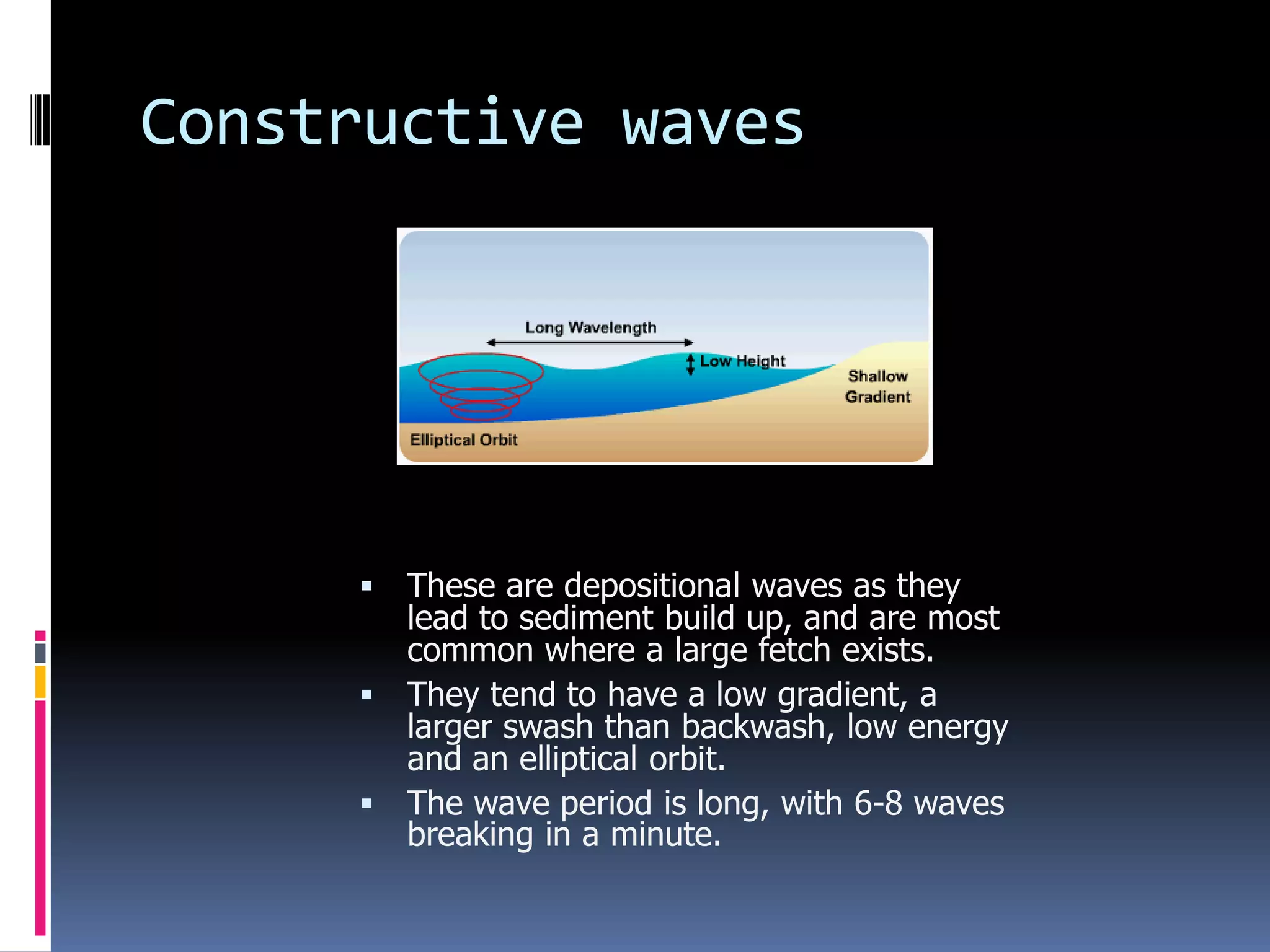
Constructive waves


      These are depositional waves as they
       lead to sediment build up, and are most
       common where a large fetch exists.
      They tend to have a low gradient, a
       larger swash than backwash, low energy
       and an elliptical orbit.
      The wave period is long, with 6-8 waves
       breaking in a minute.
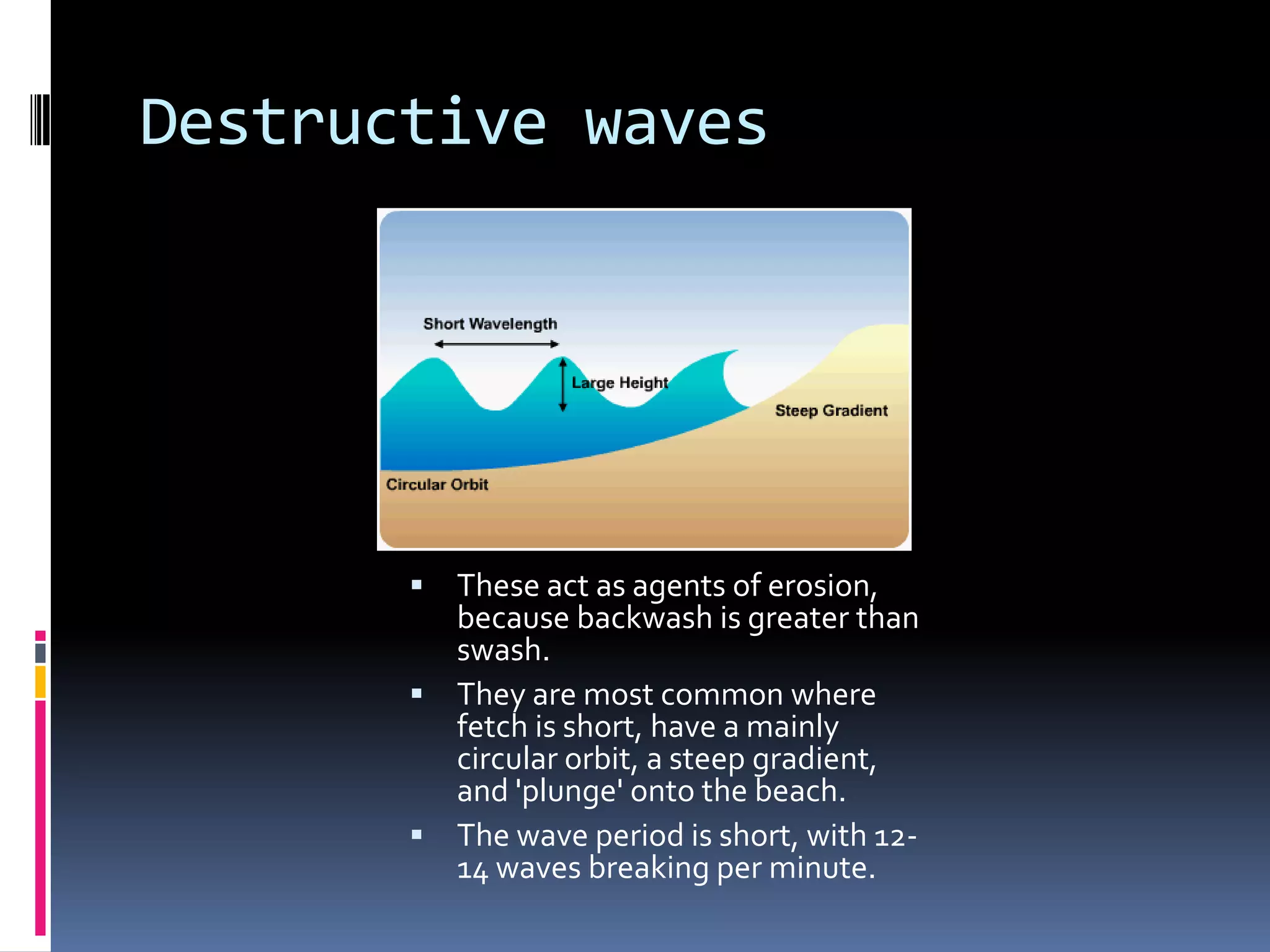
Destructive waves


        These act as agents of erosion,
         because backwash is greater than
         swash.
        They are most common where
         fetch is short, have a mainly
         circular orbit, a steep gradient,
         and 'plunge' onto the beach.
        The wave period is short, with 12-
         14 waves breaking per minute.
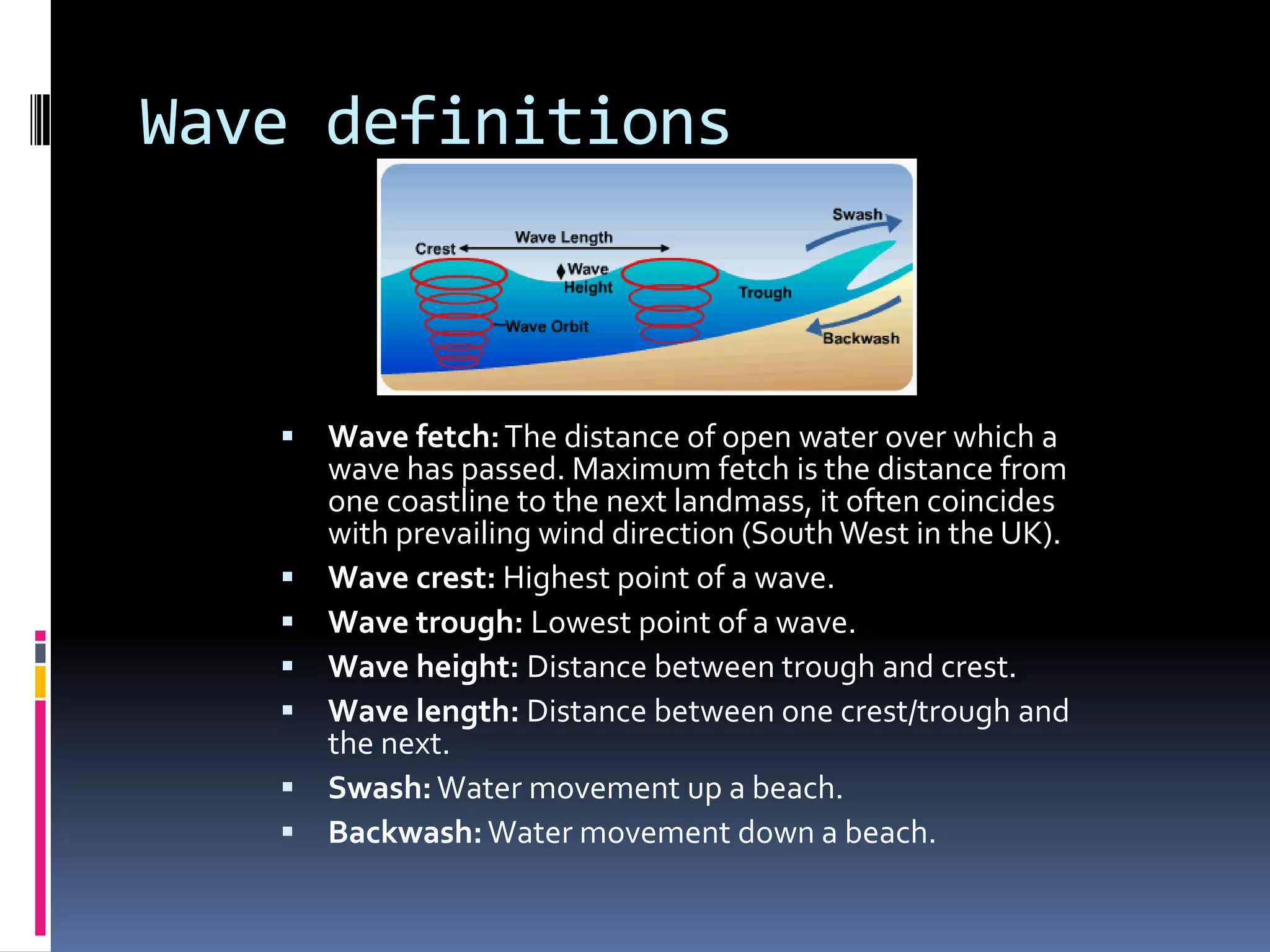
Wave definitions


      Wave fetch: The distance of open water over which a
       wave has passed. Maximum fetch is the distance from
       one coastline to the next landmass, it often coincides
       with prevailing wind direction (South West in the UK).
      Wave crest: Highest point of a wave.
      Wave trough: Lowest point of a wave.
      Wave height: Distance between trough and crest.
      Wave length: Distance between one crest/trough and
       the next.
      Swash: Water movement up a beach.
      Backwash: Water movement down a beach.
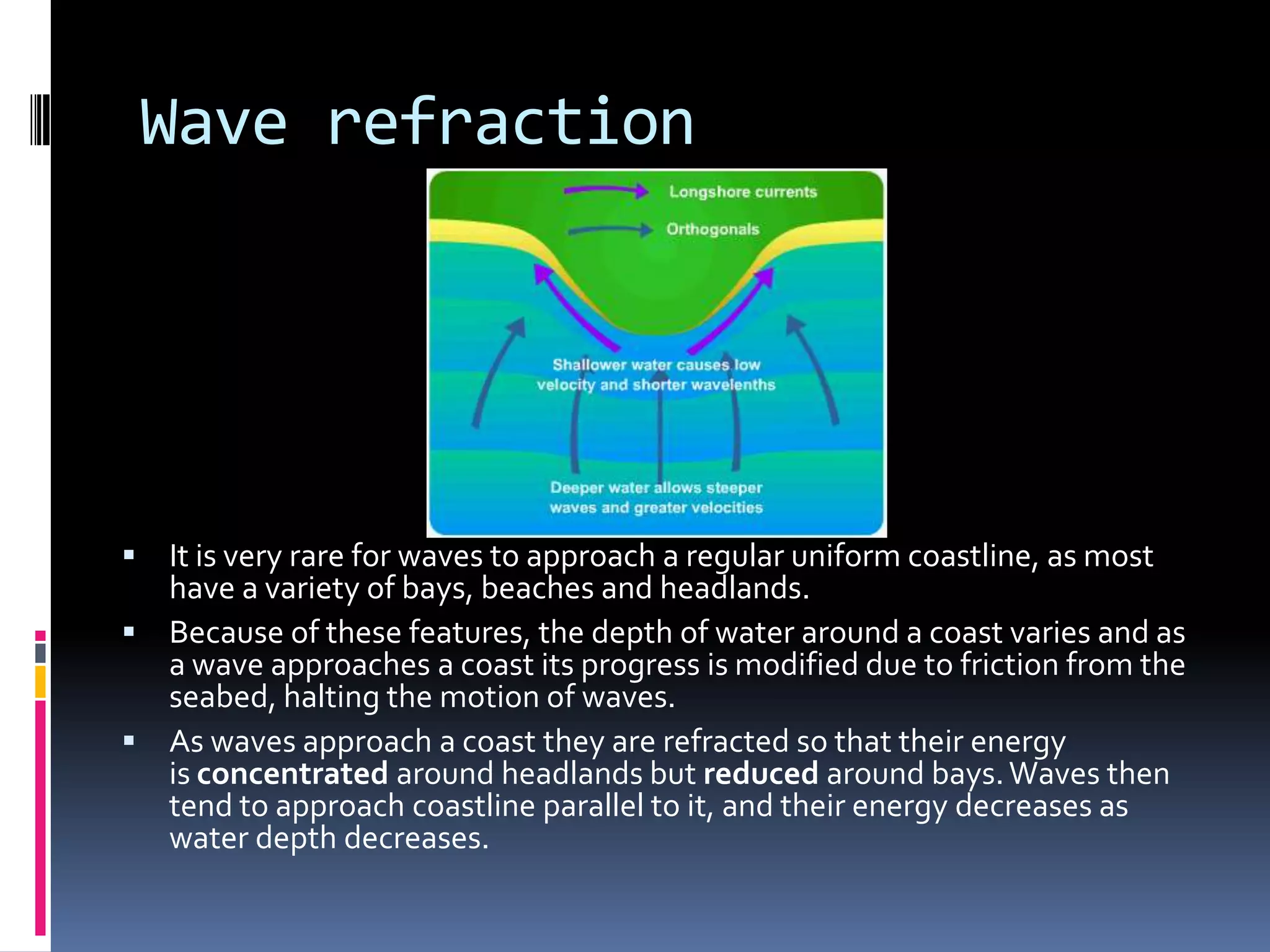
Wave refraction


 It is very rare for waves to approach a regular uniform coastline, as most
  have a variety of bays, beaches and headlands.
 Because of these features, the depth of water around a coast varies and as
  a wave approaches a coast its progress is modified due to friction from the
  seabed, halting the motion of waves.
 As waves approach a coast they are refracted so that their energy
  is concentrated around headlands but reduced around bays. Waves then
  tend to approach coastline parallel to it, and their energy decreases as
  water depth decreases.
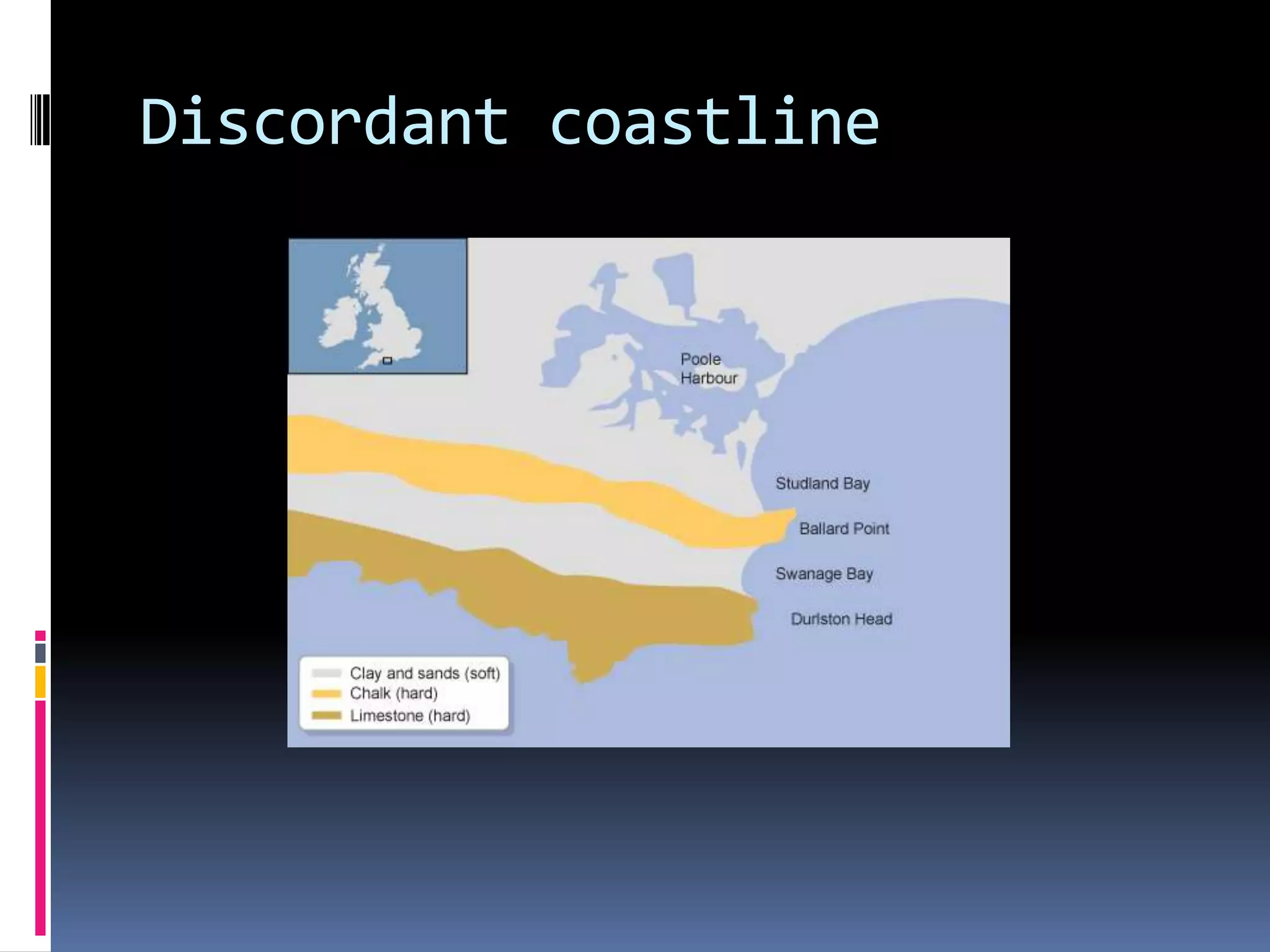
Discordant coastline
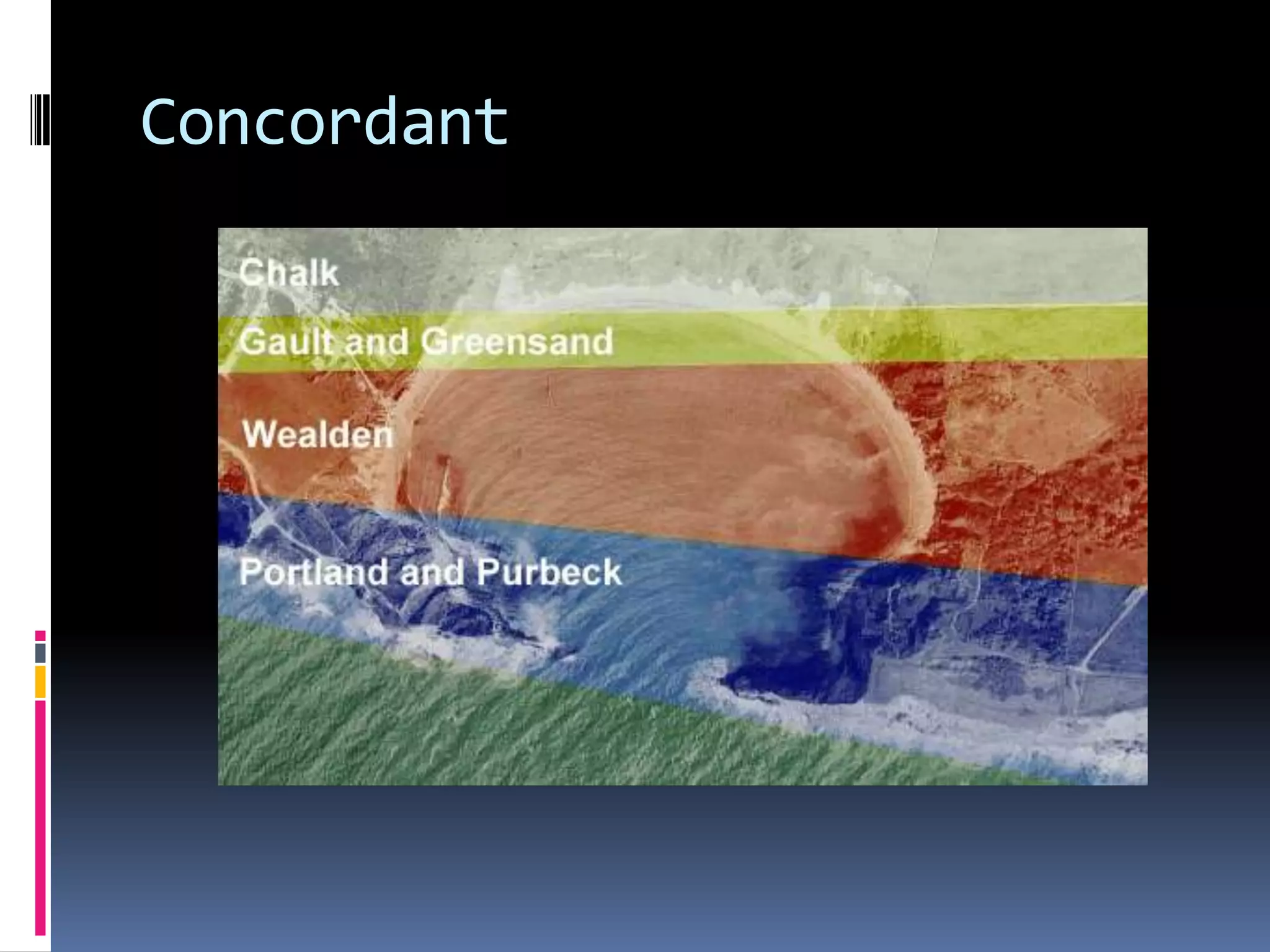
Concordant
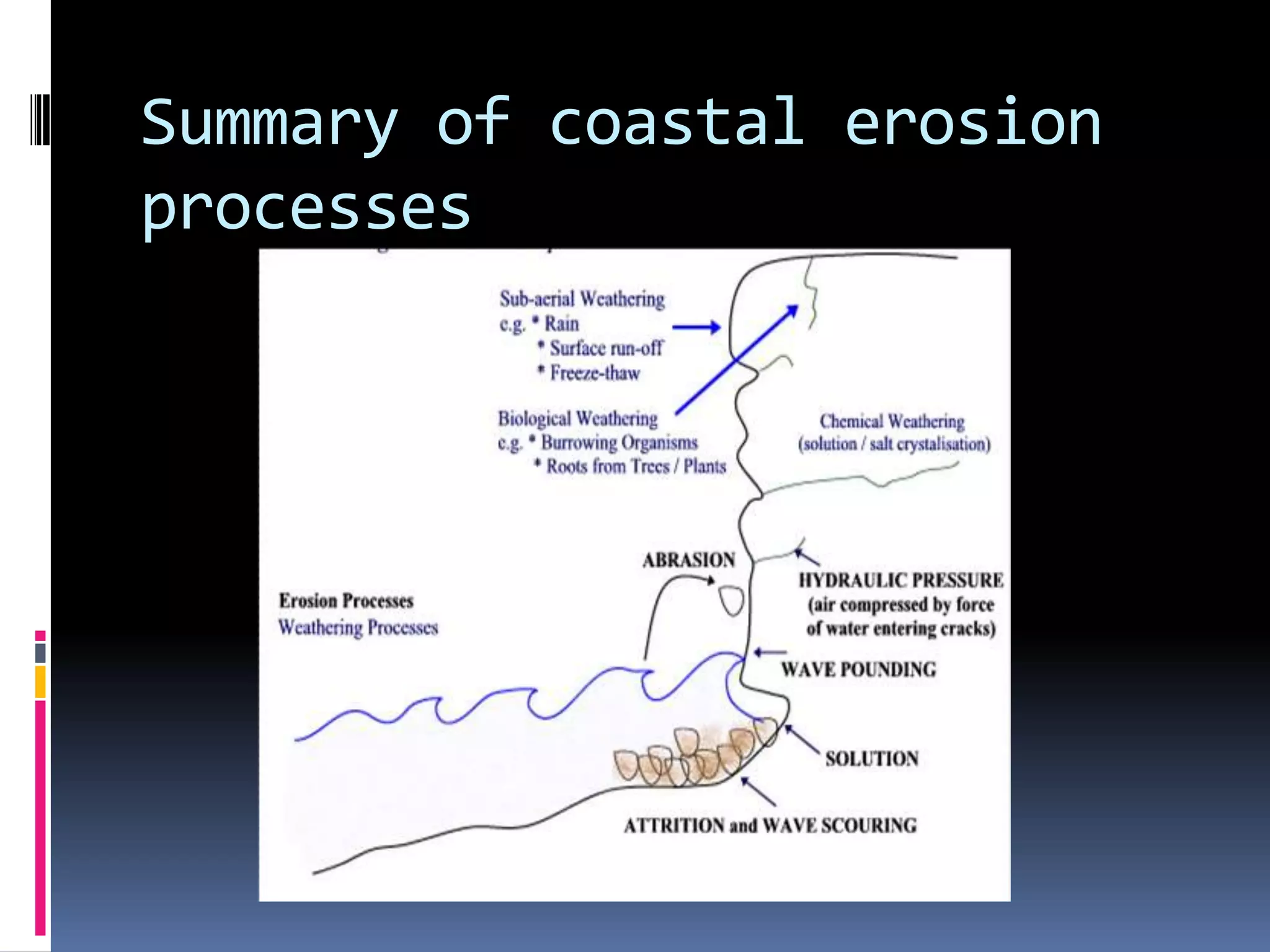
Summary of coastal erosion
processes
Coastal erosion
Abrasion/corrasion:
   When waves approach the coastline they are carrying material such as sand, shingle, pebbles and
    boulders. Abrasion occurs when this material is hurled against cliffs as waves hit them, wearing
    the cliff away.
Hydraulic pressure:
   Cliffs and rocks contain many lines of weakness in the form of joints and cracks. A parcel of air can
    become trapped/compressed in these cracks when water is thrown against it. The increase in
    pressure leads to a weakening/cracking of the rock.
Corrosion/solution:
   Seawater contains carbonic acid, which is capable of dissolving limestone. The evaporation of salts
    in seawater produces crystals and their formation can lead to the disintegration of rocks.
Sub-aerial:
   Coastal erosional processes that are not linked to the action of the sea. Erosion occurs via rain,
    weathering by wind and frost. Its impact is often seen in soil creep, slumping and landslides.
Human activity:
   Much building and recreation occurs at the coast, and this increases pressure on cliff tops, making
    them more liable to erosion and subsidence. The building of sea defences upsets the dynamic
    equilibrium of the coastline.
Influences on the rate of
erosion
 The rate at which a stretch of coastline is
  eroded is related to the following factors:
   The point at which the wave breaks - (if at the foot of a
      cliff, the cliff is subject to maximum energy and most
      erosion).
     Steepness of the wave.
     Depth of sea, fetch, aspect.
     Amount of beach material - (a wide beach protects a
      cliff more than an arrow beach).
     Rock type and structure - (hard rock such as granite is
      far more resistant to erosion than soft rocks, such as
      clay).
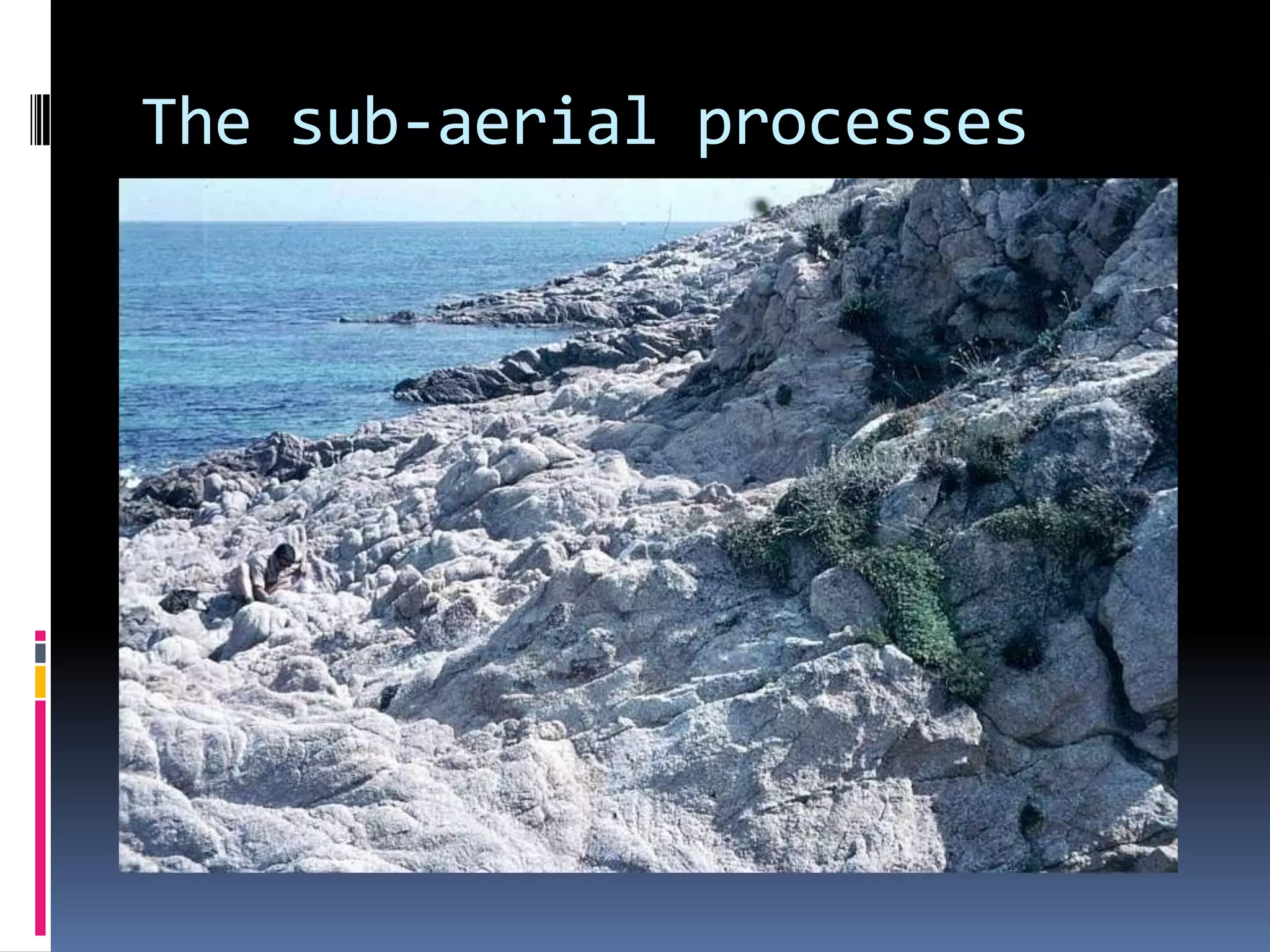
The sub-aerial processes
Sub-aerial processes

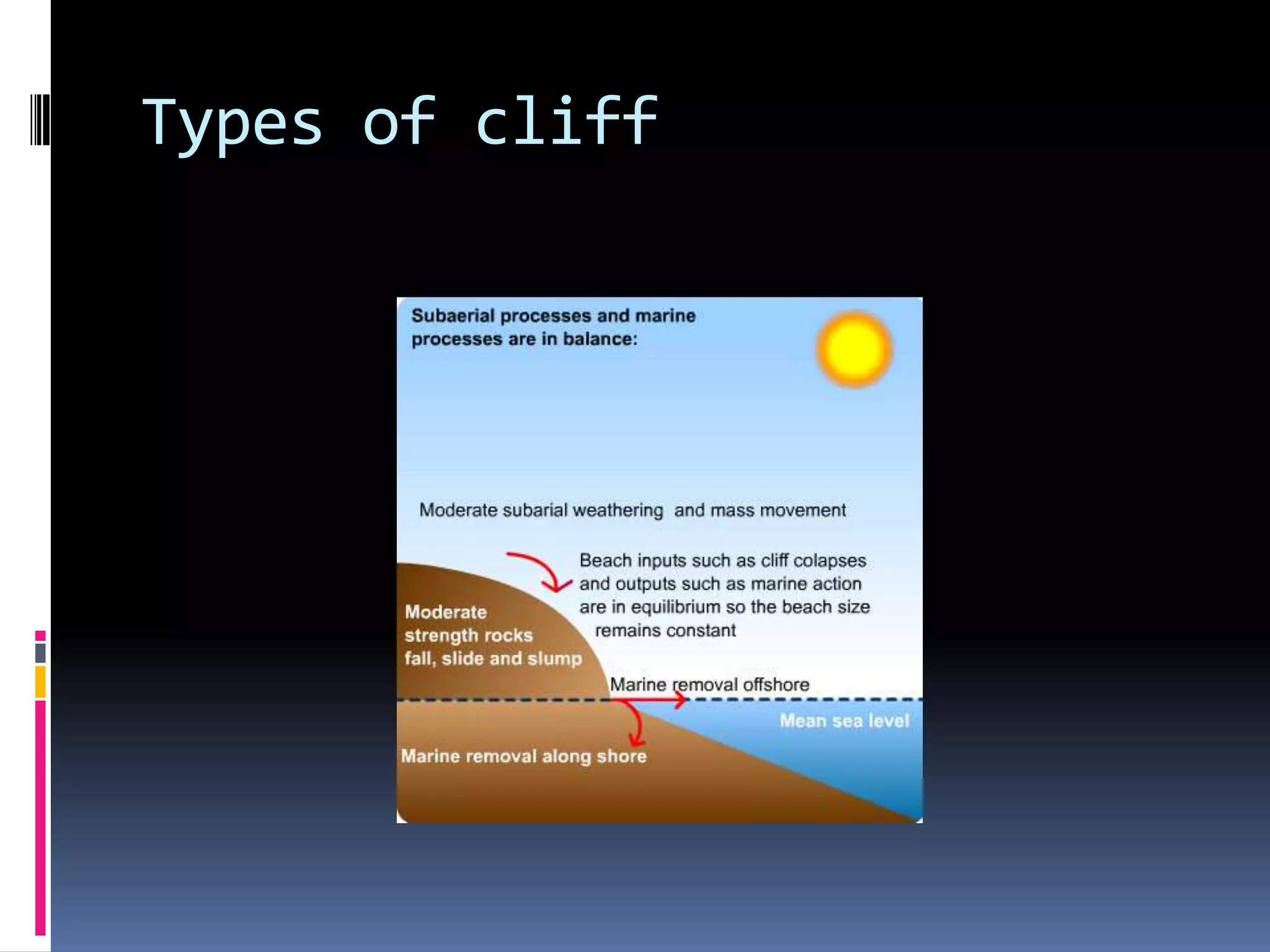
      Sub-aerial processes = weathering + mass
                 movement + humans*

Weathering = physical + chemical
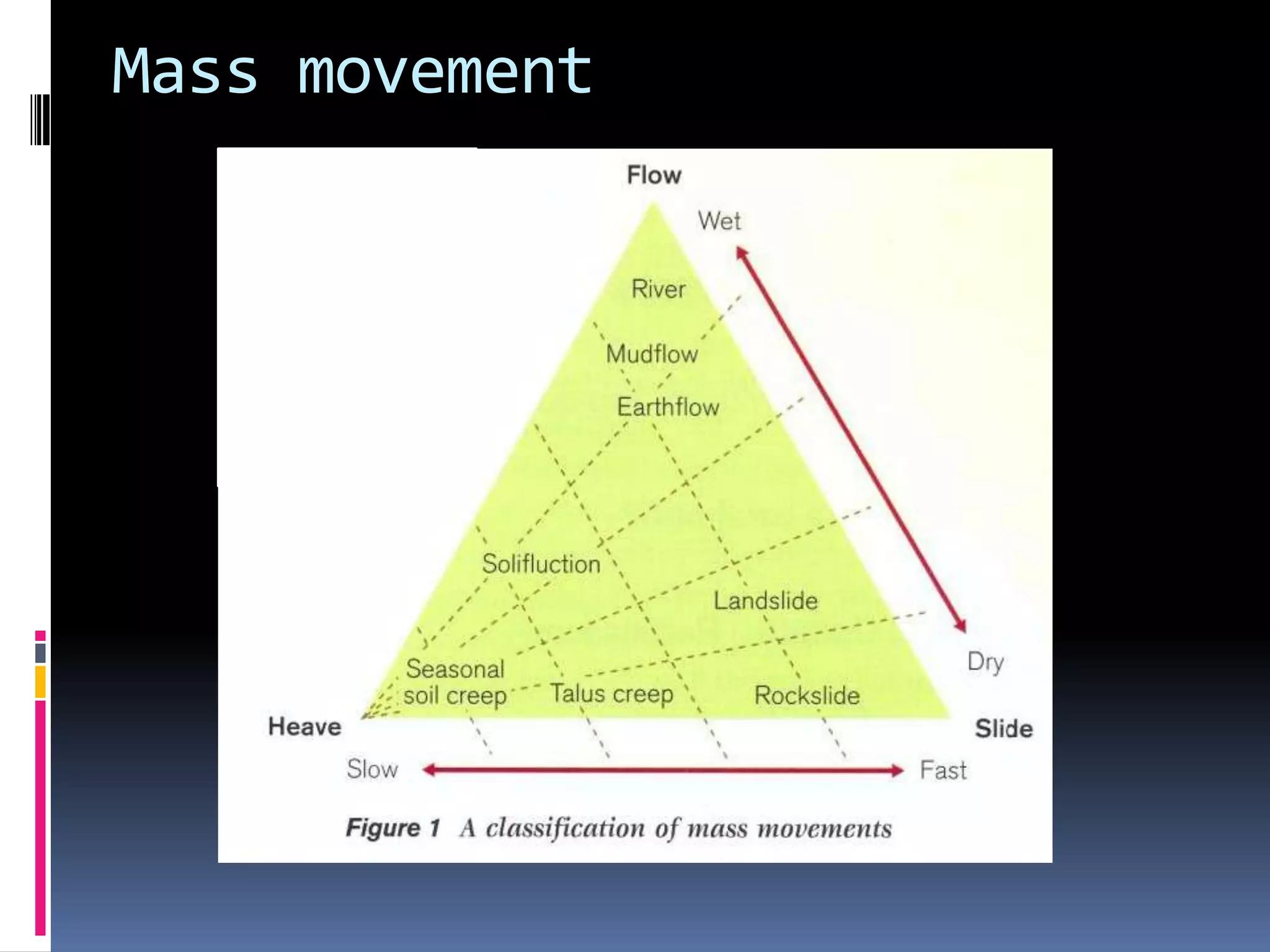
Mass movement = falls + flows + slides + slumps + creep


*Pressure on cliffs (construction work)
  Sea Defences (although designed to reduce erosion - in some
  instances (e.g. the use of groynes) can increase erosion by
  starving down stream areas of sediment
Weathering – basic summary
 Weathering Processes:
 Weathering is the breaking up of rock in situ
 Freeze-thaw processes (as water freezes and thaws in
  cracks in cliffs, the expansion and contraction forces the
  rock open, making them more susceptible to the action of
  waves).

 Chemical weathering - water running down the face of
  cliffs, either from surface runoff from above or from rainfall
  can result in solution so that rock cracks are enlarged,
  leaving the remaining rock loosened
  Biological weathering - burrowing organisms and roots of
  vegetation forces open cracks, making them more
  susceptible to wave erosion) [NOT sub-aerial]
  Human Activity
The weathering processes
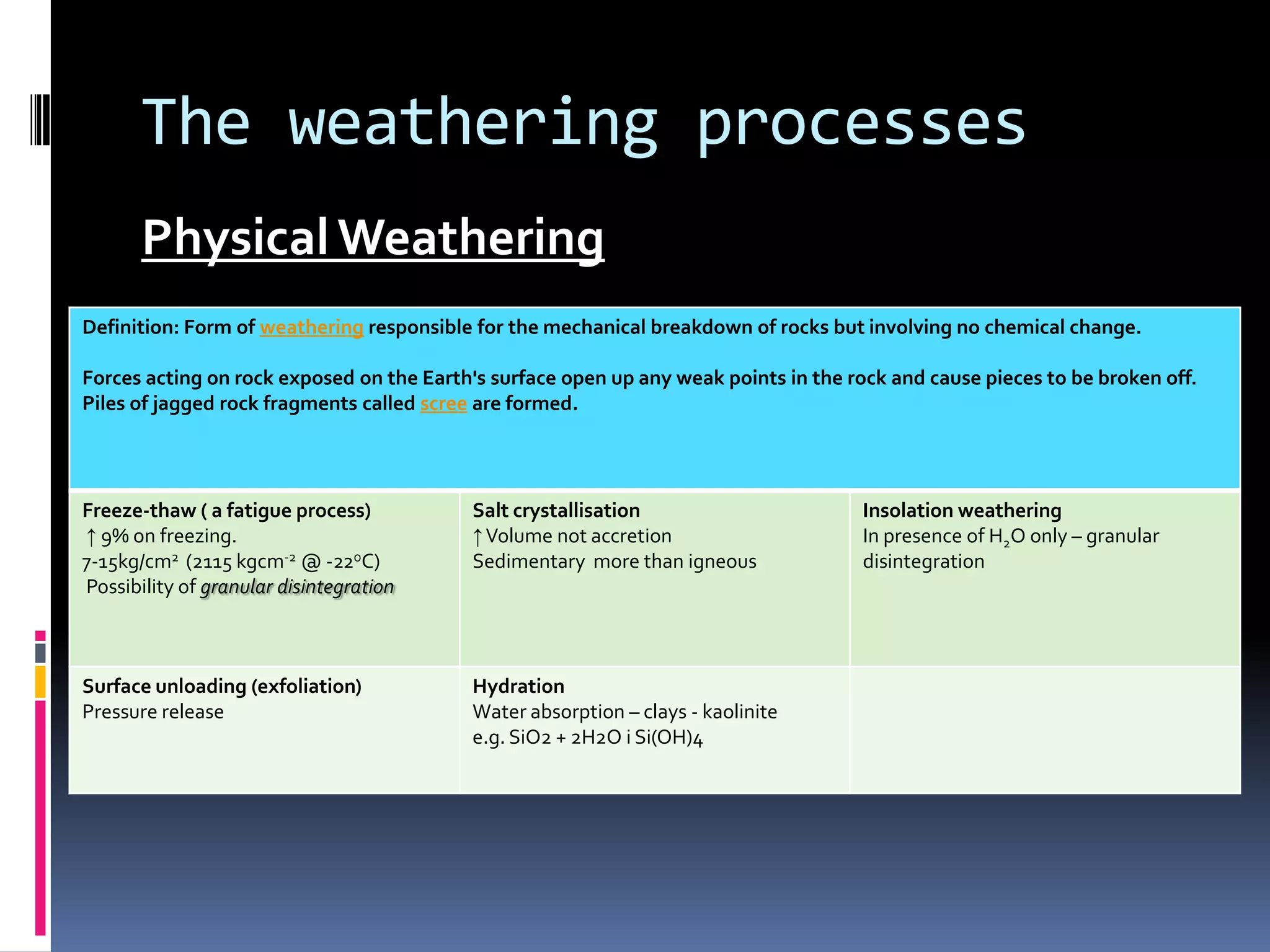
       Physical Weathering
Definition: Form of weathering responsible for the mechanical breakdown of rocks but involving no chemical change.

Forces acting on rock exposed on the Earth's surface open up any weak points in the rock and cause pieces to be broken off.
Piles of jagged rock fragments called scree are formed.


Freeze-thaw ( a fatigue process)           Salt crystallisation                       Insolation weathering
↑ 9% on freezing.                          ↑ Volume not accretion                     In presence of H2O only – granular
7-15kg/cm2 (2115 kgcm-2 @ -22oC)           Sedimentary more than igneous              disintegration
Possibility of granular disintegration


Surface unloading (exfoliation)            Hydration
Pressure release                           Water absorption – clays - kaolinite
                                           e.g. SiO2 + 2H2O i Si(OH)4
The weathering processes

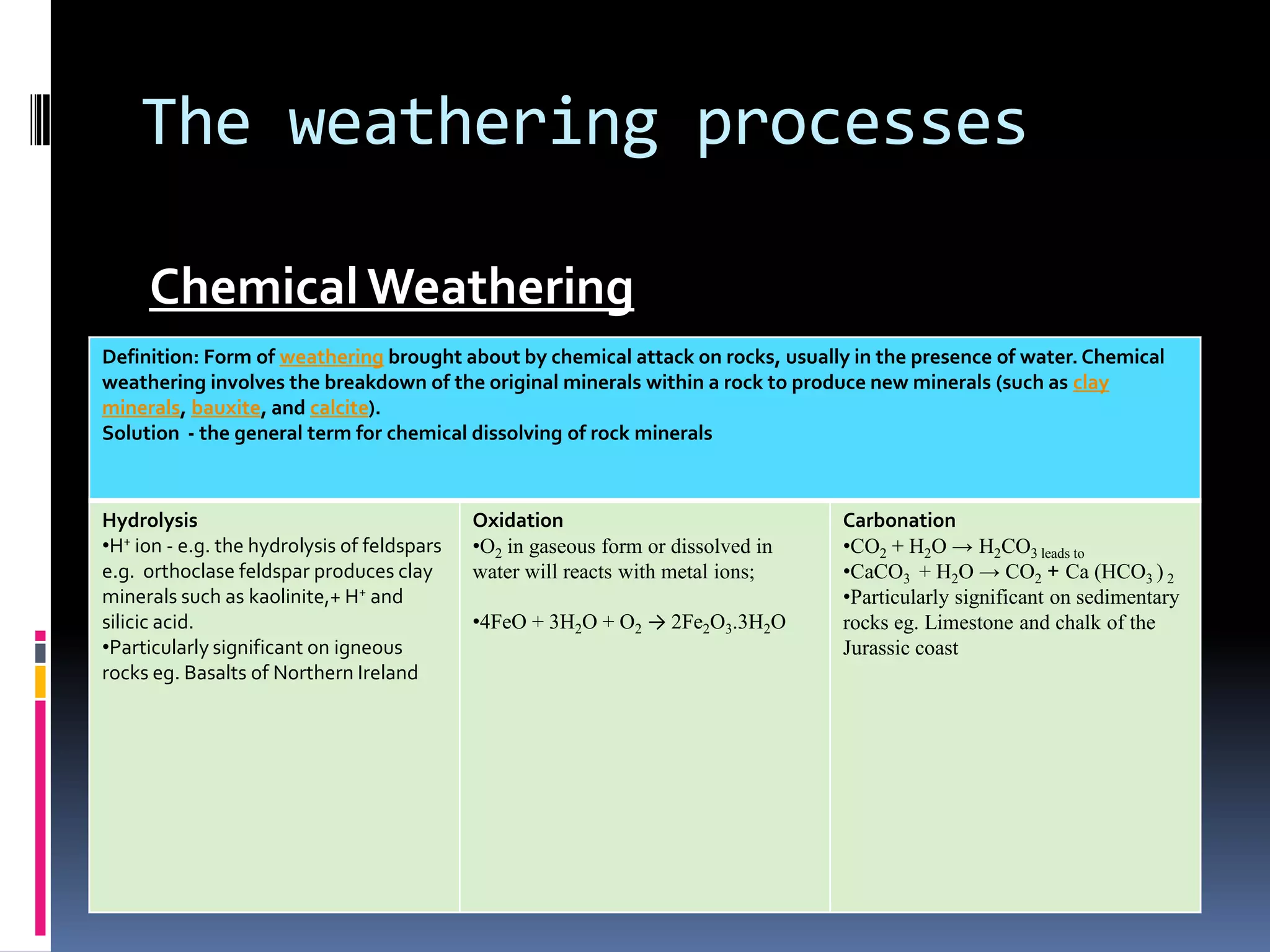
     Chemical Weathering
Definition: Form of weathering brought about by chemical attack on rocks, usually in the presence of water. Chemical
weathering involves the breakdown of the original minerals within a rock to produce new minerals (such as clay
minerals, bauxite, and calcite).
Solution - the general term for chemical dissolving of rock minerals


Hydrolysis                                   Oxidation                             Carbonation
•H+ ion - e.g. the hydrolysis of feldspars   •O2 in gaseous form or dissolved in   •CO2 + H2O → H2CO3 leads to
e.g. orthoclase feldspar produces clay       water will reacts with metal ions;    •CaCO3 + H2O → CO2 + Ca (HCO3 ) 2
minerals such as kaolinite,+ H+ and                                                •Particularly significant on sedimentary
silicic acid.                                •4FeO + 3H2O + O2 → 2Fe2O3.3H2O       rocks eg. Limestone and chalk of the
•Particularly significant on igneous                                               Jurassic coast
rocks eg. Basalts of Northern Ireland
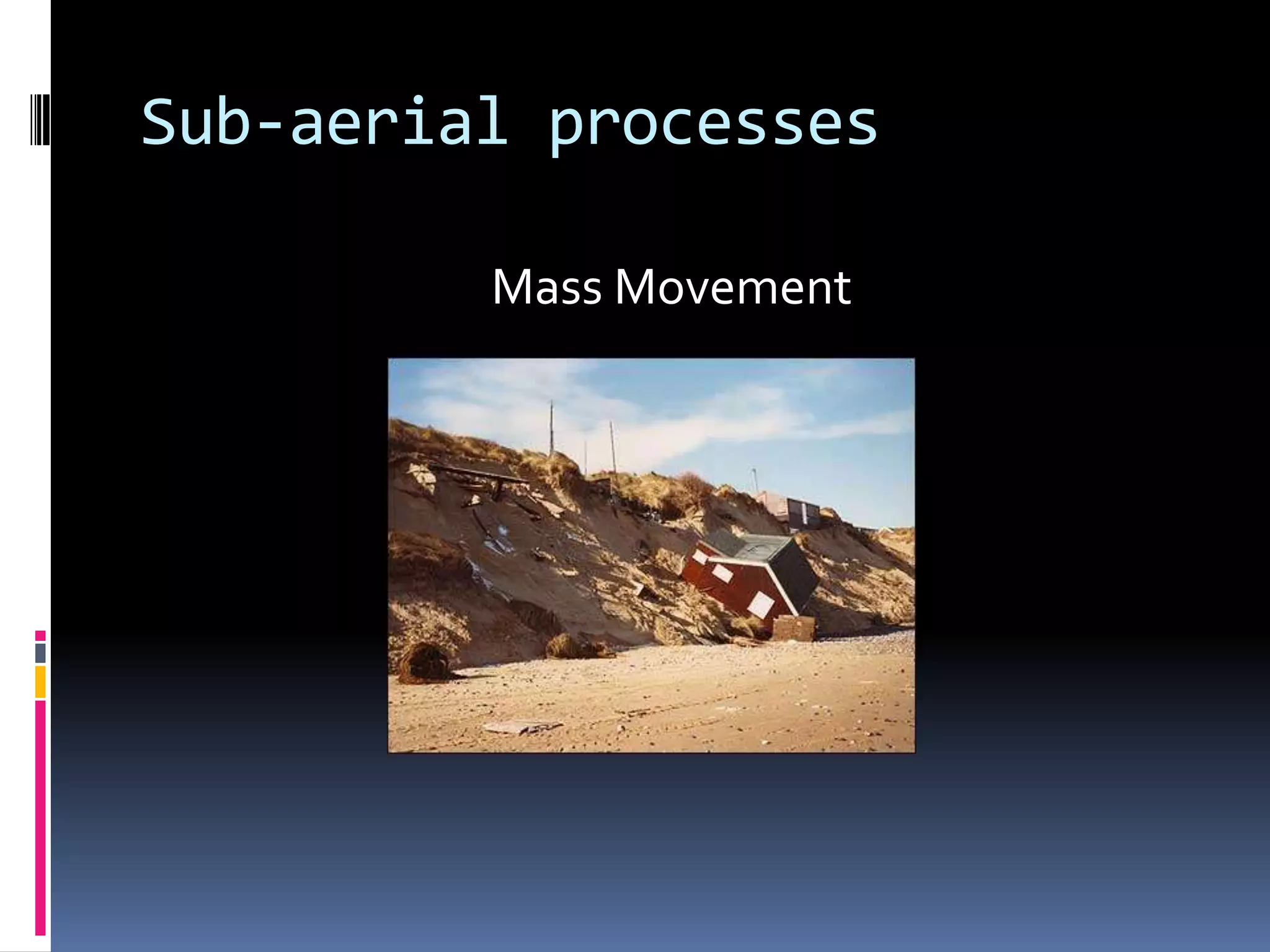
Sub-aerial processes

         Mass Movement
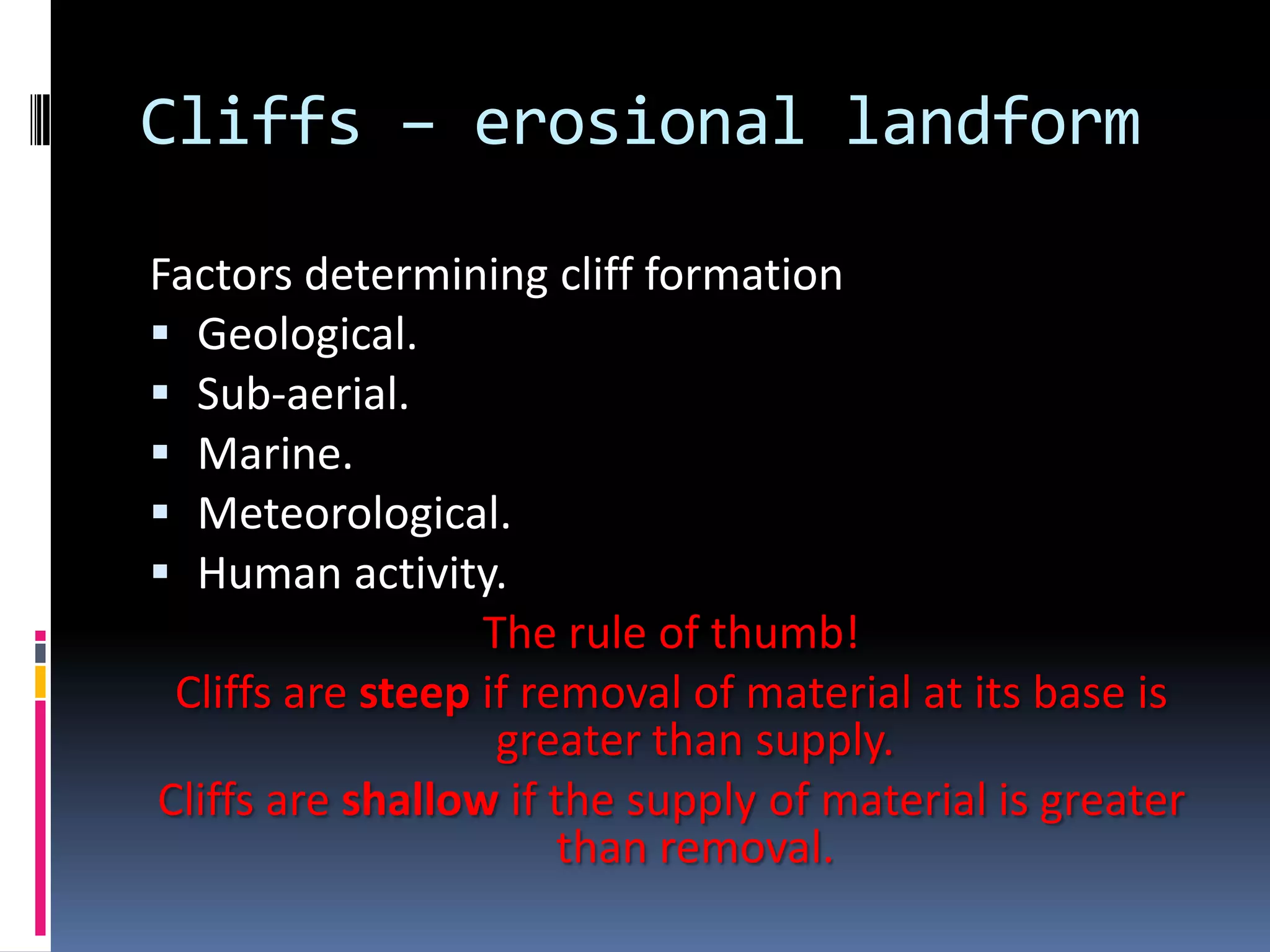
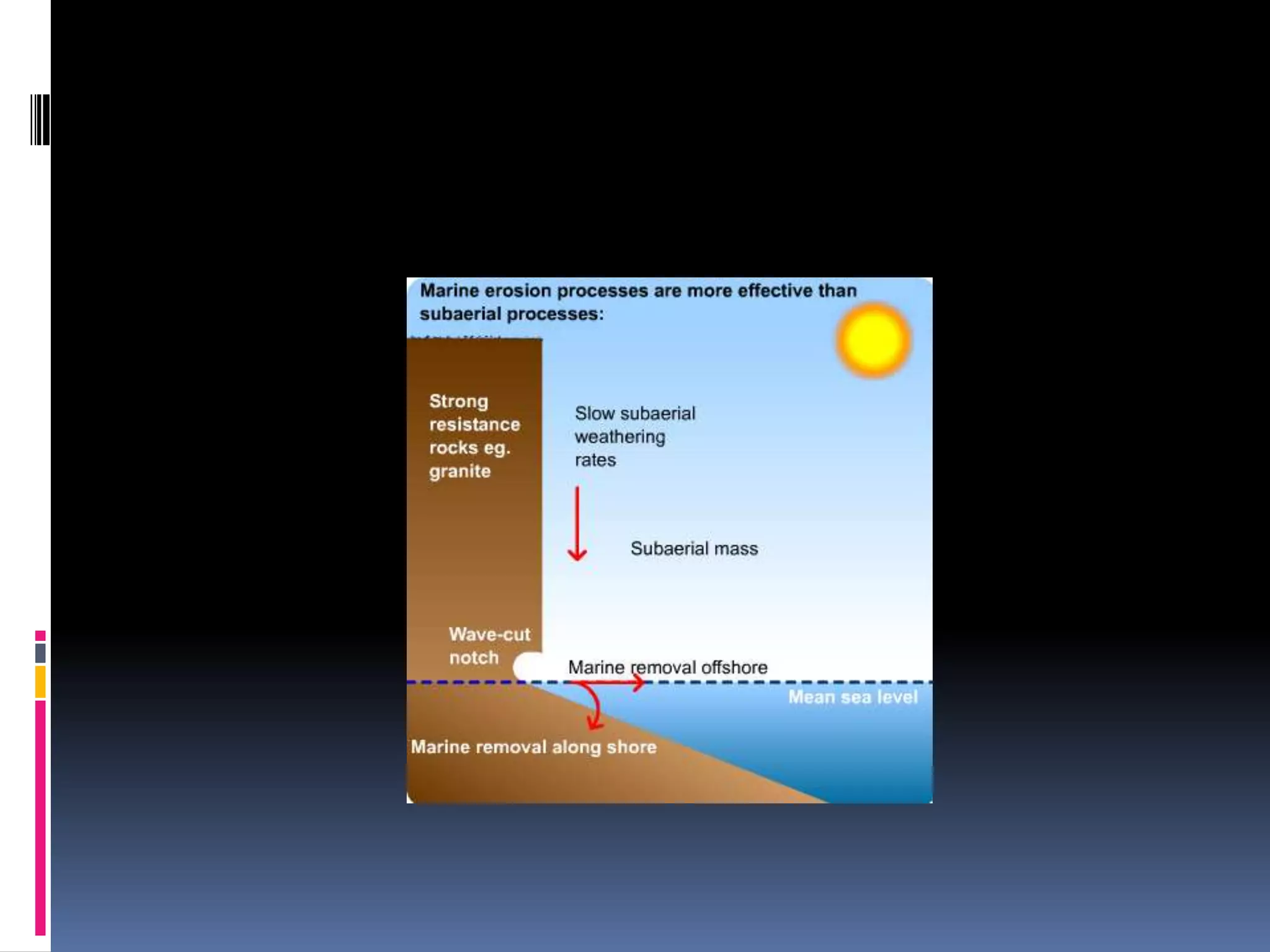
Cliffs – erosional landform

Factors determining cliff formation
 Geological.
 Sub-aerial.
 Marine.
 Meteorological.
 Human activity.
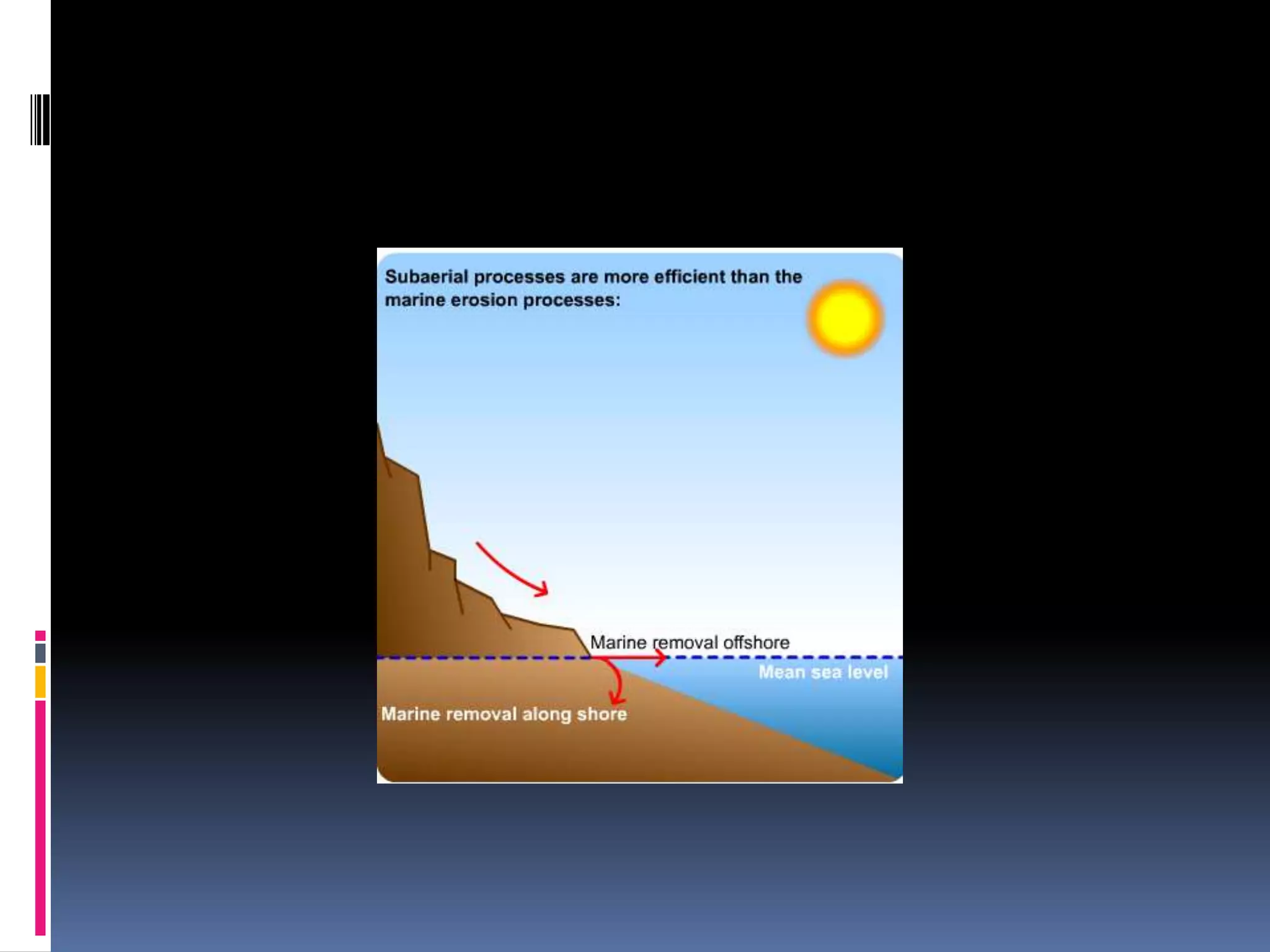
                  The rule of thumb!
 Cliffs are steep if removal of material at its base is
                   greater than supply.
Cliffs are shallow if the supply of material is greater
                       than removal.
Mass movement
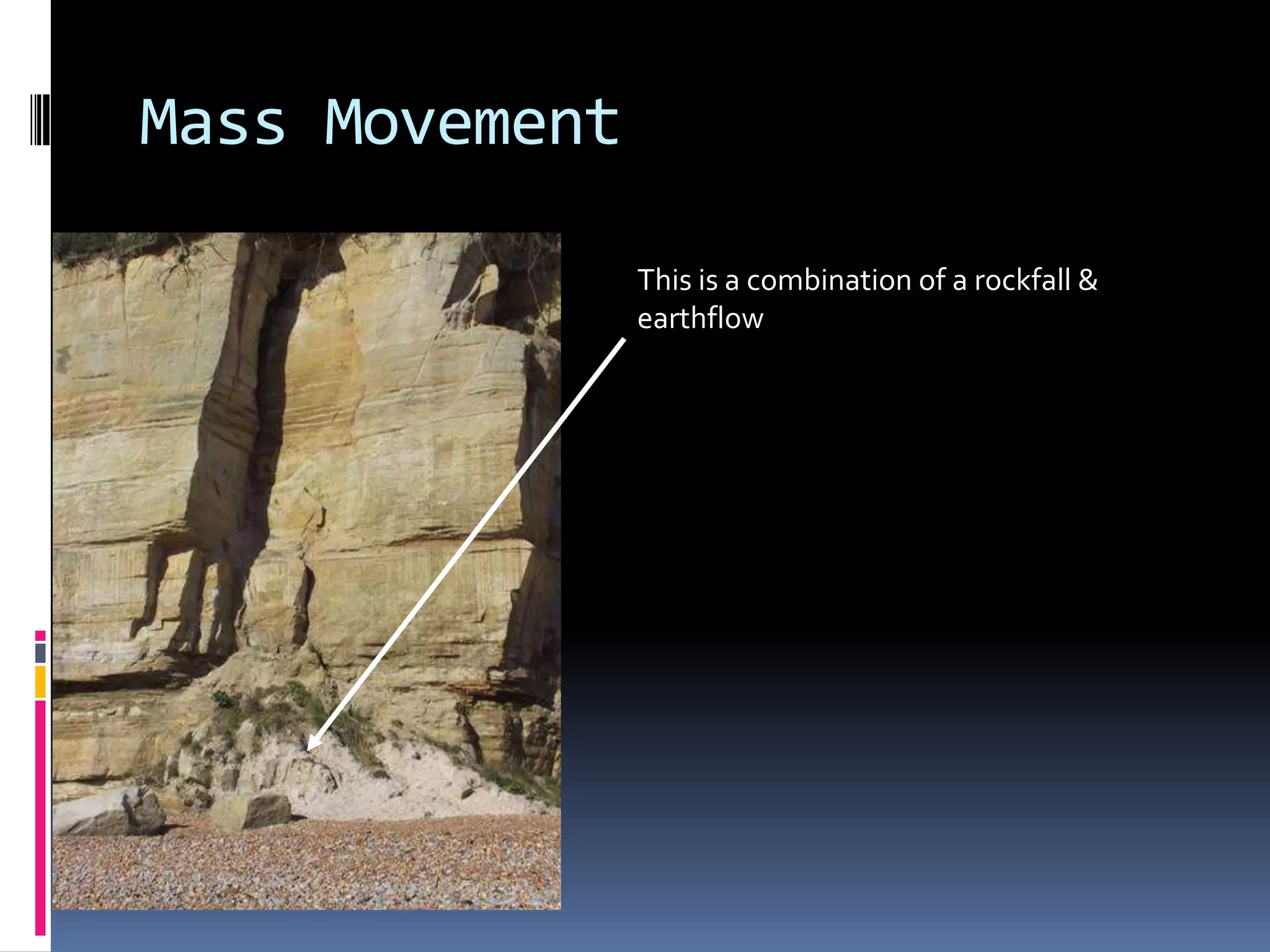
Mass Movement

                This is a combination of a rockfall &
                earthflow
Types of cliff
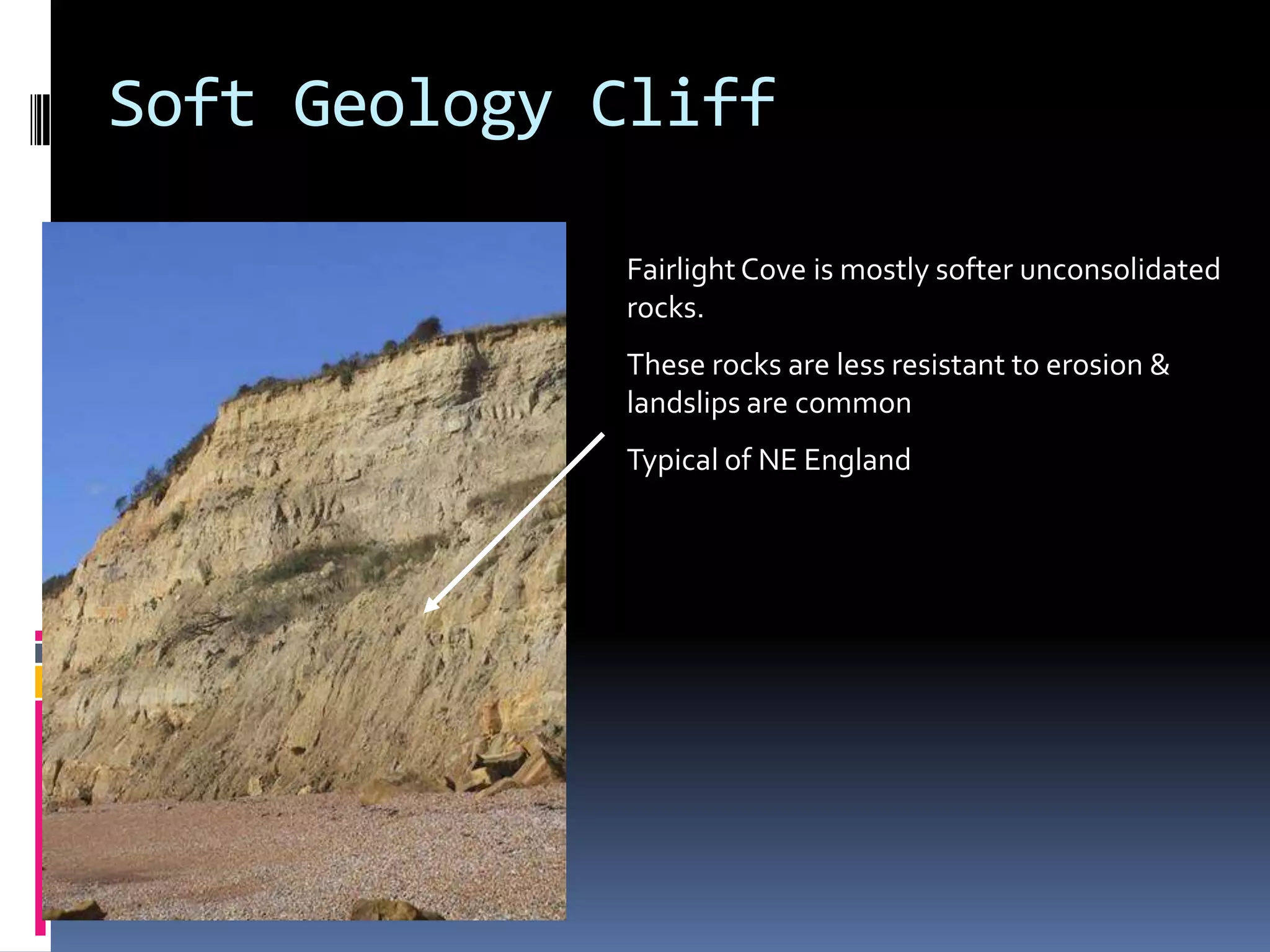
Soft Geology Cliff

             Fairlight Cove is mostly softer unconsolidated
             rocks.
             These rocks are less resistant to erosion &
             landslips are common
             Typical of NE England
Cliff & Wave Cut Platform

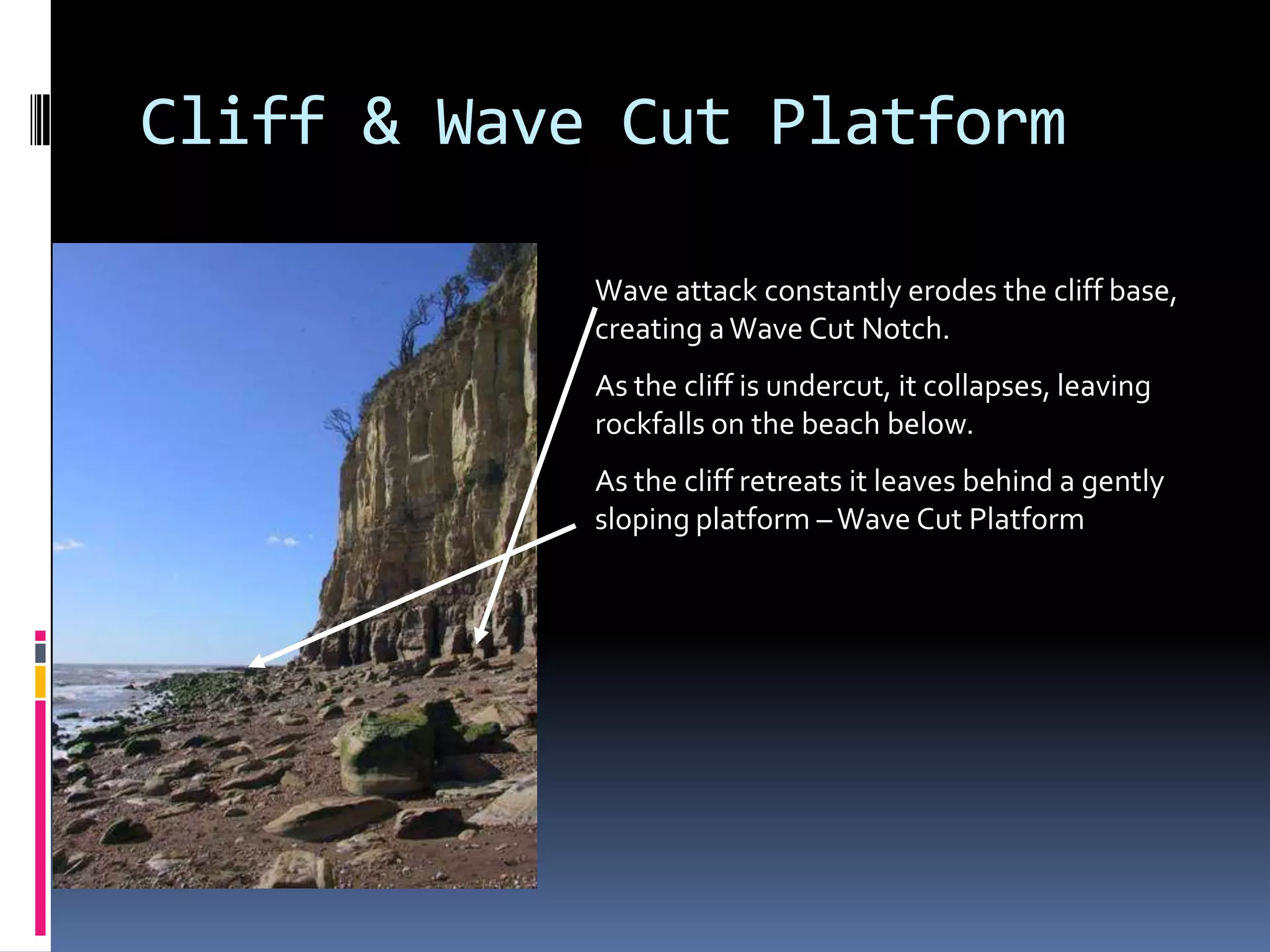
            Wave attack constantly erodes the cliff base,
            creating a Wave Cut Notch.
            As the cliff is undercut, it collapses, leaving
            rockfalls on the beach below.
            As the cliff retreats it leaves behind a gently
            sloping platform – Wave Cut Platform
Rotational Slumping

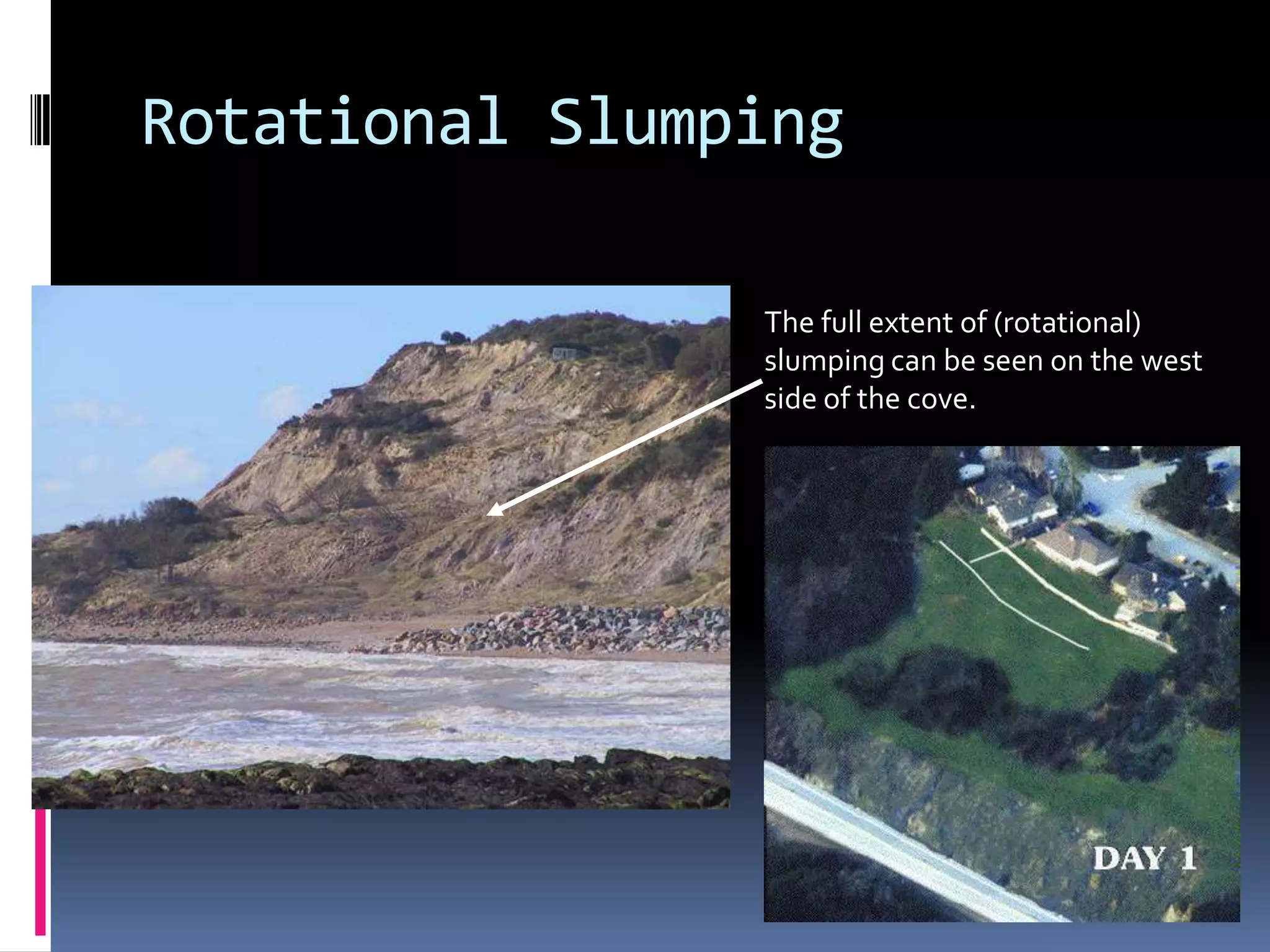
                The full extent of (rotational)
                slumping can be seen on the west
                side of the cove.
Coastal transport
Coastal Transport
Weathering and erosion at the coast produces large amounts of material which is
moved along the coast line and out to sea by the action of waves.
Up and down the beach: Material is moved up the beach in the swash and back
down the beach in the backwash. Constructive waves move large amounts of
material up the beach as they have a strong swash, whereas destructive waves
move large amounts of material down the beach due to their strong backwash.
The movement of material by waves: The movement of material within the waves
themselves depends on (i) the size of the material and (ii) the energy available for
transporting the material. There are four possible types of transport within the
water:

Solution - material carried dissolved in the water
Suspension - fine material carried suspended within the water itself
Saltation - material which is too heavy to be continuously held in suspension is
bounced along the sea bed.
Traction - the heaviest material is simply rolled along the sea bed
Coastal transport
                    1. Waves break on
                    the beach at an
                    angle controlled by
                    the prevailing wind
                    direction. Material is
                    moved up the beach
                    in the swash.
                    2. Material then
                    moves straight back
                    down the beach in
                    the backwash under
                    the influence of
                    gravity.
                    3. As the processes
                    continues material
                    moves along the
                    coast in a zig-zag
                    movement.

Igcse coastal geomorph

  • 1.
    Coastal Geomorphology The shapeof the coast and its landforms is a direct result of: Geology + Marine processes + Sub-aerial processes + Man + (Climate)
  • 2.
  • 3.
    Constructive waves  These are depositional waves as they lead to sediment build up, and are most common where a large fetch exists.  They tend to have a low gradient, a larger swash than backwash, low energy and an elliptical orbit.  The wave period is long, with 6-8 waves breaking in a minute.
  • 4.
    Destructive waves  These act as agents of erosion, because backwash is greater than swash.  They are most common where fetch is short, have a mainly circular orbit, a steep gradient, and 'plunge' onto the beach.  The wave period is short, with 12- 14 waves breaking per minute.
  • 5.
    Wave definitions  Wave fetch: The distance of open water over which a wave has passed. Maximum fetch is the distance from one coastline to the next landmass, it often coincides with prevailing wind direction (South West in the UK).  Wave crest: Highest point of a wave.  Wave trough: Lowest point of a wave.  Wave height: Distance between trough and crest.  Wave length: Distance between one crest/trough and the next.  Swash: Water movement up a beach.  Backwash: Water movement down a beach.
  • 6.
    Wave refraction  Itis very rare for waves to approach a regular uniform coastline, as most have a variety of bays, beaches and headlands.  Because of these features, the depth of water around a coast varies and as a wave approaches a coast its progress is modified due to friction from the seabed, halting the motion of waves.  As waves approach a coast they are refracted so that their energy is concentrated around headlands but reduced around bays. Waves then tend to approach coastline parallel to it, and their energy decreases as water depth decreases.
  • 7.
  • 8.
  • 9.
    Summary of coastalerosion processes
  • 10.
    Coastal erosion Abrasion/corrasion:  When waves approach the coastline they are carrying material such as sand, shingle, pebbles and boulders. Abrasion occurs when this material is hurled against cliffs as waves hit them, wearing the cliff away. Hydraulic pressure:  Cliffs and rocks contain many lines of weakness in the form of joints and cracks. A parcel of air can become trapped/compressed in these cracks when water is thrown against it. The increase in pressure leads to a weakening/cracking of the rock. Corrosion/solution:  Seawater contains carbonic acid, which is capable of dissolving limestone. The evaporation of salts in seawater produces crystals and their formation can lead to the disintegration of rocks. Sub-aerial:  Coastal erosional processes that are not linked to the action of the sea. Erosion occurs via rain, weathering by wind and frost. Its impact is often seen in soil creep, slumping and landslides. Human activity:  Much building and recreation occurs at the coast, and this increases pressure on cliff tops, making them more liable to erosion and subsidence. The building of sea defences upsets the dynamic equilibrium of the coastline.
  • 11.
    Influences on therate of erosion  The rate at which a stretch of coastline is eroded is related to the following factors:  The point at which the wave breaks - (if at the foot of a cliff, the cliff is subject to maximum energy and most erosion).  Steepness of the wave.  Depth of sea, fetch, aspect.  Amount of beach material - (a wide beach protects a cliff more than an arrow beach).  Rock type and structure - (hard rock such as granite is far more resistant to erosion than soft rocks, such as clay).
  • 12.
  • 13.
    Sub-aerial processes Sub-aerial processes = weathering + mass movement + humans* Weathering = physical + chemical Mass movement = falls + flows + slides + slumps + creep *Pressure on cliffs (construction work) Sea Defences (although designed to reduce erosion - in some instances (e.g. the use of groynes) can increase erosion by starving down stream areas of sediment
  • 14.
    Weathering – basicsummary  Weathering Processes:  Weathering is the breaking up of rock in situ  Freeze-thaw processes (as water freezes and thaws in cracks in cliffs, the expansion and contraction forces the rock open, making them more susceptible to the action of waves).  Chemical weathering - water running down the face of cliffs, either from surface runoff from above or from rainfall can result in solution so that rock cracks are enlarged, leaving the remaining rock loosened Biological weathering - burrowing organisms and roots of vegetation forces open cracks, making them more susceptible to wave erosion) [NOT sub-aerial] Human Activity
  • 15.
    The weathering processes Physical Weathering Definition: Form of weathering responsible for the mechanical breakdown of rocks but involving no chemical change. Forces acting on rock exposed on the Earth's surface open up any weak points in the rock and cause pieces to be broken off. Piles of jagged rock fragments called scree are formed. Freeze-thaw ( a fatigue process) Salt crystallisation Insolation weathering ↑ 9% on freezing. ↑ Volume not accretion In presence of H2O only – granular 7-15kg/cm2 (2115 kgcm-2 @ -22oC) Sedimentary more than igneous disintegration Possibility of granular disintegration Surface unloading (exfoliation) Hydration Pressure release Water absorption – clays - kaolinite e.g. SiO2 + 2H2O i Si(OH)4
  • 16.
    The weathering processes Chemical Weathering Definition: Form of weathering brought about by chemical attack on rocks, usually in the presence of water. Chemical weathering involves the breakdown of the original minerals within a rock to produce new minerals (such as clay minerals, bauxite, and calcite). Solution - the general term for chemical dissolving of rock minerals Hydrolysis Oxidation Carbonation •H+ ion - e.g. the hydrolysis of feldspars •O2 in gaseous form or dissolved in •CO2 + H2O → H2CO3 leads to e.g. orthoclase feldspar produces clay water will reacts with metal ions; •CaCO3 + H2O → CO2 + Ca (HCO3 ) 2 minerals such as kaolinite,+ H+ and •Particularly significant on sedimentary silicic acid. •4FeO + 3H2O + O2 → 2Fe2O3.3H2O rocks eg. Limestone and chalk of the •Particularly significant on igneous Jurassic coast rocks eg. Basalts of Northern Ireland
  • 17.
    Sub-aerial processes Mass Movement
  • 18.
    Cliffs – erosionallandform Factors determining cliff formation  Geological.  Sub-aerial.  Marine.  Meteorological.  Human activity. The rule of thumb! Cliffs are steep if removal of material at its base is greater than supply. Cliffs are shallow if the supply of material is greater than removal.
  • 19.
  • 20.
    Mass Movement This is a combination of a rockfall & earthflow
  • 21.
  • 22.
    Soft Geology Cliff Fairlight Cove is mostly softer unconsolidated rocks. These rocks are less resistant to erosion & landslips are common Typical of NE England
  • 24.
    Cliff & WaveCut Platform Wave attack constantly erodes the cliff base, creating a Wave Cut Notch. As the cliff is undercut, it collapses, leaving rockfalls on the beach below. As the cliff retreats it leaves behind a gently sloping platform – Wave Cut Platform
  • 26.
    Rotational Slumping The full extent of (rotational) slumping can be seen on the west side of the cove.
  • 27.
    Coastal transport Coastal Transport Weatheringand erosion at the coast produces large amounts of material which is moved along the coast line and out to sea by the action of waves. Up and down the beach: Material is moved up the beach in the swash and back down the beach in the backwash. Constructive waves move large amounts of material up the beach as they have a strong swash, whereas destructive waves move large amounts of material down the beach due to their strong backwash. The movement of material by waves: The movement of material within the waves themselves depends on (i) the size of the material and (ii) the energy available for transporting the material. There are four possible types of transport within the water: Solution - material carried dissolved in the water Suspension - fine material carried suspended within the water itself Saltation - material which is too heavy to be continuously held in suspension is bounced along the sea bed. Traction - the heaviest material is simply rolled along the sea bed
  • 28.
    Coastal transport 1. Waves break on the beach at an angle controlled by the prevailing wind direction. Material is moved up the beach in the swash. 2. Material then moves straight back down the beach in the backwash under the influence of gravity. 3. As the processes continues material moves along the coast in a zig-zag movement.