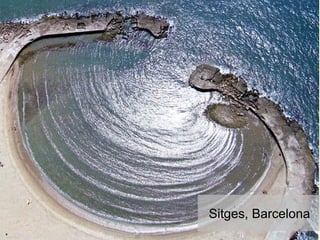
Sitges, Barcelona
What's expected for today
By the end of this lesson, you should be able to:

    Explain how headlands and bays are formed with
    the help of well-labelled diagrams

    Draw clear diagrams in boxes with:
       −   Labels
       −   Title
Textbook p. 144
           Headlands and bays
Headlands and bays form along a coast that is made
 up of bands of rock with
       v a r y ing r e s i s t a n c e to erosion.
 This means that, the rate at which a coast is eroded
         depends partly on rock resistance.
Textbook p. 144
          Headlands and bays
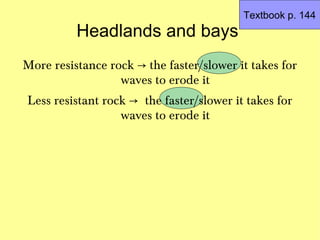
More resistance rock → the faster/slower it takes for
                  waves to erode it
Less resistant rock → the faster/slower it takes for
                  waves to erode it
1.3 Formation
Wave energy is concentrated at the headlands
 because the waves bend as they approach the
 protruding headlands.
This is due to the waves slowing down as they reach
 the shallower waters in front of the headlands while
 other waves not affected by the headlands continue
 ahead at the same speed. [1]
1.3 Formation
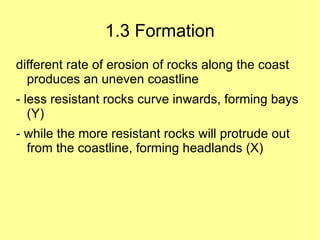
different rate of erosion of rocks along the coast
  produces an uneven coastline
- less resistant rocks curve inwards, forming bays
   (Y)
- while the more resistant rocks will protrude out
  from the coastline, forming headlands (X)
Textbook p. 144
            1.1 Some specifics
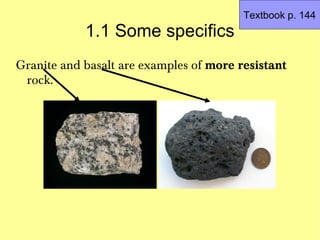
Granite and basalt are examples of more resistant
 rock.
Textbook p. 144
            1.1 Some specifics
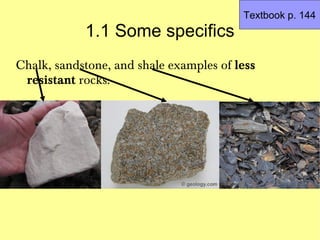
Chalk, sandstone, and shale examples of less
 resistant rocks.
Textbook p. 144
            1.1 Some specifics
What are some of the places where headlands and
 bays can be found?


  This is Homework Part 1: due tomorrow (April 3,
   Tuesday).
Textbook p. 145
            1.2 Wave refraction
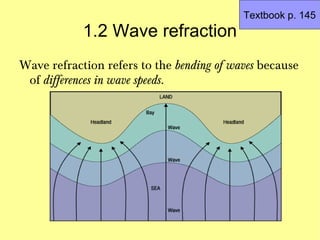
Wave refraction refers to the bending of waves because
 of differences in wave speeds.
Textbook p. 145
              1.2 Wave refraction
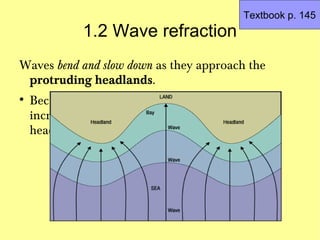
Waves bend and slow down as they approach the
 protruding headlands.

    Because they encounter friction with the
    increasingly shallow seabeds in front of these
    headlands
Textbook p. 145
          1.2 Wave refraction
Wave refraction causes headlands to be the
 focus of wave energy and thus the focus of
 erosion.
Wave energy is weakened along the wider
 stretches in the bays, so waves deposit
 sediments at bays.
Textbook p. 144
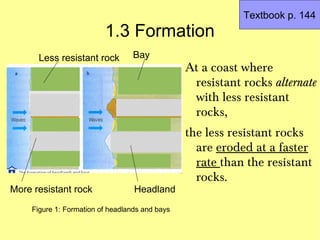
                          1.3 Formation
       Less resistant rock         Bay
                                                 At a coast where
                                                  resistant rocks alternate
     More                                         with less resistant
     resistant rock
                                                  rocks,

                              Headland
                                                 the less resistant rocks
                                                   are eroded at a faster
                                                   rate than the resistant
                                                   rocks.
More resistant rock                Headland

     Figure 1: Formation of headlands and bays
Textbook p. 144
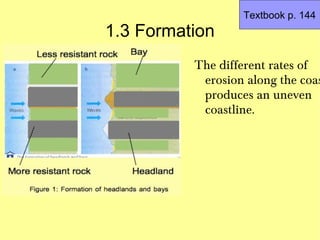
1.3 Formation
          The different rates of
           erosion along the coas
           produces an uneven
           coastline.
Textbook p. 144
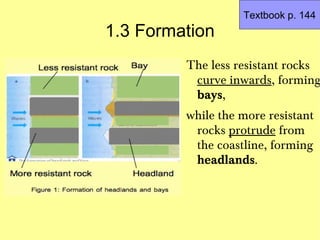
1.3 Formation
         The less resistant rocks
          curve inwards, forming
          bays,
         while the more resistant
          rocks protrude from
          the coastline, forming
          headlands.
Homework
Part 1

    Complete asterisked (*) question under 1.2 Some
    specifics
Part 2

    Read textbook pages 146-148 for tomorrow's lesson
    on beaches, spits and tombolos.
Looking back and ahead...
1. Coastal processes   2. Coastal landforms
Erosion ✔              Cliff & shore platform ✔
Deposition ✔           Headland and bay ✔
Longshore drift ✔      Beach
                       Spit
                       Tombolo
                       3. Coastal engineering
What's expected for today
By the end of this lesson, you should be able to:

    Explain how a coastal SPIT is form with the help
    of well-labelled diagrams

    Predict what a spit would turn into if there is an
    offshore island nearby - TOMBOLO

    Draw clear diagrams in boxes with:
       −   Labels
       −   Title
Depositional Landforms

    In addition to shore platforms there are three
    other types of depositional landforms.
    
        Beach
    
        Tombolo
    
        Spit
Beach
A beach is the result of constructive waves
 depositing material on the coast.

    Swash is stronger than backwash
    Waves have energy to bring material upshore but not
     back into the sea
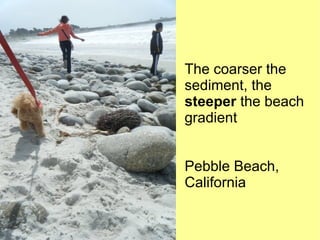
The coarser the
sediment, the
steeper the beach
gradient


Pebble Beach,
California
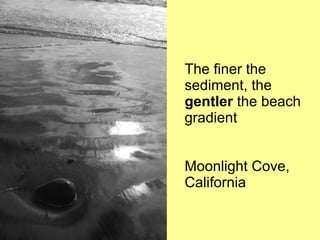
The finer the
sediment, the
gentler the beach
gradient


Moonlight Cove,
California
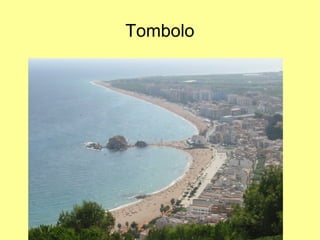
Tombolo
Homework

    Complete Worksheet _____ in the Workbook.

Coasts: Headlands and Bays

  • 1.
  • 2.
    What's expected fortoday By the end of this lesson, you should be able to:  Explain how headlands and bays are formed with the help of well-labelled diagrams  Draw clear diagrams in boxes with: − Labels − Title
  • 3.
    Textbook p. 144 Headlands and bays Headlands and bays form along a coast that is made up of bands of rock with v a r y ing r e s i s t a n c e to erosion. This means that, the rate at which a coast is eroded depends partly on rock resistance.
  • 4.
    Textbook p. 144 Headlands and bays More resistance rock → the faster/slower it takes for waves to erode it Less resistant rock → the faster/slower it takes for waves to erode it
  • 5.
    1.3 Formation Wave energyis concentrated at the headlands because the waves bend as they approach the protruding headlands. This is due to the waves slowing down as they reach the shallower waters in front of the headlands while other waves not affected by the headlands continue ahead at the same speed. [1]
  • 6.
    1.3 Formation different rateof erosion of rocks along the coast produces an uneven coastline - less resistant rocks curve inwards, forming bays (Y) - while the more resistant rocks will protrude out from the coastline, forming headlands (X)
  • 7.
    Textbook p. 144 1.1 Some specifics Granite and basalt are examples of more resistant rock.
  • 8.
    Textbook p. 144 1.1 Some specifics Chalk, sandstone, and shale examples of less resistant rocks.
  • 9.
    Textbook p. 144 1.1 Some specifics What are some of the places where headlands and bays can be found? This is Homework Part 1: due tomorrow (April 3, Tuesday).
  • 10.
    Textbook p. 145 1.2 Wave refraction Wave refraction refers to the bending of waves because of differences in wave speeds.
  • 11.
    Textbook p. 145 1.2 Wave refraction Waves bend and slow down as they approach the protruding headlands.  Because they encounter friction with the increasingly shallow seabeds in front of these headlands
  • 12.
    Textbook p. 145 1.2 Wave refraction Wave refraction causes headlands to be the focus of wave energy and thus the focus of erosion. Wave energy is weakened along the wider stretches in the bays, so waves deposit sediments at bays.
  • 13.
    Textbook p. 144 1.3 Formation Less resistant rock Bay At a coast where resistant rocks alternate More with less resistant resistant rock rocks, Headland the less resistant rocks are eroded at a faster rate than the resistant rocks. More resistant rock Headland Figure 1: Formation of headlands and bays
  • 14.
    Textbook p. 144 1.3Formation The different rates of erosion along the coas produces an uneven coastline.
  • 15.
    Textbook p. 144 1.3Formation The less resistant rocks curve inwards, forming bays, while the more resistant rocks protrude from the coastline, forming headlands.
  • 16.
    Homework Part 1  Complete asterisked (*) question under 1.2 Some specifics Part 2  Read textbook pages 146-148 for tomorrow's lesson on beaches, spits and tombolos.
  • 17.
    Looking back andahead... 1. Coastal processes 2. Coastal landforms Erosion ✔ Cliff & shore platform ✔ Deposition ✔ Headland and bay ✔ Longshore drift ✔ Beach Spit Tombolo 3. Coastal engineering
  • 18.
    What's expected fortoday By the end of this lesson, you should be able to:  Explain how a coastal SPIT is form with the help of well-labelled diagrams  Predict what a spit would turn into if there is an offshore island nearby - TOMBOLO  Draw clear diagrams in boxes with: − Labels − Title
  • 19.
    Depositional Landforms  In addition to shore platforms there are three other types of depositional landforms.  Beach  Tombolo  Spit
  • 20.
    Beach A beach isthe result of constructive waves depositing material on the coast.  Swash is stronger than backwash Waves have energy to bring material upshore but not back into the sea
  • 21.
    The coarser the sediment,the steeper the beach gradient Pebble Beach, California
  • 22.
    The finer the sediment,the gentler the beach gradient Moonlight Cove, California
  • 23.
  • 24.
    Homework  Complete Worksheet _____ in the Workbook.