Coal Liquefaction
By : Nurhua Kumala Sari
Coal Liquefaction??

 • Convert coal to liquid
 • The purpose of this process is to producing liquid
   fuels from coal
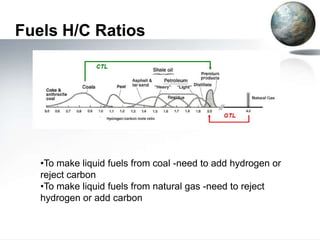
Fuels H/C Ratios


   •To make liquid fuels from coal -need to add hydrogen or
   reject carbon
   •To make liquid fuels from natural gas -need to reject
   hydrogen or add carbon
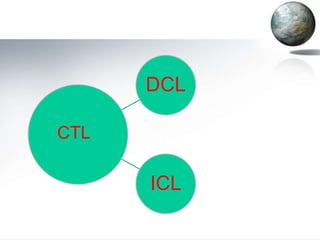
DCL

CTL

      ICL
Direct Coal Liquefaction (DCL)


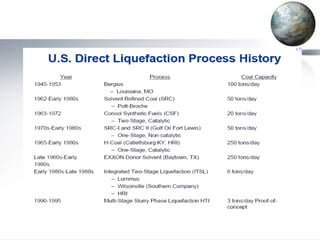
 • Direct coal liquefaction starts just prior to World
   War II by Germany, continues through the 1950s
   and 1960s with the research by the U.S.
 • Direct coal liquefaction refers to the direct reaction
   of coal with hydrogen to form liquids.
 • The hydrogen is also required to increasing the
   H/C ratio of the coal as it is liquefied. One of the
   key differences between coal and petroleum is the
   much lower H/C atomic ratio of coal (0.7 vs 1.5 for
   petroleum )
• Direct liquefaction involves the addition of
  hydrogen to coal in a solvent slurry at elevated
  temperature and pressure.
• Coal dissolution is accomplished under high
  temperature (~400 0C) and pressure (~1500-3000
  psi) with hydrogen and a coal-derived solvent.
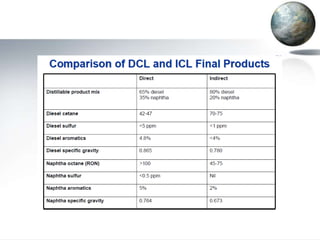
• The principal products of a direct-liquefaction CTL
  plant would be naphtha and middle distillates.
• direct-liquefaction products contain more aromatic
  and cyclic hydrocarbons and fewer paraffins, and
  they have a lower overall hydrogen content.
• prospective yields are reported to be between 2.7
  and 3.0 barrels per ton of as-received coal
• theoretical efficiency can be high…roughly 70-75%
Direct Liquefaction Process

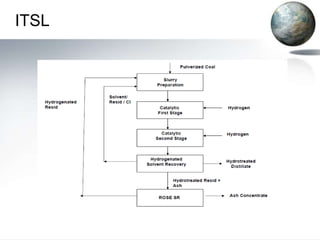
 • A single-stage direct liquefaction process
   process gives distillates via one primary reactor.

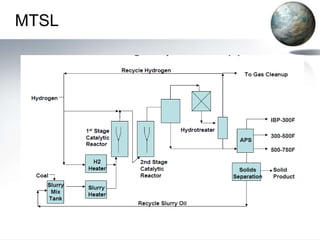
 • A two-stage direct liquefaction process
   processis designed to give distillate products via
   two reactor stages in series. The primary function
   of the first stage is coal dissolution and is operated
   either without a catalyst or with only a low-activity
   disposable catalyst.
A single-stage direct liquefaction process


 • SRC-II
 • Exxon Donor Solvent (EDS)
 • H-Coal
EDS
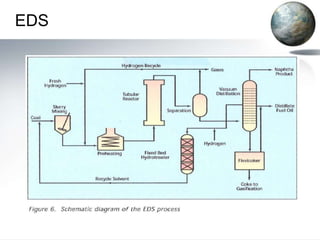
• Coal is slurried with a distillable recycled solvent
  that has been rehydrogenated to restore its
  hydrogen donation capacity
• The slurry is mixed with H2, preheated and fed to
  a simple up-flow tubular reactor that operates at
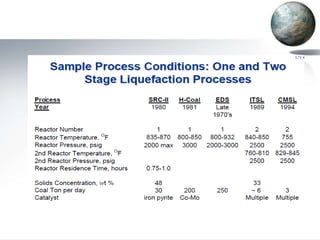
  425-450 ºC and 2575 psig .
• No catalyst is added to liquefaction reactor
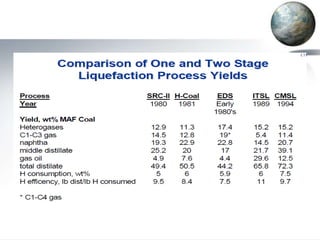
• Yields of up to 47% for lignites, 50% for sub-
  bituminous coals and 60% for bituminous coals
  could be achieved.
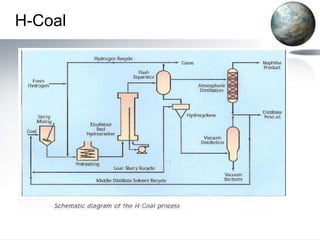
H-Coal
• This reactor operates at temperatures of 425-
  455°C and a pressure of 2900 psig
• H2 is added and the mixture is preheated and fed
  to an ebullated bed hydrocracker
• A conventional supported hydrotreating
  catalyst, either Ni-Mo or Co-Mo alumina is used.
• As with other processes, yields are dependent on
  the coal. >95% overall conversion can be obtained
  with suitable coals, with liquid yields up to 50%
  (dry basis).
A two-stage direct liquefaction
process

 • Integrated Two-Stage Liquefaction (ITSL)

 • Catalytic Multi-stage Liquefaction (CMSL)
ITSL
MTSL
Indirect Coal Liquefaction


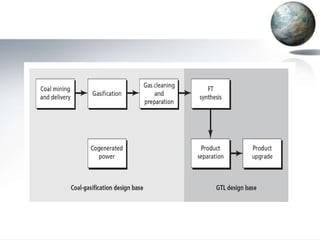
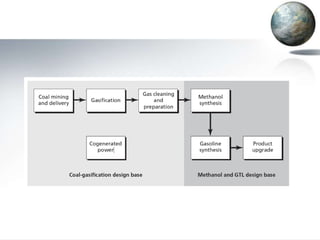
 • In Indirect Liquefaction (IL) coal is first gasified
   to form syngas. Syngas is then converted to
   liquids by means of a catalyst and Fischer
   Tropsch (FT) chemistry

 • Synthesis Gas or Syngas –mixture of
   CO, H2, CO2, H2O
 • theoretical efficiency is lower…roughly 60-65%
• The process begins with the gasification of coal
• reacting coal with steam and oxygen at elevated
  temperatures (1,000 to 1,500 degrees Celsius)
  and moderate pressure(~500 pounds per square
  inch [psi])
• The naphtha product is basically a very low–
  octane (i.e., about 40 octane) gasoline that must
  be extensively upgraded before it can be used as
  an automotive fuel.
• Conversion of synthesis gas to hydrocarbons is
  highly exothermic (i.e., it releases heat).
The Methanol-to-Gasoline Coal-
to-Liquids (MTG CTL)
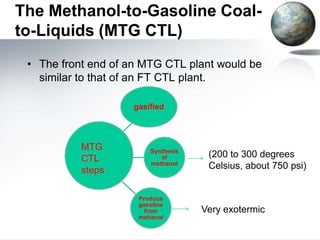
 • The front end of an MTG CTL plant would be
   similar to that of an FT CTL plant.

                    gasified


           MTG          Synthesis
           CTL             of        (200 to 300 degrees
                        methanol
           steps                     Celsius, about 750 psi)


                     Produce
                     gasoline
                       from         Very exotermic
                     mehanol
• To better control this heat release,methanol is first
  dehydrated to produce dimethyl ether.
• After upgrading and separations, the liquid-fuel
  yield of an MTG CTL plant would be about 90-
  percent gasoline, with most of the remainder being
  LPG.
• MTG reactor does not produce any of the heavy
  hydrocarbons generally found in diesel oil, jet
  fuel, and heavy oils and waxes.
Thankyou :D

Coal liquefaction

  • 1.
    Coal Liquefaction By :Nurhua Kumala Sari
  • 2.
    Coal Liquefaction?? •Convert coal to liquid • The purpose of this process is to producing liquid fuels from coal
  • 3.
    Fuels H/C Ratios •To make liquid fuels from coal -need to add hydrogen or reject carbon •To make liquid fuels from natural gas -need to reject hydrogen or add carbon
  • 4.
  • 5.
    Direct Coal Liquefaction(DCL) • Direct coal liquefaction starts just prior to World War II by Germany, continues through the 1950s and 1960s with the research by the U.S. • Direct coal liquefaction refers to the direct reaction of coal with hydrogen to form liquids. • The hydrogen is also required to increasing the H/C ratio of the coal as it is liquefied. One of the key differences between coal and petroleum is the much lower H/C atomic ratio of coal (0.7 vs 1.5 for petroleum )
  • 6.
    • Direct liquefactioninvolves the addition of hydrogen to coal in a solvent slurry at elevated temperature and pressure. • Coal dissolution is accomplished under high temperature (~400 0C) and pressure (~1500-3000 psi) with hydrogen and a coal-derived solvent.
  • 8.
    • The principalproducts of a direct-liquefaction CTL plant would be naphtha and middle distillates. • direct-liquefaction products contain more aromatic and cyclic hydrocarbons and fewer paraffins, and they have a lower overall hydrogen content. • prospective yields are reported to be between 2.7 and 3.0 barrels per ton of as-received coal • theoretical efficiency can be high…roughly 70-75%
  • 9.
    Direct Liquefaction Process • A single-stage direct liquefaction process process gives distillates via one primary reactor. • A two-stage direct liquefaction process processis designed to give distillate products via two reactor stages in series. The primary function of the first stage is coal dissolution and is operated either without a catalyst or with only a low-activity disposable catalyst.
  • 10.
    A single-stage directliquefaction process • SRC-II • Exxon Donor Solvent (EDS) • H-Coal
  • 11.
  • 12.
    • Coal isslurried with a distillable recycled solvent that has been rehydrogenated to restore its hydrogen donation capacity • The slurry is mixed with H2, preheated and fed to a simple up-flow tubular reactor that operates at 425-450 ºC and 2575 psig . • No catalyst is added to liquefaction reactor • Yields of up to 47% for lignites, 50% for sub- bituminous coals and 60% for bituminous coals could be achieved.
  • 13.
  • 14.
    • This reactoroperates at temperatures of 425- 455°C and a pressure of 2900 psig • H2 is added and the mixture is preheated and fed to an ebullated bed hydrocracker • A conventional supported hydrotreating catalyst, either Ni-Mo or Co-Mo alumina is used. • As with other processes, yields are dependent on the coal. >95% overall conversion can be obtained with suitable coals, with liquid yields up to 50% (dry basis).
  • 15.
    A two-stage directliquefaction process • Integrated Two-Stage Liquefaction (ITSL) • Catalytic Multi-stage Liquefaction (CMSL)
  • 16.
  • 17.
  • 21.
    Indirect Coal Liquefaction • In Indirect Liquefaction (IL) coal is first gasified to form syngas. Syngas is then converted to liquids by means of a catalyst and Fischer Tropsch (FT) chemistry • Synthesis Gas or Syngas –mixture of CO, H2, CO2, H2O • theoretical efficiency is lower…roughly 60-65%
  • 22.
    • The processbegins with the gasification of coal • reacting coal with steam and oxygen at elevated temperatures (1,000 to 1,500 degrees Celsius) and moderate pressure(~500 pounds per square inch [psi]) • The naphtha product is basically a very low– octane (i.e., about 40 octane) gasoline that must be extensively upgraded before it can be used as an automotive fuel. • Conversion of synthesis gas to hydrocarbons is highly exothermic (i.e., it releases heat).
  • 24.
    The Methanol-to-Gasoline Coal- to-Liquids(MTG CTL) • The front end of an MTG CTL plant would be similar to that of an FT CTL plant. gasified MTG Synthesis CTL of (200 to 300 degrees methanol steps Celsius, about 750 psi) Produce gasoline from Very exotermic mehanol
  • 25.
    • To bettercontrol this heat release,methanol is first dehydrated to produce dimethyl ether. • After upgrading and separations, the liquid-fuel yield of an MTG CTL plant would be about 90- percent gasoline, with most of the remainder being LPG. • MTG reactor does not produce any of the heavy hydrocarbons generally found in diesel oil, jet fuel, and heavy oils and waxes.
  • 28.