SLURRY CONVEYING
            Suspensions Solid - Liquid


                                     Mario Cerda C.
                                              BE mech
                               Mario.cerda.c@gmail.com
06/05/12
Objetives

   Extend      the   theoretical   and   practical
    knowledge for the selection, design and
    evaluation of fluid drive systems for the
    transport    of   Newtonian     heterogeneous
    slurries.


06/05/12
Introduction


           Aplication of slurry transport systems in mining industry :


               Concentrate from mine to port o estaciones ferroviarias (BHP - Escondida,
                Anglo American- Collahuasi, PLC AM – Los Pelambres, Codelco - Andina)
               Tailing disponsal systems (Codelco    - El Teniente, Codelco - Andina,
                Freeport McMoran - Candelaria)
               Etc, etc, etc……


 06/05/12
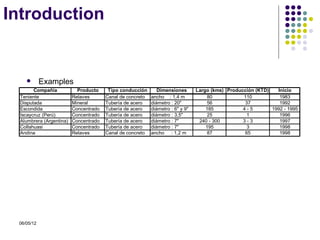
Introduction


           Examples
       Compañía            Producto     Tipo conducción       Dimensiones       Largo (kms) Producción (KTD)   Inicio
 Teniente                Relaves       Canal de concreto   ancho : 1,4 m             80           110           1983
 Disputada               Mineral       Tubería de acero    diámetro : 20"            56            37           1992
 Escondida               Concentrado   Tubería de acero    diámetro : 6" y 9"       185           4-5        1992 - 1995
 Iscaycruz (Perú)        Concentrado   Tubería de acero    diámetro : 3,5"           25             1           1996
 Alumbrera (Argentina)   Concentrado   Tubería de acero    diámetro : 7"         240 - 300        3-3           1997
 Collahuasi              Concentrado   Tubería de acero    diámetro : 7"            195             3           1998
 Andina                  Relaves       Canal de concreto   ancho : 1,2 m             87            65           1998


 06/05/12
Rheological Aspects

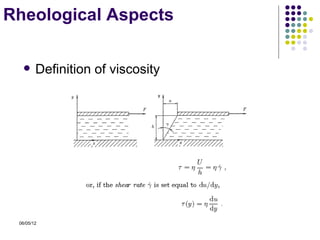
       Definition of viscosity


 06/05/12
Rheological Aspects


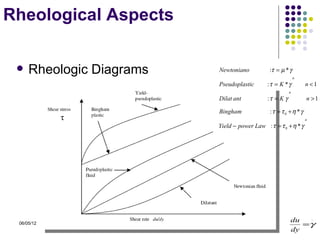
     Rheologic Diagrams
                                                            .
                         Newtoniano           :τ = µ * γ
                                                         . n
                          Pseudoplastic       :τ = K *γ             n <1
                                                      . n
                          Dilat ant           :τ = K γ              n >1
                                                                .
                          Bingham              :τ = τ 0 +η *γ
                                                                . n
                          Yield − power Law : τ = τ 0 + η * γ


                                                         du  .
 06/05/12                                                   =γ
                                                         dy
Characterization of Newtonian
Slurries

           Most of the particle with size above 50 µm.
           Concentration of solid by weight (Cp or Cw), less than 70%.
           Concentration of solid by volume (Cv), less than or equal to
            40%.


 06/05/12
Characterization of Newtonian
Slurries
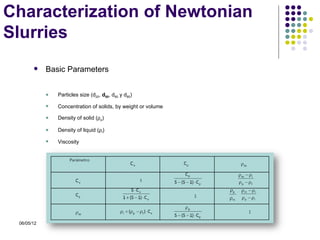
           Basic Parameters


               Particles size (d20, d50, d80 y d85)

               Concentration of solids, by weight or volume

               Density of solid (ρp)

               Density of liquid (ρl)

               Viscosity


 06/05/12
Viscosity

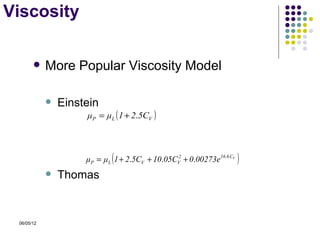
           More Popular Viscosity Model

               Einstein
                     μ P = μ L ( 1 + 2.5CV )


                             (
                     μP = μL 1 + 2.5CV + 10.05CV + 0.00273e16.6 CV
                                               2
                                                                     )
               Thomas


 06/05/12
Newtonian Slurries

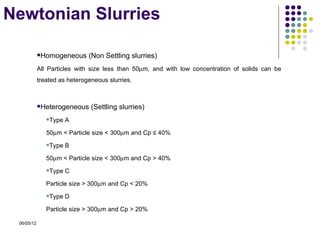
            Homogeneous      (Non Settling slurries)
            All Particles with size less than 50µm, and with low concentration of solids can be
            treated as heterogeneous slurries.


            Heterogeneous     (Settling slurries)
               Type   A

               50µm < Particle size < 300µm and Cp ≤ 40%
               Type   B

               50µm < Particle size < 300µm and Cp > 40%
               Type   C

               Particle size > 300µm and Cp < 20%
               Type   D

               Particle size > 300µm and Cp > 20%

 06/05/12
Slurry Conveying in Piping
Systems

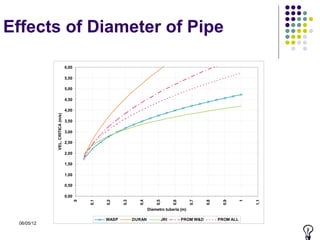
           The most important factors for the transport of slurry in pipes are :
               Settling velocity
               Head loss

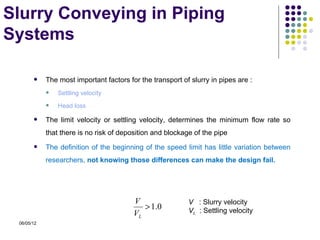
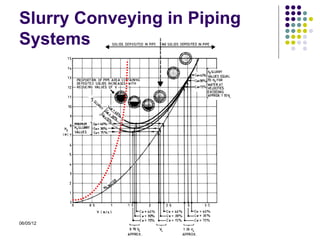
           The limit velocity or settling velocity, determines the minimum flow rate so
            that there is no risk of deposition and blockage of the pipe
           The definition of the beginning of the speed limit has little variation between
            researchers, not knowing those differences can make the design fail.


                                         V                 V : Slurry velocity
                                            > 1.0          VL : Settling velocity
                                         VL
 06/05/12
Slurry Conveying in Piping
Systems


06/05/12
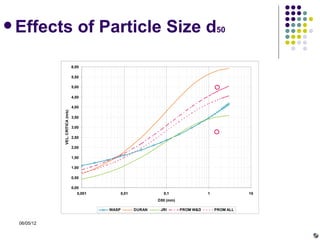
Settling Velocity Models
 .
                                                                   Durand - Condolios

             Durand

            VC = FL 2 gD( S − 1)

             Durand modified by Juan Rayo

            VC = 1.25 ⋅ FL [ 2 gD( S − 1) ]
                                              0.25


                                                                   Mc Elvain - Cave
             Wasp
                                                           1
                                                 d 50        6
            VC = 3.116C    0.186
                           V       2 gD( S − 1)       
                                                 D


 06/05/12
Effects of Diameter of Pipe

                                 6,00

                                 5,50

                                 5,00

                                 4,50

                                 4,00
            VEL. CRITICA (m/s)


                                 3,50

                                 3,00

                                 2,50

                                 2,00

                                 1,50

                                 1,00

                                 0,50

                                 0,00
                                        0


                                                  0,2


                                                         0,3


                                                                 0,4


                                                                           0,5


                                                                                               0,7


                                                                                                               0,9


                                                                                                                         1


                                                                                                                             1,1
                                            0,1


                                                                                       0,6


                                                                       Diametro tuberia (m)             0,8

                                                  WASP         DURAN             JRI         PROM W&D         PROM ALL
 06/05/12
 Effects                            of Particle Size d50

                                  6,00

                                  5,50

                                  5,00

                                  4,50

                                  4,00
             VEL. CRITICA (m/s)


                                  3,50

                                  3,00

                                  2,50

                                  2,00

                                  1,50

                                  1,00

                                  0,50

                                  0,00
                                     0,001          0,01             0,1                 1              10
                                                                   D50 (mm)

                                             WASP          DURAN    JRI       PROM W&D       PROM ALL


  06/05/12
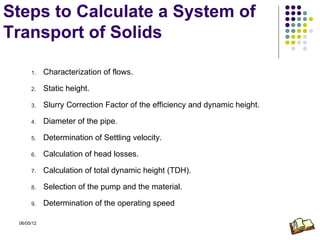
Steps to Calculate a System of
Transport of Solids

      1.    Characterization of flows.

      2.    Static height.

      3.    Slurry Correction Factor of the efficiency and dynamic height.

      4.    Diameter of the pipe.

      5.    Determination of Settling velocity.

      6.    Calculation of head losses.

      7.    Calculation of total dynamic height (TDH).

      8.    Selection of the pump and the material.

      9.    Determination of the operating speed

 06/05/12
Steps to Calculate a System of
Transport of Solids

      1.    Required motor and Power

      2.    Others.
               NPSH
               Casting Pressure
               Froth pumping
               Conical enlargement
               Pump feed hopper
               Shaft sealing
               Multi staging
               Drive selection


 06/05/12
Slurry Correction Factor of the
efficiency and dynamic height
      Curves supplied by the manufacturer corresponds to pump operation with
       pure water.
      The correction factor is:

                                                  Hw
                                            H =
                                                  HR
       Where:
               H   : Slurry TDH

               Hw : Water TDH

               HR : Slurry Correction Factor


 06/05/12
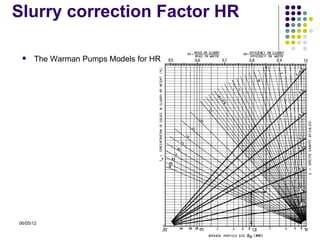
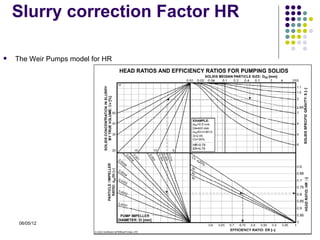
Slurry correction Factor HR

     McElvain & Cave model for HR
                              K × Cv
               HR = 1 -
                                20
      where:
                                                K                       S

               K = K ( S, d 50 )       0.50                                 8.00
                                       0.45                                 5.00
                                                                            4.00
                                       0.40
                                                                            3.00
                                       0.35                                 2.55
                                       0.30
                                                                            2.00
                                       0.25
                                                                            1.80
                                       0.20

                                       0.15                                 1.25

                                       0.10
                                                                            1.10
                                       0.05

                                       0.00
                                              0.01   0.1   1.0         10.0
    06/05/12
                                                                 D50 [mm]
Slurry correction Factor HR

     The Warman Pumps Models for HR


06/05/12
Slurry correction Factor HR

   The Weir Pumps model for HR


     06/05/12
Cerda Model for HR & FL
Limite settling velocity factor (FL)

       [                                             ] [
Fl = 1.4Cv0.045 + ( 0.18 + 0.006 ln ( Cv ) ) ln ( d 50 ) * 0.042d 50 − 0.218d 50 + 0.265d 50 + .96
                                                                  3           2
                                                                                                     ]
Slurry correction factor HR & ER

                    HR = a( c ln( d 50 ) + d ) + 1
                    where :
                    a = −0.1605C p + .000466
                         ρs
                    b=
                         ρl
                    c = 0.0133b 3 − 0.1785b 2 + 1.0555b − 0.8232
                    d = .04630b 3 − 0.6361b 2 + 3.8714b − 2.9632
06/05/12
Additional Design
Considerations
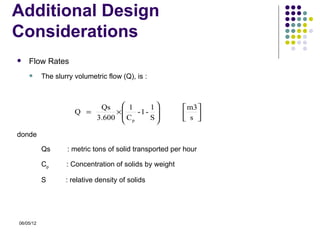
   Flow Rates
          The slurry volumetric flow (Q), is :


                           Qs     1     1               m3 
                      Q =      ×    -1 - 
                                 C
                          3.600  p      S               s 
                                                             
                                          
donde

           Qs      : metric tons of solid transported per hour

           Cp      : Concentration of solids by weight

           S       : relative density of solids


06/05/12
Additional Design
Considerations

     In the case of restricted systems, you must manipulate the % solids in order to
      maintain constant flow.

     The minimum flow will be given for a minimum production (Qs)min and maximum S
      and Cp.

     The maximum flow will be given for maximum production (Qs)max and minimum S
      and Cp.
     Transportable minimum flows (Qs), are defined by the minimum settling velocity.


06/05/12
Questions….

             The End..
               Fin..
               Fine..
              Ende..


06/05/12

Slurry conveying

  • 1.
    SLURRY CONVEYING Suspensions Solid - Liquid Mario Cerda C. BE mech Mario.cerda.c@gmail.com 06/05/12
  • 2.
    Objetives  Extend the theoretical and practical knowledge for the selection, design and evaluation of fluid drive systems for the transport of Newtonian heterogeneous slurries. 06/05/12
  • 3.
    Introduction  Aplication of slurry transport systems in mining industry :  Concentrate from mine to port o estaciones ferroviarias (BHP - Escondida, Anglo American- Collahuasi, PLC AM – Los Pelambres, Codelco - Andina)  Tailing disponsal systems (Codelco - El Teniente, Codelco - Andina, Freeport McMoran - Candelaria)  Etc, etc, etc…… 06/05/12
  • 4.
    Introduction  Examples Compañía Producto Tipo conducción Dimensiones Largo (kms) Producción (KTD) Inicio Teniente Relaves Canal de concreto ancho : 1,4 m 80 110 1983 Disputada Mineral Tubería de acero diámetro : 20" 56 37 1992 Escondida Concentrado Tubería de acero diámetro : 6" y 9" 185 4-5 1992 - 1995 Iscaycruz (Perú) Concentrado Tubería de acero diámetro : 3,5" 25 1 1996 Alumbrera (Argentina) Concentrado Tubería de acero diámetro : 7" 240 - 300 3-3 1997 Collahuasi Concentrado Tubería de acero diámetro : 7" 195 3 1998 Andina Relaves Canal de concreto ancho : 1,2 m 87 65 1998 06/05/12
  • 5.
    Rheological Aspects  Definition of viscosity 06/05/12
  • 6.
    Rheological Aspects Rheologic Diagrams .  Newtoniano :τ = µ * γ . n Pseudoplastic :τ = K *γ n <1 . n Dilat ant :τ = K γ n >1 . Bingham :τ = τ 0 +η *γ . n Yield − power Law : τ = τ 0 + η * γ du . 06/05/12 =γ dy
  • 7.
    Characterization of Newtonian Slurries  Most of the particle with size above 50 µm.  Concentration of solid by weight (Cp or Cw), less than 70%.  Concentration of solid by volume (Cv), less than or equal to 40%. 06/05/12
  • 8.
    Characterization of Newtonian Slurries  Basic Parameters  Particles size (d20, d50, d80 y d85)  Concentration of solids, by weight or volume  Density of solid (ρp)  Density of liquid (ρl)  Viscosity 06/05/12
  • 9.
    Viscosity  More Popular Viscosity Model  Einstein μ P = μ L ( 1 + 2.5CV ) ( μP = μL 1 + 2.5CV + 10.05CV + 0.00273e16.6 CV 2 )  Thomas 06/05/12
  • 10.
    Newtonian Slurries Homogeneous (Non Settling slurries) All Particles with size less than 50µm, and with low concentration of solids can be treated as heterogeneous slurries. Heterogeneous (Settling slurries) Type A 50µm < Particle size < 300µm and Cp ≤ 40% Type B 50µm < Particle size < 300µm and Cp > 40% Type C Particle size > 300µm and Cp < 20% Type D Particle size > 300µm and Cp > 20% 06/05/12
  • 11.
    Slurry Conveying inPiping Systems  The most important factors for the transport of slurry in pipes are :  Settling velocity  Head loss  The limit velocity or settling velocity, determines the minimum flow rate so that there is no risk of deposition and blockage of the pipe  The definition of the beginning of the speed limit has little variation between researchers, not knowing those differences can make the design fail. V V : Slurry velocity > 1.0 VL : Settling velocity VL 06/05/12
  • 12.
    Slurry Conveying inPiping Systems 06/05/12
  • 13.
    Settling Velocity Models . Durand - Condolios  Durand VC = FL 2 gD( S − 1)  Durand modified by Juan Rayo VC = 1.25 ⋅ FL [ 2 gD( S − 1) ] 0.25 Mc Elvain - Cave  Wasp 1  d 50  6 VC = 3.116C 0.186 V 2 gD( S − 1)    D 06/05/12
  • 14.
    Effects of Diameterof Pipe 6,00 5,50 5,00 4,50 4,00 VEL. CRITICA (m/s) 3,50 3,00 2,50 2,00 1,50 1,00 0,50 0,00 0 0,2 0,3 0,4 0,5 0,7 0,9 1 1,1 0,1 0,6 Diametro tuberia (m) 0,8 WASP DURAN JRI PROM W&D PROM ALL 06/05/12
  • 15.
     Effects of Particle Size d50 6,00 5,50 5,00 4,50 4,00 VEL. CRITICA (m/s) 3,50 3,00 2,50 2,00 1,50 1,00 0,50 0,00 0,001 0,01 0,1 1 10 D50 (mm) WASP DURAN JRI PROM W&D PROM ALL 06/05/12
  • 16.
    Steps to Calculatea System of Transport of Solids 1. Characterization of flows. 2. Static height. 3. Slurry Correction Factor of the efficiency and dynamic height. 4. Diameter of the pipe. 5. Determination of Settling velocity. 6. Calculation of head losses. 7. Calculation of total dynamic height (TDH). 8. Selection of the pump and the material. 9. Determination of the operating speed 06/05/12
  • 17.
    Steps to Calculatea System of Transport of Solids 1. Required motor and Power 2. Others.  NPSH  Casting Pressure  Froth pumping  Conical enlargement  Pump feed hopper  Shaft sealing  Multi staging  Drive selection 06/05/12
  • 18.
    Slurry Correction Factorof the efficiency and dynamic height  Curves supplied by the manufacturer corresponds to pump operation with pure water.  The correction factor is: Hw H = HR Where:  H : Slurry TDH  Hw : Water TDH  HR : Slurry Correction Factor 06/05/12
  • 19.
    Slurry correction FactorHR  McElvain & Cave model for HR K × Cv HR = 1 - 20 where: K S K = K ( S, d 50 ) 0.50 8.00 0.45 5.00 4.00 0.40 3.00 0.35 2.55 0.30 2.00 0.25 1.80 0.20 0.15 1.25 0.10 1.10 0.05 0.00 0.01 0.1 1.0 10.0 06/05/12 D50 [mm]
  • 20.
    Slurry correction FactorHR  The Warman Pumps Models for HR 06/05/12
  • 21.
    Slurry correction FactorHR  The Weir Pumps model for HR 06/05/12
  • 22.
    Cerda Model forHR & FL Limite settling velocity factor (FL) [ ] [ Fl = 1.4Cv0.045 + ( 0.18 + 0.006 ln ( Cv ) ) ln ( d 50 ) * 0.042d 50 − 0.218d 50 + 0.265d 50 + .96 3 2 ] Slurry correction factor HR & ER HR = a( c ln( d 50 ) + d ) + 1 where : a = −0.1605C p + .000466 ρs b= ρl c = 0.0133b 3 − 0.1785b 2 + 1.0555b − 0.8232 d = .04630b 3 − 0.6361b 2 + 3.8714b − 2.9632 06/05/12
  • 23.
    Additional Design Considerations  Flow Rates  The slurry volumetric flow (Q), is : Qs  1 1  m3  Q = ×  -1 -  C 3.600  p S  s     donde Qs : metric tons of solid transported per hour Cp : Concentration of solids by weight S : relative density of solids 06/05/12
  • 24.
    Additional Design Considerations  In the case of restricted systems, you must manipulate the % solids in order to maintain constant flow.  The minimum flow will be given for a minimum production (Qs)min and maximum S and Cp.  The maximum flow will be given for maximum production (Qs)max and minimum S and Cp.  Transportable minimum flows (Qs), are defined by the minimum settling velocity. 06/05/12
  • 25.
    Questions…. The End.. Fin.. Fine.. Ende.. 06/05/12