Petroleum Exploration
Petroleum System Elements
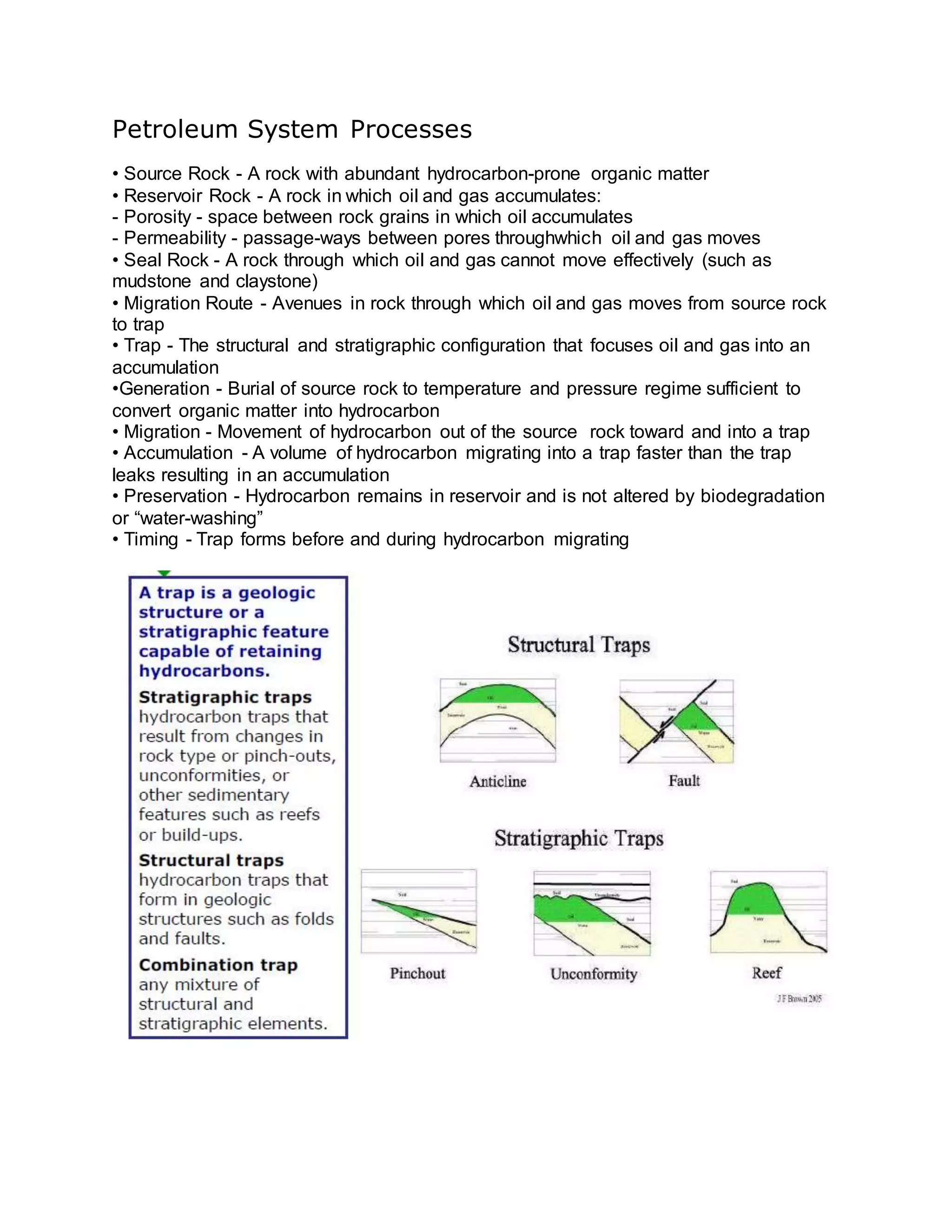
Petroleum System Processes
• Source Rock - A rock with abundant hydrocarbon-prone organic matter
• Reservoir Rock - A rock in which oil and gas accumulates:
- Porosity - space between rock grains in which oil accumulates
- Permeability - passage-ways between pores throughwhich oil and gas moves
• Seal Rock - A rock through which oil and gas cannot move effectively (such as
mudstone and claystone)
• Migration Route - Avenues in rock through which oil and gas moves from source rock
to trap
• Trap - The structural and stratigraphic configuration that focuses oil and gas into an
accumulation
•Generation - Burial of source rock to temperature and pressure regime sufficient to
convert organic matter into hydrocarbon
• Migration - Movement of hydrocarbon out of the source rock toward and into a trap
• Accumulation - A volume of hydrocarbon migrating into a trap faster than the trap
leaks resulting in an accumulation
• Preservation - Hydrocarbon remains in reservoir and is not altered by biodegradation
or “water-washing”
• Timing - Trap forms before and during hydrocarbon migrating
Petroleum System at Critical Moment – Oil Window
Burial History Chart
Sedimentary Basins
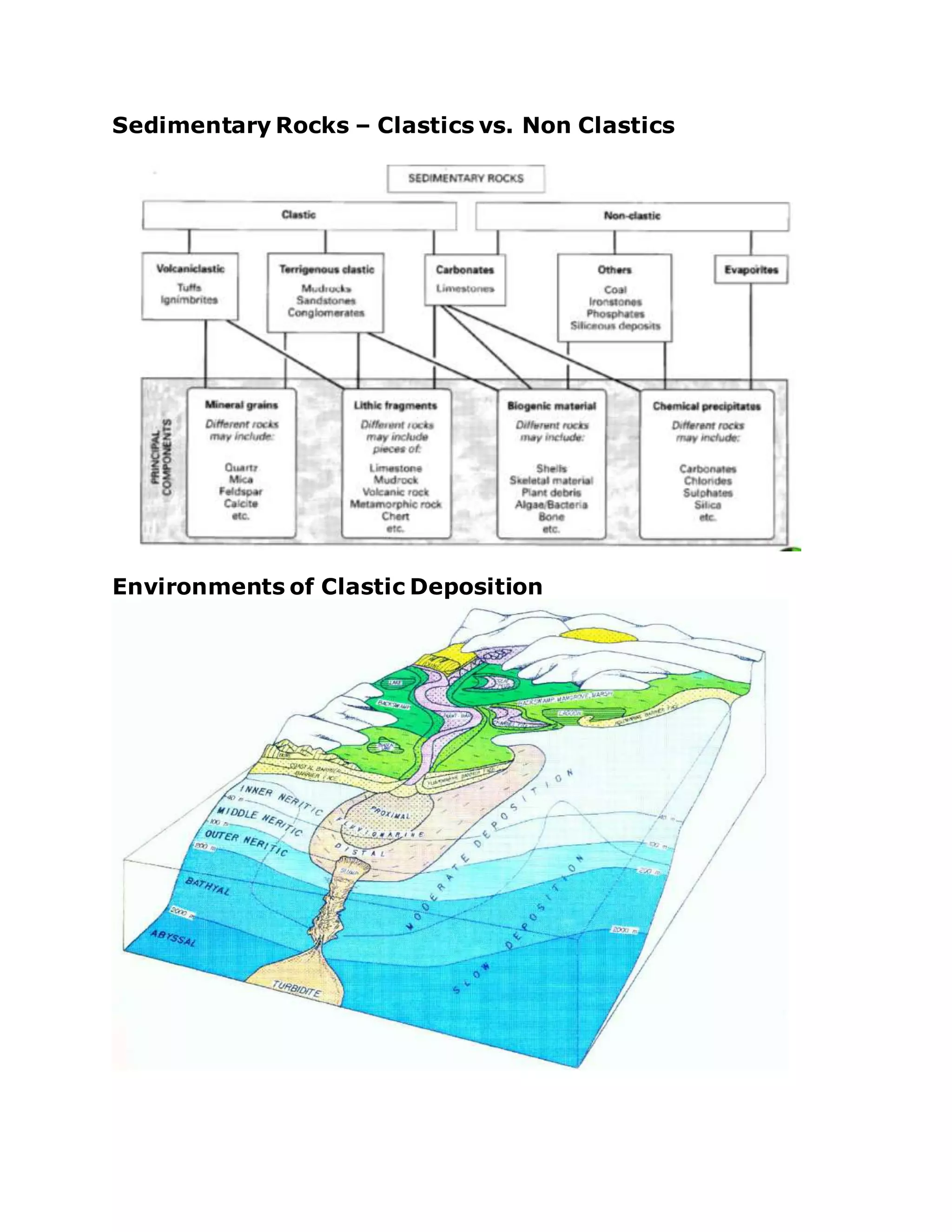
Sedimentary Rocks – Clastics vs. Non Clastics
Environments of Clastic Deposition
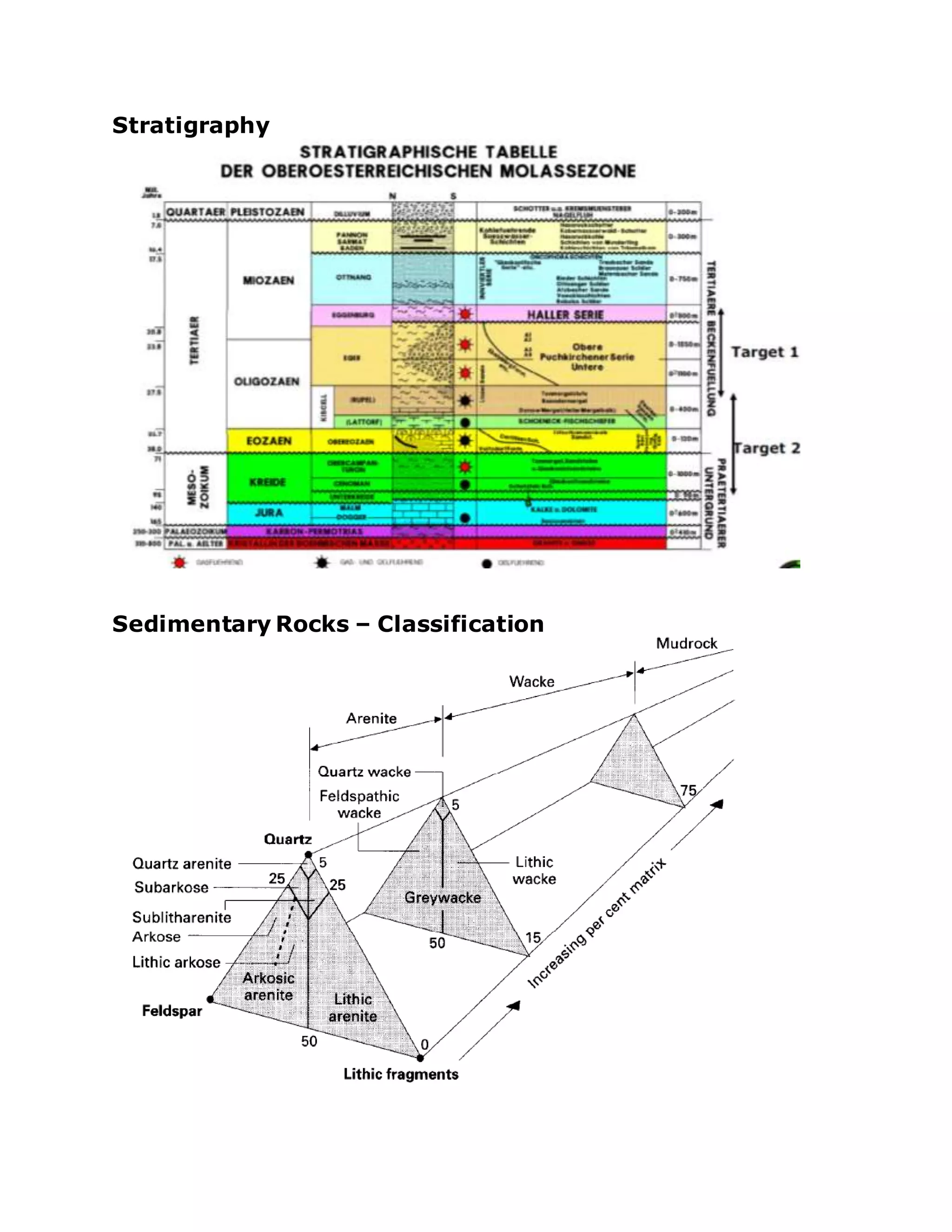
Stratigraphy
Sedimentary Rocks – Classification
Mud – Sand – Gravel
Carbonate Rocks
_ Carbonate sediments and rocks
_ Carbonate sand usually consists either of (fragmented) skeletal remains or non-
skeletal grains. Biogenic carbonate formation occurs by a wide range of organisms
(e.g., molluscs, corals, forams, algae, bacteria, and many others)
 _ Most organisms initially form unconsolidated carbonate sediments
 _ Coral reefs and microbial mats (e.g., stromatolites) are examples of more solid
carbonate structures
_ Carbonate mud (micrite) is commonly the product either of chemical precipitation or
algal/bacterial activity. Chemical precipitation produces non-skeletal carbonate grains
of various sizes (e.g., ooids, pisoids, micrite)
_ Dunham classification of carbonate rocks:
 _ Texturally-based subdivision (cf. clastics): mudstone, wackestone, packstone,
grainstone, rudstone
 _ Organically bound framework during formation: boundstone
Carbonates – Depositional Texture
Seismic Acquisition
2D Seismic – Single Shot Record
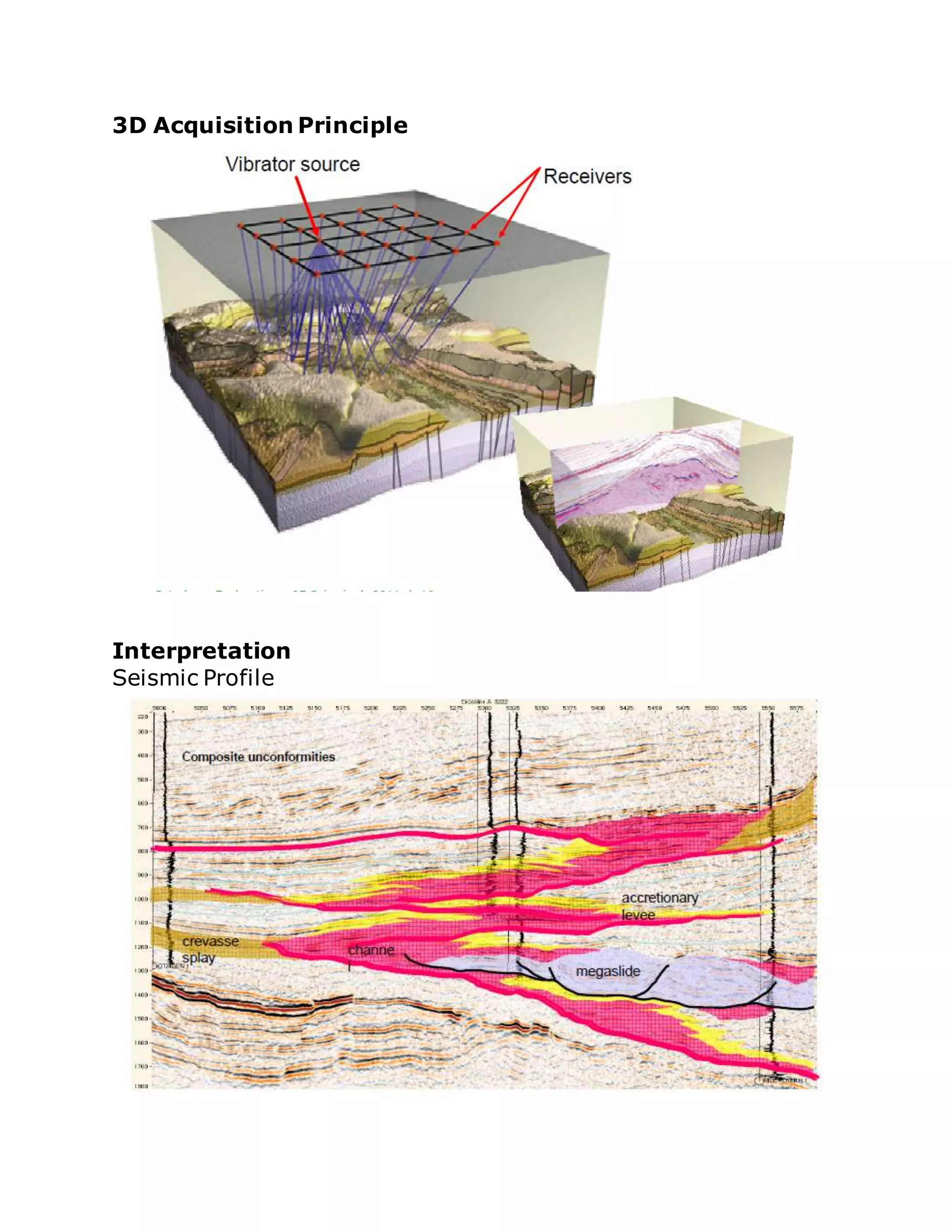
3D Acquisition Principle
Interpretation
Seismic Profile
Geological Profile
Resources & Reserves
The resource triangle
Resources Classification System
Economic Evaluation
Conventional vs. Unconventional Reservoirs
Conventional Reservoir:
Reservoirs that can be produced at economic flow rates and recover economic
volumes of oil and gas without the need for massive stimulation treatments,
special recovery processes, or leading edge technology.
Unconventional Reservoir:
Reservoirs that can not be produced at economic flow rates nor recover
economic volumes of oil and gas unless large stimulation treatments or
special recovery processes and technologies are applied to assist recovery.
Unconventional Resource Play:
A regionally extensive hydrocarbon play that occurs within a direct hydrocarbon
migration pathway adjacent to/or within the hydrocarbon source rock of a “petroleum
system” These plays usually occur within complex reservoirs that include:
− “adsorbed hydrocarbon” component resulting in triple/dual porosity and dual
permeability systems
− with “free” hydrocarbons and “adsorbed” hydrocarbons These URPs most often occur
within tight or extremely low porous reservoirs that include fractured or fracturable:
• tight sands
• carbonates
• shales
• coals
References
From many sources

Petroleum exploration

  • 1.
    Petroleum Exploration Petroleum SystemElements Petroleum System Processes
  • 2.
    Petroleum System Processes •Source Rock - A rock with abundant hydrocarbon-prone organic matter • Reservoir Rock - A rock in which oil and gas accumulates: - Porosity - space between rock grains in which oil accumulates - Permeability - passage-ways between pores throughwhich oil and gas moves • Seal Rock - A rock through which oil and gas cannot move effectively (such as mudstone and claystone) • Migration Route - Avenues in rock through which oil and gas moves from source rock to trap • Trap - The structural and stratigraphic configuration that focuses oil and gas into an accumulation •Generation - Burial of source rock to temperature and pressure regime sufficient to convert organic matter into hydrocarbon • Migration - Movement of hydrocarbon out of the source rock toward and into a trap • Accumulation - A volume of hydrocarbon migrating into a trap faster than the trap leaks resulting in an accumulation • Preservation - Hydrocarbon remains in reservoir and is not altered by biodegradation or “water-washing” • Timing - Trap forms before and during hydrocarbon migrating
  • 3.
    Petroleum System atCritical Moment – Oil Window Burial History Chart
  • 4.
  • 5.
    Sedimentary Rocks –Clastics vs. Non Clastics Environments of Clastic Deposition
  • 6.
  • 7.
    Mud – Sand– Gravel Carbonate Rocks _ Carbonate sediments and rocks _ Carbonate sand usually consists either of (fragmented) skeletal remains or non- skeletal grains. Biogenic carbonate formation occurs by a wide range of organisms (e.g., molluscs, corals, forams, algae, bacteria, and many others)  _ Most organisms initially form unconsolidated carbonate sediments  _ Coral reefs and microbial mats (e.g., stromatolites) are examples of more solid carbonate structures _ Carbonate mud (micrite) is commonly the product either of chemical precipitation or algal/bacterial activity. Chemical precipitation produces non-skeletal carbonate grains of various sizes (e.g., ooids, pisoids, micrite) _ Dunham classification of carbonate rocks:  _ Texturally-based subdivision (cf. clastics): mudstone, wackestone, packstone, grainstone, rudstone  _ Organically bound framework during formation: boundstone
  • 8.
    Carbonates – DepositionalTexture Seismic Acquisition 2D Seismic – Single Shot Record
  • 9.
  • 10.
    Geological Profile Resources &Reserves The resource triangle
  • 11.
  • 12.
    Economic Evaluation Conventional vs.Unconventional Reservoirs Conventional Reservoir: Reservoirs that can be produced at economic flow rates and recover economic volumes of oil and gas without the need for massive stimulation treatments, special recovery processes, or leading edge technology. Unconventional Reservoir: Reservoirs that can not be produced at economic flow rates nor recover economic volumes of oil and gas unless large stimulation treatments or special recovery processes and technologies are applied to assist recovery. Unconventional Resource Play: A regionally extensive hydrocarbon play that occurs within a direct hydrocarbon migration pathway adjacent to/or within the hydrocarbon source rock of a “petroleum system” These plays usually occur within complex reservoirs that include: − “adsorbed hydrocarbon” component resulting in triple/dual porosity and dual permeability systems − with “free” hydrocarbons and “adsorbed” hydrocarbons These URPs most often occur within tight or extremely low porous reservoirs that include fractured or fracturable: • tight sands • carbonates • shales • coals References From many sources