CNS TUMORS Alina Valdes, M.D.
Devastating  effects High mortality  rates Benign tumors may be  unresectable  so incurable Malignant  if cannot be removed completely Incidence  increases  with advancing age after childhood, when second most common cancer No  environmental agent known to be causative except for vinyl chloride with gliomas and CNS radiation with several tumors No  evidence supports viral origin
Classification   World Health Organization  classification Primary tumors classified on basis of  cell origin Most  primary tumors of neuroepithelial origin From malignant transformation of astrocytes, ependymocytes, and oligodendrocytes Gliomas  most common Arise from astrocytes Metastases more likely  than primary CNS tumor in patient with known systemic malignant disease
Clinical Manifestations Symptoms  from intracranial tumors Compression  of brain by tumor and presence of associated edema Infiltration  and destruction of brain parenchyma by tumor cells Rigid  cranial cavity so benign and malignant  tumors may cause symptoms
Symptoms from  primary  brain tumors  slowly progressive Symptoms from  metastatic  tumors more  acute Grow more rapidly and associated with edema Hemorrhage into tumor May present with  generalized  symptoms from increased intracranial pressure or  focal  symptoms from areas of compromise
Generalized symptoms Headache Most common  generalized symptom and first in ½  of adults Infrequently from tumor itself but rather from increased intracranial pressure Changes  in mood or personality Decrease  in appetite Nausea Projectile vomiting  – in children Generalized or focal  seizures  – in 20% of patients
Focal symptoms Frontal lobe  tumors May be massive before symptoms cause problems Progressive difficulty with concentration and memory, personality changes, and lack of spontaneity Urinary incontinence and gait disorder Appearance of primitive reflexes in bifrontal disease
Parietal lobe  tumors Subtle signs or more dramatic like hemianesthesia Righ t: spatial disorientation or left homonymous hemianopia Left : receptive aphasia or right homonymous hemianopia
Temporal lobe  tumors Personality changes, auditory hallucinations, complex partial seizures, and quadrantanopia Uncal herniation if large enough Metastatic  spread of primary CNS tumors to sites outside CNS rare Spread to meninges and spinal cord occurs with most malignant CNS tumors
Patient Evaluation Careful  neuro exam Contrast-enhanced  CT scan or MRI MRI superior   More useful in imaging posterior fossa More sensitive in detecting parenchymal invasion CT scan without contrast  not adequate  for primary or metastatic tumors Cerebral angiography only when tumor blood supply needed prior to resection
Biopsy Accurate histological diagnosis Detect other disease like abscess Open craniotomy or MRI-guided or CT-guided stereotactic techniques In 20% of patients with metastatic tumors, CNS biopsy helpful in identifying primary site Lumbar puncture Helpful only if suspect leptomeningeal involvement Contraindicated when intracranial mass lesion present
Treatment   Surgery Most patients with  primary  tumors Many patients with  solitary  brain metastasis May relieve symptoms for many months if  debulk  tumor when surgical cure unlikely No  extensive resection with brain stem tumors Radical resection  not  recommended for tumors in language or sensorimotor areas, basal ganglia, or corpus callosum due to neuro dysfunction Not  recommended for CNS lymphoma: multifocal and respond to chemo and radiation combination
Increased intracranial pressure Most patients have brain edema and benefit from  glucocorticoids , usually dexamethasone In life-threatening edema with signs of herniation, can give mannitol with dexamethasone Anticonvulsants Given if  develop  seizures Given if  at risk  of developing seizures before performing biopsy or surgery: many patients don’t need postoperatively
Radiation Conventional  – external beam Uses direct X-rays to whole-brain or focal area Whole-brain radiation associated with long-term toxicity, like dementia and gait disturbance  Brachytherapy Implantation of permanent or temporary radiation “seeds” within tumor Allows higher doses to tumor while preserving normal tissue “ Radiosurgery ” Converging more than 200 beams of radiation onto small, well-defined tumors
Chemotherapy Not  used as sole therapy Major obstacle is  blood-brain barrier CNS tumors often  drug resistant Biodegradable wafers impregnated with nitrosurea BCNU placed into tumor after resection Oligodendrogliomas unusually sensitive CNS lymphomas treated with combination chemo and radiation
Malignant Astrocytomas Group of heterogeneous tumors:  glioblastoma multiforme, anaplastic astrocytoma, and anaplastic oligodendroglioma Glioblastoma multiforme Worst prognosis  with median survival  <12 mos . Surgery and radiation to improve symptoms and quality of life If relapse, benefit of treatment  short-lived
Anaplastic astrocytoma and anaplastic oligodendroglioma Median survival of  4 to 5 years Oligodendroglioma or mixed benefit most from chemo after surgery Recurrent treated same as glioblastoma multiforme
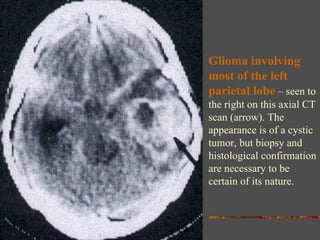
Glioma involving most of the left parietal lobe  – seen to the right on this axial CT scan (arrow). The appearance is of a cystic tumor, but biopsy and histological confirmation are necessary to be certain of its nature.
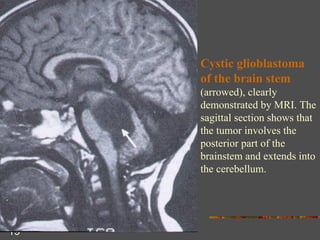
Cystic glioblastoma of the brain stem  (arrowed), clearly demonstrated by MRI. The sagittal section shows that the tumor involves the posterior part of the brainstem and extends into the cerebellum.
Meningiomas   Arise  outside  brain Generally grow  slowly Benign in  90%  of cases Complete resection  should be attempted Risk of recurrence proportionate to extent of resection If partial resection, give postop  radiation If malignant,  radiation  given Chemotherapy  not  used
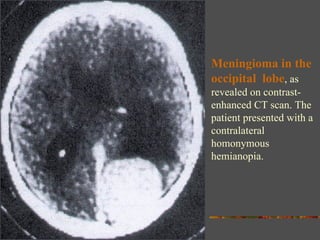
Meningioma in the occipital  lobe , as revealed on contrast-enhanced CT scan. The patient presented with a contralateral homonymous hemianopia.
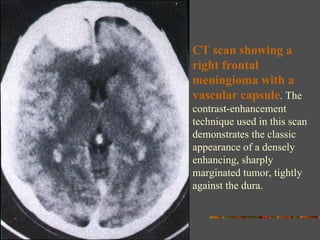
CT scan showing a right frontal meningioma with a vascular capsule . The contrast-enhancement technique used in this scan demonstrates the classic appearance of a densely enhancing, sharply marginated tumor, tightly against the dura.
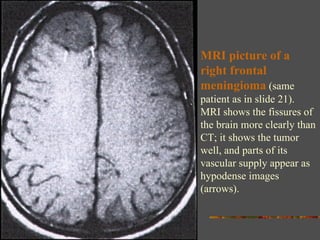
MRI picture of a right frontal meningioma  (same patient as in slide 21). MRI shows the fissures of the brain more clearly than CT; it shows the tumor well, and parts of its vascular supply appear as hypodense images (arrows).
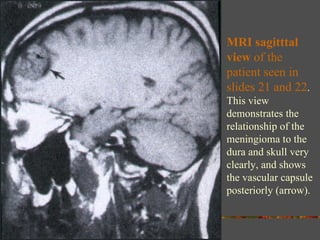
MRI sagitttal view  of the patient seen in slides 21 and 22 . This view demonstrates the relationship of the meningioma to the dura and skull very clearly, and shows the vascular capsule posteriorly (arrow).
CNS Lymphoma Increasing  in incidence No  evidence of lymphoma outside CNS if primary Most often occur deep in  frontal lobe  so less likely to present with seizures than other primary and metastatic CNS neoplasms Presenting  complaints – headache, personality changes, and focal symptoms
40% of immunocompetent  and  nearly 100% of AIDS  patients have  multifocal  lymphoma when diagnosed >40%  of patients have leptomeningeal involvement – rarely symptomatic 20%  of patients have involvement of one or both eyes May be confused with metastatic disease since often multifocal Surgical resection  not  indicated
Treatment Corticosteroids : cytotoxic effects on lymphoma cells; not sufficient Combination  of systemic chemotherapy before whole-brain radiation 5-year survival  rates with combined therapy as high as 30% If complete response to chemotherapy, may defer radiation due to associated late effects
Metastatic Tumors to the Brain Comprise  most  of intracranial tumors Common : lung, breast, and melanoma Present  with headache, seizures, focal symptoms, depression, and changes in mental status Metastases usually  multifocal Rapidly growing tumors can cause massive  edema
Treatment Corticosteroids  – dexamethasone in brain edema Radiation Surgery  possible if solitary or easily resectable and systemic disease well controlled Not  usually respond to chemotherapy because of blood-brain barrier
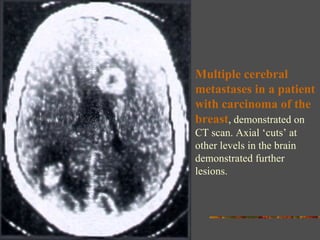
Multiple cerebral metastases in a patient with carcinoma of the breast , demonstrated on CT scan. Axial ‘cuts’ at other levels in the brain demonstrated further lesions.
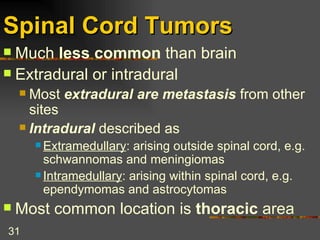
Spinal Cord Tumors Much  less common  than brain Extradural or intradural Most  extradural are metastasis  from other sites Intradural  described as Extramedullary : arising outside spinal cord, e.g. schwannomas and meningiomas Intramedullary : arising within spinal cord, e.g. ependymomas and astrocytomas Most common location is  thoracic  area
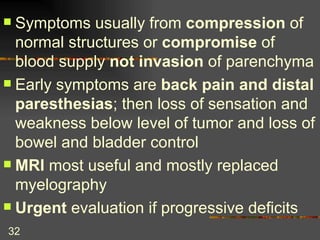
Symptoms usually from  compression  of normal structures or  compromise  of blood supply  not invasion  of parenchyma Early symptoms are  back pain and distal paresthesias ; then loss of sensation and weakness below level of tumor and loss of bowel and bladder control MRI  most useful and mostly replaced myelography Urgent  evaluation if progressive deficits
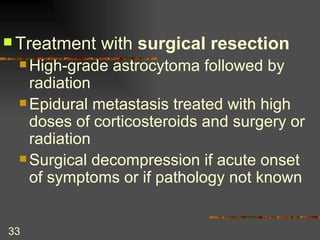
Treatment with  surgical resection High-grade astrocytoma followed by radiation Epidural metastasis treated with high doses of corticosteroids and surgery or radiation Surgical decompression if acute onset of symptoms or if pathology not known
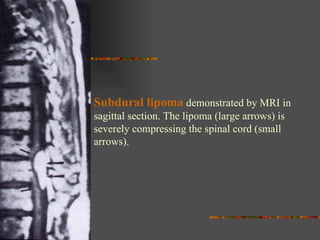
Subdural lipoma  demonstrated by MRI in sagittal section. The lipoma (large arrows) is severely compressing the spinal cord (small arrows).

CNS Tumors

  • 1.
    CNS TUMORS AlinaValdes, M.D.
  • 2.
    Devastating effectsHigh mortality rates Benign tumors may be unresectable so incurable Malignant if cannot be removed completely Incidence increases with advancing age after childhood, when second most common cancer No environmental agent known to be causative except for vinyl chloride with gliomas and CNS radiation with several tumors No evidence supports viral origin
  • 3.
    Classification World Health Organization classification Primary tumors classified on basis of cell origin Most primary tumors of neuroepithelial origin From malignant transformation of astrocytes, ependymocytes, and oligodendrocytes Gliomas most common Arise from astrocytes Metastases more likely than primary CNS tumor in patient with known systemic malignant disease
  • 4.
    Clinical Manifestations Symptoms from intracranial tumors Compression of brain by tumor and presence of associated edema Infiltration and destruction of brain parenchyma by tumor cells Rigid cranial cavity so benign and malignant tumors may cause symptoms
  • 5.
    Symptoms from primary brain tumors slowly progressive Symptoms from metastatic tumors more acute Grow more rapidly and associated with edema Hemorrhage into tumor May present with generalized symptoms from increased intracranial pressure or focal symptoms from areas of compromise
  • 6.
    Generalized symptoms HeadacheMost common generalized symptom and first in ½ of adults Infrequently from tumor itself but rather from increased intracranial pressure Changes in mood or personality Decrease in appetite Nausea Projectile vomiting – in children Generalized or focal seizures – in 20% of patients
  • 7.
    Focal symptoms Frontallobe tumors May be massive before symptoms cause problems Progressive difficulty with concentration and memory, personality changes, and lack of spontaneity Urinary incontinence and gait disorder Appearance of primitive reflexes in bifrontal disease
  • 8.
    Parietal lobe tumors Subtle signs or more dramatic like hemianesthesia Righ t: spatial disorientation or left homonymous hemianopia Left : receptive aphasia or right homonymous hemianopia
  • 9.
    Temporal lobe tumors Personality changes, auditory hallucinations, complex partial seizures, and quadrantanopia Uncal herniation if large enough Metastatic spread of primary CNS tumors to sites outside CNS rare Spread to meninges and spinal cord occurs with most malignant CNS tumors
  • 10.
    Patient Evaluation Careful neuro exam Contrast-enhanced CT scan or MRI MRI superior More useful in imaging posterior fossa More sensitive in detecting parenchymal invasion CT scan without contrast not adequate for primary or metastatic tumors Cerebral angiography only when tumor blood supply needed prior to resection
  • 11.
    Biopsy Accurate histologicaldiagnosis Detect other disease like abscess Open craniotomy or MRI-guided or CT-guided stereotactic techniques In 20% of patients with metastatic tumors, CNS biopsy helpful in identifying primary site Lumbar puncture Helpful only if suspect leptomeningeal involvement Contraindicated when intracranial mass lesion present
  • 12.
    Treatment Surgery Most patients with primary tumors Many patients with solitary brain metastasis May relieve symptoms for many months if debulk tumor when surgical cure unlikely No extensive resection with brain stem tumors Radical resection not recommended for tumors in language or sensorimotor areas, basal ganglia, or corpus callosum due to neuro dysfunction Not recommended for CNS lymphoma: multifocal and respond to chemo and radiation combination
  • 13.
    Increased intracranial pressureMost patients have brain edema and benefit from glucocorticoids , usually dexamethasone In life-threatening edema with signs of herniation, can give mannitol with dexamethasone Anticonvulsants Given if develop seizures Given if at risk of developing seizures before performing biopsy or surgery: many patients don’t need postoperatively
  • 14.
    Radiation Conventional – external beam Uses direct X-rays to whole-brain or focal area Whole-brain radiation associated with long-term toxicity, like dementia and gait disturbance Brachytherapy Implantation of permanent or temporary radiation “seeds” within tumor Allows higher doses to tumor while preserving normal tissue “ Radiosurgery ” Converging more than 200 beams of radiation onto small, well-defined tumors
  • 15.
    Chemotherapy Not used as sole therapy Major obstacle is blood-brain barrier CNS tumors often drug resistant Biodegradable wafers impregnated with nitrosurea BCNU placed into tumor after resection Oligodendrogliomas unusually sensitive CNS lymphomas treated with combination chemo and radiation
  • 16.
    Malignant Astrocytomas Groupof heterogeneous tumors: glioblastoma multiforme, anaplastic astrocytoma, and anaplastic oligodendroglioma Glioblastoma multiforme Worst prognosis with median survival <12 mos . Surgery and radiation to improve symptoms and quality of life If relapse, benefit of treatment short-lived
  • 17.
    Anaplastic astrocytoma andanaplastic oligodendroglioma Median survival of 4 to 5 years Oligodendroglioma or mixed benefit most from chemo after surgery Recurrent treated same as glioblastoma multiforme
  • 18.
    Glioma involving mostof the left parietal lobe – seen to the right on this axial CT scan (arrow). The appearance is of a cystic tumor, but biopsy and histological confirmation are necessary to be certain of its nature.
  • 19.
    Cystic glioblastoma ofthe brain stem (arrowed), clearly demonstrated by MRI. The sagittal section shows that the tumor involves the posterior part of the brainstem and extends into the cerebellum.
  • 20.
    Meningiomas Arise outside brain Generally grow slowly Benign in 90% of cases Complete resection should be attempted Risk of recurrence proportionate to extent of resection If partial resection, give postop radiation If malignant, radiation given Chemotherapy not used
  • 21.
    Meningioma in theoccipital lobe , as revealed on contrast-enhanced CT scan. The patient presented with a contralateral homonymous hemianopia.
  • 22.
    CT scan showinga right frontal meningioma with a vascular capsule . The contrast-enhancement technique used in this scan demonstrates the classic appearance of a densely enhancing, sharply marginated tumor, tightly against the dura.
  • 23.
    MRI picture ofa right frontal meningioma (same patient as in slide 21). MRI shows the fissures of the brain more clearly than CT; it shows the tumor well, and parts of its vascular supply appear as hypodense images (arrows).
  • 24.
    MRI sagitttal view of the patient seen in slides 21 and 22 . This view demonstrates the relationship of the meningioma to the dura and skull very clearly, and shows the vascular capsule posteriorly (arrow).
  • 25.
    CNS Lymphoma Increasing in incidence No evidence of lymphoma outside CNS if primary Most often occur deep in frontal lobe so less likely to present with seizures than other primary and metastatic CNS neoplasms Presenting complaints – headache, personality changes, and focal symptoms
  • 26.
    40% of immunocompetent and nearly 100% of AIDS patients have multifocal lymphoma when diagnosed >40% of patients have leptomeningeal involvement – rarely symptomatic 20% of patients have involvement of one or both eyes May be confused with metastatic disease since often multifocal Surgical resection not indicated
  • 27.
    Treatment Corticosteroids :cytotoxic effects on lymphoma cells; not sufficient Combination of systemic chemotherapy before whole-brain radiation 5-year survival rates with combined therapy as high as 30% If complete response to chemotherapy, may defer radiation due to associated late effects
  • 28.
    Metastatic Tumors tothe Brain Comprise most of intracranial tumors Common : lung, breast, and melanoma Present with headache, seizures, focal symptoms, depression, and changes in mental status Metastases usually multifocal Rapidly growing tumors can cause massive edema
  • 29.
    Treatment Corticosteroids – dexamethasone in brain edema Radiation Surgery possible if solitary or easily resectable and systemic disease well controlled Not usually respond to chemotherapy because of blood-brain barrier
  • 30.
    Multiple cerebral metastasesin a patient with carcinoma of the breast , demonstrated on CT scan. Axial ‘cuts’ at other levels in the brain demonstrated further lesions.
  • 31.
    Spinal Cord TumorsMuch less common than brain Extradural or intradural Most extradural are metastasis from other sites Intradural described as Extramedullary : arising outside spinal cord, e.g. schwannomas and meningiomas Intramedullary : arising within spinal cord, e.g. ependymomas and astrocytomas Most common location is thoracic area
  • 32.
    Symptoms usually from compression of normal structures or compromise of blood supply not invasion of parenchyma Early symptoms are back pain and distal paresthesias ; then loss of sensation and weakness below level of tumor and loss of bowel and bladder control MRI most useful and mostly replaced myelography Urgent evaluation if progressive deficits
  • 33.
    Treatment with surgical resection High-grade astrocytoma followed by radiation Epidural metastasis treated with high doses of corticosteroids and surgery or radiation Surgical decompression if acute onset of symptoms or if pathology not known
  • 34.
    Subdural lipoma demonstrated by MRI in sagittal section. The lipoma (large arrows) is severely compressing the spinal cord (small arrows).