RENAL CELL CARCINOMA
SUNIL KUMAR.P1SUNIL KUMAR.P
SYNONYMS
• - Adenocarcinoma
• - Hypernephroma
• - Grawitz Tumour
2SUNIL KUMAR.P
DEFINITION
• Renal cell carcinoma (RCC) is a kidney cancer
that originates in the lining of the proximal
convoluted tubule, a part of the very small
tubes in the kidney that transport primary
urine.
RCC is the most common
type of kidney cancer in adults, responsible
for approximately 90–95% of cases.
3SUNIL KUMAR.P9
EPIDEMIOLOGY
• The most common neoplasm of the kidney
(75%) or up to 85% .
• - Arises from renal tubular cells .
• - ( 2 – 3 ) % of all adulthood cancers .
• - ( 40 % ) of patients die of cancer .
• - Most common in 6th & 7th decades .
• - Male : Female ratio 2:1
• - Blacks at an higher risk than whites.
4SUNIL KUMAR.P
ETIOLOGY & PATHOGENESIS
• Various etiological factors implicated in the
aetiology of the RCC are as follows.
• 1.Tobacco
• 2.genetic factors
• 3.Cystic diseases of the kidney
• 4.Other risk factors
5SUNIL KUMAR.P
TOBACCO
• - Tobacco is the major risk factor for RCC
• - Whether chewed or smoked and accounts
for 20-30% cases of RCC
• - Cigarette smokers have two-fold higher risk
of developing RCC
6SUNIL KUMAR.P
GENETIC FACTORS
• -Hereditary and first –degree relatives of RCC
are associated with higher risk.
• Although majority of the cases of RCC
sporadic but about 5% cases are inherited.
• These cases have following associations
• 1.Von Hippel Disease (VHL)
• 2.Herediiatry Clear cell RCC
• 3.Chromophobe RCC
7SUNIL KUMAR.P
CYTIC DISEASE OF THE KIDNEY
• -Both hereditary & Acquired cystic disease of
the kidney have increased risk of development
of RCC.
• Pt’s .. On long term dialysis develop acquired
cystic disease …….. Which may evolve into
RCC.
• Adult PCKD and Multicystic Nephroma is
associated with higher occurrence of papillary
RCC.
8SUNIL KUMAR.P
OTHER RISK FACTORS
• Besides above, following other factors are
associated with higher incidence of RCC…..
• 1.Exposure to asbestos, heavy metals,
petrochemical products.
• 2.In women, obesity, & oestrogen therapy
• 3.Analgesic nephropathy
• 4.Tuberous sclerosis
9SUNIL KUMAR.P
10SUNIL KUMAR.P
CLASSIFICATION
• Based on Cytogenetics of sporadic and familial
tumour , RCC has been Classified in to ..
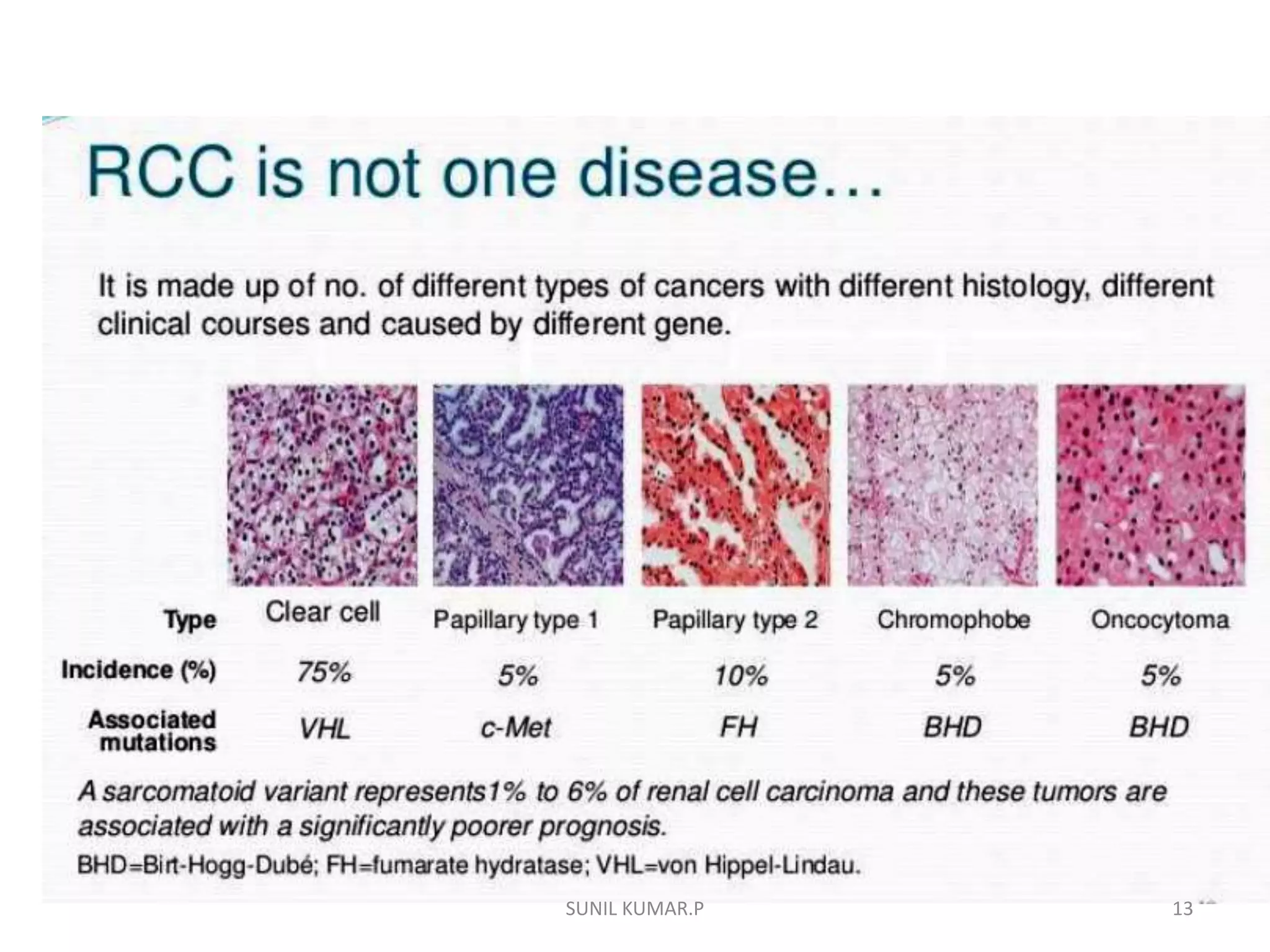
• 1.Clear cell renal cell carcinoma.
• 2.Papillary renal cell carcinoma.
• 3.Chromophobe renal cell carcinoma.
• 4.Sarcomatoid type renal cell carcinoma
• 5.Collecting duct carcinoma.
11SUNIL KUMAR.P
12SUNIL KUMAR.P
13SUNIL KUMAR.P
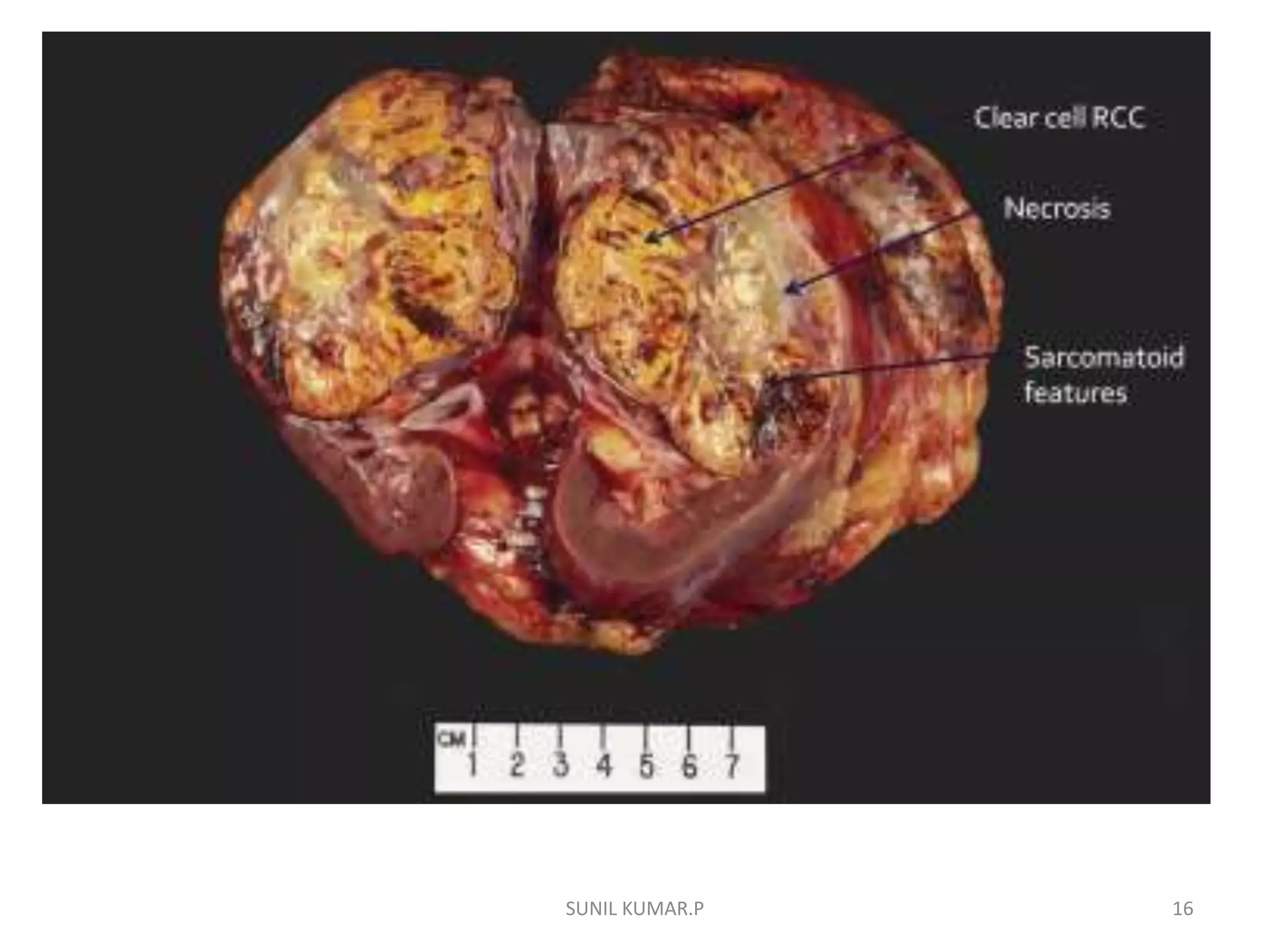
Renal cell carcinoma arising in the middle pole of the kidney. Fairly
circumscribed, The cut surface
demonstrates a yellowish areas, white areas, brown areas, and hemorrhagic
red areas.
14SUNIL KUMAR.P
15SUNIL KUMAR.P
SUNIL KUMAR.P 16
SUNIL KUMAR.P 17
SUNIL KUMAR.P 18
SUNIL KUMAR.P 19
GROSS FINDINGS
• RCC commonly arises from the poles of the
kidney as a solitary and unilateral tumour,
more often in the upper pole.
• The tumour is generally large, golden yellow
and circumscribed.
• Papillary tumours have grossly visible papillae
and may be multifocal.
• About 1% RCC are bilateral .
SUNIL KUMAR.P 20
• C/S – of the tumour commonly shows large
areas of ischemic necrosis, cystic change and
foci of haemorrhages.
• Another significant characteristic is the
frequent presence of tumour thrombus in the
renal vein ………. Which may extend to
venacava.
SUNIL KUMAR.P 21
MICROSCOPY FINDINGS
• 1. Clear Cell Type (RCC) – 70 %
• - This is the most common pattern
• - The clear cytoplasm of tumor is due to
removal of glycogen and lipid from the
cytoplasm during the processing of the tissue .
• - The tumour cells have a variety of patterns ;
solid, trabecular and tubular, separated by
delicate vasculature.
SUNIL KUMAR.P 22
23SUNIL KUMAR.P
• 2. Papillary type RCC : 15%
• - The tumour cells are arranged in papillary
pattern over the fibro vascular stalks.
• The tumour cells are cuboidal with small
round nuclei
SUNIL KUMAR.P 24
• 3.Granular cell type : 8%
• - The tumour cells have abundant acidophilic
cytoplasm.
• These tumours have more marked nuclear
pleomorphisim.
SUNIL KUMAR.P 25
26SUNIL KUMAR.P
27SUNIL KUMAR.P
28SUNIL KUMAR.P
• Occur anywhere in the urinary tract, but they
are most common in the bladder.
• Smoking, exposure to analine or azo dyes, and
napthylamine exposure are known to be
associated with urothelial cancers.
• Urothelial tumors often are multicentric .
• These patients need careful follow-up.
29SUNIL KUMAR.P
• Rare .
• - Often associated with chronic inflammation
resulting from stones.
• - Metastasize early and the prognosis is poor .
• -Radiosensitive
30SUNIL KUMAR.P
SIGNS AND SYMPTOMS
• Classic triad of : Hematuria,,
• Flank pain
• Abdominal mass
31SUNIL KUMAR.P
Signs may include:
• Malaise,weight loss and anorexia
• Abnormal urine color
• Polycythemia
• Anemia
• Fracture of hip
• Varicocele.enlargement of testicle on left side
• Pallor or plethora
• Hirsutism
• Constipation
• Hypertension
• Hypercalcemia
• Leg and ankle swelling
32SUNIL KUMAR.P
DIAGNOSIS
• Physical examination:
• Fever
• High blood pressure
• Lab tests:
• Complete blood count
• Urineanalysis
• Serum calcium
• Imaging tests:
• Ultrasound abdomen
• Abdominal CT scan
• MRI scan
• PET scan
• Renal angiography
• Intravenous pyelogram
• Chest x ray
• Bone scan
• Biopsy
• Fine needle aspiration
• Core needle biopsy
33SUNIL KUMAR.P
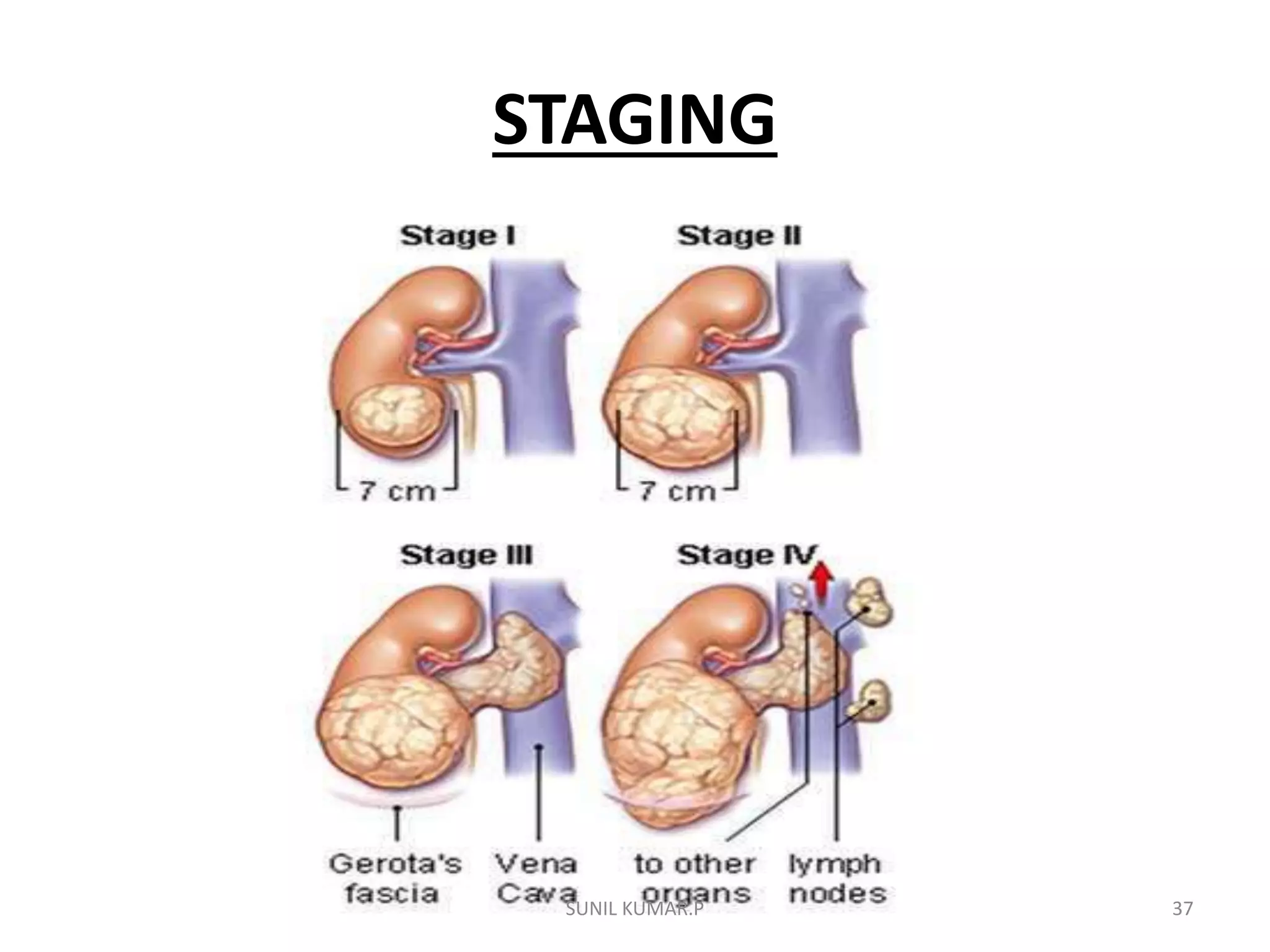
STAGING
• Based on examination, imaging and biopsy
• AJCC (TNM) staging system:
• T categories for kidney cancer:
• T0: No evidence of primary tumor
• T1: The tumor is only in the kidney and is 7cm or less across
• T2: The tumor is larger than 7cm across but is still in the
kidney
• T3: The tumor is growing into a major vein or tissue around
the kidney but not into adrenals or beyond Gerota,s fascia
• T4: The tumor has spread beyond Gerota,s fascia. It may
have grown into the adrenal gland
34SUNIL KUMAR.P
TNM STAGING
35SUNIL KUMAR.P
36SUNIL KUMAR.P
STAGING
37SUNIL KUMAR.P
TREATMENT
• If only in kidneys, it can be cured 90% of the time with
• surgery.
• If it has spread outside the kidneys into the nodes or the
• main vein, it must be treated with cytoreductive surgery.
• RRC is resistant to chemo and radiotherapy in most
• Cases
• May respond to immunotherapy
• PARTIAL NEPHRECTOMY:
• For treating small renal tumors(< 4cm)
• Bilateral renal cell carcinoma
• It can be done via laproscopic techniques
38SUNIL KUMAR.P
• RADICAL NEPHRECTOMY:
• Surgical removal of kidney along with adrenal
gland, retroperitoneal lymphnodes,
perinephric fat an Gerota's fascia
• In cases where the tumor has spread into the
renal vein, IVC and right atrium, this portion of
tumor can be surgically removed as well.
• Medications like tyrosine kinase inhibitors
including
39SUNIL KUMAR.P
40SUNIL KUMAR.P
PROGNOSIS
• For tumors less than 4cm 5 year survival rate is
90-95%
• For larger tumors confined to kidneys without
venous invasion survival is 80-85%
• For tumors that extend through the renal capsule
n local fascia survivability reduces to near 60%
• For metastasis to lymph nodes survival rate is
around 5-15%
• For spread to other organs 5 year survival rate is
less than 5%
41SUNIL KUMAR.P
42SUNIL KUMAR.P
SUMMARY
43SUNIL KUMAR.P

Renal cell carcinoma

  • 1.
    RENAL CELL CARCINOMA SUNILKUMAR.P1SUNIL KUMAR.P
  • 2.
    SYNONYMS • - Adenocarcinoma •- Hypernephroma • - Grawitz Tumour 2SUNIL KUMAR.P
  • 3.
    DEFINITION • Renal cellcarcinoma (RCC) is a kidney cancer that originates in the lining of the proximal convoluted tubule, a part of the very small tubes in the kidney that transport primary urine. RCC is the most common type of kidney cancer in adults, responsible for approximately 90–95% of cases. 3SUNIL KUMAR.P9
  • 4.
    EPIDEMIOLOGY • The mostcommon neoplasm of the kidney (75%) or up to 85% . • - Arises from renal tubular cells . • - ( 2 – 3 ) % of all adulthood cancers . • - ( 40 % ) of patients die of cancer . • - Most common in 6th & 7th decades . • - Male : Female ratio 2:1 • - Blacks at an higher risk than whites. 4SUNIL KUMAR.P
  • 5.
    ETIOLOGY & PATHOGENESIS •Various etiological factors implicated in the aetiology of the RCC are as follows. • 1.Tobacco • 2.genetic factors • 3.Cystic diseases of the kidney • 4.Other risk factors 5SUNIL KUMAR.P
  • 6.
    TOBACCO • - Tobaccois the major risk factor for RCC • - Whether chewed or smoked and accounts for 20-30% cases of RCC • - Cigarette smokers have two-fold higher risk of developing RCC 6SUNIL KUMAR.P
  • 7.
    GENETIC FACTORS • -Hereditaryand first –degree relatives of RCC are associated with higher risk. • Although majority of the cases of RCC sporadic but about 5% cases are inherited. • These cases have following associations • 1.Von Hippel Disease (VHL) • 2.Herediiatry Clear cell RCC • 3.Chromophobe RCC 7SUNIL KUMAR.P
  • 8.
    CYTIC DISEASE OFTHE KIDNEY • -Both hereditary & Acquired cystic disease of the kidney have increased risk of development of RCC. • Pt’s .. On long term dialysis develop acquired cystic disease …….. Which may evolve into RCC. • Adult PCKD and Multicystic Nephroma is associated with higher occurrence of papillary RCC. 8SUNIL KUMAR.P
  • 9.
    OTHER RISK FACTORS •Besides above, following other factors are associated with higher incidence of RCC….. • 1.Exposure to asbestos, heavy metals, petrochemical products. • 2.In women, obesity, & oestrogen therapy • 3.Analgesic nephropathy • 4.Tuberous sclerosis 9SUNIL KUMAR.P
  • 10.
  • 11.
    CLASSIFICATION • Based onCytogenetics of sporadic and familial tumour , RCC has been Classified in to .. • 1.Clear cell renal cell carcinoma. • 2.Papillary renal cell carcinoma. • 3.Chromophobe renal cell carcinoma. • 4.Sarcomatoid type renal cell carcinoma • 5.Collecting duct carcinoma. 11SUNIL KUMAR.P
  • 12.
  • 13.
  • 14.
    Renal cell carcinomaarising in the middle pole of the kidney. Fairly circumscribed, The cut surface demonstrates a yellowish areas, white areas, brown areas, and hemorrhagic red areas. 14SUNIL KUMAR.P
  • 15.
  • 16.
  • 17.
  • 18.
  • 19.
  • 20.
    GROSS FINDINGS • RCCcommonly arises from the poles of the kidney as a solitary and unilateral tumour, more often in the upper pole. • The tumour is generally large, golden yellow and circumscribed. • Papillary tumours have grossly visible papillae and may be multifocal. • About 1% RCC are bilateral . SUNIL KUMAR.P 20
  • 21.
    • C/S –of the tumour commonly shows large areas of ischemic necrosis, cystic change and foci of haemorrhages. • Another significant characteristic is the frequent presence of tumour thrombus in the renal vein ………. Which may extend to venacava. SUNIL KUMAR.P 21
  • 22.
    MICROSCOPY FINDINGS • 1.Clear Cell Type (RCC) – 70 % • - This is the most common pattern • - The clear cytoplasm of tumor is due to removal of glycogen and lipid from the cytoplasm during the processing of the tissue . • - The tumour cells have a variety of patterns ; solid, trabecular and tubular, separated by delicate vasculature. SUNIL KUMAR.P 22
  • 23.
  • 24.
    • 2. Papillarytype RCC : 15% • - The tumour cells are arranged in papillary pattern over the fibro vascular stalks. • The tumour cells are cuboidal with small round nuclei SUNIL KUMAR.P 24
  • 25.
    • 3.Granular celltype : 8% • - The tumour cells have abundant acidophilic cytoplasm. • These tumours have more marked nuclear pleomorphisim. SUNIL KUMAR.P 25
  • 26.
  • 27.
  • 28.
  • 29.
    • Occur anywherein the urinary tract, but they are most common in the bladder. • Smoking, exposure to analine or azo dyes, and napthylamine exposure are known to be associated with urothelial cancers. • Urothelial tumors often are multicentric . • These patients need careful follow-up. 29SUNIL KUMAR.P
  • 30.
    • Rare . •- Often associated with chronic inflammation resulting from stones. • - Metastasize early and the prognosis is poor . • -Radiosensitive 30SUNIL KUMAR.P
  • 31.
    SIGNS AND SYMPTOMS •Classic triad of : Hematuria,, • Flank pain • Abdominal mass 31SUNIL KUMAR.P
  • 32.
    Signs may include: •Malaise,weight loss and anorexia • Abnormal urine color • Polycythemia • Anemia • Fracture of hip • Varicocele.enlargement of testicle on left side • Pallor or plethora • Hirsutism • Constipation • Hypertension • Hypercalcemia • Leg and ankle swelling 32SUNIL KUMAR.P
  • 33.
    DIAGNOSIS • Physical examination: •Fever • High blood pressure • Lab tests: • Complete blood count • Urineanalysis • Serum calcium • Imaging tests: • Ultrasound abdomen • Abdominal CT scan • MRI scan • PET scan • Renal angiography • Intravenous pyelogram • Chest x ray • Bone scan • Biopsy • Fine needle aspiration • Core needle biopsy 33SUNIL KUMAR.P
  • 34.
    STAGING • Based onexamination, imaging and biopsy • AJCC (TNM) staging system: • T categories for kidney cancer: • T0: No evidence of primary tumor • T1: The tumor is only in the kidney and is 7cm or less across • T2: The tumor is larger than 7cm across but is still in the kidney • T3: The tumor is growing into a major vein or tissue around the kidney but not into adrenals or beyond Gerota,s fascia • T4: The tumor has spread beyond Gerota,s fascia. It may have grown into the adrenal gland 34SUNIL KUMAR.P
  • 35.
  • 36.
  • 37.
  • 38.
    TREATMENT • If onlyin kidneys, it can be cured 90% of the time with • surgery. • If it has spread outside the kidneys into the nodes or the • main vein, it must be treated with cytoreductive surgery. • RRC is resistant to chemo and radiotherapy in most • Cases • May respond to immunotherapy • PARTIAL NEPHRECTOMY: • For treating small renal tumors(< 4cm) • Bilateral renal cell carcinoma • It can be done via laproscopic techniques 38SUNIL KUMAR.P
  • 39.
    • RADICAL NEPHRECTOMY: •Surgical removal of kidney along with adrenal gland, retroperitoneal lymphnodes, perinephric fat an Gerota's fascia • In cases where the tumor has spread into the renal vein, IVC and right atrium, this portion of tumor can be surgically removed as well. • Medications like tyrosine kinase inhibitors including 39SUNIL KUMAR.P
  • 40.
  • 41.
    PROGNOSIS • For tumorsless than 4cm 5 year survival rate is 90-95% • For larger tumors confined to kidneys without venous invasion survival is 80-85% • For tumors that extend through the renal capsule n local fascia survivability reduces to near 60% • For metastasis to lymph nodes survival rate is around 5-15% • For spread to other organs 5 year survival rate is less than 5% 41SUNIL KUMAR.P
  • 42.
  • 43.