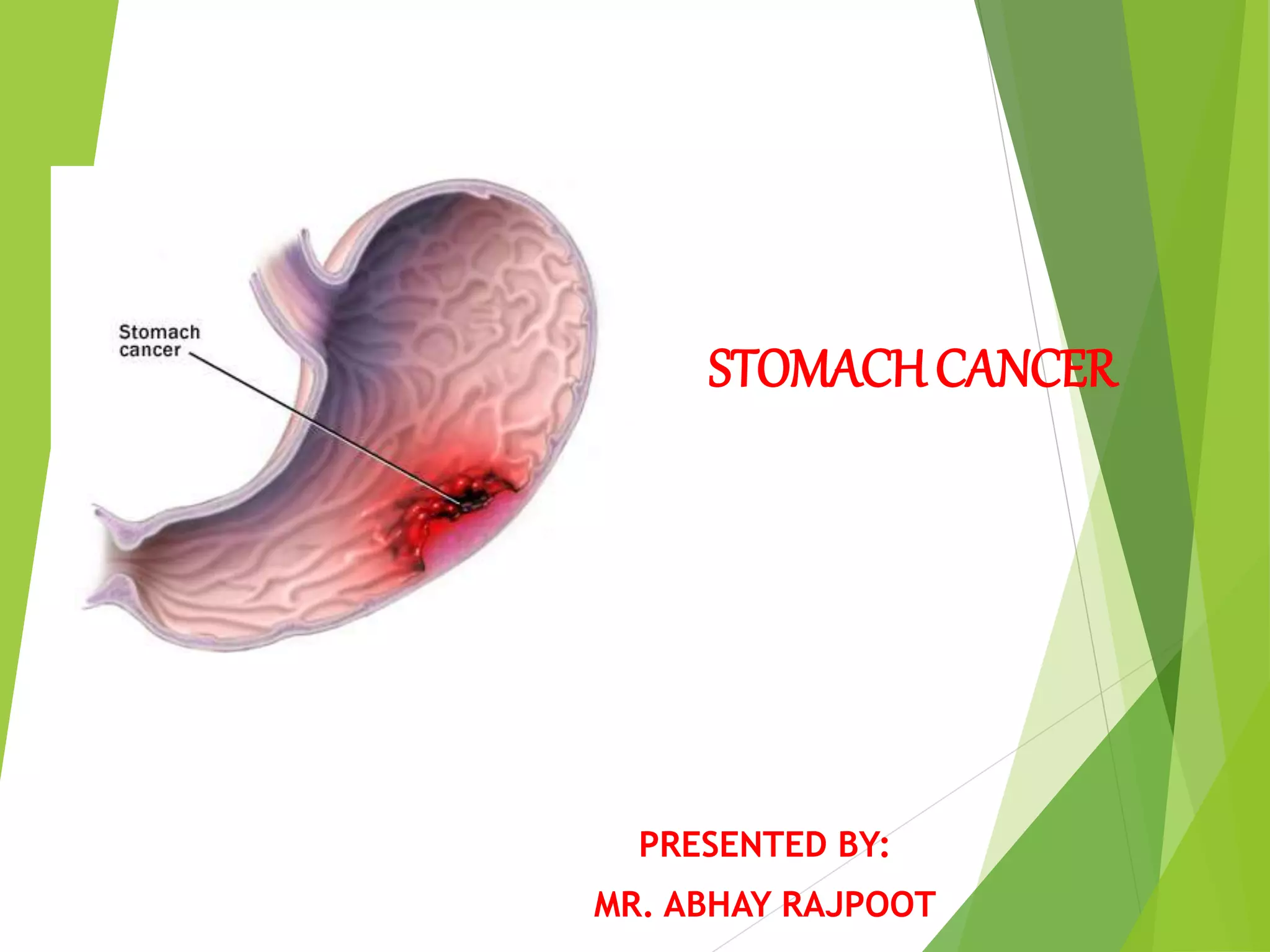







STOMACHCANCER
PRESENTED BY:
MR. ABHAY RAJPOOT
INTRODUCTION
 Gastric cancer refers to malignant lesions found in the
stomach.
 It is more common in men than women.
 The most common cause is infection by the bacteria
HELICOBACTER pylori.
 Most cases of the stomach cancers are gastric carcinomas.
DEFINITION
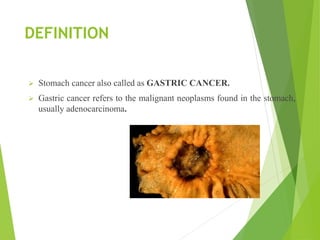
 Stomach cancer also called as GASTRIC CANCER.
 Gastric cancer refers to the malignant neoplasms found in the stomach,
usually adenocarcinoma.
INCIDENCE
 The incidence of gastric or stomach cancer continues to decrease in
the United States, it still accounts for more than 11,000 deaths
anually.
 The typical patient with gastric cancer is between 40 $ 70 years of
age, but gastric cancer can occur in people younger than 40 years of
age.
 Stomach cancer is twice as common in men as in women more
common in whites in the United States.
 It is estimated that 21,500 new cases of gastric cancer would
be diagnosed in 2003 with 13,000 deaths attributed to gastric
cancer.
ETIOLOGY & RISK FACTORS
 CHRONIC ATROPIC GASTRITIS
 LOW SOCIOECONOMIC STATES
 BACKGROUND RADIATION
 ACHLORHYDIA
 PERNICIOUS ANEMIA
 SMOKING
 H PYLORI INFECTION
 METAL CRAFTS WORKERS & COALMINERS
TNM CLASSIFICATION
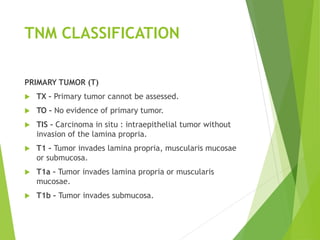
PRIMARY TUMOR (T)
 TX – Primary tumor cannot be assessed.
 TO – No evidence of primary tumor.
 TIS – Carcinoma in situ : intraepithelial tumor without
invasion of the lamina propria.
 T1 – Tumor invades lamina propria, muscularis mucosae
or submucosa.
 T1a – Tumor invades lamina propria or muscularis
mucosae.
 T1b – Tumor invades submucosa.
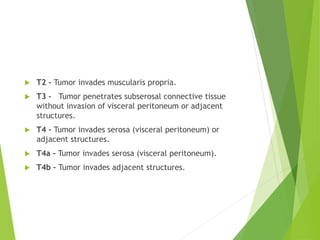
 T2 – Tumor invades muscularis propria.
 T3 - Tumor penetrates subserosal connective tissue
without invasion of visceral peritoneum or adjacent
structures.
 T4 – Tumor invades serosa (visceral peritoneum) or
adjacent structures.
 T4a – Tumor invades serosa (visceral peritoneum).
 T4b – Tumor invades adjacent structures.
REGIONAL LYMPH NODES (N)
 NX – Regional lymph nodes cannot be assessed.
 NO – No regional lymph node metastasis.
 N1 - Metastasis in 1-2 regional lymph nodes.
 N2 - Metastasis in 3-6 regional lymph nodes.
 N3 - Metastasis in seven or more regional lymph nodes.
 N3a – Metastasis in 7-15 regional lymph nodes.
 N3b – Metastasis in 16 or more regional lymph nodes.
DISTANT METASTASIS (M)
 MO – No distant metastasis.
 M1 – Distant metastasis.
CLINICAL MANIFESTATIONS
1) EARLY MANIFESTATION
 Loss of appetite
 Vomiting & nausea
 Upper abdominal pain
 Heart burn
2) LATE MANIFESTATION
 Weight loss
 Anemia
 Blood usually occult in the stool
 Haemorrhage
 Difficulty swallowing
 Loss of strength
COMPLICATIONS
 Haemorrhage
 Acute gastric distention
 Nutritional problems
DIAGNOSTIC EVALUATION
It is conformed by –
 GASTROSCOPIC EXAM
 COMPUTED TOMOGRAPHY or CT SCAN
 COMPLETE BLOOD COUNT (CBC)
 FAECAL OCCULT BLOOD TEST
 UPPER GASTROINTESTINAL X-RAY EXAMINATION
MANAGEMENT
MEDICAL MANAGEMENT
 GOAL – To inhibit tumor growth & cure.
 1) CHEMOTHERAPY – Some drugs used in stomach cancer treatment
are-
 5- fluorouracil (5-FU) , cisplatin (platinol), doxorubicin
(adriamycin), etoposide ( etopophos), & mitomycinc (mutamycin).
 RADIATION THERAPY – Radiation therapy can be used to slow the
growth & ease the symptoms of advanced stomach cancer, such as
pain, bleeding & eating problems.
 External beam radiation therapy – Is a type of radiation therapy
often used to treat stomach cancer. This treatment focuses radiation
on the cancer from a machine outside the body.
 Treatments are usually given 5 days a week over several weeks or
months.
SURGICAL MANAGEMENT
The surgery include :
 GASTRECTOMY – A total gastrectomy may be performed for a
resectable cancer in the midportion or body of the stomach. The
entire stomach is removed along with the duodenum, the lower
portion of the esophagus, supporting mesentery & lymph nodes.
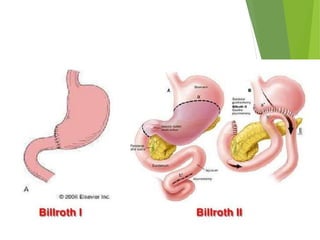
 The Billroth I involves a limited resection & offers a lower cure
rate than the billroth II.
 The Billroth II procedure is a wider resection that involves 75%
approximately removing of the stomach & decreases the
possibility of lymph node spread or metastatic recurrence.
 GASTROENTEROSTOMY – It is the surgical creation of a passage
between the stomach & small intestine. It is performed to treat
peptic ulcersa.
NURSING MANAGEMENT
PREOPERATIVE CARE
 Consent must be taken prior to surgery.
 The patients history of major illness, previous surgeries,
medication, alcohol & tobacco is obtained.
 Bowel preparation must be done.
 Catheterisation is provided before surgery.
 All pre-medication should be done.
 Prepare the patient psychologically & reduce anxiety of
the patient.
 Patient should be NPO 12 hours before surgery.
POSTOPERATIVE CARE
 Monitor vital sign every 2 hourly.
 Inspect surgical site for redness, itching etc.
 Assess complete blood count especially WBC level to
check for infection.
 Monitor for complication like dumping syndrome.
 Monitor input & output of the patient.
 Protect the airway.
 Monitor for gag reflexes.
 Provide comfort like semi-fowlers position.
 Manage drainage system.
 Decreasing the amount of food taken at one time &
maintaining a high-protein, high fat, low carbohydrate, dry
diet. Gastric emptying can be delayed by eating in a
recumbent position or semi- recumbent position, lying down
after meals, increasing the fat content in a diet $ avoiding
fluids 1 hr before or 2 hrs after meals.
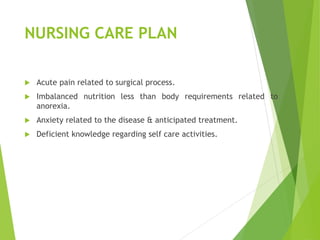
NURSING CARE PLAN
 Acute pain related to surgical process.
 Imbalanced nutrition less than body requirements related to
anorexia.
 Anxiety related to the disease & anticipated treatment.
 Deficient knowledge regarding self care activities.
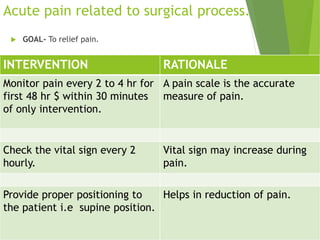
Acute pain related to surgical process.
 GOAL- To relief pain.
INTERVENTION RATIONALE
Monitor pain every 2 to 4 hr for
first 48 hr $ within 30 minutes
of only intervention.
A pain scale is the accurate
measure of pain.
Check the vital sign every 2
hourly.
Vital sign may increase during
pain.
Provide proper positioning to
the patient i.e supine position.
Helps in reduction of pain.
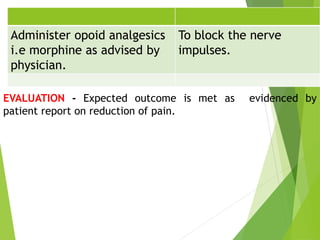
EVALUATION - Expected outcome is met as evidenced by
patient report on reduction of pain.
Administer opoid analgesics
i.e morphine as advised by
physician.
To block the nerve
impulses.
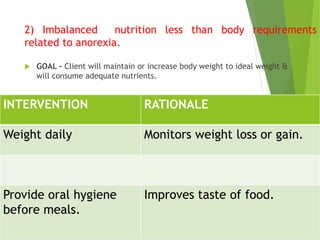
2) Imbalanced nutrition less than body requirements
related to anorexia.
 GOAL – Client will maintain or increase body weight to ideal weight &
will consume adequate nutrients.
INTERVENTION RATIONALE
Weight daily Monitors weight loss or gain.
Provide oral hygiene
before meals.
Improves taste of food.
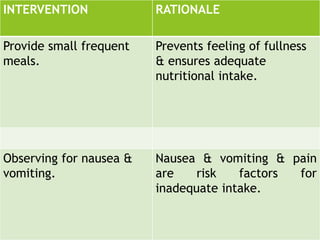
INTERVENTION RATIONALE
Provide small frequent
meals.
Prevents feeling of fullness
& ensures adequate
nutritional intake.
Observing for nausea &
vomiting.
Nausea & vomiting & pain
are risk factors for
inadequate intake.
 EVALUATION – Expected outcome is partially met as evidenced by
patient begin to gain weight.
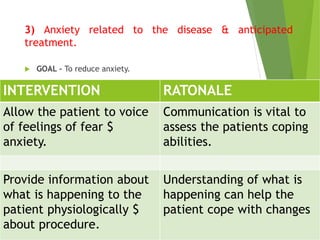
3) Anxiety related to the disease & anticipated
treatment.
 GOAL – To reduce anxiety.
INTERVENTION RATONALE
Allow the patient to voice
of feelings of fear $
anxiety.
Communication is vital to
assess the patients coping
abilities.
Provide information about
what is happening to the
patient physiologically $
about procedure.
Understanding of what is
happening can help the
patient cope with changes
Clear all the doubts from
the patients mind.
It will help to reduce the
anxiety level.
Encourage the patient to
participate in physical &
occupational therapy.
Seeing progress towards
becoming independent may
reduce anxiety & fear.
 EVALUATION – Expected outcome is met as evidenced by
patients expressions.
THANK YOU

Stomach cancer

  • 1.
  • 2.
    INTRODUCTION  Gastric cancerrefers to malignant lesions found in the stomach.  It is more common in men than women.  The most common cause is infection by the bacteria HELICOBACTER pylori.  Most cases of the stomach cancers are gastric carcinomas.
  • 4.
    DEFINITION  Stomach canceralso called as GASTRIC CANCER.  Gastric cancer refers to the malignant neoplasms found in the stomach, usually adenocarcinoma.
  • 5.
    INCIDENCE  The incidenceof gastric or stomach cancer continues to decrease in the United States, it still accounts for more than 11,000 deaths anually.  The typical patient with gastric cancer is between 40 $ 70 years of age, but gastric cancer can occur in people younger than 40 years of age.
  • 6.
     Stomach canceris twice as common in men as in women more common in whites in the United States.  It is estimated that 21,500 new cases of gastric cancer would be diagnosed in 2003 with 13,000 deaths attributed to gastric cancer.
  • 7.
    ETIOLOGY & RISKFACTORS  CHRONIC ATROPIC GASTRITIS  LOW SOCIOECONOMIC STATES  BACKGROUND RADIATION  ACHLORHYDIA  PERNICIOUS ANEMIA  SMOKING  H PYLORI INFECTION  METAL CRAFTS WORKERS & COALMINERS
  • 8.
    TNM CLASSIFICATION PRIMARY TUMOR(T)  TX – Primary tumor cannot be assessed.  TO – No evidence of primary tumor.  TIS – Carcinoma in situ : intraepithelial tumor without invasion of the lamina propria.  T1 – Tumor invades lamina propria, muscularis mucosae or submucosa.  T1a – Tumor invades lamina propria or muscularis mucosae.  T1b – Tumor invades submucosa.
  • 9.
     T2 –Tumor invades muscularis propria.  T3 - Tumor penetrates subserosal connective tissue without invasion of visceral peritoneum or adjacent structures.  T4 – Tumor invades serosa (visceral peritoneum) or adjacent structures.  T4a – Tumor invades serosa (visceral peritoneum).  T4b – Tumor invades adjacent structures.
  • 10.
    REGIONAL LYMPH NODES(N)  NX – Regional lymph nodes cannot be assessed.  NO – No regional lymph node metastasis.  N1 - Metastasis in 1-2 regional lymph nodes.  N2 - Metastasis in 3-6 regional lymph nodes.  N3 - Metastasis in seven or more regional lymph nodes.
  • 11.
     N3a –Metastasis in 7-15 regional lymph nodes.  N3b – Metastasis in 16 or more regional lymph nodes. DISTANT METASTASIS (M)  MO – No distant metastasis.  M1 – Distant metastasis.
  • 12.
    CLINICAL MANIFESTATIONS 1) EARLYMANIFESTATION  Loss of appetite  Vomiting & nausea  Upper abdominal pain  Heart burn 2) LATE MANIFESTATION  Weight loss  Anemia  Blood usually occult in the stool  Haemorrhage  Difficulty swallowing  Loss of strength
  • 13.
    COMPLICATIONS  Haemorrhage  Acutegastric distention  Nutritional problems
  • 14.
    DIAGNOSTIC EVALUATION It isconformed by –  GASTROSCOPIC EXAM  COMPUTED TOMOGRAPHY or CT SCAN  COMPLETE BLOOD COUNT (CBC)  FAECAL OCCULT BLOOD TEST  UPPER GASTROINTESTINAL X-RAY EXAMINATION
  • 15.
    MANAGEMENT MEDICAL MANAGEMENT  GOAL– To inhibit tumor growth & cure.  1) CHEMOTHERAPY – Some drugs used in stomach cancer treatment are-  5- fluorouracil (5-FU) , cisplatin (platinol), doxorubicin (adriamycin), etoposide ( etopophos), & mitomycinc (mutamycin).  RADIATION THERAPY – Radiation therapy can be used to slow the growth & ease the symptoms of advanced stomach cancer, such as pain, bleeding & eating problems.
  • 16.
     External beamradiation therapy – Is a type of radiation therapy often used to treat stomach cancer. This treatment focuses radiation on the cancer from a machine outside the body.  Treatments are usually given 5 days a week over several weeks or months.
  • 17.
    SURGICAL MANAGEMENT The surgeryinclude :  GASTRECTOMY – A total gastrectomy may be performed for a resectable cancer in the midportion or body of the stomach. The entire stomach is removed along with the duodenum, the lower portion of the esophagus, supporting mesentery & lymph nodes.  The Billroth I involves a limited resection & offers a lower cure rate than the billroth II.  The Billroth II procedure is a wider resection that involves 75% approximately removing of the stomach & decreases the possibility of lymph node spread or metastatic recurrence.
  • 19.
     GASTROENTEROSTOMY –It is the surgical creation of a passage between the stomach & small intestine. It is performed to treat peptic ulcersa.
  • 20.
    NURSING MANAGEMENT PREOPERATIVE CARE Consent must be taken prior to surgery.  The patients history of major illness, previous surgeries, medication, alcohol & tobacco is obtained.  Bowel preparation must be done.  Catheterisation is provided before surgery.  All pre-medication should be done.
  • 21.
     Prepare thepatient psychologically & reduce anxiety of the patient.  Patient should be NPO 12 hours before surgery.
  • 22.
    POSTOPERATIVE CARE  Monitorvital sign every 2 hourly.  Inspect surgical site for redness, itching etc.  Assess complete blood count especially WBC level to check for infection.  Monitor for complication like dumping syndrome.  Monitor input & output of the patient.  Protect the airway.  Monitor for gag reflexes.  Provide comfort like semi-fowlers position.  Manage drainage system.
  • 23.
     Decreasing theamount of food taken at one time & maintaining a high-protein, high fat, low carbohydrate, dry diet. Gastric emptying can be delayed by eating in a recumbent position or semi- recumbent position, lying down after meals, increasing the fat content in a diet $ avoiding fluids 1 hr before or 2 hrs after meals.
  • 24.
    NURSING CARE PLAN Acute pain related to surgical process.  Imbalanced nutrition less than body requirements related to anorexia.  Anxiety related to the disease & anticipated treatment.  Deficient knowledge regarding self care activities.
  • 25.
    Acute pain relatedto surgical process.  GOAL- To relief pain. INTERVENTION RATIONALE Monitor pain every 2 to 4 hr for first 48 hr $ within 30 minutes of only intervention. A pain scale is the accurate measure of pain. Check the vital sign every 2 hourly. Vital sign may increase during pain. Provide proper positioning to the patient i.e supine position. Helps in reduction of pain.
  • 26.
    EVALUATION - Expectedoutcome is met as evidenced by patient report on reduction of pain. Administer opoid analgesics i.e morphine as advised by physician. To block the nerve impulses.
  • 27.
    2) Imbalanced nutritionless than body requirements related to anorexia.  GOAL – Client will maintain or increase body weight to ideal weight & will consume adequate nutrients. INTERVENTION RATIONALE Weight daily Monitors weight loss or gain. Provide oral hygiene before meals. Improves taste of food.
  • 28.
    INTERVENTION RATIONALE Provide smallfrequent meals. Prevents feeling of fullness & ensures adequate nutritional intake. Observing for nausea & vomiting. Nausea & vomiting & pain are risk factors for inadequate intake.
  • 29.
     EVALUATION –Expected outcome is partially met as evidenced by patient begin to gain weight.
  • 30.
    3) Anxiety relatedto the disease & anticipated treatment.  GOAL – To reduce anxiety. INTERVENTION RATONALE Allow the patient to voice of feelings of fear $ anxiety. Communication is vital to assess the patients coping abilities. Provide information about what is happening to the patient physiologically $ about procedure. Understanding of what is happening can help the patient cope with changes
  • 31.
    Clear all thedoubts from the patients mind. It will help to reduce the anxiety level. Encourage the patient to participate in physical & occupational therapy. Seeing progress towards becoming independent may reduce anxiety & fear.
  • 32.
     EVALUATION –Expected outcome is met as evidenced by patients expressions.
  • 33.