Mrs. Samia Dogar
Associate Prof
Federal College Of Education H-9 Islamabad
Attributes ====Qualities, Characteristics,
Features, Traits
These are features of a stimulus that one must
look for to decide if that stimulus is a
positive instance of the concept.
Attributes are a very important source of
requirements information.
 Just as every person has attributes (age,
hair color, gender), each requirement has
a source, a relative importance, and time it
was created.
 The attributes of religion, include Catholic,
Jew, Protestant, Muslim, etc.
 Attributes do more than simply clarify
a requirement.  If created properly, they
can yield significant information about the
state of the
system/Person/Phenomena/Event.
•Source 
Person, document or other origin 
•Comparison
Statement of relative importance of the 
requirement, either to the system (mandatory, critical, 
optional) or to other requirements (high, medium, 
low.)
•Comments 
Reviewer's or writer's comments on a
requirement.
Status 
Degree of completeness (completed, partial, not
started).
Risk -
Confidence measure on the likelihood of meeting
(or not meeting) a requirement. Could be high, medium,
low or the integers one through ten.
 Due By - Date the requirement must be
provided.
 Method of verification - Qualification type
to be used to verify that a requirement has
been met: analysis, demonstration,
inspection, test, and walkthrough.
 Level of Test - Describes the verification
lifecycle stage at which the requirement is
determined to be met: unit test, component,
system or product.
Analyzing
Concepts
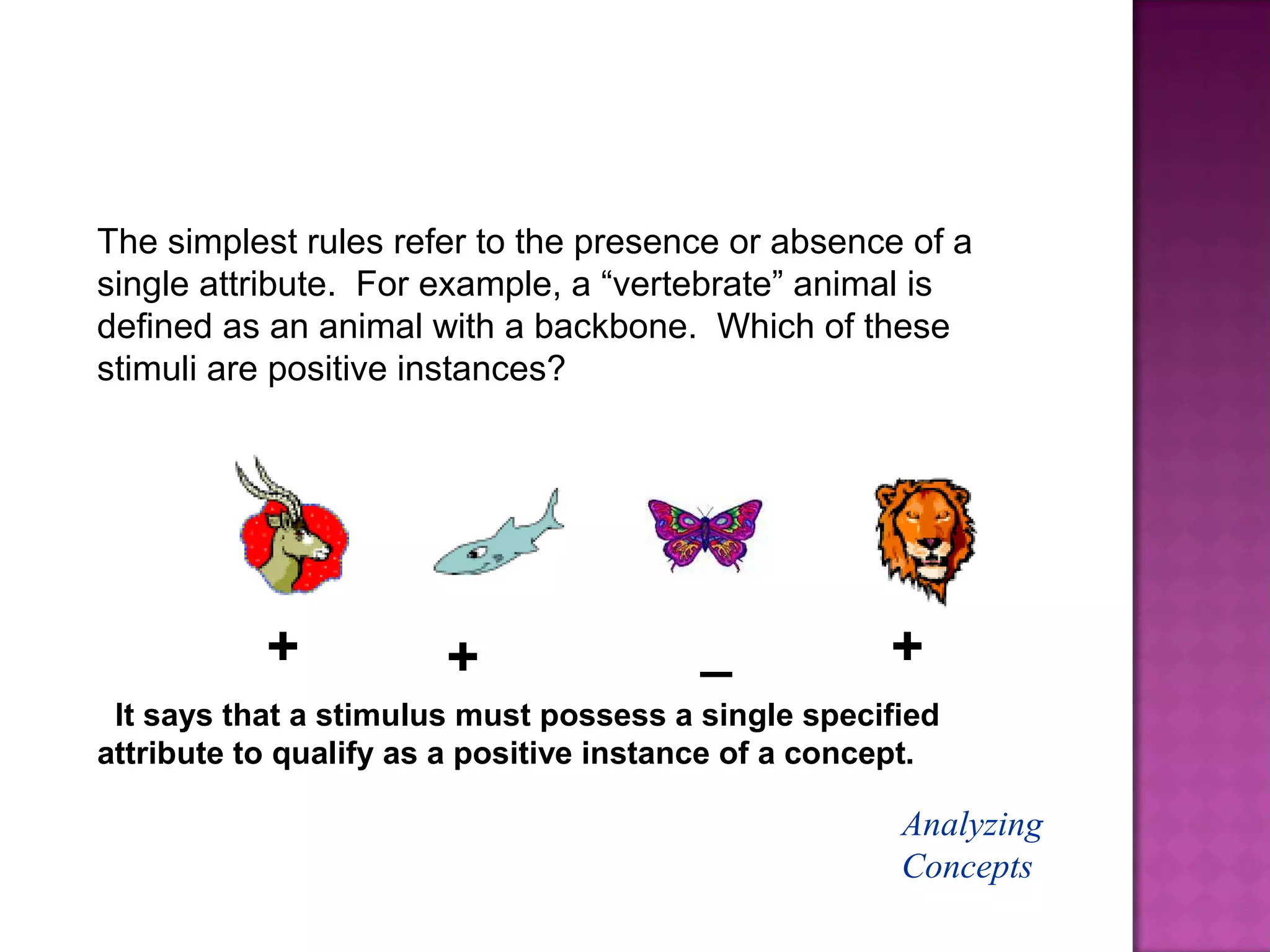
The simplest rules refer to the presence or absence of a
single attribute. For example, a “vertebrate” animal is
defined as an animal with a backbone. Which of these
stimuli are positive instances?
+ + +_
It says that a stimulus must possess a single specified
attribute to qualify as a positive instance of a concept.
Analyzing
Concepts
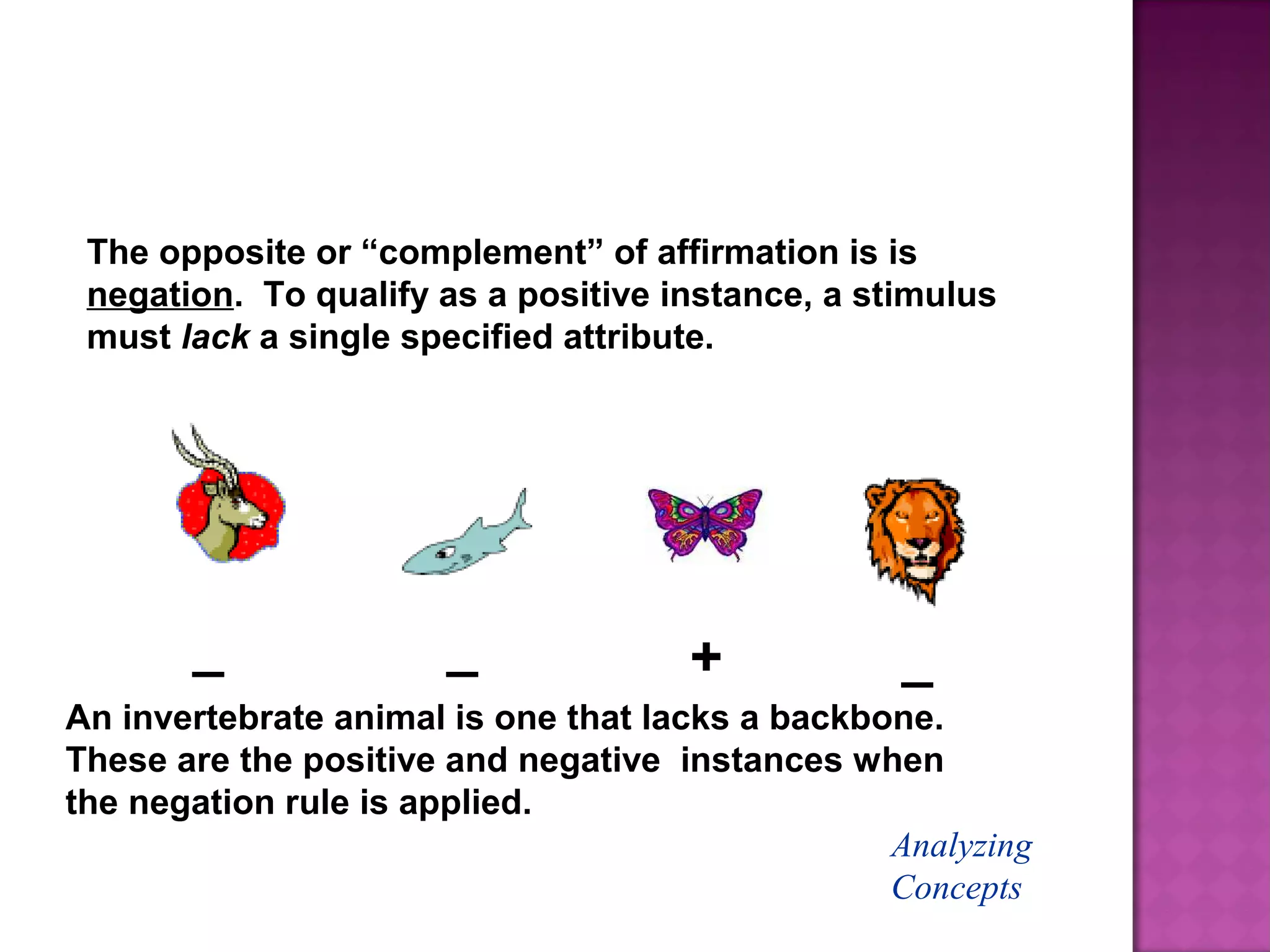
The opposite or “complement” of affirmation is is
negation. To qualify as a positive instance, a stimulus
must lack a single specified attribute.
+_
An invertebrate animal is one that lacks a backbone.
These are the positive and negative instances when
the negation rule is applied.
_ _
Behavioral
Processes
In behavioral terms, when a concept is learned, two
processes control how we respond to a stimulus:
Generalization:
Student generalize a certain response (like the name of an
object) to all members of the conceptual class based on
their common attributes.
Discrimination:
Student discriminate between stimuli which belong to the
conceptual class and those that don’t because they lack
one or more of the defining attributes.
Behavioral
Processes
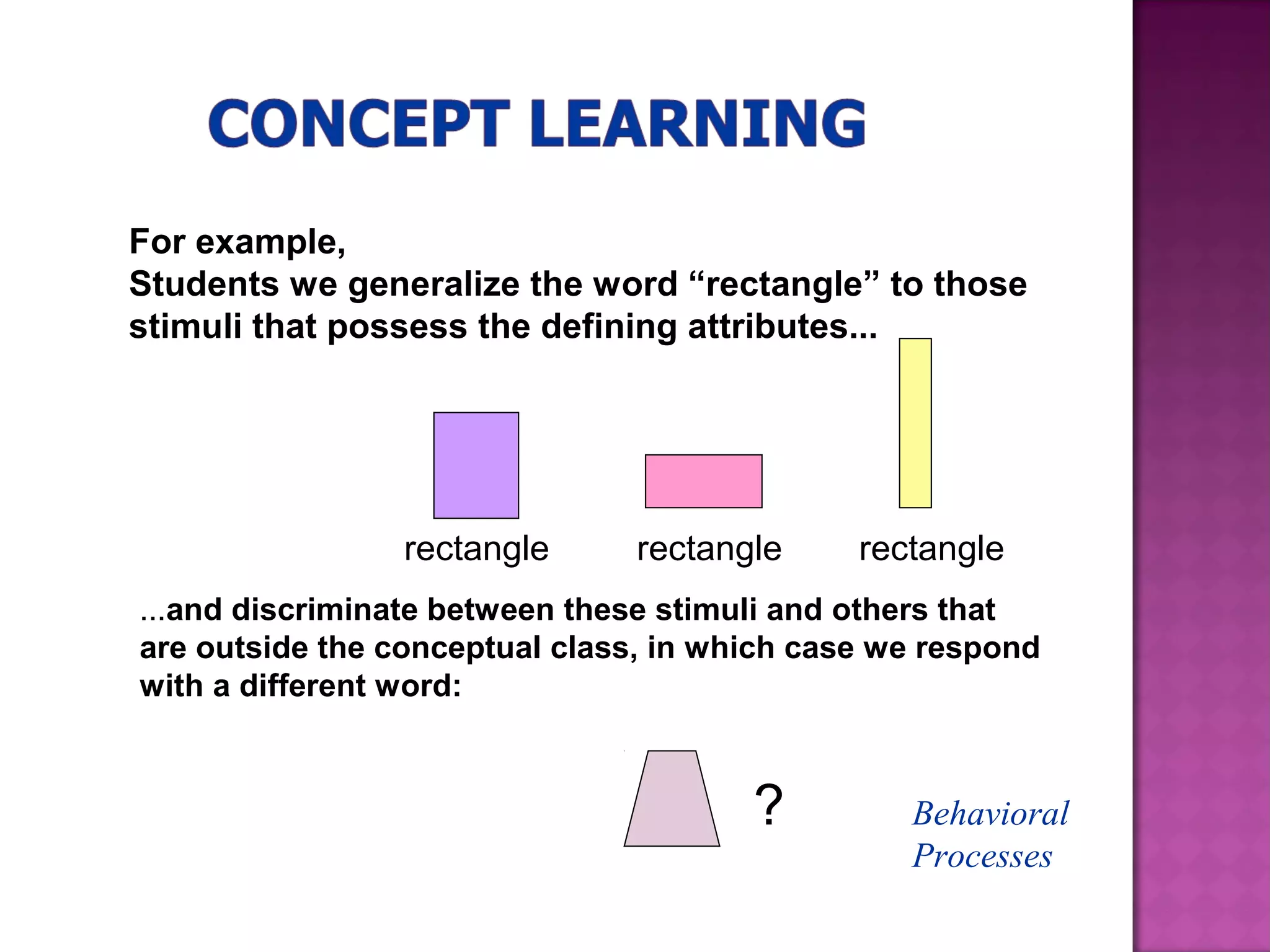
For example,
Students we generalize the word “rectangle” to those
stimuli that possess the defining attributes...
...and discriminate between these stimuli and others that
are outside the conceptual class, in which case we respond
with a different word:
rectangle rectangle rectangle
?
Rote Learning vs.
Concept Learning
Rote learning is learning without understanding the
meaning of what is learned. For example, you can
learn to make the correct response to a stimulus
without discovering the conceptual category to which
the stimulus belongs.
More technically, sharing correct response and idea
attributes that the stimulus shares with other
students ie members of the conceptual class.
 Any Questions?
 For any question
samia42001@yahoo.com

Attributes Of Concepts

  • 1.
    Mrs. Samia Dogar AssociateProf Federal College Of Education H-9 Islamabad
  • 2.
    Attributes ====Qualities, Characteristics, Features,Traits These are features of a stimulus that one must look for to decide if that stimulus is a positive instance of the concept. Attributes are a very important source of requirements information.
  • 3.
     Just asevery person has attributes (age, hair color, gender), each requirement has a source, a relative importance, and time it was created.  The attributes of religion, include Catholic, Jew, Protestant, Muslim, etc.  Attributes do more than simply clarify a requirement.  If created properly, they can yield significant information about the state of the system/Person/Phenomena/Event.
  • 5.
    •Source  Person, document or other origin  •Comparison Statement of relative importance of the  requirement, either to the system (mandatory, critical,  optional) or to other requirements (high, medium,  low.) •Comments  Reviewer's or writer'scomments on a requirement. Status  Degree of completeness (completed, partial, not started). Risk - Confidence measure on the likelihood of meeting (or not meeting) a requirement. Could be high, medium, low or the integers one through ten.
  • 6.
     Due By -Date the requirement must be provided.  Method of verification - Qualification type to be used to verify that a requirement has been met: analysis, demonstration, inspection, test, and walkthrough.  Level of Test - Describes the verification lifecycle stage at which the requirement is determined to be met: unit test, component, system or product.
  • 7.
    Analyzing Concepts The simplest rulesrefer to the presence or absence of a single attribute. For example, a “vertebrate” animal is defined as an animal with a backbone. Which of these stimuli are positive instances? + + +_ It says that a stimulus must possess a single specified attribute to qualify as a positive instance of a concept.
  • 8.
    Analyzing Concepts The opposite or“complement” of affirmation is is negation. To qualify as a positive instance, a stimulus must lack a single specified attribute. +_ An invertebrate animal is one that lacks a backbone. These are the positive and negative instances when the negation rule is applied. _ _
  • 9.
    Behavioral Processes In behavioral terms,when a concept is learned, two processes control how we respond to a stimulus: Generalization: Student generalize a certain response (like the name of an object) to all members of the conceptual class based on their common attributes. Discrimination: Student discriminate between stimuli which belong to the conceptual class and those that don’t because they lack one or more of the defining attributes.
  • 10.
    Behavioral Processes For example, Students wegeneralize the word “rectangle” to those stimuli that possess the defining attributes... ...and discriminate between these stimuli and others that are outside the conceptual class, in which case we respond with a different word: rectangle rectangle rectangle ?
  • 11.
    Rote Learning vs. ConceptLearning Rote learning is learning without understanding the meaning of what is learned. For example, you can learn to make the correct response to a stimulus without discovering the conceptual category to which the stimulus belongs. More technically, sharing correct response and idea attributes that the stimulus shares with other students ie members of the conceptual class.
  • 12.
     Any Questions? For any question samia42001@yahoo.com