Implications of Children’s IdeasImplications of Children’s Ideas
For Curriculum and TeacherFor Curriculum and Teacher
EducationEducation
By
Mrs. Samia Rehman Dogar
Associate Prof
Federal College Of Education
H-9,Islamabad
samia42001@yahoo.com
Students differ by IQ/Ideas/Cultural
etc,,,,may be inconvenient, but it is
inescapable. Adapting to that diversity is
the inevitable price of productivity, high
standards, and fairness to the students.
2
 learning by improving the match between a student's individual
needs and the curriculum.
 A general term used to describe the range of strategies, which
are used to ensure children’s needs are met.
 Adapting the curriculum to meet the unique needs of learners by
making modifications in complexity, depth, and pacing.
3
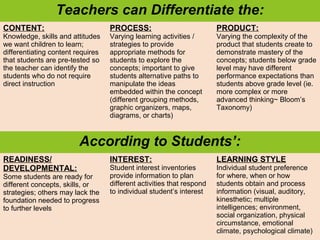
Teachers can Differentiate the:
CONTENT:
Knowledge, skills and attitudes
we want children to learn;
differentiating content requires
that students are pre-tested so
the teacher can identify the
students who do not require
direct instruction
PROCESS:
Varying learning activities /
strategies to provide
appropriate methods for
students to explore the
concepts; important to give
students alternative paths to
manipulate the ideas
embedded within the concept
(different grouping methods,
graphic organizers, maps,
diagrams, or charts)
PRODUCT:
Varying the complexity of the
product that students create to
demonstrate mastery of the
concepts; students below grade
level may have different
performance expectations than
students above grade level (ie.
more complex or more
advanced thinking~ Bloom’s
Taxonomy)
According to Students’:
READINESS/
DEVELOPMENTAL:
Some students are ready for
different concepts, skills, or
strategies; others may lack the
foundation needed to progress
to further levels
INTEREST:
Student interest inventories
provide information to plan
different activities that respond
to individual student’s interest
LEARNING STYLE
Individual student preference
for where, when or how
students obtain and process
information (visual, auditory,
kinesthetic; multiple
intelligences; environment,
social organization, physical
circumstance, emotional
climate, psychological climate)
4
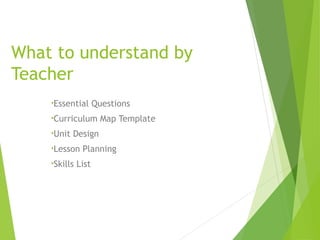
What to understand by
Teacher
•Essential Questions
•Curriculum Map Template
•Unit Design
•Lesson Planning
•Skills List
5
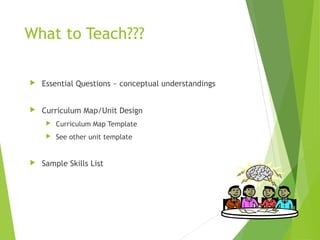
What to Teach???
 Essential Questions ~ conceptual understandings
 Curriculum Map/Unit Design
 Curriculum Map Template
 See other unit template
 Sample Skills List
6
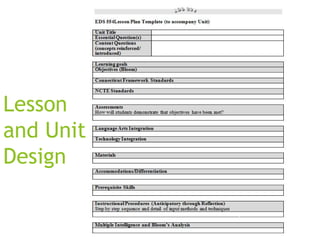
Lesson
and Unit
Design
7
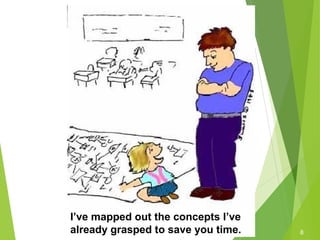
I’ve mapped out the concepts I’ve
already grasped to save you time. 8
Eight Steps
(Student Readiness)
1. Identify objectives
2. Create pretest (end of unit expectations;)
3. Identify students to Pretest
4. Administer Pretest
5. Eliminate content in areas of mastery
6. Streamline instruction
7. Offer enrichment or acceleration activities
8. Keep records of progress
Management SuggestionsManagement Suggestions
 Explain the activity and the procedures
with the whole class
 Make expectations clear – develop ground rules for:
Behavior
Performance
 Use tasks that require time and thinking – this is not
an extension of the “seat-work” concept
 Provide clear instructions, materials,
responsibilities, check points, and expectations
(rubrics)
QUESTIONING & DISCUSSIONQUESTIONING & DISCUSSION
"I have no answers, only questions."
~Socrates, c. 300 B.C.
Open Ended Questions
 have no “right” answer
 can be discussed and debated
 provoke and sustain student inquiry
 raise other important questions
 address the conceptual or philosophical foundations of a
discipline
 stimulate vital, ongoing reflection of big ideas and
assumptions
12
 Any Question
13

Student &curriculum

  • 1.
    Implications of Children’sIdeasImplications of Children’s Ideas For Curriculum and TeacherFor Curriculum and Teacher EducationEducation By Mrs. Samia Rehman Dogar Associate Prof Federal College Of Education H-9,Islamabad samia42001@yahoo.com
  • 2.
    Students differ byIQ/Ideas/Cultural etc,,,,may be inconvenient, but it is inescapable. Adapting to that diversity is the inevitable price of productivity, high standards, and fairness to the students. 2
  • 3.
     learning byimproving the match between a student's individual needs and the curriculum.  A general term used to describe the range of strategies, which are used to ensure children’s needs are met.  Adapting the curriculum to meet the unique needs of learners by making modifications in complexity, depth, and pacing. 3
  • 4.
    Teachers can Differentiatethe: CONTENT: Knowledge, skills and attitudes we want children to learn; differentiating content requires that students are pre-tested so the teacher can identify the students who do not require direct instruction PROCESS: Varying learning activities / strategies to provide appropriate methods for students to explore the concepts; important to give students alternative paths to manipulate the ideas embedded within the concept (different grouping methods, graphic organizers, maps, diagrams, or charts) PRODUCT: Varying the complexity of the product that students create to demonstrate mastery of the concepts; students below grade level may have different performance expectations than students above grade level (ie. more complex or more advanced thinking~ Bloom’s Taxonomy) According to Students’: READINESS/ DEVELOPMENTAL: Some students are ready for different concepts, skills, or strategies; others may lack the foundation needed to progress to further levels INTEREST: Student interest inventories provide information to plan different activities that respond to individual student’s interest LEARNING STYLE Individual student preference for where, when or how students obtain and process information (visual, auditory, kinesthetic; multiple intelligences; environment, social organization, physical circumstance, emotional climate, psychological climate) 4
  • 5.
    What to understandby Teacher •Essential Questions •Curriculum Map Template •Unit Design •Lesson Planning •Skills List 5
  • 6.
    What to Teach??? Essential Questions ~ conceptual understandings  Curriculum Map/Unit Design  Curriculum Map Template  See other unit template  Sample Skills List 6
  • 7.
  • 8.
    I’ve mapped outthe concepts I’ve already grasped to save you time. 8
  • 9.
    Eight Steps (Student Readiness) 1.Identify objectives 2. Create pretest (end of unit expectations;) 3. Identify students to Pretest 4. Administer Pretest 5. Eliminate content in areas of mastery 6. Streamline instruction 7. Offer enrichment or acceleration activities 8. Keep records of progress
  • 10.
    Management SuggestionsManagement Suggestions Explain the activity and the procedures with the whole class  Make expectations clear – develop ground rules for: Behavior Performance  Use tasks that require time and thinking – this is not an extension of the “seat-work” concept  Provide clear instructions, materials, responsibilities, check points, and expectations (rubrics)
  • 11.
    QUESTIONING & DISCUSSIONQUESTIONING& DISCUSSION "I have no answers, only questions." ~Socrates, c. 300 B.C.
  • 12.
    Open Ended Questions have no “right” answer  can be discussed and debated  provoke and sustain student inquiry  raise other important questions  address the conceptual or philosophical foundations of a discipline  stimulate vital, ongoing reflection of big ideas and assumptions 12
  • 13.