

“Educate your child, they must live
in a time different from you”
Muhammad (PBUH)
Mrs. Samia Dogar
Associate Prof
Federal College Of Education H-9
Islamabad
The Electromagnetic
Spectrum
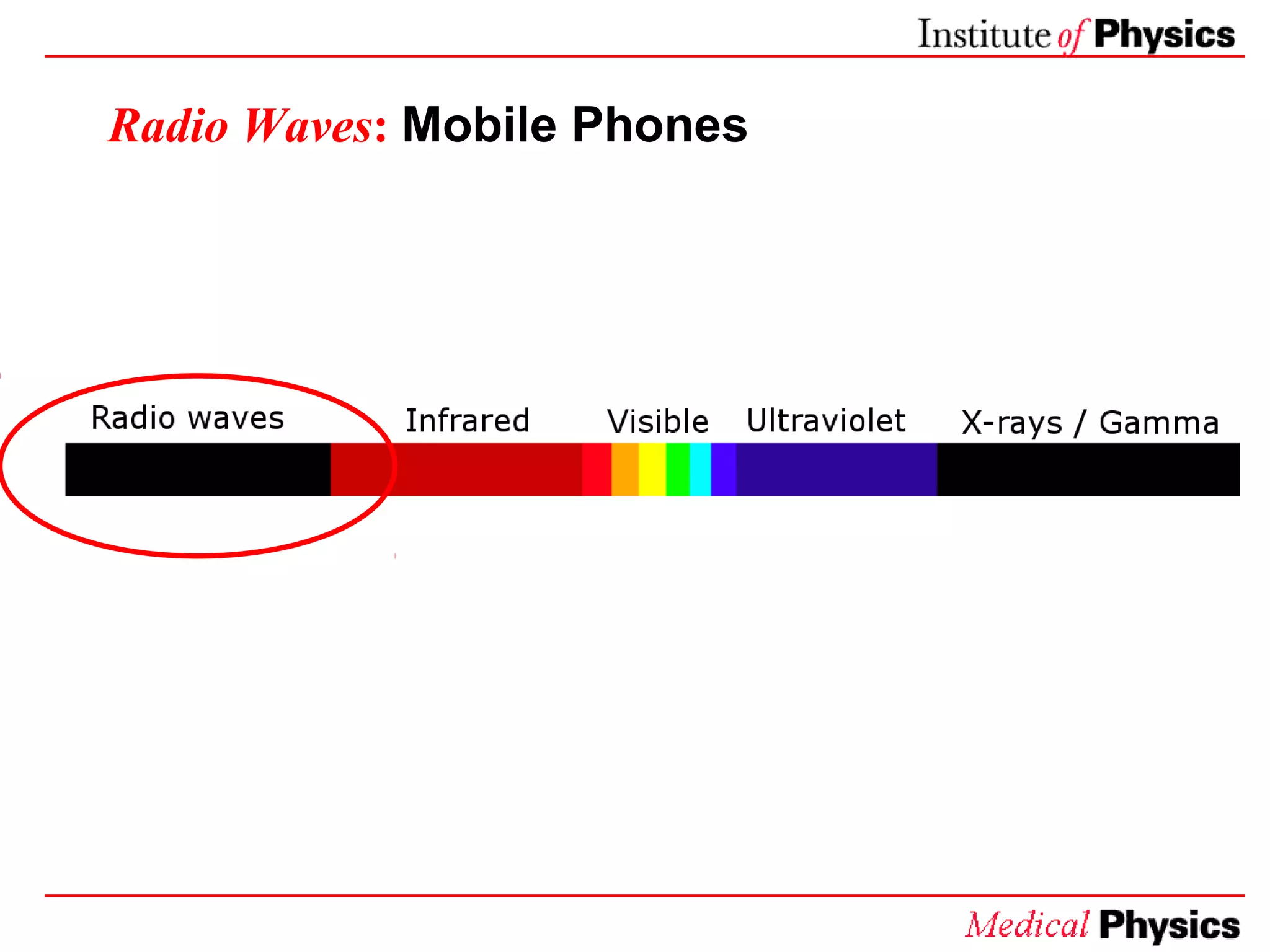
Radio Waves: Mobile Phones
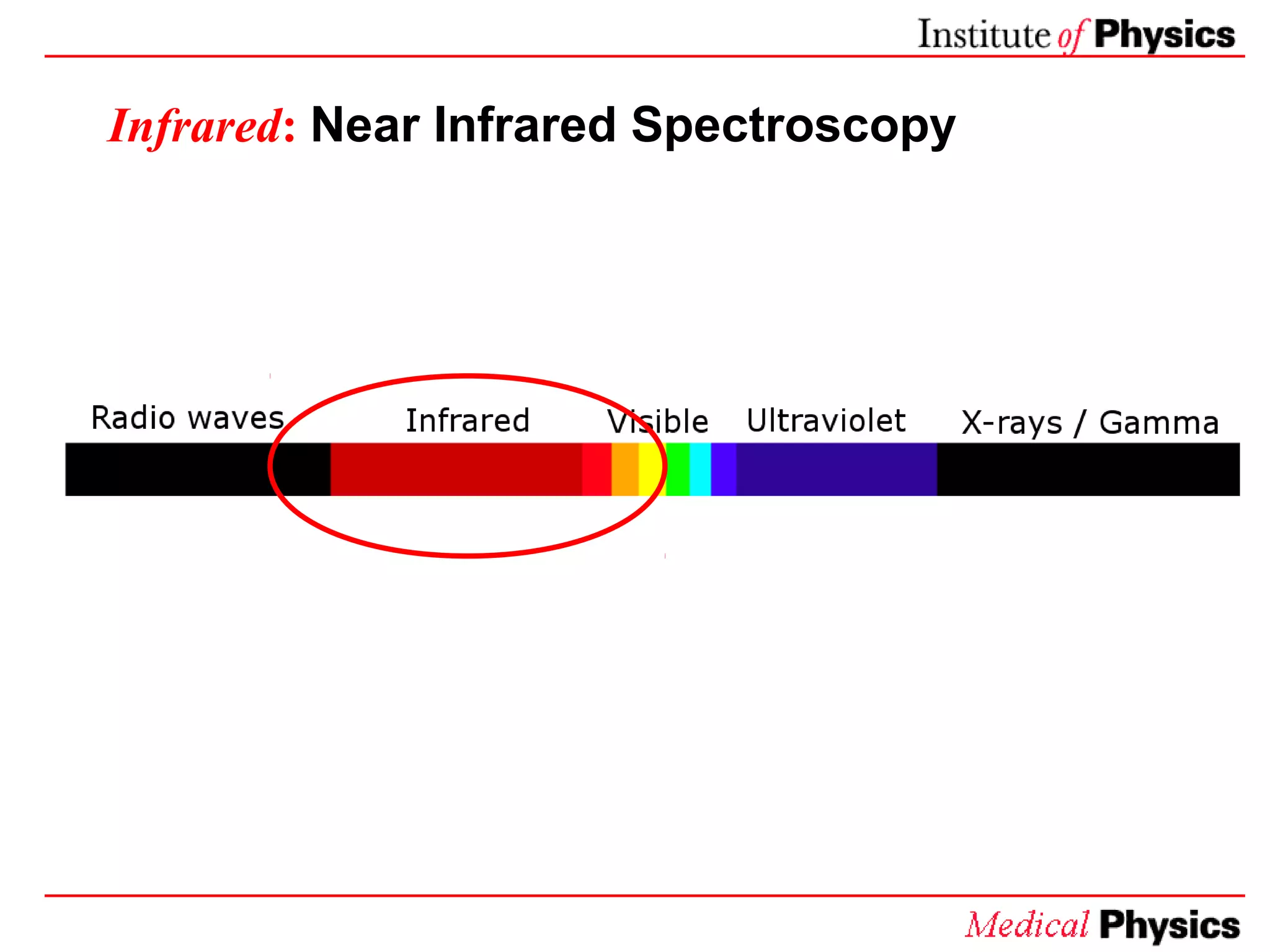
Infrared: Near Infrared Spectroscopy
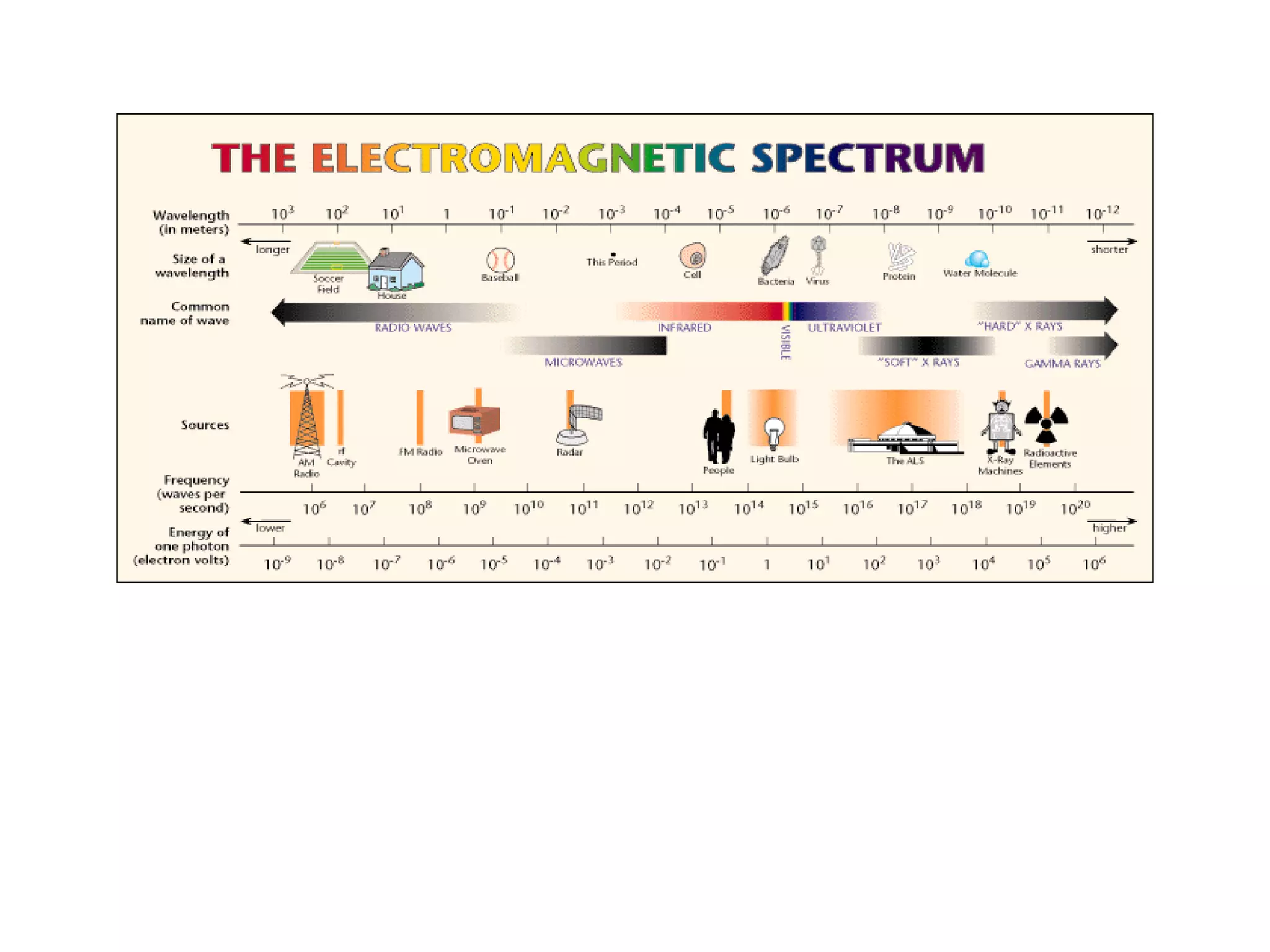
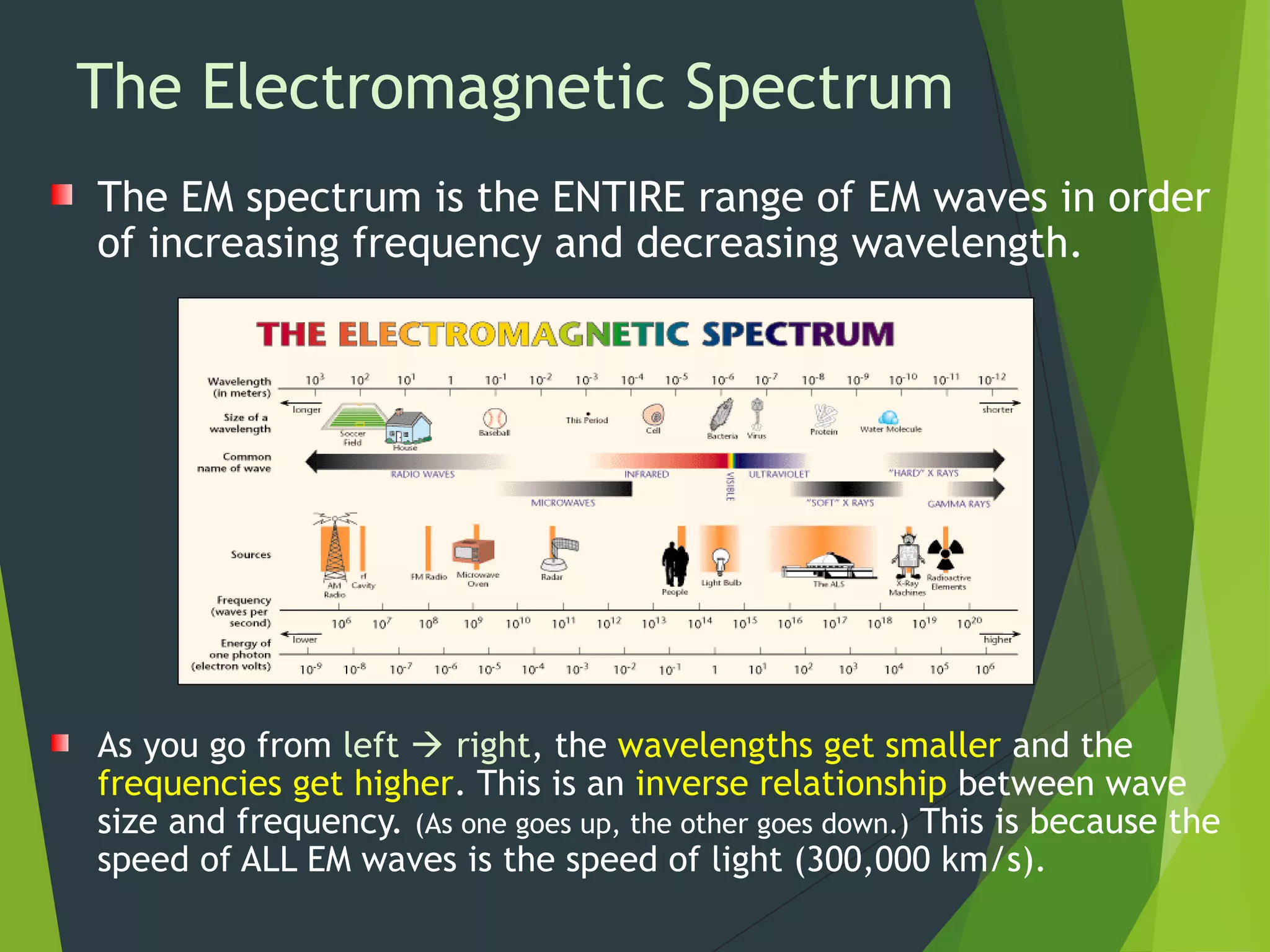
The Electromagnetic Spectrum
The EM spectrum is the ENTIRE range of EM waves in order
of increasing frequency and decreasing wavelength.
As you go from left  right, the wavelengths get smaller and the
frequencies get higher. This is an inverse relationship between wave
size and frequency. (As one goes up, the other goes down.) This is because the
speed of ALL EM waves is the speed of light (300,000 km/s).
Things to RememberThings to Remember
The higher the frequency, the more energy theThe higher the frequency, the more energy the
wave has.wave has.
EM wavesEM waves do not require mediado not require media in which to travelin which to travel
or move.or move.
EM waves are considered to beEM waves are considered to be transverse wavestransverse waves
because they are made of vibrating electric andbecause they are made of vibrating electric and
magnetic fields at right angles to each other, andmagnetic fields at right angles to each other, and
to the direction the waves are traveling.to the direction the waves are traveling.
Inverse relationship between wave size and
frequency: as wavelengths get smaller, frequencies
get higher.
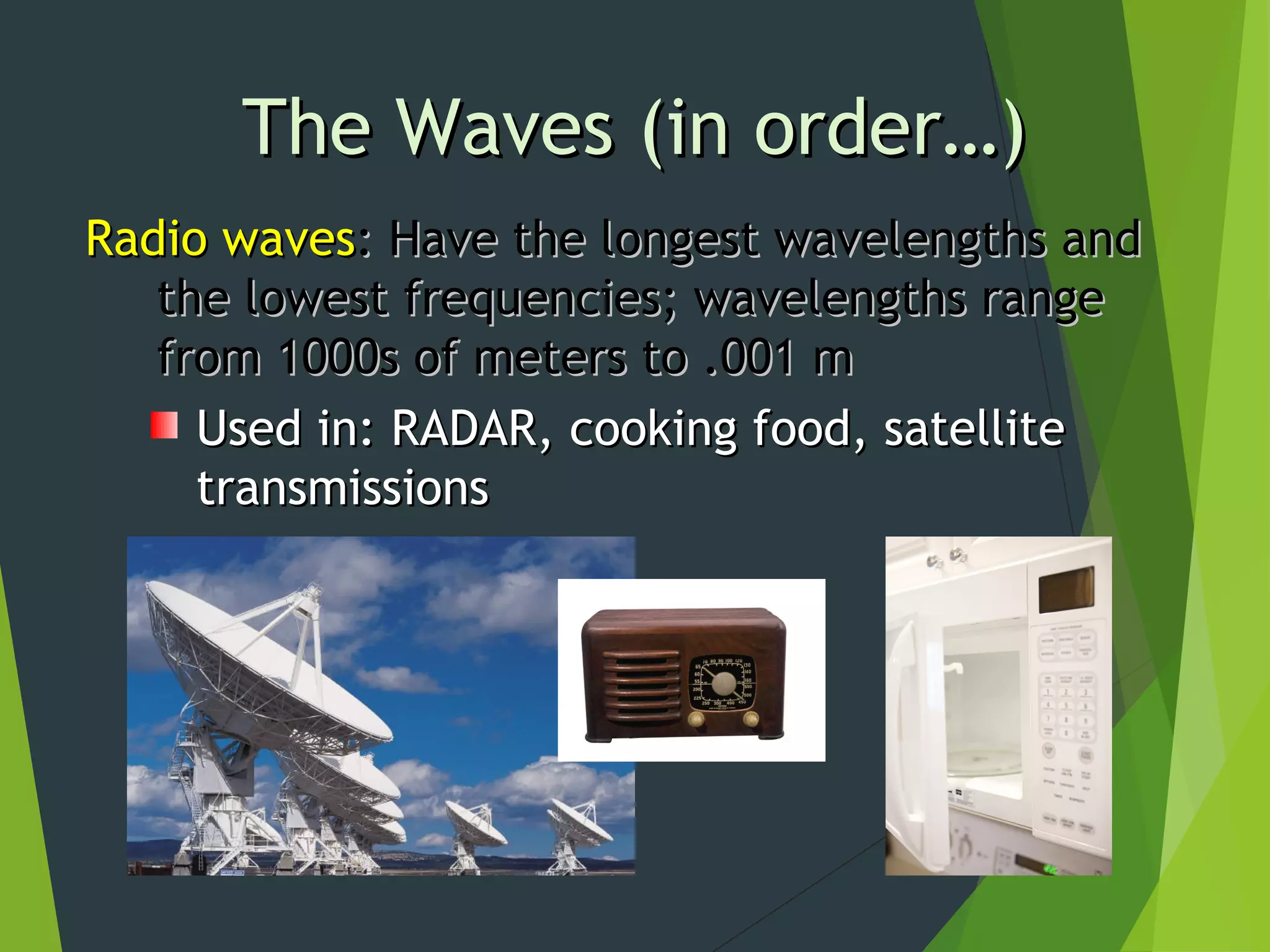
Radio wavesRadio waves: Have the longest wavelengths and: Have the longest wavelengths and
the lowest frequencies; wavelengths rangethe lowest frequencies; wavelengths range
from 1000s of meters to .001 mfrom 1000s of meters to .001 m
Used in: RADAR, cooking food, satelliteUsed in: RADAR, cooking food, satellite
transmissionstransmissions
The Waves (in order…)The Waves (in order…)
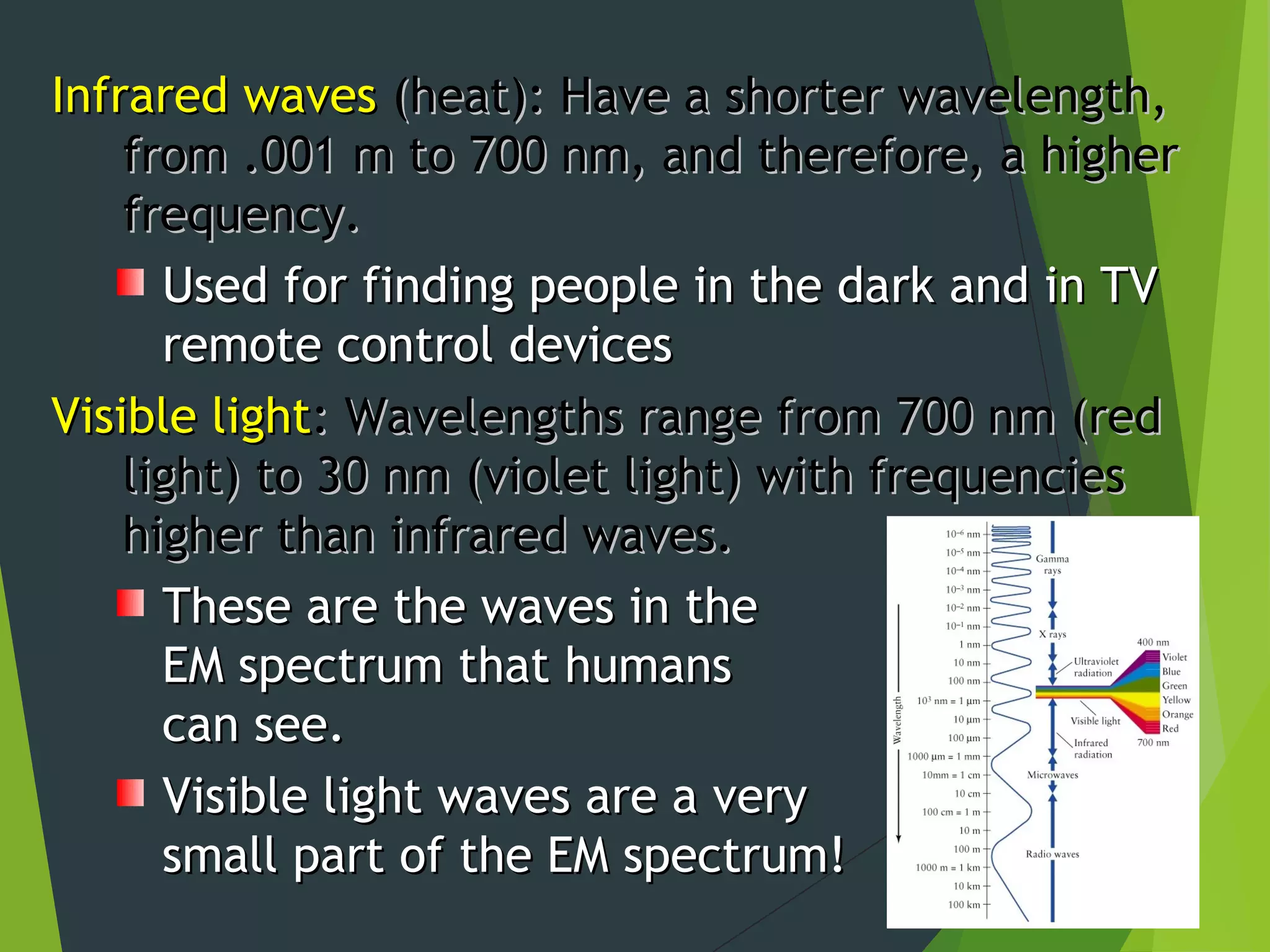
Infrared wavesInfrared waves (heat): Have a shorter wavelength,(heat): Have a shorter wavelength,
from .001 m to 700 nm, and therefore, a higherfrom .001 m to 700 nm, and therefore, a higher
frequency.frequency.
Used for finding people in the dark and in TVUsed for finding people in the dark and in TV
remote control devicesremote control devices
Visible lightVisible light: Wavelengths range from 700 nm (red: Wavelengths range from 700 nm (red
light) to 30 nm (violet light) with frequencieslight) to 30 nm (violet light) with frequencies
higher than infrared waves.higher than infrared waves.
These are the waves in theThese are the waves in the
EM spectrum that humansEM spectrum that humans
can see.can see.
Visible light waves are a veryVisible light waves are a very
small part of the EM spectrum!small part of the EM spectrum!
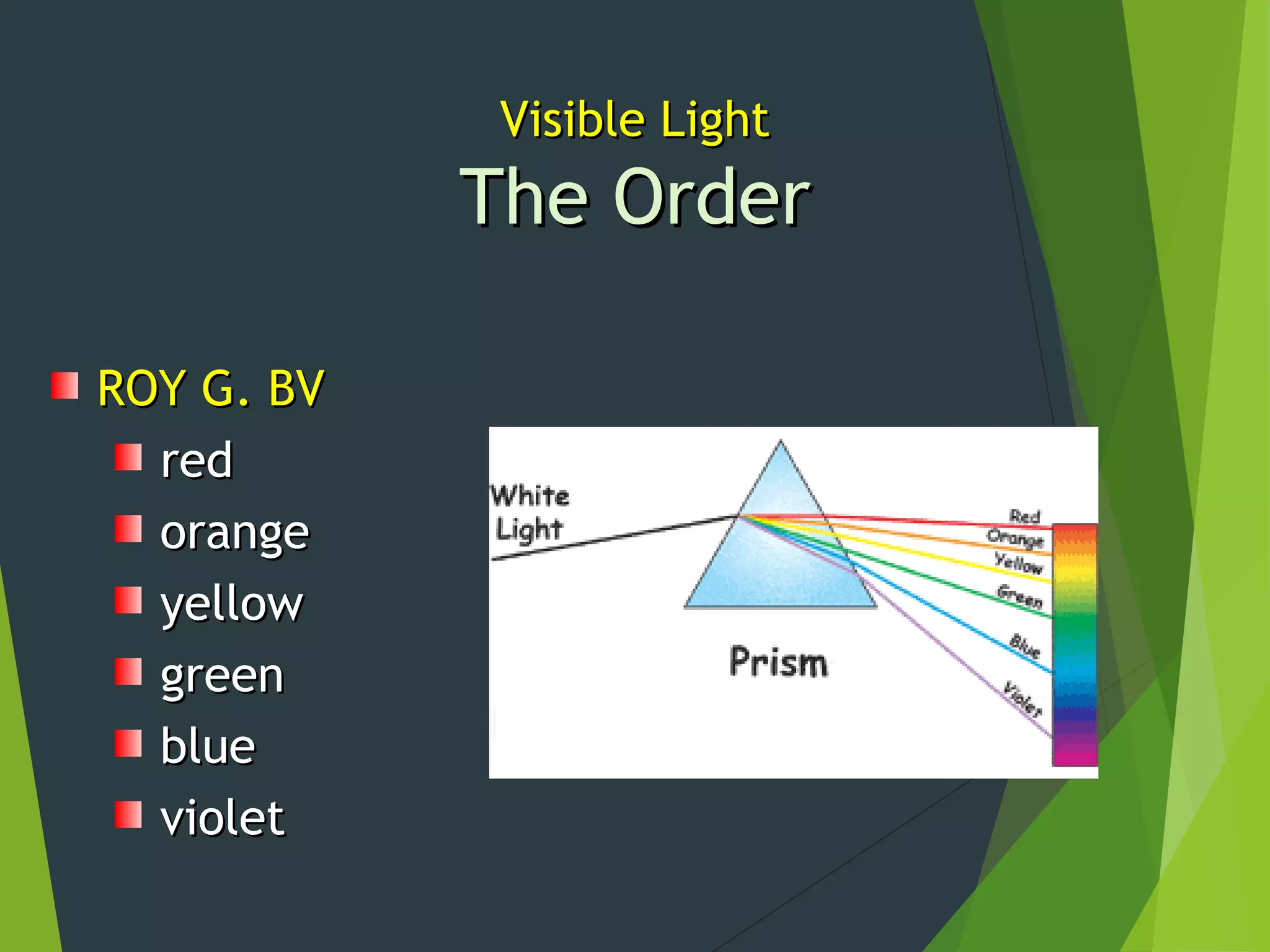
ROY G. BVROY G. BV
redred
orangeorange
yellowyellow
greengreen
blueblue
violetviolet
Visible LightVisible Light
The OrderThe Order
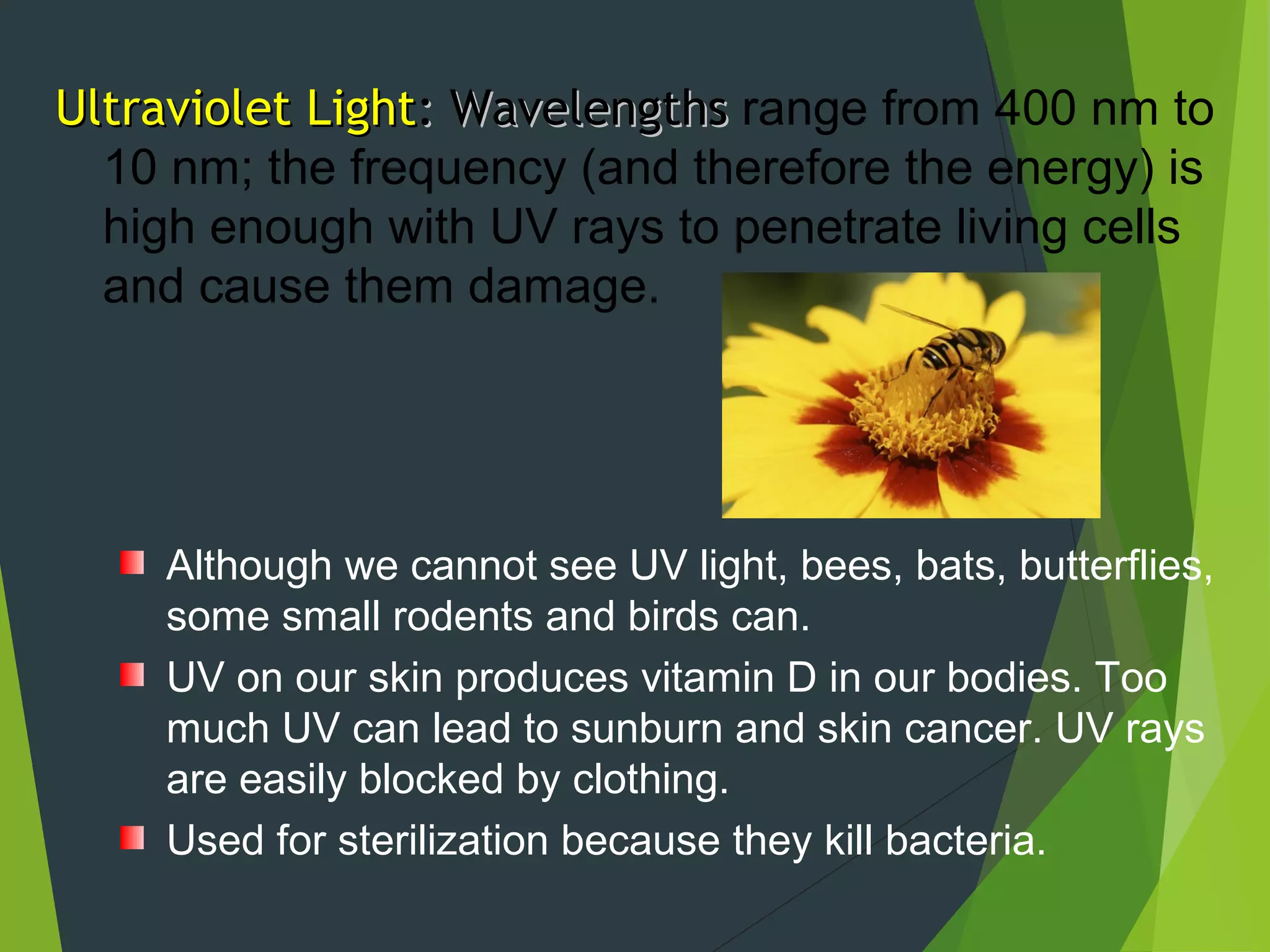
Ultraviolet LightUltraviolet Light: Wavelengths: Wavelengths range from 400 nm to
10 nm; the frequency (and therefore the energy) is
high enough with UV rays to penetrate living cells
and cause them damage.
Although we cannot see UV light, bees, bats, butterflies,
some small rodents and birds can.
UV on our skin produces vitamin D in our bodies. Too
much UV can lead to sunburn and skin cancer. UV rays
are easily blocked by clothing.
Used for sterilization because they kill bacteria.
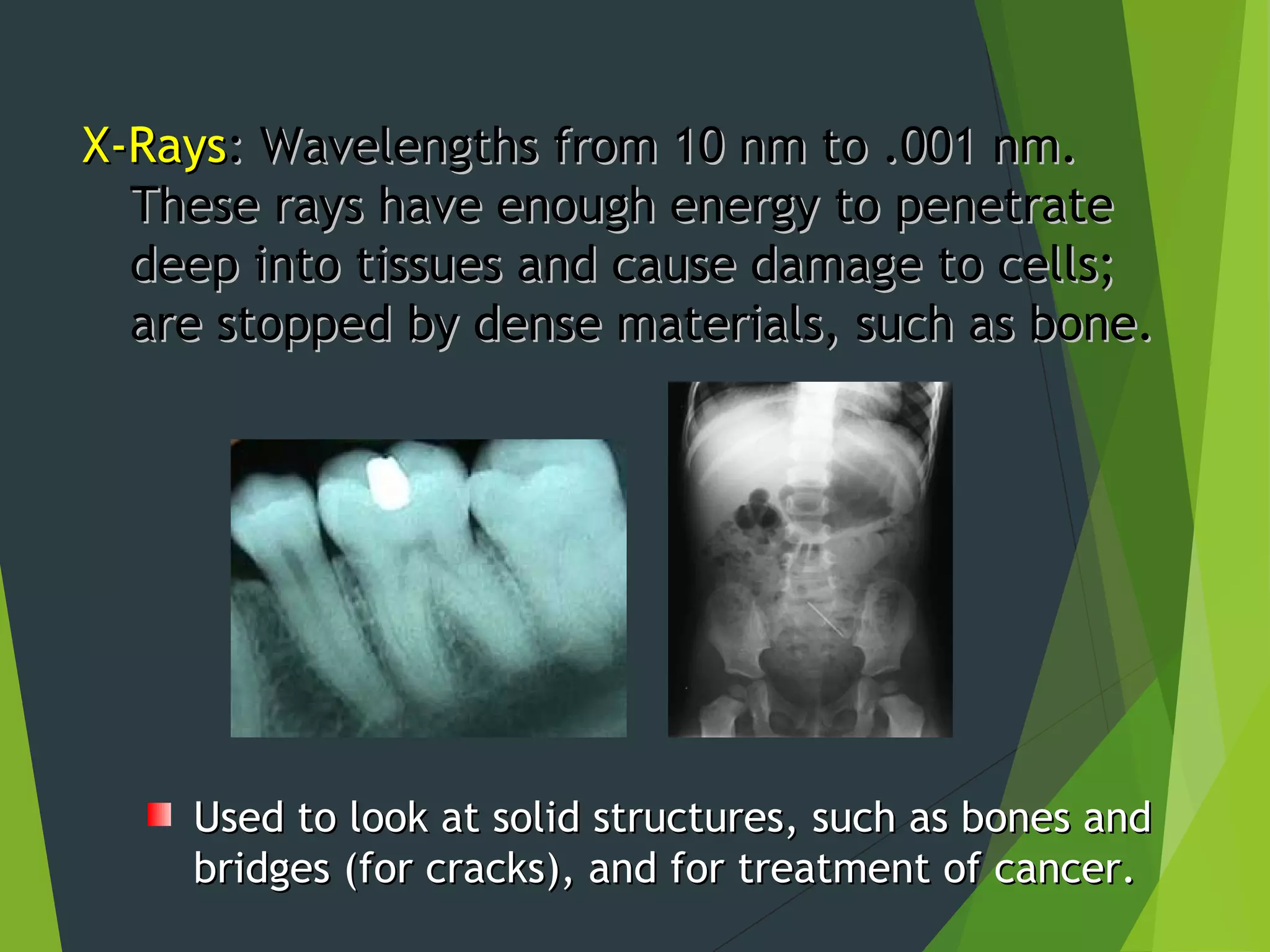
X-RaysX-Rays: Wavelengths from 10 nm to .001 nm.: Wavelengths from 10 nm to .001 nm.
These rays have enough energy to penetrateThese rays have enough energy to penetrate
deep into tissues and cause damage to cells;deep into tissues and cause damage to cells;
are stopped by dense materials, such as bone.are stopped by dense materials, such as bone.
Used to look at solid structures, such as bones andUsed to look at solid structures, such as bones and
bridges (for cracks), and for treatment of cancer.bridges (for cracks), and for treatment of cancer.
Gamma RaysGamma Rays: Carry the most energy and have the: Carry the most energy and have the
shortest wavelengths, less than one trillionthshortest wavelengths, less than one trillionth
of a meter (10of a meter (10-12-12
).).
Gamma rays have enough energy to go throughGamma rays have enough energy to go through
most materials easily; you would need a 3-4 ft thickmost materials easily; you would need a 3-4 ft thick
concrete wall to stop them!concrete wall to stop them!
Gamma rays are releasedGamma rays are released
by nuclear reactions inby nuclear reactions in
nuclear power plants, bynuclear power plants, by
nuclear bombs, and bynuclear bombs, and by
naturally occurringnaturally occurring
elements on Earth.elements on Earth.
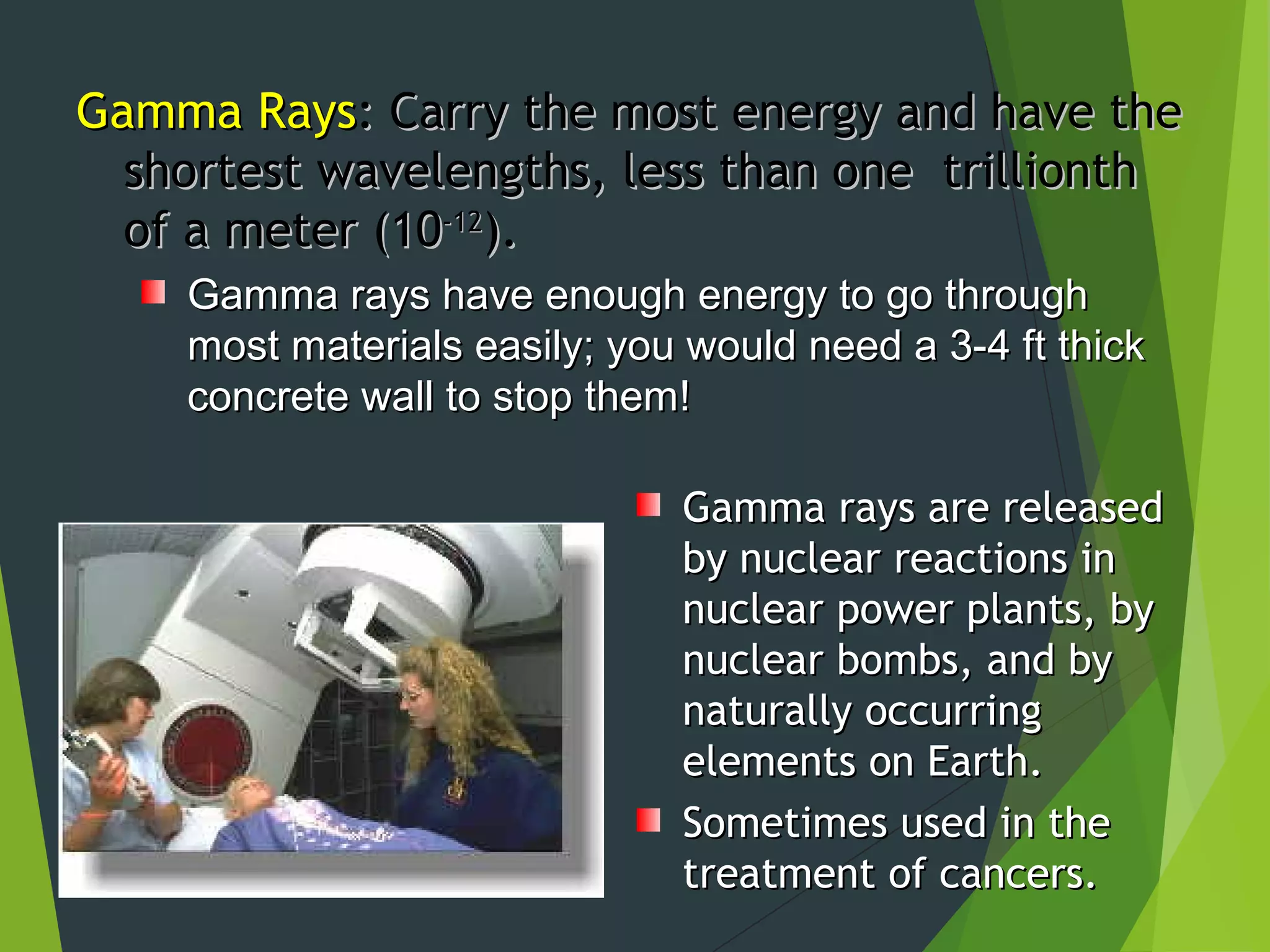
Sometimes used in theSometimes used in the
treatment of cancers.treatment of cancers.
Any Question??
For further details
samia42001@yahoo.com

Electromagnetic spectrum

  • 1.
    “Educate your child,they must live in a time different from you” Muhammad (PBUH) Mrs. Samia Dogar Associate Prof Federal College Of Education H-9 Islamabad
  • 2.
  • 3.
  • 4.
  • 5.
    The Electromagnetic Spectrum TheEM spectrum is the ENTIRE range of EM waves in order of increasing frequency and decreasing wavelength. As you go from left  right, the wavelengths get smaller and the frequencies get higher. This is an inverse relationship between wave size and frequency. (As one goes up, the other goes down.) This is because the speed of ALL EM waves is the speed of light (300,000 km/s).
  • 6.
    Things to RememberThingsto Remember The higher the frequency, the more energy theThe higher the frequency, the more energy the wave has.wave has. EM wavesEM waves do not require mediado not require media in which to travelin which to travel or move.or move. EM waves are considered to beEM waves are considered to be transverse wavestransverse waves because they are made of vibrating electric andbecause they are made of vibrating electric and magnetic fields at right angles to each other, andmagnetic fields at right angles to each other, and to the direction the waves are traveling.to the direction the waves are traveling. Inverse relationship between wave size and frequency: as wavelengths get smaller, frequencies get higher.
  • 7.
    Radio wavesRadio waves:Have the longest wavelengths and: Have the longest wavelengths and the lowest frequencies; wavelengths rangethe lowest frequencies; wavelengths range from 1000s of meters to .001 mfrom 1000s of meters to .001 m Used in: RADAR, cooking food, satelliteUsed in: RADAR, cooking food, satellite transmissionstransmissions The Waves (in order…)The Waves (in order…)
  • 8.
    Infrared wavesInfrared waves(heat): Have a shorter wavelength,(heat): Have a shorter wavelength, from .001 m to 700 nm, and therefore, a higherfrom .001 m to 700 nm, and therefore, a higher frequency.frequency. Used for finding people in the dark and in TVUsed for finding people in the dark and in TV remote control devicesremote control devices Visible lightVisible light: Wavelengths range from 700 nm (red: Wavelengths range from 700 nm (red light) to 30 nm (violet light) with frequencieslight) to 30 nm (violet light) with frequencies higher than infrared waves.higher than infrared waves. These are the waves in theThese are the waves in the EM spectrum that humansEM spectrum that humans can see.can see. Visible light waves are a veryVisible light waves are a very small part of the EM spectrum!small part of the EM spectrum!
  • 9.
    ROY G. BVROYG. BV redred orangeorange yellowyellow greengreen blueblue violetviolet Visible LightVisible Light The OrderThe Order
  • 10.
    Ultraviolet LightUltraviolet Light:Wavelengths: Wavelengths range from 400 nm to 10 nm; the frequency (and therefore the energy) is high enough with UV rays to penetrate living cells and cause them damage. Although we cannot see UV light, bees, bats, butterflies, some small rodents and birds can. UV on our skin produces vitamin D in our bodies. Too much UV can lead to sunburn and skin cancer. UV rays are easily blocked by clothing. Used for sterilization because they kill bacteria.
  • 11.
    X-RaysX-Rays: Wavelengths from10 nm to .001 nm.: Wavelengths from 10 nm to .001 nm. These rays have enough energy to penetrateThese rays have enough energy to penetrate deep into tissues and cause damage to cells;deep into tissues and cause damage to cells; are stopped by dense materials, such as bone.are stopped by dense materials, such as bone. Used to look at solid structures, such as bones andUsed to look at solid structures, such as bones and bridges (for cracks), and for treatment of cancer.bridges (for cracks), and for treatment of cancer.
  • 12.
    Gamma RaysGamma Rays:Carry the most energy and have the: Carry the most energy and have the shortest wavelengths, less than one trillionthshortest wavelengths, less than one trillionth of a meter (10of a meter (10-12-12 ).). Gamma rays have enough energy to go throughGamma rays have enough energy to go through most materials easily; you would need a 3-4 ft thickmost materials easily; you would need a 3-4 ft thick concrete wall to stop them!concrete wall to stop them! Gamma rays are releasedGamma rays are released by nuclear reactions inby nuclear reactions in nuclear power plants, bynuclear power plants, by nuclear bombs, and bynuclear bombs, and by naturally occurringnaturally occurring elements on Earth.elements on Earth. Sometimes used in theSometimes used in the treatment of cancers.treatment of cancers.
  • 13.
    Any Question?? For furtherdetails samia42001@yahoo.com

Editor's Notes

  • #7 Play an interactive tutorial to explore the classical representation of an electromagnetic wave as a sine function; you can vary amplitude and wavelength to demonstrate how this function appears in three dimensions. (requires java plug-in) See: http://micro.magnet.fsu.edu/primer/java/electromagnetic/index.html
  • #10 Light from the sun looks white, but it is really made up of all the colors of the rainbow. A prism is a specially shaped crystal. When white light shines through a prism, the light is separated into all its colors.