CLONING OF PCR PRODUCTS
MRS.S.AMIRTHAM
ASSISTANT PROFESSOR
PG & Research department of biotechnology
Bon secours college for women
Thanjavur.
Introduction


PCR Cloning differs from traditional
Cloning in that the DNA fragment of
interest, and even the vector, can be
amplified by the polymerase chain
reaction (PCR) and ligated together,
without the use of restriction enzymes.
A little amount of DNA is necessary.
• PCR cloning is rapid method for cloning genes,
and is often used for projects that require
higher throughput than traditional cloning
methods can accommodate.
• It allows for the cloning of DNA fragments that
are not available in large amounts.
Discovery of PCR



PCR was invented by kary Mullis.
Born on 28th December 1944,kary
Mullis is a noble prize winning
biochemist, author and lecturer.
Started working at citus
corporation, California in 1973.
How PCR was invented?
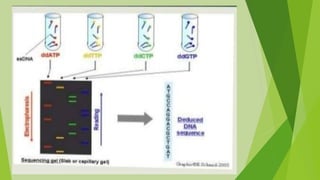
 Thinking to use simpler method for DNA
sequencing.
 planning to use Sanger method called
“dideoxytechnique”.
 Use dideoxy bases (ie., O removed from
2prime position of carbon ring) &
polymerase.
 Stop further addition of bases.
Working of PCR
The basic protocol of a PCR require
following ingredients :



Template DNA Pair of primers
DNA polymerase (usually Taq polymerase)
dNTPs(ie., four bases A T G C) Some ions and
salts are also used.
Types
There are many different types of
polymerase chain reaction on the basis of
their principles.
Real time PCR
Reverse transcriptase PCR
Quantitative real-time PCR
Multiplex PCR
Nested PCR
1.Real time PCR
 Real time PCR is introduced by Higuchiand
fellows in 1992.
 In Real time PCR we find out an accurate
quantification of DNA sequence in a
complex mixture.
 Real time PCR is divided into twotypes:
 Non-specific detection using binding
dyes
 Specific detection target specific
probes.
• Specific detection target specific
probes
Oligonucleotides probe are used for the
specific detection.
Oligonucleotides are labelled with
fluorescent dye.
Different types of probe are used:
 Taq man probes
 FRET hybridization probes
 Molecular beacons.
• Non-specific detection using
binding dyes
 In real time PCR,DNA binding dyes are
used as fluorescent protein work as reporter
molecules.
Fluorescent reporter molecules increase as
the reaction proceeds.
Different dyes are used but SYBR green is
commonly used dye in real time PCR.
It is the specific dowble stranded DNAdye.
2.Reverse Transcriptase PCR
Reverse transcriptase PCR is a modified
technique used for the detection of
RNA expression In this technique,RNAis
used for rather than DNA.
In Real time PCR, transcriptase enzyme
is used for converting mRNA into cDNA.
DNA strands are now denatured then
add two primers for the synthesis of
cDNA.
Procedure
PCR nucleotide sequence of child and
suspected father is run on the gel by
applying electric current.
The nucleotide sequence of PCR
products may resemble to either father
1 or 2.
If the sequence match this show the
relatedness between the child and the
parent.
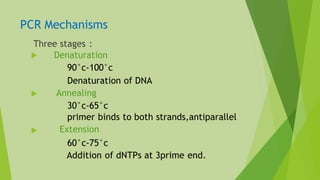
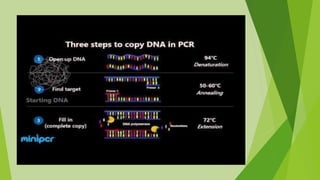
PCR Mechanisms
Three stages :


 Denaturation
90°c-100°c
Denaturation of DNA
Annealing
30°c-65°c
primer binds to both strands,antiparallel
Extension
60°c-75°c
Addition of dNTPs at 3prime end.
PCR applications
Paternity Testing:
 Genetic material is inherited from both
parents,half from mother and half from
father.
 DNA sample from buccal saliva or blood is
collected and extracted from the alleged
child.
 Then the extracted DNA is subjected to PCR,
thousands of copies of amplified DNA is
obtained.
Mutation detection in inherited
disease
Any point mutation,a deletion or an
insertion and expanded tandem
trinucleotide repeat can be detected by
PCR.
Somatic mutations in oncogenes or tumor
repressor genes can also be detected by
PCR with primers flanking the insertions or
deletions.
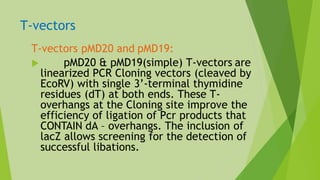
T-vectors pMD20 and pMD19:
 pMD20 & pMD19(simple) T-vectors are
linearized PCR Cloning vectors (cleaved by
EcoRV) with single 3’-terminal thymidine
residues (dT) at both ends. These T-
overhangs at the Cloning site improve the
efficiency of ligation of Pcr products that
CONTAIN dA – overhangs. The inclusion of
lacZ allows screening for the detection of
successful libations.
T-vectors
Proofreading enzymes
 A repair mechanism that helps to ensure
faithful DNA replication in living cells. It is a
function of the enzyme DNA polymerase,
which catalyses the replication process.
 This enzyme identifies and excises
mismatched bases at the end of the growing
strand, leaving the end free to accept the
correct nucleotide instead, thereby restoring
the correct complementary base sequence.
Why are Proofreading enzymes
Important?
It allows the enzyme to check each
nucleotide during DNA synthesis and
excise mismatched nucleotides in the
3’to 5’ direction. The Proofreading
domain also enables a polymerase to
remove unpaired 3’overhanging
nucleotides to create blunt ends.
Different types of proofreading
Bilingual proofreading
Monolingual proofreading
Stylistic proofreading
Pre-print proofreading
Other types of proofreading.
How do proofreading enzymes work?
 DNA polymerases are the enzymesthat
build DNA in cells. During DNA
replication (copying),most DNA
polymerase can “Chech their work” with
each base that they add. This process is
called proofreading... Polymerase uses
3’ to 5’ exonuclease activity to remove
the incorrect T from the 3’end of the
new strand.
Polymerase adds an
incorrect nucleotide to
the new strand of DNA
Polymerase detects th
bases are mispaired.
Polymerase uses 3’-
5‘exonuclease activity
to remove incorrect
nucleotide.
•
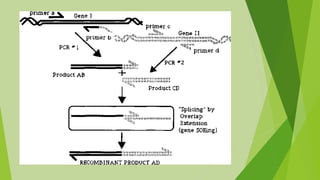
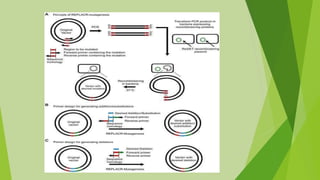
PCR in gene recombination
• Gene splicing by overlap extension (gene SOEing) is
a sequence – independent method for site-directed
mutagenesis and recombination of DNAmolecules.
• It is based on the idea that a PCR product can be
engineered by adding or changing sequences at its ends
so that the product can itself be used to prime DNA
synthesis in a subsequent overlap – extension reaction to
create mutant or recombinant molecules.
Deletion
 The PCR mediated plasmid DNAdeletion method is
a simple approach to delete DNA sequence from
plasmids using only one round of PCR, with two primers,
and without ligation or purification prior to the invivo
recombination. By using only PCR, the method is
sequence independent and, as shown in this study, is
applicable to various sizes of plasmids.
Addition
Before adding the overhangs it is very important to remove all
the Proofreading DNA polymerase by purifying the PCR product
carefully (eg.,with a commercial PCR purification kit or phenol
extraction and DNA precipitation) ;since the Proofreading activity
of DNA polymerase will degrade the A overhangs, creating blunt
ends again.
Site specific mutagenesis
 Site – directed mutagenesis is an in vitro method
in a known sequence. While often performed using
PCR based methods, the availability of custom –
designed, synthetic, double – stranded DNA (dsDNA)
fragments can drastically reduce the time and steps
required to obtain the same sequence changes.
 primers designed with mutations can introduce
small sequence changes, and primer extension or
inverse PCR can be used to achieve longer mutant
regions.
Thank you

Cloning pcr amirtham

  • 1.
    CLONING OF PCRPRODUCTS MRS.S.AMIRTHAM ASSISTANT PROFESSOR PG & Research department of biotechnology Bon secours college for women Thanjavur.
  • 2.
    Introduction   PCR Cloning differsfrom traditional Cloning in that the DNA fragment of interest, and even the vector, can be amplified by the polymerase chain reaction (PCR) and ligated together, without the use of restriction enzymes. A little amount of DNA is necessary.
  • 3.
    • PCR cloningis rapid method for cloning genes, and is often used for projects that require higher throughput than traditional cloning methods can accommodate. • It allows for the cloning of DNA fragments that are not available in large amounts.
  • 5.
    Discovery of PCR    PCRwas invented by kary Mullis. Born on 28th December 1944,kary Mullis is a noble prize winning biochemist, author and lecturer. Started working at citus corporation, California in 1973.
  • 6.
    How PCR wasinvented?  Thinking to use simpler method for DNA sequencing.  planning to use Sanger method called “dideoxytechnique”.  Use dideoxy bases (ie., O removed from 2prime position of carbon ring) & polymerase.  Stop further addition of bases.
  • 8.
    Working of PCR Thebasic protocol of a PCR require following ingredients :    Template DNA Pair of primers DNA polymerase (usually Taq polymerase) dNTPs(ie., four bases A T G C) Some ions and salts are also used.
  • 9.
    Types There are manydifferent types of polymerase chain reaction on the basis of their principles. Real time PCR Reverse transcriptase PCR Quantitative real-time PCR Multiplex PCR Nested PCR
  • 10.
    1.Real time PCR Real time PCR is introduced by Higuchiand fellows in 1992.  In Real time PCR we find out an accurate quantification of DNA sequence in a complex mixture.  Real time PCR is divided into twotypes:  Non-specific detection using binding dyes  Specific detection target specific probes.
  • 11.
    • Specific detectiontarget specific probes Oligonucleotides probe are used for the specific detection. Oligonucleotides are labelled with fluorescent dye. Different types of probe are used:  Taq man probes  FRET hybridization probes  Molecular beacons.
  • 12.
    • Non-specific detectionusing binding dyes  In real time PCR,DNA binding dyes are used as fluorescent protein work as reporter molecules. Fluorescent reporter molecules increase as the reaction proceeds. Different dyes are used but SYBR green is commonly used dye in real time PCR. It is the specific dowble stranded DNAdye.
  • 13.
    2.Reverse Transcriptase PCR Reversetranscriptase PCR is a modified technique used for the detection of RNA expression In this technique,RNAis used for rather than DNA. In Real time PCR, transcriptase enzyme is used for converting mRNA into cDNA. DNA strands are now denatured then add two primers for the synthesis of cDNA.
  • 14.
    Procedure PCR nucleotide sequenceof child and suspected father is run on the gel by applying electric current. The nucleotide sequence of PCR products may resemble to either father 1 or 2. If the sequence match this show the relatedness between the child and the parent.
  • 15.
    PCR Mechanisms Three stages:    Denaturation 90°c-100°c Denaturation of DNA Annealing 30°c-65°c primer binds to both strands,antiparallel Extension 60°c-75°c Addition of dNTPs at 3prime end.
  • 18.
    PCR applications Paternity Testing: Genetic material is inherited from both parents,half from mother and half from father.  DNA sample from buccal saliva or blood is collected and extracted from the alleged child.  Then the extracted DNA is subjected to PCR, thousands of copies of amplified DNA is obtained.
  • 19.
    Mutation detection ininherited disease Any point mutation,a deletion or an insertion and expanded tandem trinucleotide repeat can be detected by PCR. Somatic mutations in oncogenes or tumor repressor genes can also be detected by PCR with primers flanking the insertions or deletions.
  • 20.
    T-vectors pMD20 andpMD19:  pMD20 & pMD19(simple) T-vectors are linearized PCR Cloning vectors (cleaved by EcoRV) with single 3’-terminal thymidine residues (dT) at both ends. These T- overhangs at the Cloning site improve the efficiency of ligation of Pcr products that CONTAIN dA – overhangs. The inclusion of lacZ allows screening for the detection of successful libations. T-vectors
  • 22.
    Proofreading enzymes  Arepair mechanism that helps to ensure faithful DNA replication in living cells. It is a function of the enzyme DNA polymerase, which catalyses the replication process.  This enzyme identifies and excises mismatched bases at the end of the growing strand, leaving the end free to accept the correct nucleotide instead, thereby restoring the correct complementary base sequence.
  • 23.
    Why are Proofreadingenzymes Important? It allows the enzyme to check each nucleotide during DNA synthesis and excise mismatched nucleotides in the 3’to 5’ direction. The Proofreading domain also enables a polymerase to remove unpaired 3’overhanging nucleotides to create blunt ends.
  • 24.
    Different types ofproofreading Bilingual proofreading Monolingual proofreading Stylistic proofreading Pre-print proofreading Other types of proofreading.
  • 25.
    How do proofreadingenzymes work?  DNA polymerases are the enzymesthat build DNA in cells. During DNA replication (copying),most DNA polymerase can “Chech their work” with each base that they add. This process is called proofreading... Polymerase uses 3’ to 5’ exonuclease activity to remove the incorrect T from the 3’end of the new strand.
  • 26.
    Polymerase adds an incorrectnucleotide to the new strand of DNA Polymerase detects th bases are mispaired. Polymerase uses 3’- 5‘exonuclease activity to remove incorrect nucleotide.
  • 27.
    • PCR in generecombination • Gene splicing by overlap extension (gene SOEing) is a sequence – independent method for site-directed mutagenesis and recombination of DNAmolecules. • It is based on the idea that a PCR product can be engineered by adding or changing sequences at its ends so that the product can itself be used to prime DNA synthesis in a subsequent overlap – extension reaction to create mutant or recombinant molecules.
  • 29.
    Deletion  The PCRmediated plasmid DNAdeletion method is a simple approach to delete DNA sequence from plasmids using only one round of PCR, with two primers, and without ligation or purification prior to the invivo recombination. By using only PCR, the method is sequence independent and, as shown in this study, is applicable to various sizes of plasmids.
  • 31.
    Addition Before adding theoverhangs it is very important to remove all the Proofreading DNA polymerase by purifying the PCR product carefully (eg.,with a commercial PCR purification kit or phenol extraction and DNA precipitation) ;since the Proofreading activity of DNA polymerase will degrade the A overhangs, creating blunt ends again.
  • 33.
    Site specific mutagenesis Site – directed mutagenesis is an in vitro method in a known sequence. While often performed using PCR based methods, the availability of custom – designed, synthetic, double – stranded DNA (dsDNA) fragments can drastically reduce the time and steps required to obtain the same sequence changes.  primers designed with mutations can introduce small sequence changes, and primer extension or inverse PCR can be used to achieve longer mutant regions.
  • 35.