Plant Metabolic Engineering
PLANT METABOLIC ENGINEERING
BY NEHA P PATEL
M.Sc II
Outline of the Talk
Introduction to Metabolic Engineering
Plants as natural factories
Metabolic Engineering in Plant
Choice of plant system for ME
Stratigies for ME
Applications
Emerging technologies
Future
Introduction to Metabolic Engineering
It is the directed improvement of product
formation or cellular properties through
the modification of specific biochemical
reaction(s) or the introduction of new
one(s) with the use of recombinant DNA
technology
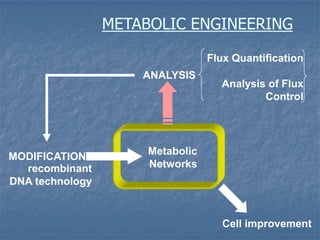
METABOLIC ENGINEERING
Metabolic
Networks
MODIFICATION
recombinant
DNA technology
ANALYSIS
Flux Quantification
Analysis of Flux
Control
Cell improvement
OTHER TERMS FOR ME
1.MOLECULAR BREEDING
2.PATHWAY ENGINEERING
3.CELLULAR ENGINEERING
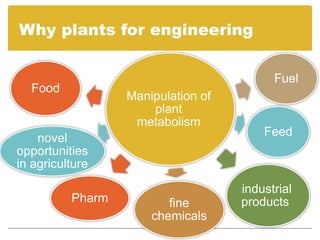
Manipulation of
plant
metabolism
Food
Feed
industrial
productsfine
chemicals
Fuel
Pharm
novel
opportunities
in agriculture
Why plants for engineering
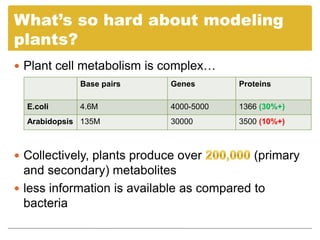
What’s so hard about modeling
plants?
 Plant cell metabolism is complex…
 Collectively, plants produce over (primary
and secondary) metabolites
 less information is available as compared to
bacteria
ProteinsGenesBase pairs
1366 (30%+)4000-50004.6ME.coli
3500 (10%+)30000135MArabidopsis
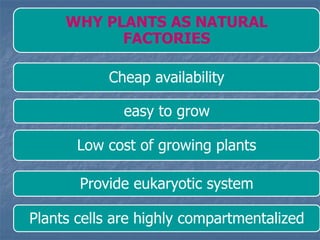
WHY PLANTS AS NATURAL
FACTORIES
Cheap availability
easy to grow
Low cost of growing plants
Provide eukaryotic system
Plants cells are highly compartmentalized
PLANT METABOLIC ENGINEERING
 Plant metabolic engineering involves the
manipulation of existing metabolic pathways
by either increasing or diverting flux to
desired or from undesired products,
respectively, or the generation of chemical
entities not normally found in the plant
production system (cells or whole
plants),through the introduction of genes
from other organisms.
Essential elements in the toolbox
of the metabolic engineer are
mechanisms to eliminate or
over express gene activity
Introduction of new pathway
Strategies available to eliminate the activity of
specific enzymes in a pathway involve one of
several possible approaches
Identification of a mutant gene for the corresponding
enzyme.
Knocking out gene function by targeted RNA
degradation.
Interfering with protein function using specific
inhibitors or antibodies.
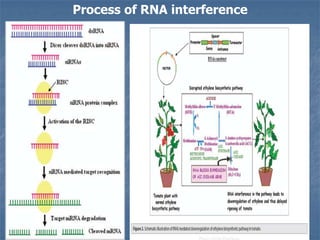
Process of RNA interference
The expression of genes in plants or plant cells is
dependent on several factors that include:
method to introduce genes into the plant
Promoters to direct gene expression in
the appropriate spatial and temporal
landscape.
source for the gene encoding the enzyme
of interest.
CHOICE OF PLANT SYSTEM FOR
METABOLIC ENGINEERING
Whole Plants
Plant Cells in Culture
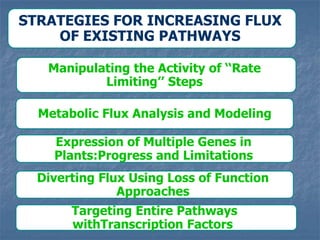
STRATEGIES FOR INCREASING FLUX
OF EXISTING PATHWAYS
Manipulating the Activity of ‘‘Rate
Limiting’’ Steps
Metabolic Flux Analysis and Modeling
Expression of Multiple Genes in
Plants:Progress and Limitations
Diverting Flux Using Loss of Function
Approaches
Targeting Entire Pathways
withTranscription Factors
PLANTS AS BIOREACTOR
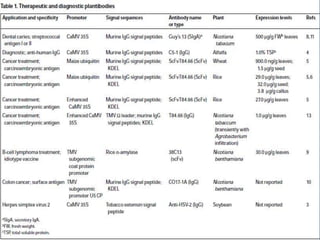
Antibodies
edible vaccines
Polymers
Pharmaceutical drugs etc
ANTIBODIES
Stable integration of gene as compare to
microorganisms
Provide eukaryotic system for production
Low cost production as compare to fermentation-it
costs approx. $5,000 /gm to produce antibodies
from hybridoma technology cells in culture,$10 to
100 /gm to produce antibodies from transgenic
plants.
Foreign proteins are mostly produced in seed
But often not properly glycosylated
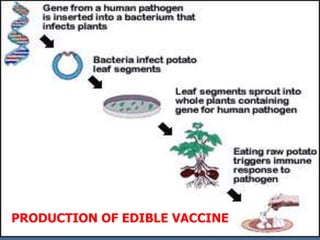
PRODUCTION OF EDIBLE VACCINE
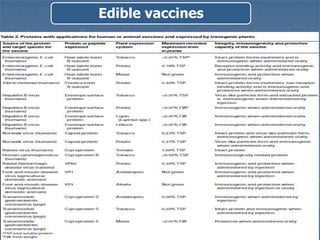
Edible vaccines
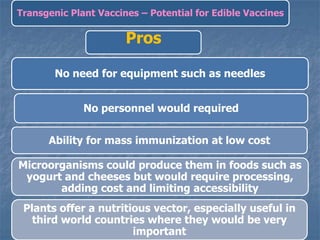
Transgenic Plant Vaccines – Potential for Edible Vaccines
Pros
No need for equipment such as needles
No personnel would required
Ability for mass immunization at low cost
Microorganisms could produce them in foods such as
yogurt and cheeses but would require processing,
adding cost and limiting accessibility
Plants offer a nutritious vector, especially useful in
third world countries where they would be very
important
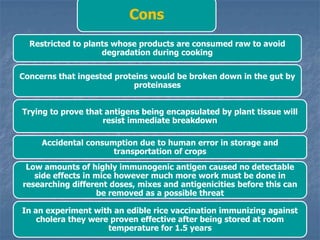
Cons
Restricted to plants whose products are consumed raw to avoid
degradation during cooking
Concerns that ingested proteins would be broken down in the gut by
proteinases
Trying to prove that antigens being encapsulated by plant tissue will
resist immediate breakdown
Accidental consumption due to human error in storage and
transportation of crops
Low amounts of highly immunogenic antigen caused no detectable
side effects in mice however much more work must be done in
researching different doses, mixes and antigenicities before this can
be removed as a possible threat
In an experiment with an edible rice vaccination immunizing against
cholera they were proven effective after being stored at room
temperature for 1.5 years
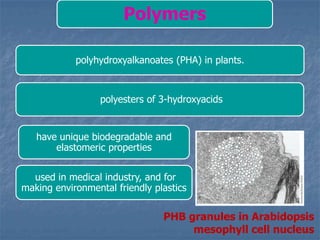
Polymers
polyhydroxyalkanoates (PHA) in plants.
polyesters of 3-hydroxyacids
have unique biodegradable and
elastomeric properties
used in medical industry, and for
making environmental friendly plastics
PHB granules in Arabidopsis
mesophyll cell nucleus
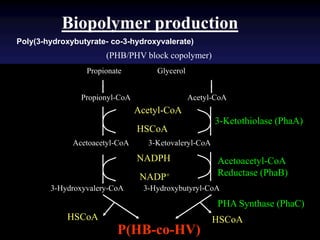
(PHB/PHV block copolymer)
Poly(3-hydroxybutyrate- co-3-hydroxyvalerate)
Biopolymer production
GlycerolPropionate
Acetyl-CoAPropionyl-CoA
Acetoacetyl-CoA 3-Ketovaleryl-CoA
3-Hydroxybutyryl-CoA3-Hydroxyvalery-CoA
Acetyl-CoA
HSCoA
3-Ketothiolase (PhaA)
NADPH
NADP+
Acetoacetyl-CoA
Reductase (PhaB)
P(HB-co-HV)
HSCoAHSCoA
PHA Synthase (PhaC)
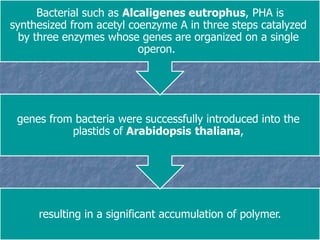
resulting in a significant accumulation of polymer.
genes from bacteria were successfully introduced into the
plastids of Arabidopsis thaliana,
Bacterial such as Alcaligenes eutrophus, PHA is
synthesized from acetyl coenzyme A in three steps catalyzed
by three enzymes whose genes are organized on a single
operon.
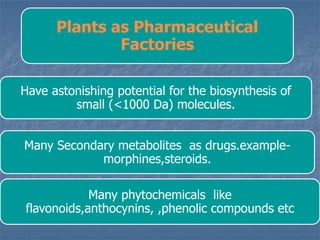
Plants as Pharmaceutical
Factories
Have astonishing potential for the biosynthesis of
small (<1000 Da) molecules.
Many Secondary metabolites as drugs.example-
morphines,steroids.
Many phytochemicals like
flavonoids,anthocynins, ,phenolic compounds etc
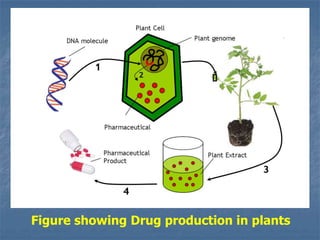
Figure showing Drug production in plants
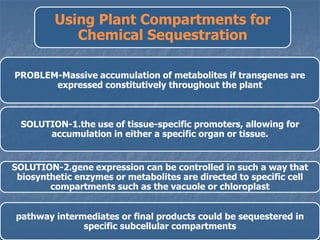
Using Plant Compartments for
Chemical Sequestration
PROBLEM-Massive accumulation of metabolites if transgenes are
expressed constitutively throughout the plant
SOLUTION-1.the use of tissue-specific promoters, allowing for
accumulation in either a specific organ or tissue.
SOLUTION-2.gene expression can be controlled in such a way that
biosynthetic enzymes or metabolites are directed to specific cell
compartments such as the vacuole or chloroplast
pathway intermediates or final products could be sequestered in
specific subcellular compartments
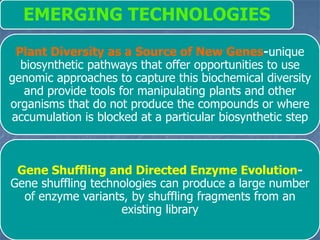
EMERGING TECHNOLOGIES
Plant Diversity as a Source of New Genes-unique
biosynthetic pathways that offer opportunities to use
genomic approaches to capture this biochemical diversity
and provide tools for manipulating plants and other
organisms that do not produce the compounds or where
accumulation is blocked at a particular biosynthetic step
Gene Shuffling and Directed Enzyme Evolution-
Gene shuffling technologies can produce a large number
of enzyme variants, by shuffling fragments from an
existing library
The FUTURE
 Focus on secondary metabolism
 Progress in ‘omics technologies’.
 Better use of what we know!
 Choose model systems we can experimentally validate
 Apply known constraints
 Define appropriate objective functions
 Integrate regulatory mechanisms
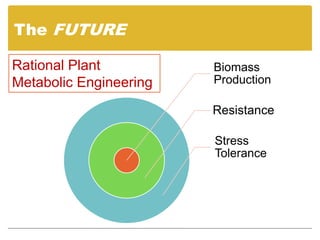
The FUTURE
Biomass
Production
Resistance
Stress
Tolerance
Rational Plant
Metabolic Engineering
THANK YOU

Plant metabolite engineering

  • 1.
    Plant Metabolic Engineering PLANTMETABOLIC ENGINEERING BY NEHA P PATEL M.Sc II
  • 2.
    Outline of theTalk Introduction to Metabolic Engineering Plants as natural factories Metabolic Engineering in Plant Choice of plant system for ME Stratigies for ME Applications Emerging technologies Future
  • 3.
    Introduction to MetabolicEngineering It is the directed improvement of product formation or cellular properties through the modification of specific biochemical reaction(s) or the introduction of new one(s) with the use of recombinant DNA technology
  • 4.
  • 5.
    OTHER TERMS FORME 1.MOLECULAR BREEDING 2.PATHWAY ENGINEERING 3.CELLULAR ENGINEERING
  • 6.
  • 7.
    What’s so hardabout modeling plants?  Plant cell metabolism is complex…  Collectively, plants produce over (primary and secondary) metabolites  less information is available as compared to bacteria ProteinsGenesBase pairs 1366 (30%+)4000-50004.6ME.coli 3500 (10%+)30000135MArabidopsis
  • 8.
    WHY PLANTS ASNATURAL FACTORIES Cheap availability easy to grow Low cost of growing plants Provide eukaryotic system Plants cells are highly compartmentalized
  • 9.
    PLANT METABOLIC ENGINEERING Plant metabolic engineering involves the manipulation of existing metabolic pathways by either increasing or diverting flux to desired or from undesired products, respectively, or the generation of chemical entities not normally found in the plant production system (cells or whole plants),through the introduction of genes from other organisms.
  • 10.
    Essential elements inthe toolbox of the metabolic engineer are mechanisms to eliminate or over express gene activity Introduction of new pathway
  • 11.
    Strategies available toeliminate the activity of specific enzymes in a pathway involve one of several possible approaches Identification of a mutant gene for the corresponding enzyme. Knocking out gene function by targeted RNA degradation. Interfering with protein function using specific inhibitors or antibodies.
  • 12.
    Process of RNAinterference
  • 13.
    The expression ofgenes in plants or plant cells is dependent on several factors that include: method to introduce genes into the plant Promoters to direct gene expression in the appropriate spatial and temporal landscape. source for the gene encoding the enzyme of interest.
  • 14.
    CHOICE OF PLANTSYSTEM FOR METABOLIC ENGINEERING Whole Plants Plant Cells in Culture
  • 15.
    STRATEGIES FOR INCREASINGFLUX OF EXISTING PATHWAYS Manipulating the Activity of ‘‘Rate Limiting’’ Steps Metabolic Flux Analysis and Modeling Expression of Multiple Genes in Plants:Progress and Limitations Diverting Flux Using Loss of Function Approaches Targeting Entire Pathways withTranscription Factors
  • 16.
    PLANTS AS BIOREACTOR Antibodies ediblevaccines Polymers Pharmaceutical drugs etc
  • 17.
    ANTIBODIES Stable integration ofgene as compare to microorganisms Provide eukaryotic system for production Low cost production as compare to fermentation-it costs approx. $5,000 /gm to produce antibodies from hybridoma technology cells in culture,$10 to 100 /gm to produce antibodies from transgenic plants. Foreign proteins are mostly produced in seed But often not properly glycosylated
  • 19.
  • 20.
  • 21.
    Transgenic Plant Vaccines– Potential for Edible Vaccines Pros No need for equipment such as needles No personnel would required Ability for mass immunization at low cost Microorganisms could produce them in foods such as yogurt and cheeses but would require processing, adding cost and limiting accessibility Plants offer a nutritious vector, especially useful in third world countries where they would be very important
  • 22.
    Cons Restricted to plantswhose products are consumed raw to avoid degradation during cooking Concerns that ingested proteins would be broken down in the gut by proteinases Trying to prove that antigens being encapsulated by plant tissue will resist immediate breakdown Accidental consumption due to human error in storage and transportation of crops Low amounts of highly immunogenic antigen caused no detectable side effects in mice however much more work must be done in researching different doses, mixes and antigenicities before this can be removed as a possible threat In an experiment with an edible rice vaccination immunizing against cholera they were proven effective after being stored at room temperature for 1.5 years
  • 23.
    Polymers polyhydroxyalkanoates (PHA) inplants. polyesters of 3-hydroxyacids have unique biodegradable and elastomeric properties used in medical industry, and for making environmental friendly plastics PHB granules in Arabidopsis mesophyll cell nucleus
  • 24.
    (PHB/PHV block copolymer) Poly(3-hydroxybutyrate-co-3-hydroxyvalerate) Biopolymer production GlycerolPropionate Acetyl-CoAPropionyl-CoA Acetoacetyl-CoA 3-Ketovaleryl-CoA 3-Hydroxybutyryl-CoA3-Hydroxyvalery-CoA Acetyl-CoA HSCoA 3-Ketothiolase (PhaA) NADPH NADP+ Acetoacetyl-CoA Reductase (PhaB) P(HB-co-HV) HSCoAHSCoA PHA Synthase (PhaC)
  • 25.
    resulting in asignificant accumulation of polymer. genes from bacteria were successfully introduced into the plastids of Arabidopsis thaliana, Bacterial such as Alcaligenes eutrophus, PHA is synthesized from acetyl coenzyme A in three steps catalyzed by three enzymes whose genes are organized on a single operon.
  • 26.
    Plants as Pharmaceutical Factories Haveastonishing potential for the biosynthesis of small (<1000 Da) molecules. Many Secondary metabolites as drugs.example- morphines,steroids. Many phytochemicals like flavonoids,anthocynins, ,phenolic compounds etc
  • 27.
    Figure showing Drugproduction in plants
  • 28.
    Using Plant Compartmentsfor Chemical Sequestration PROBLEM-Massive accumulation of metabolites if transgenes are expressed constitutively throughout the plant SOLUTION-1.the use of tissue-specific promoters, allowing for accumulation in either a specific organ or tissue. SOLUTION-2.gene expression can be controlled in such a way that biosynthetic enzymes or metabolites are directed to specific cell compartments such as the vacuole or chloroplast pathway intermediates or final products could be sequestered in specific subcellular compartments
  • 29.
    EMERGING TECHNOLOGIES Plant Diversityas a Source of New Genes-unique biosynthetic pathways that offer opportunities to use genomic approaches to capture this biochemical diversity and provide tools for manipulating plants and other organisms that do not produce the compounds or where accumulation is blocked at a particular biosynthetic step Gene Shuffling and Directed Enzyme Evolution- Gene shuffling technologies can produce a large number of enzyme variants, by shuffling fragments from an existing library
  • 30.
    The FUTURE  Focuson secondary metabolism  Progress in ‘omics technologies’.  Better use of what we know!  Choose model systems we can experimentally validate  Apply known constraints  Define appropriate objective functions  Integrate regulatory mechanisms
  • 31.
  • 32.

Editor's Notes

  • #9 PLANTS CELLS ARE HIGHLY COMPARTMENTALIZED ,FACILITATING ,FOR EXAMPLE ,THE SEPARATION OF SUBSTRATE FROM THE PRODUCTS.