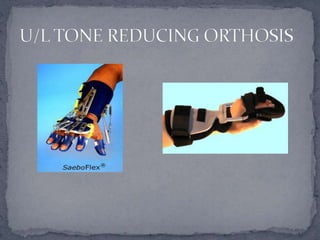
BY:- MISS SMITA NAYAK
MPO (2011 BATCH)
 Tone is a normal characteristic of muscle physiology
and defined as “ normal degree of vigour and tension:
in muscle, the resistance to passive elongation or
stretch”
 Tone and reflex activity assist the infant to balance and
maintain posture during the developmental process of
standing and walking. As the higher learning of
movement develops the primitive reflexes diminish.
 Overactivity of tone and reflexes in the neurologically
impaired patient is a greater challenge for the Rehab
professionals.
 Tone reducing concepts have evolved from neuro
developmental techniques, utilised in inhibitive cast to
reduce excessive amounts of tone or spasticity.
 The inhibitive casting techniques of the past involved
the custom manufacture of a plaster or wooden foot
plate that applied the pressures to specific regions of
the foot. The modified foot plates were then wrapped
into a below knee walking cast. In the development of
this technique over the last 10 years commercial
fabrication facilities have produced pre fabricated foot
plates that incorporate these features to increase
efficiency of impression casting.
 The concept began in the late 1960s with the introduction
of thermoplastic molded orthoses and the design
possibilities afforded by total contact. As neuro
physiological approaches were developed to include tone-
reducing casts and temporary splints from low-
temperature plastics, the implication to orthotic practice
became clear
 The biomechanical and total contact features of plastic
orthoses had been enhanced by the emergence of
neurophysiological handling techniques. The result was a
markedly improved function for the patient with a central
nervous system disorder. The efficacy of tone reducing
theories have been debated and varying opinions are held
in regard to their demonstrable effect.
 Tone literally means the activation of muscle.
 Muscle tone is what enables us to keep our bodies in a certain
position or posture.
 To complete a movement smoothly, the tone in all muscle
groups involved must be balanced.
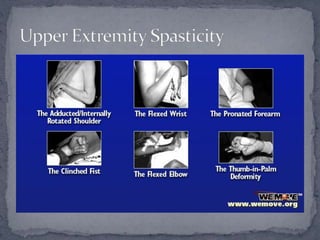
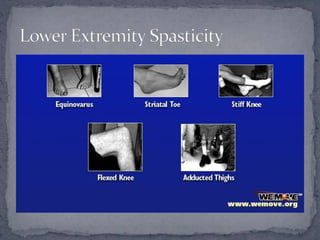
 Hypertonia is seen in upper motor neuron diseases like lesions
in pyramidal tract and extrapyramidal tract. Hypertonia can
present clinically as either spasticity or rigidity.
 Hypotonia is seen in lower motor neuron disease like
poliomyelitis. Hypotonia can present clinically as muscle
flaccidity, where the limbs appear floppy, stretch reflex
responses are decreased, and the limb’s resistance to passive
movement is also decreased
 Velocity dependent increase in muscle tone with exagerated
tendon jerks resulting in hyper-excitability of the stretch reflex
in association with other features of the Upper Motor Neurone
Syndrome
or
 A motor disorder characterized by a velocity-dependent increase
in tonic stretch reflexes (muscle tone) with exaggerated tendon
jerks, resulting from hyperexcitability of the stretch reflex…”
 INCIDENCE
 SCI
 Closed head injury
 Stroke
 Cerebral palsy
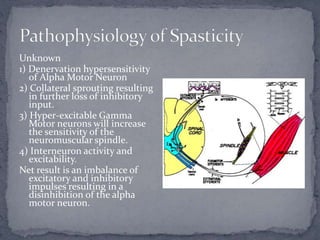
Unknown
1) Denervation hypersensitivity
of Alpha Motor Neuron
2) Collateral sprouting resulting
in further loss of inhibitory
input.
3) Hyper-excitable Gamma
Motor neurons will increase
the sensitivity of the
neuromuscular spindle.
4) Interneuron activity and
excitability.
Net result is an imbalance of
excitatory and inhibitory
impulses resulting in a
disinhibition of the alpha
motor neuron.
Modified Ashworth Scale:
0 = no increase in muscle tone
1 = slight increase in muscle tone (catch or min
resistance at end range)
1 + = slight increase in muscle resistance throughout the
range.
2 = moderate increase in muscle tone throughout ROM,
PROM is easy
3 = marked increase in muscle tone throughout ROM,
PROM is difficult
4 = marked increase in muscle tone, affected part is rigid
Consequences
 Increased Tone
 Decreased Range of
Motion
 Involuntary Movements
 Increased Autonomic
Reflexes
 Exaggerated Reflexes
 Muscle Weakness
 Muscle Fatigue
 Muscle Control
 Balance Problems
 Increased Caloric Needs
 Abnormal Bone Stress
 Muscle Tone
 Tendon Jerks
 Repetitive Stretch
Reflexes - Clonus
 Extensor St. Reflexes
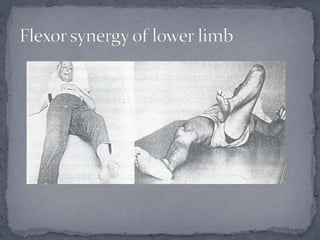
 Released Flexor Reflexes
- Babinski, Mass synergy
pattern
Positive Symptoms
 Improvements in position
 Mobility
 Pain
 Contracture prevention
 Ease of care are possible
 Inhibition of abnormal reflexes as per NDT technique.
 pressure over muscle insertions,
 Prolonged stretch
 orthokinetics
 A design configuration intended to utilize both
biomechanical principles to limit calcano- varus and
neuro physiological principles (of facilitation and
inhibition) to obtain dynamic ankle dorsiflexion and
plantar flexion.
 A neurophysiological force to inhibit the toe grasp
reflex (toe flexors and gastrocnemius- soleus) by
unweighting of the metatarsal heads through use of a
metatarsal arch
• Prolonged stretch of the ankle plantar flexors and
long toe flexors
• Weight bearing in proper alignment to influence
proprioceptors through joint compression.
• Altered muscle length resulting in change in
resistance to passive stretch.
• Inhibition of reflexes induced by tactile stimulation
 When the central nervous system-which is responsible
for normal voluntary control-is damaged, these
primitive reflexes will again dominate motor activity
and contribute to patterns of spasticity
Reflexes of the foot that influence AFO designs
 Planter reflexes
 Positive supporting action
 The inversion
 Eversion reflexes
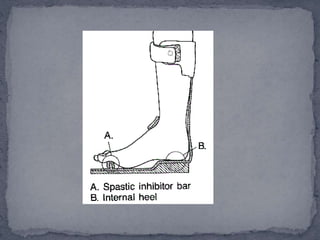
 The toe grasp (plantar grasp) reflex is triggered by
pressure over the ball of the foot and results in marked
increase of tone in toe flexion or ankle plantarflexion.
 AFO design features that reportedly reduce stimulus
pressure include spastic inhibitor bars, foam toe
separators and metatarsal arch supports to un weigh
metatarsal heads.
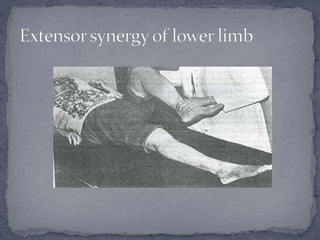
 The positive supporting reaction, also triggered by
pressure over the ball of the foot, results in a total
extensor pattern with a noted increase of tone in
plantarflexion and inversion. AFO design features that
reportedly reduce stimulus pressure include toe
extensions, toe hyperextensions and pressure under
metatarsal heads
2211/20/2018DHARAM
 The inversion reflex is triggered by pressure over the
first metatarsal head along the medial border of the
foot while, conversely, the eversion reflex is triggered
by pressure over the fifth metatarsal head along the
foot's lateral border
 An AFO design feature that reportedly reduces the
abnormal tone of these patterns is stimulating the
antagonistic reflex to balance the deformity by
extending the metatarsal pad to the foot's extreme
lateral margin, hereby triggering the eversion reflex .
Conversely, by extending the metatarsal pad medially,
the inversion reflex would be triggered .
 In 1974, Farmer reported that continuous firm pressure at
the point of insertion has a tone-reducing effect . Recent
orthotic literature has incorporated this AFO design by
applying pressure on either side of the tendo-calcaneus and
at the insertion of the gastrocnemius-soleus muscle group
 Increased muscle tone in this group frequently is
accompanied by excessive plantar flexion. This rationale
might also be applied to control excessive knee extension
tone. By incorporating a patella tendon-bearing design into
a floor reaction AFO, pressure would be maintained at the
insertion of the quadriceps
 Tone-reducing AFOs and inhibitory casting have been
observed to decrease reflex tone by providing mechanical
stabilization of the joint and altering properties of the
muscle spindle through static immobilization . These goals
have been achieved through a variety of designs that
provide total ankle-foot contact
 Plaster serial casts
 Supra malleolar orthoses and
 Bivalved thermoplastic AFOs .
 Adjustable designs allow for a graduated change in the
position of joint range at which static force is applied .
 The orthokinetic rationale focuses on the physical effects of
materials placed over muscle bellies . Passive field
materials (those that are cool, rigid and smooth), including
thermoplastics, tend to produce an inhibitory effect. These
materials do not mechanically deform or elongate
underlying muscles, which would stimulate or increase
muscle tone.
 Active field materials (those that are warm, expansive and
textured) include materials such as foam, elastic and
hook/loop straps and tend to produce a facilitatory effect.
During muscle contraction these materials tend to expand,
providing minute pinching motions to the dermatome over
the active muscle. This facilitation is referred to as extero
proprioceptive stimulation, and its principles have been
incorporated in AFO design .
 The foam interface on the anterior shell of the Chattanooga
articulating AFO provides active field stimulation of
anterior tibialis that would encourage dorsiflexion. The
unpadded posterior shell of a conventional AFO provides
passive field inhibition to gastronemius, reducing
spasticity to plantarflexors. It is important to understand
these dual orthokinetic concepts are interrelated and
should be applied simultaneously. When attempting to
provide passive reduced stimulus over the hypertonic
muscle, always apply active increased stimulus over the
antagonist muscle groups
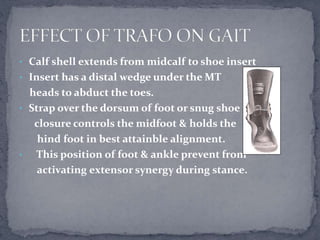
• Calf shell extends from midcalf to shoe insert
• Insert has a distal wedge under the MT
heads to abduct the toes.
• Strap over the dorsum of foot or snug shoe
closure controls the midfoot & holds the
hind foot in best attainble alignment.
• This position of foot & ankle prevent from
activating extensor synergy during stance.
 When ankle DF during midstance & TS the leg pulls
away from the shell
 Preswing when ankle PF the leg pushes against the
shell. It gives a proprioception & tactile input to
stimulate ankle DF & minimise toe drag.
 Cyndi Ford, The Neurophysiological Ankle-Foot
Orthosis Clinical prosthetic & orthotic vol-10,no-1
page-15-23
 JAMES E. Effect of Tone-Inhibiting Casts and Orthoses
on Gait PHYS THER. 1982; 62:453-455.
 Michael Loh Alternative Strategies in Tone-Reducing
AFO Design man JPO 1993 Vol. 5, Num. 1 pp. 1-4
 Bipin B Bhakta Management of spasticity in stroke
British Medical Bulletin 2000, 56 (No 2) 476-485
 MICHAEL R BARNES Management of spasticity Age
and Ageing 1998; 27: 239-245
Tone reducing orthosis