CLIMATES AND
CLIMATE CHANGE
Reporters:
Michelle Norte
Erika Dela Cruz
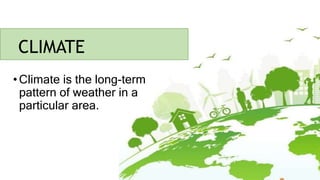
CLIMATE
•Climate is the long-term
pattern of weather in a
particular area.
CLIMATE SYSTEM
• Some parts of the world are hot and rainy nearly everyday.
• Others with cold and snow-covered most of the year.
• Between the icy poles and the steamy tropics are many other
climates that contributes to Earth’s biodiversity and geologic
heritage.
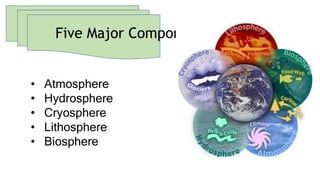
Five Major Components:
• Atmosphere
• Hydrosphere
• Cryosphere
• Lithosphere
• Biosphere
CLIMATE CLASSIFICATIONS
• CHARLES THORNTHWAITE
American Climatologist
• In1948, he developed a climate
classification system that scientists still use
today.
MAJOR CLASSIFICATIONS:
• Microthermal
• Mesothermal
• Megathermal
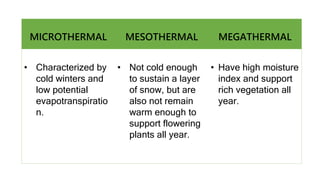
MICROTHERMAL MESOTHERMAL MEGATHERMAL
• Characterized by
cold winters and
low potential
evapotranspiratio
n.
• Not cold enough
to sustain a layer
of snow, but are
also not remain
warm enough to
support flowering
plants all year.
• Have high moisture
index and support
rich vegetation all
year.
KOPPEN CLASSIFICATION SYSTEM
• WLADIMIR KOPPEN
Russian-German Scientist
• In 1990, the most popular system of classifying
climates was proposed.
FIVE CLIMATE GROUPS:
• Tropical
• Dry
• Mild
• Continental
• Polar
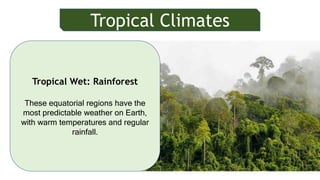
Tropical Climates
Tropical Wet: Rainforest
These equatorial regions have the
most predictable weather on Earth,
with warm temperatures and regular
rainfall.
Tropical Climates
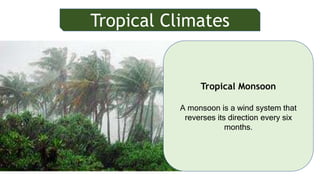
Tropical Monsoon
A monsoon is a wind system that
reverses its direction every six
months.
Tropical Climates
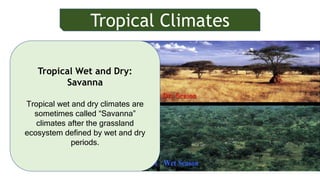
Tropical Wet and Dry:
Savanna
Tropical wet and dry climates are
sometimes called “Savanna”
climates after the grassland
ecosystem defined by wet and dry
periods.
Dry Climates
Arid
• Most Arid climates receive 10-30
centimeters of rain each year.
• Hottest spots in the world.
Semiarid
• Semiarid climates receive
enough to support entensive
grasslands.
• Often located between arid and
tropical climate regions.
Mild Climates
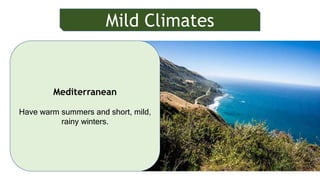
Mediterranean
Have warm summers and short, mild,
rainy winters.
Mild Climates
Humid Subtropical
A humid subtropical climate is a zone
of climate characterized by hot and
humid summers, and cool to mild
winters.
Mild Climates
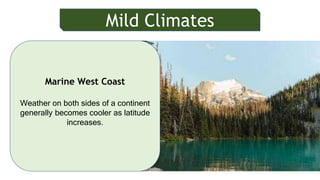
Marine West Coast
Weather on both sides of a continent
generally becomes cooler as latitude
increases.
Continental Climates
Warm Summer
Often have wet
summer seasons,
similar to monsoon
climates.
(Humid Continental)
Cool Summer
Have winters with low
temperatures and
snow.
Subarctic
Experience very long,
cold winters with little
precipitation.
(Boreal
Climates/Taiga)
Polar Climates
Tundra
Summers are short, but plants and
animals are plentiful.
Polar Climates
Ice Cap
Temperatures rarely rise above
freezing, even in summer.
INFLUENCE OF CLIMATE
Clothing
• In Indigenous Arctic cultures of
Europe, Asia, and North America
developed warm, durable, fur, and
animal-skin clothing.
• Papery tapa cloth is part of many
cultures in the warm, humid climates
of Polynesia in the South Pacific.
INFLUENCE OF CLIMATE
Shelter
• The ancient Anasazi people of
Southern North America built
apartments into tall cliffs.
• The Yurt which is a part of the
identity of many cultures across
windy, semiarid steppe of central
Asia.
INFLUENCE OF CLIMATE
Agriculture
• Ancient Agricultural civilizations
flourished where the climate was mild.
• Today, farmers are sill in tune with the
climate.
CLIMATE CHANGE
•Climate does not change from day to day like weather,
but it does change over time.
•Climate changes happen slowly over hundreds or
even thousands of years.
CAUSES OF CLIMATE CHANGE
• Generating Power
• Manufacturing Goods
• Cutting Down Forests
• Using Transportation
• Powering Buildings
• Consuming too much

Climates and Climate Change

  • 1.
  • 2.
    CLIMATE •Climate is thelong-term pattern of weather in a particular area.
  • 3.
    CLIMATE SYSTEM • Someparts of the world are hot and rainy nearly everyday. • Others with cold and snow-covered most of the year. • Between the icy poles and the steamy tropics are many other climates that contributes to Earth’s biodiversity and geologic heritage.
  • 4.
    Five Major Components: •Atmosphere • Hydrosphere • Cryosphere • Lithosphere • Biosphere
  • 5.
    CLIMATE CLASSIFICATIONS • CHARLESTHORNTHWAITE American Climatologist • In1948, he developed a climate classification system that scientists still use today. MAJOR CLASSIFICATIONS: • Microthermal • Mesothermal • Megathermal
  • 6.
    MICROTHERMAL MESOTHERMAL MEGATHERMAL •Characterized by cold winters and low potential evapotranspiratio n. • Not cold enough to sustain a layer of snow, but are also not remain warm enough to support flowering plants all year. • Have high moisture index and support rich vegetation all year.
  • 7.
    KOPPEN CLASSIFICATION SYSTEM •WLADIMIR KOPPEN Russian-German Scientist • In 1990, the most popular system of classifying climates was proposed. FIVE CLIMATE GROUPS: • Tropical • Dry • Mild • Continental • Polar
  • 8.
    Tropical Climates Tropical Wet:Rainforest These equatorial regions have the most predictable weather on Earth, with warm temperatures and regular rainfall.
  • 9.
    Tropical Climates Tropical Monsoon Amonsoon is a wind system that reverses its direction every six months.
  • 10.
    Tropical Climates Tropical Wetand Dry: Savanna Tropical wet and dry climates are sometimes called “Savanna” climates after the grassland ecosystem defined by wet and dry periods.
  • 11.
    Dry Climates Arid • MostArid climates receive 10-30 centimeters of rain each year. • Hottest spots in the world. Semiarid • Semiarid climates receive enough to support entensive grasslands. • Often located between arid and tropical climate regions.
  • 12.
    Mild Climates Mediterranean Have warmsummers and short, mild, rainy winters.
  • 13.
    Mild Climates Humid Subtropical Ahumid subtropical climate is a zone of climate characterized by hot and humid summers, and cool to mild winters.
  • 14.
    Mild Climates Marine WestCoast Weather on both sides of a continent generally becomes cooler as latitude increases.
  • 15.
    Continental Climates Warm Summer Oftenhave wet summer seasons, similar to monsoon climates. (Humid Continental) Cool Summer Have winters with low temperatures and snow. Subarctic Experience very long, cold winters with little precipitation. (Boreal Climates/Taiga)
  • 16.
    Polar Climates Tundra Summers areshort, but plants and animals are plentiful.
  • 17.
    Polar Climates Ice Cap Temperaturesrarely rise above freezing, even in summer.
  • 18.
    INFLUENCE OF CLIMATE Clothing •In Indigenous Arctic cultures of Europe, Asia, and North America developed warm, durable, fur, and animal-skin clothing. • Papery tapa cloth is part of many cultures in the warm, humid climates of Polynesia in the South Pacific.
  • 19.
    INFLUENCE OF CLIMATE Shelter •The ancient Anasazi people of Southern North America built apartments into tall cliffs. • The Yurt which is a part of the identity of many cultures across windy, semiarid steppe of central Asia.
  • 20.
    INFLUENCE OF CLIMATE Agriculture •Ancient Agricultural civilizations flourished where the climate was mild. • Today, farmers are sill in tune with the climate.
  • 21.
    CLIMATE CHANGE •Climate doesnot change from day to day like weather, but it does change over time. •Climate changes happen slowly over hundreds or even thousands of years.
  • 22.
    CAUSES OF CLIMATECHANGE • Generating Power • Manufacturing Goods • Cutting Down Forests • Using Transportation • Powering Buildings • Consuming too much