Climate Change and  Food Security Joachim von Braun International Food Policy Research Institute IPC and ICTSD Seminar “Climate Change, Agriculture, and Trade: Promoting Policy Coherence” Washington DC, October 29, 2009
Big picture of climate change policy challenges
Challenges of getting to a  global climate change regime  Questions of global climate justice, historic liability, equal rights Equitable cost-sharing for mitigation and adaption (per capita) The Kyoto Protocol has large shortcomings A more efficient global regime on basis of int’l cooperation  is needed
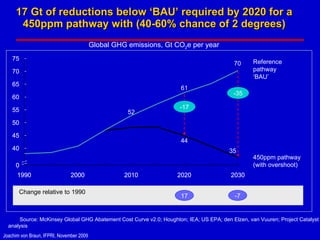
17 Gt of reductions below ‘BAU’ required by 2020 for a 450ppm pathway with (40-60% chance of 2 degrees) Global GHG emissions, Gt CO 2 e per year 52 61 70 50 55 60 65 70 75 1990 2000 2010 2020 2030 0 40 45 44 35 -17 -35 Reference  pathway ‘ BAU’ 450ppm pathway  (with overshoot) Change relative to 1990 17 -7 Source: McKinsey Global GHG Abatement Cost Curve v2.0; Houghton; IEA; US EPA; den Elzen, van Vuuren; Project Catalyst analysis 50 55 60 65 70 75 1990 2000 2010 2020 2030 0 40 45
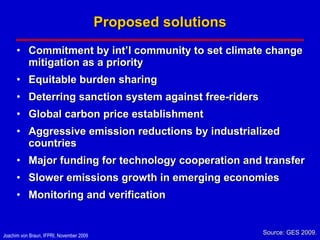
Proposed solutions Commitment by int’l community to set climate change mitigation as a priority Equitable burden sharing Deterring sanction system against free-riders Global carbon price establishment Aggressive emission reductions by industrialized countries Major funding for technology cooperation and transfer Slower emissions growth in emerging economies Monitoring and verification Source: GES 2009.
Dealing with  agriculture  by appropriate integration into a Copenhagen agreement and beyond
Taking a dual perspective on climate change and food security Address climate change in the context  of food security Address food security in the context of climate change Not each in isolation! This way find common grounds between developing and developed countries
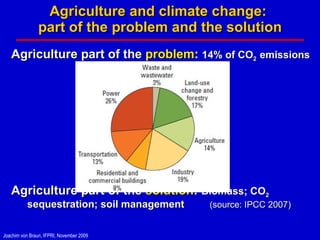
Agriculture and climate change:  part of the problem and the solution Agriculture part of the  problem :  14% of CO 2  emissions Agriculture part of the  solution :  Biomass; CO 2  sequestration; soil management  (source: IPCC 2007)
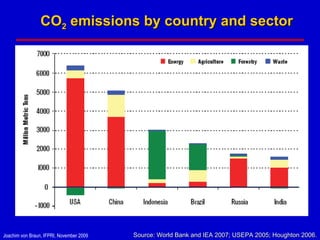
CO 2  emissions by country and sector Source: World Bank and IEA 2007; USEPA 2005; Houghton 2006.
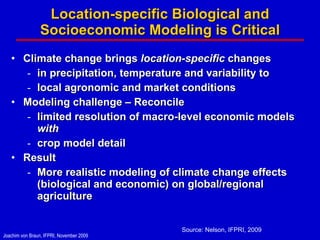
Location-specific Biological and Socioeconomic Modeling is Critical Climate change brings  location-specific  changes in precipitation, temperature and variability to local agronomic and market conditions Modeling challenge – Reconcile  limited resolution of macro-level economic models  with  crop model detail Result More realistic modeling of climate change effects (biological and economic) on global/regional agriculture Source: Nelson, IFPRI, 2009
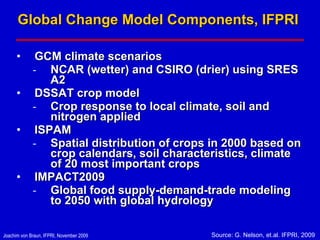
Global Change Model Components, IFPRI  GCM climate scenarios NCAR (wetter) and CSIRO (drier) using SRES A2 DSSAT crop model Crop response to local climate, soil and nitrogen applied ISPAM  Spatial distribution of crops in 2000 based on crop calendars, soil characteristics, climate of 20 most important crops IMPACT2009 Global food supply-demand-trade modeling to 2050 with global hydrology Source: G. Nelson, et.al. IFPRI, 2009
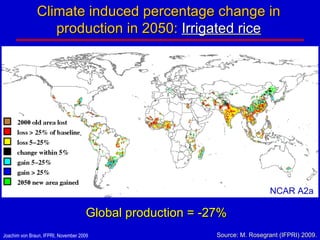
Climate induced percentage change in production in 2050:  Irrigated rice Global production = -27% NCAR A2a Source: M. Rosegrant (IFPRI) 2009.
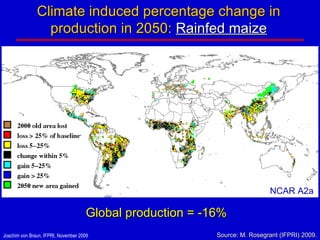
Climate induced percentage change in production in 2050:  Rainfed maize Source: M. Rosegrant (IFPRI) 2009. NCAR A2a Global production = -16%
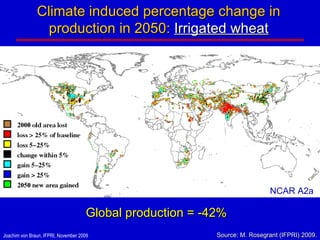
Climate induced percentage change in production in 2050:  Irrigated wheat NCAR A2a Global production = -42% Source: M. Rosegrant (IFPRI) 2009.
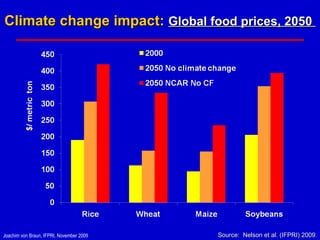
Climate change impact:  Global food prices, 2050  Source:  Nelson et al. (IFPRI) 2009 .
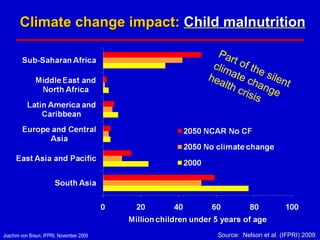
Climate change impact:  Child malnutrition Part of the silent climate change  health crisis   Source:  Nelson et al. (IFPRI) 2009 .
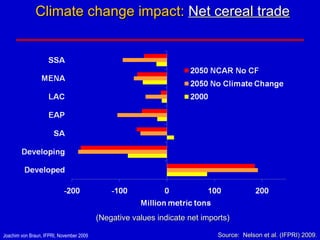
Climate change impact:  Net cereal trade Source:  Nelson et al. (IFPRI) 2009 . (Negative values indicate net imports)
Trade promotes coordination of environmental policies Trade may  Provide opportunities for linkage between environmental and trade concessions Facilitate implicit side payments Grant countries direct leverage over other countries’ production Instill perception of shared goals Example: Water pollution is lower in rivers shared between countries with more trade  (analysis using data from the UN Global Environmental Monitoring System) Source:  Ringler, Biswas, Cline (eds.) 2009 .
The ongoing policy debate and potential actions
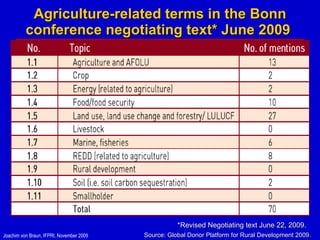
Agriculture-related terms in the Bonn conference negotiating text* June 2009  Source: Global Donor Platform for Rural Development 2009. *Revised Negotiating text June 22, 2009.
What  costs agricultural adaptation ?  IFPRI Model Assumptions 60% increase in all crop yield growth over baseline 30% increase in animal numbers growth 40% increase in production growth of oils and meals 25% increase in irrigated area growth 15% decrease in rainfed area growth 0.15% increase in basin water efficiency by 2050 Source:  Nelson et al. (IFPRI) 2009 .
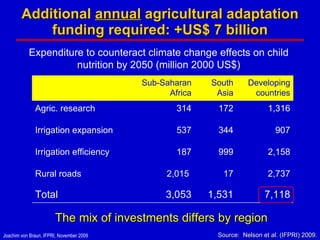
Additional  annual  agricultural adaptation funding required: +US$ 7 billion Expenditure to counteract climate change effects on child nutrition by 2050 (million 2000 US$) Source:  Nelson et al. (IFPRI) 2009 . The mix of investments differs by region Sub-Saharan Africa South Asia Developing countries Agric. research 314 172 1,316 Irrigation expansion 537 344 907 Irrigation efficiency 187 999 2,158 Rural roads 2,015  17 2,737 Total 3,053 1,531 7,118
Agricultural research, water management, and rural investment Crop breeding for both irrigated and rainfed agriculture Biotechnology for stress tolerant materials to address drought- and heat-tolerance, salinization  Water harvesting, minimum tillage, integrated soil fertility management etc. Rural infrastructure investment to improve access to markets, risk insurance, credit, inputs Adaptation for increasing agricultural productivity Source:  Rosegrant (IFPRI) 2009 .
Agricultural mitigation policy Include carbon sequestration from soil carbon in global carbon trading system Fund development and implementation of low-cost monitoring systems Allow innovative payment mechanisms and support for novel institutions for agricultural mitigation Create institutional innovations linking communities to global markets e.g. regional centers for carbon trading Source:  Rosegrant (IFPRI) 2009 .
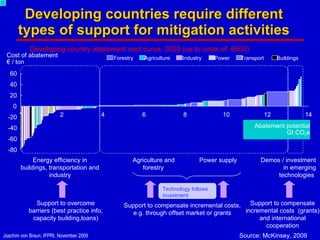
Developing countries require different types of support for mitigation activities Source: McKinsey, 2009  Energy efficiency in buildings, transportation and industry Demos / investment in emerging technologies  Agriculture and forestry Developing country abatement cost curve, 2020 (up to costs of  €60/t) Support to overcome barriers (best practice info, capacity building,loans) Support to compensate incremental costs, e.g. through offset market or grants Support to compensate incremental costs  (grants) and international cooperation Power supply  8 10 12 14 2 4 6 * Cost of abatement  €  / ton Forestry Agriculture Industry Power Transport Buildings 0 20 40 60 -20 -80 -60 -40 Technology follows investment Abatement potential Gt CO 2 e
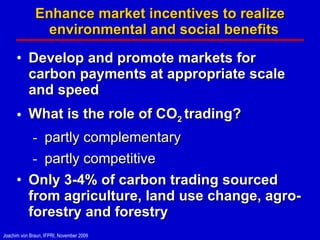
Enhance market incentives to realize environmental and social benefits  Develop and promote markets for carbon payments at appropriate scale and speed What is the role of CO 2  trading?  partly complementary partly competitive Only 3-4% of carbon trading sourced from agriculture, land use change, agro-forestry and forestry
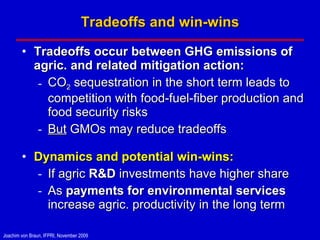
Tradeoffs and win-wins Tradeoffs occur between GHG emissions of  agric. and related mitigation action: CO 2  sequestration in the short term leads to competition with food-fuel-fiber production and food security risks But  GMOs may reduce tradeoffs Dynamics and potential win-wins: If agric  R&D  investments have higher share As  payments for environmental services  increase agric. productivity in the long term
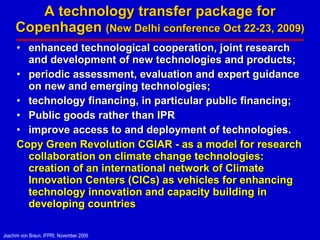
A technology transfer package for Copenhagen  (New Delhi conference Oct 22-23, 2009) enhanced technological cooperation, joint research and development of new technologies and products;  periodic assessment, evaluation and expert guidance on new and emerging technologies;  technology financing, in particular public financing;  Public goods rather than IPR improve access to and deployment of technologies. Copy Green Revolution CGIAR - as a model for research collaboration on climate change technologies: creation of an international network of Climate Innovation Centers (CICs) as vehicles for enhancing technology innovation and capacity building in developing countries
The broad directions for food security conscious climate change policy  An efficient and fair  global  climate regime is needed The  food security  effects of climate change must be important determinants for policy;  Investment for  agriculture’s GHG neutrality  must not be delayed Invest in  adaptation in developmental ways ; $ 7 billn. p.a. Climate stress requires to more  open trade Carbon market opportunities for agriculture  must not undermine food security Combining agric.  carbon market participation with sound agricultural R&D  promises win-win
IFPRI on the web  http://www.ifpri.org/

Climate Change and Food Security

  • 1.
    Climate Change and Food Security Joachim von Braun International Food Policy Research Institute IPC and ICTSD Seminar “Climate Change, Agriculture, and Trade: Promoting Policy Coherence” Washington DC, October 29, 2009
  • 2.
    Big picture ofclimate change policy challenges
  • 3.
    Challenges of gettingto a global climate change regime Questions of global climate justice, historic liability, equal rights Equitable cost-sharing for mitigation and adaption (per capita) The Kyoto Protocol has large shortcomings A more efficient global regime on basis of int’l cooperation is needed
  • 4.
    17 Gt ofreductions below ‘BAU’ required by 2020 for a 450ppm pathway with (40-60% chance of 2 degrees) Global GHG emissions, Gt CO 2 e per year 52 61 70 50 55 60 65 70 75 1990 2000 2010 2020 2030 0 40 45 44 35 -17 -35 Reference pathway ‘ BAU’ 450ppm pathway (with overshoot) Change relative to 1990 17 -7 Source: McKinsey Global GHG Abatement Cost Curve v2.0; Houghton; IEA; US EPA; den Elzen, van Vuuren; Project Catalyst analysis 50 55 60 65 70 75 1990 2000 2010 2020 2030 0 40 45
  • 5.
    Proposed solutions Commitmentby int’l community to set climate change mitigation as a priority Equitable burden sharing Deterring sanction system against free-riders Global carbon price establishment Aggressive emission reductions by industrialized countries Major funding for technology cooperation and transfer Slower emissions growth in emerging economies Monitoring and verification Source: GES 2009.
  • 6.
    Dealing with agriculture by appropriate integration into a Copenhagen agreement and beyond
  • 7.
    Taking a dualperspective on climate change and food security Address climate change in the context of food security Address food security in the context of climate change Not each in isolation! This way find common grounds between developing and developed countries
  • 8.
    Agriculture and climatechange: part of the problem and the solution Agriculture part of the problem : 14% of CO 2 emissions Agriculture part of the solution : Biomass; CO 2 sequestration; soil management (source: IPCC 2007)
  • 9.
    CO 2 emissions by country and sector Source: World Bank and IEA 2007; USEPA 2005; Houghton 2006.
  • 10.
    Location-specific Biological andSocioeconomic Modeling is Critical Climate change brings location-specific changes in precipitation, temperature and variability to local agronomic and market conditions Modeling challenge – Reconcile limited resolution of macro-level economic models with crop model detail Result More realistic modeling of climate change effects (biological and economic) on global/regional agriculture Source: Nelson, IFPRI, 2009
  • 11.
    Global Change ModelComponents, IFPRI GCM climate scenarios NCAR (wetter) and CSIRO (drier) using SRES A2 DSSAT crop model Crop response to local climate, soil and nitrogen applied ISPAM Spatial distribution of crops in 2000 based on crop calendars, soil characteristics, climate of 20 most important crops IMPACT2009 Global food supply-demand-trade modeling to 2050 with global hydrology Source: G. Nelson, et.al. IFPRI, 2009
  • 12.
    Climate induced percentagechange in production in 2050: Irrigated rice Global production = -27% NCAR A2a Source: M. Rosegrant (IFPRI) 2009.
  • 13.
    Climate induced percentagechange in production in 2050: Rainfed maize Source: M. Rosegrant (IFPRI) 2009. NCAR A2a Global production = -16%
  • 14.
    Climate induced percentagechange in production in 2050: Irrigated wheat NCAR A2a Global production = -42% Source: M. Rosegrant (IFPRI) 2009.
  • 15.
    Climate change impact: Global food prices, 2050 Source: Nelson et al. (IFPRI) 2009 .
  • 16.
    Climate change impact: Child malnutrition Part of the silent climate change health crisis Source: Nelson et al. (IFPRI) 2009 .
  • 17.
    Climate change impact: Net cereal trade Source: Nelson et al. (IFPRI) 2009 . (Negative values indicate net imports)
  • 18.
    Trade promotes coordinationof environmental policies Trade may Provide opportunities for linkage between environmental and trade concessions Facilitate implicit side payments Grant countries direct leverage over other countries’ production Instill perception of shared goals Example: Water pollution is lower in rivers shared between countries with more trade (analysis using data from the UN Global Environmental Monitoring System) Source: Ringler, Biswas, Cline (eds.) 2009 .
  • 19.
    The ongoing policydebate and potential actions
  • 20.
    Agriculture-related terms inthe Bonn conference negotiating text* June 2009 Source: Global Donor Platform for Rural Development 2009. *Revised Negotiating text June 22, 2009.
  • 21.
    What costsagricultural adaptation ? IFPRI Model Assumptions 60% increase in all crop yield growth over baseline 30% increase in animal numbers growth 40% increase in production growth of oils and meals 25% increase in irrigated area growth 15% decrease in rainfed area growth 0.15% increase in basin water efficiency by 2050 Source: Nelson et al. (IFPRI) 2009 .
  • 22.
    Additional annual agricultural adaptation funding required: +US$ 7 billion Expenditure to counteract climate change effects on child nutrition by 2050 (million 2000 US$) Source: Nelson et al. (IFPRI) 2009 . The mix of investments differs by region Sub-Saharan Africa South Asia Developing countries Agric. research 314 172 1,316 Irrigation expansion 537 344 907 Irrigation efficiency 187 999 2,158 Rural roads 2,015 17 2,737 Total 3,053 1,531 7,118
  • 23.
    Agricultural research, watermanagement, and rural investment Crop breeding for both irrigated and rainfed agriculture Biotechnology for stress tolerant materials to address drought- and heat-tolerance, salinization Water harvesting, minimum tillage, integrated soil fertility management etc. Rural infrastructure investment to improve access to markets, risk insurance, credit, inputs Adaptation for increasing agricultural productivity Source: Rosegrant (IFPRI) 2009 .
  • 24.
    Agricultural mitigation policyInclude carbon sequestration from soil carbon in global carbon trading system Fund development and implementation of low-cost monitoring systems Allow innovative payment mechanisms and support for novel institutions for agricultural mitigation Create institutional innovations linking communities to global markets e.g. regional centers for carbon trading Source: Rosegrant (IFPRI) 2009 .
  • 25.
    Developing countries requiredifferent types of support for mitigation activities Source: McKinsey, 2009 Energy efficiency in buildings, transportation and industry Demos / investment in emerging technologies Agriculture and forestry Developing country abatement cost curve, 2020 (up to costs of €60/t) Support to overcome barriers (best practice info, capacity building,loans) Support to compensate incremental costs, e.g. through offset market or grants Support to compensate incremental costs (grants) and international cooperation Power supply 8 10 12 14 2 4 6 * Cost of abatement € / ton Forestry Agriculture Industry Power Transport Buildings 0 20 40 60 -20 -80 -60 -40 Technology follows investment Abatement potential Gt CO 2 e
  • 26.
    Enhance market incentivesto realize environmental and social benefits Develop and promote markets for carbon payments at appropriate scale and speed What is the role of CO 2 trading? partly complementary partly competitive Only 3-4% of carbon trading sourced from agriculture, land use change, agro-forestry and forestry
  • 27.
    Tradeoffs and win-winsTradeoffs occur between GHG emissions of agric. and related mitigation action: CO 2 sequestration in the short term leads to competition with food-fuel-fiber production and food security risks But GMOs may reduce tradeoffs Dynamics and potential win-wins: If agric R&D investments have higher share As payments for environmental services increase agric. productivity in the long term
  • 28.
    A technology transferpackage for Copenhagen (New Delhi conference Oct 22-23, 2009) enhanced technological cooperation, joint research and development of new technologies and products; periodic assessment, evaluation and expert guidance on new and emerging technologies; technology financing, in particular public financing; Public goods rather than IPR improve access to and deployment of technologies. Copy Green Revolution CGIAR - as a model for research collaboration on climate change technologies: creation of an international network of Climate Innovation Centers (CICs) as vehicles for enhancing technology innovation and capacity building in developing countries
  • 29.
    The broad directionsfor food security conscious climate change policy An efficient and fair global climate regime is needed The food security effects of climate change must be important determinants for policy; Investment for agriculture’s GHG neutrality must not be delayed Invest in adaptation in developmental ways ; $ 7 billn. p.a. Climate stress requires to more open trade Carbon market opportunities for agriculture must not undermine food security Combining agric. carbon market participation with sound agricultural R&D promises win-win
  • 30.
    IFPRI on theweb http://www.ifpri.org/

Editor's Notes

  • #24 After water demand for different sectors
  • #25 Our recommendation then is that agriculture be included in any mitigation funding modalities, with funds available for development and implementation of low-cost monitoring systems and that allow innovative payment mechanisms to address the characteristics of agriculture, especially in developing countries, where small producer predominate and legal institutions are not always fully effective. The principle of common by differentiated responsibilities implies that any funding should support mitigation of agricultural emissions by the poorest but as countries progress and their incomes rise, the burden of mitigation should be adjusted too. 5) Linking communities to global markets - Establish regional centers for carbon trading, specialized business services and local intermediaries. Simplify standards for small-scale projects. Deal with permanence issue in carbon sequestration.