
Research Outputs and Approaches  to Enhance Food Security and Improve Livelihoods in Dry Areas International Center for Agricultural Research in the Dry Areas Mahmoud Solh Director General IFAD/ICARDA Information Exchange Workshop
Outline Constraints leading to food insecurity and poverty in Dry Areas. What can make a difference? ICARDA Strategic Plan 2007-2016: Agricultural Research for Development in Dry Areas. Technologies towards food security & better livelihoods  Approach for technology transfer IFAD Strategic Partnerships
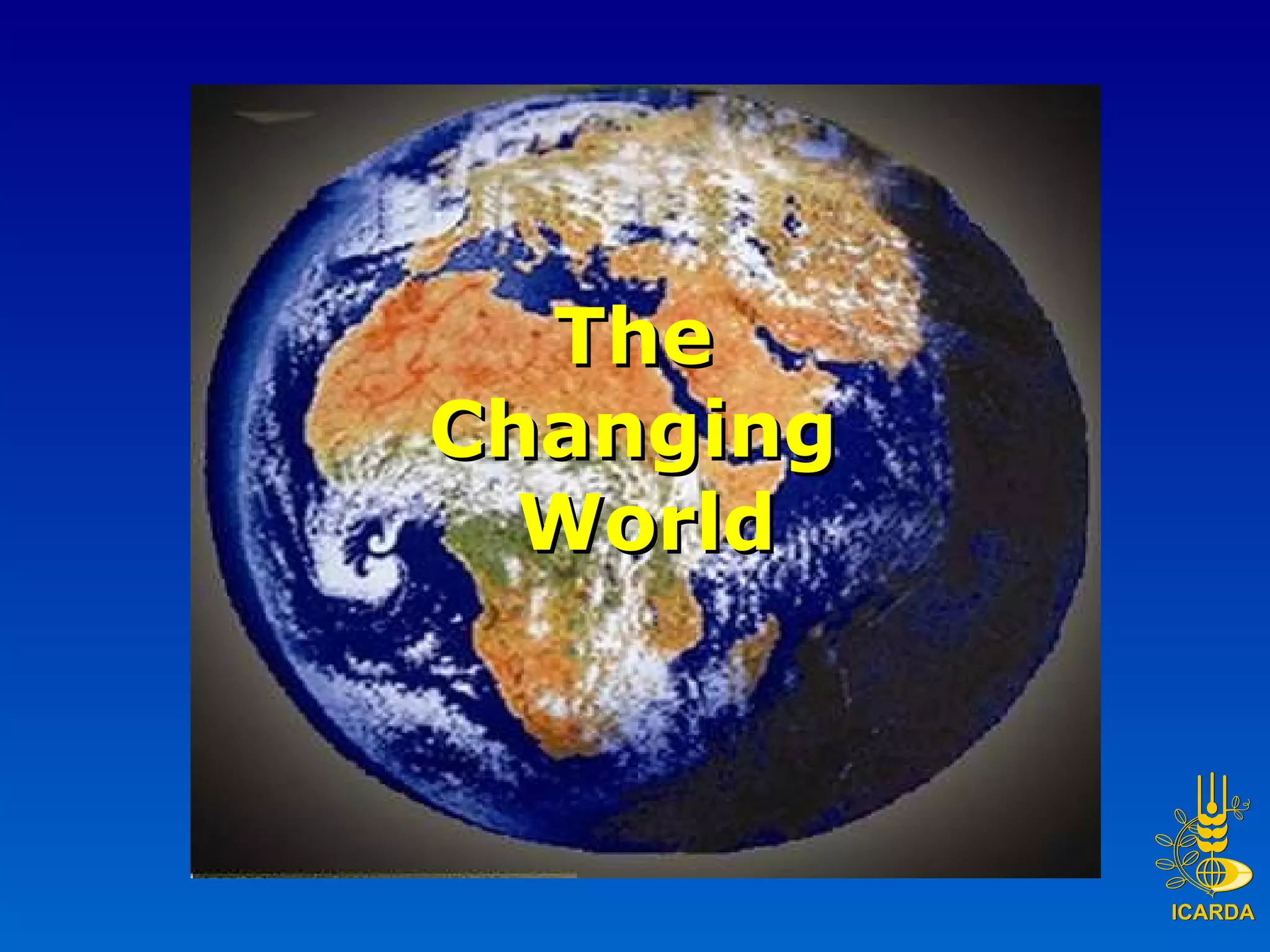
The  Changing  World
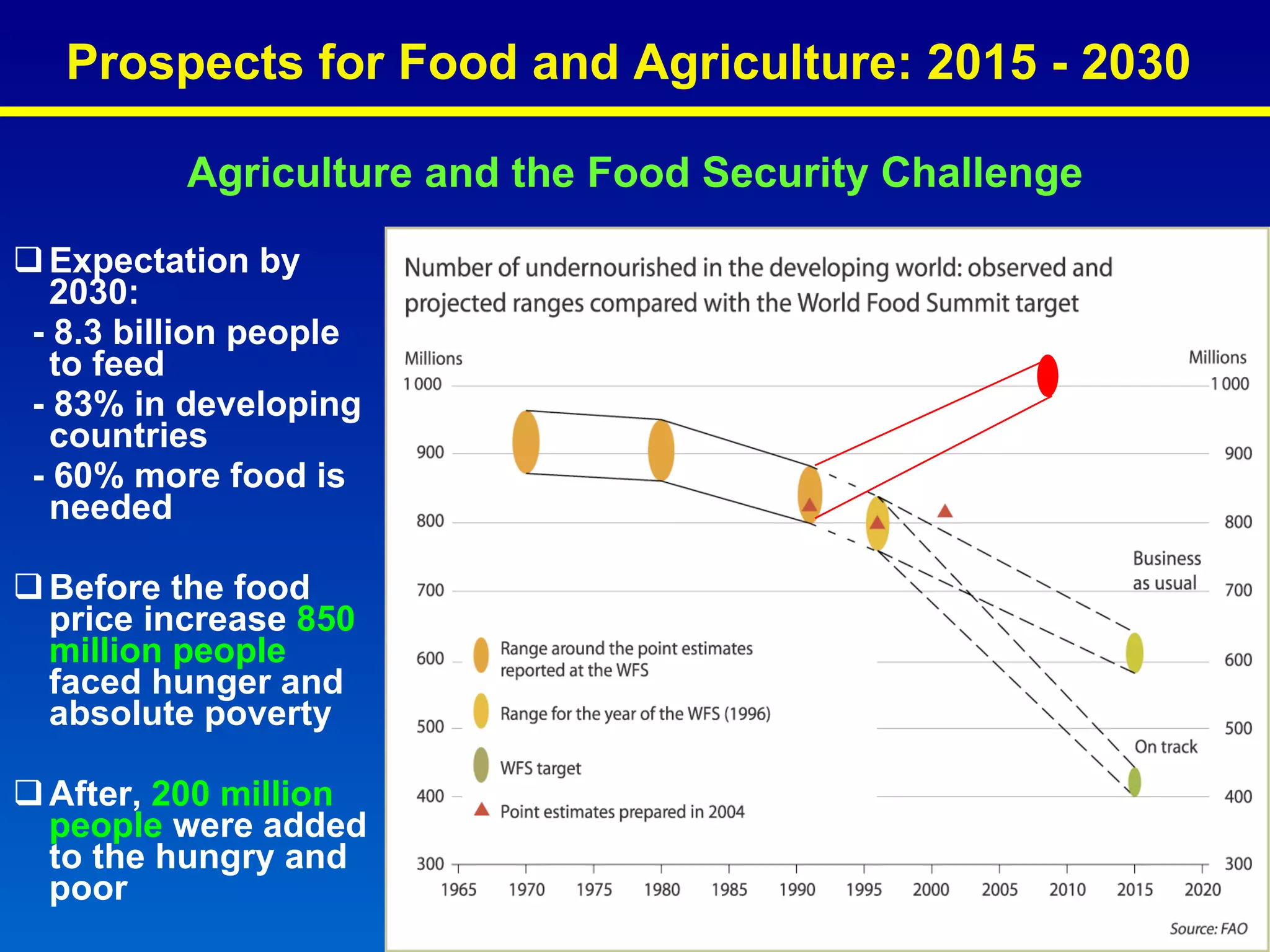
Agriculture and the Food Security Challenge Expectation by  2030: - 8.3 billion people to feed - 83% in developing countries - 60% more food is needed Before the food price increase  850 million people   faced hunger and absolute poverty After,  200 million people  were added to the hungry and poor  Prospects for Food and Agriculture: 2015 - 2030
Constraints leading to  Food Insecurity  and poverty in dry areas
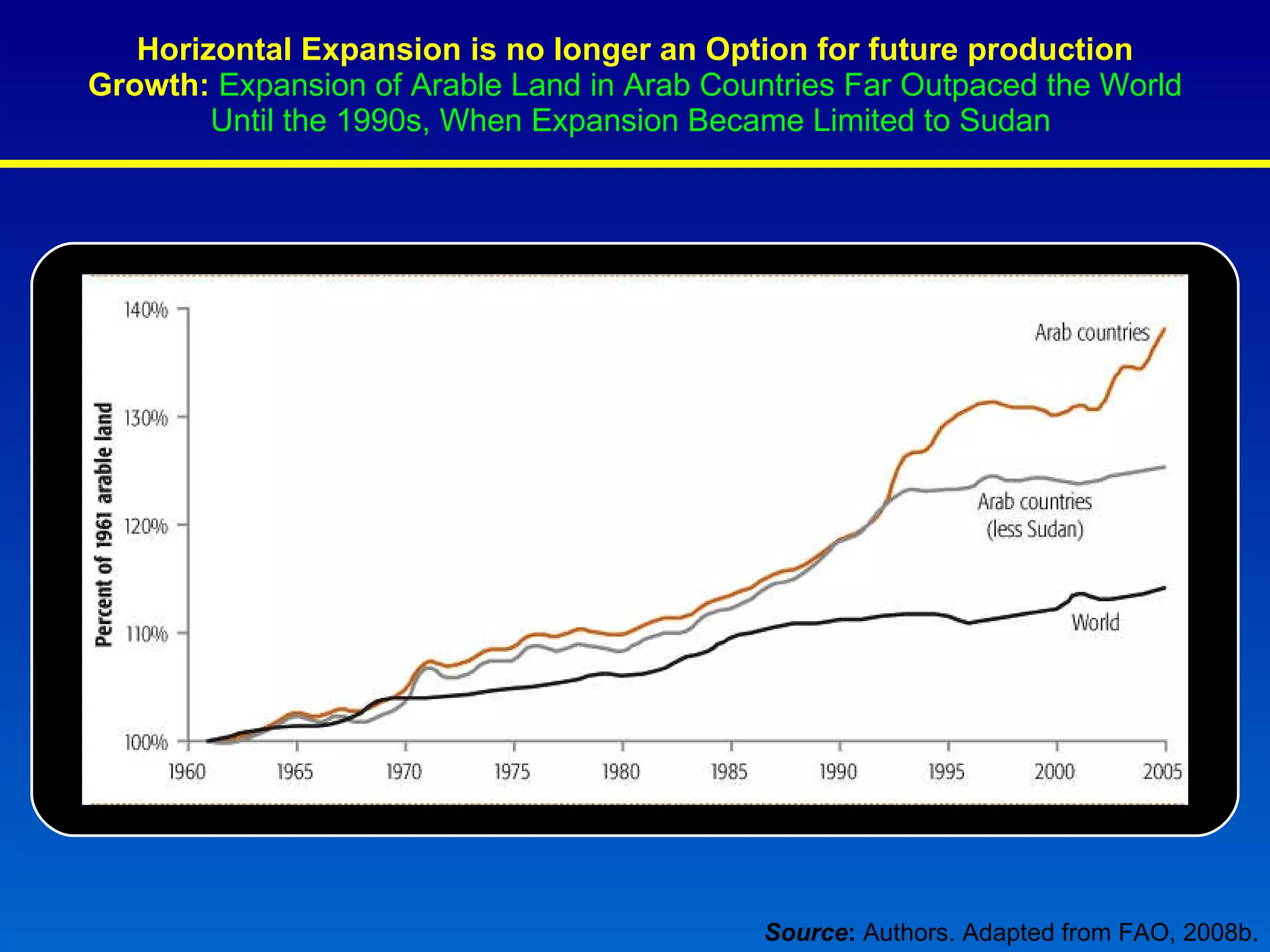
Horizontal Expansion is no longer an Option for future production Growth:   Expansion of Arable Land in Arab Countries Far Outpaced the World Until the 1990s, When Expansion Became Limited to Sudan   Source :  Authors. Adapted from FAO, 2008b.
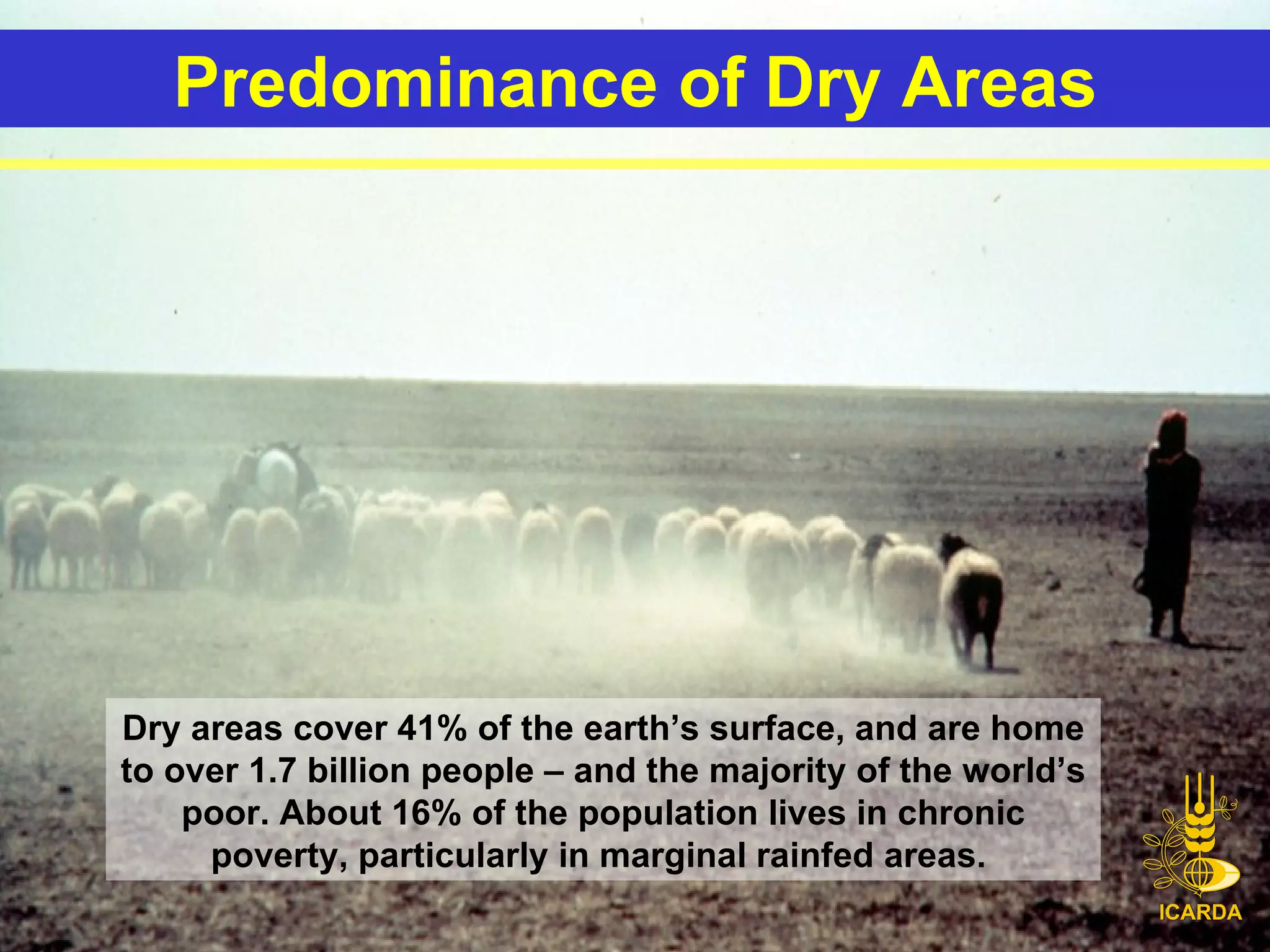
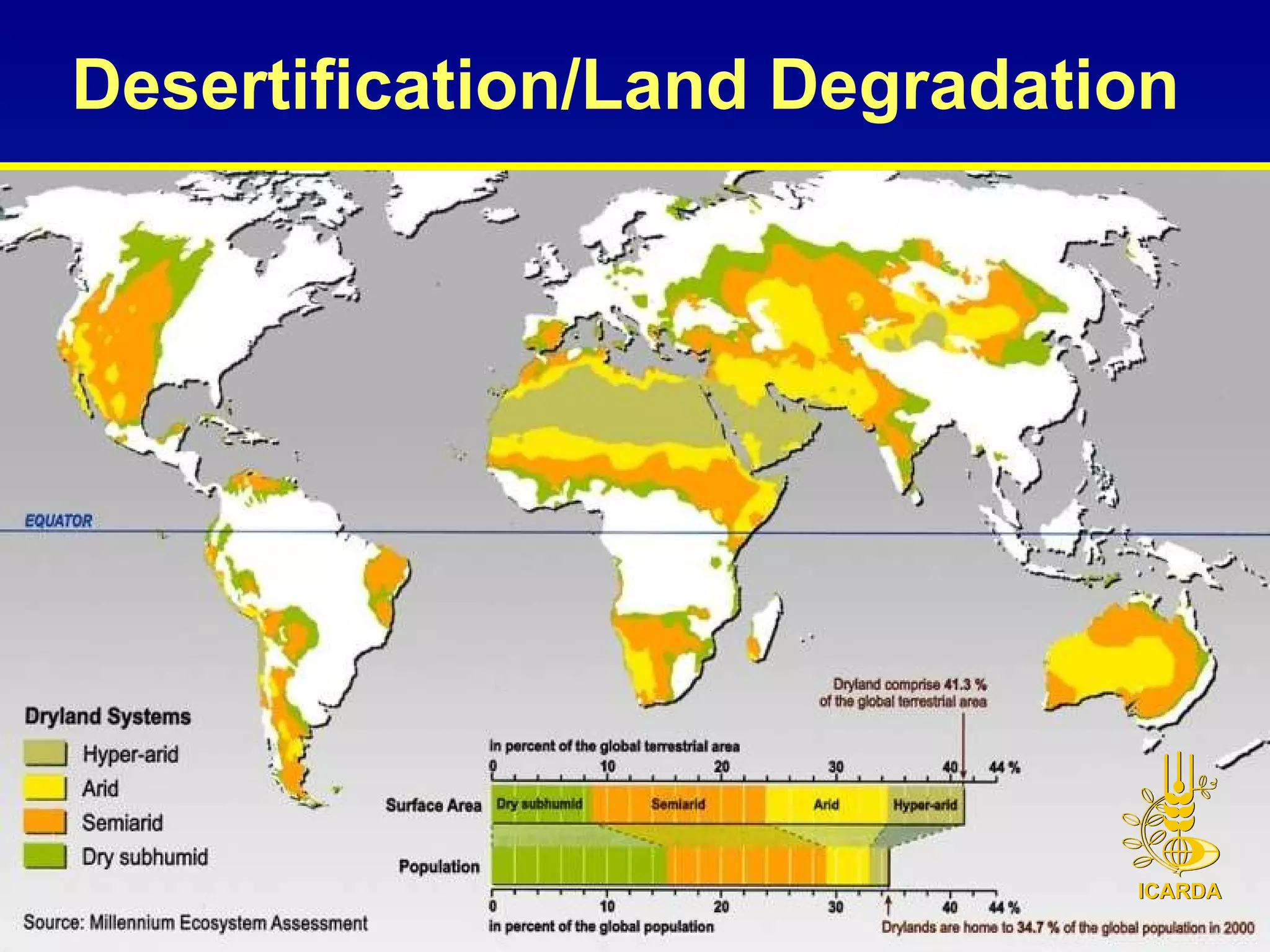
Dry areas cover 41% of the earth’s surface, and are home to over 1.7 billion people – and the majority of the world’s poor.   About 16% of the population lives in chronic poverty, particularly in marginal rainfed areas.  Predominance of Dry Areas
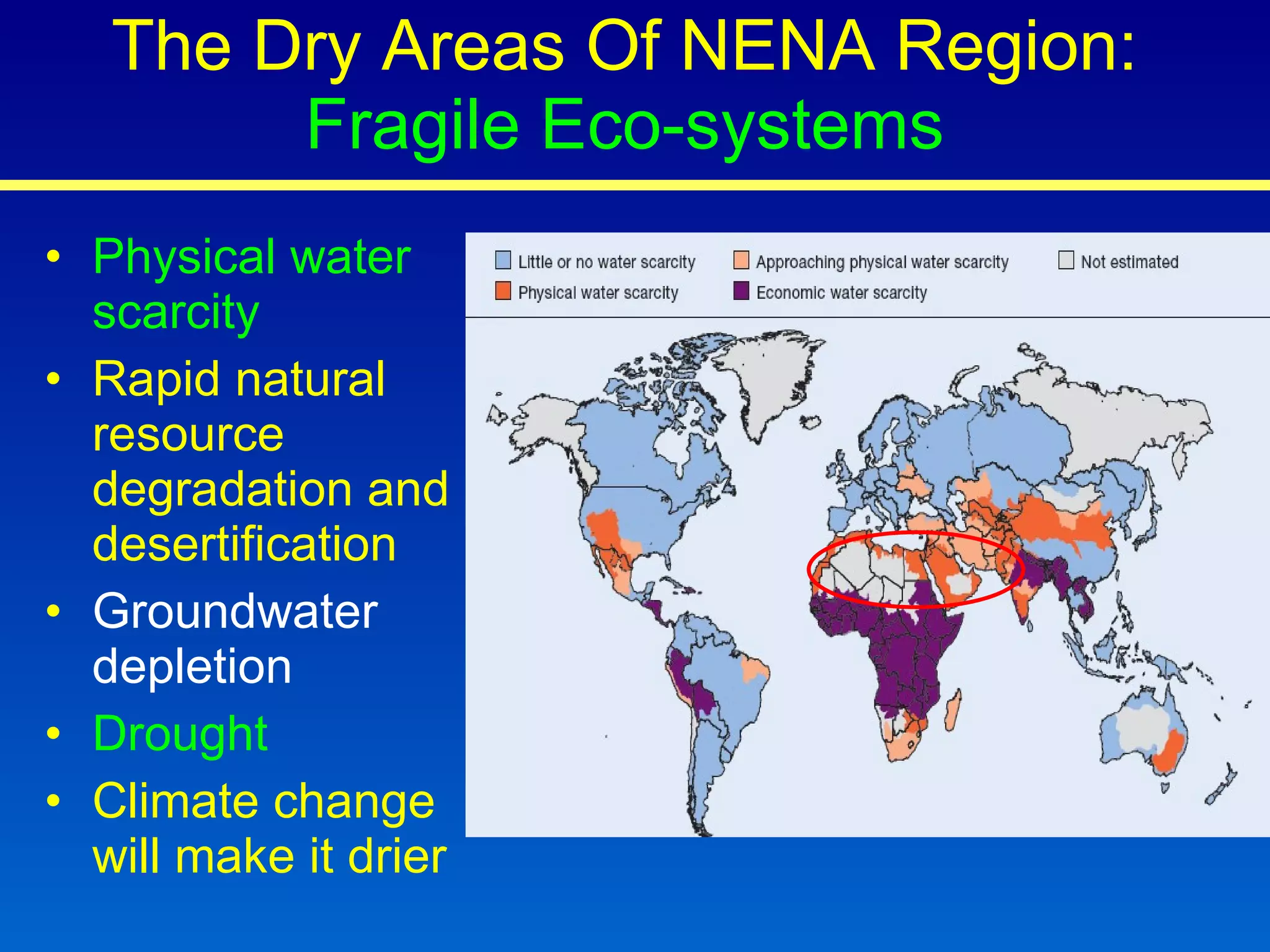
The Dry Areas Of NENA Region:  Fragile Eco-systems Physical water scarcity   Rapid natural resource degradation and desertification Groundwater depletion Drought Climate change will make it drier -80 -70 -60 -50 -40 -30 -20 -10 1982 1985 1988 1991 1994 1997 2000 2003 2006 m Decrease of the Souss aquifer level in Morocco
Desertification/Land Degradation
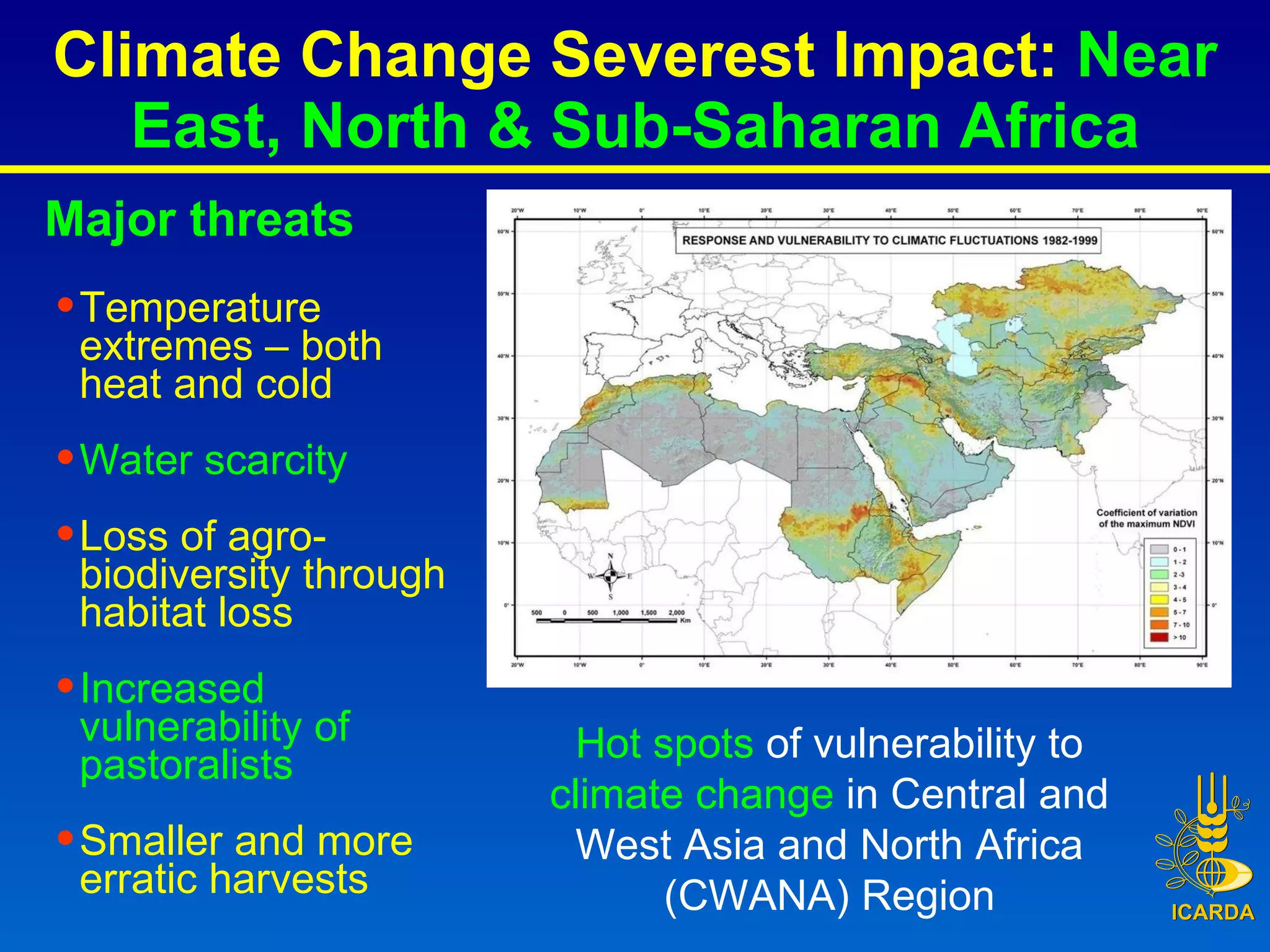
Climate Change Severest Impact:  Near East, North & Sub-Saharan Africa Hot spots  of vulnerability to  climate change  in Central and West Asia and North Africa (CWANA) Region Temperature extremes – both heat and cold Water scarcity Loss of agro-biodiversity through habitat loss Increased vulnerability of pastoralists Smaller and more erratic harvests Major threats
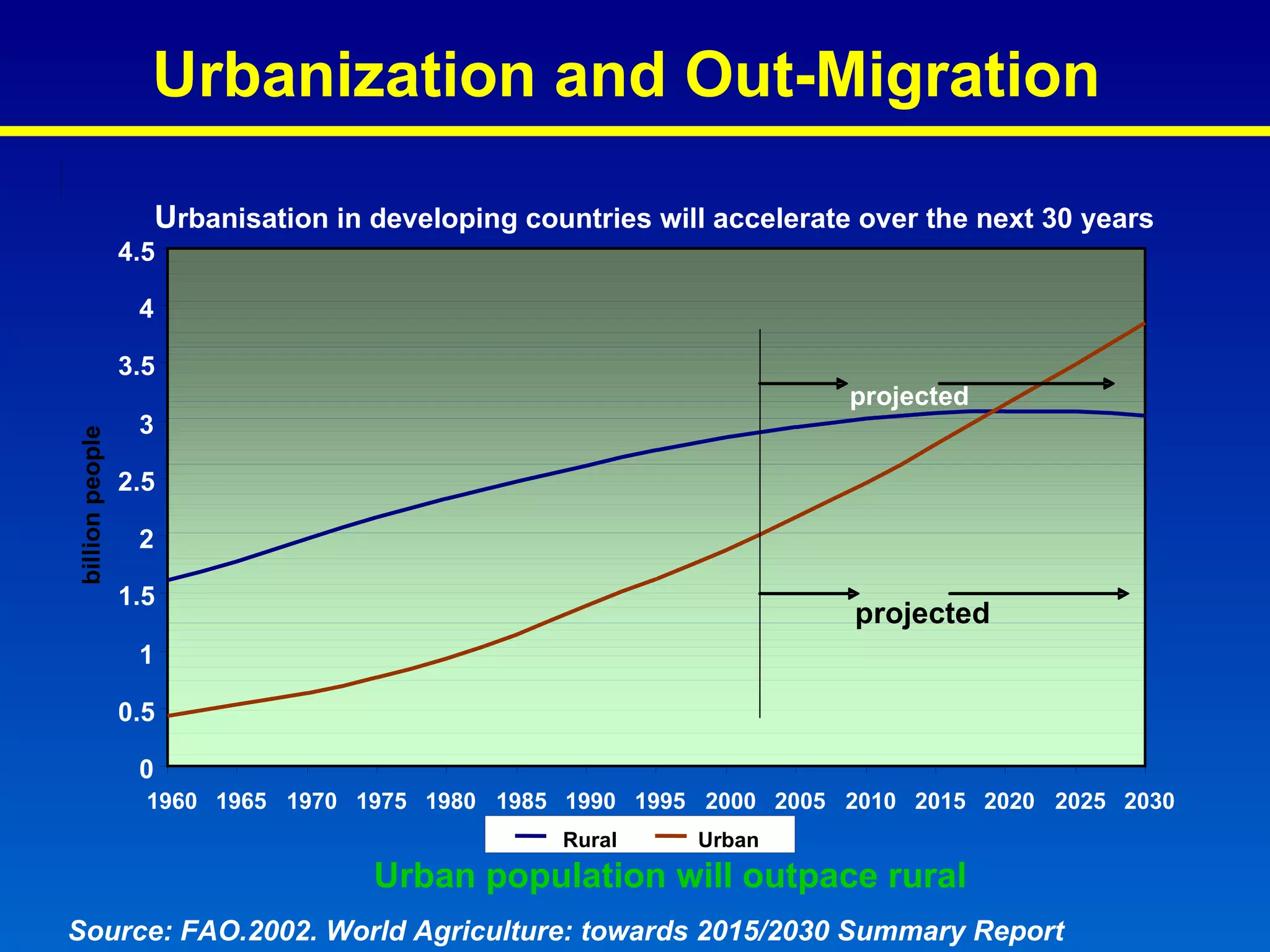
Urban population will outpace rural Urbanization and Out-Migration  Source: FAO.2002. World Agriculture: towards 2015/2030 Summary Report U rbanisation in developing countries will accelerate over the next 30 years 0 0.5 1 1.5 2 2.5 3 3.5 4 4.5 1960 1965 1970 1975 1980 1985 1990 1995 2000 2005 2010 2015 2020 2025 2030 billion people Rural Urban projected projected
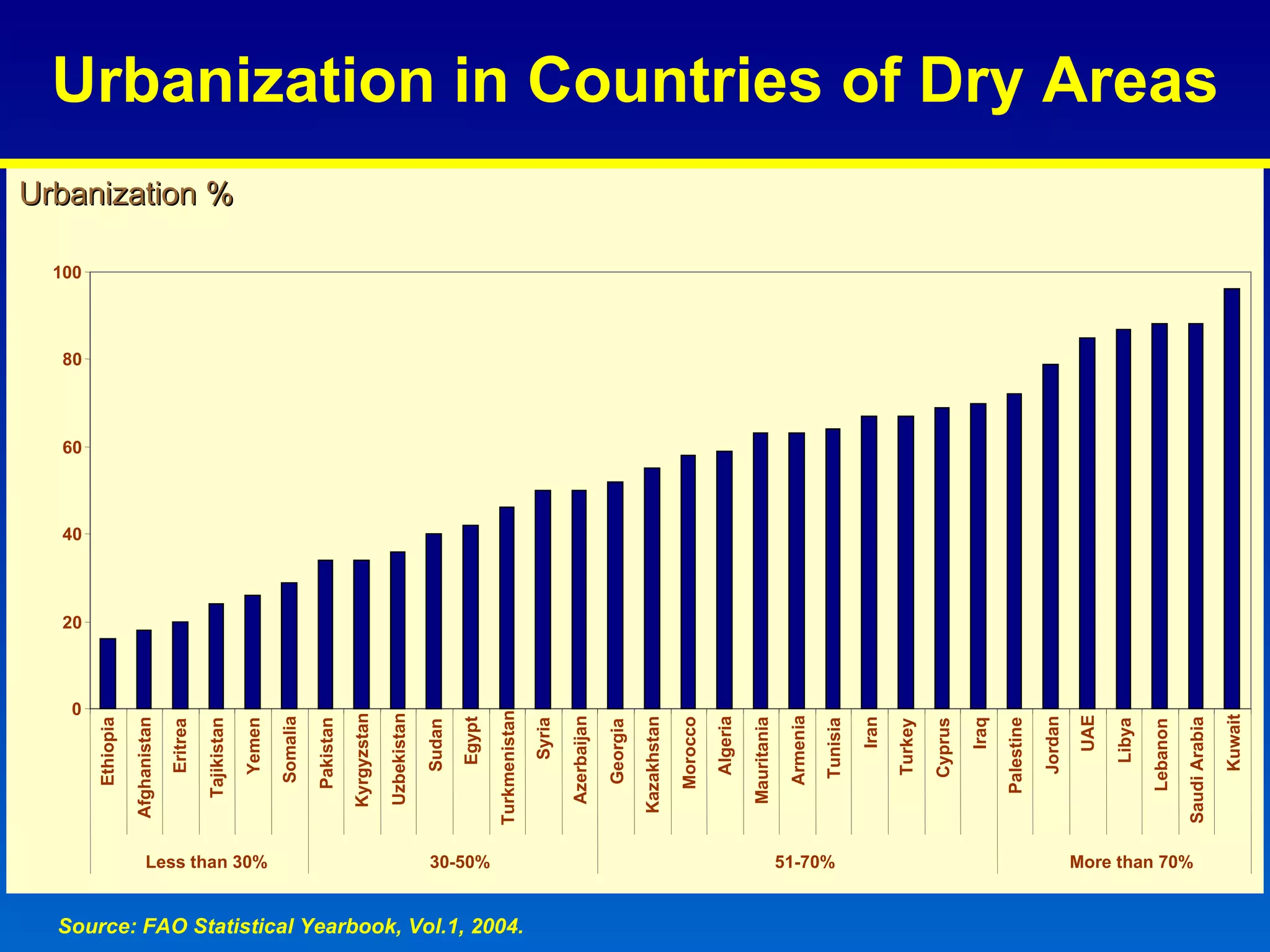
Urbanization in Countries of Dry Areas Source: FAO Statistical Yearbook, Vol.1, 2004. Urbanization % 0 20 40 60 80 100 Ethiopia Afghanistan Eritrea Tajikistan Yemen Somalia Pakistan Kyrgyzstan Uzbekistan Sudan Egypt Turkmenistan Syria Azerbaijan Georgia Kazakhstan Morocco Algeria Mauritania Armenia Tunisia Iran Turkey Cyprus Iraq Palestine Jordan UAE Libya Lebanon Saudi Arabia Kuwait Less than 30% 30-50% 51-70% More than 70%
Further Challenges  towards Food Security   Inadequate agricultural policies for sustainable agricultural development Insufficient investment in agricultural research and development
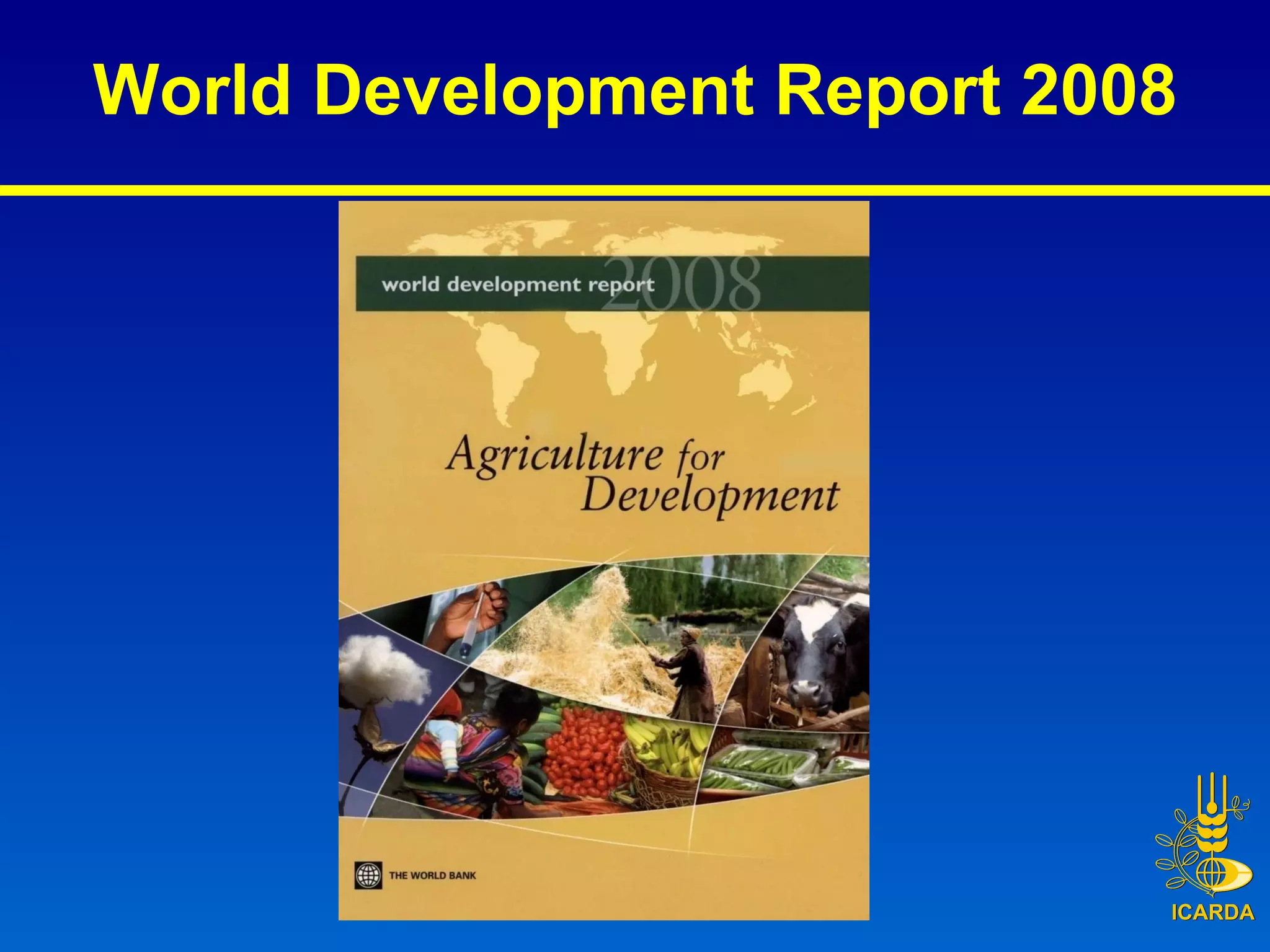
World Development Report 2008
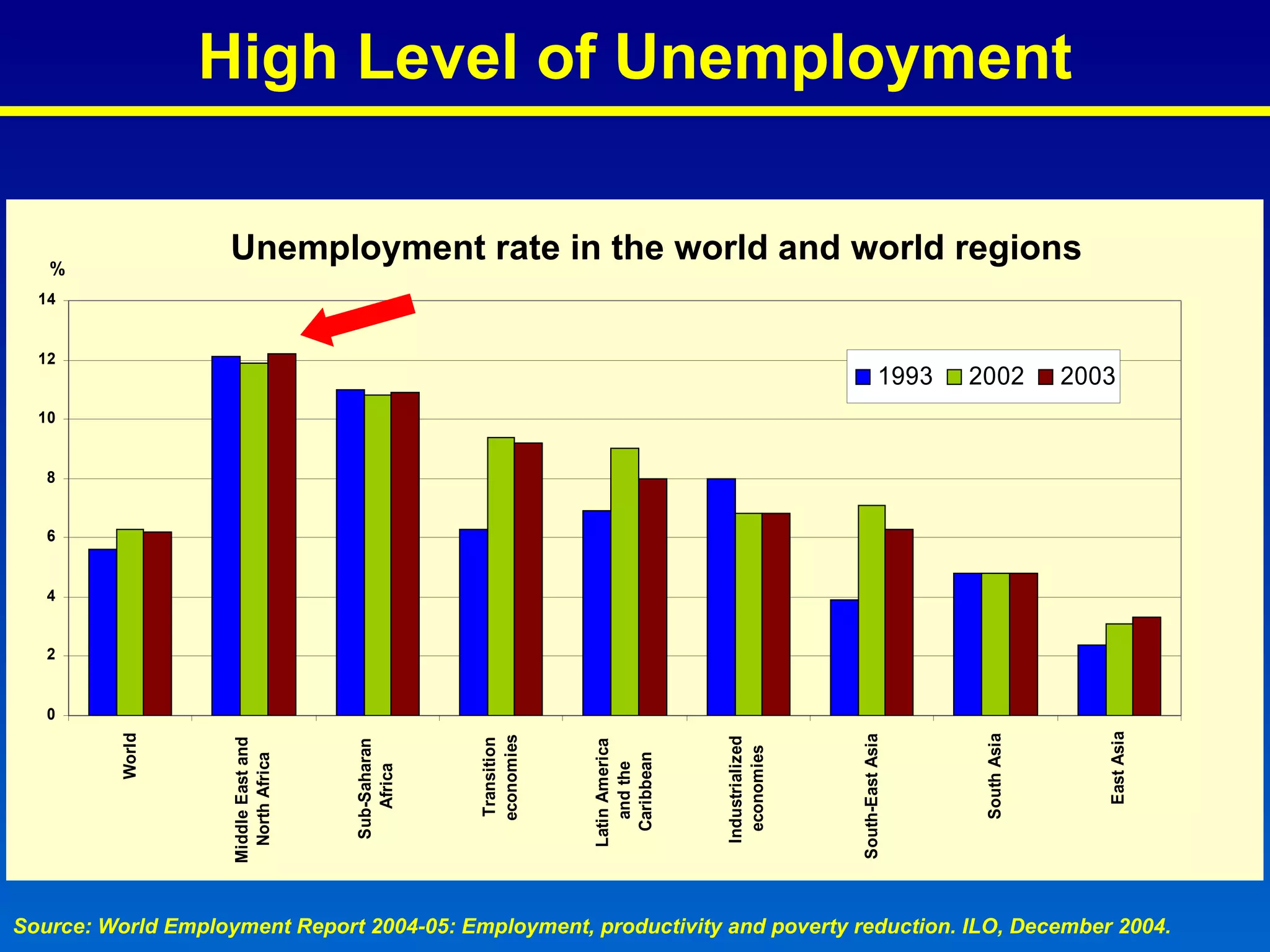
Unemployment rate in the world and world regions High Level of Unemployment Source:  World Employment Report 2004-05: Employment, productivity and poverty reduction. ILO, December 2004.
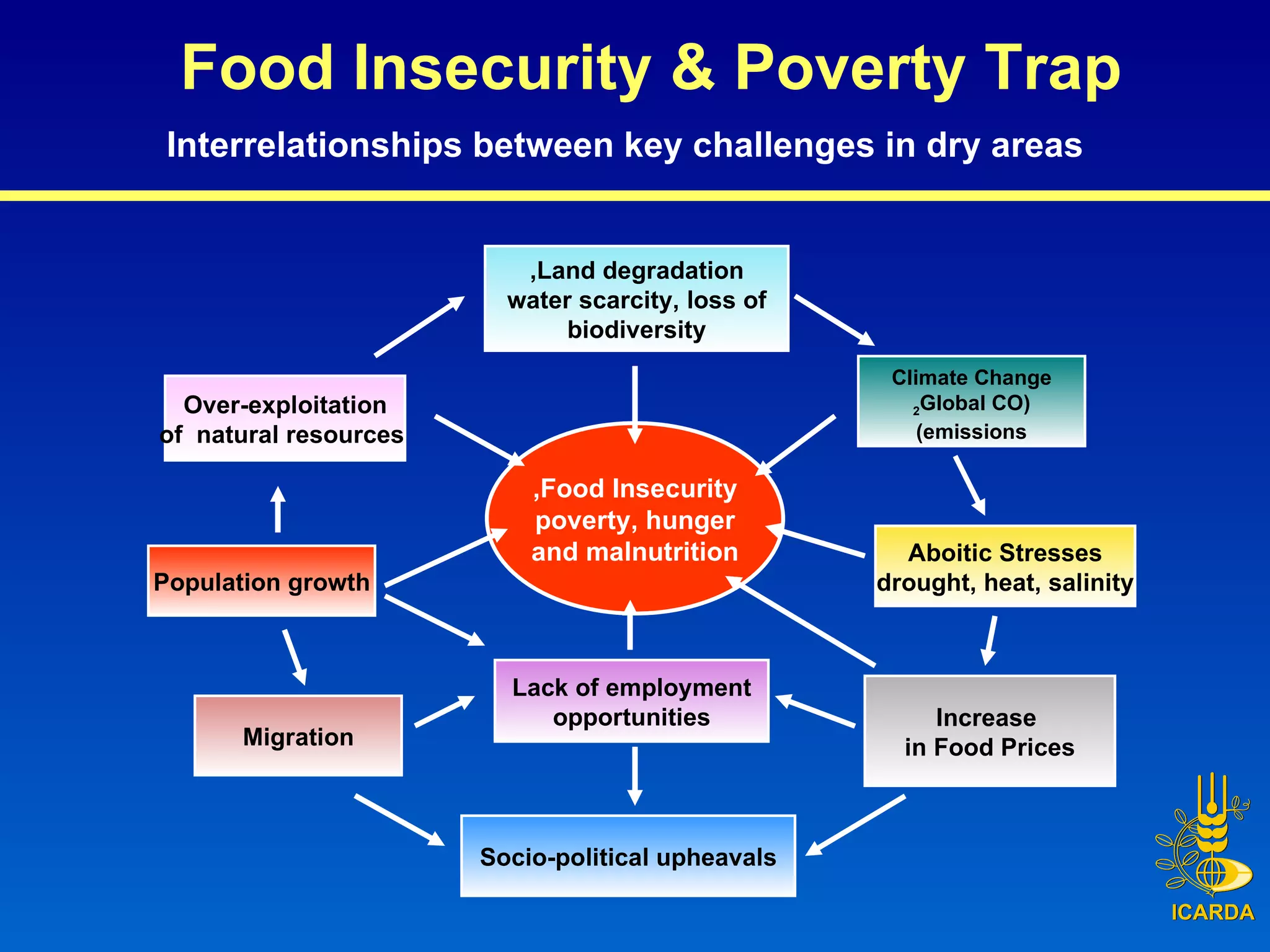
Lack of employment opportunities Socio-political upheavals Increase  in Food Prices Climate Change (Global CO 2 emissions) Over-exploitation of  natural resources Migration Population growth Aboitic Stresses drought, heat, salinity Food Insecurity, poverty, hunger and malnutrition Land degradation, water scarcity, loss of biodiversity Interrelationships between key challenges in dry areas Food Insecurity & Poverty Trap
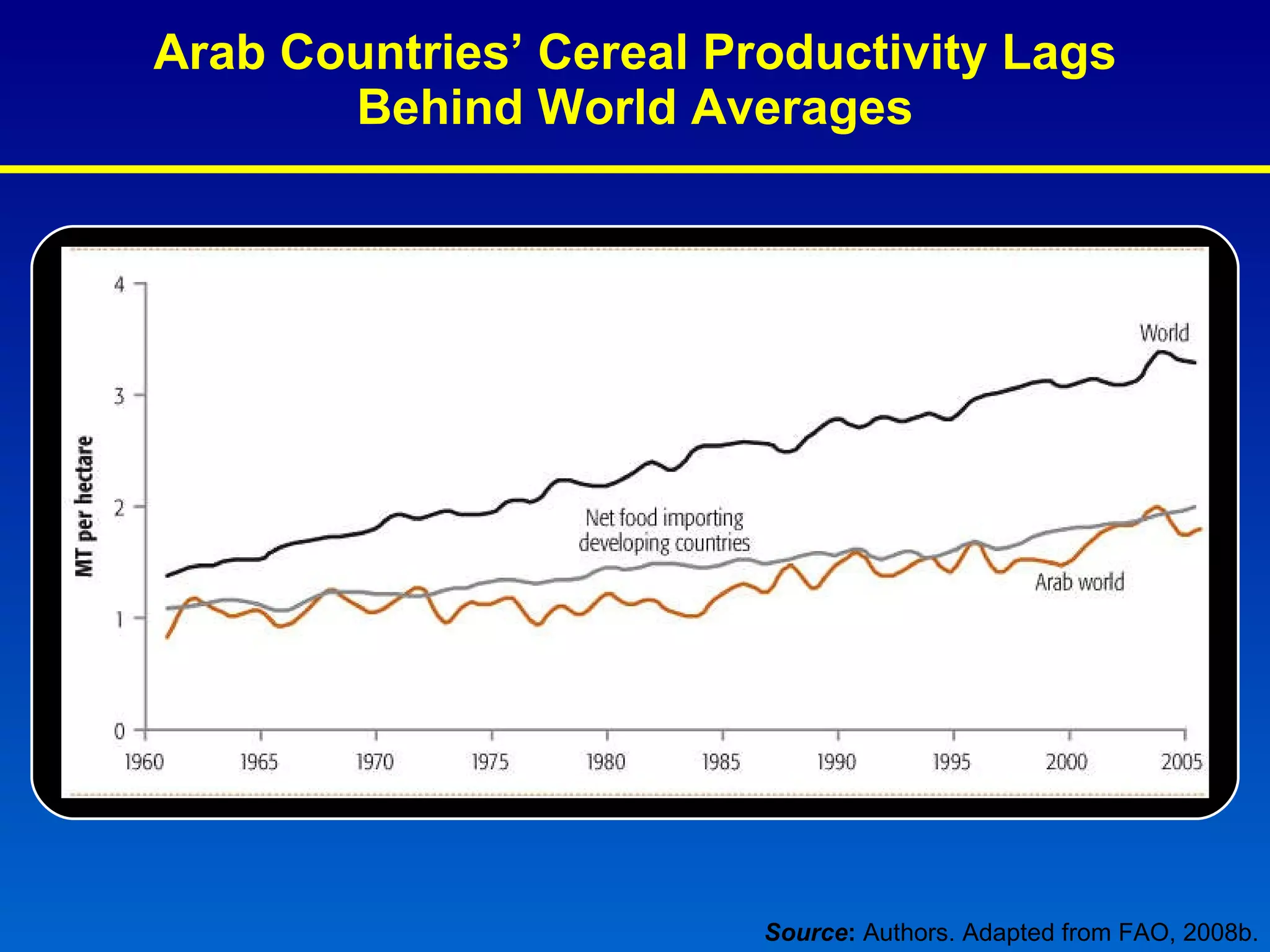
Arab Countries’ Cereal Productivity Lags Behind World Averages Source :  Authors. Adapted from FAO, 2008b.
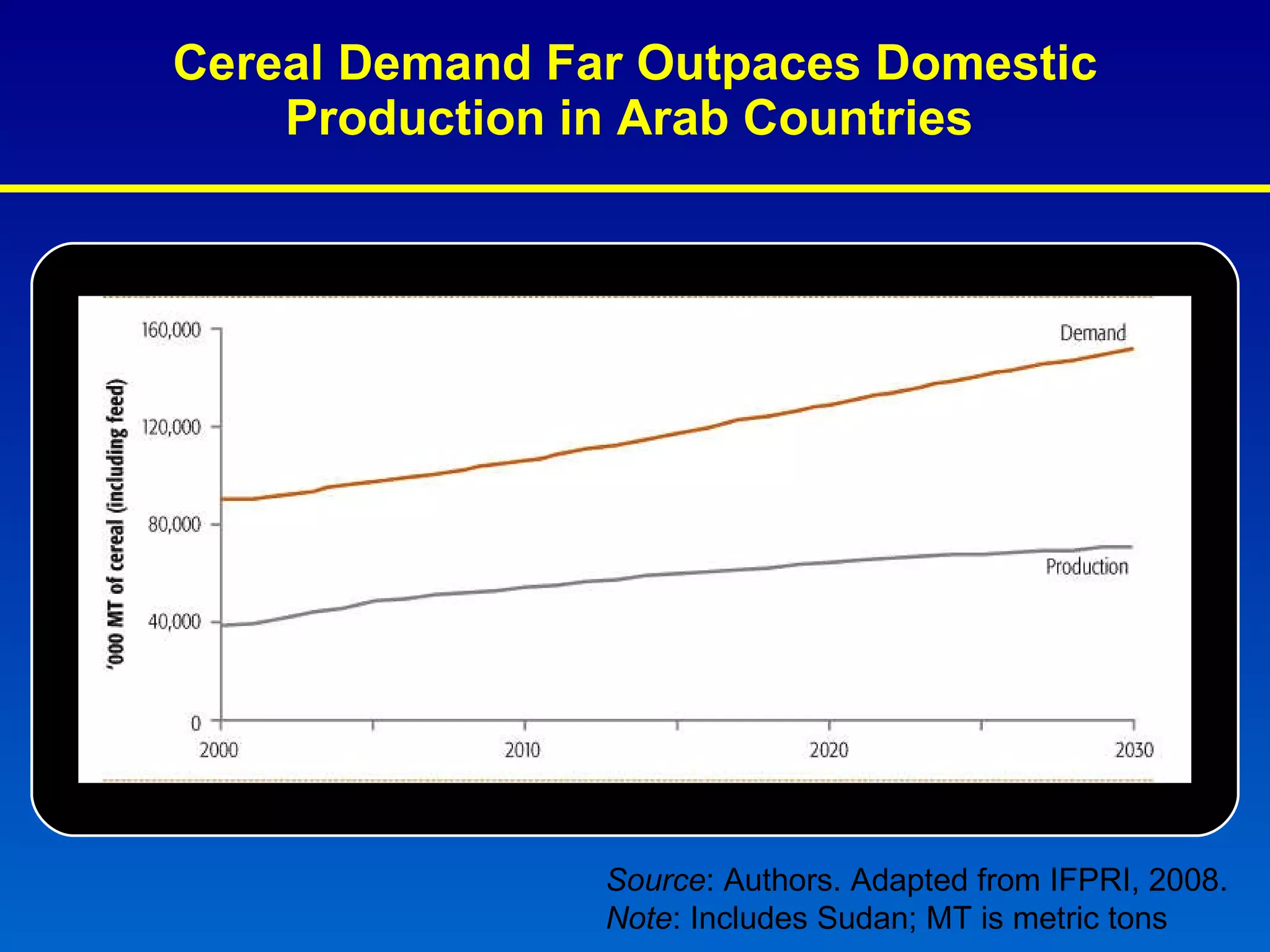
Cereal Demand Far Outpaces Domestic Production in Arab Countries   Source : Authors. Adapted from IFPRI, 2008.  Note : Includes Sudan; MT is metric tons
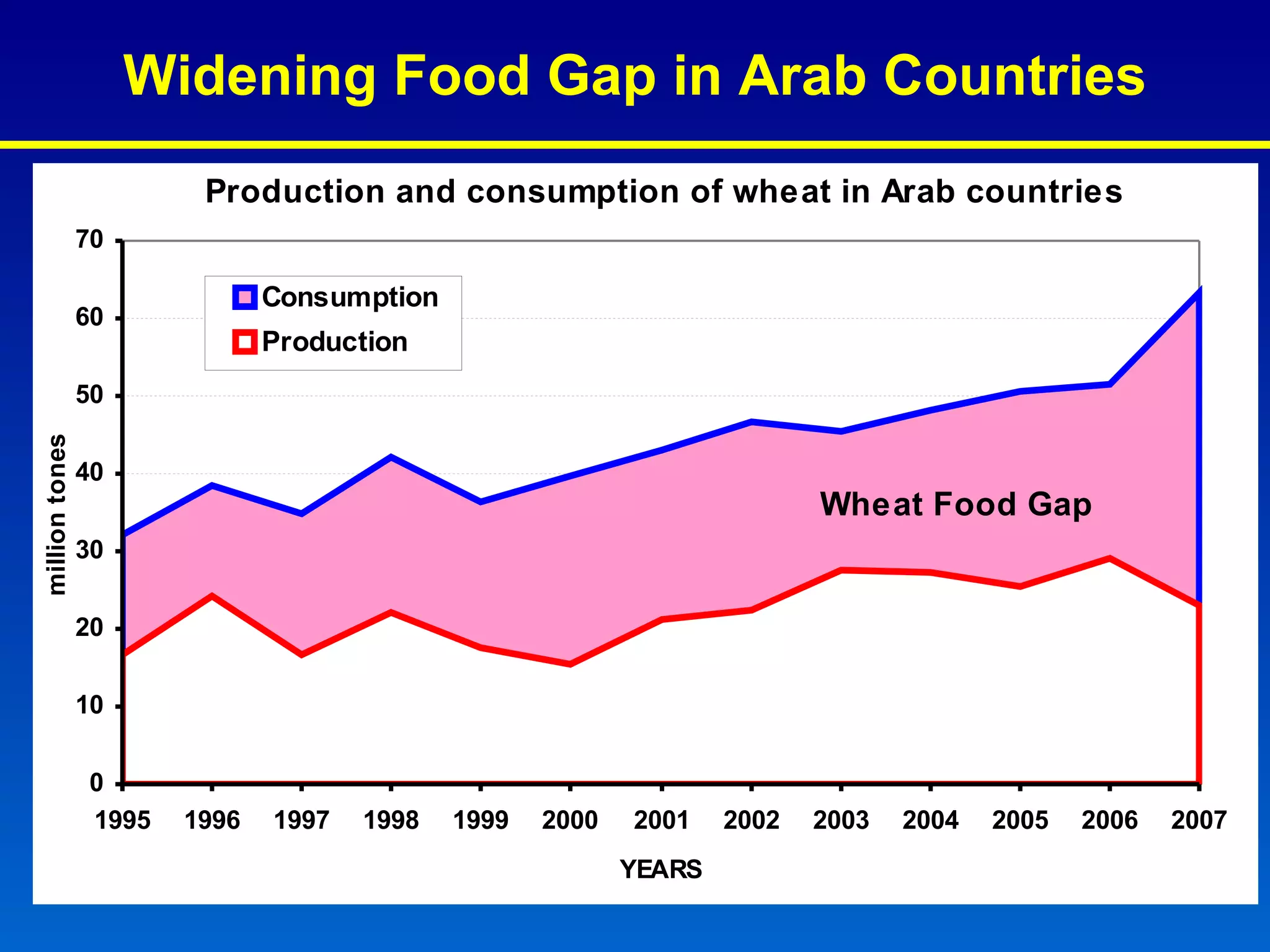
Widening Food Gap in Arab Countries
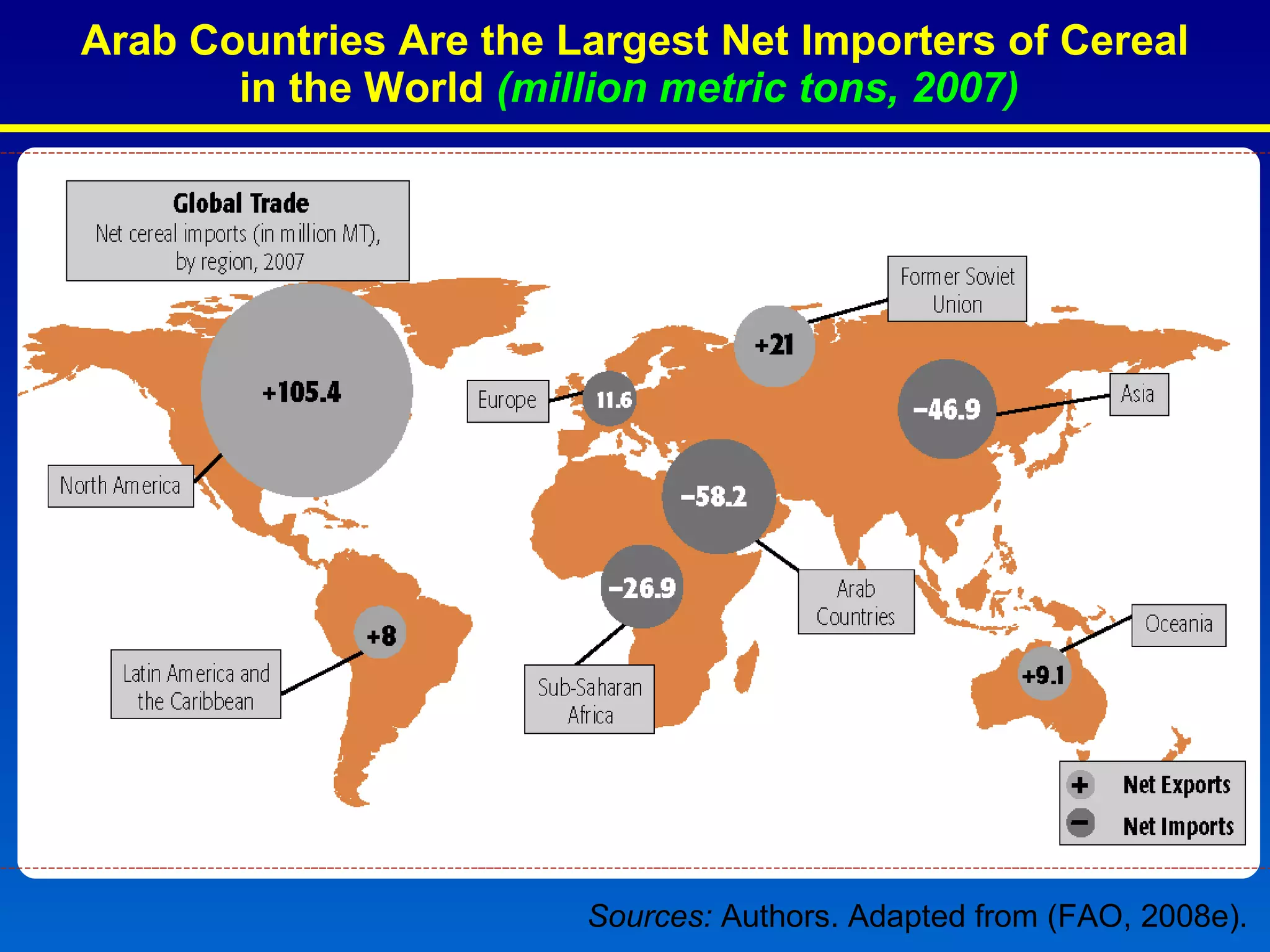
Arab Countries Are the Largest Net Importers of Cereal in the World   (million metric tons, 2007)   Sources:  Authors. Adapted from (FAO, 2008e).
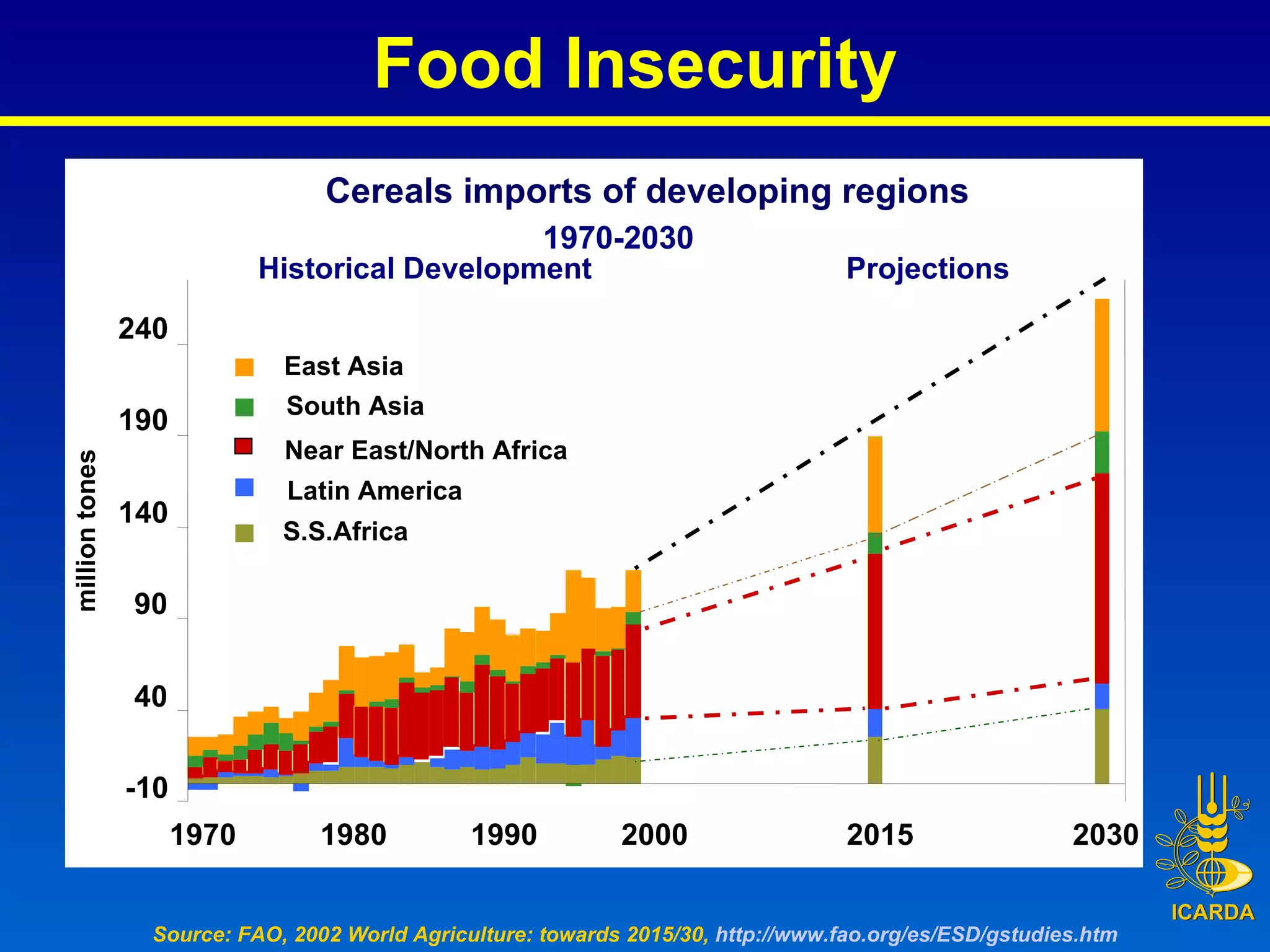
1970-2030 -10 40 90 140 190 240 1970 1980 1990 2000 2015 2030 million tones East Asia South Asia Near East/North Africa Latin America S.S.Africa Historical Development Projections Cereals imports of developing regions Food Insecurity Source: FAO, 2002  World Agriculture: towards 2015/30,   http://www.fao.org/es/ESD/gstudies.htm
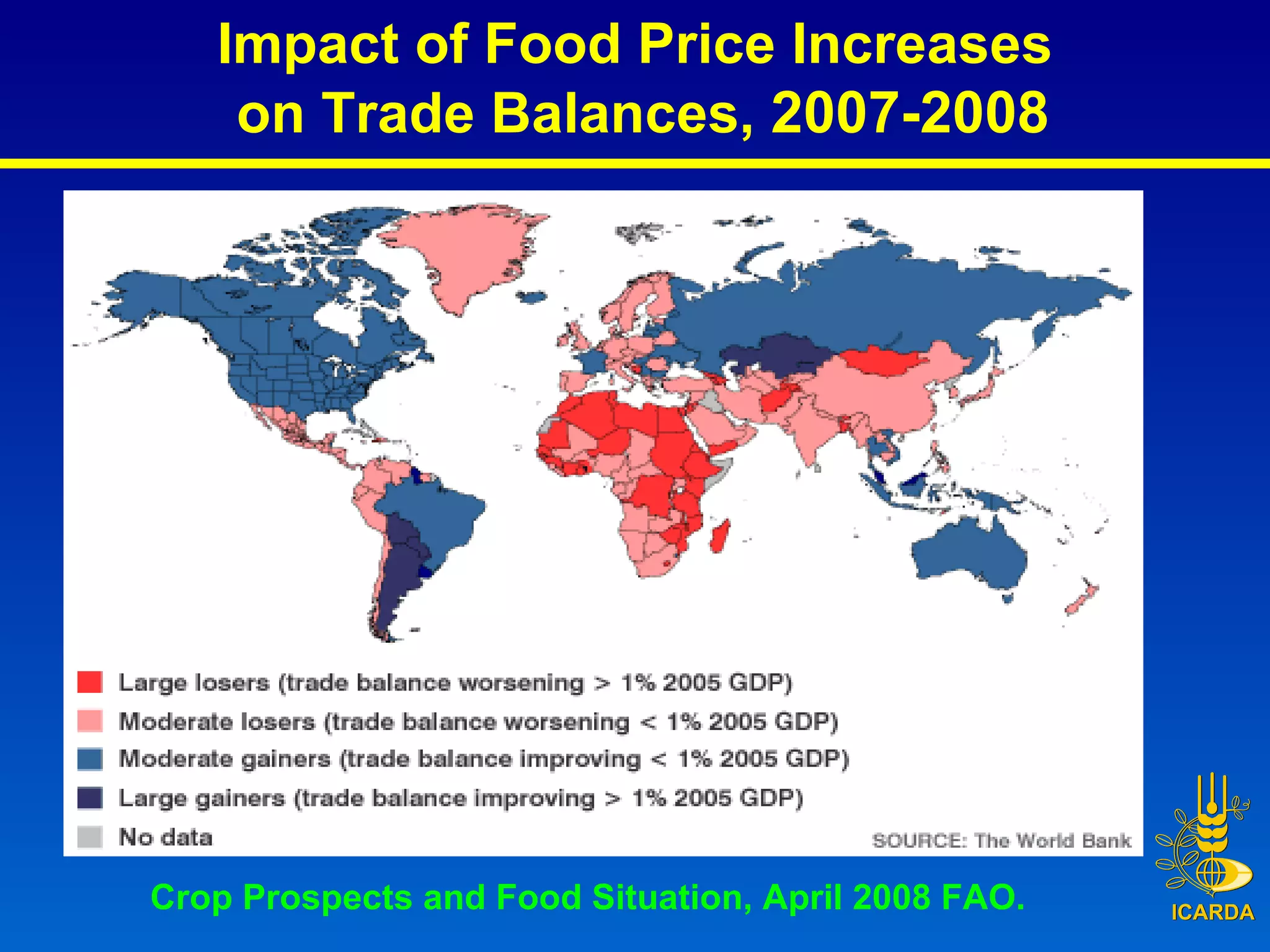
Crop Prospects and Food Situation, April 2008 FAO.   Impact of Food Price Increases on Trade Balances,  2007-2008
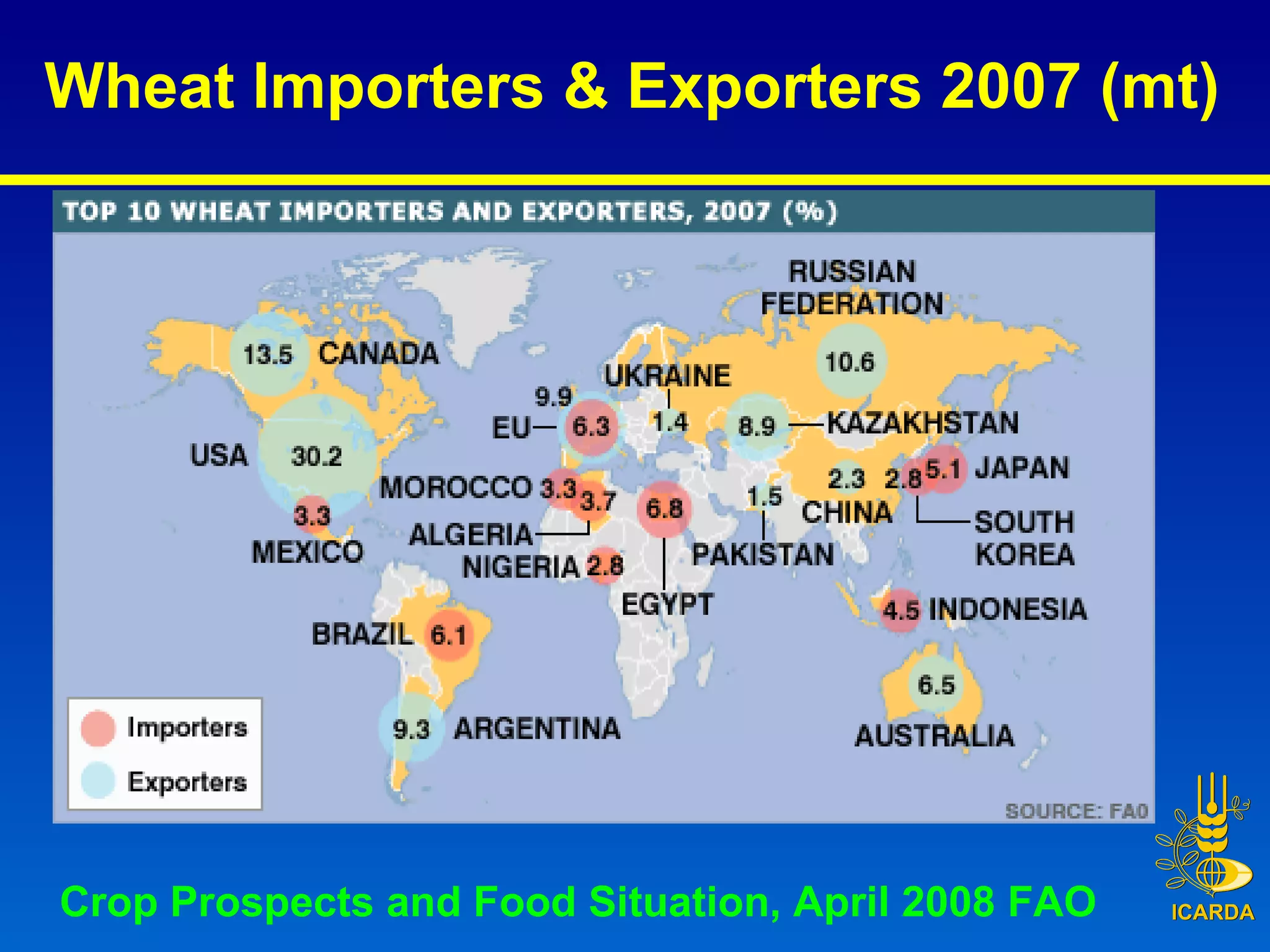
Crop Prospects and Food Situation, April 2008 FAO Wheat Importers & Exporters 2007 (mt)
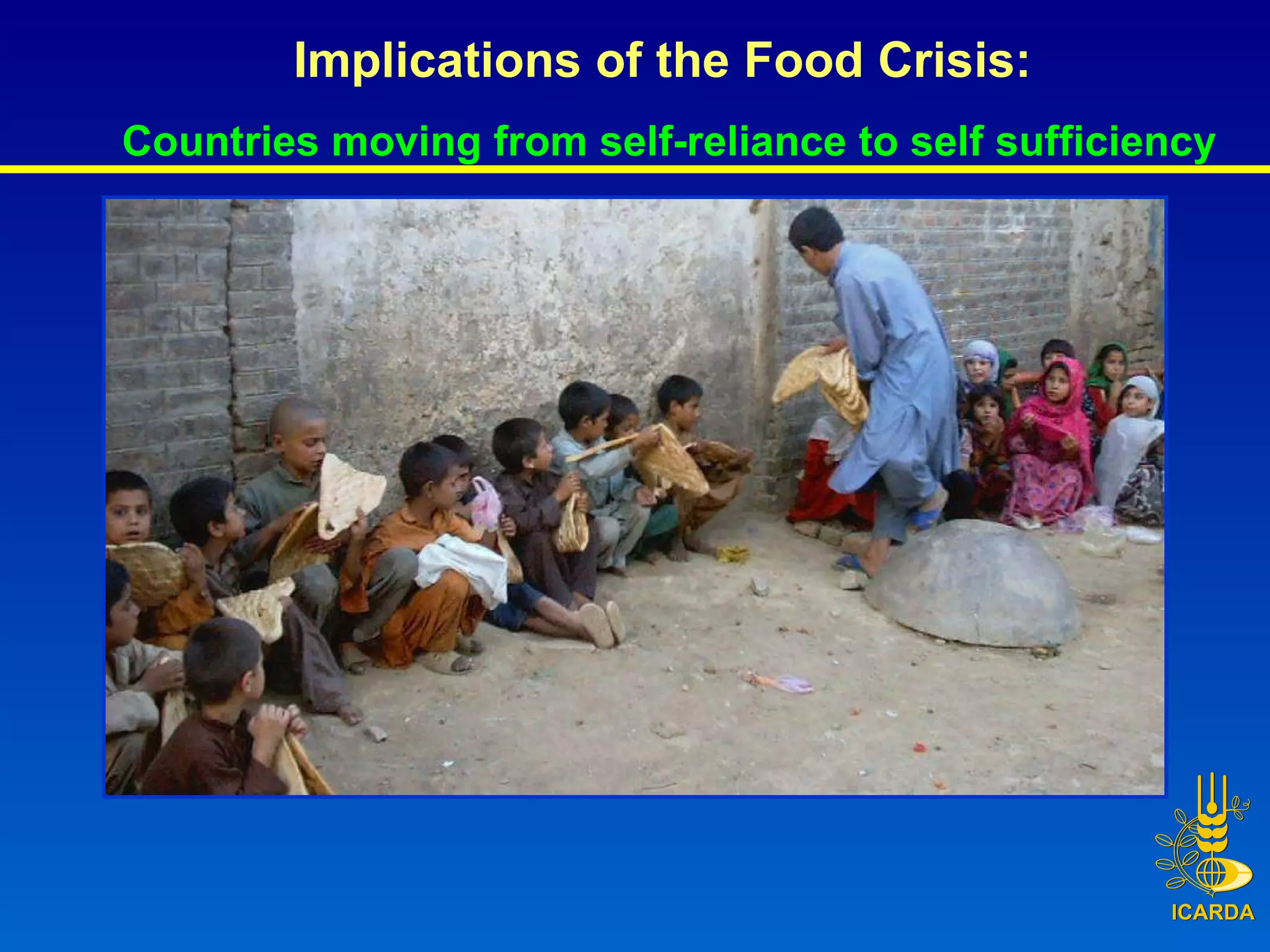
Implications of the Food Crisis:  Countries moving from self-reliance to self sufficiency
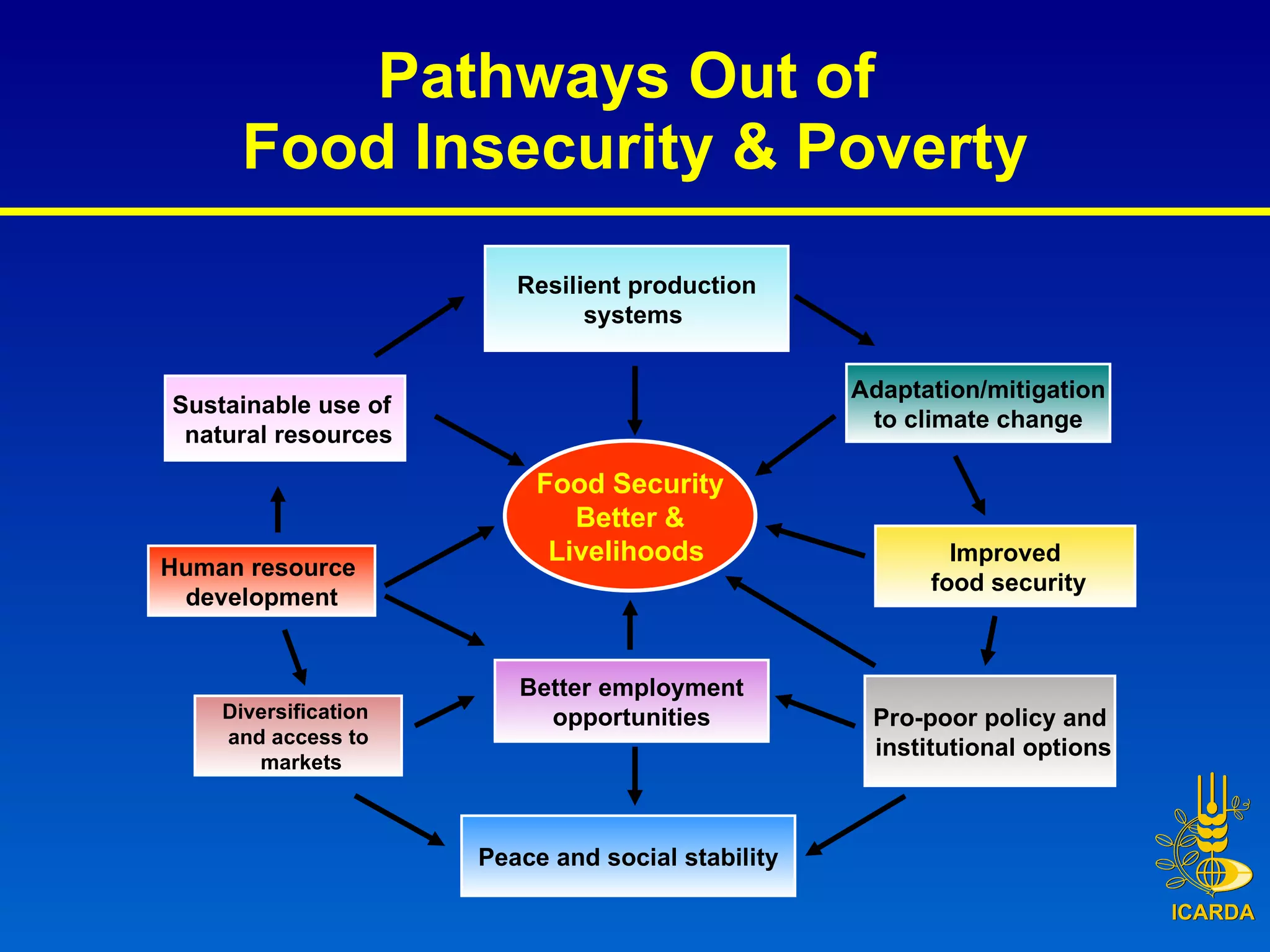
Pathways Out of  Food Insecurity & Poverty Better employment opportunities Peace and social stability Pro-poor policy and institutional options Adaptation/mitigation to climate change Diversification  and access to markets Human resource  development Improved food security Food Security & Better Livelihoods Resilient production systems Sustainable use of  natural resources
What can make a difference?
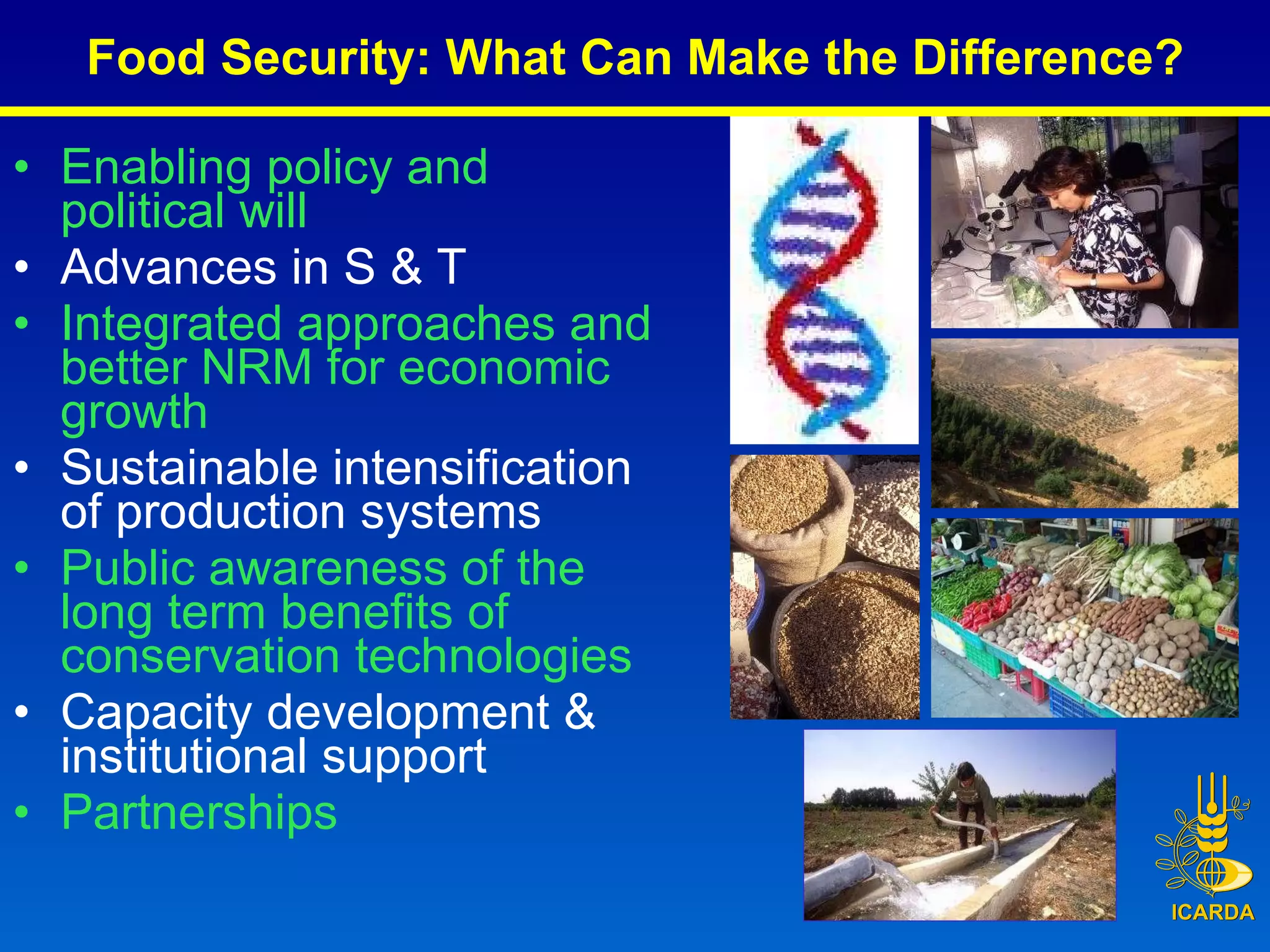
Food Security: What Can Make the Difference? Enabling policy and political will Advances in S & T Integrated approaches and better NRM for economic growth Sustainable intensification of production systems Public awareness of the long term benefits of conservation technologies Capacity development & institutional support Partnerships
ICARDA Strategic Plan 2007-2016:  Agricultural Research for Development in Dry Areas.
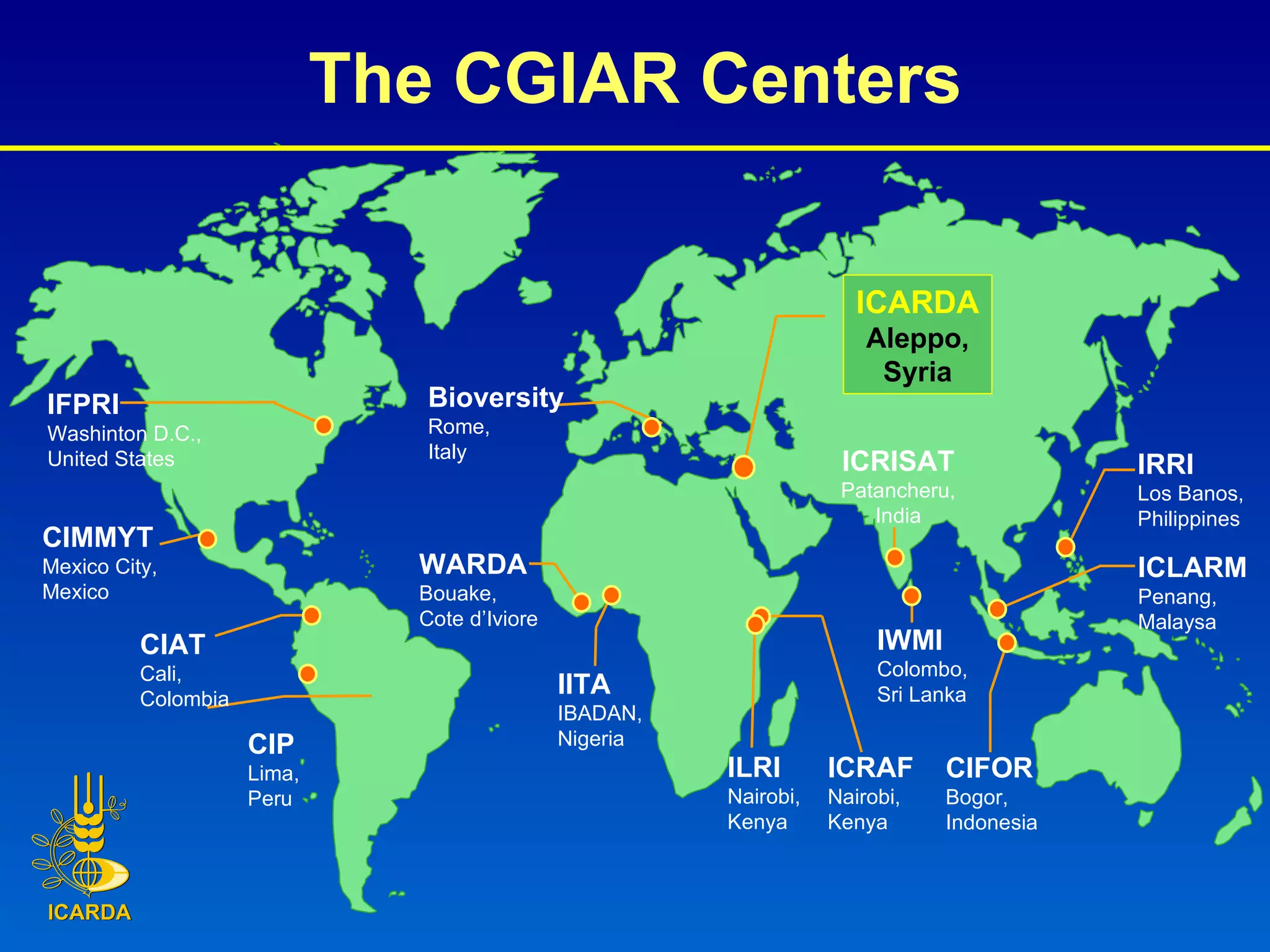
IWMI Colombo, Sri Lanka CIFOR Bogor, Indonesia ICLARM Penang, Malaysa IRRI Los Banos, Philippines ICRISAT Patancheru, India ICRAF Nairobi, Kenya ILRI Nairobi, Kenya IITA IBADAN, Nigeria WARDA Bouake, Cote d’Iviore Bioversity Rome, Italy CIP Lima, Peru CIAT Cali, Colombia CIMMYT Mexico City, Mexico IFPRI Washinton D.C., United States ICARDA Aleppo, Syria The   CGIAR Centers
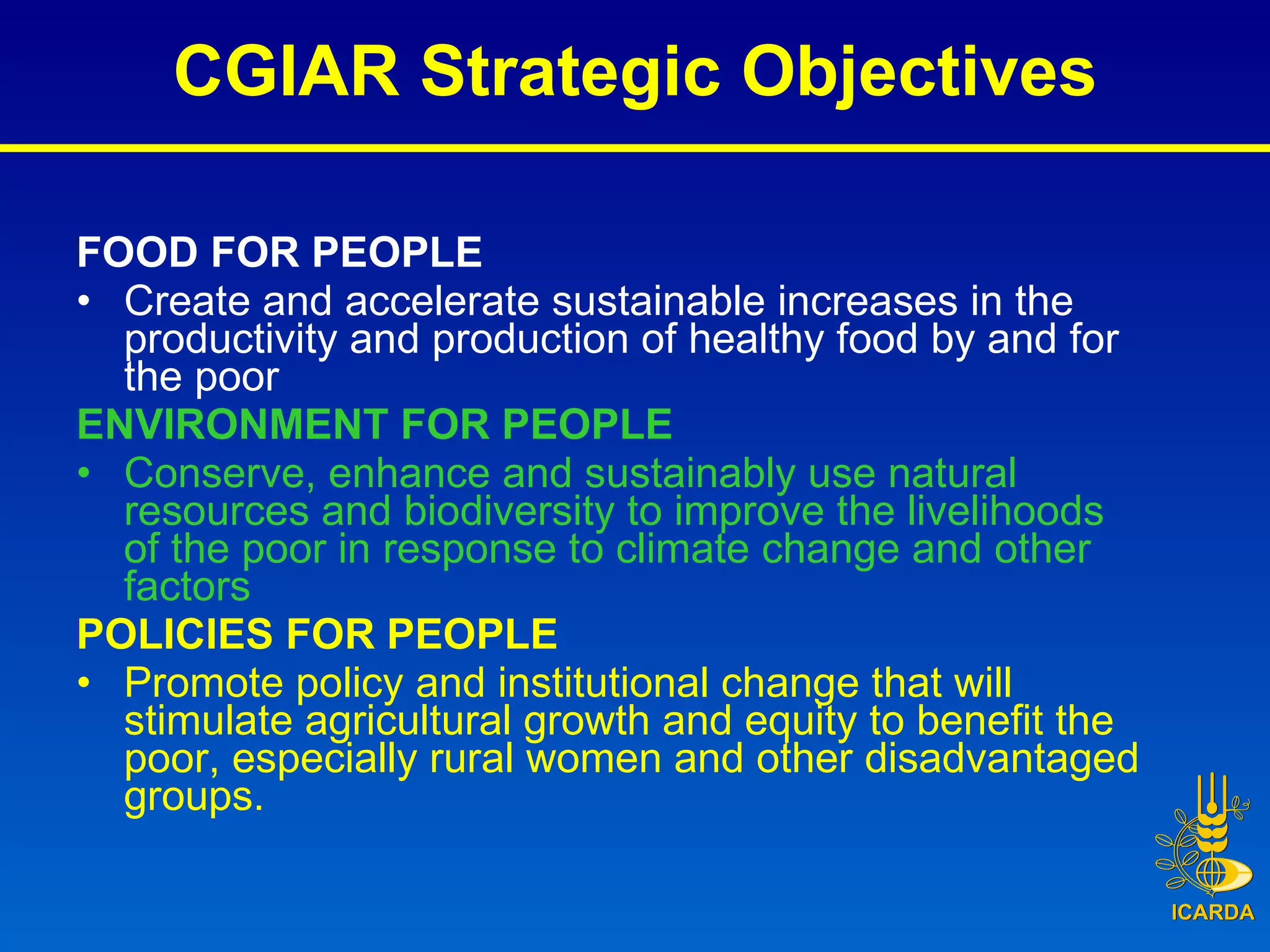
CGIAR Strategic Objectives FOOD FOR PEOPLE Create and accelerate sustainable increases in the productivity and production of healthy food by and for the poor ENVIRONMENT FOR PEOPLE Conserve, enhance and sustainably use natural resources and biodiversity to improve the livelihoods of the poor in response to climate change and other factors POLICIES FOR PEOPLE Promote policy and institutional change that will stimulate agricultural growth and equity to benefit the poor, especially rural women and other disadvantaged groups.
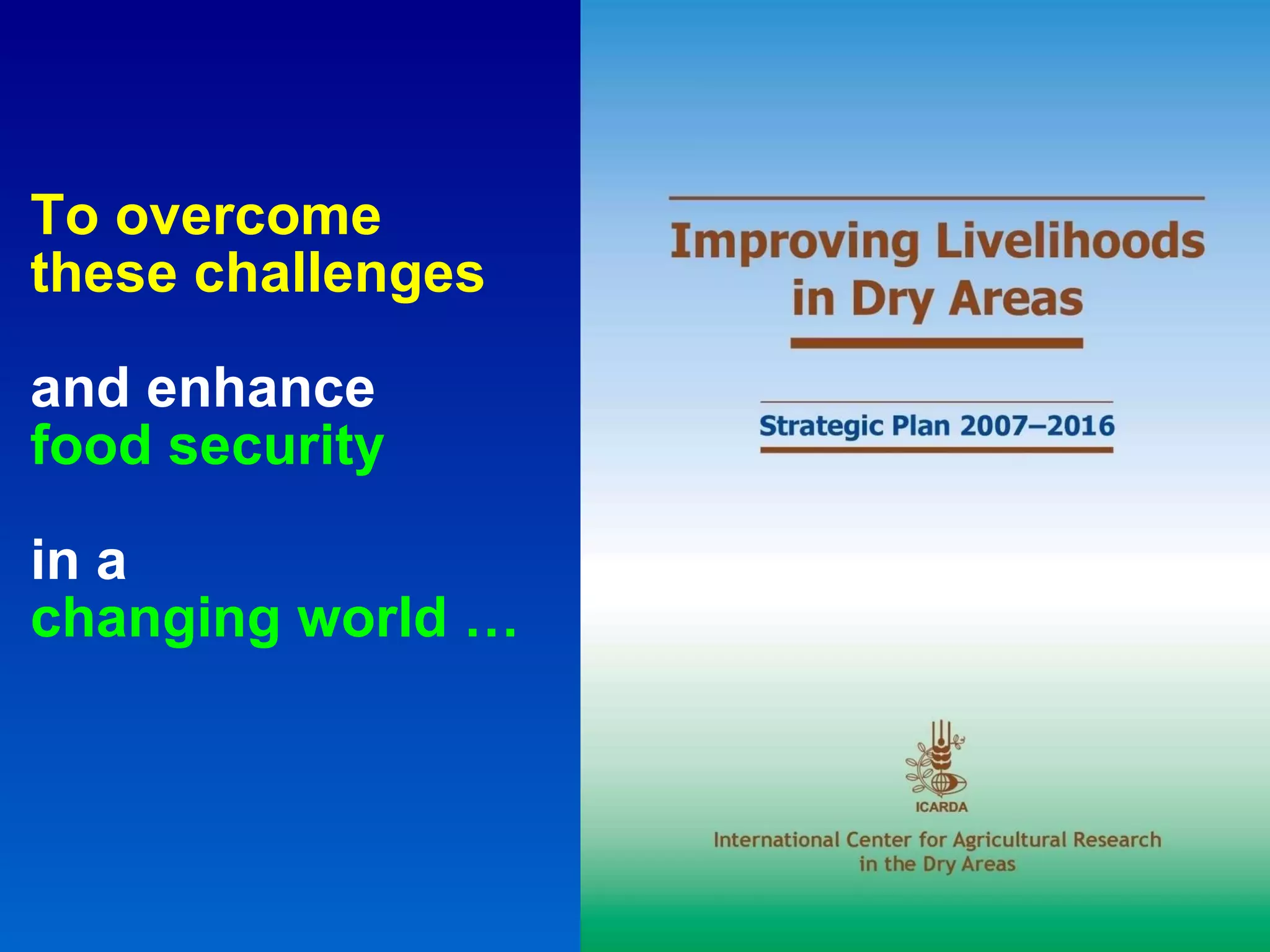
To overcome  these challenges   and enhance   food security in a changing world …
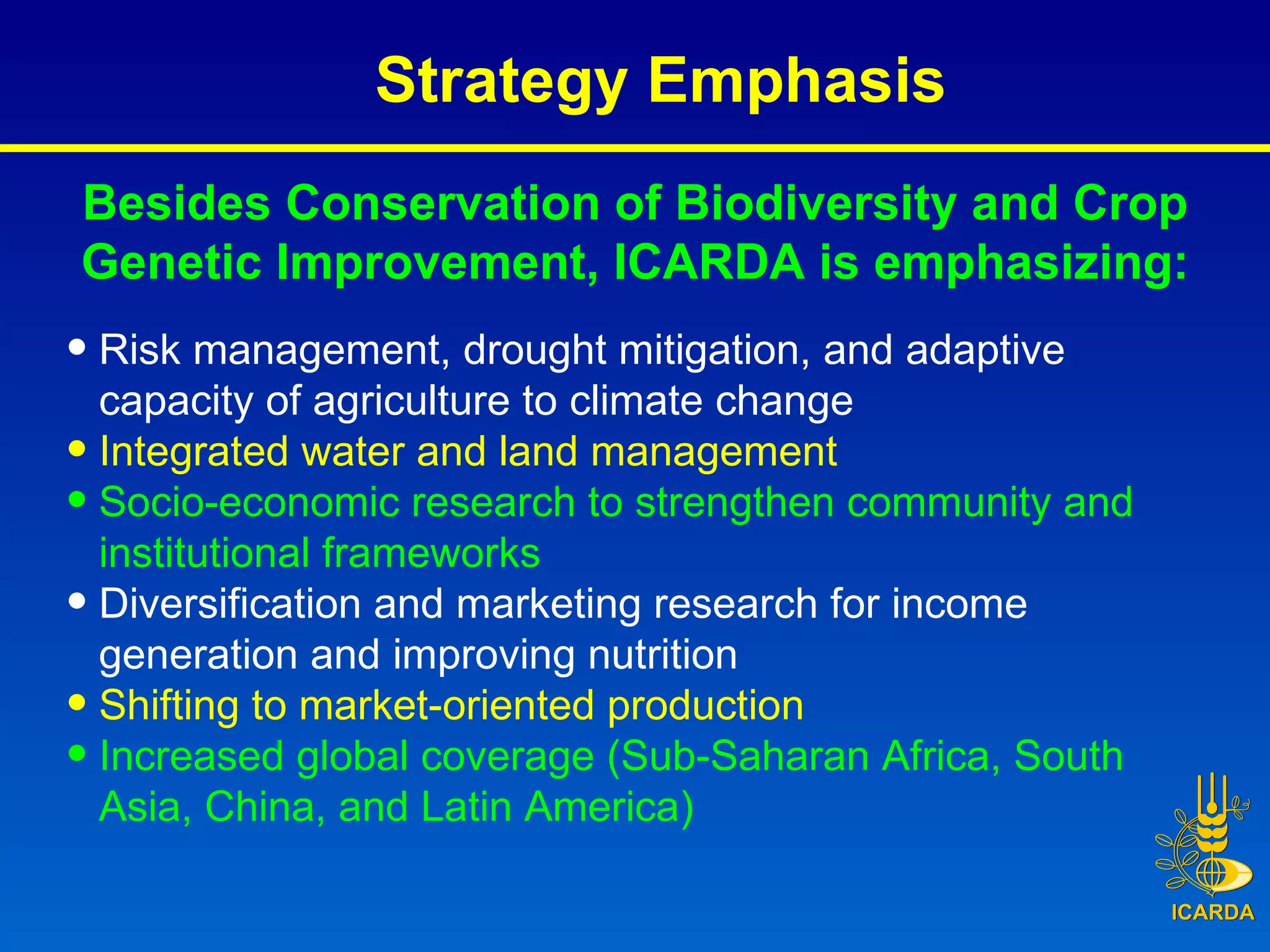
Besides Conservation of Biodiversity and Crop Genetic Improvement, ICARDA is emphasizing: Risk management, drought mitigation, and adaptive capacity of agriculture to climate change Integrated water and land management Socio-economic research to strengthen community and institutional frameworks Diversification and marketing research for income generation and improving nutrition Shifting to market-oriented production  Increased global coverage (Sub-Saharan Africa, South Asia, China, and Latin America) Strategy Emphasis
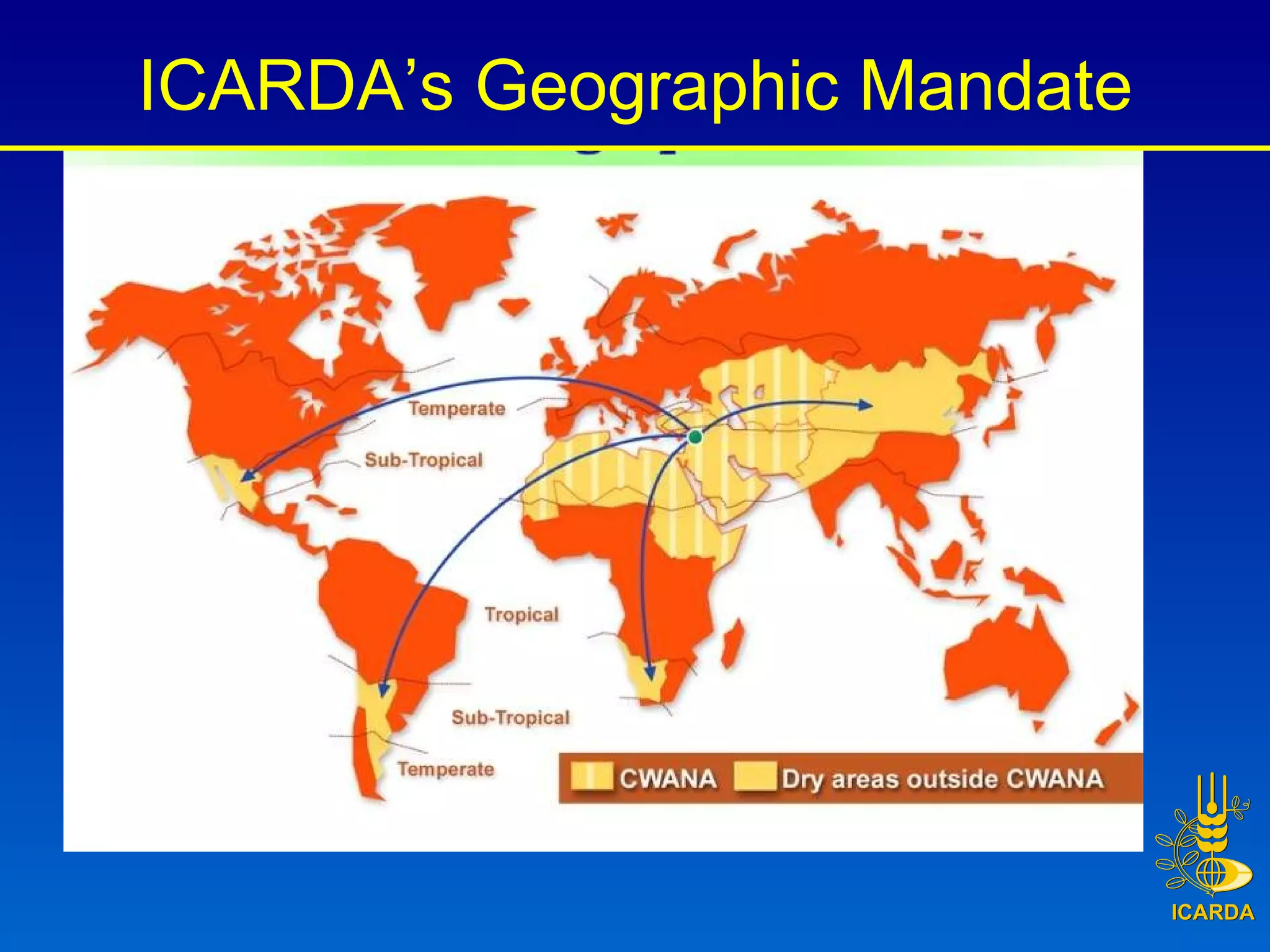
ICARDA’s Geographic Mandate
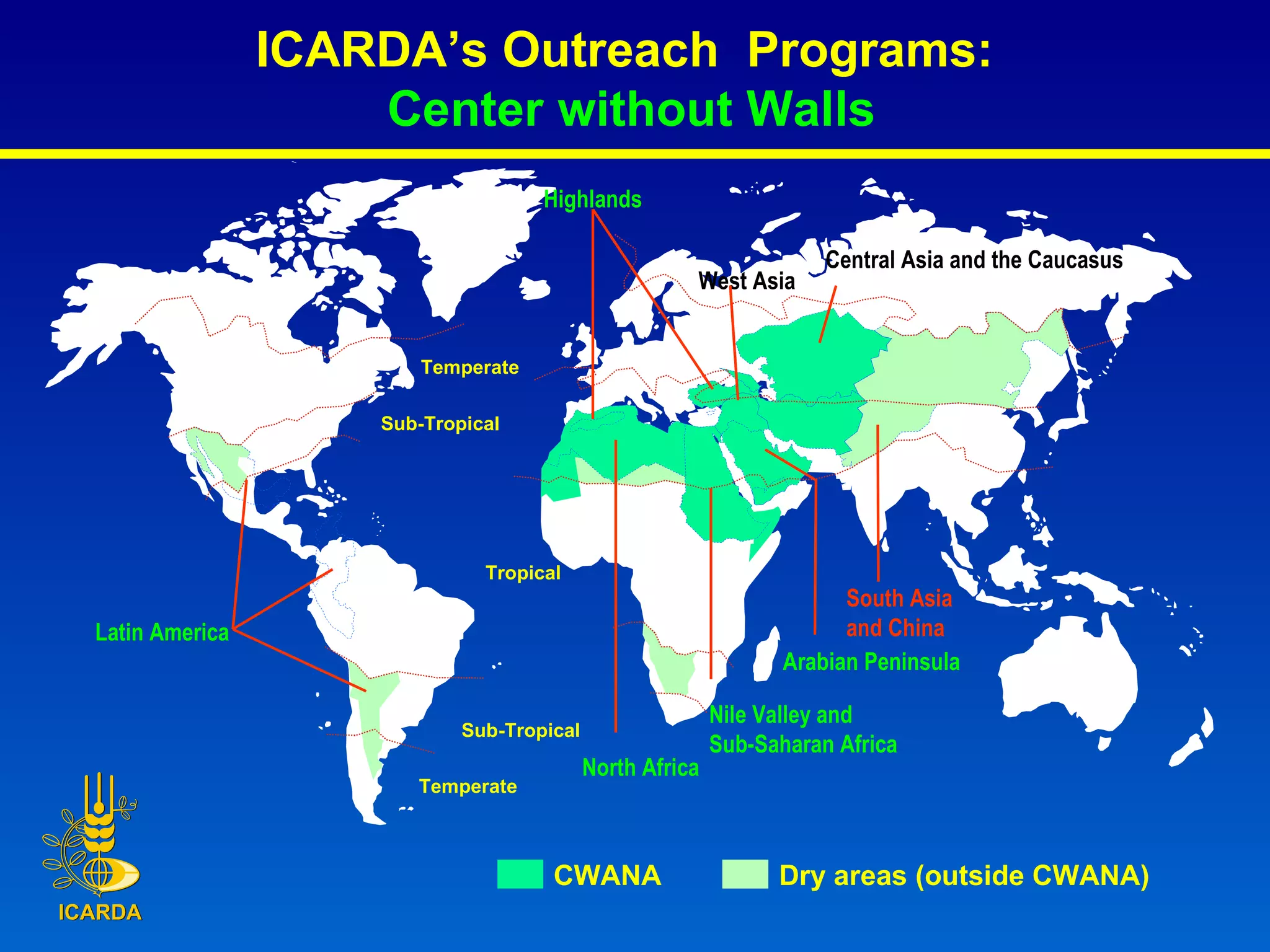
CWANA   Dry areas (outside CWANA) Temperate Temperate Sub-Tropical Sub-Tropical Tropical Latin America Nile Valley and Sub-Saharan Africa North Africa West Asia Arabian Peninsula South Asia  and China Highlands Central Asia and the Caucasus ICARDA’s Outreach  Programs: Center without Walls
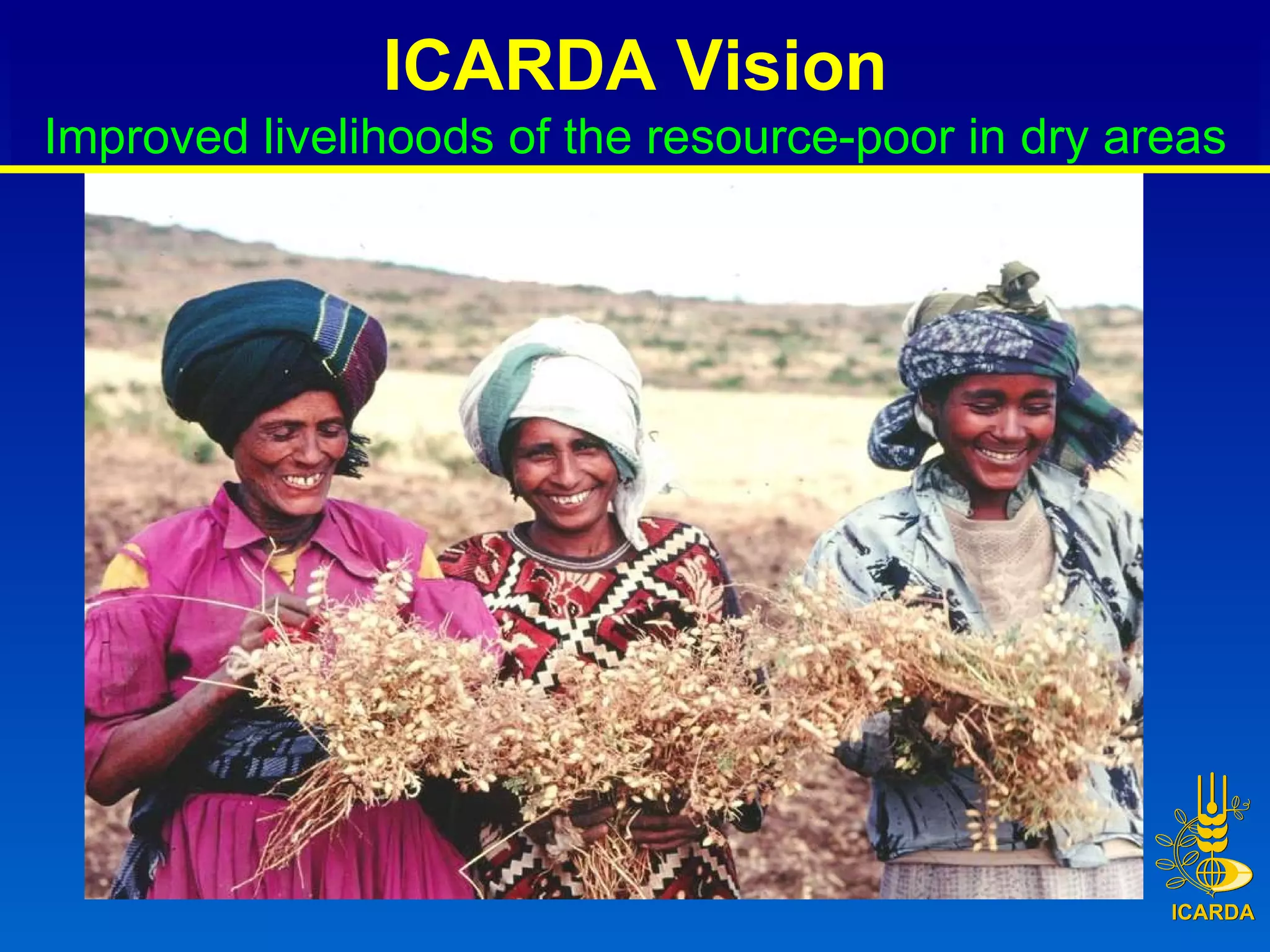
ICARDA Vision Improved livelihoods of the resource-poor in dry areas
ICARDA’s Mission “ To contribute to the improvement of livelihoods of the resource poor in dry areas by enhancing food security and alleviating poverty through research and partnerships to achieve sustainable increases in agricultural productivity and income, while ensuring the efficient and more equitable use and conservation of natural resources.”
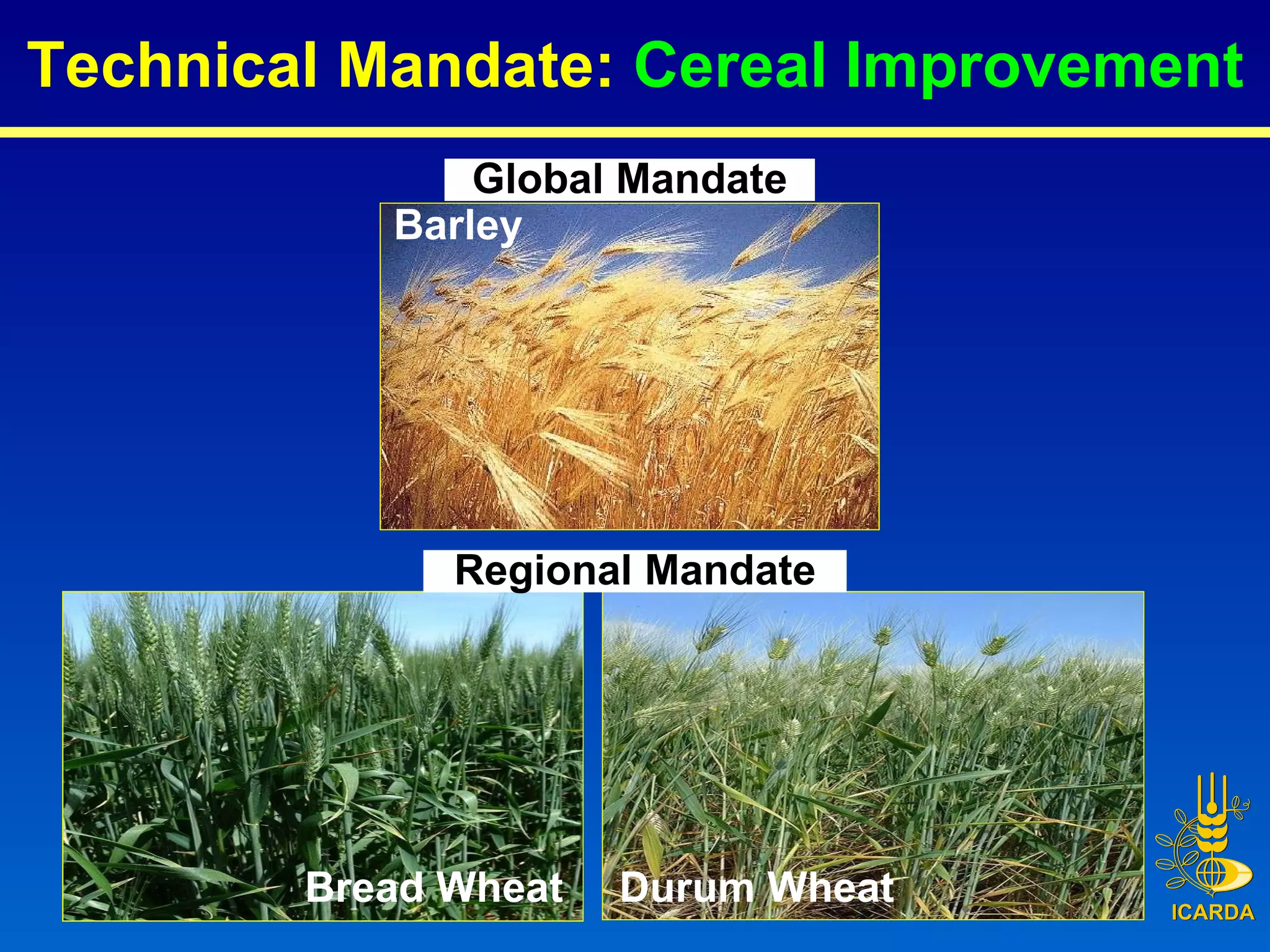
Technical Mandate:  Cereal Improvement Barley Global Mandate Bread Wheat Durum Wheat Regional Mandate
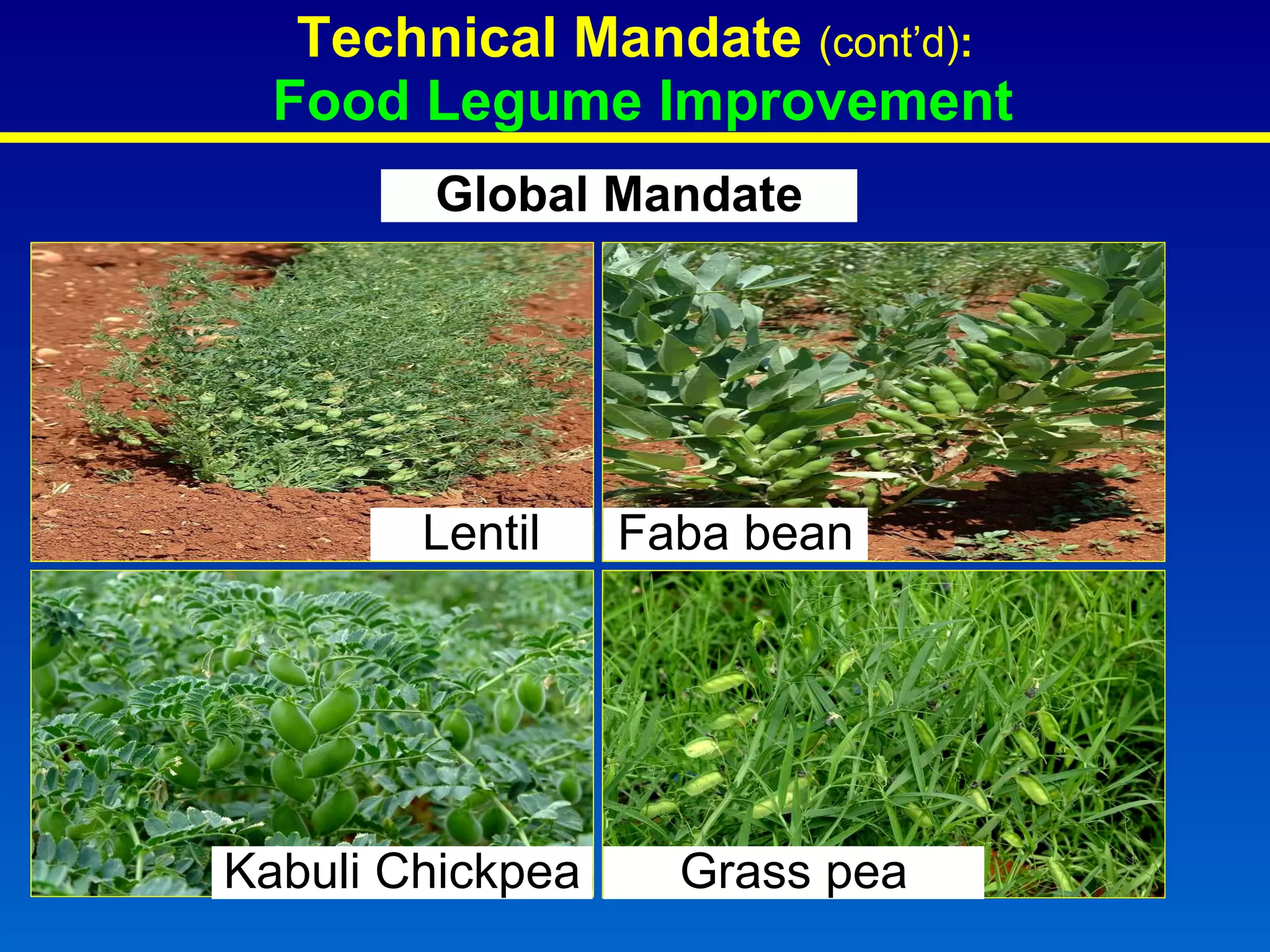
Technical Mandate  (cont’d) :   Food Legume Improvement Global Mandate Lentil Kabuli Chickpea Grass pea Faba bean
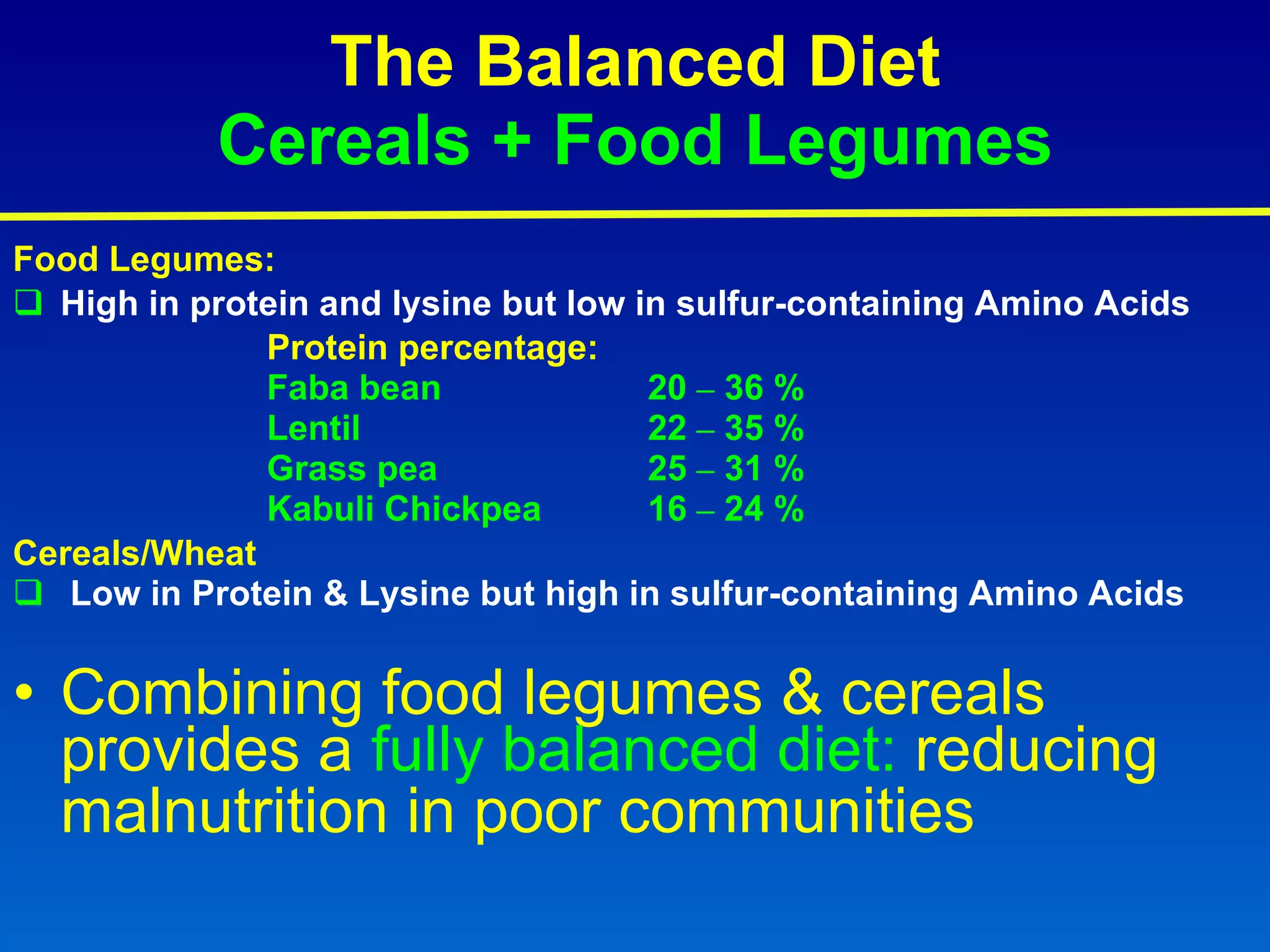
The Balanced Diet Cereals + Food Legumes Food Legumes: High in protein and lysine but low in sulfur-containing Amino Acids  Protein percentage:   Faba bean 20  –  36 % Lentil 22  –  35 % Grass pea 25  –  31 % Kabuli Chickpea 16  –  24 % Cereals/Wheat Low in Protein & Lysine but high in sulfur-containing Amino Acids   Combining food legumes & cereals provides a  fully balanced diet:  reducing malnutrition in poor communities
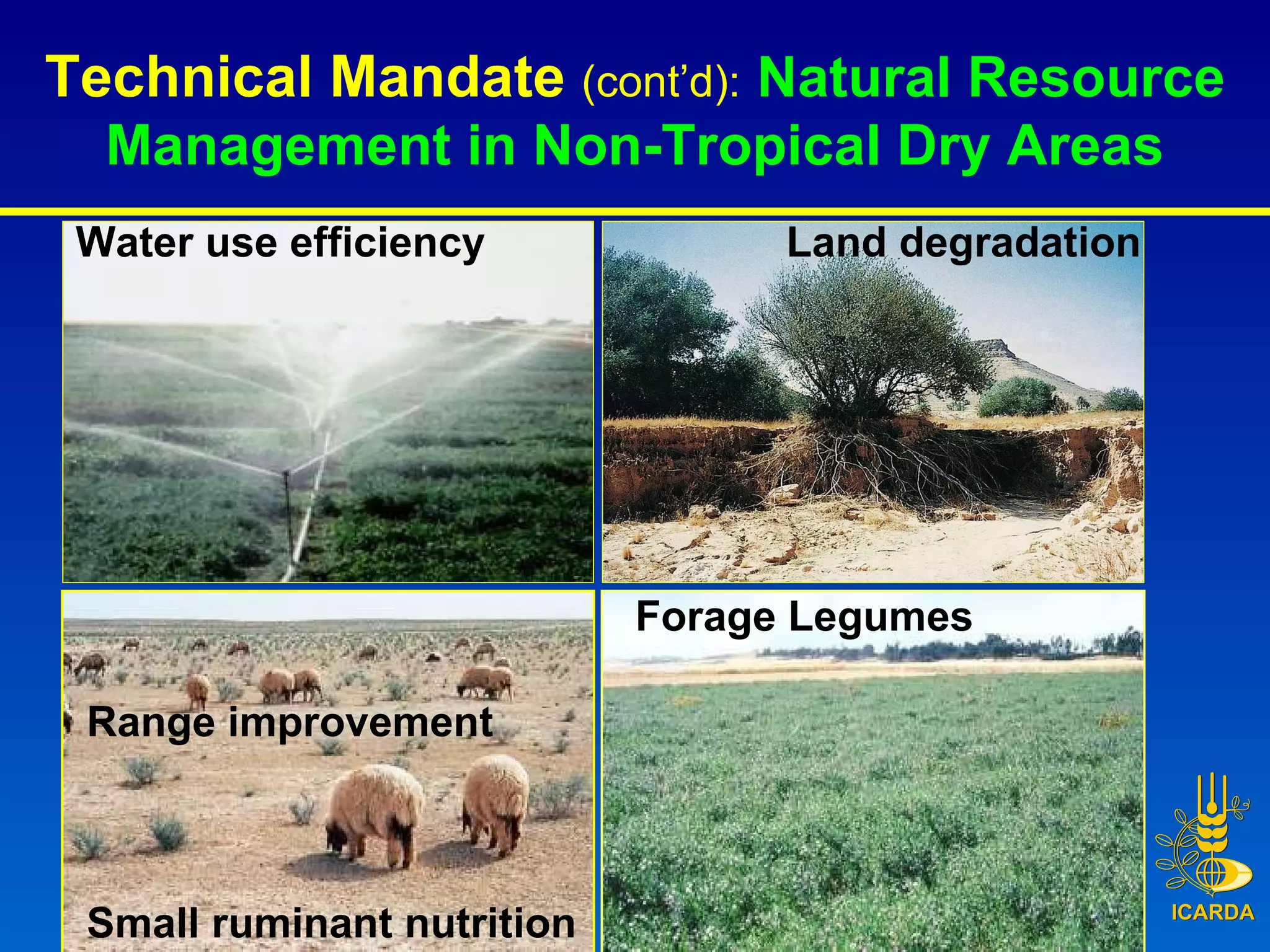
Technical Mandate  (cont’d):   Natural Resource Management in Non-Tropical Dry Areas Range improvement Forage Legumes Water use efficiency Land degradation Small ruminant nutrition
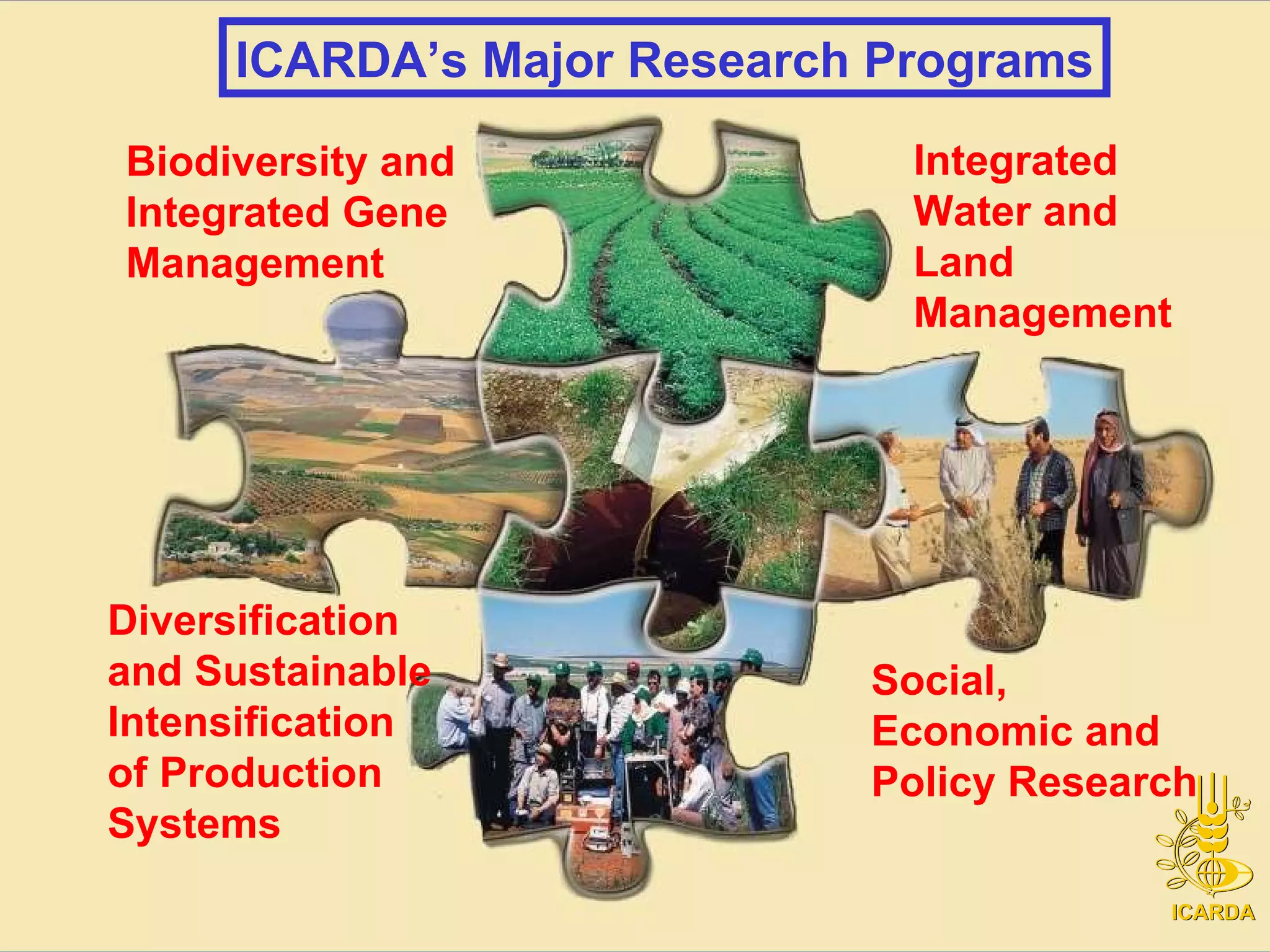
ICARDA’s Major Research Programs Biodiversity and Integrated Gene Management Integrated Water and Land Management Diversification and Sustainable Intensification of Production Systems Social, Economic and Policy Research
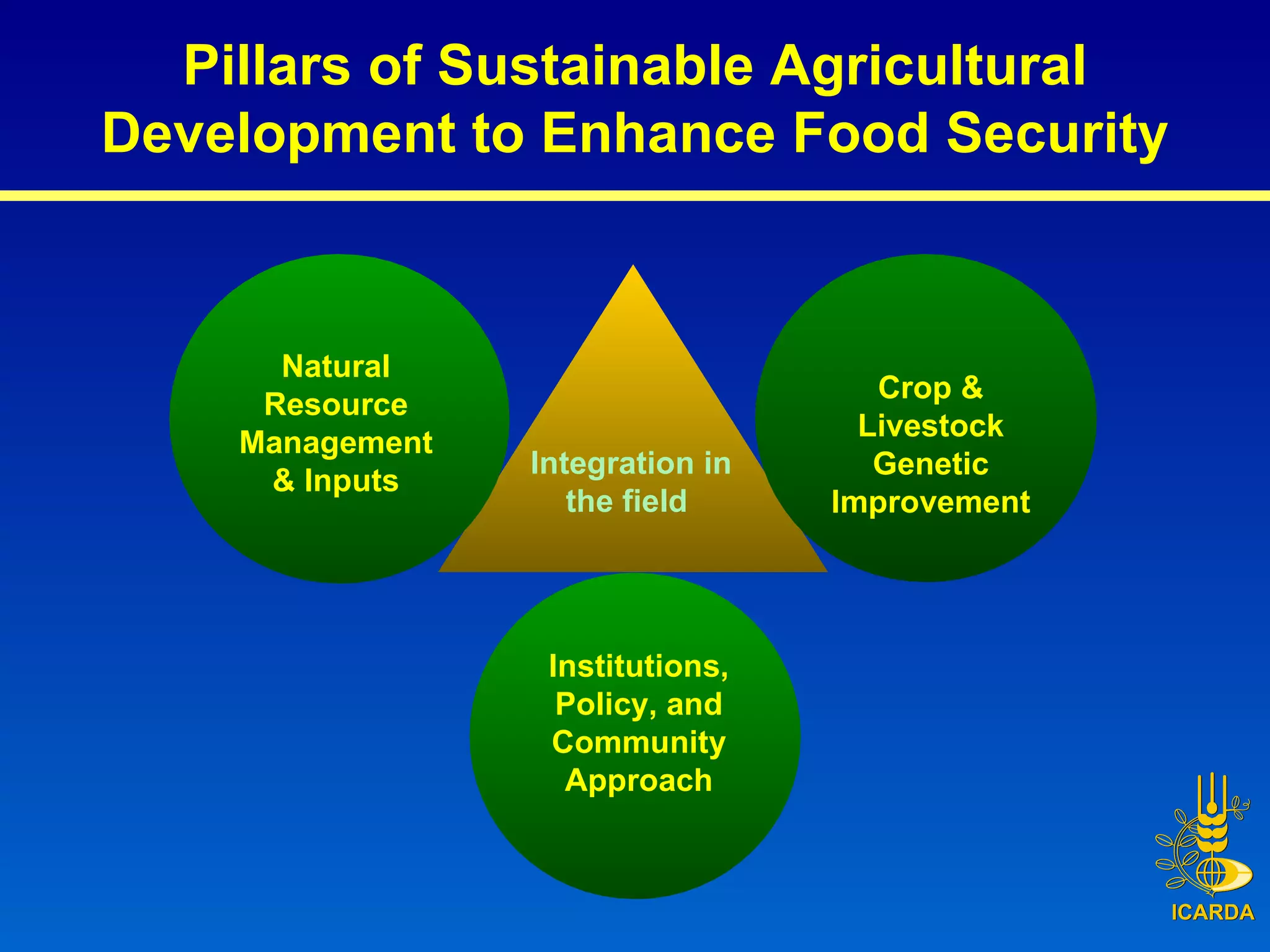
Pillars of Sustainable Agricultural Development to Enhance Food Security Integration in the field  Institutions, Policy, and Community Approach Natural Resource Management& Inputs Crop & Livestock Genetic Improvement
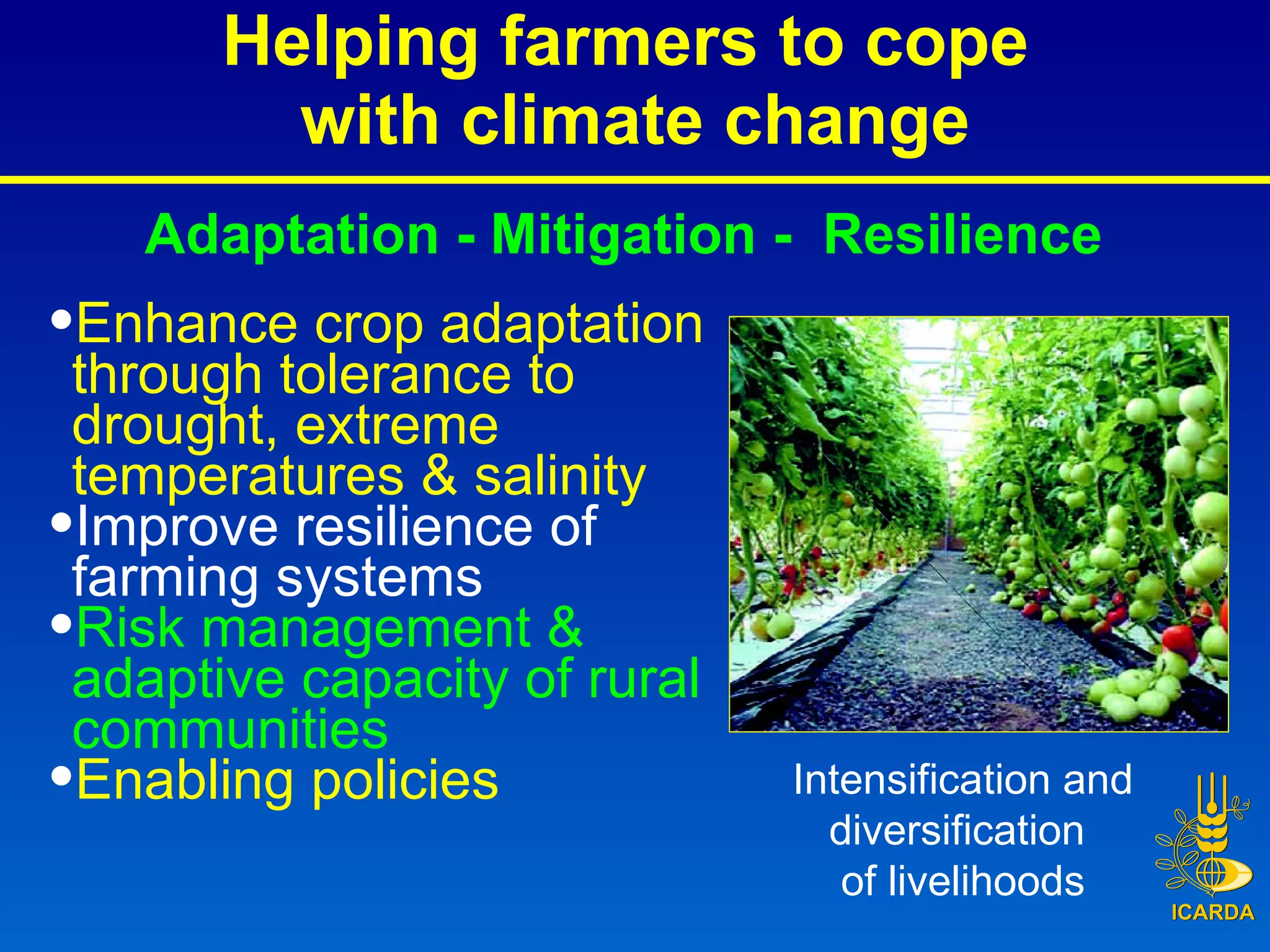
Helping farmers to cope  with climate change Intensification and diversification  of livelihoods Enhance crop adaptation through tolerance to drought, extreme temperatures & salinity Improve resilience of farming systems Risk management &  adaptive capacity of rural communities Enabling policies Adaptation -   Mitigation -  Resilience
Research Outputs & Technologies towards food security & better livelihoods 1.  Improved Varieties
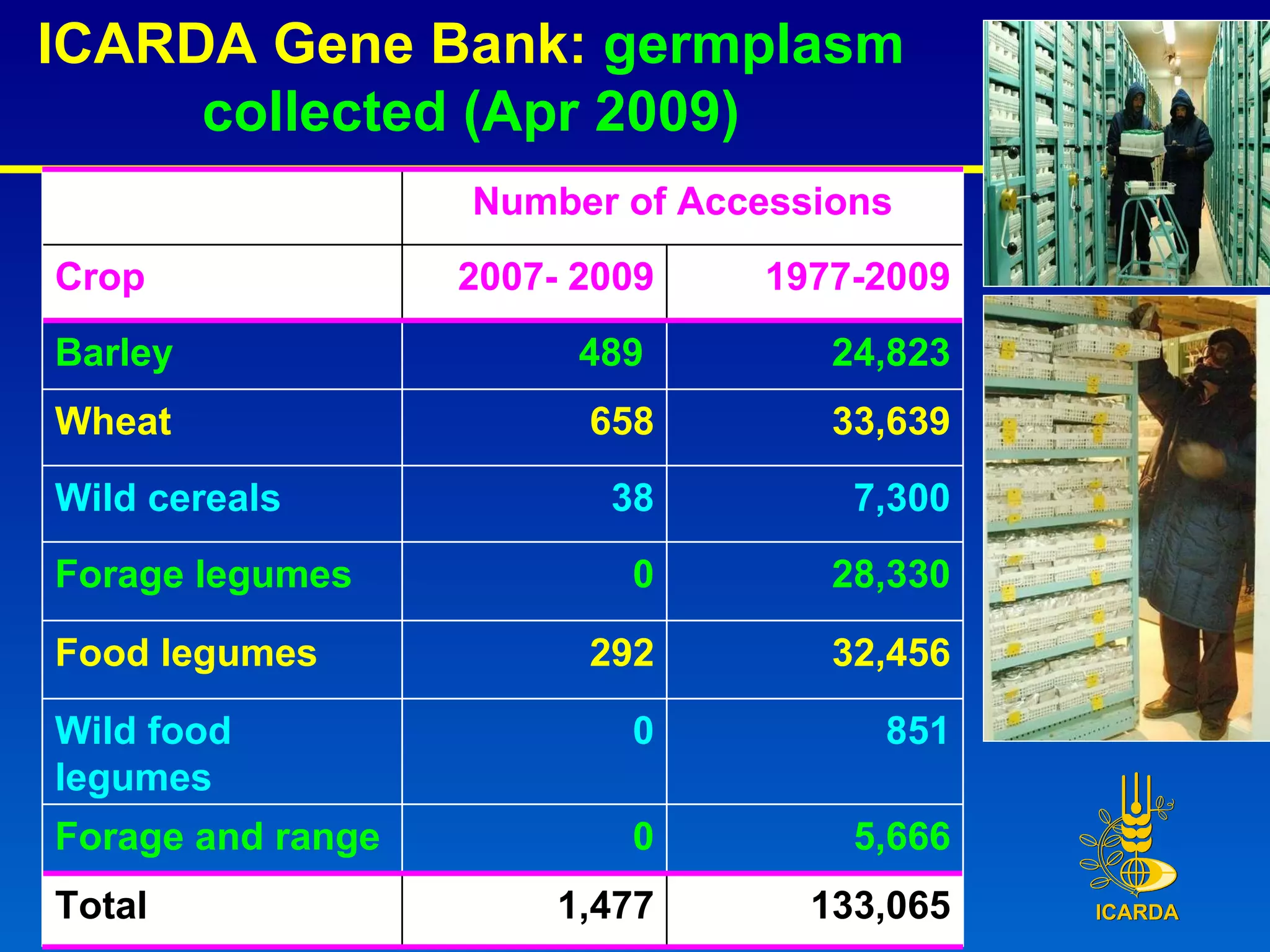
ICARDA Gene Bank:  germplasm collected (Apr 2009) Number of Accessions Crop 2007- 2009 1977-2009 Barley  489  24,823 Wheat 658 33,639 Wild cereals 38 7,300 Forage legumes 0 28,330 Food legumes 292 32,456 Wild food legumes 0 851 Forage and range 0 5,666 Total 1,477 133,065
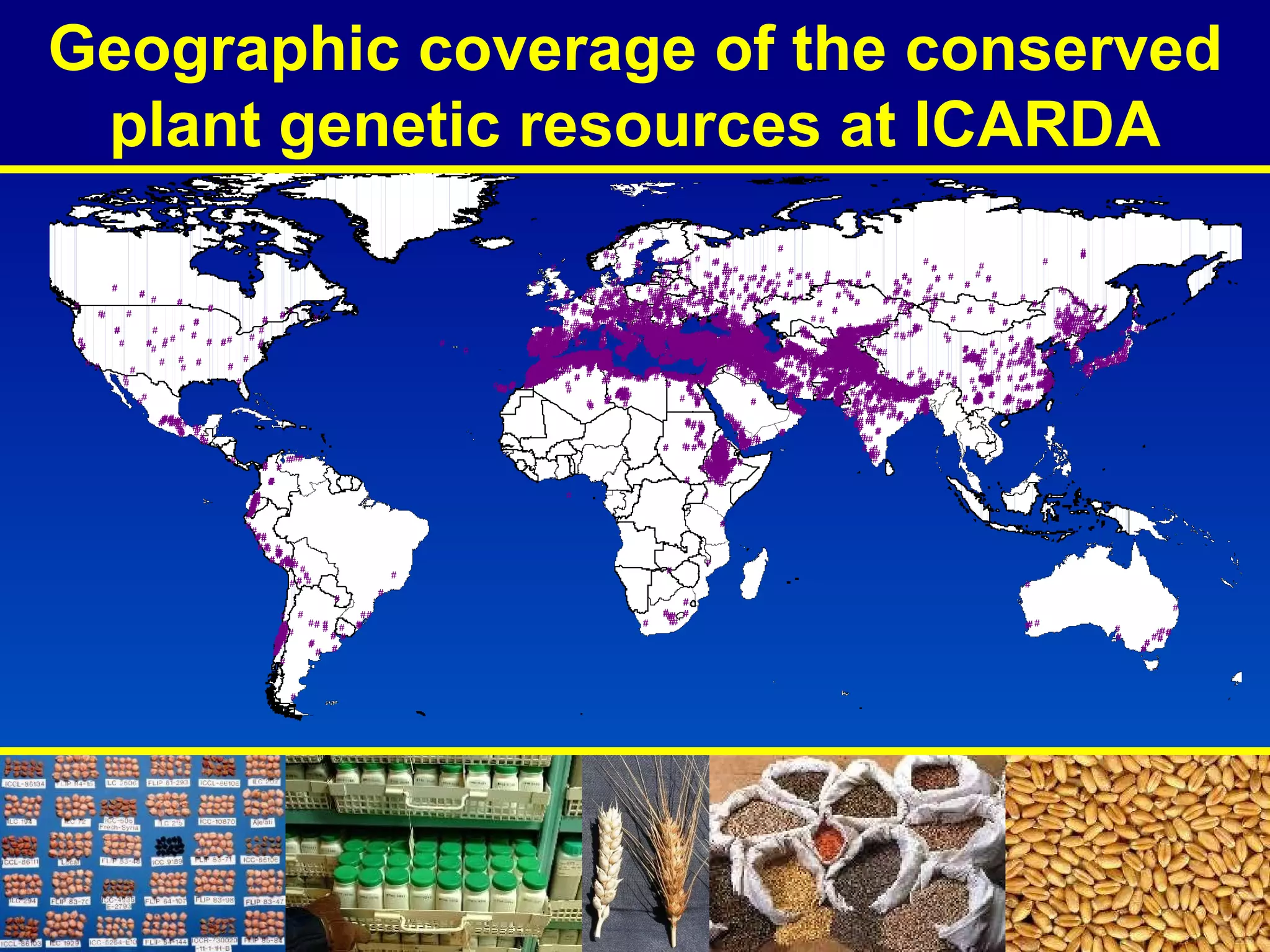
Geographic coverage of the conserved plant genetic resources at ICARDA
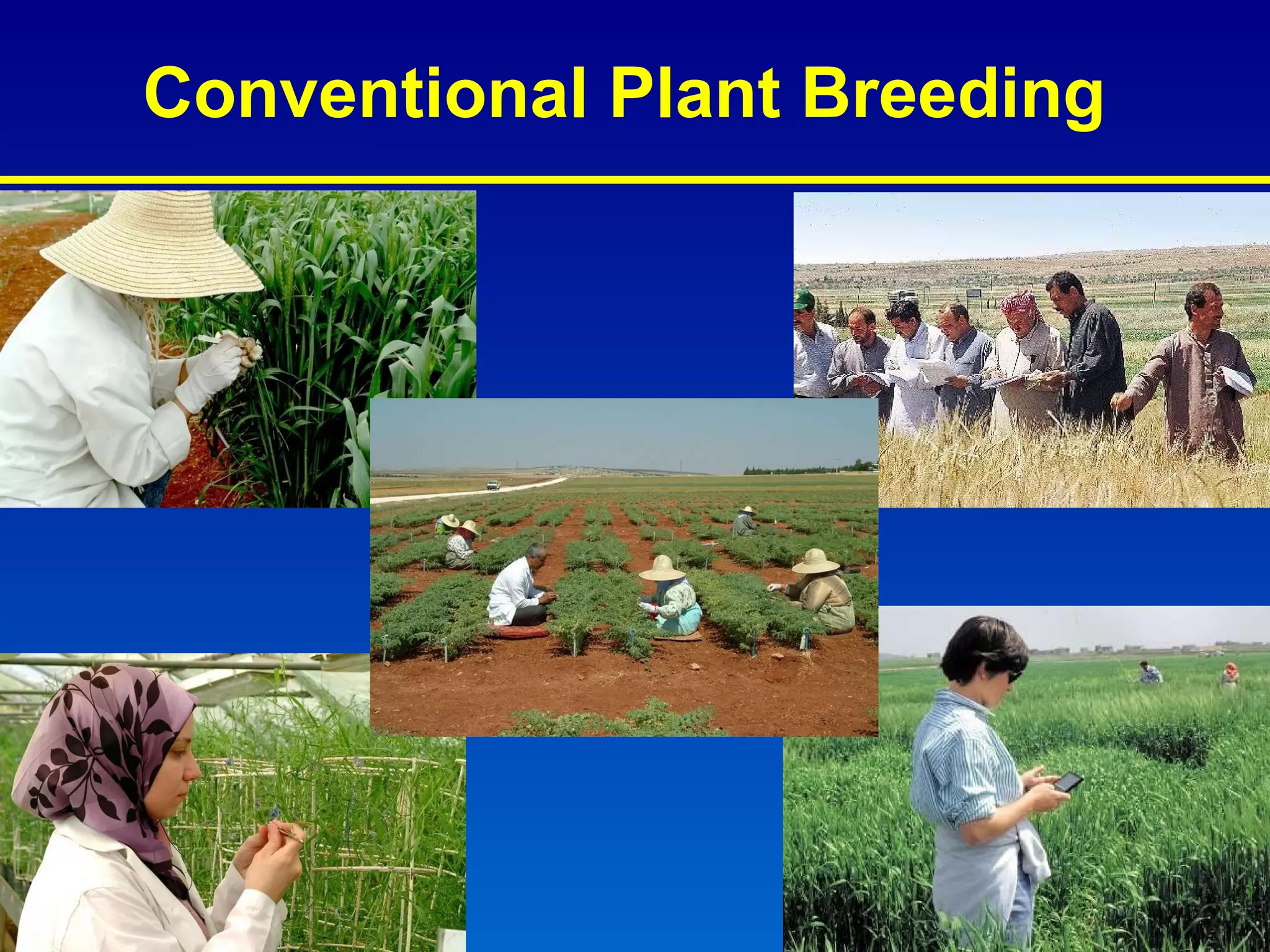
Conventional Plant Breeding
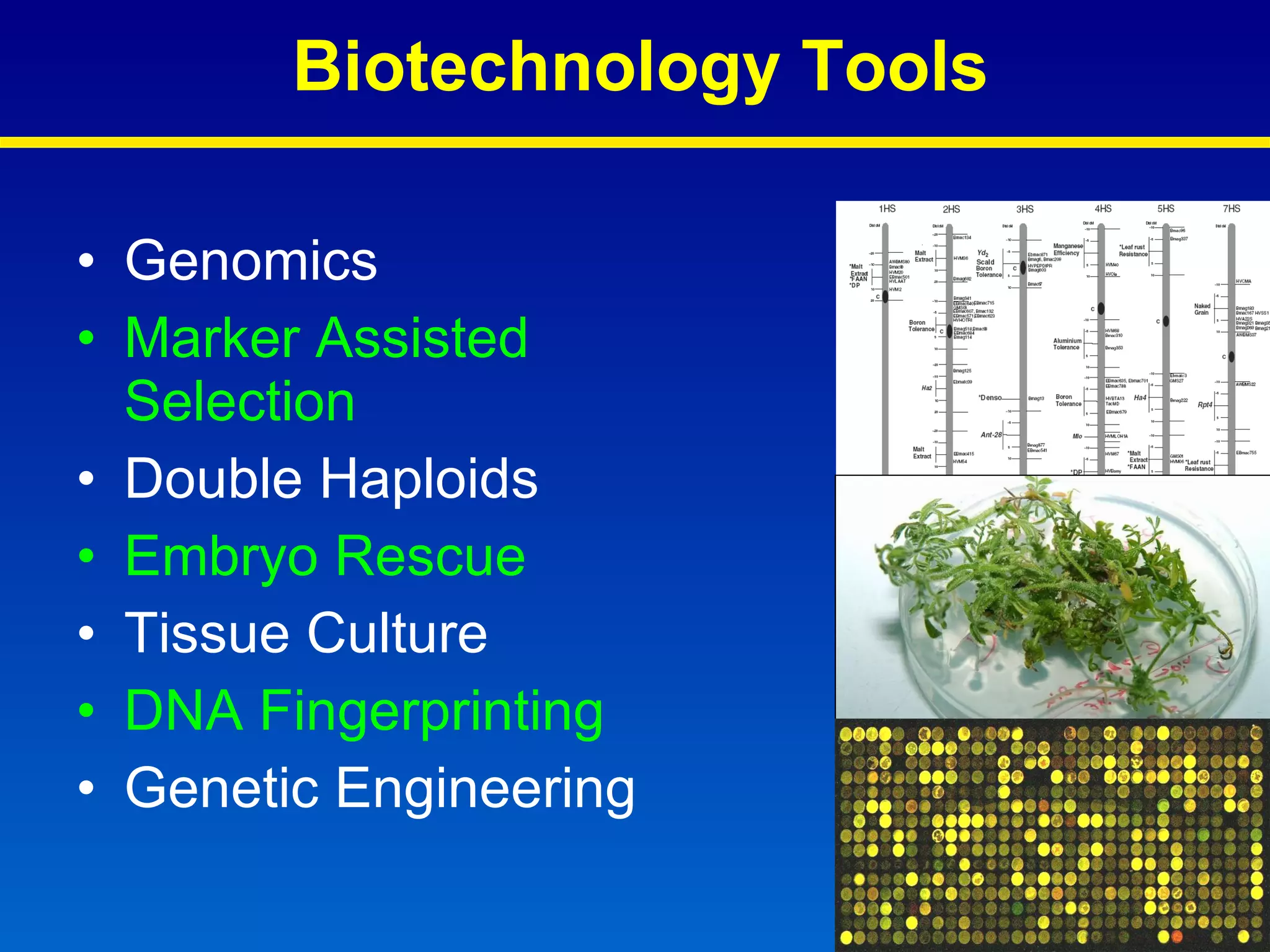
Genomics Marker Assisted Selection Double Haploids Embryo Rescue Tissue Culture DNA Fingerprinting Genetic Engineering Biotechnology Tools
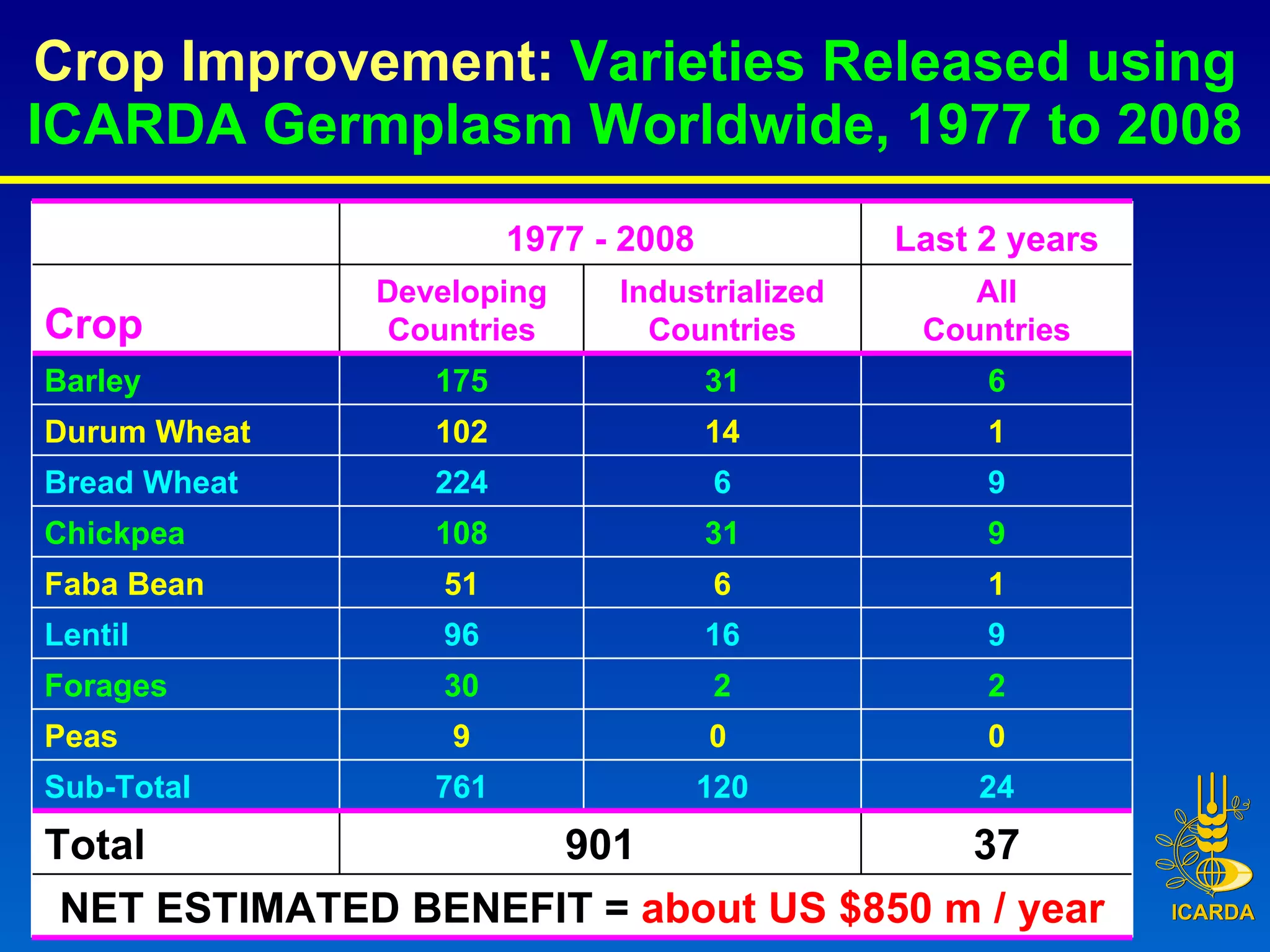
Crop Improvement:  Varieties Released using ICARDA Germplasm Worldwide, 1977 to 2008 1977 - 2008 Last 2 years Crop Developing Countries Industrialized Countries All Countries Barley 175 31 6 Durum Wheat 102 14 1 Bread Wheat 224 6 9 Chickpea 108 31 9 Faba Bean 51 6 1 Lentil 96 16 9 Forages 30 2 2 Peas 9 0  0 Sub-Total 761 120 24 Total 901 37 NET ESTIMATED BENEFIT   =  about US $850 m / year
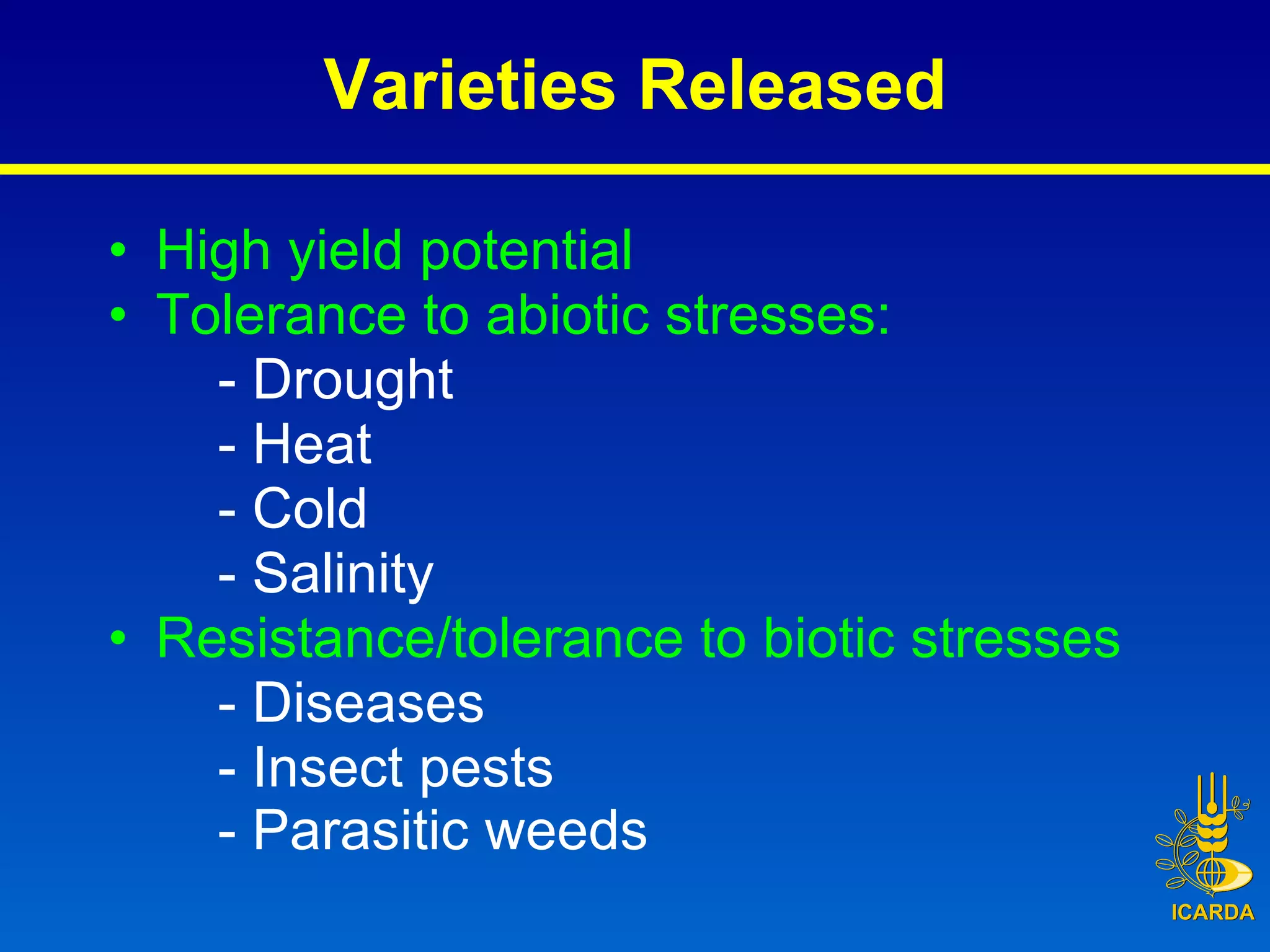
Varieties Released High yield potential Tolerance to abiotic stresses: - Drought - Heat - Cold - Salinity  Resistance/tolerance to biotic stresses - Diseases - Insect pests - Parasitic weeds
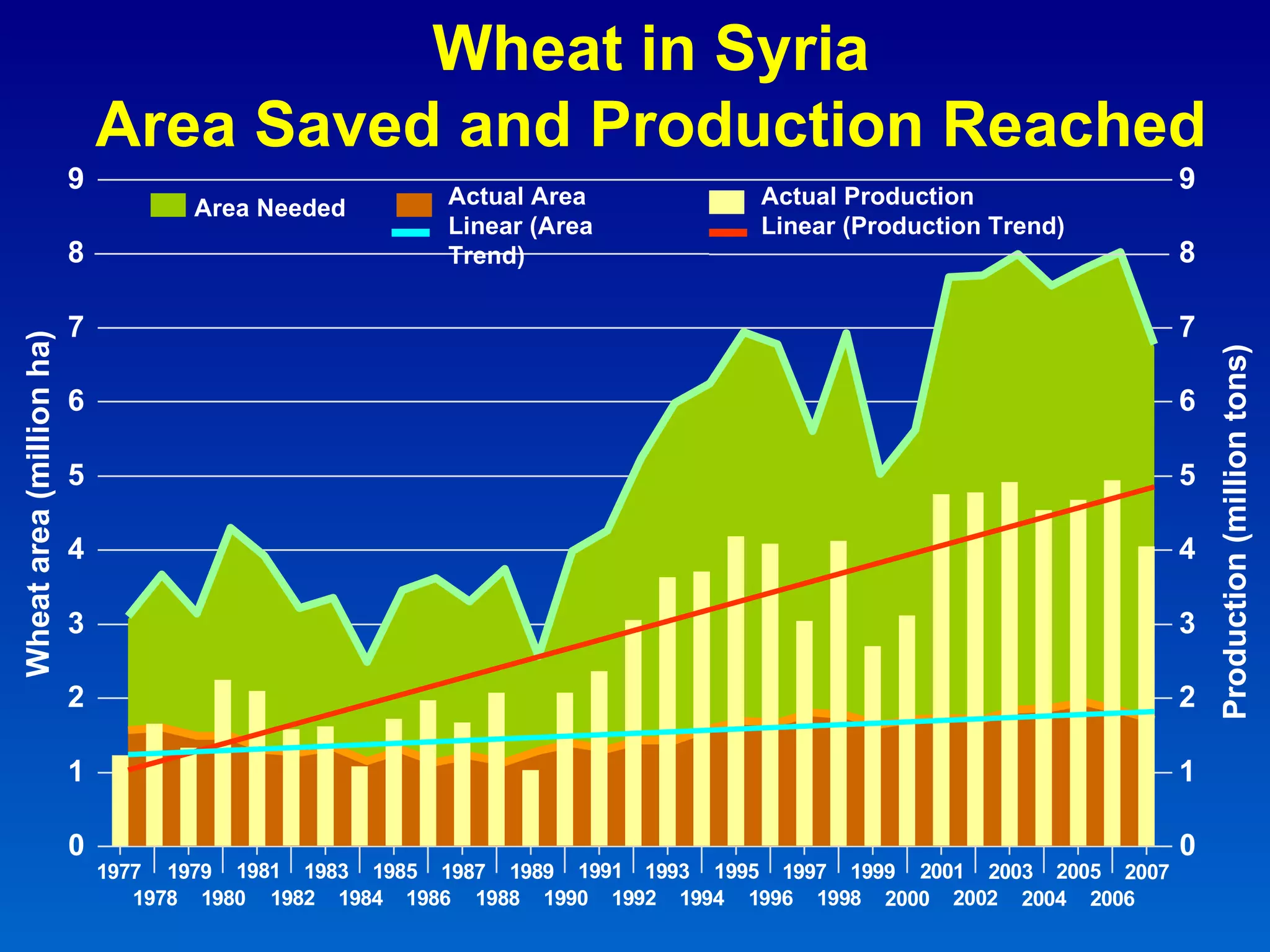
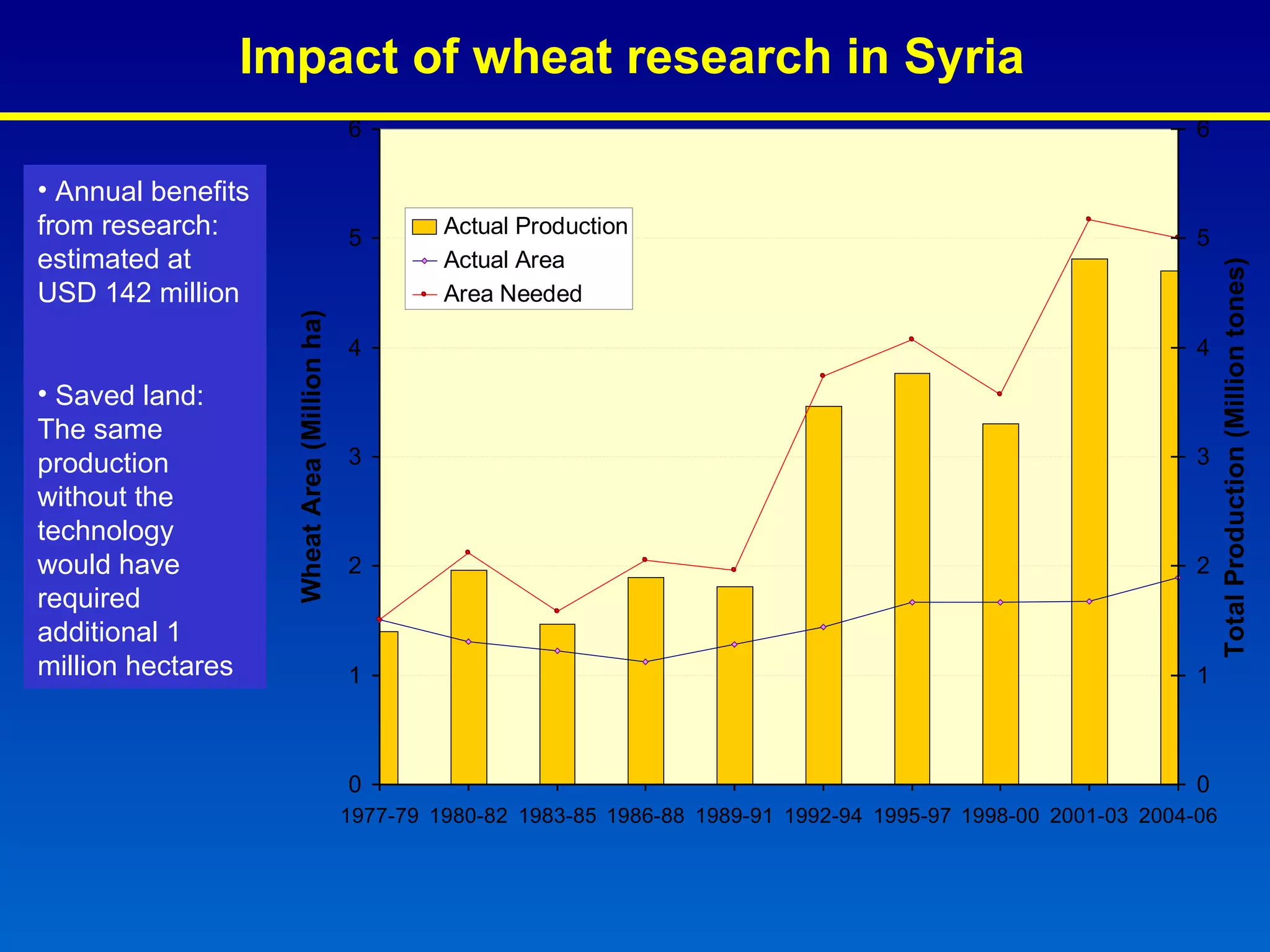
0 1 2 3 4 5 6 7 8 9 Area Needed Actual Area Linear (Area Trend) Actual Production Linear (Production Trend) 0 1 2 3 4 5 6 7 8 9 Wheat in Syria Area Saved and Production Reached Wheat area (million ha) Production (million tons) 1 9 7 8 1 9 8 0 1 9 8 2 1 9 8 4 1 9 8 6 1 9 8 8 1 9 9 0 1 9 9 2 1 9 9 4 1 9 9 6 1 9 9 8 2 0 0 0 2 0 0 2 2 0 0 4 2 0 0 6 1 9 7 7 1 9 7 9 1 9 8 1 1 9 8 3 1 9 8 5 1 9 8 7 1 9 8 9 1 9 9 1 1 9 9 3 1 9 9 5 1 9 9 7 1 9 9 9 2 0 0 1 2 0 0 3 2 0 0 5 2 0 0 7
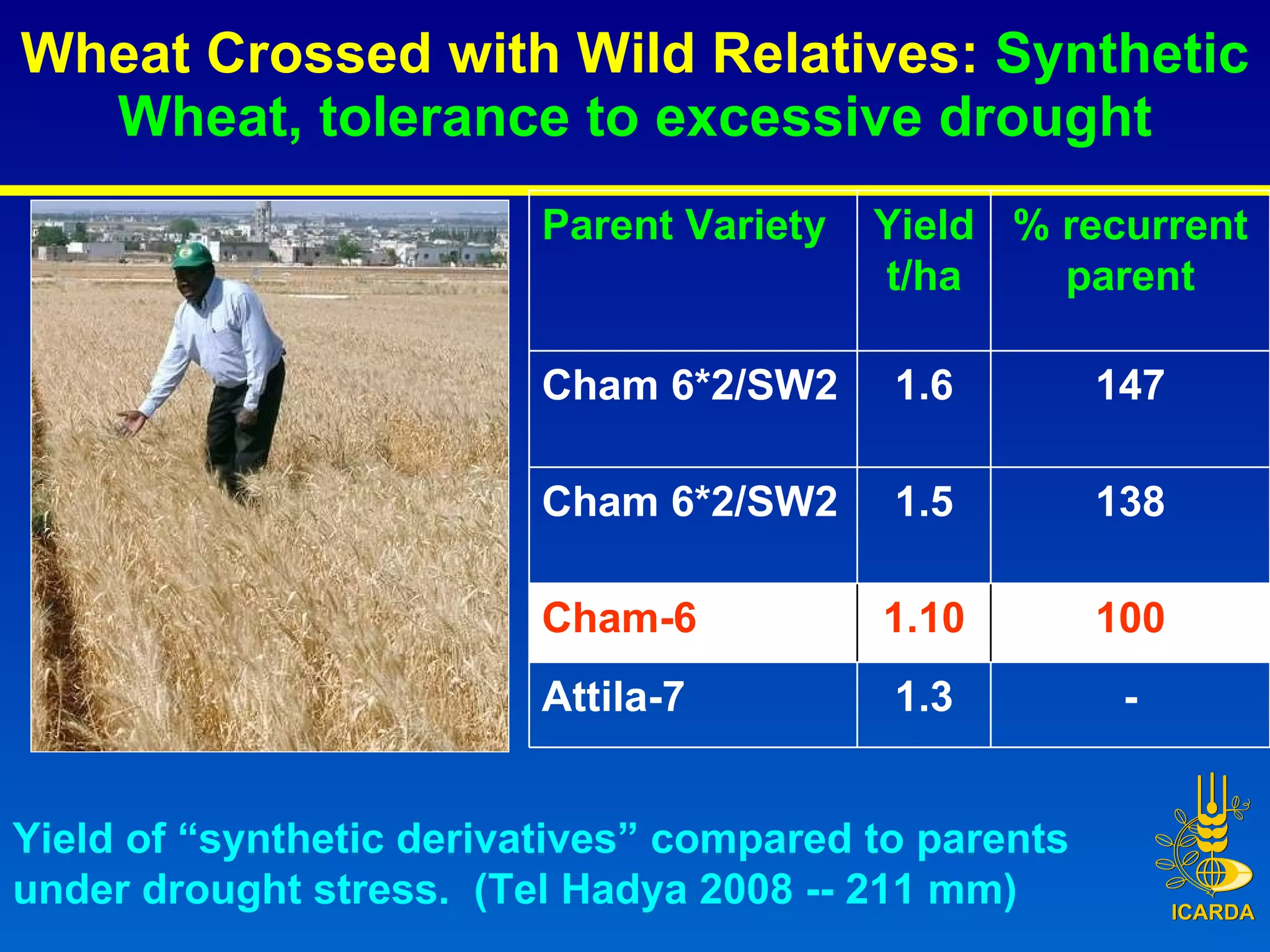
Wheat Crossed with Wild Relatives:  Synthetic Wheat, tolerance to excessive drought Yield of “synthetic derivatives” compared to parents  under drought stress.  (Tel Hadya 2008 -- 211 mm) Parent Variety Yield t/ha % recurrent parent Cham 6*2/SW2 1.6 147 Cham 6*2/SW2 1.5 138 Cham-6 1.10 100 Attila-7 1.3 -
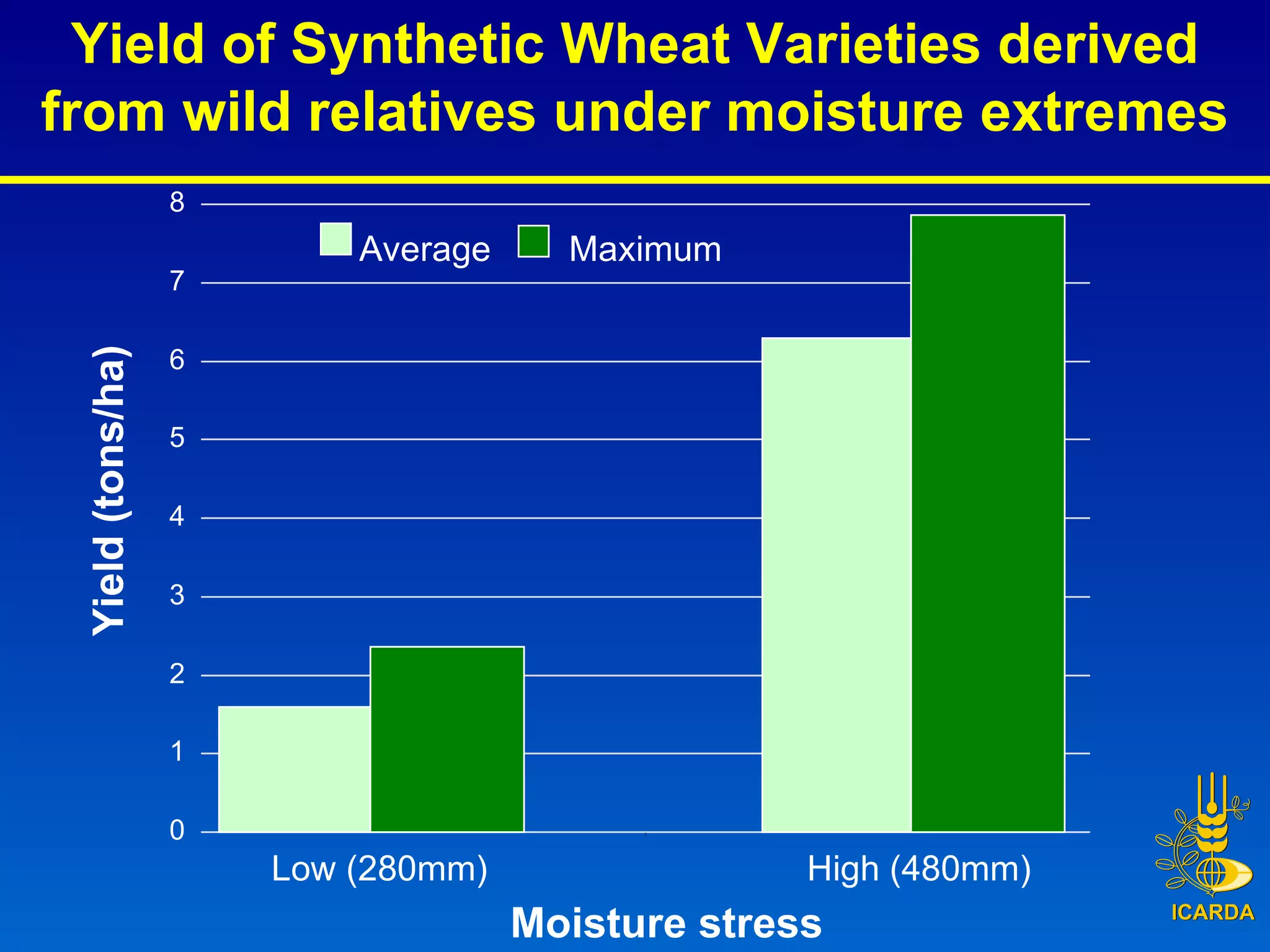
0 1 2 3 4 5 6 7 8 Low (280mm) High (480mm) Average  Maximum Yield of Synthetic Wheat Varieties derived from wild relatives under moisture extremes Yield (tons/ha) Moisture stress
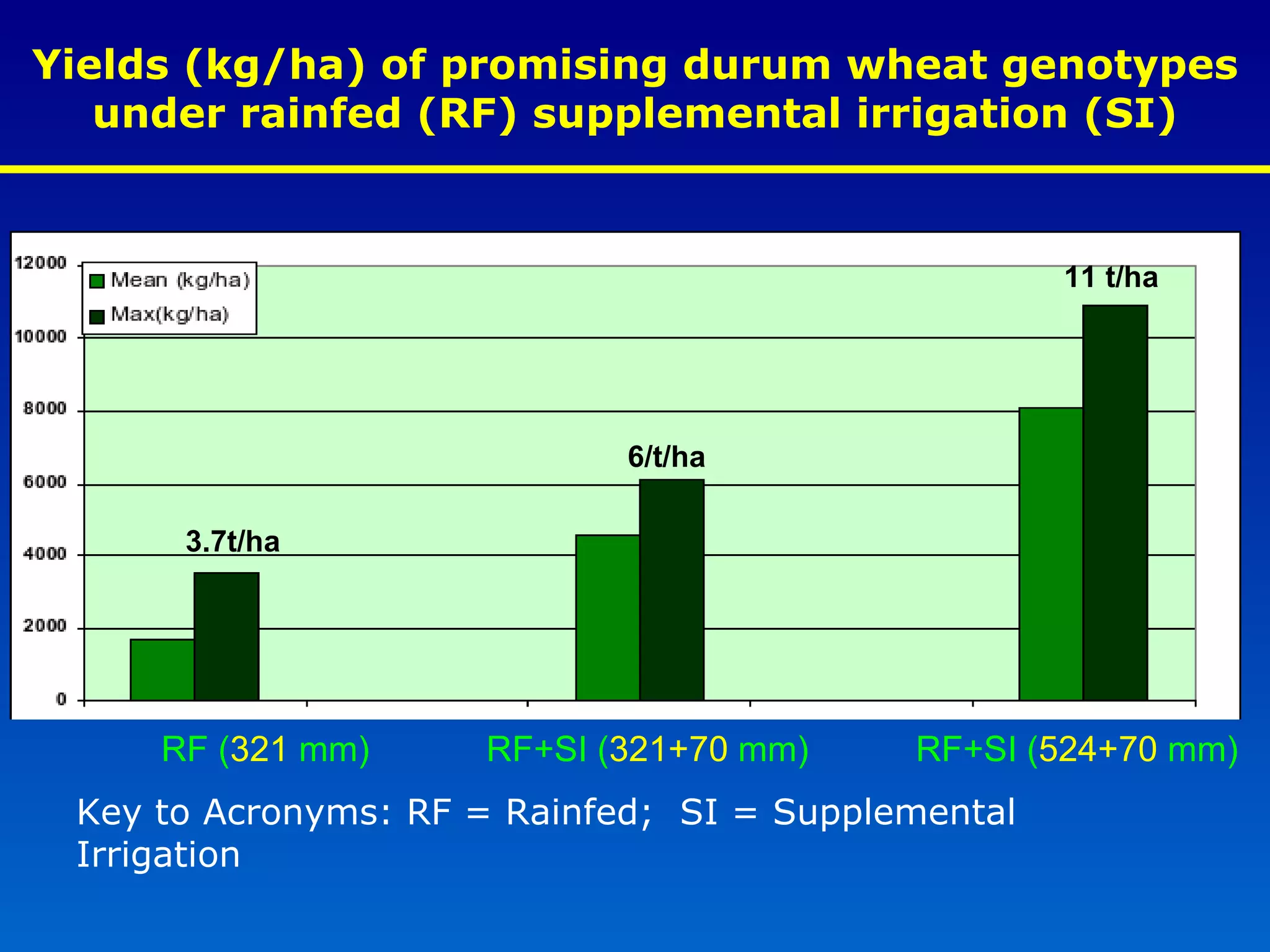
Yields (kg/ha) of promising durum wheat genotypes under rainfed (RF) supplemental irrigation (SI) Key to Acronyms: RF = Rainfed;  SI = Supplemental Irrigation RF ( 321  mm)  RF+SI ( 321+70  mm)  RF+SI ( 524+70  mm) 11 t/ha 6/t/ha 3.7t/ha
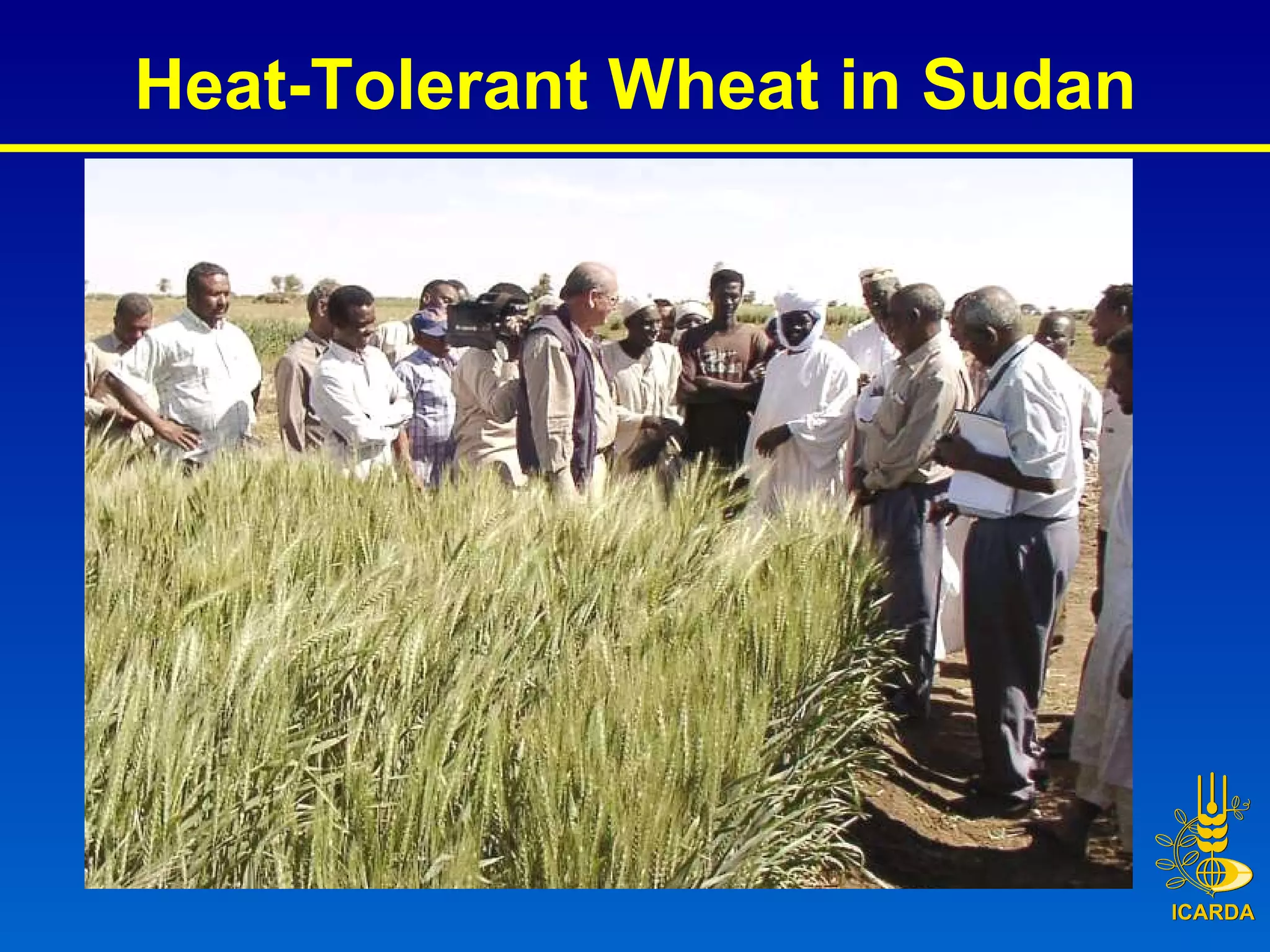
Heat-Tolerant Wheat in Sudan
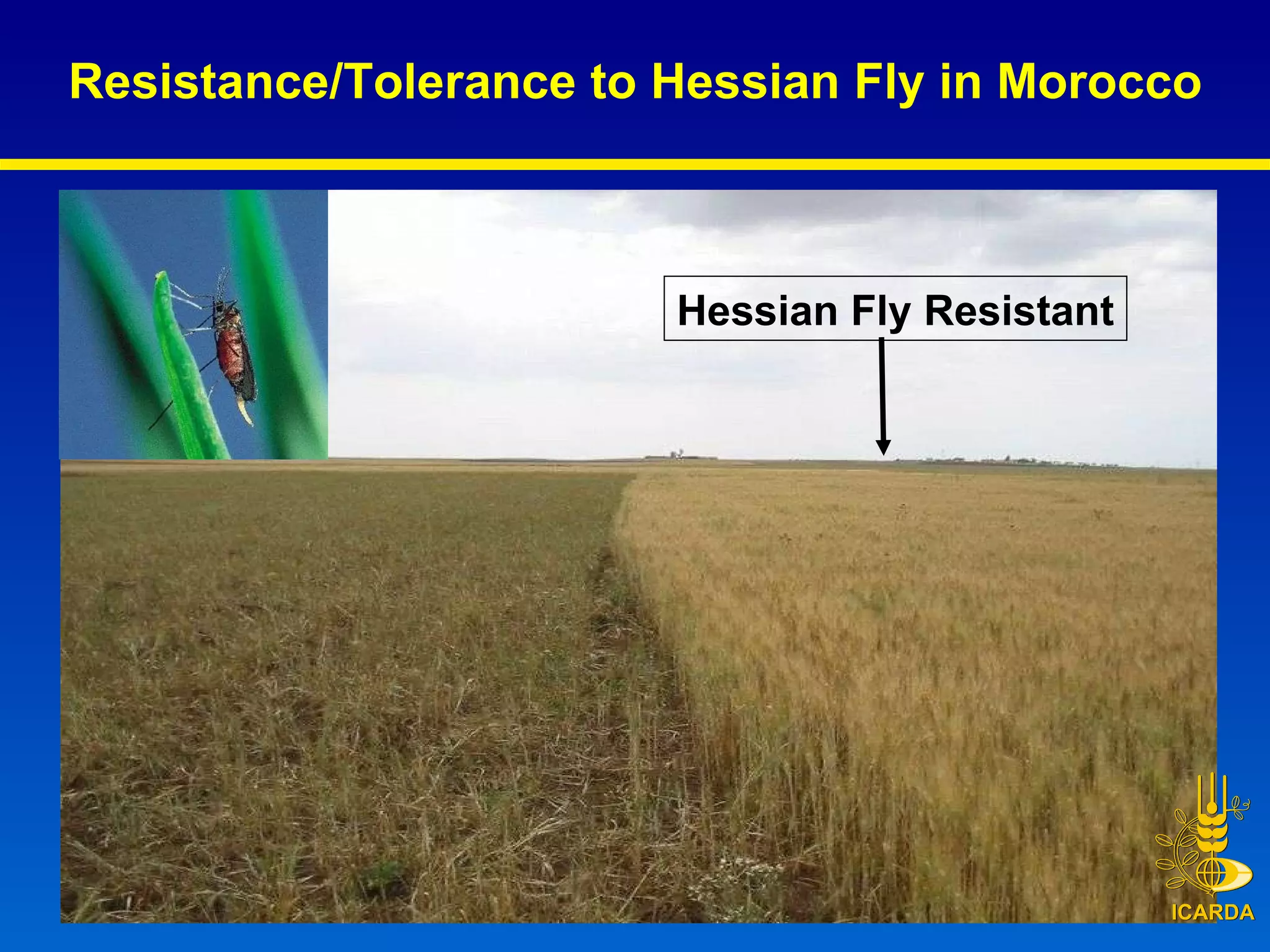
Resistance/Tolerance to Hessian Fly in Morocco Hessian Fly Resistant
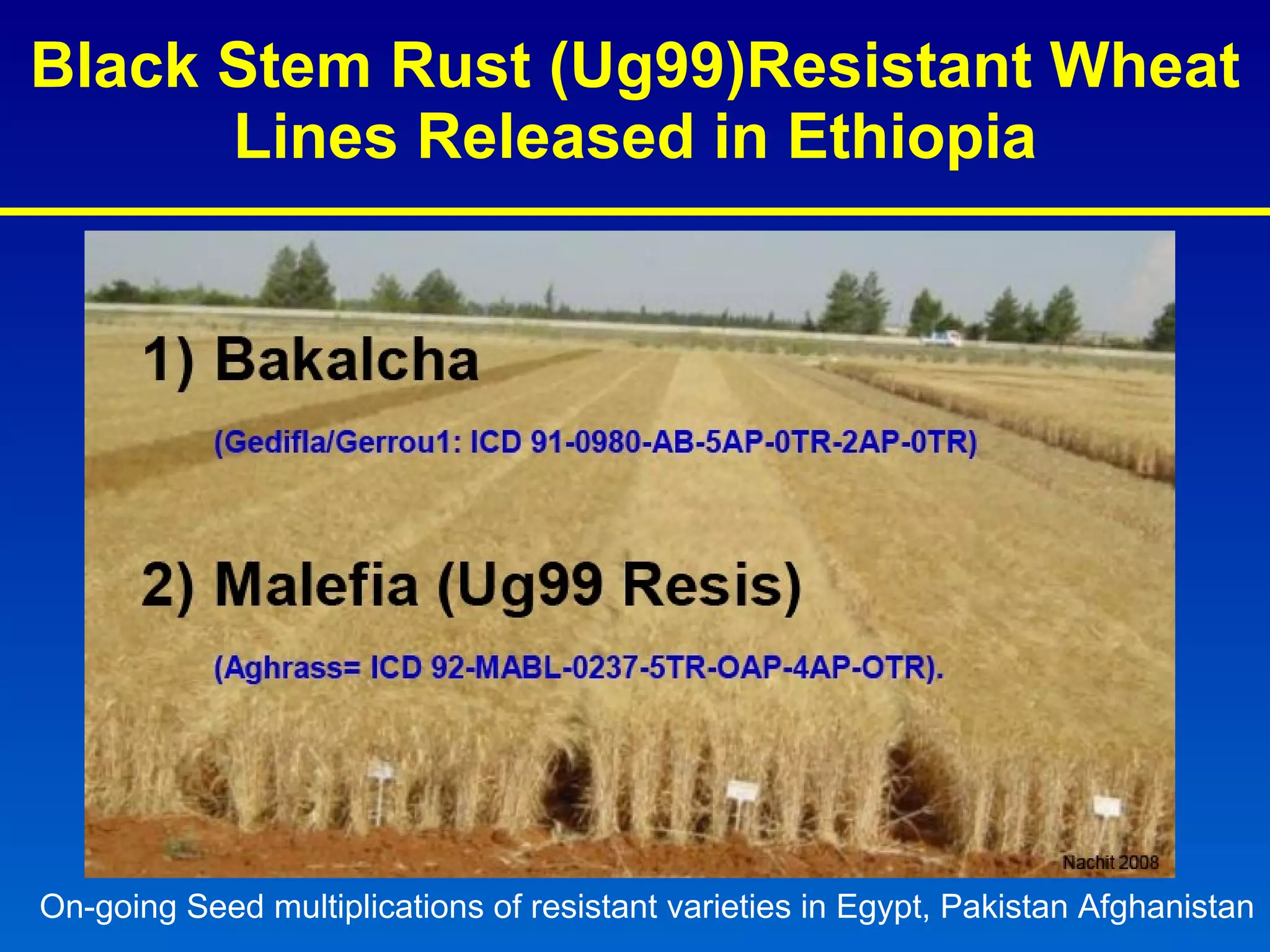
Black Stem Rust (Ug99)Resistant Wheat Lines Released in Ethiopia On-going Seed multiplications of resistant varieties in Egypt, Pakistan Afghanistan
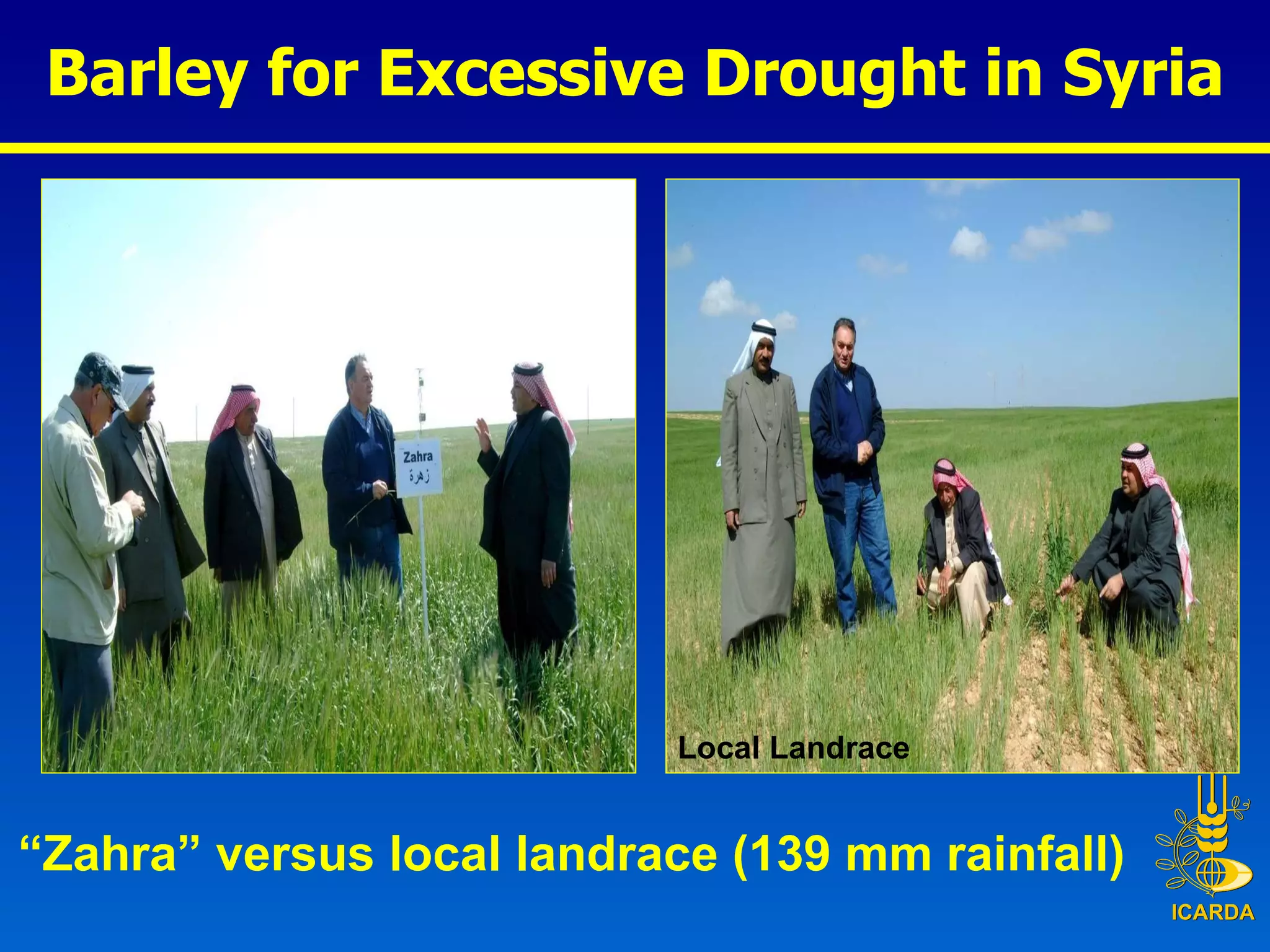
Barley for Excessive Drought in Syria Local Landrace “ Zahra” versus local landrace (139 mm rainfall)
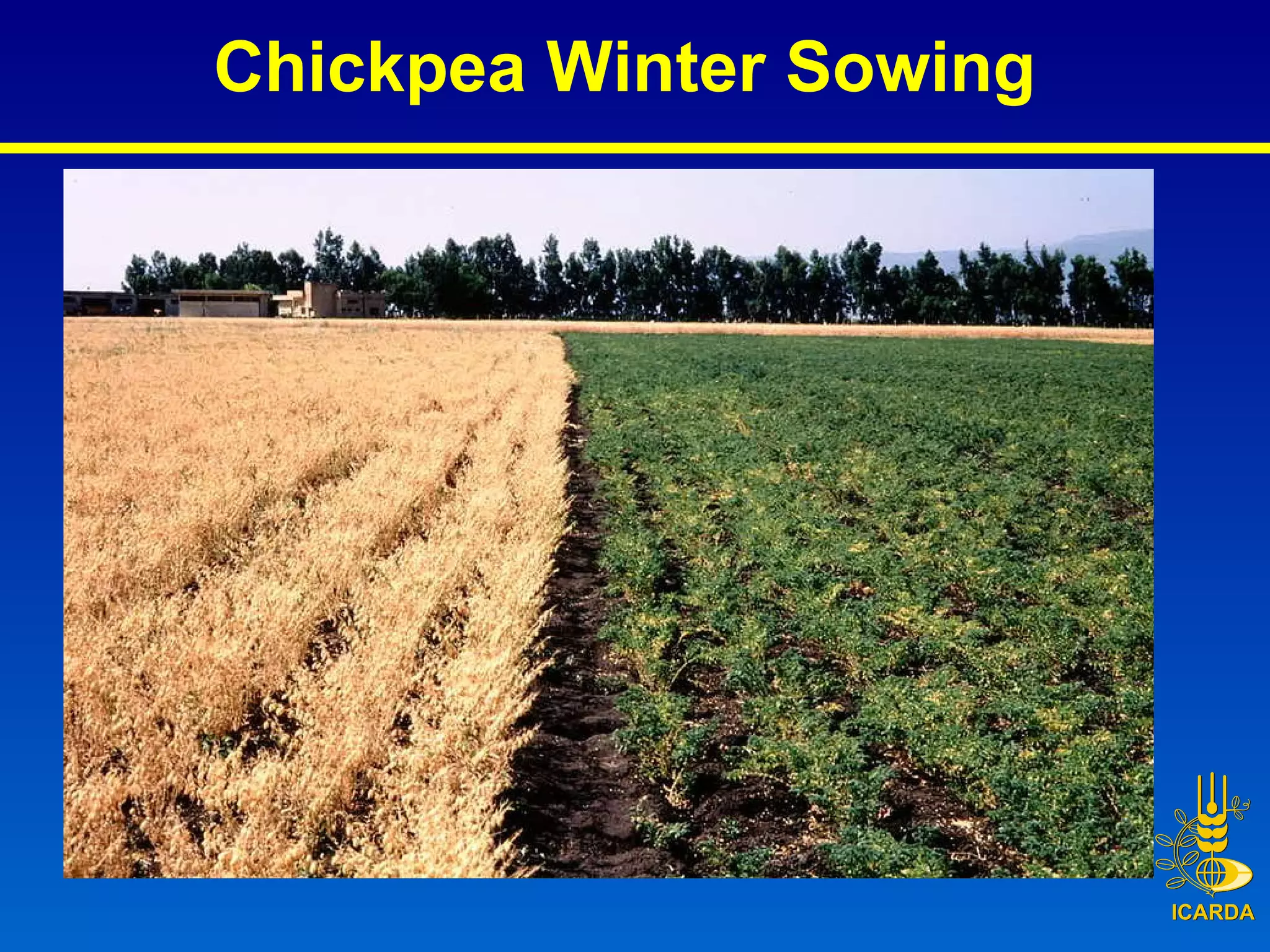
Chickpea Winter Sowing
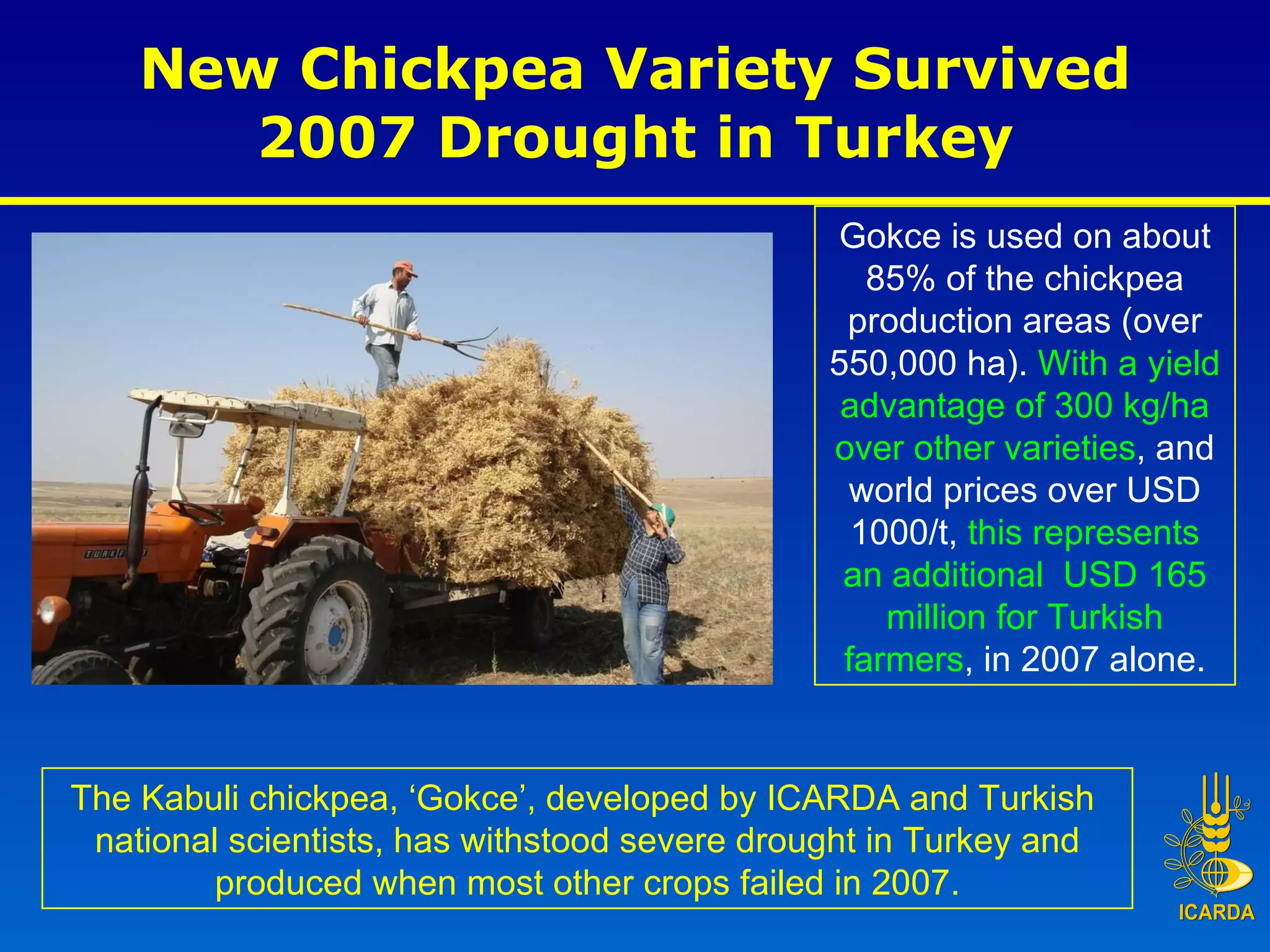
New Chickpea Variety Survived 2007 Drought in Turkey The Kabuli chickpea, ‘Gokce’, developed by ICARDA and Turkish  national scientists, has withstood severe drought in Turkey and produced when most other crops failed in 2007. Gokce is used on about 85% of the chickpea production areas (over 550,000 ha).  With a yield advantage of 300 kg/ha over other varieties , and world prices over USD 1000/t,  this represents an additional  USD 165 million for Turkish farmers , in 2007 alone.
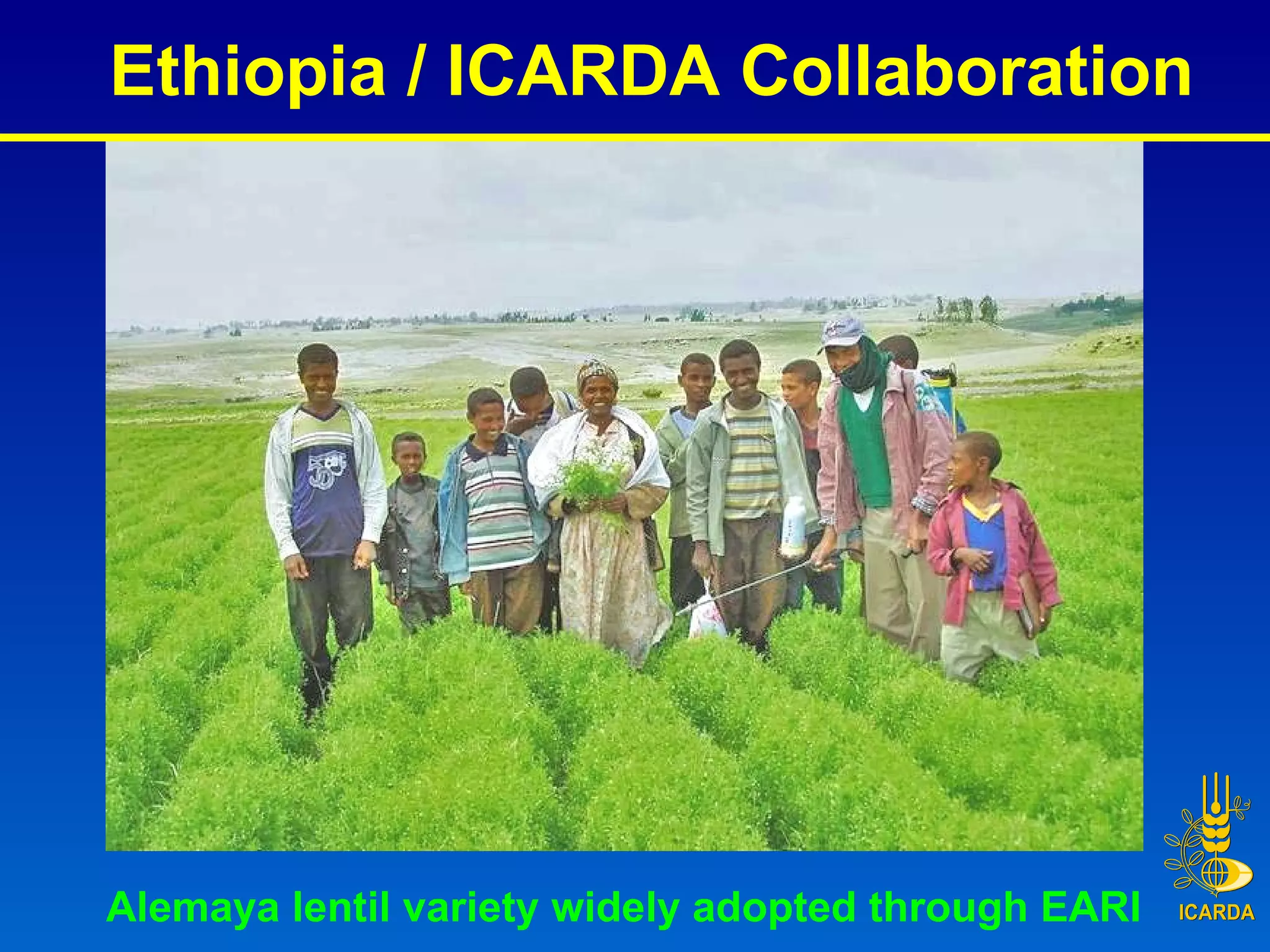
Ethiopia / ICARDA Collaboration Alemaya lentil variety widely adopted through EARI
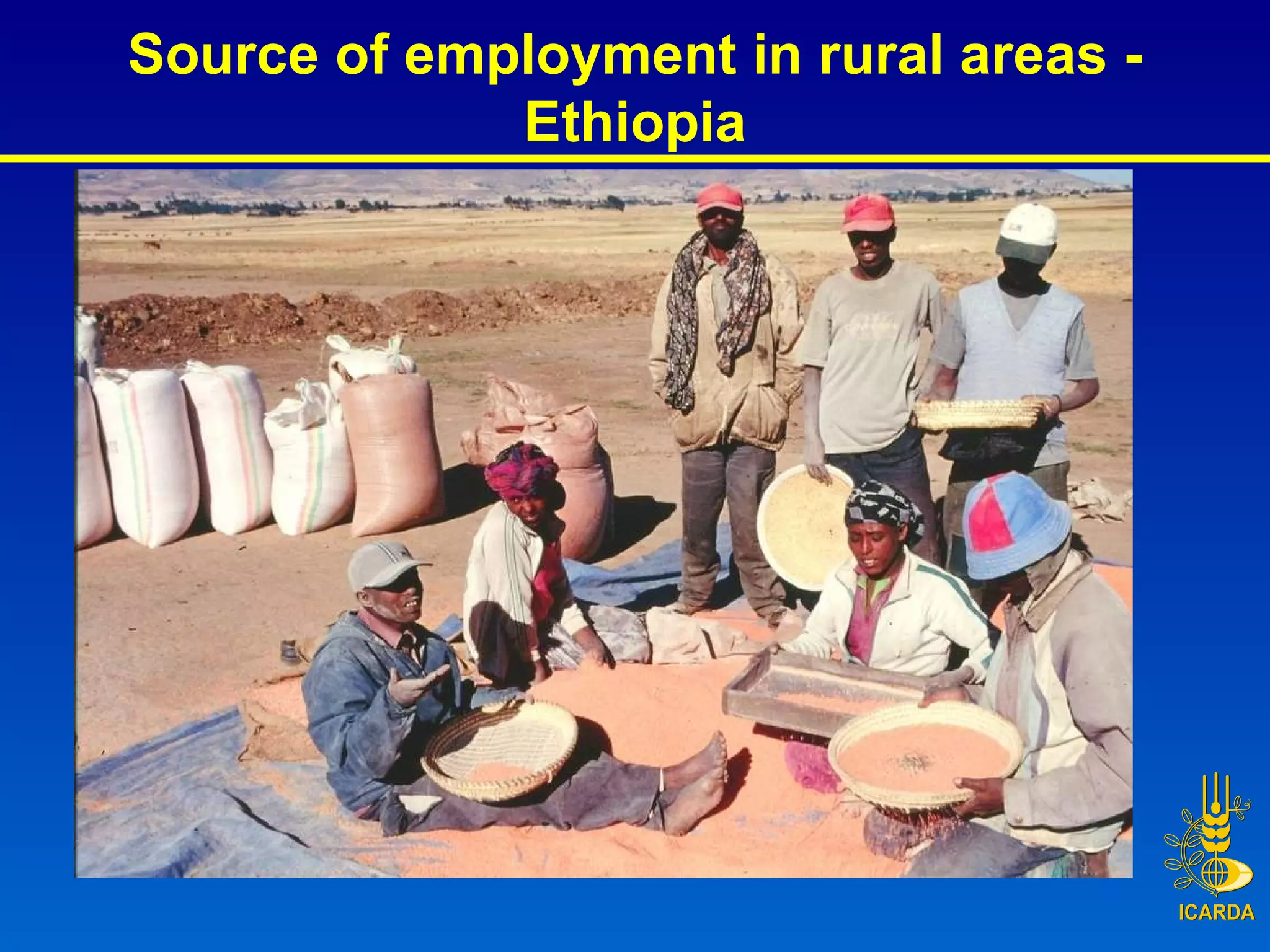
Source of employment in rural areas - Ethiopia
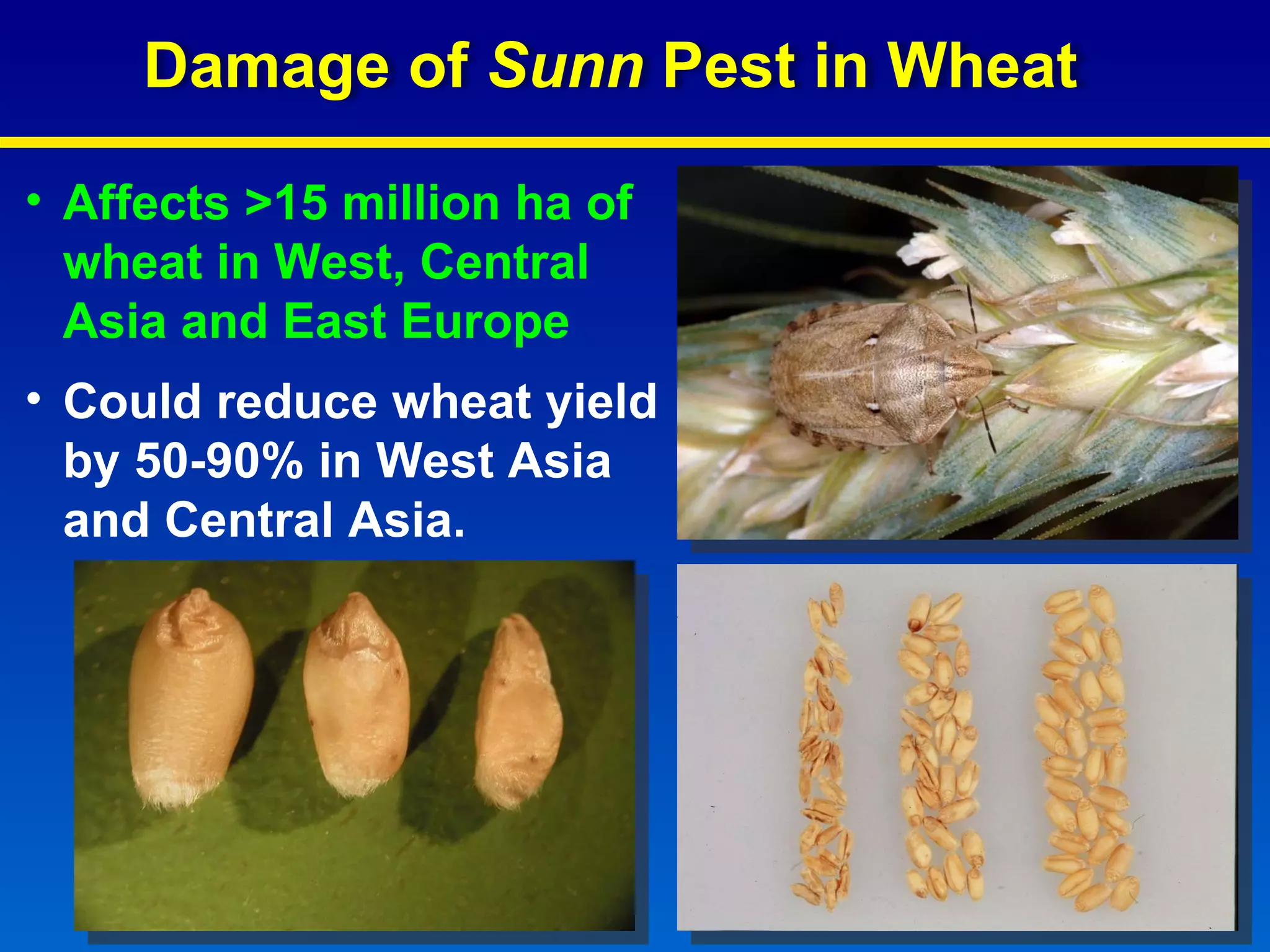
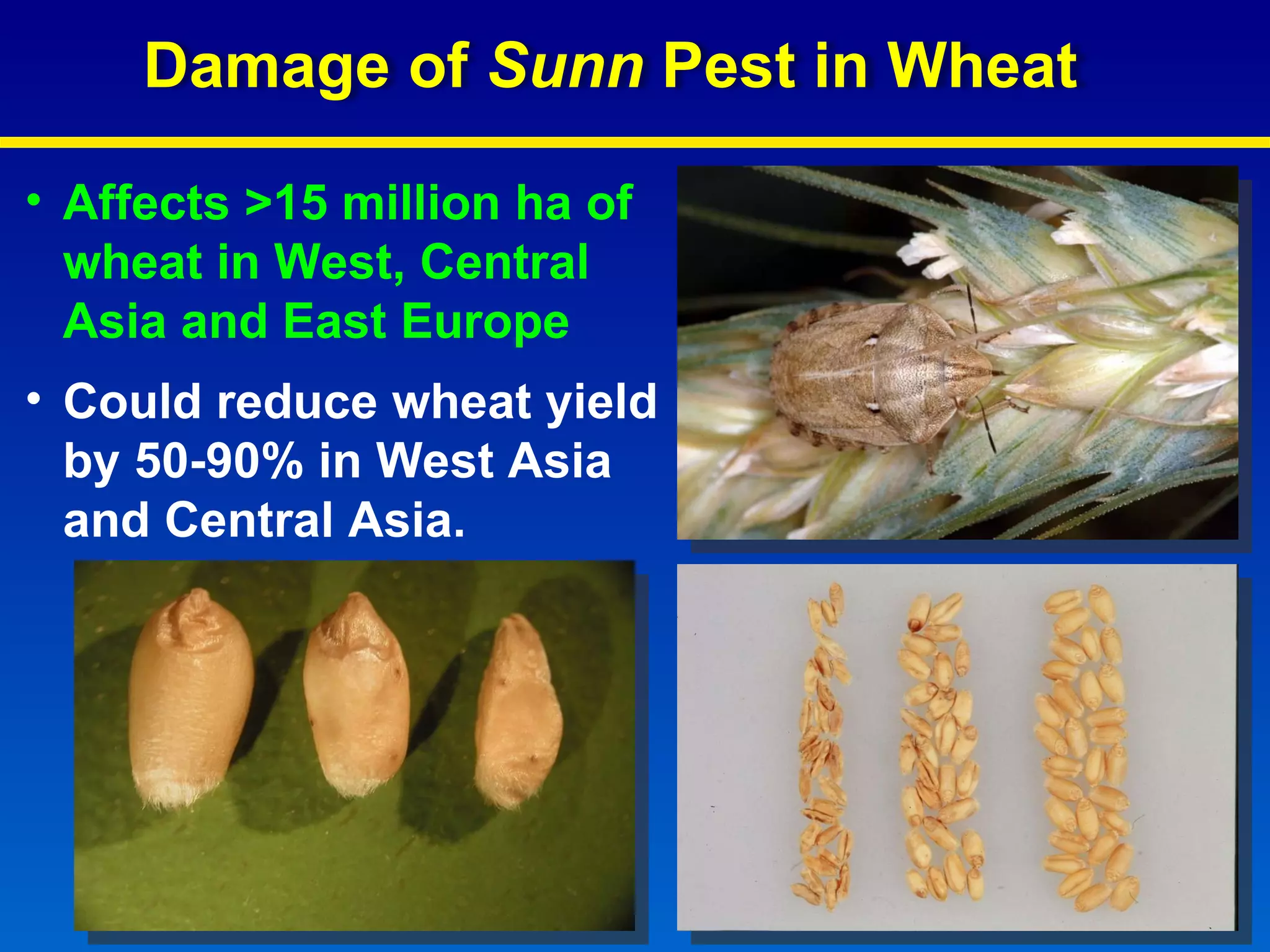
Affects >15 million ha of wheat in West, Central Asia and East Europe Could reduce wheat yield by 50-90% in West Asia and Central Asia. Damage of  Sunn  Pest   in Wheat
Research Outputs & Technologies towards food security & better livelihoods 2. Seed Production:  Formal Seed Sector Informal Seed Sector:  Village-based Seed System “ Seed for Grain” System  to cope with drought
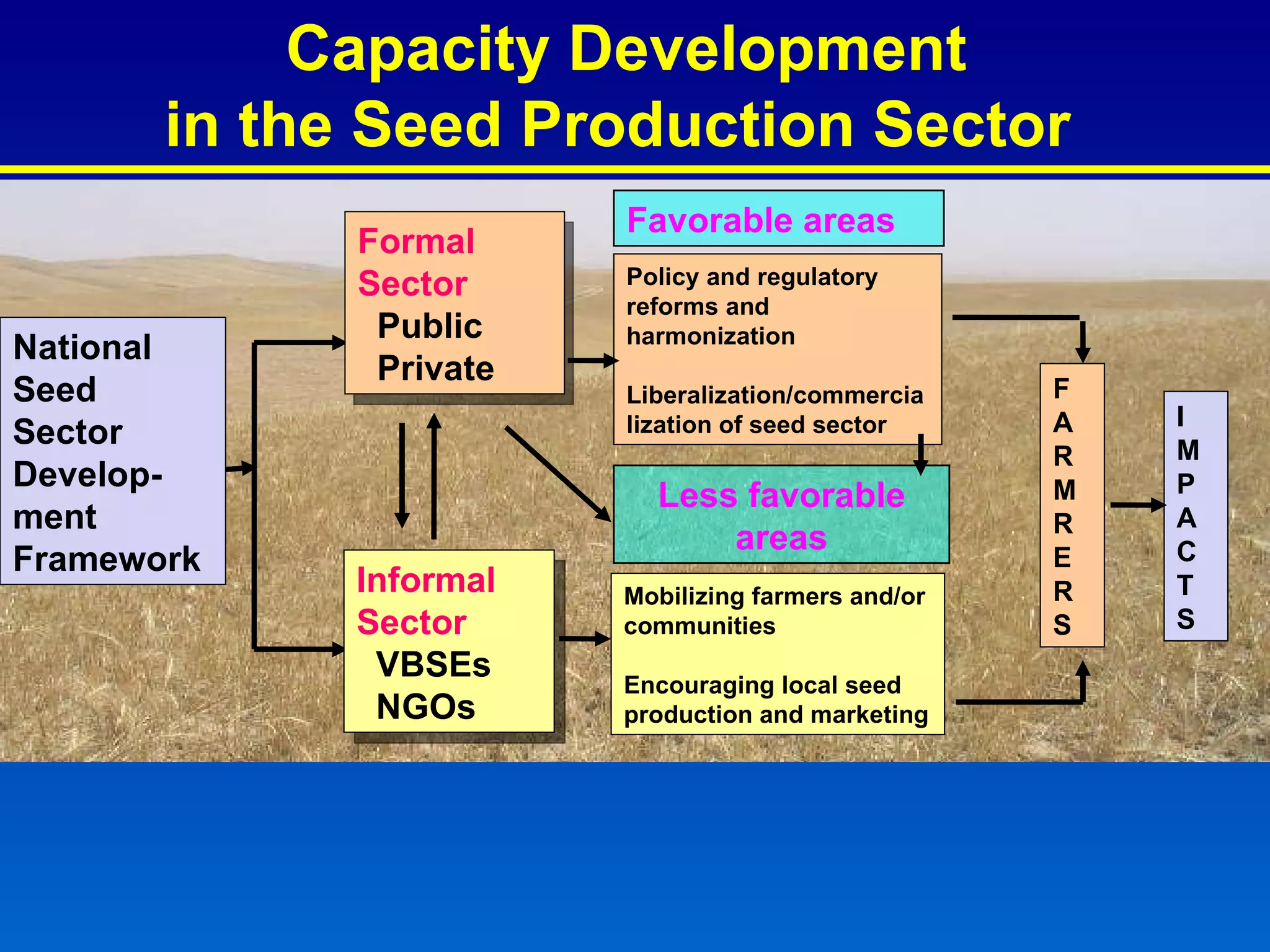
Capacity Development  in the Seed Production Sector   Favorable areas Less favorable areas National  Seed  Sector Develop-ment Framework Policy and regulatory reforms and harmonization Liberalization/commercialization of seed sector Mobilizing farmers and/or communities  Encouraging local seed production and marketing Formal Sector Public Private Informal Sector VBSEs NGOs F A R M R E R S I M P A C T S
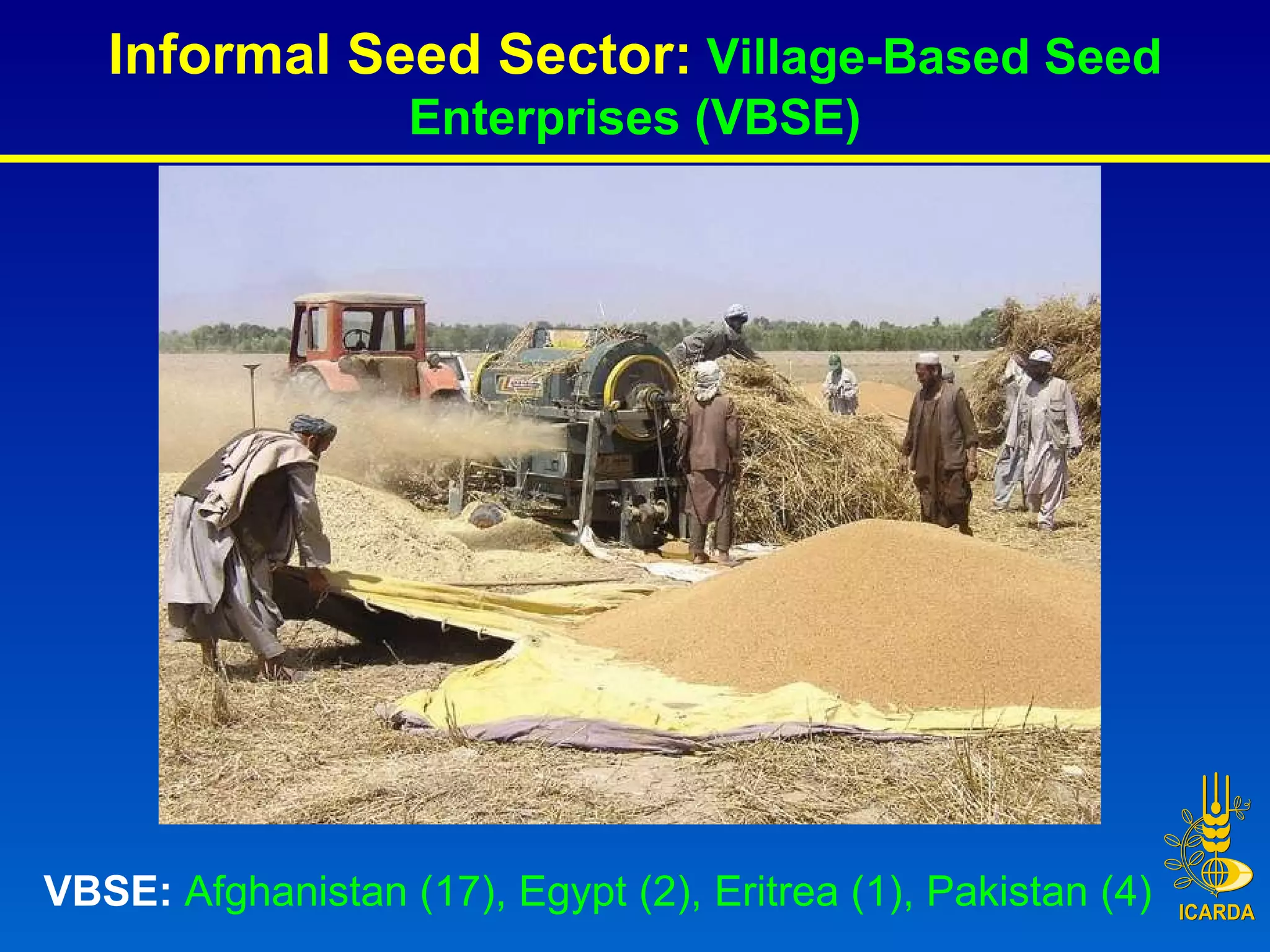
Informal Seed Sector:  Village-Based Seed Enterprises (VBSE) VBSE:  Afghanistan (17), Egypt (2), Eritrea (1), Pakistan (4)
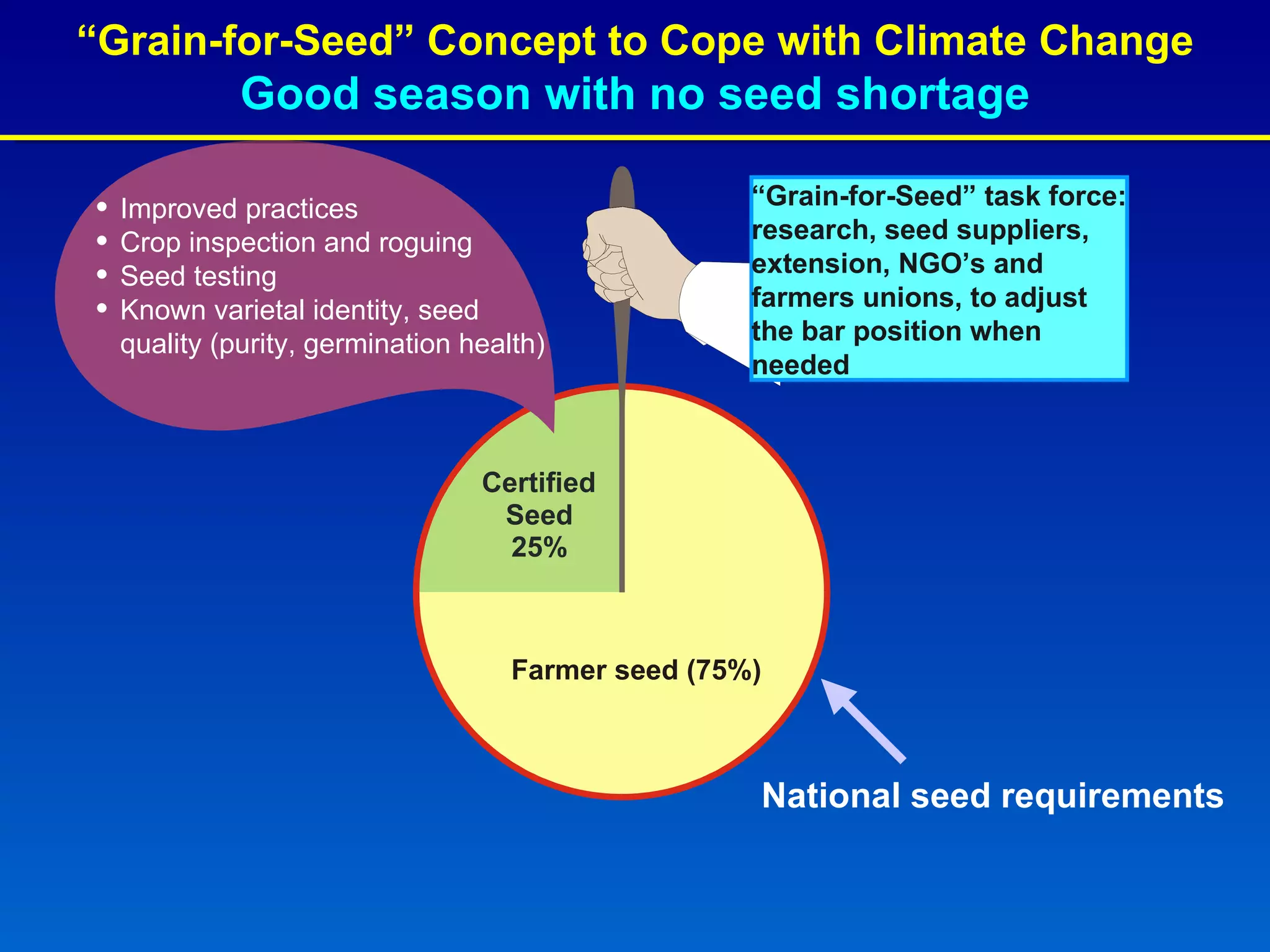
Farmer seed (75%) Certified Seed 25% National seed requirements Improved practices Crop inspection and roguing Seed testing Known varietal identity, seed quality (purity, germination health) “ Grain-for-Seed” Concept to Cope with Climate Change Good season with no seed shortage “ Grain-for-Seed”   task force: research, seed suppliers, extension, NGO’s and farmers unions, to adjust the bar position when needed
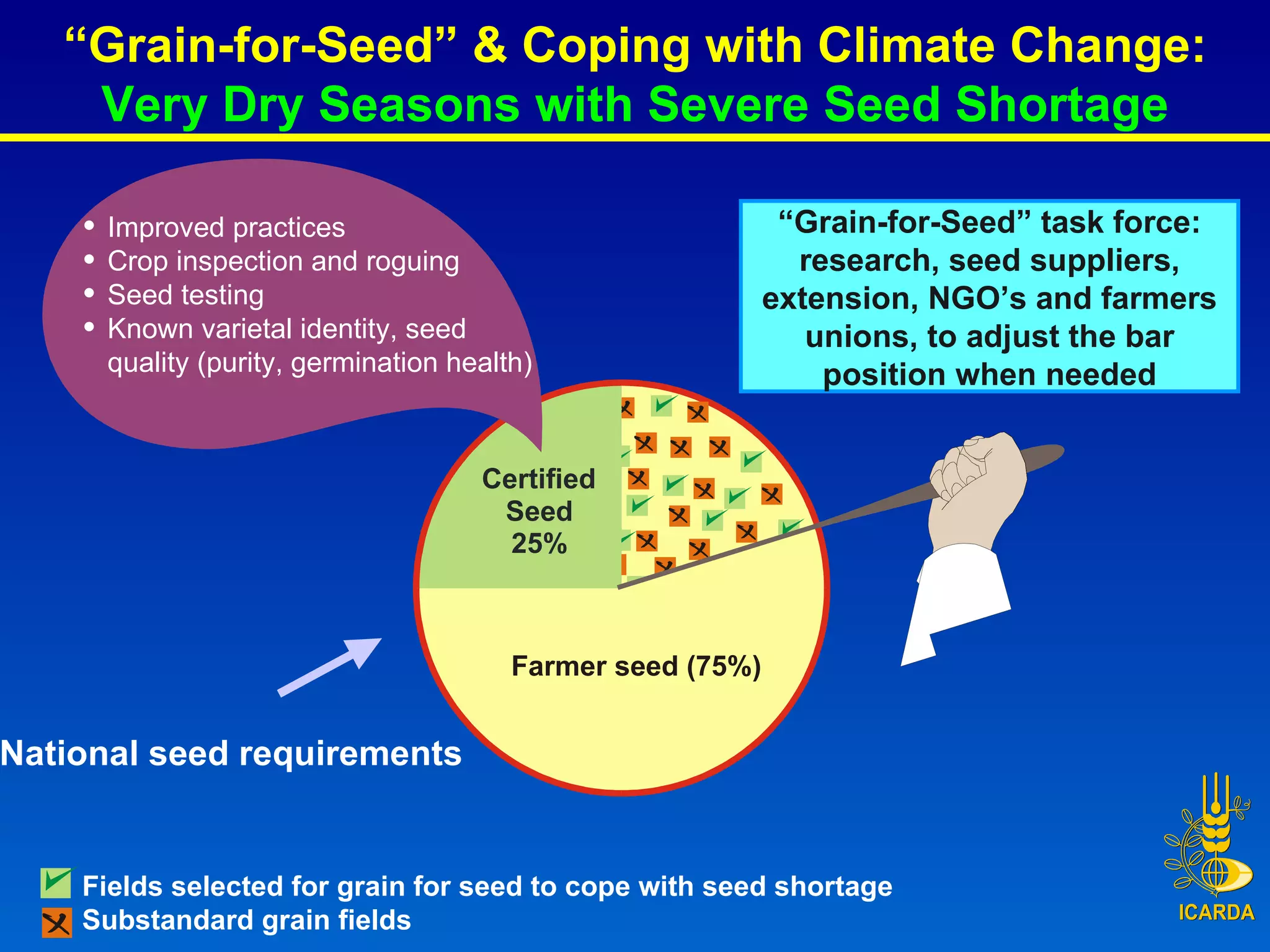
Farmer seed (75%) Certified Seed 25% National seed requirements Fields selected for grain for seed to cope with seed shortage Substandard grain fields “ Grain-for-Seed” & Coping with Climate Change: Very Dry Seasons with Severe Seed Shortage Improved practices Crop inspection and roguing Seed testing Known varietal identity, seed quality (purity, germination health) “ Grain-for-Seed”   task force: research, seed suppliers, extension, NGO’s and farmers unions, to adjust the bar position when needed
Research Outputs & Technologies towards food security & better livelihoods 3. Integrated Pest Management (IPM)
Affects >15 million ha of wheat in West, Central Asia and East Europe Could reduce wheat yield by 50-90% in West Asia and Central Asia. Damage of  Sunn  Pest   in Wheat
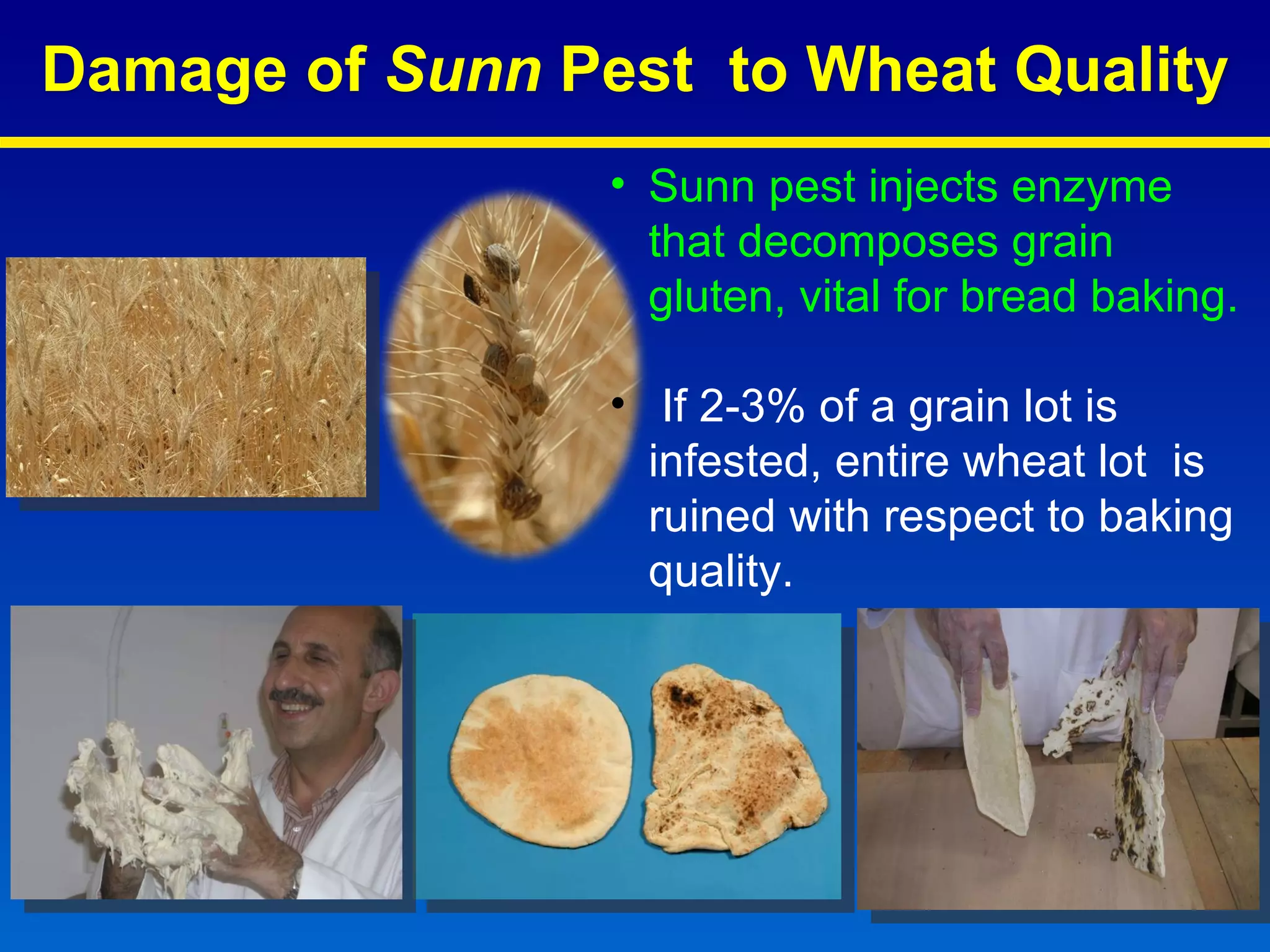
Sunn pest injects enzyme that decomposes grain gluten, vital for bread baking.  If 2-3% of a grain lot is infested, entire wheat lot  is ruined with respect to baking quality. Damage of  Sunn  Pest  to Wheat Quality
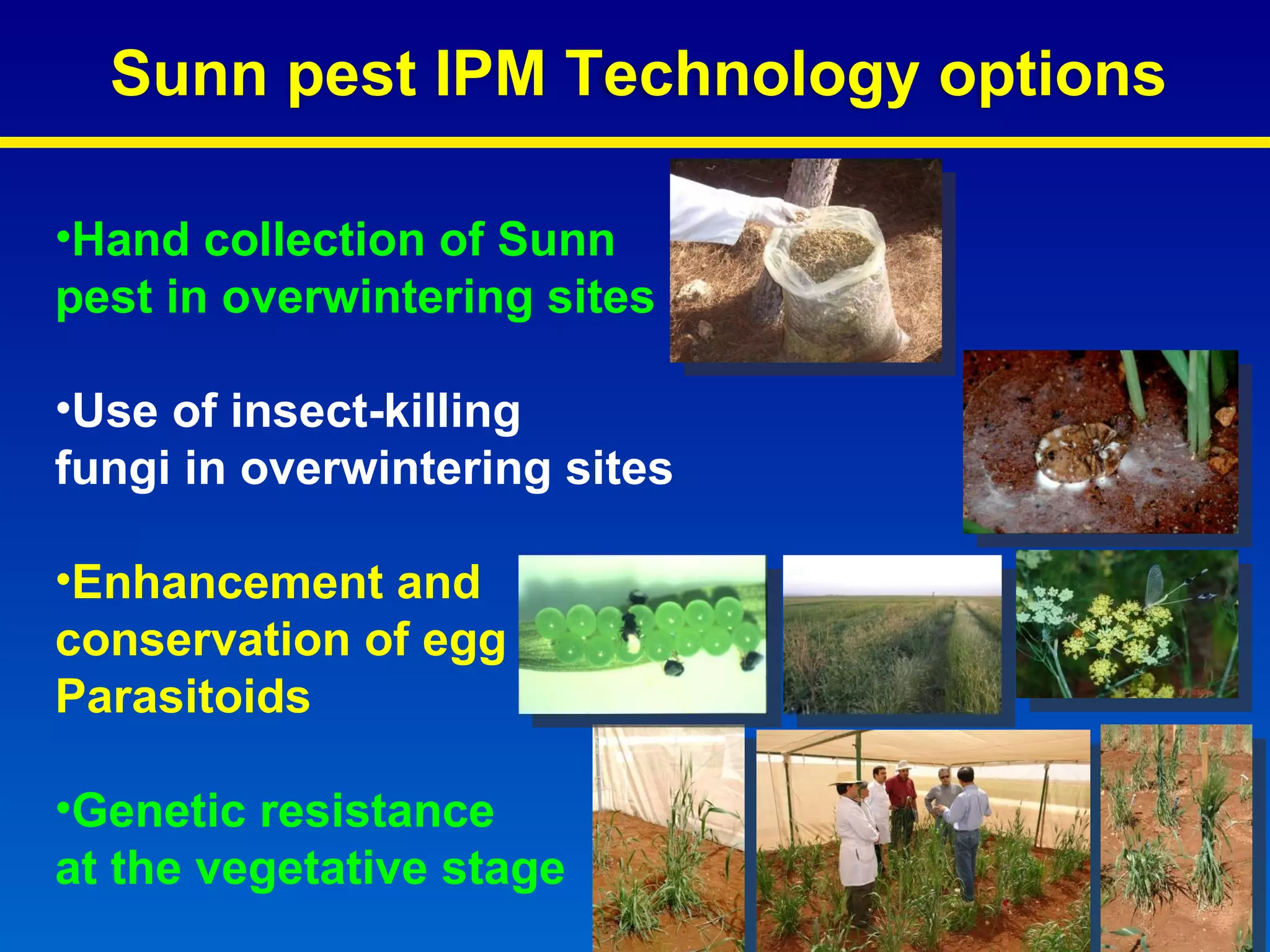
Hand collection of Sunn  pest in overwintering sites  Use of insect-killing fungi in overwintering sites  Enhancement and  conservation of egg  Parasitoids Genetic resistance  at the vegetative stage  Sunn pest IPM Technology options
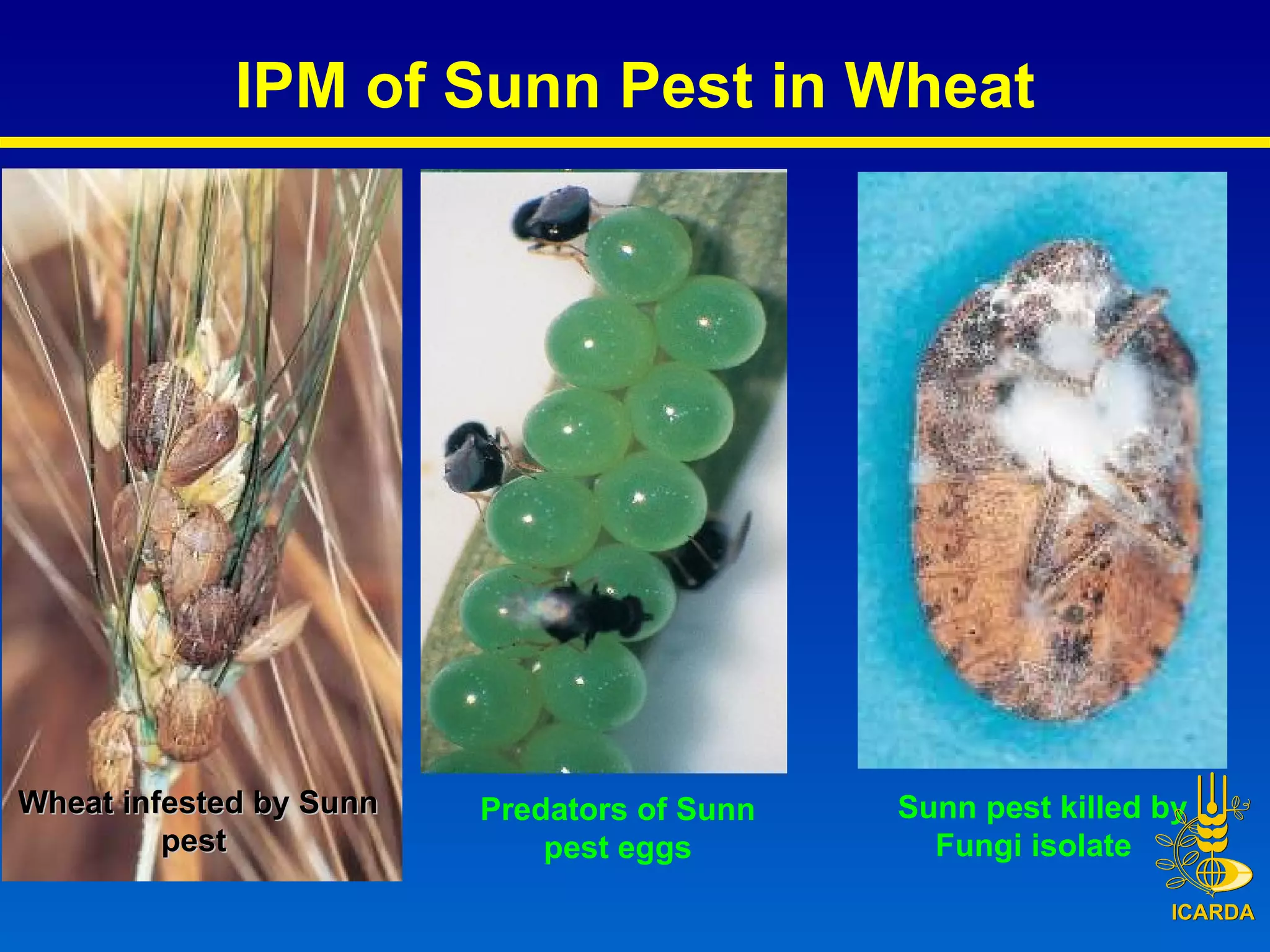
Wheat infested by Sunn pest  Predators of Sunn pest eggs Sunn pest killed by Fungi isolate  IPM of Sunn Pest in Wheat
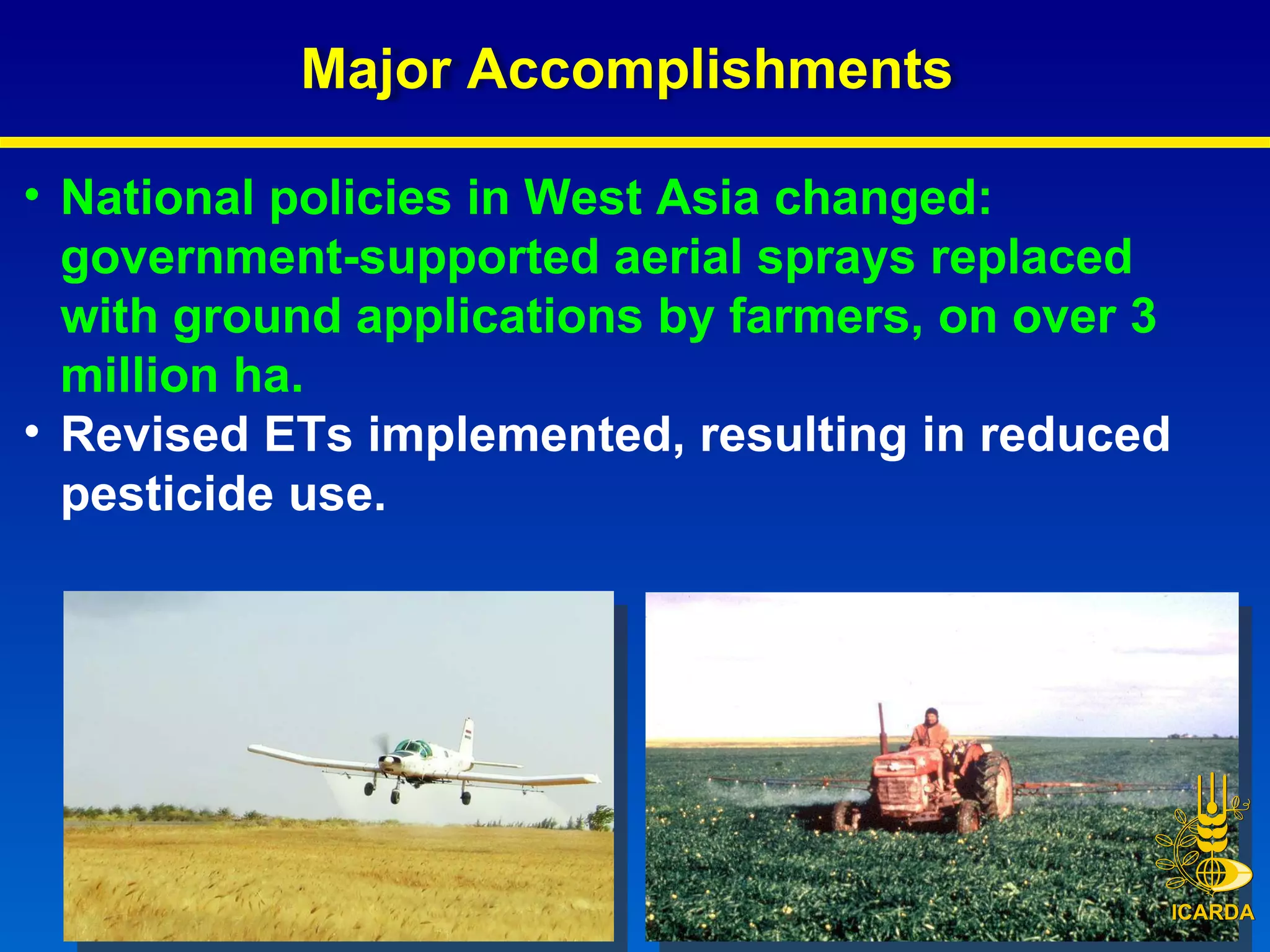
National policies in West Asia changed: government-supported aerial sprays replaced with ground applications by farmers, on over 3 million ha. Revised ETs implemented, resulting in reduced pesticide use.  Major Accomplishments
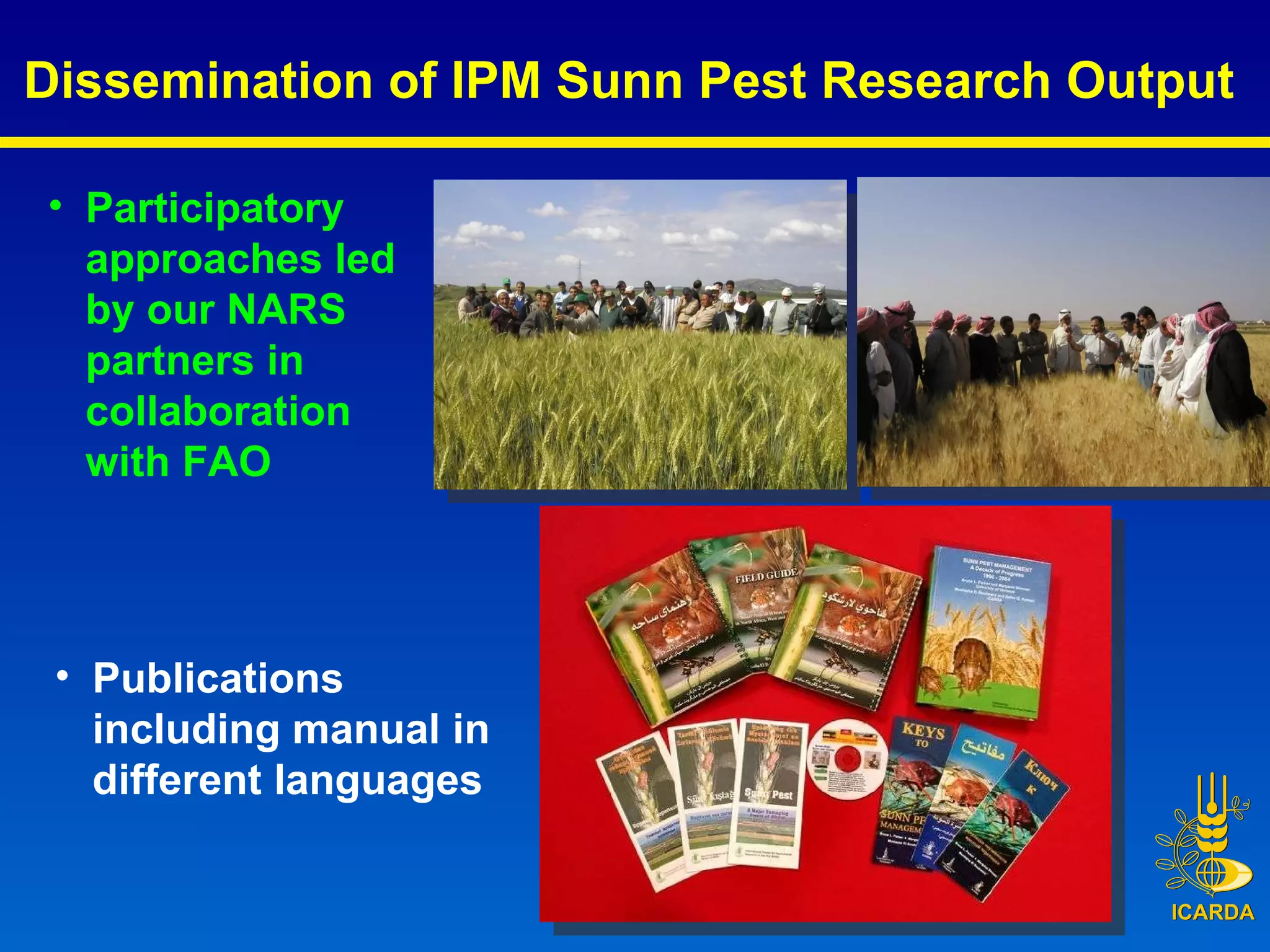
Participatory approaches led by our NARS partners in collaboration with FAO Publications including manual in different languages Dissemination of IPM Sunn Pest Research Output
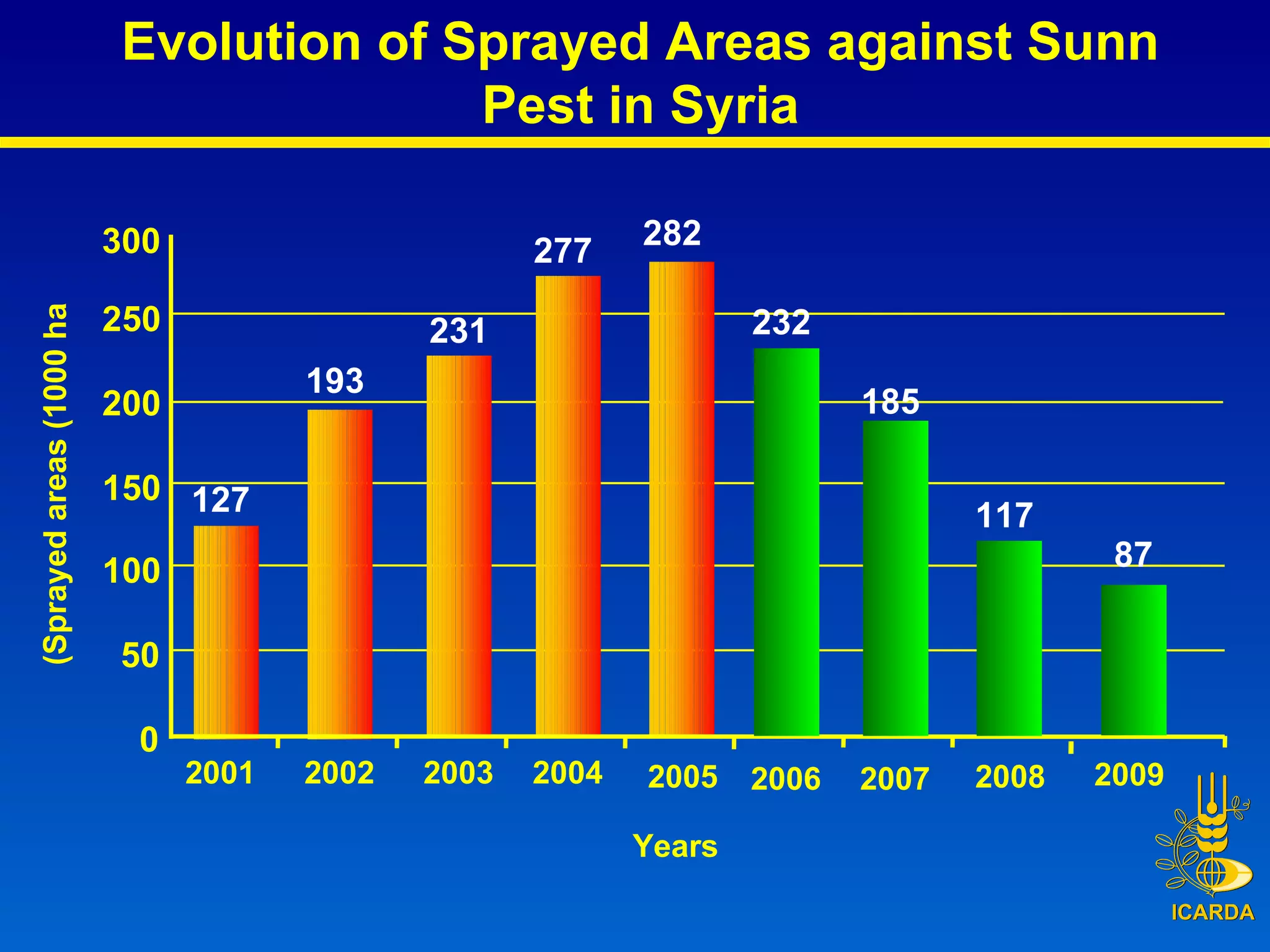
0 50 100 150 200 250 2001 2002 2003 Years 127 193 231 300 277 2004 Sprayed areas (1000 ha) Evolution of Sprayed Areas against Sunn Pest in Syria 282 2005 232 2006 185 117 2007 2008 2009 87
Research Outputs & Technologies towards food security & better livelihoods 4. Water Management Supplemental Irrigation  (Systems and management) Macro- and Micro-Water Catchments  (Vallerani and other types) Deficit Irrigation  as   a water management strategy for the water scarce areas
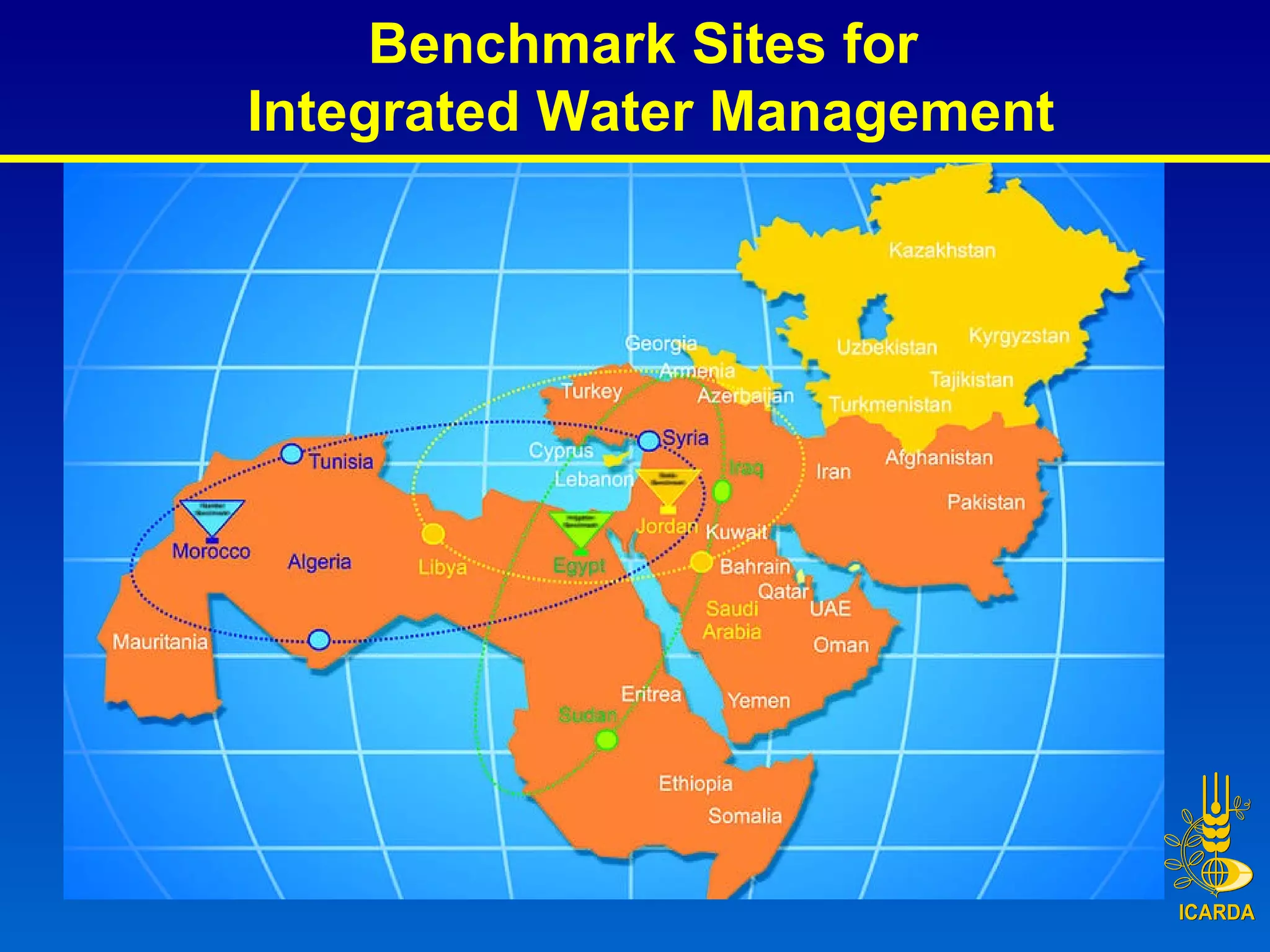
Benchmark Sites for  Integrated Water Management
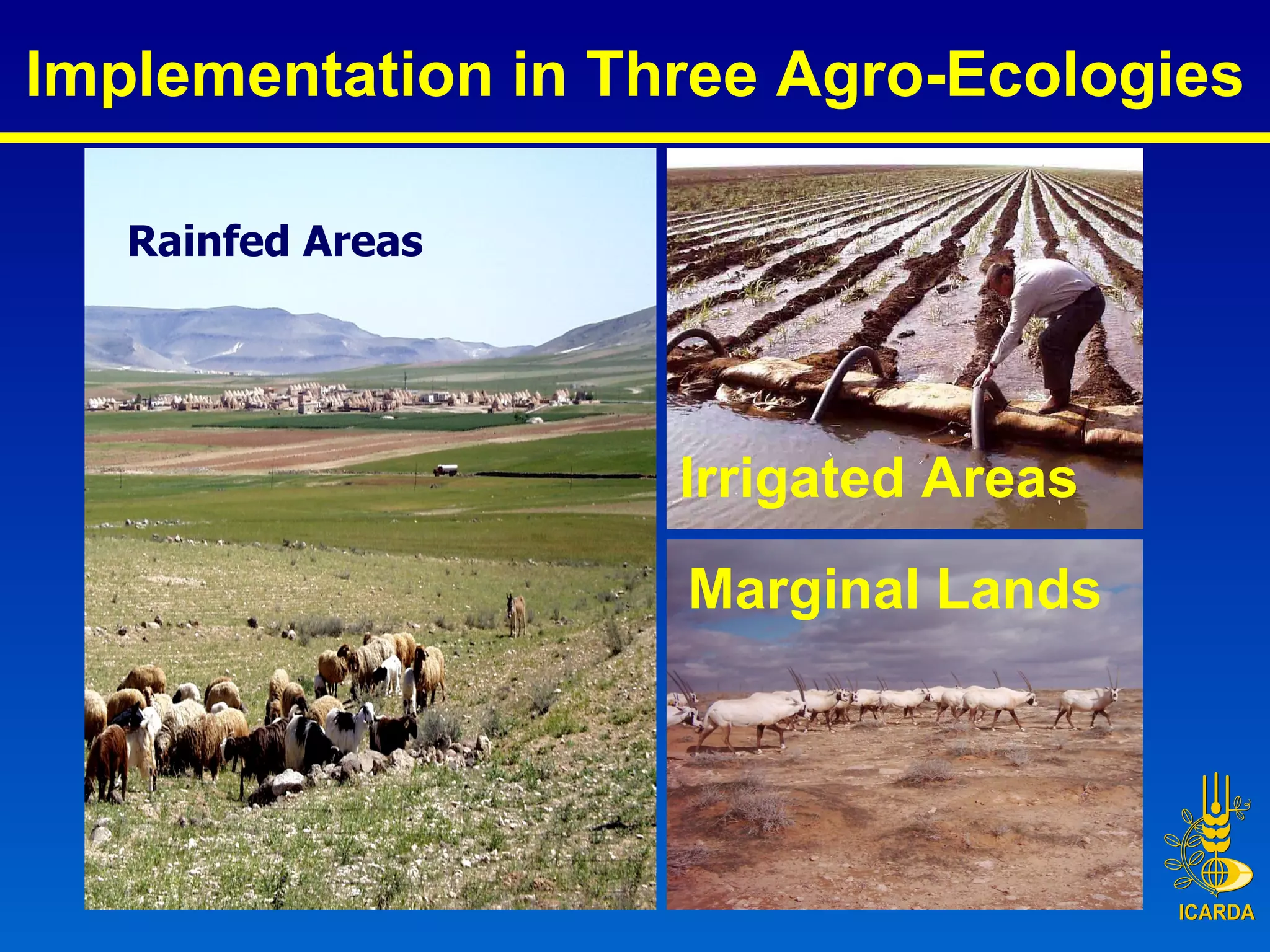
Implementation in Three Agro-Ecologies Rainfed Areas Marginal Lands Irrigated Areas
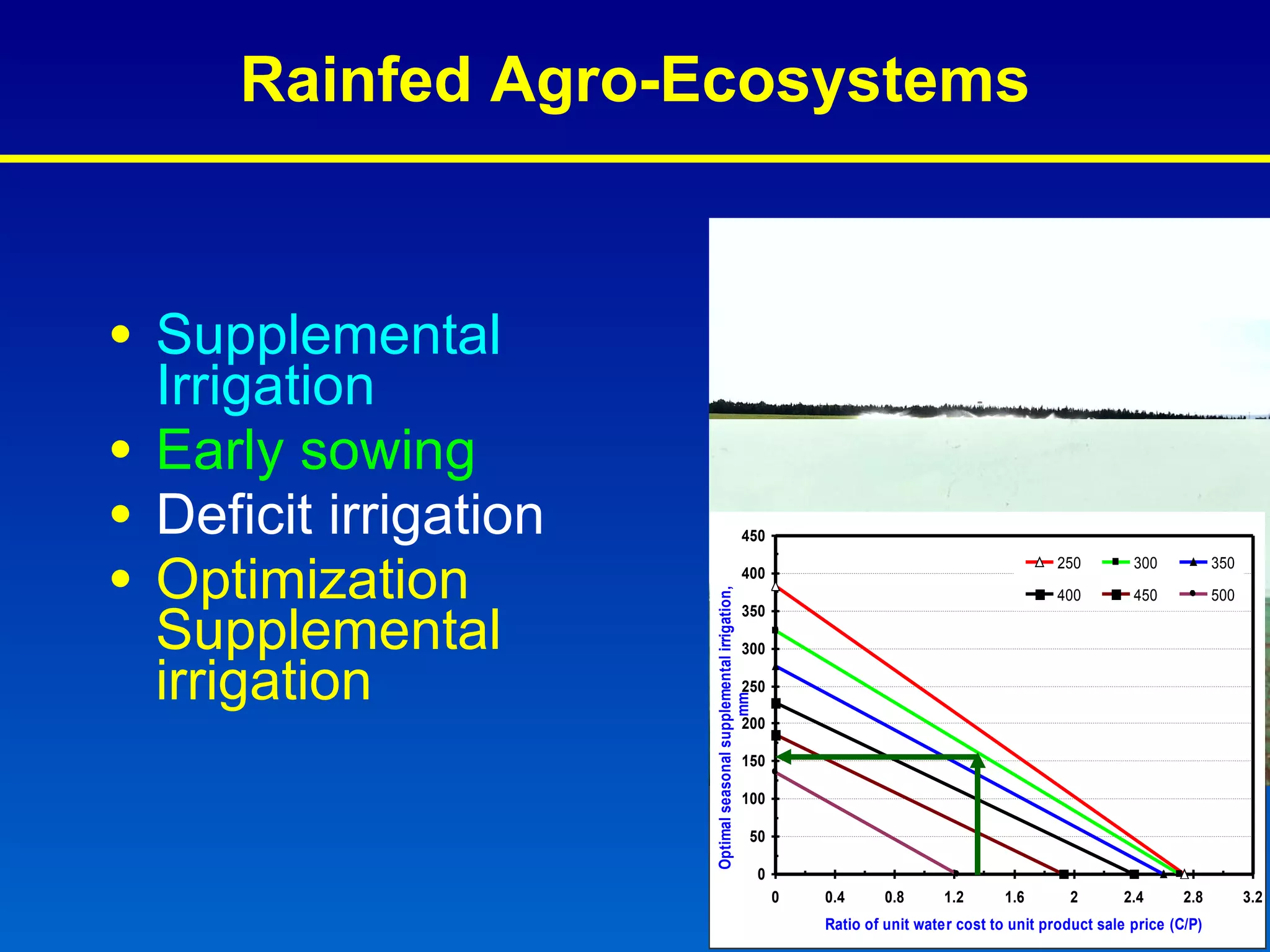
Rainfed Agro-Ecosystems Supplemental Irrigation Early sowing Deficit irrigation Optimization Supplemental irrigation
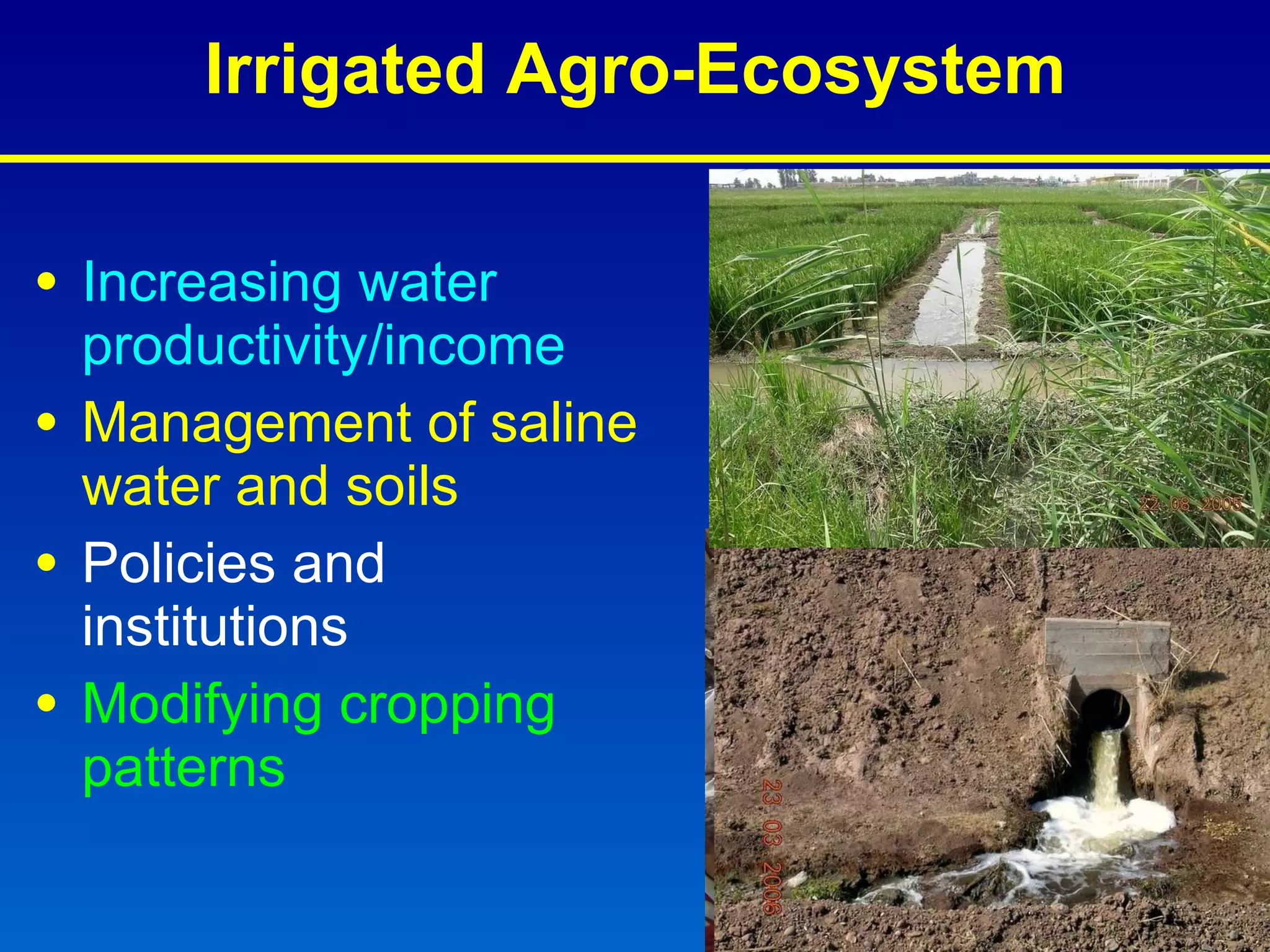
Irrigated Agro-Ecosystem Increasing water productivity/income Management of saline water and soils Policies and institutions Modifying cropping patterns
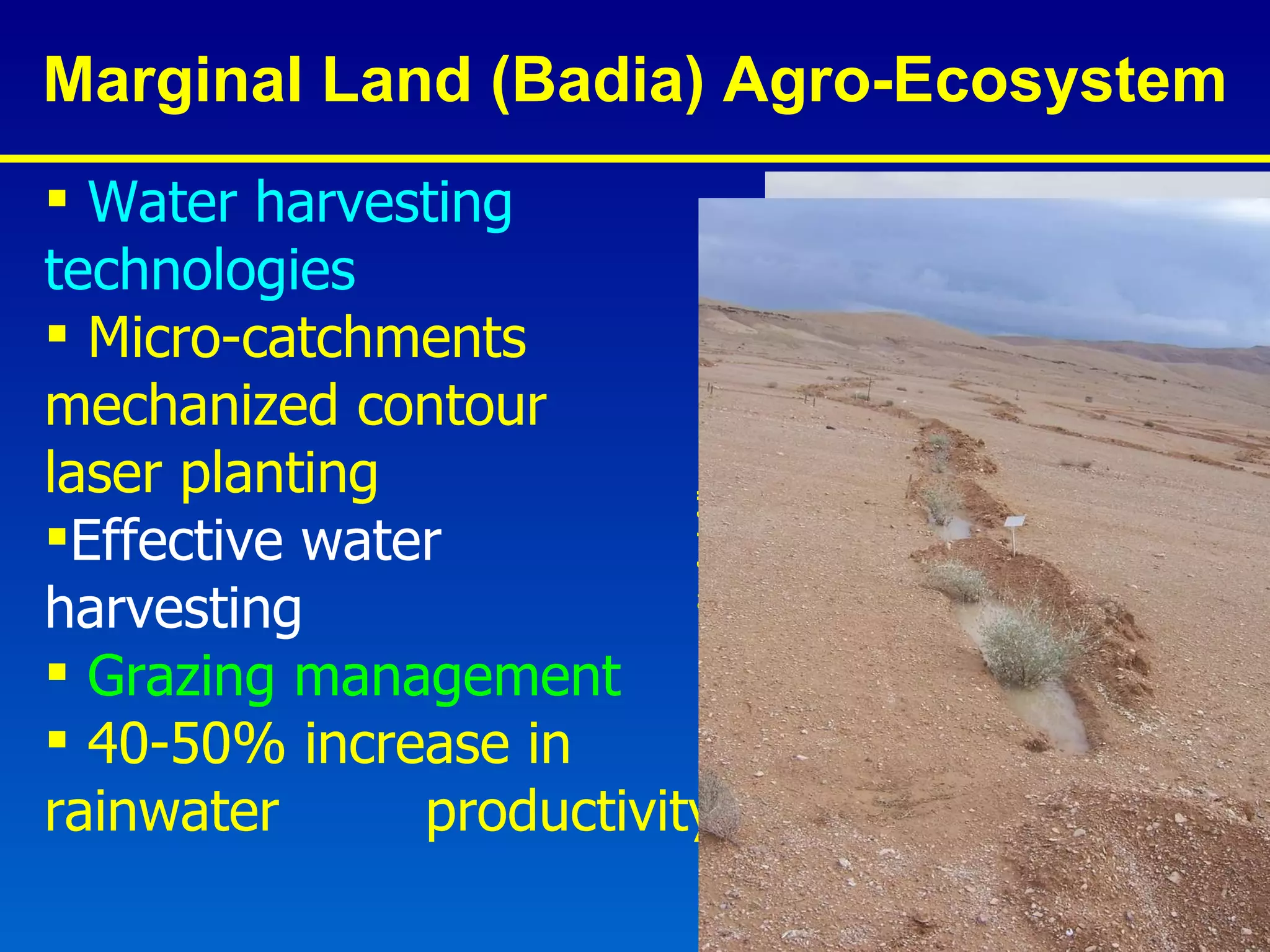
Marginal Land (Badia) Agro-Ecosystem Water harvesting  technologies Micro-catchments  mechanized contour  laser planting Effective water  harvesting Grazing management   40-50% increase in  rainwater  productivity
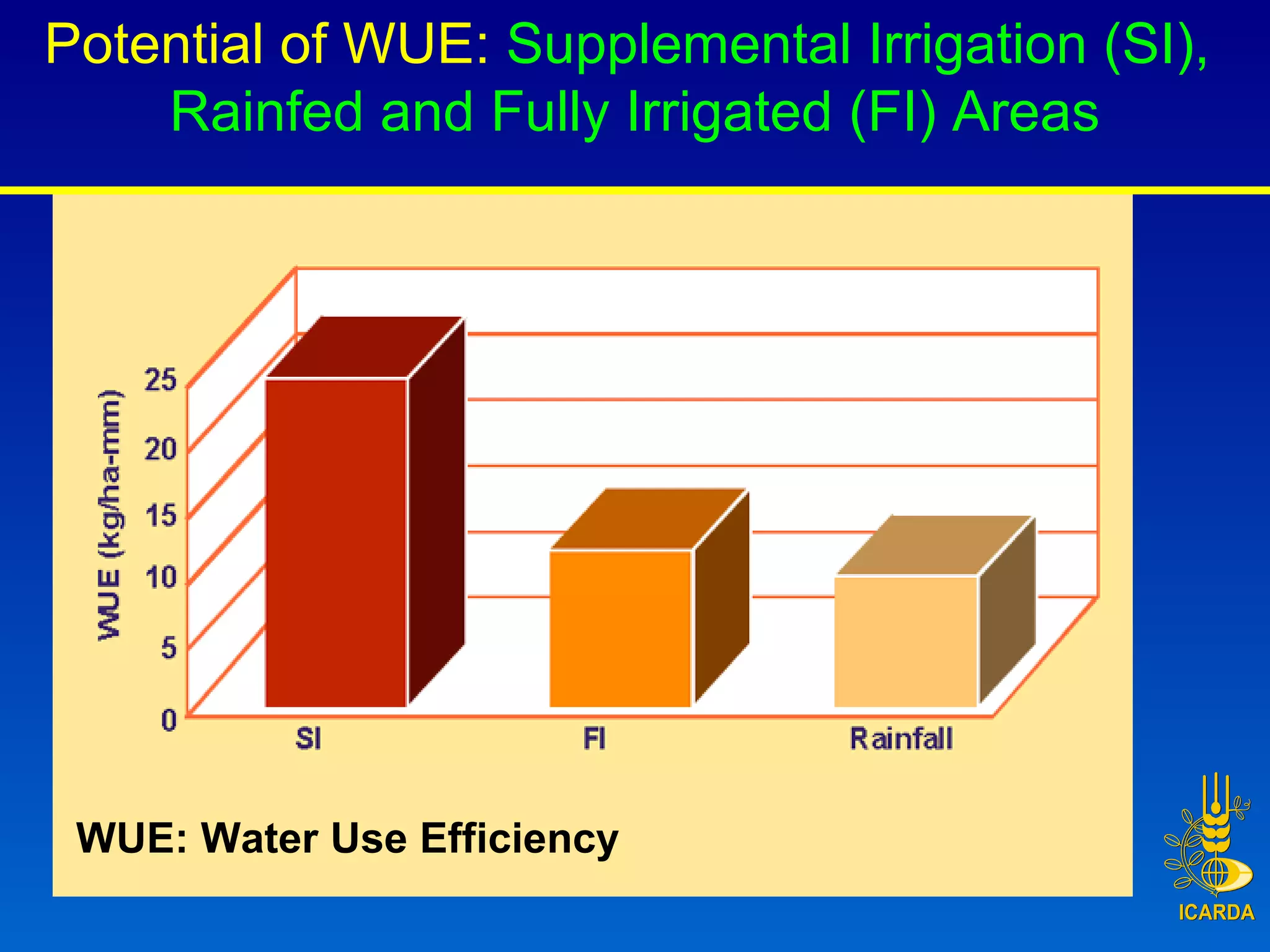
Potential of WUE:  Supplemental Irrigation (SI),  Rainfed and Fully Irrigated (FI) Areas WUE: Water Use Efficiency
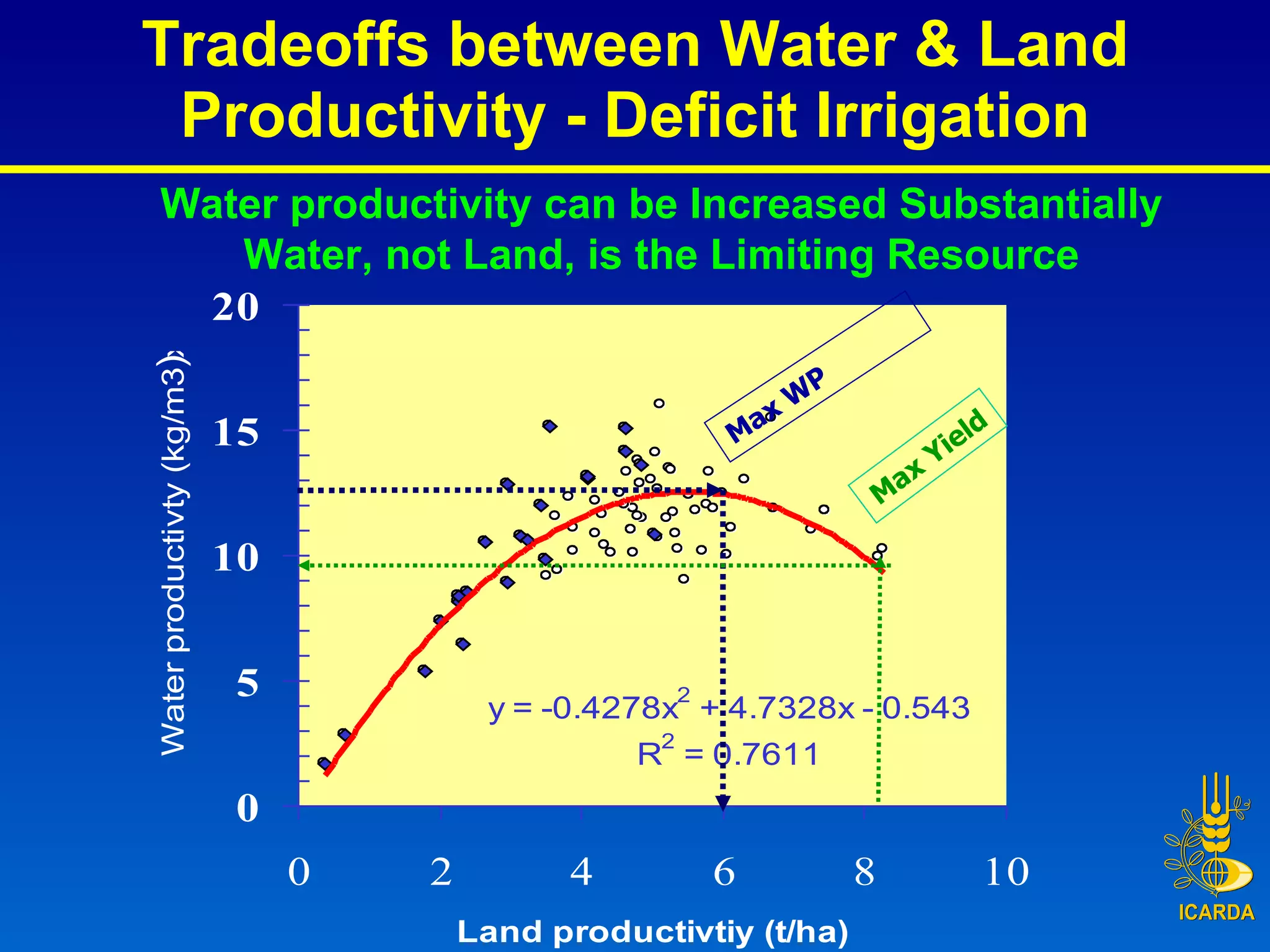
Tradeoffs between Water & Land Productivity - Deficit Irrigation Water productivity can be Increased Substantially Water, not Land, is the Limiting Resource Max WP Max Yield
Research Outputs & Technologies towards food security & better livelihoods 5.  Diversification of Production Systems with High Value Crops Dryland Fruit Trees Protected Agriculture Herbal, Medicinal and Aromatic Plants
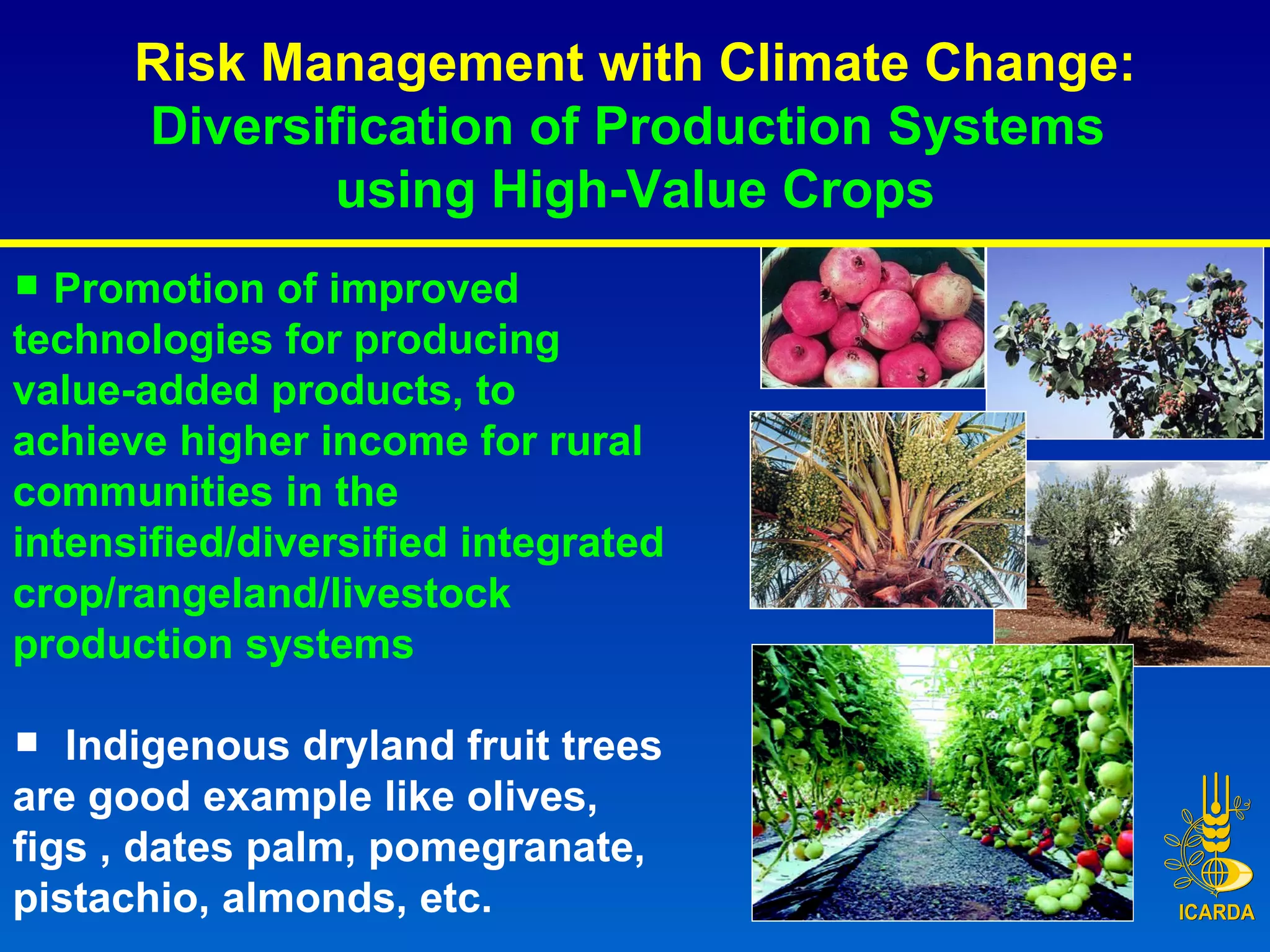
Risk Management with Climate Change:  Diversification of Production Systems  using High-Value Crops Promotion of improved technologies for producing value-added products, to achieve higher income for rural communities in the intensified/diversified integrated crop/rangeland/livestock production systems Indigenous dryland fruit trees are good example like olives, figs , dates palm, pomegranate, pistachio, almonds, etc.
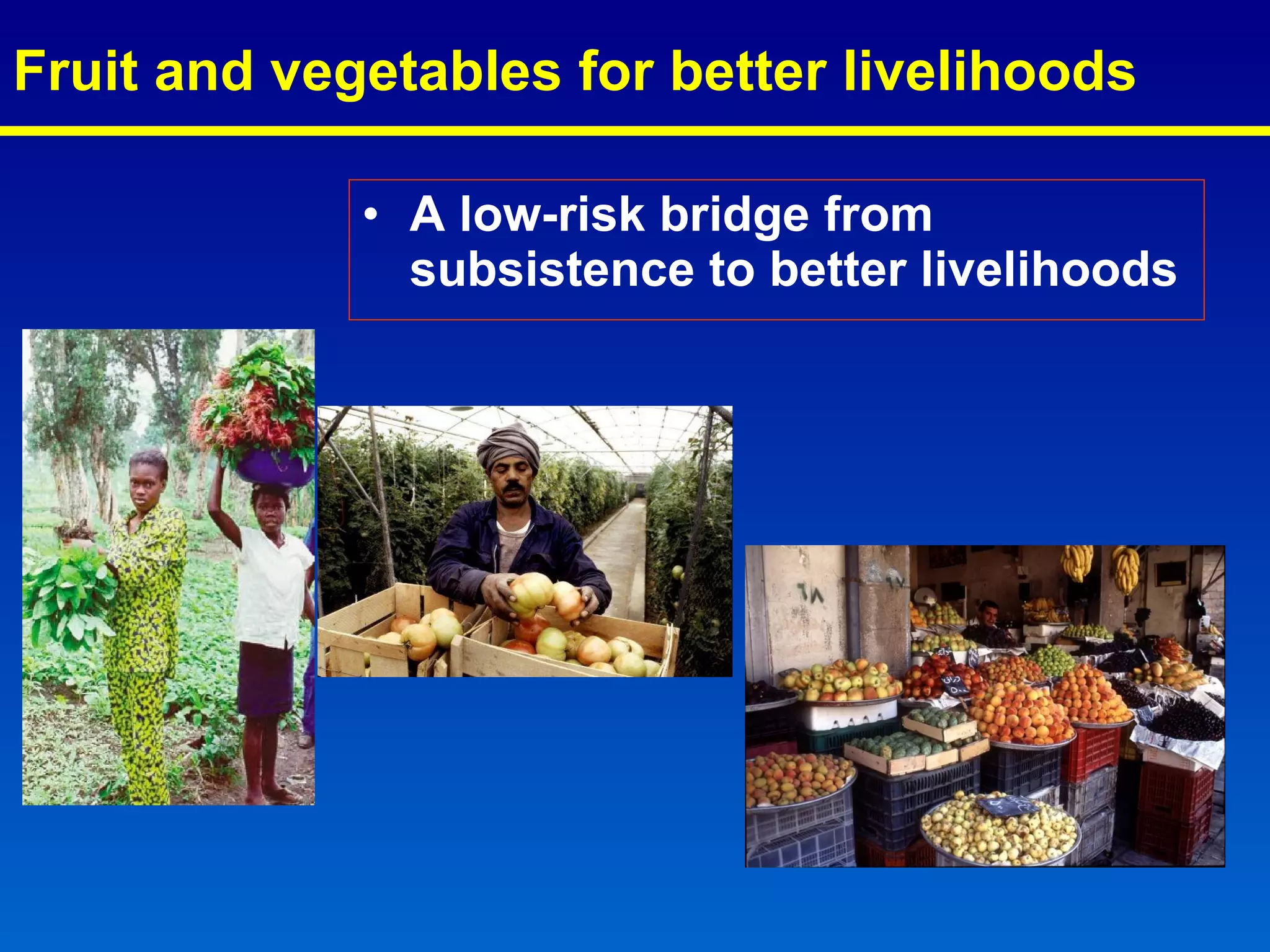
Fruit and vegetables for better livelihoods A low-risk bridge from subsistence to better livelihoods
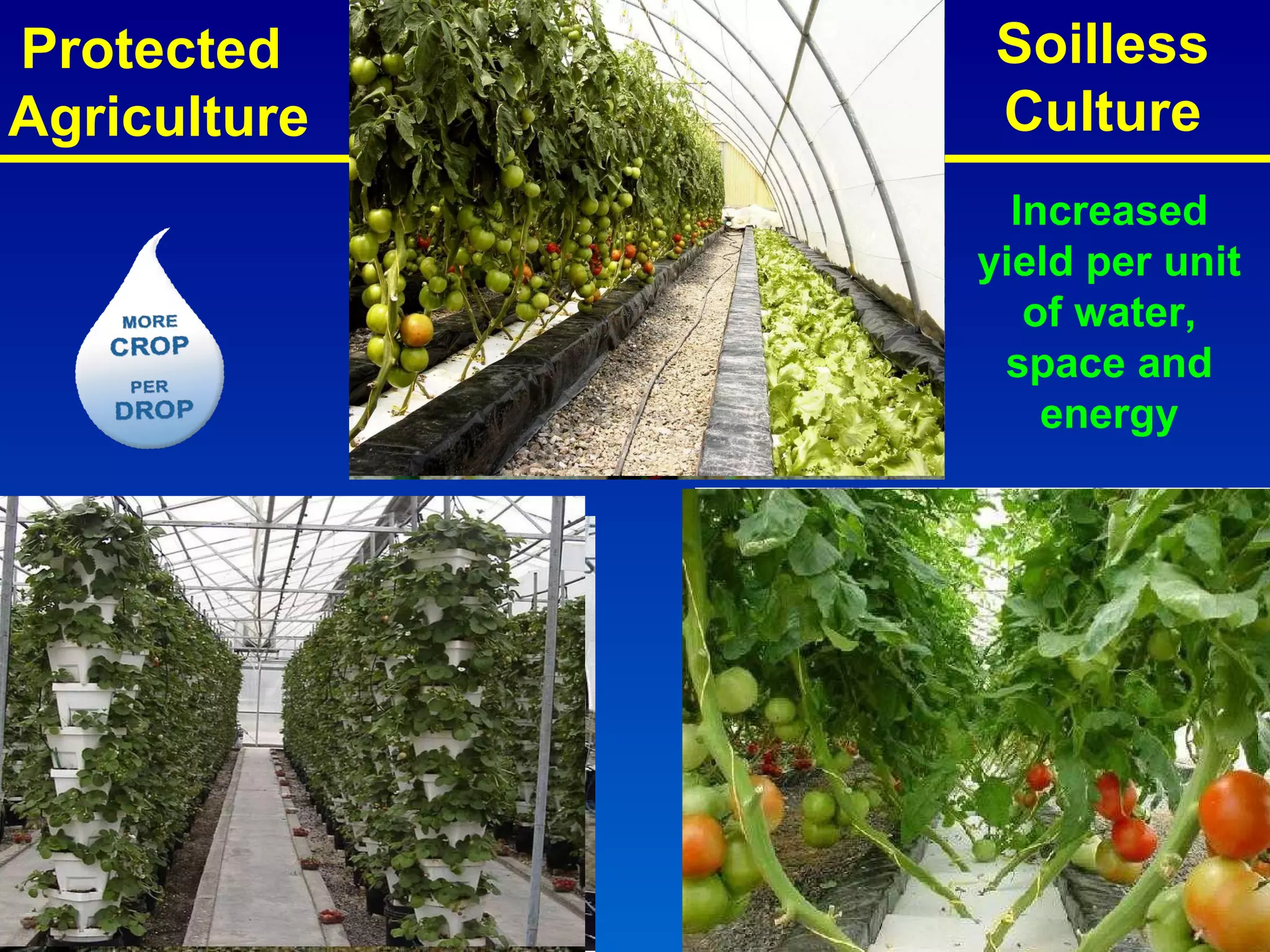
Soilless Culture Increased yield per unit of water, space and energy Protected  Agriculture
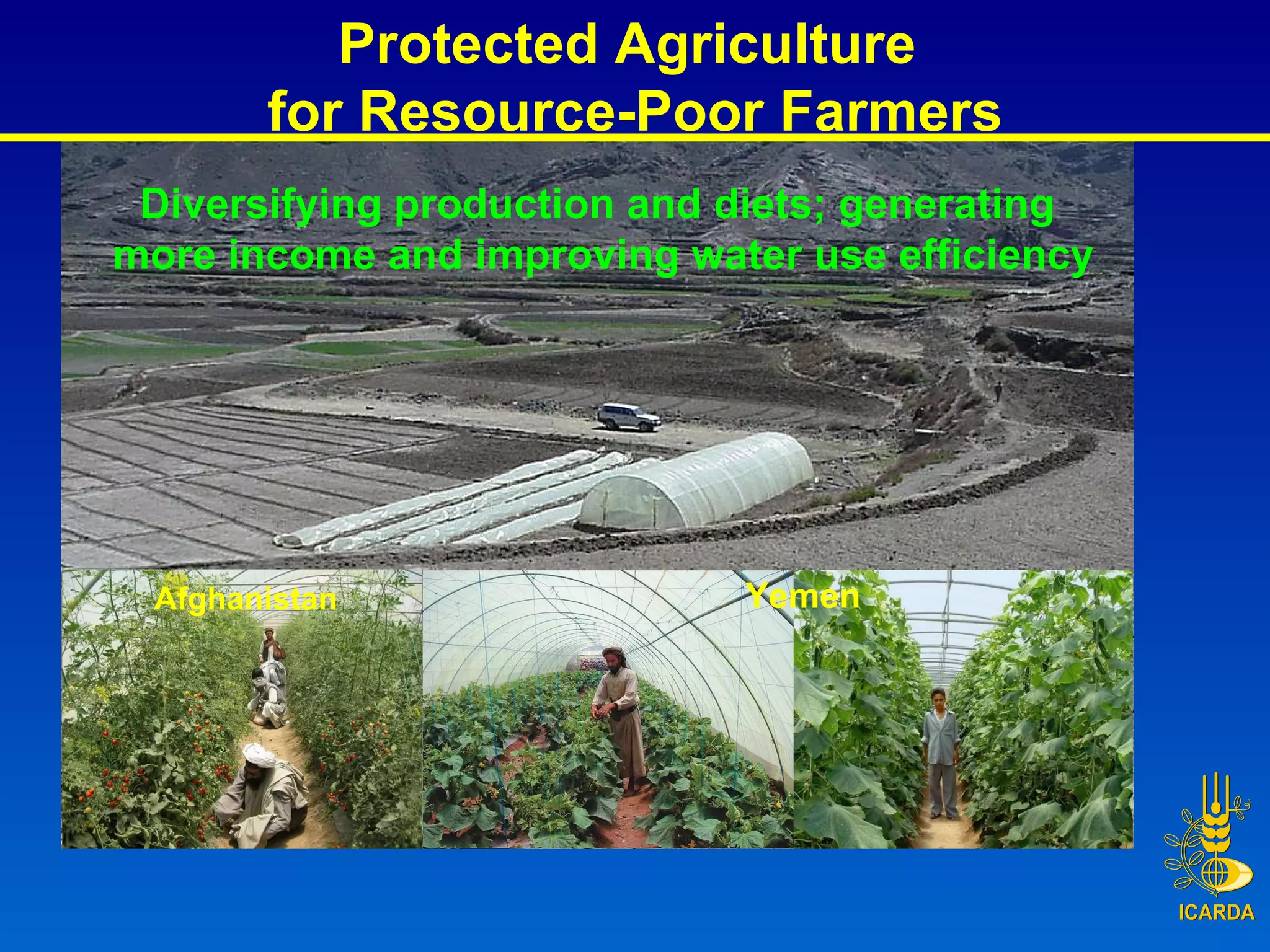
Diversifying production and diets; generating  more income and improving water use efficiency Protected Agriculture  for Resource-Poor Farmers Afghanistan Yemen
Research Outputs & Technologies towards food security & better livelihoods 6. Geographic Information System (GIS) Land use mapping to promote diversification of production systems Maps for potential areas for water harvesting Maps for potential areas for de-rocking
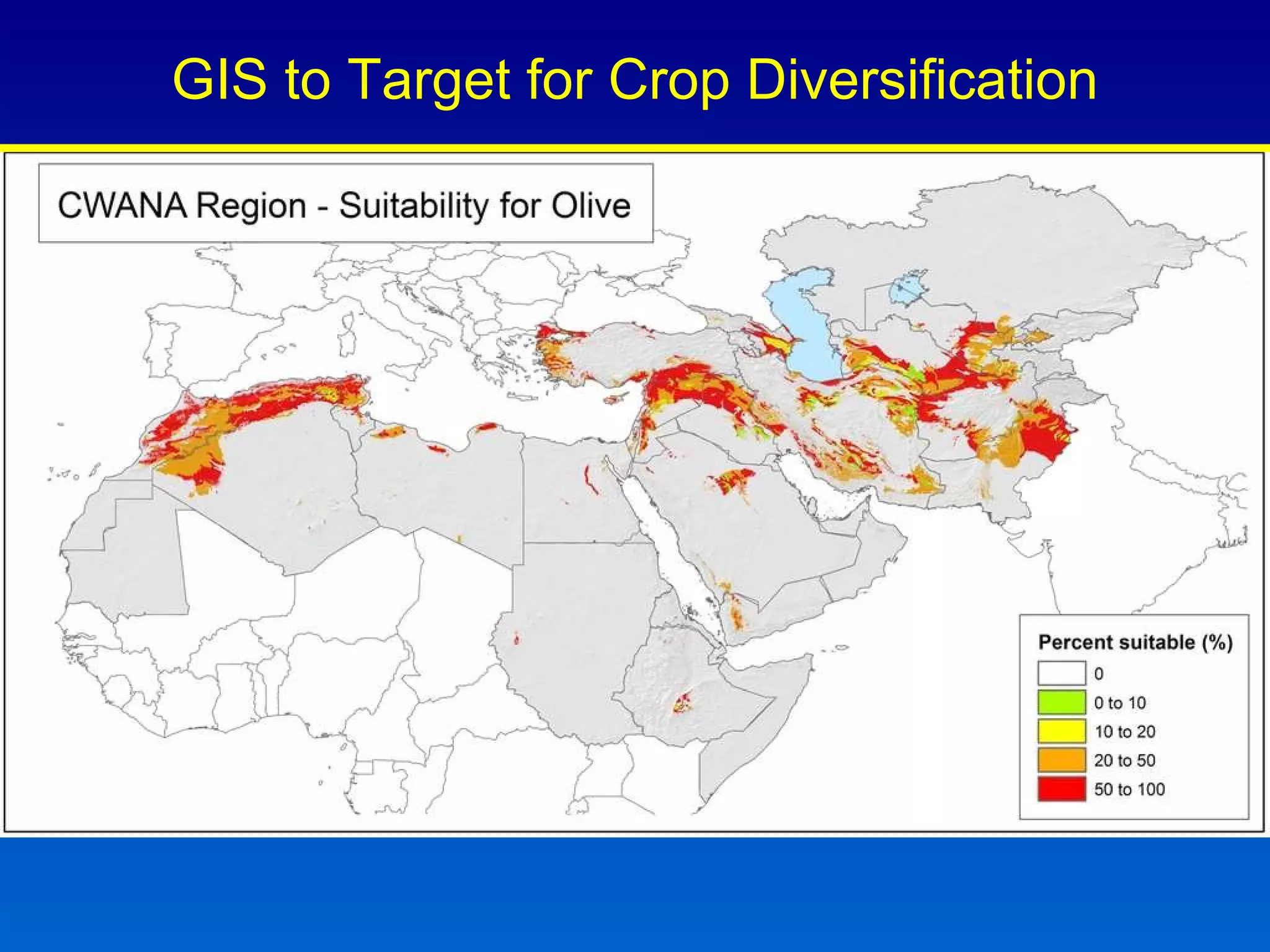
GIS to Target for Crop Diversification
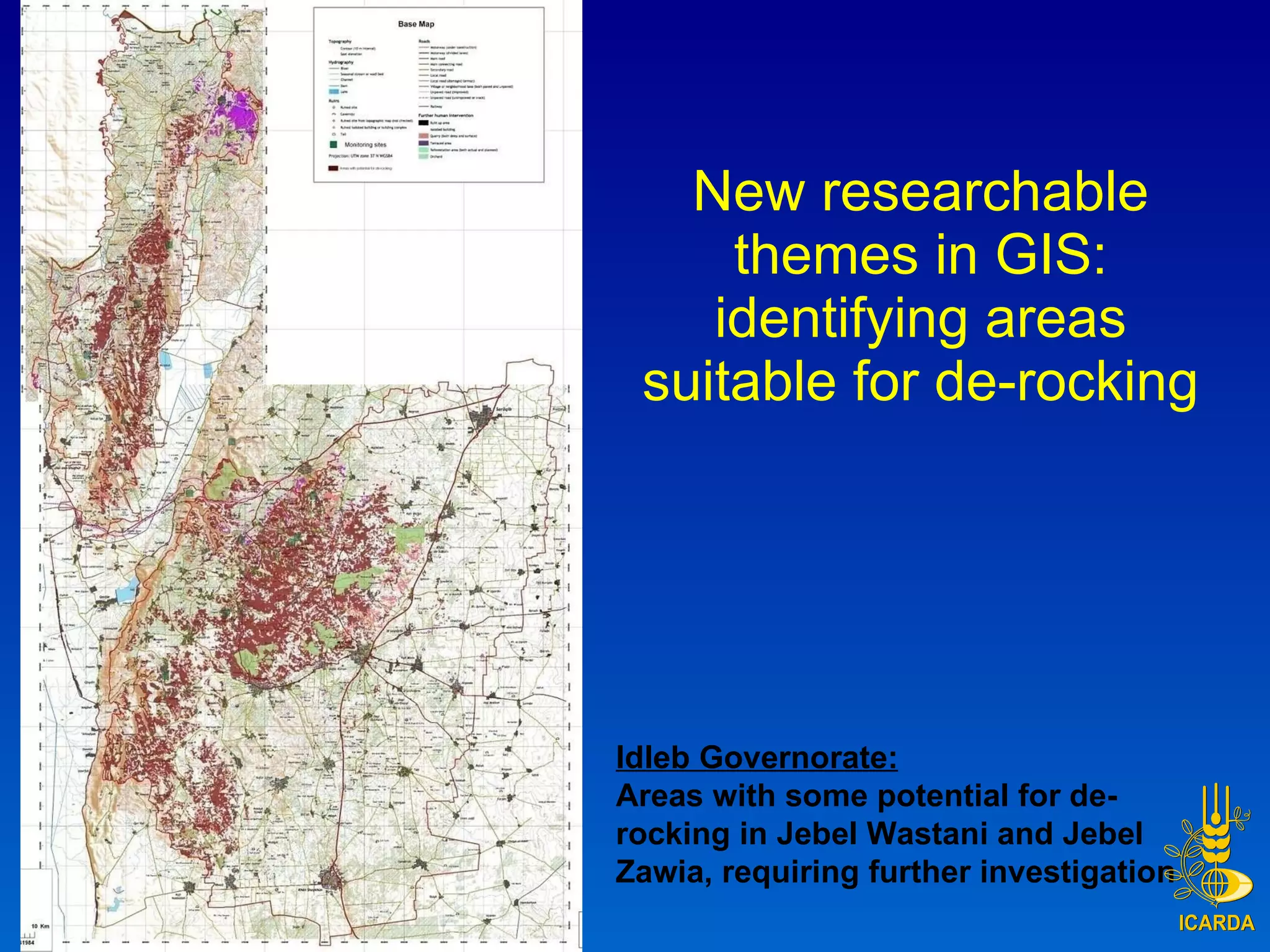
New researchable themes in GIS: identifying areas suitable for de-rocking Idleb Governorate: Areas with some potential for de-rocking in Jebel Wastani and Jebel Zawia, requiring further investigation
Research Outputs & Technologies towards food security & better livelihoods 7. Conservation Agriculture: - Zero-Tillage Technology
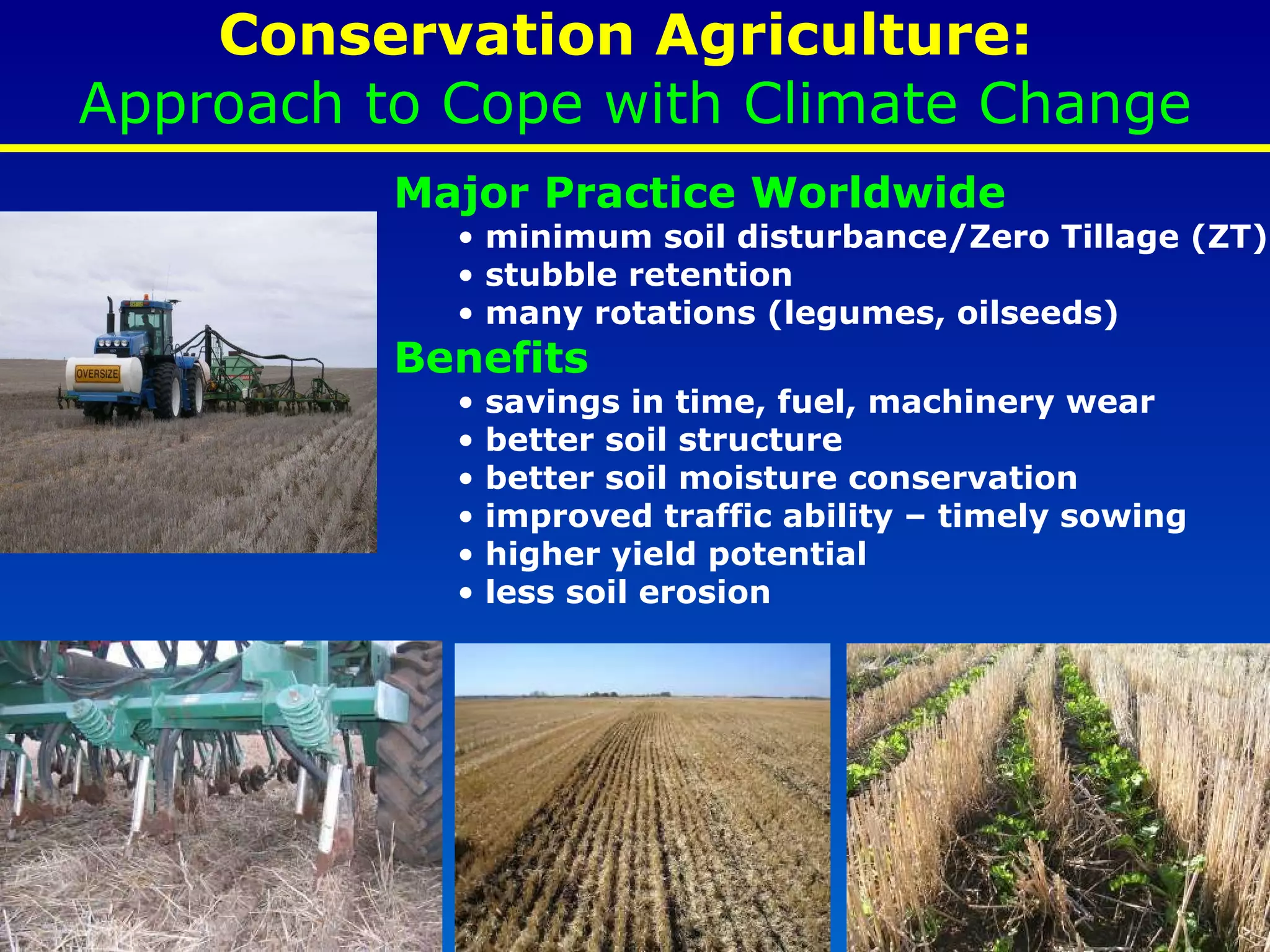
Conservation Agriculture:  Approach to Cope with Climate Change Major Practice Worldwide minimum soil disturbance/Zero Tillage (ZT) stubble retention many rotations (legumes, oilseeds) Benefits savings in time, fuel, machinery wear better soil structure better soil moisture conservation improved traffic ability  – timely sowing higher yield potential less soil erosion
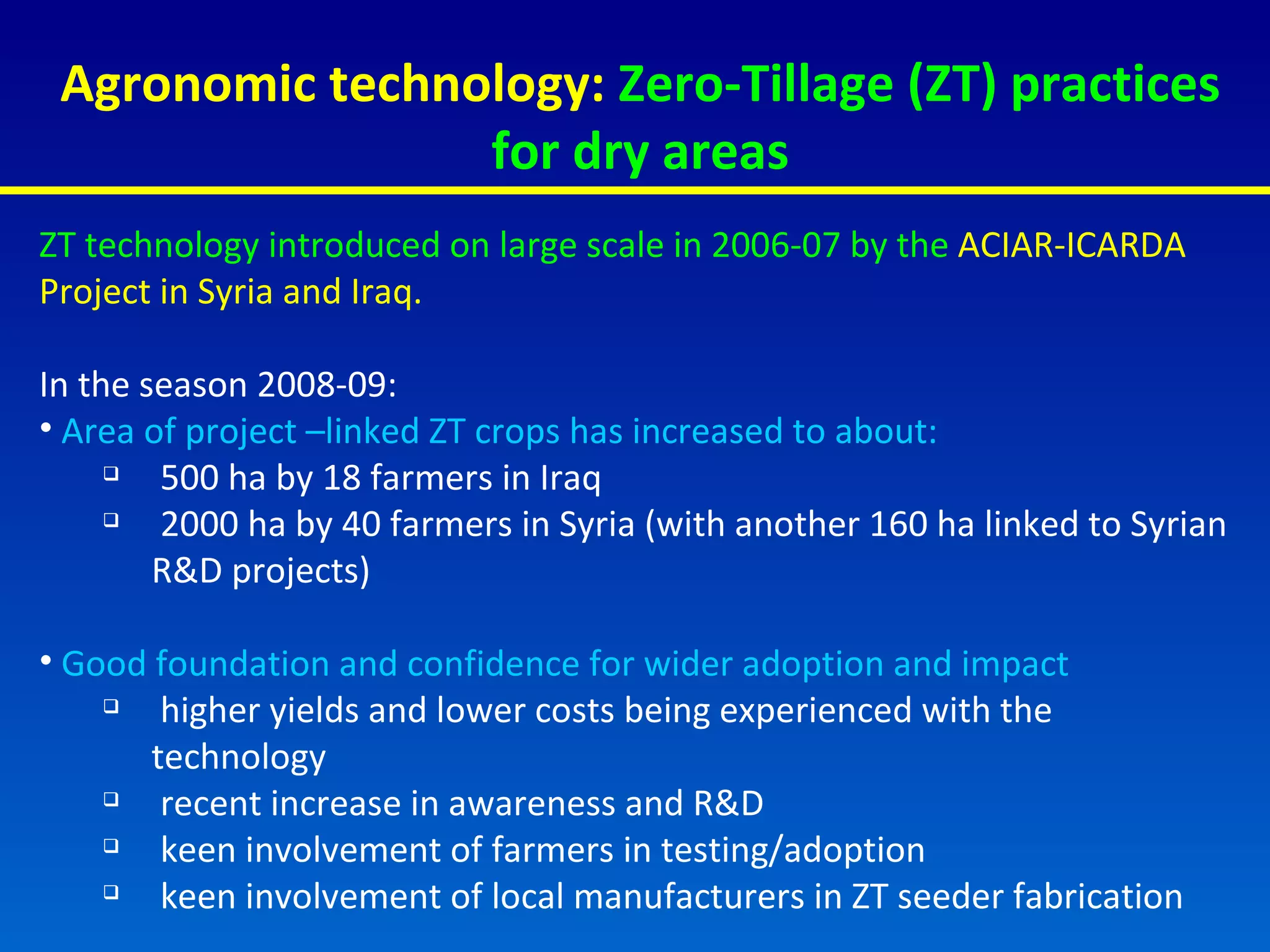
Agronomic technology:  Zero-Tillage (ZT) practices for dry areas ZT technology introduced on large scale in 2006-07 by the  ACIAR-ICARDA Project in Syria and Iraq.  In the season 2008-09: Area of project –linked ZT crops has increased to about: 500 ha by 18 farmers in Iraq 2000 ha by 40 farmers in Syria (with another 160 ha linked to Syrian R&D projects)  Good foundation and confidence for wider adoption and impact higher yields and lower costs being experienced with the technology recent increase in awareness and R&D keen involvement of farmers in testing/adoption keen involvement of local manufacturers in ZT seeder fabrication
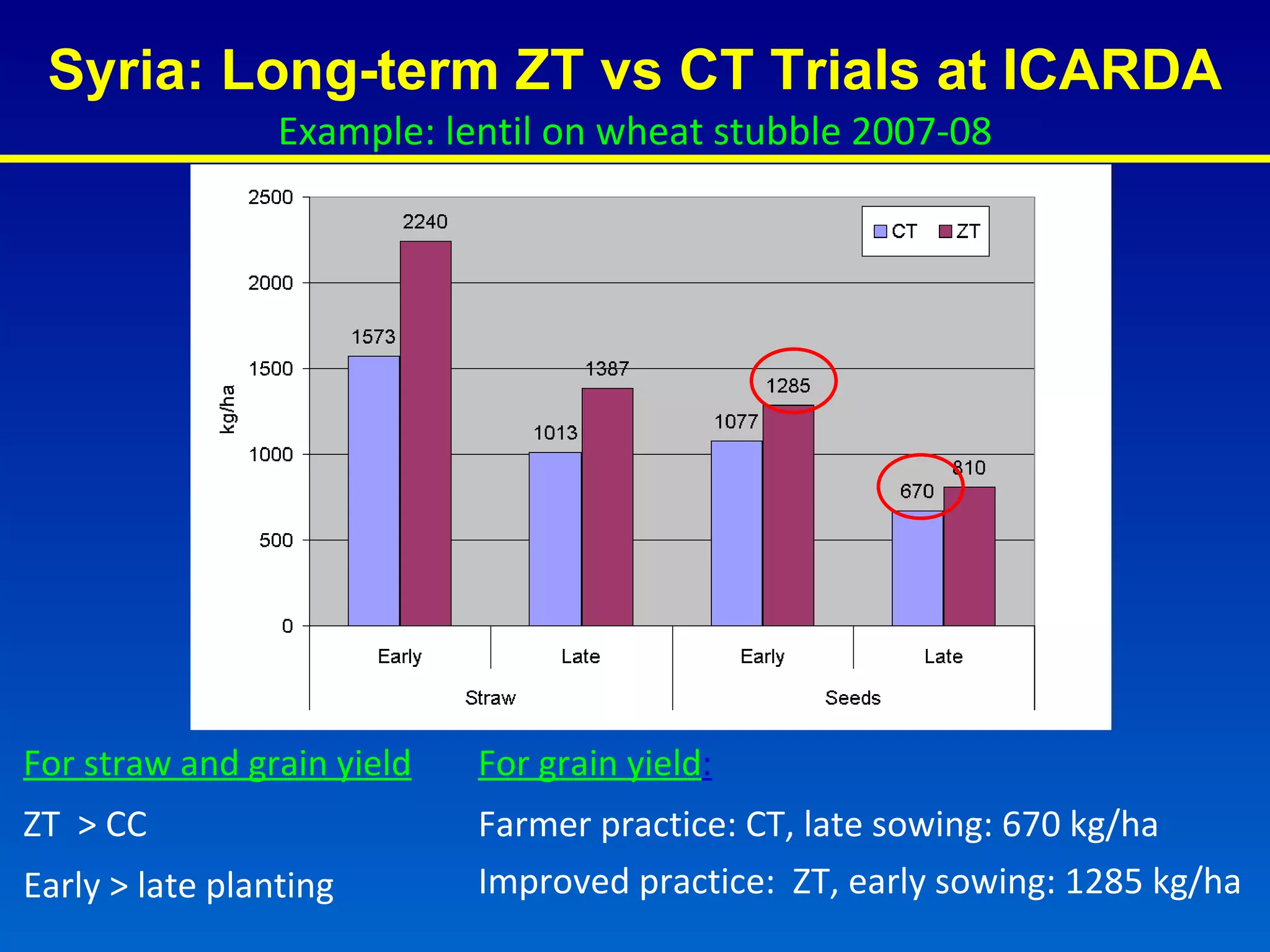
Syria: Long-term ZT vs CT Trials at ICARDA For straw and grain yield ZT  > CC Early > late planting For grain yield : Farmer practice: CT, late sowing: 670 kg/ha Improved practice:  ZT, early sowing: 1285 kg/ha Example: lentil on wheat stubble 2007-08
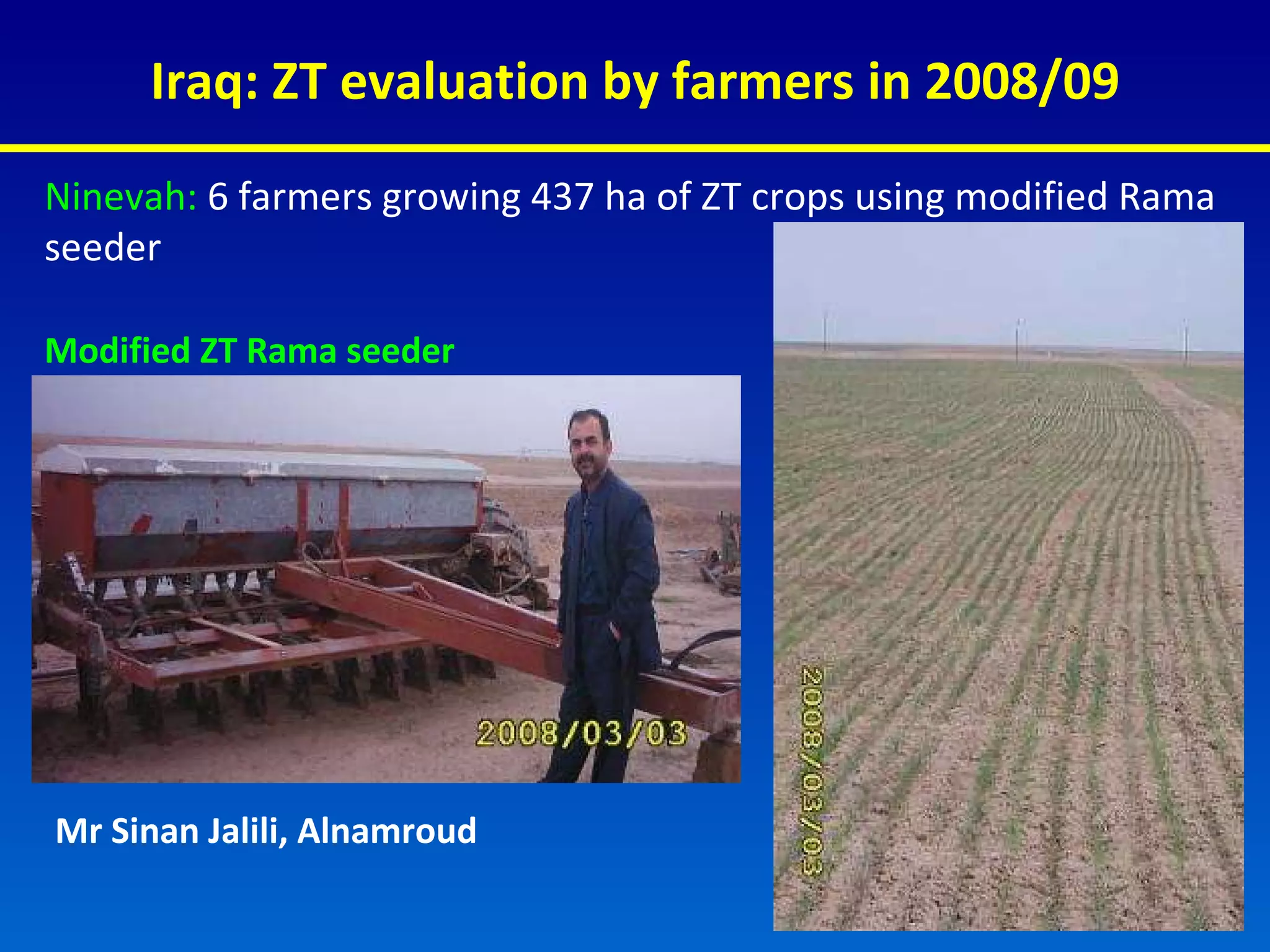
Iraq: ZT evaluation by farmers in 2008/09 Azaz Tel Kief Ninevah:   6 farmers growing 437 ha of ZT crops using modified Rama seeder Mr Sinan Jalili, Alnamroud Modified ZT Rama seeder
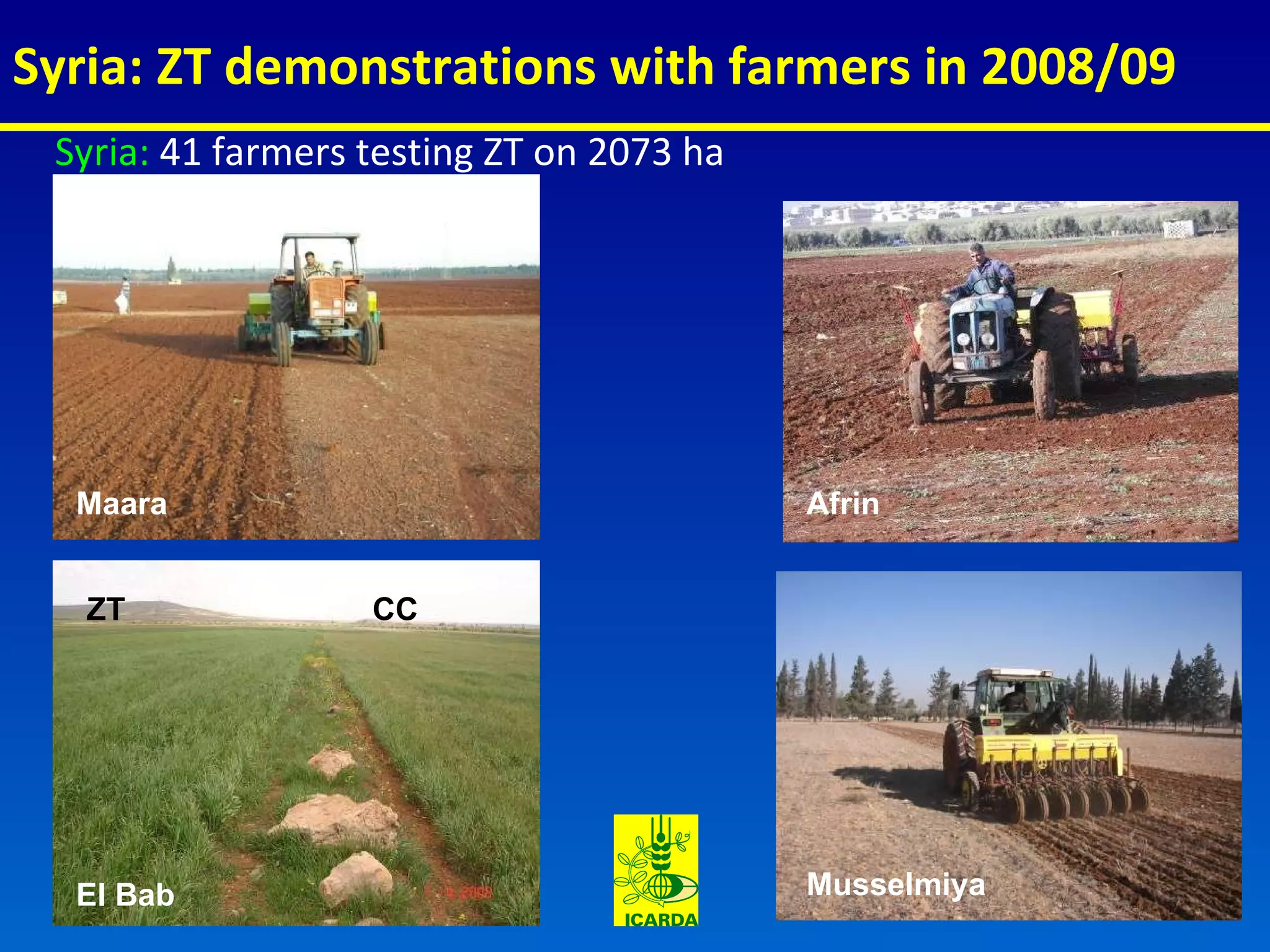
Syria: ZT demonstrations with farmers in 2008/09 Afrin El Bab Syria:  41 farmers testing ZT on 2073 ha Musselmiya Maara ZT CC
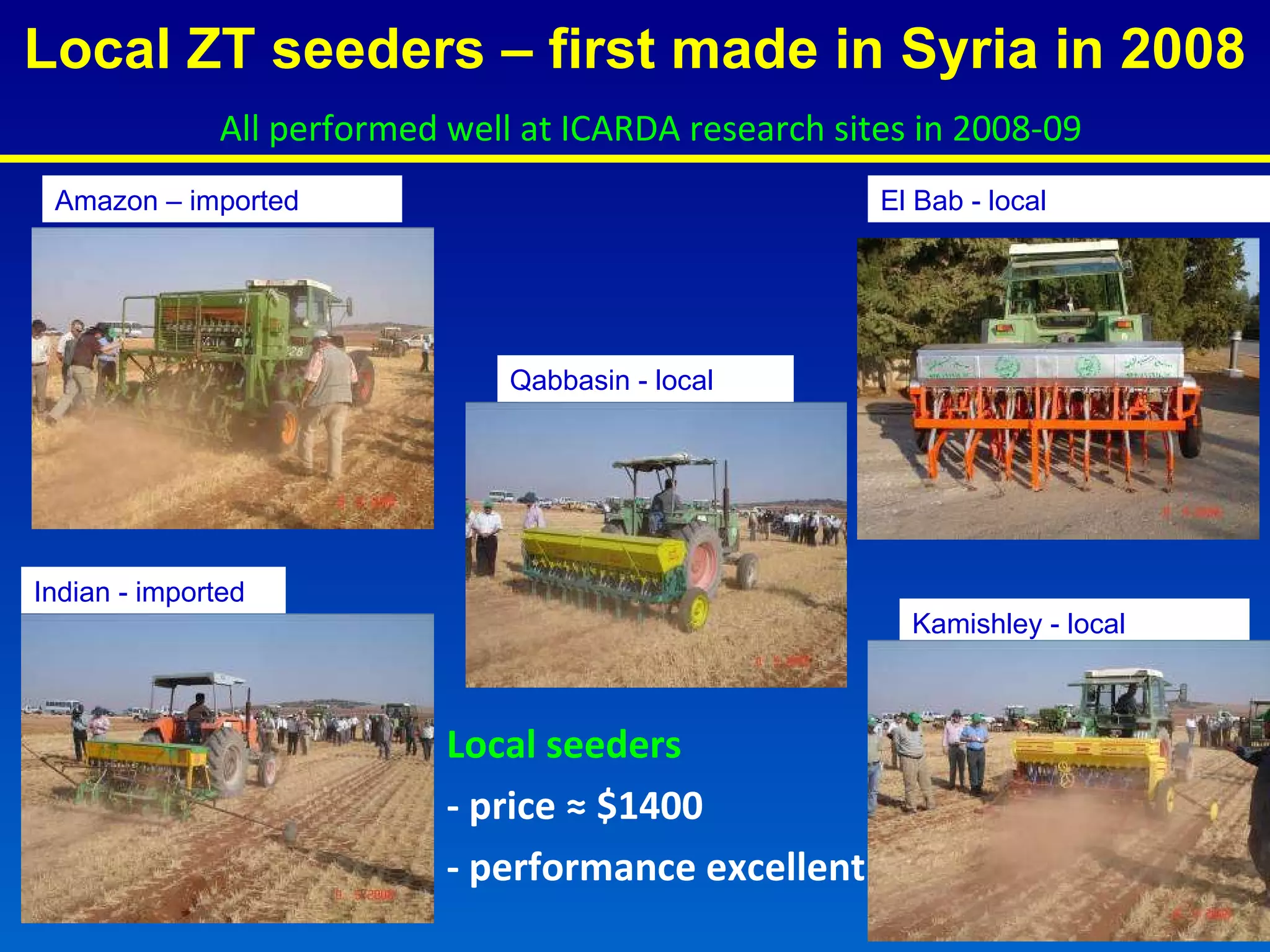
Local ZT seeders – first made in Syria in 2008 Kamishley - local El Bab - local Qabbasin - local Amazon – imported Indian - imported Local seeders - price ≈ $1400 - performance excellent All performed well at ICARDA research sites in 2008-09
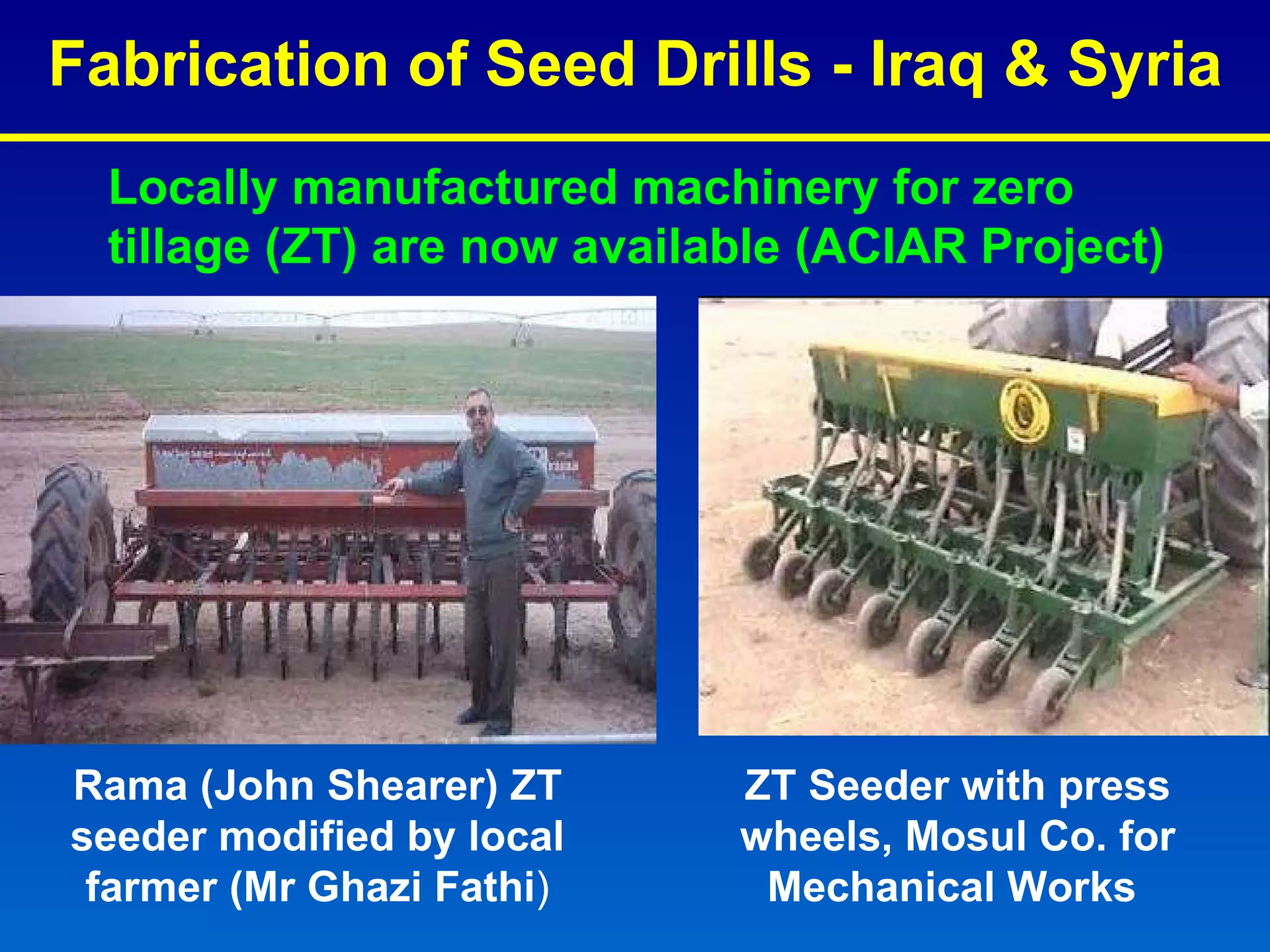
Fabrication of Seed Drills - Iraq & Syria ZT Seeder with press wheels, Mosul Co. for Mechanical Works  Rama (John Shearer) ZT seeder modified by local farmer ( Mr Ghazi Fathi ) Locally manufactured machinery for zero tillage (ZT) are now available (ACIAR Project)
Research Outputs & Technologies towards food security & better livelihoods 8. Livestock-Based Production Systems:  - Strategic feeding of low cost balanced diets  - Technologies for fodder production - Technology for improved milking  - Technology for improved yogurt processing  -   Technology for improved cheese processing
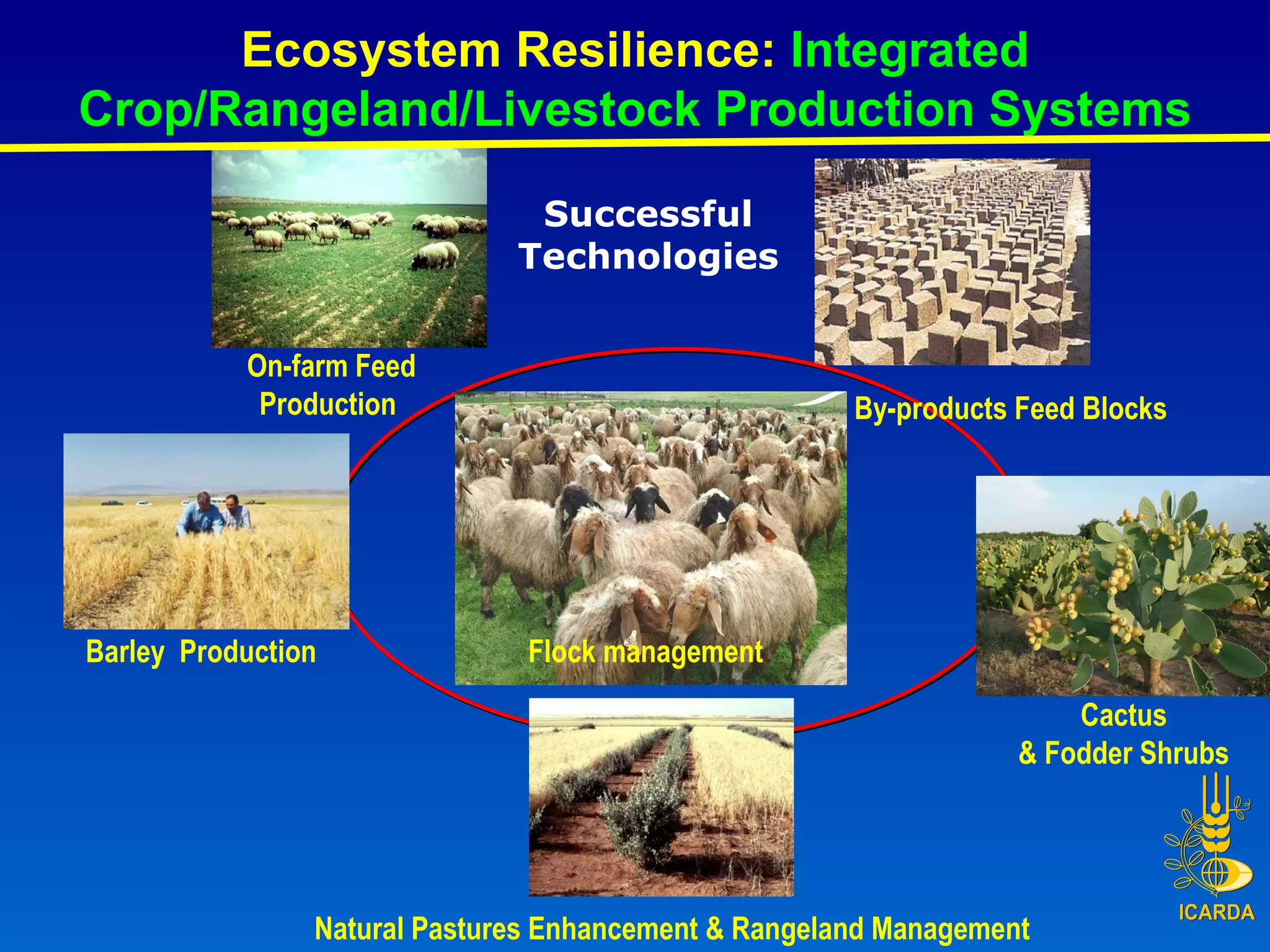
Ecosystem Resilience:  Integrated Crop/Rangeland/Livestock Production Systems Barley  Production Cactus & Fodder Shrubs By-products Feed Blocks On-farm Feed Production   Natural Pastures Enhancement & Rangeland Management Successful Technologies Flock management
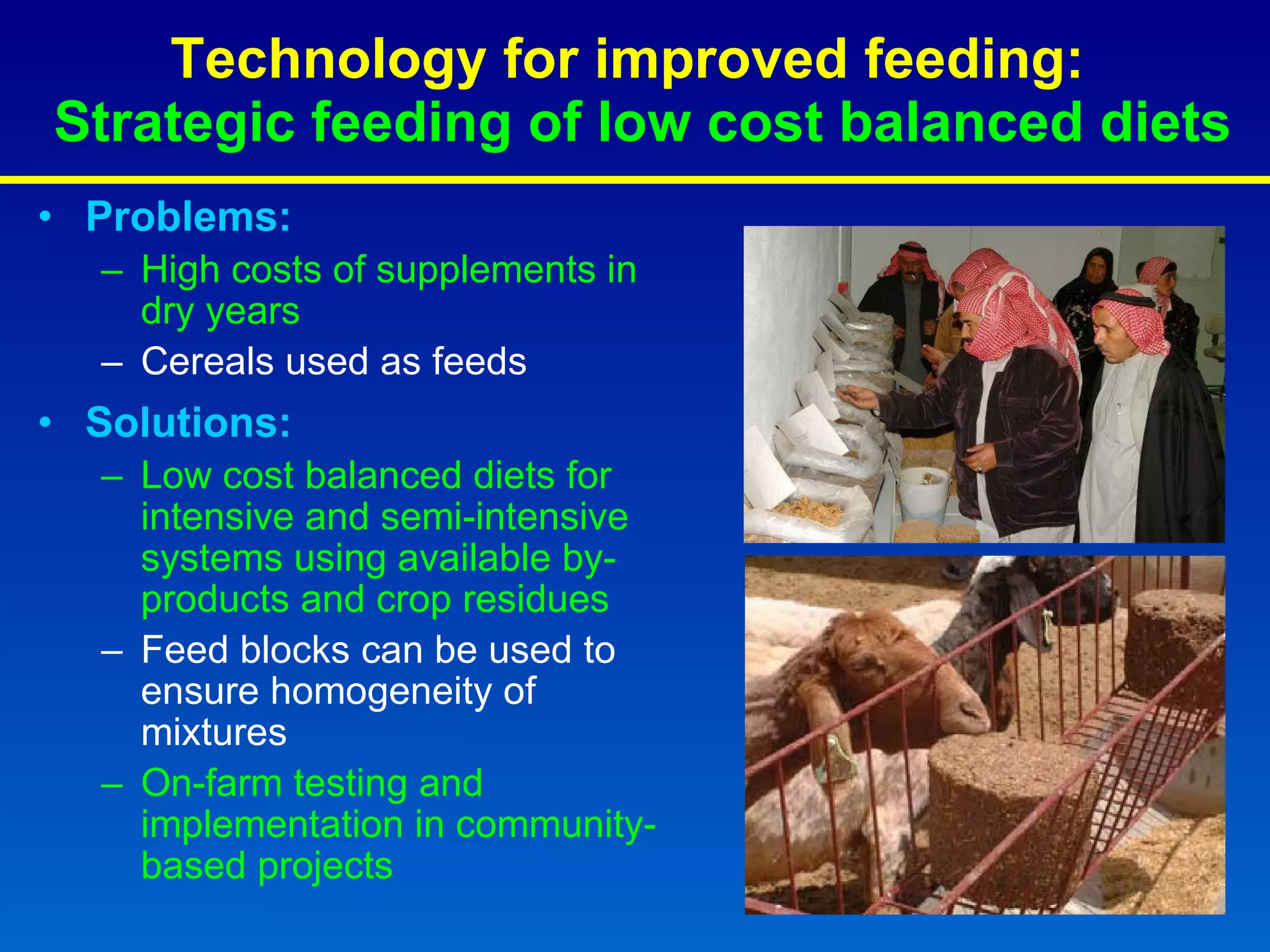
Problems: High costs of supplements in dry years Cereals used as feeds Solutions: Low cost balanced diets for intensive and semi-intensive systems using available by-products and crop residues Feed blocks can be used to ensure homogeneity of mixtures On-farm testing and implementation in community-based projects Technology for improved feeding:    Strategic feeding of low cost balanced diets
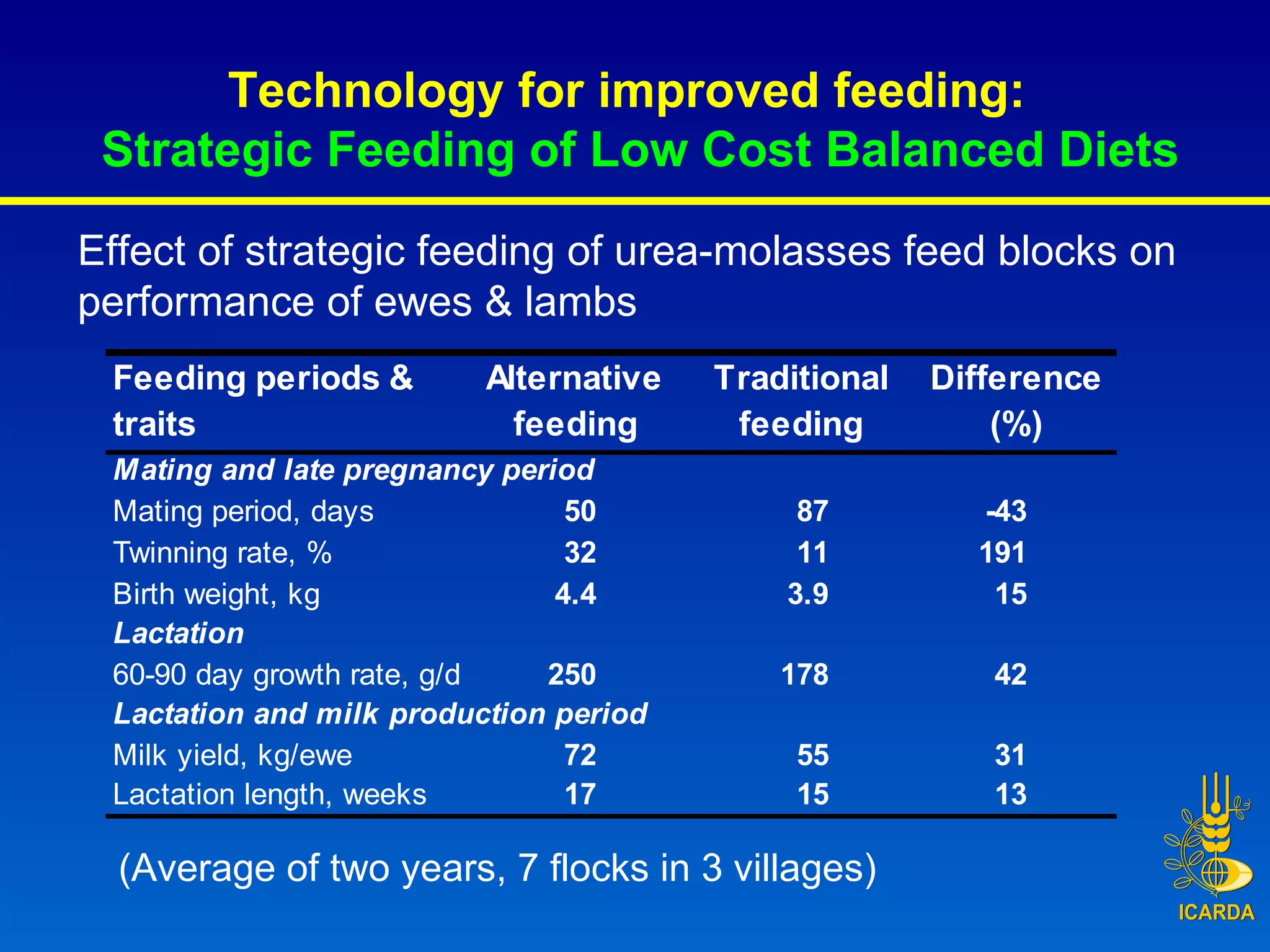
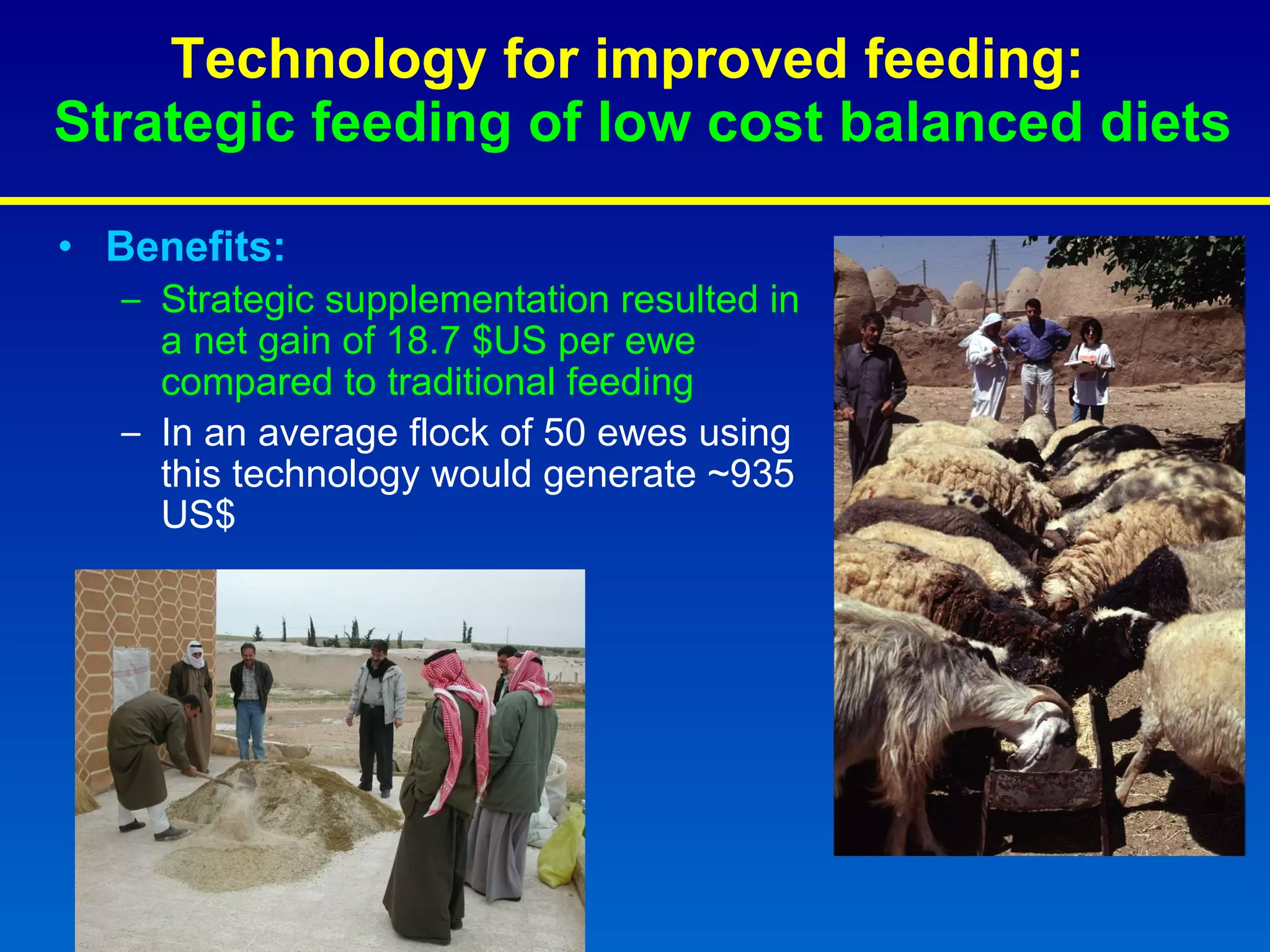
Effect of strategic feeding of urea-molasses feed blocks on performance of ewes & lambs (Average of two years, 7 flocks in 3 villages) Technology for improved feeding:   Strategic Feeding of Low Cost Balanced Diets
Benefits: Strategic supplementation resulted in a net gain of 18.7 $US per ewe compared to traditional feeding  In an average flock of 50 ewes using this technology would generate ~935 US$ Technology for improved feeding:   Strategic feeding of low cost balanced diets
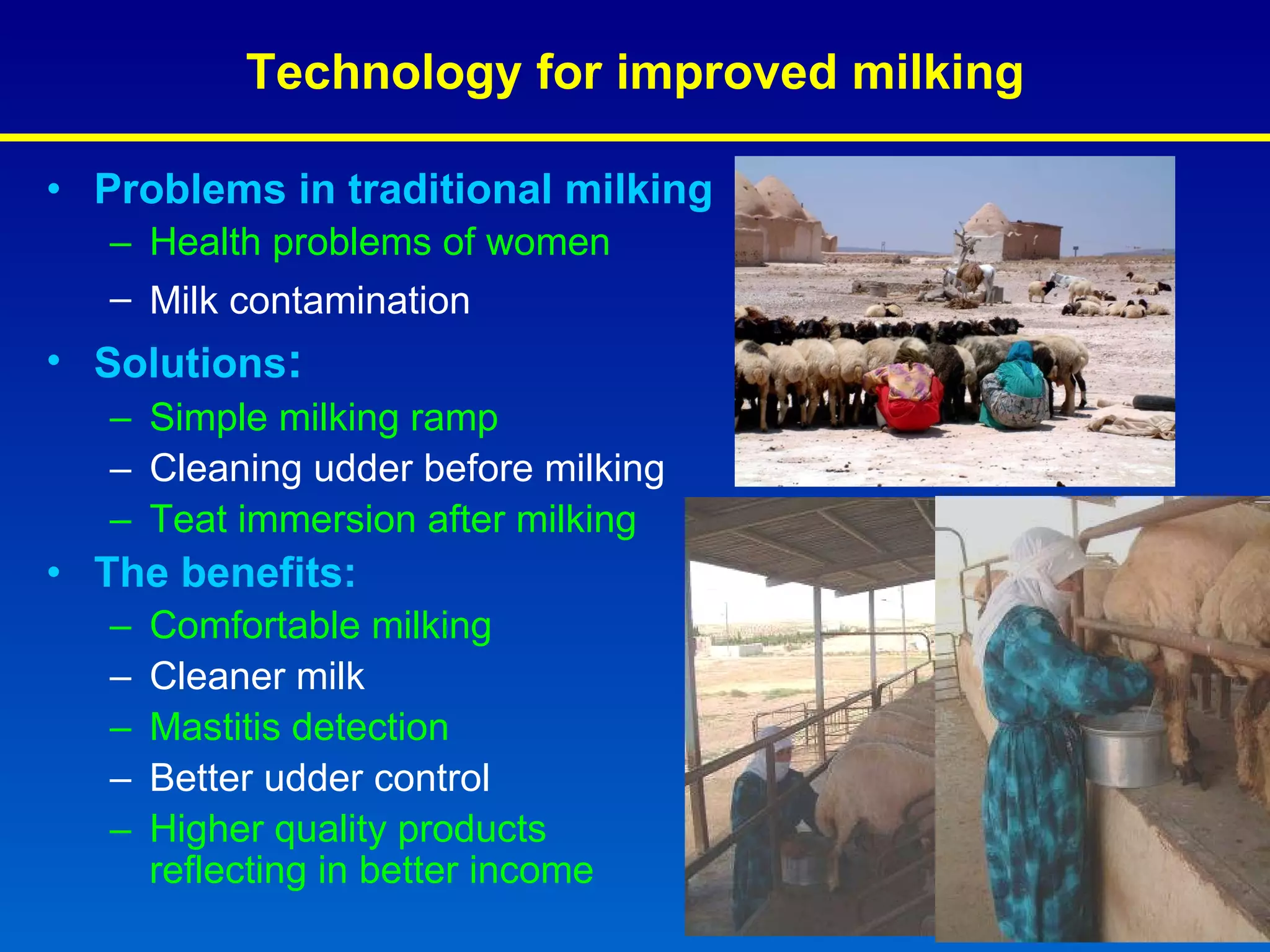
Technology for improved milking Problems in traditional milking Health problems of women Milk contamination   Solutions : Simple milking ramp   Cleaning udder before milking Teat immersion after milking The benefits:   Comfortable milking Cleaner milk Mastitis detection Better udder control Higher quality products  reflecting in better income
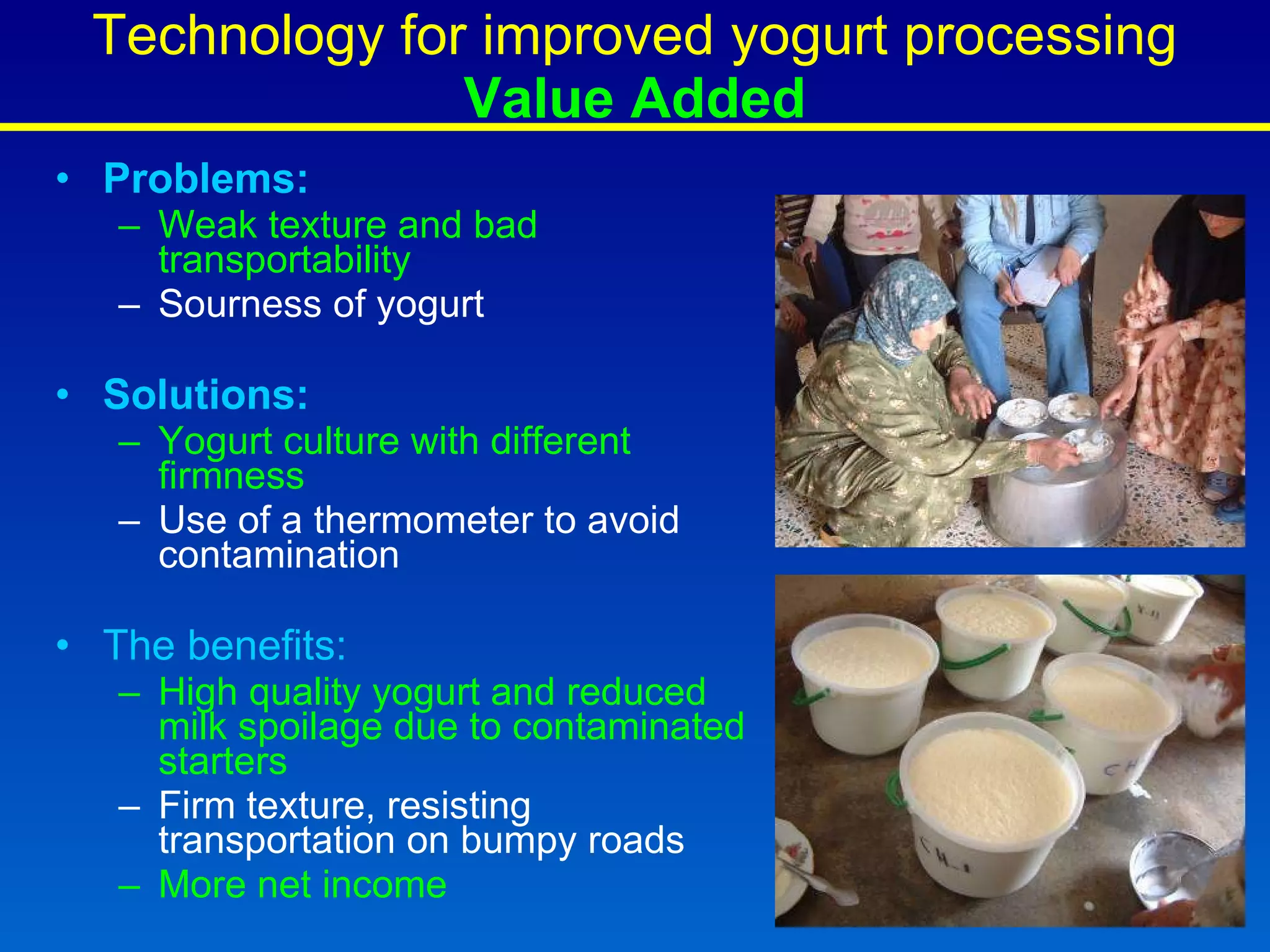
Technology for improved yogurt processing  Value Added Problems: Weak texture and bad transportability Sourness of yogurt  Solutions: Yogurt culture with different firmness Use of a thermometer to avoid contamination The benefits: High quality yogurt and reduced milk spoilage due to contaminated starters Firm texture, resisting transportation on bumpy roads More net income
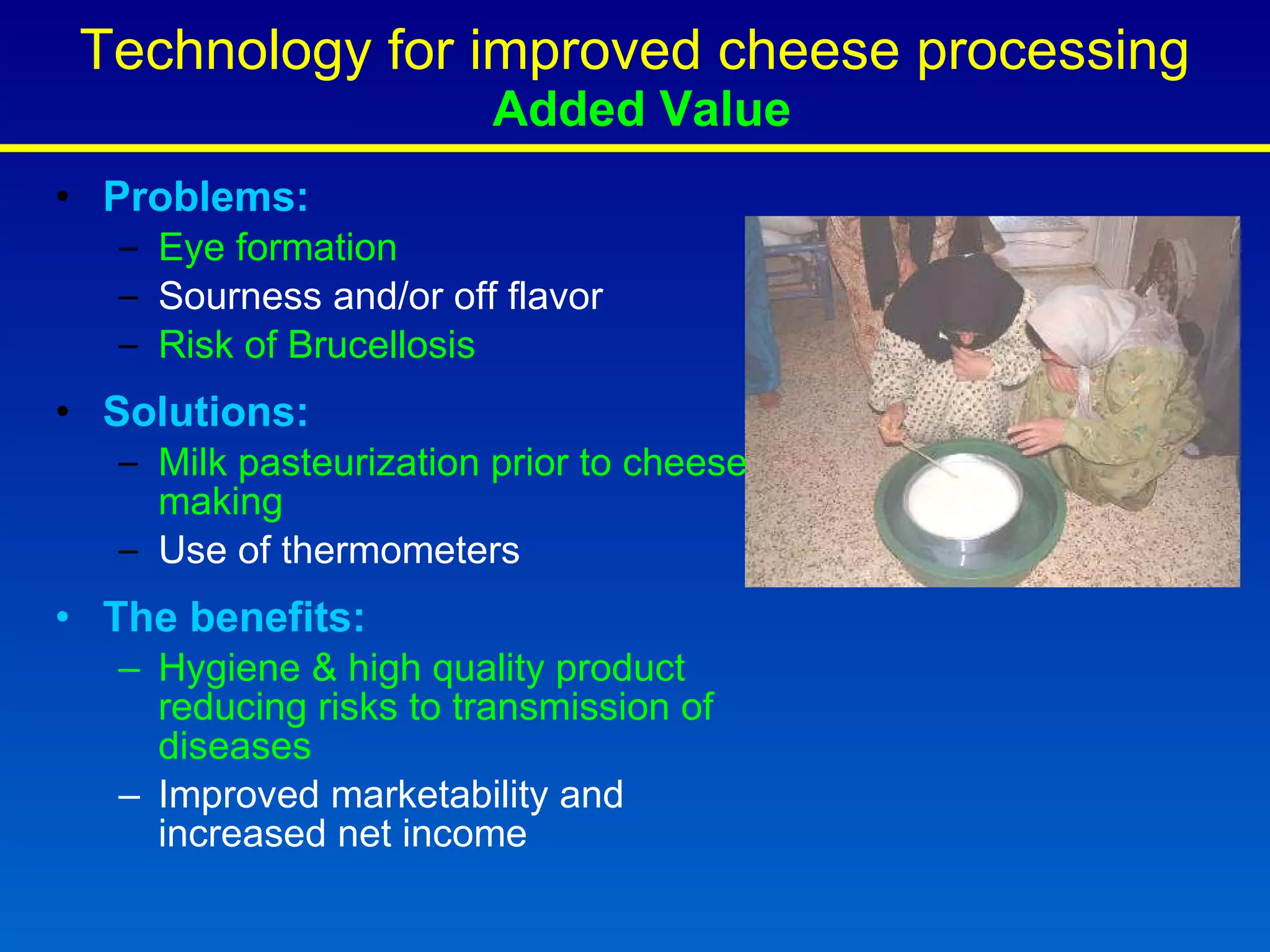
Technology for improved cheese processing   Added Value Problems: Eye formation Sourness and/or off flavor  Risk of Brucellosis Solutions: Milk pasteurization prior to cheese making  Use of thermometers The benefits:  Hygiene & high quality product reducing risks to transmission of diseases Improved marketability and increased net income
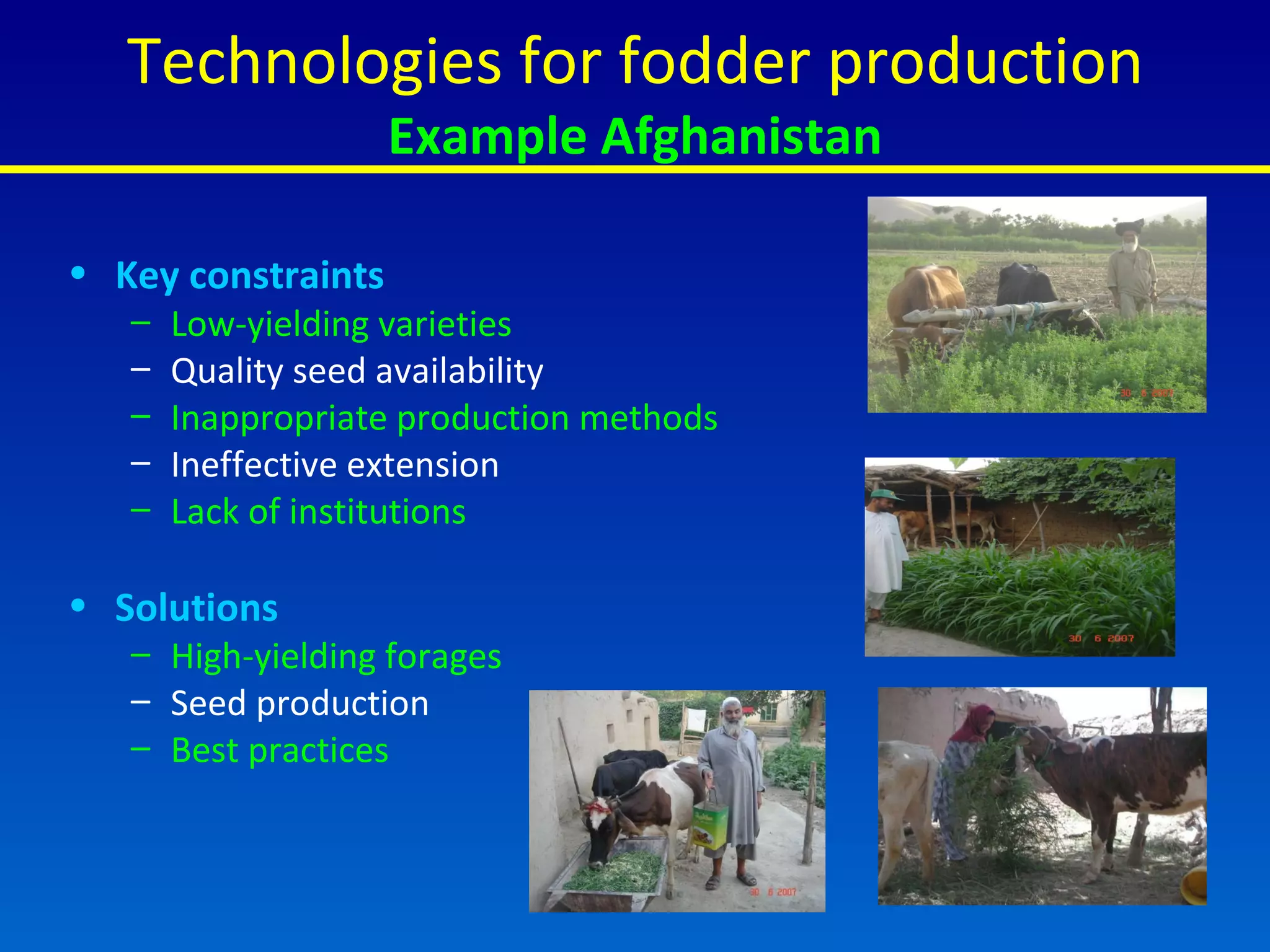
Key constraints Low-yielding varieties Quality seed availability Inappropriate production methods Ineffective extension Lack of institutions  Solutions High-yielding forages Seed production Best practices Technologies for fodder production Example Afghanistan
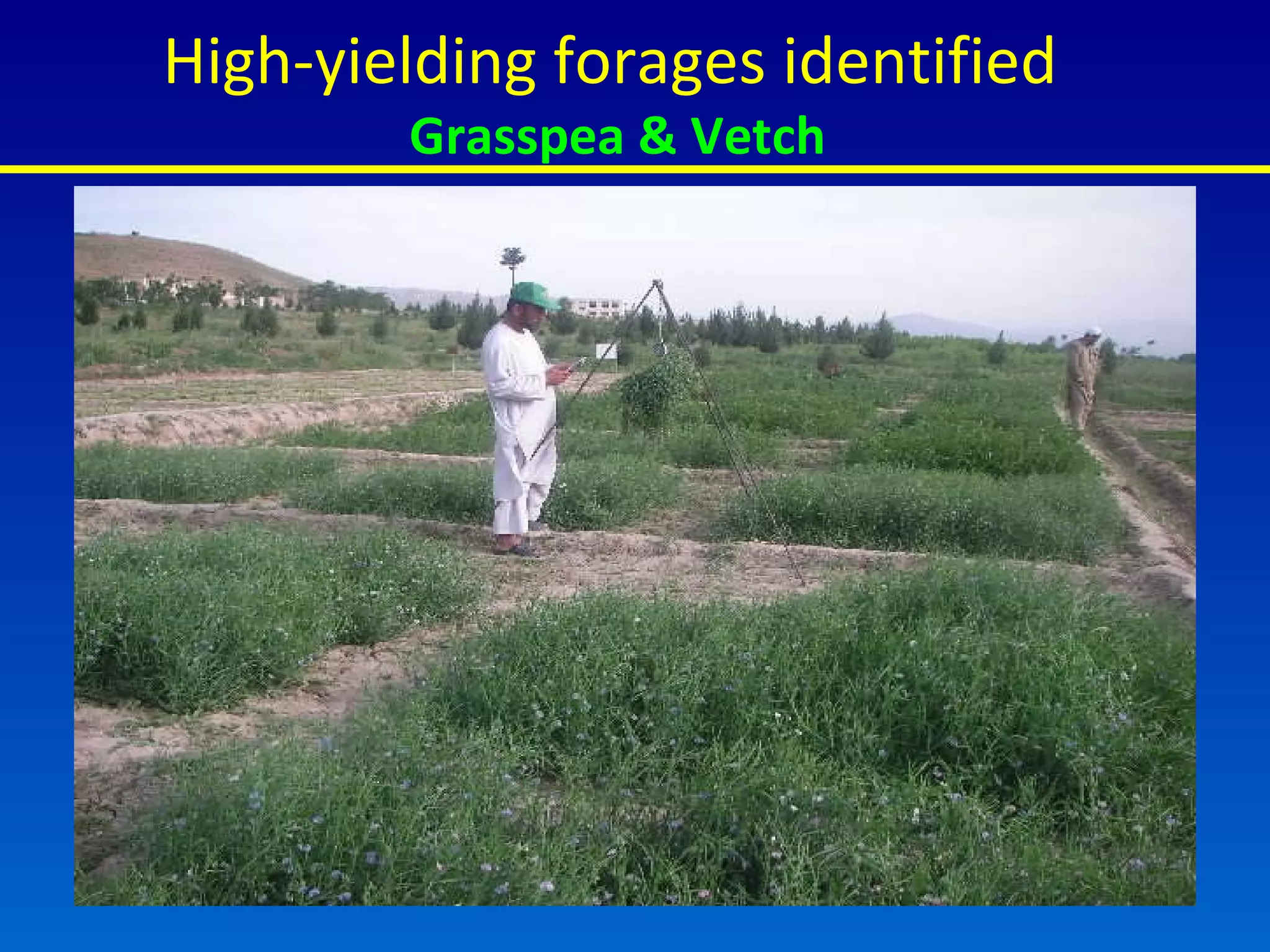
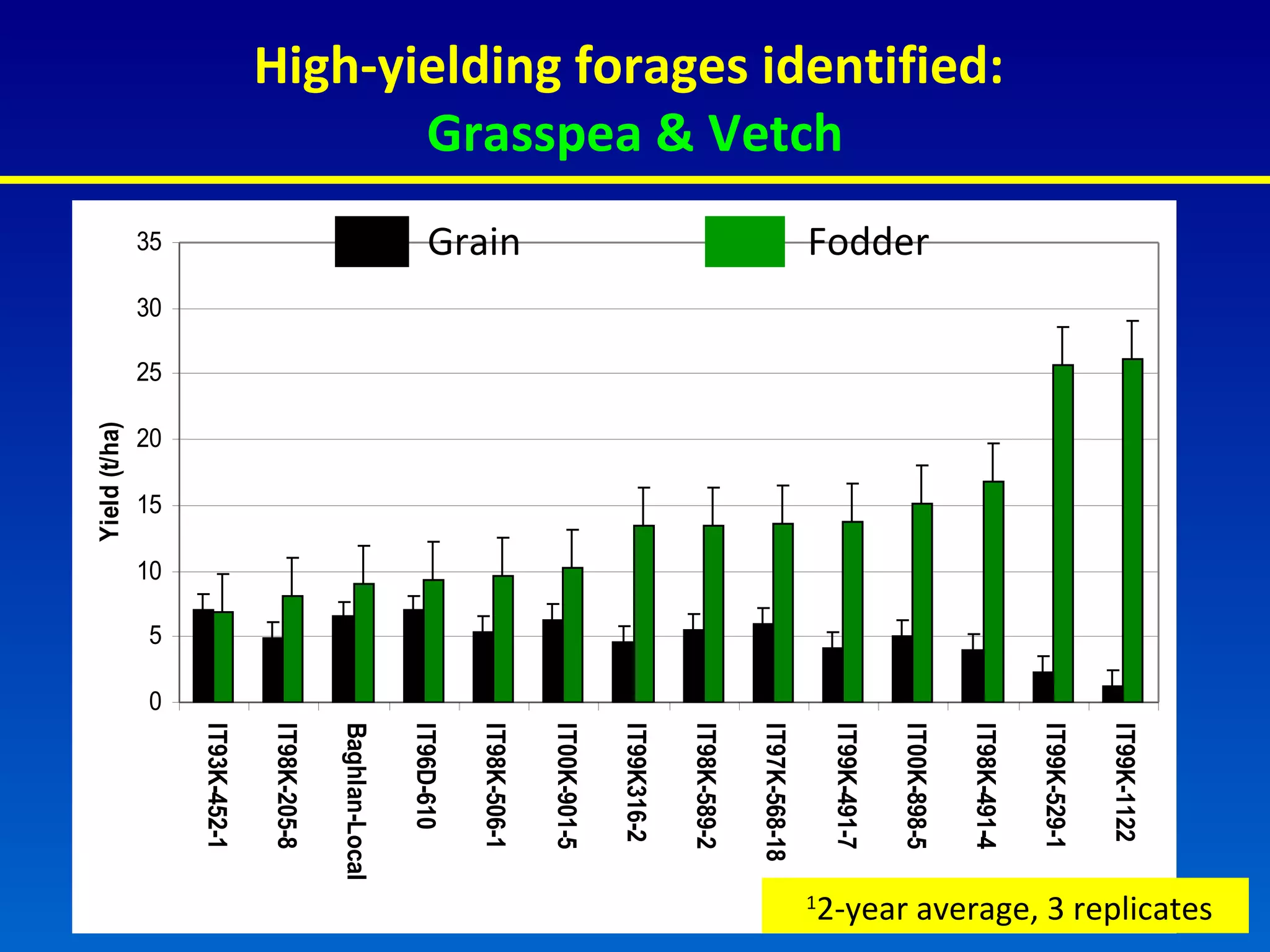
High-yielding forages identified  Grasspea & Vetch
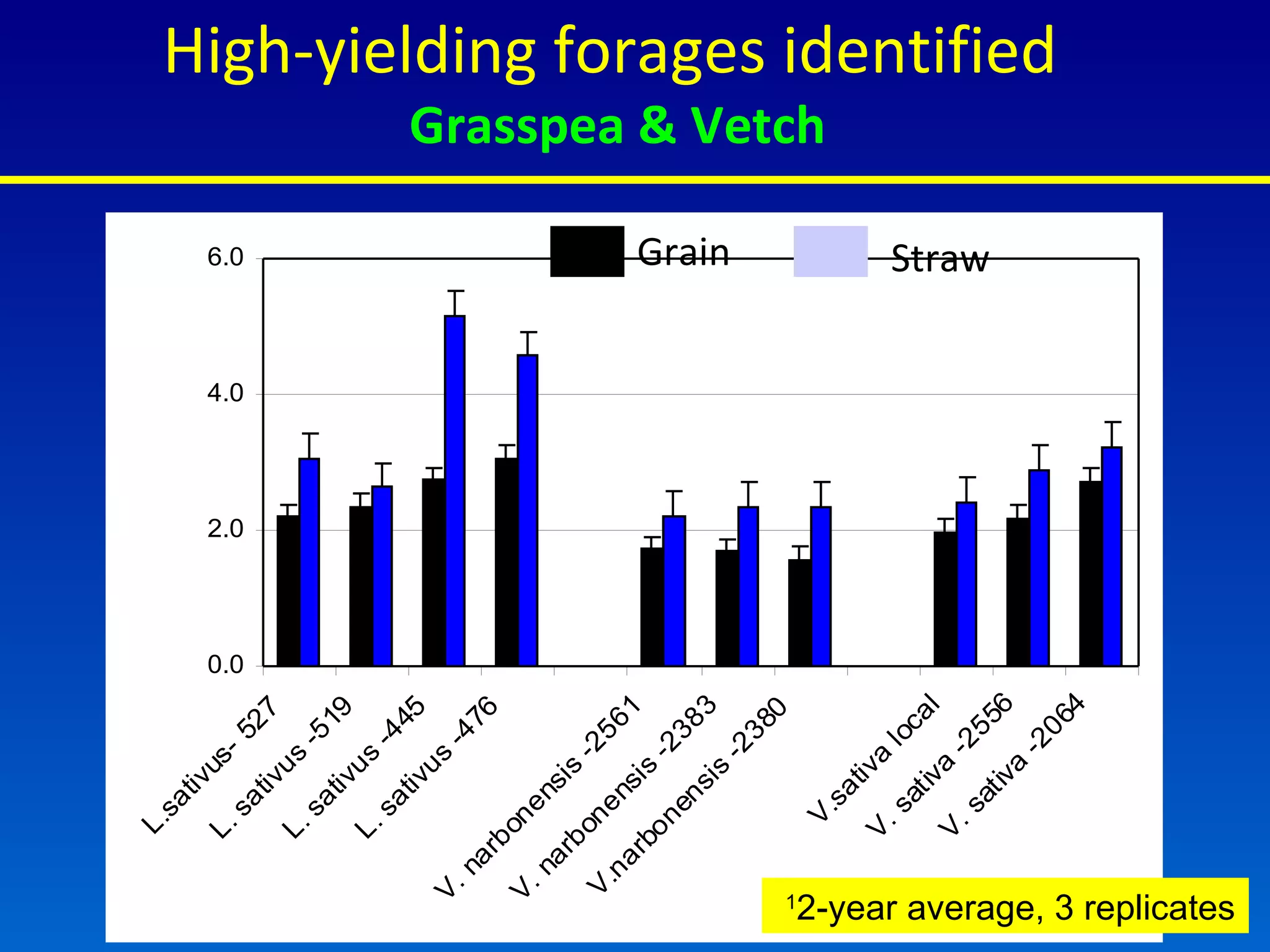
Grain Straw 1 2-year average, 3 replicates High-yielding forages identified  Grasspea & Vetch
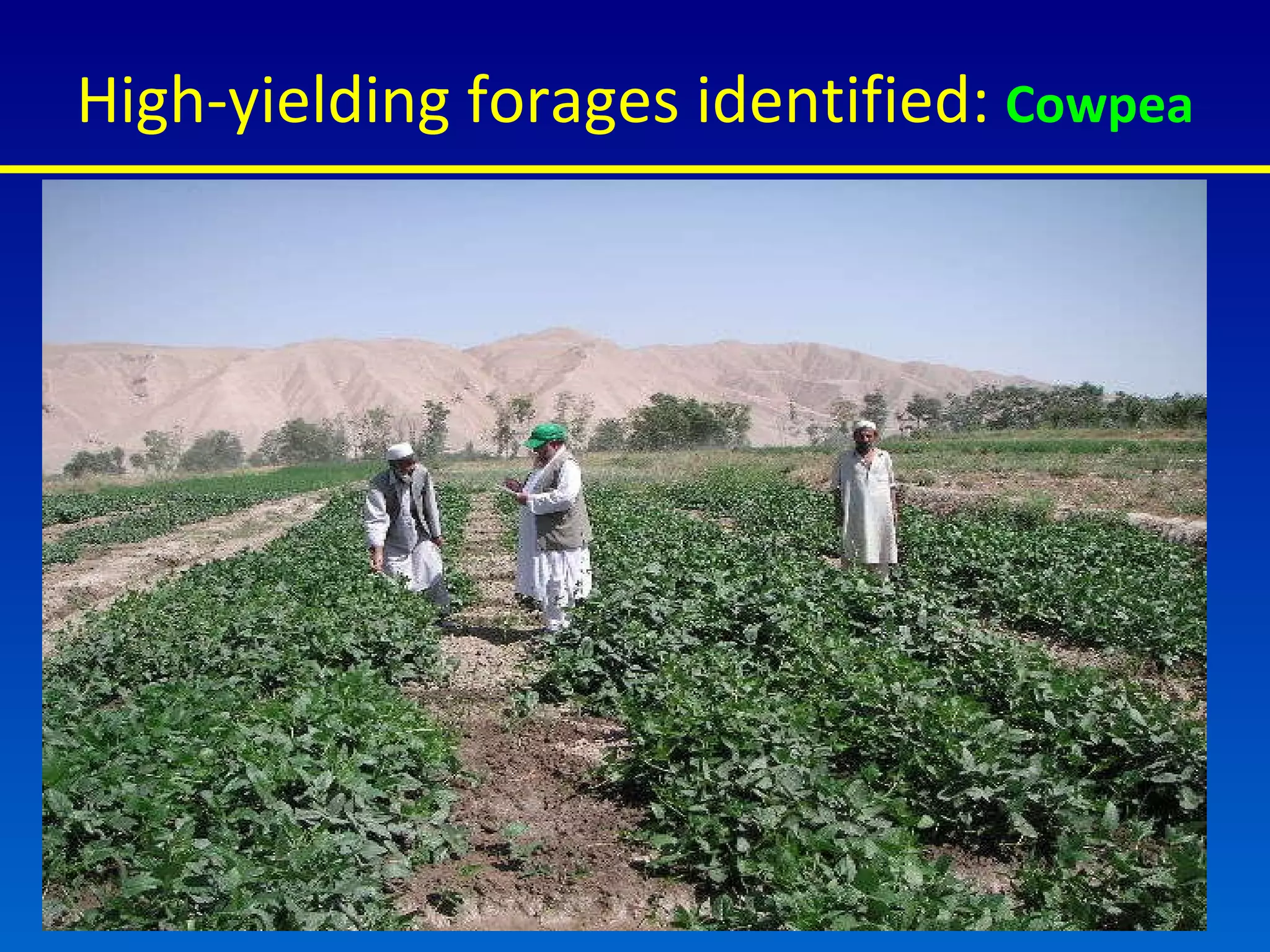
High-yielding forages identified:  Cowpea
Grain Fodder 1 2-year average, 3 replicates High-yielding forages identified:  Grasspea & Vetch
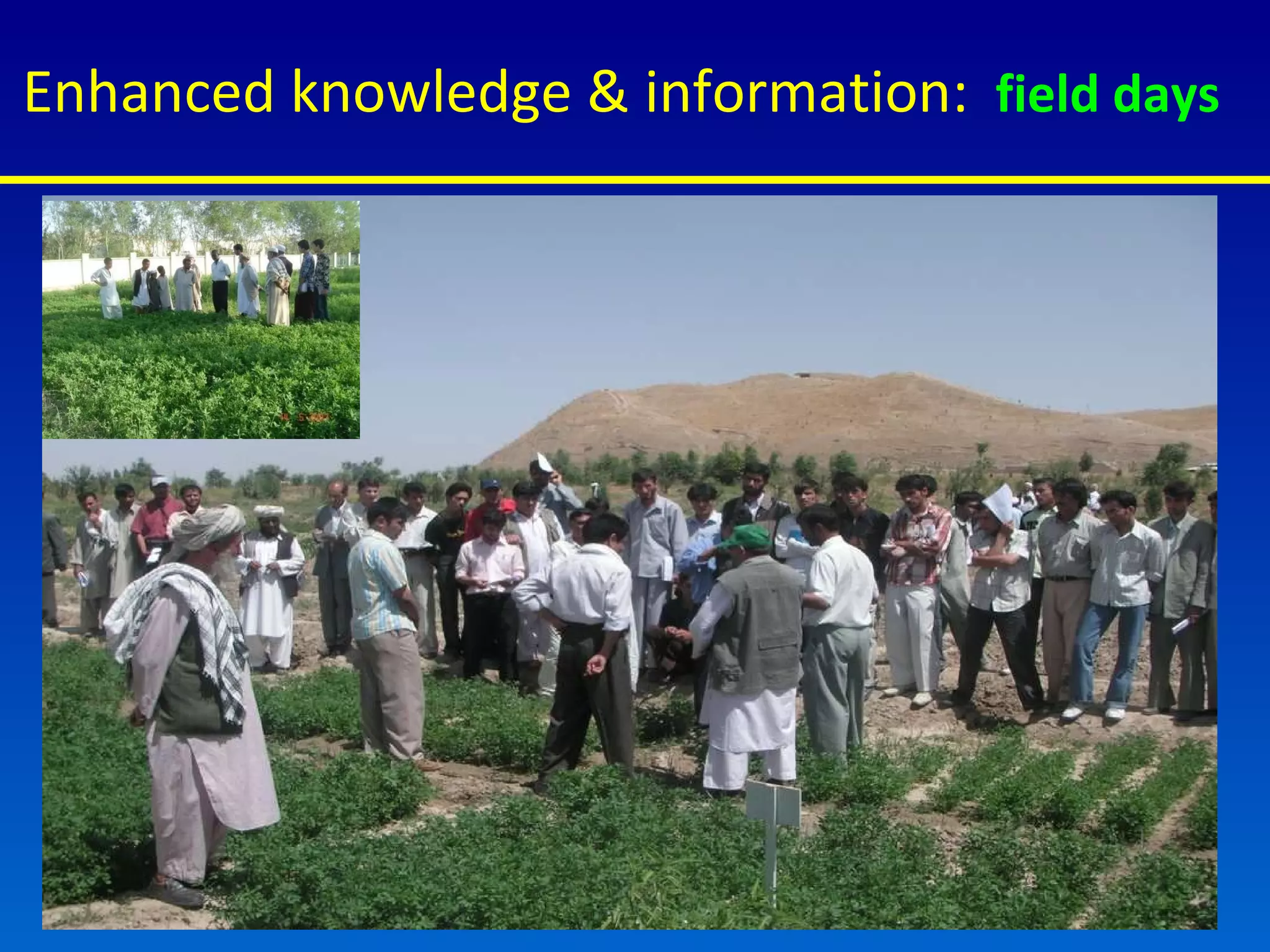
Enhanced knowledge & information:  field days
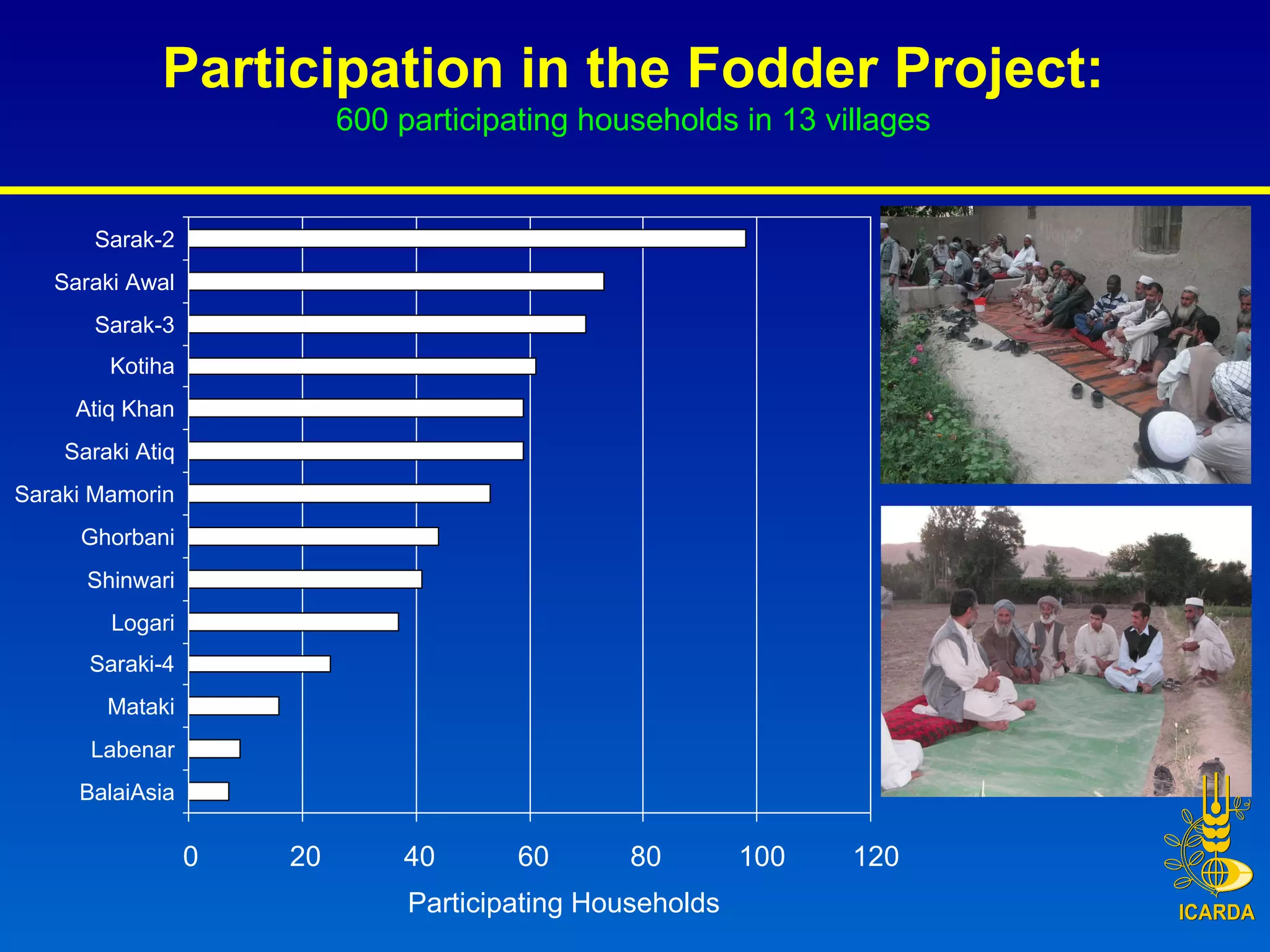
Participation in the Fodder Project: 600 participating households in 13 villages 0 20 40 60 80 100 120 BalaiAsia Labenar Mataki Saraki-4 Logari Shinwari Ghorbani Saraki Mamorin Saraki Atiq Atiq Khan Kotiha Sarak-3 Saraki Awal Sarak-2 Participating Households
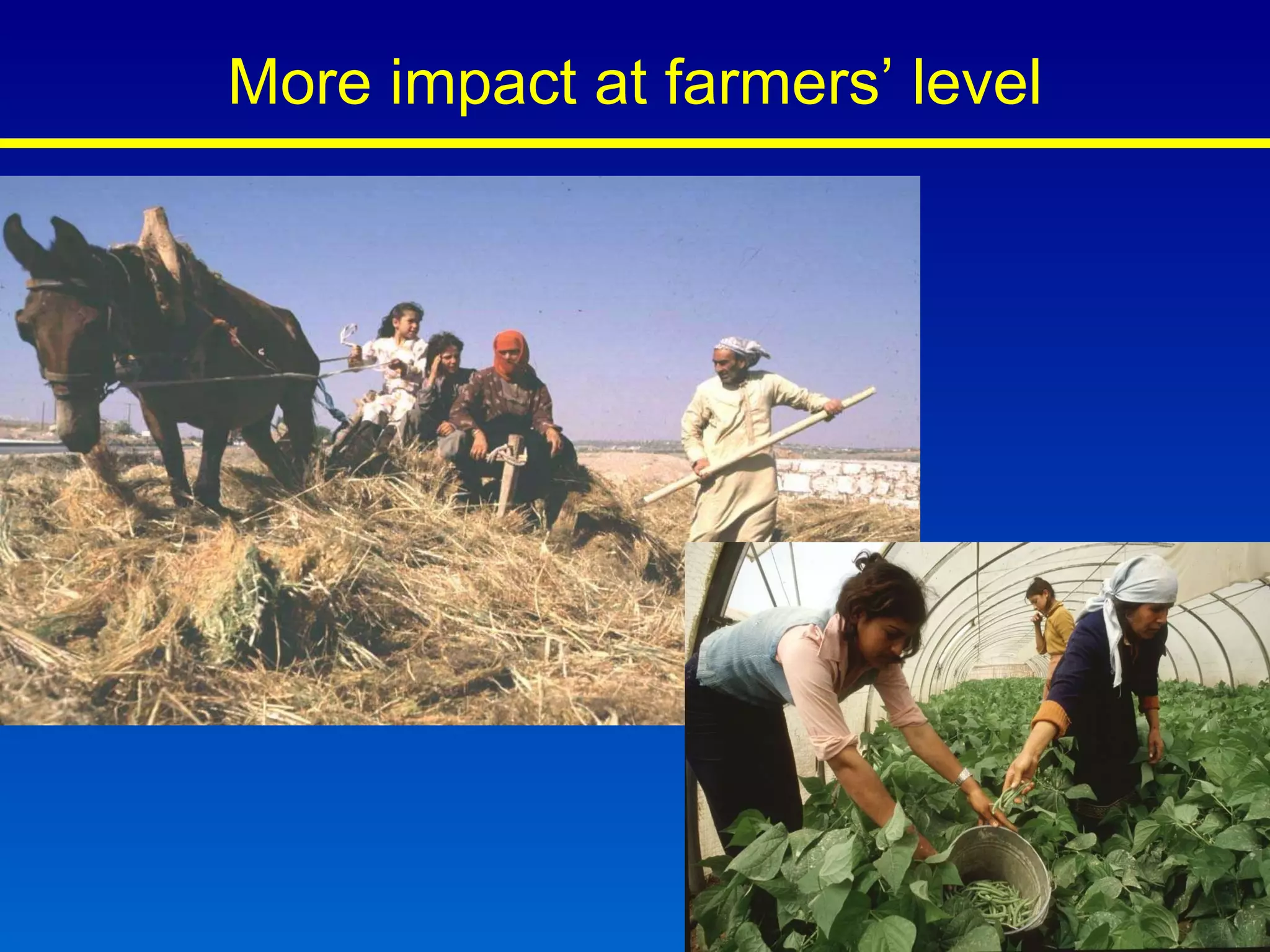
More impact at farmers’ level
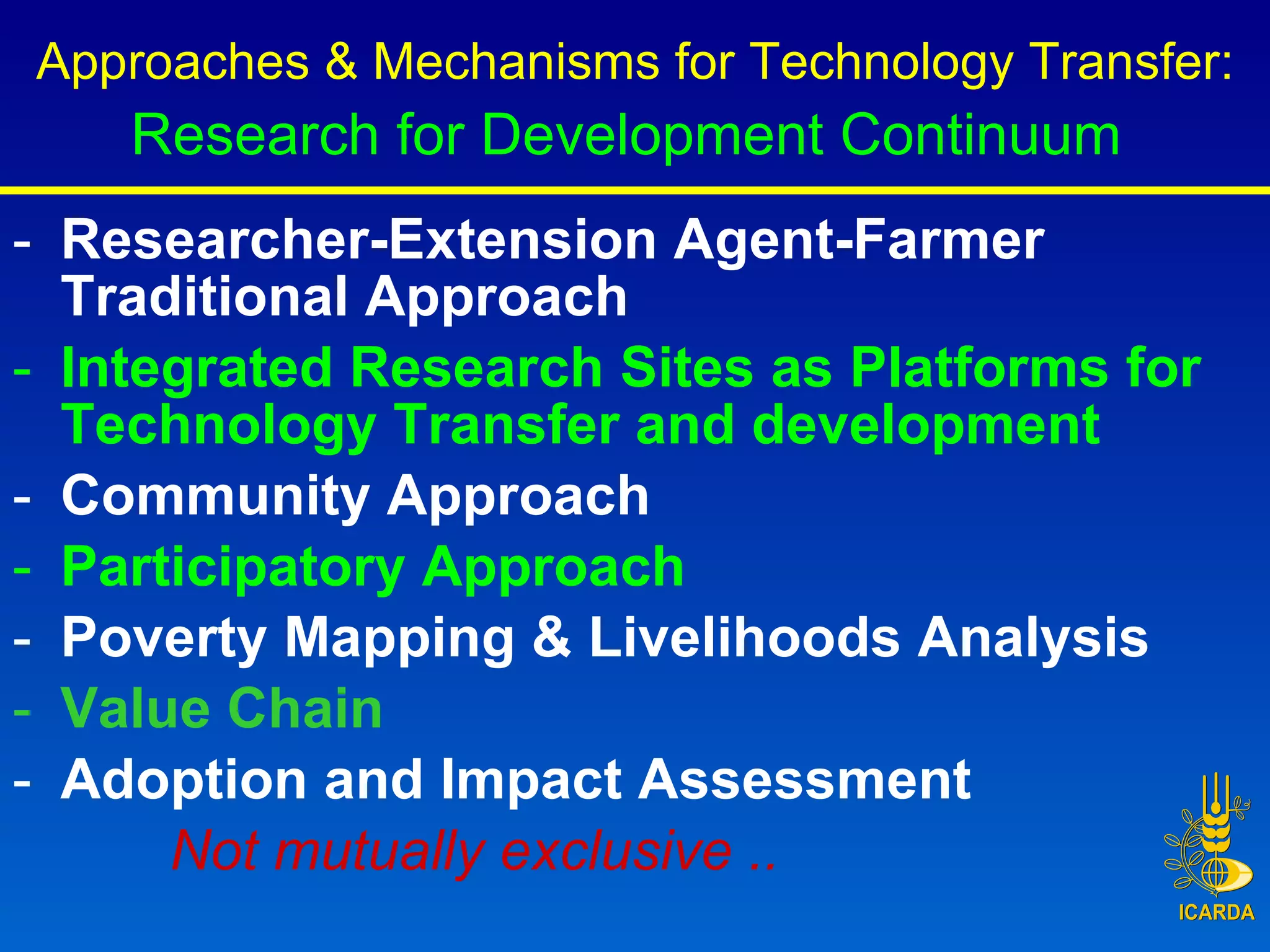
Researcher-Extension Agent-Farmer Traditional Approach Integrated Research Sites as Platforms for Technology Transfer and development Community Approach Participatory Approach   Poverty Mapping & Livelihoods Analysis Value Chain Adoption and Impact Assessment  Not mutually exclusive ..   Approaches & Mechanisms for Technology Transfer: Research for Development Continuum
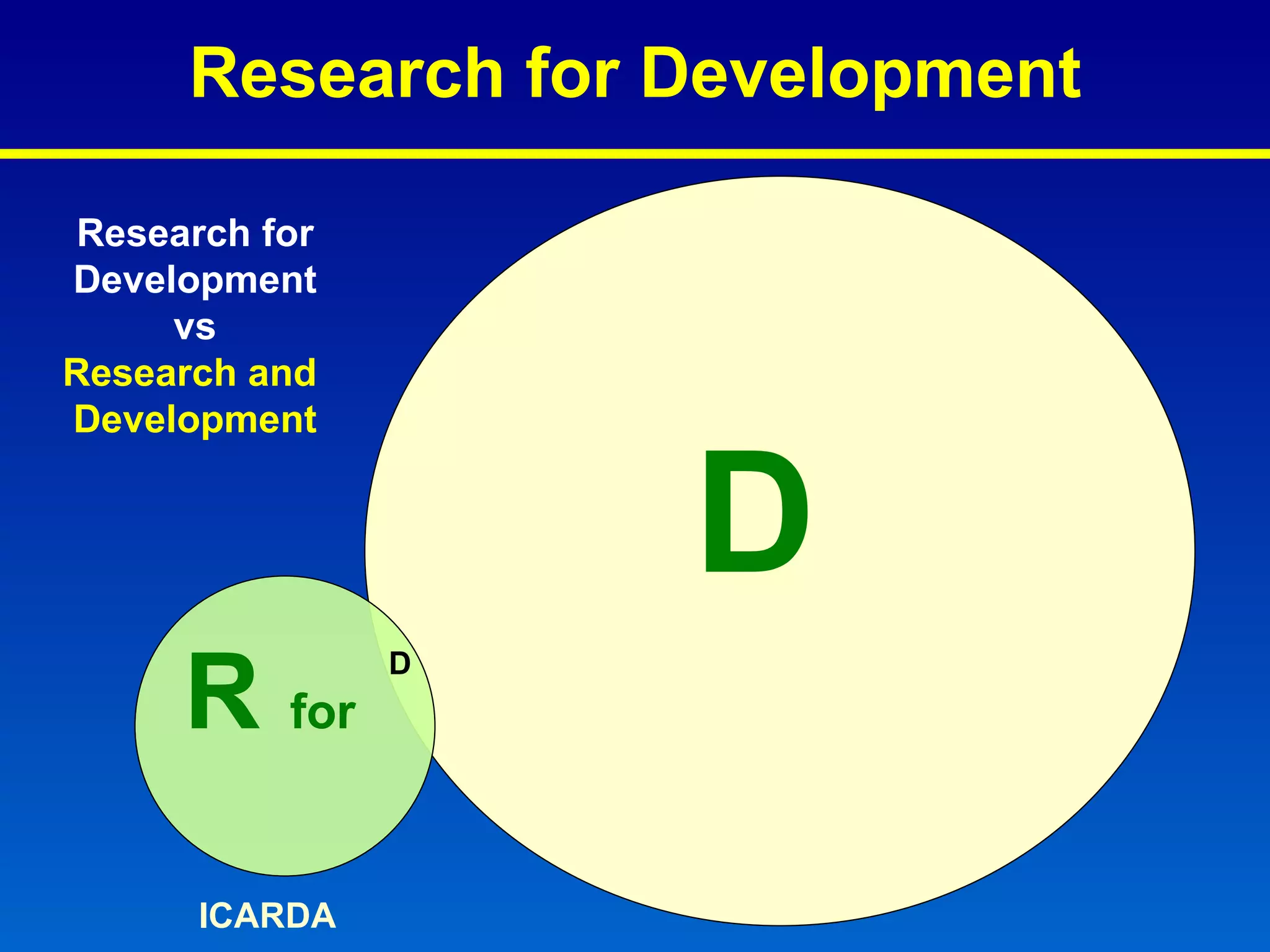
D D R  for ICARDA Research for Development vs  Research and  Development Research for Development
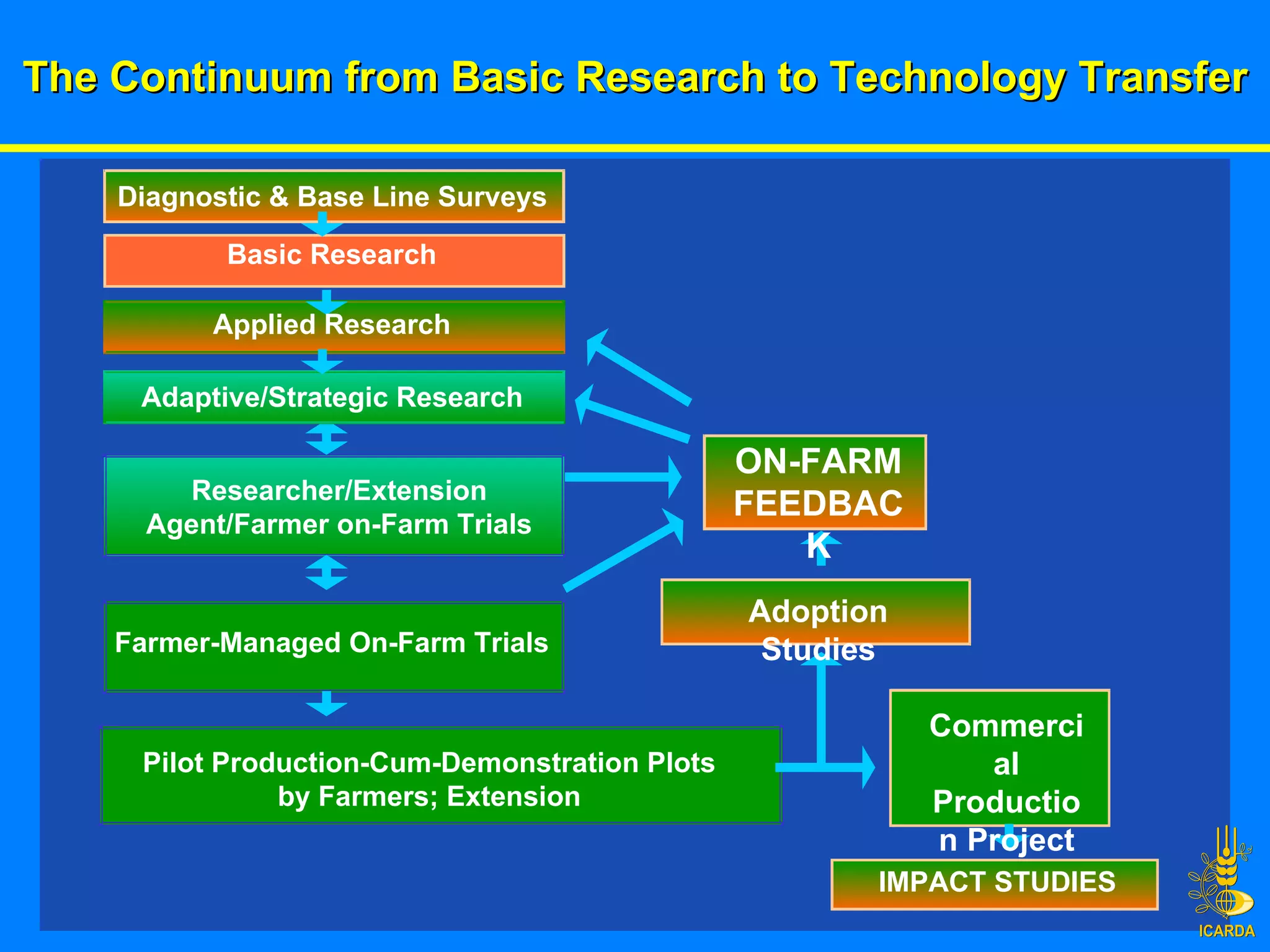
Diagnostic & Base Line Surveys Basic Research Applied Research Adaptive/Strategic Research Researcher/Extension Agent/Farmer on-Farm Trials Farmer-Managed On-Farm Trials Pilot Production-Cum-Demonstration Plots by Farmers; Extension Commercial Production Project IMPACT STUDIES The Continuum from Basic Research to Technology Transfer ON-FARM FEEDBACK Adoption Studies
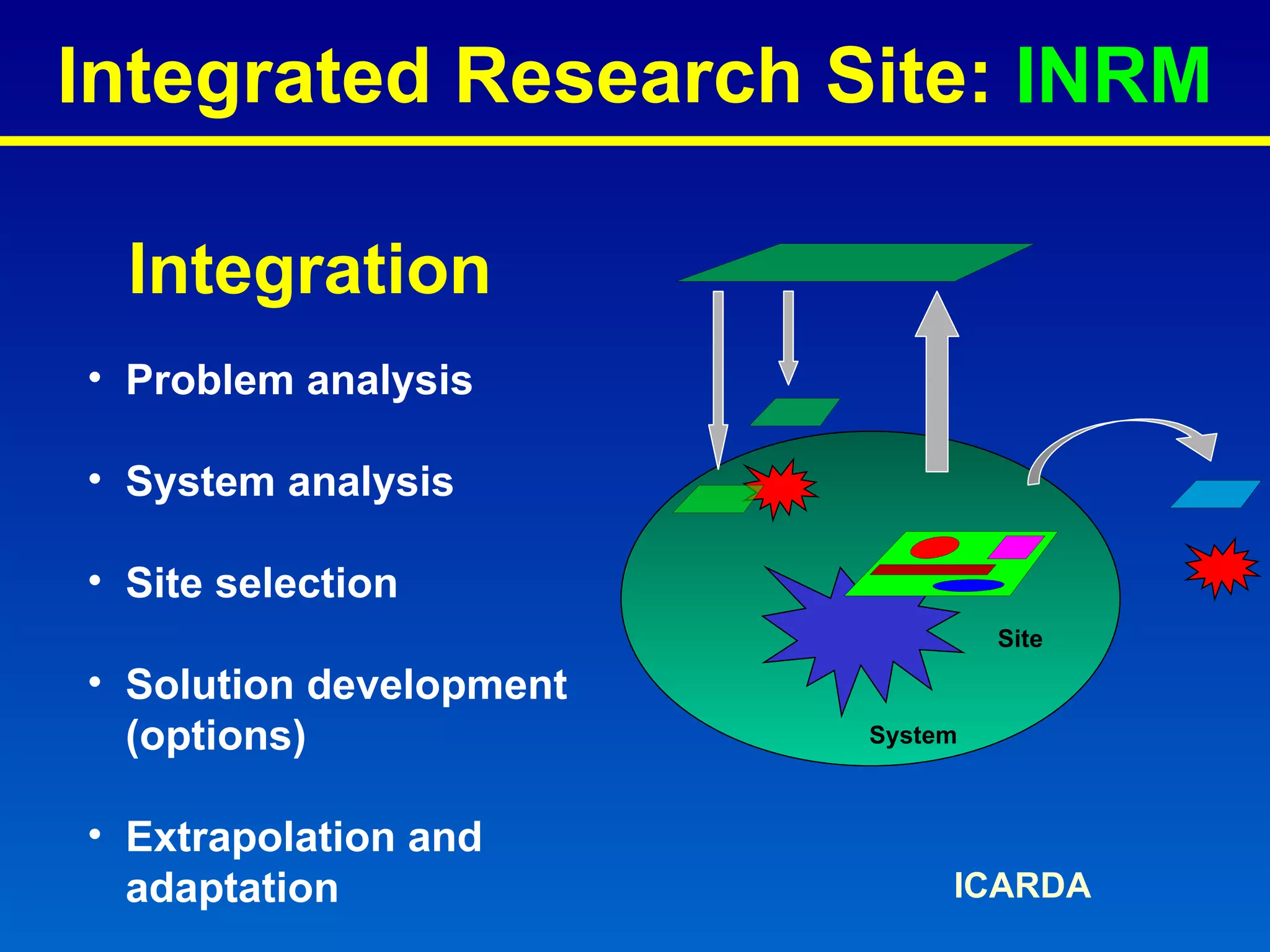
Site Integration Problem analysis System analysis Site selection Solution development (options) Extrapolation and adaptation ICARDA Integrated Research Site:  INRM System
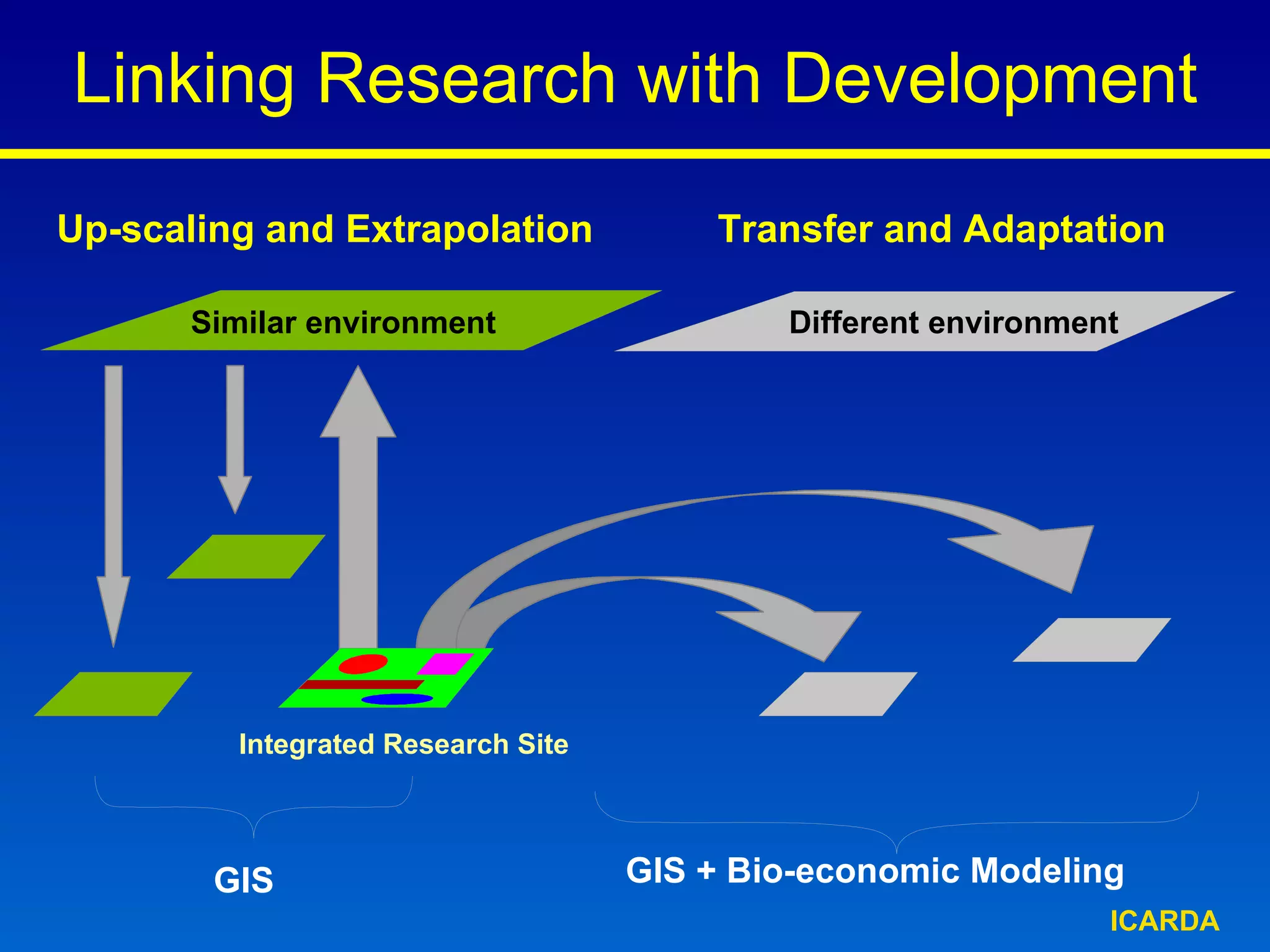
Transfer and Adaptation Up-scaling and Extrapolation Integrated Research Site Similar environment Different environment ICARDA Linking Research with Development GIS + Bio-economic Modeling GIS
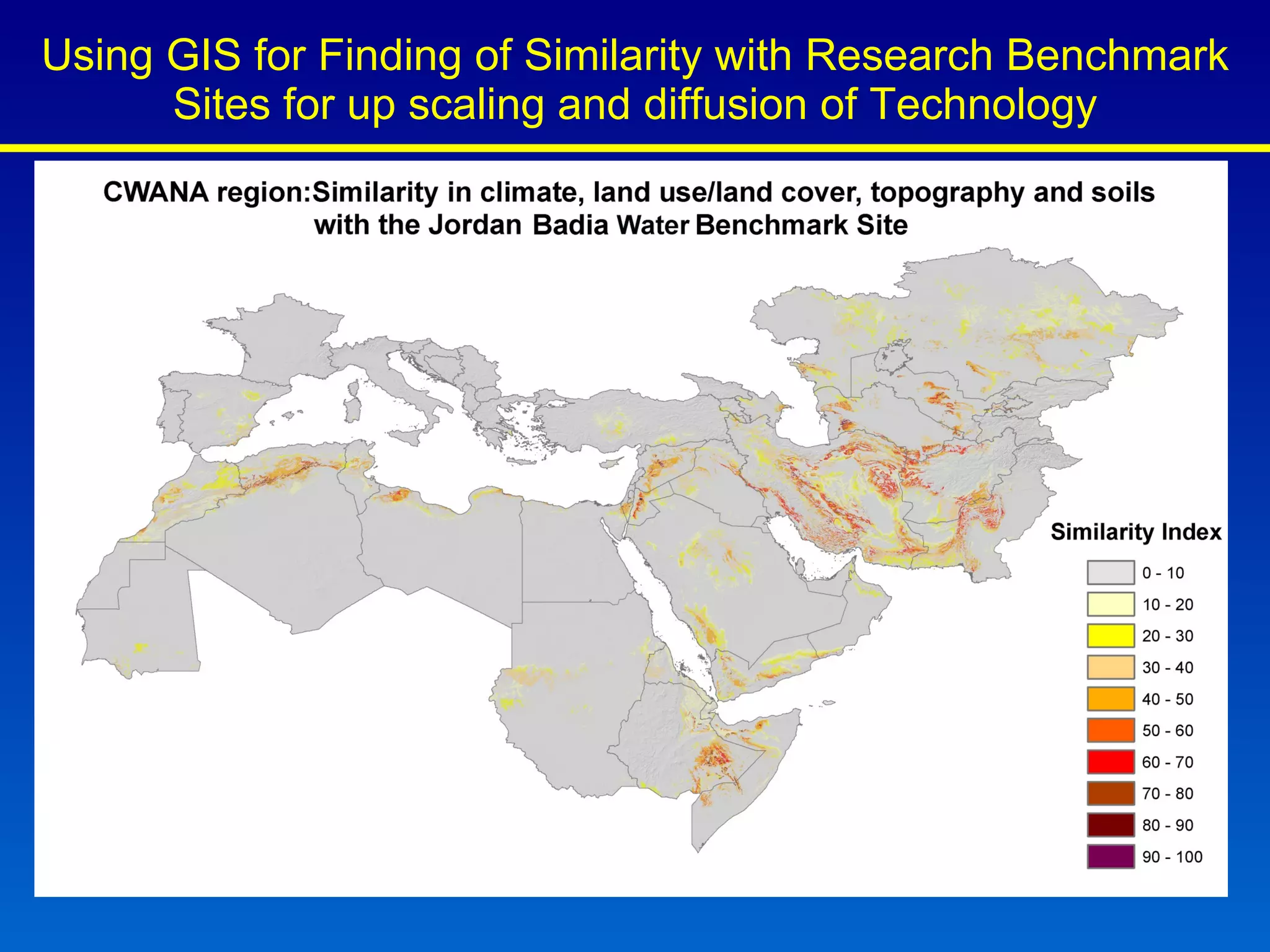
Using GIS for Finding of Similarity with Research Benchmark Sites for up scaling and diffusion of Technology
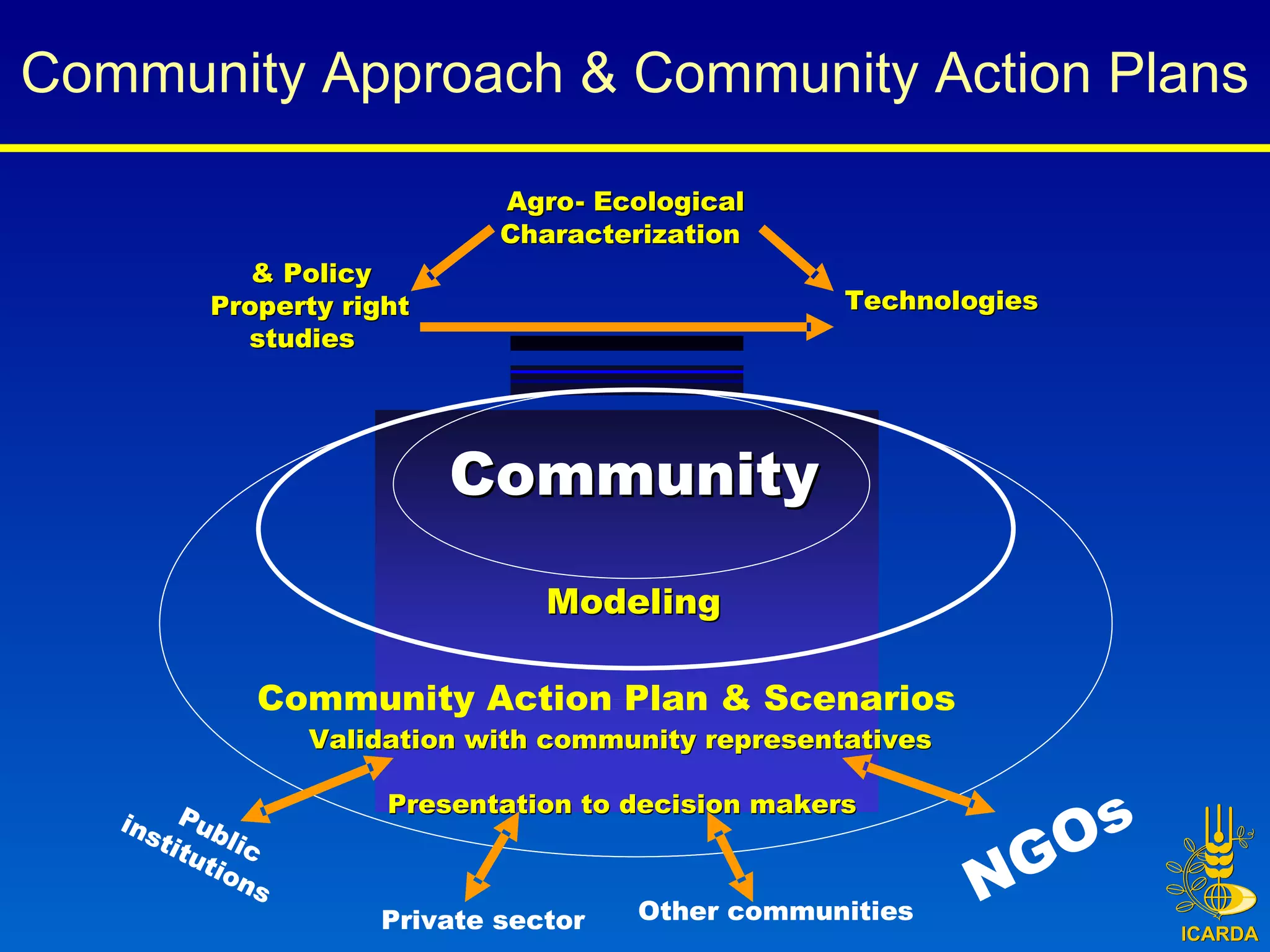
Community Approach & Community Action Plans   Community Community Technologies Technologies Policy &  Policy &  Property right  Property right  studies studies Agro Agro - - Ecological  Ecological  Characterization Characterization Scenarii Scenarii Modeling Modeling Validation with community representatives Validation with community representatives Presentation to decision makers Presentation to decision makers Private sector Other communities Public  institutions Community Community Technologies Technologies Policy &  Policy &  Property right  Property right  studies studies Agro Agro - - Ecological  Ecological  Characterization Characterization Community Action Plan & Scenarios Modeling Modeling NGOs Validation with community representatives Validation with community representatives Presentation to decision makers Presentation to decision makers Private sector Other communities Public  institutions
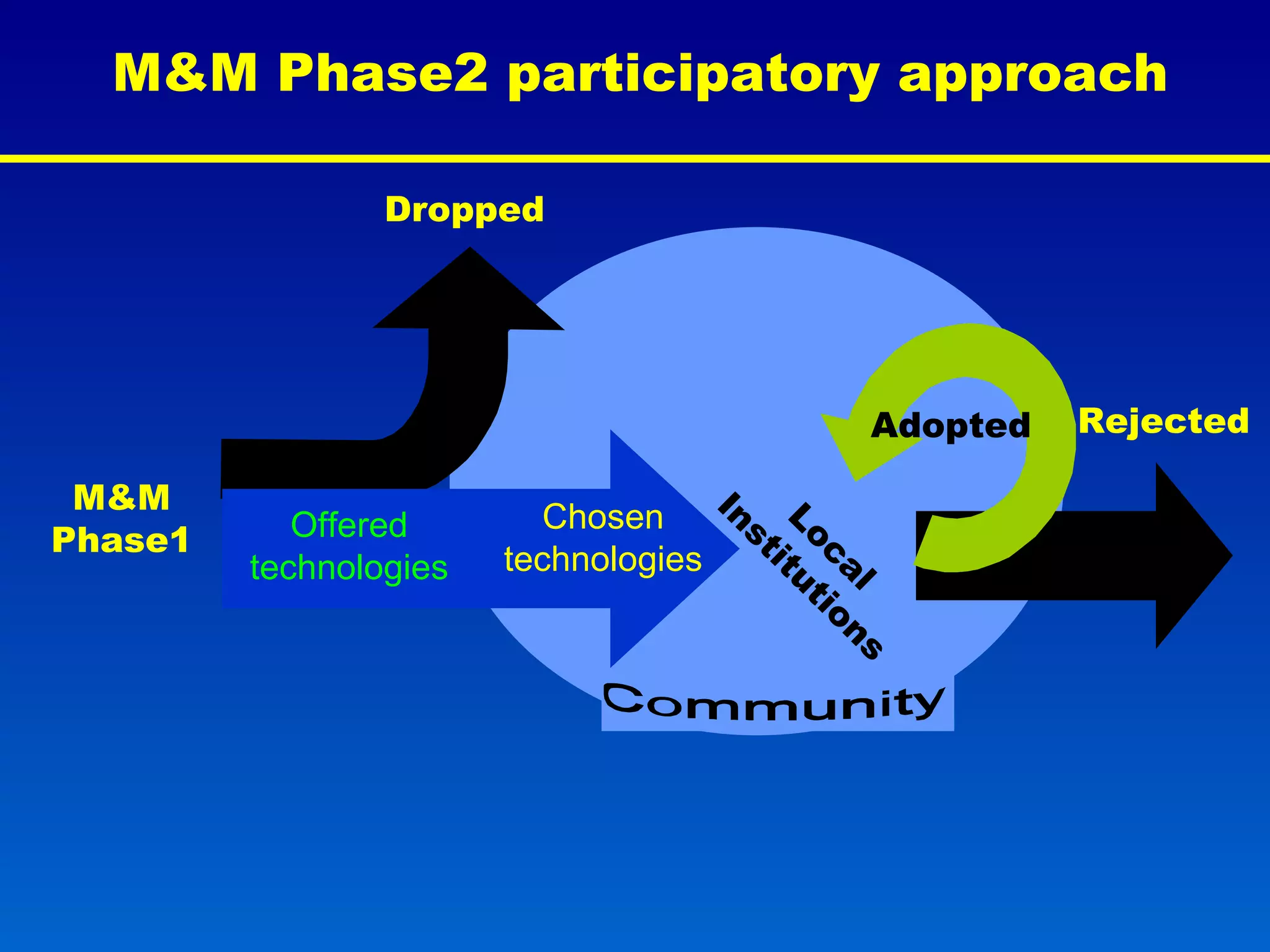
M&M Phase1 Dropped Chosen technologies Local Institutions Adopted Rejected Offered technologies M&M Phase2 participatory approach
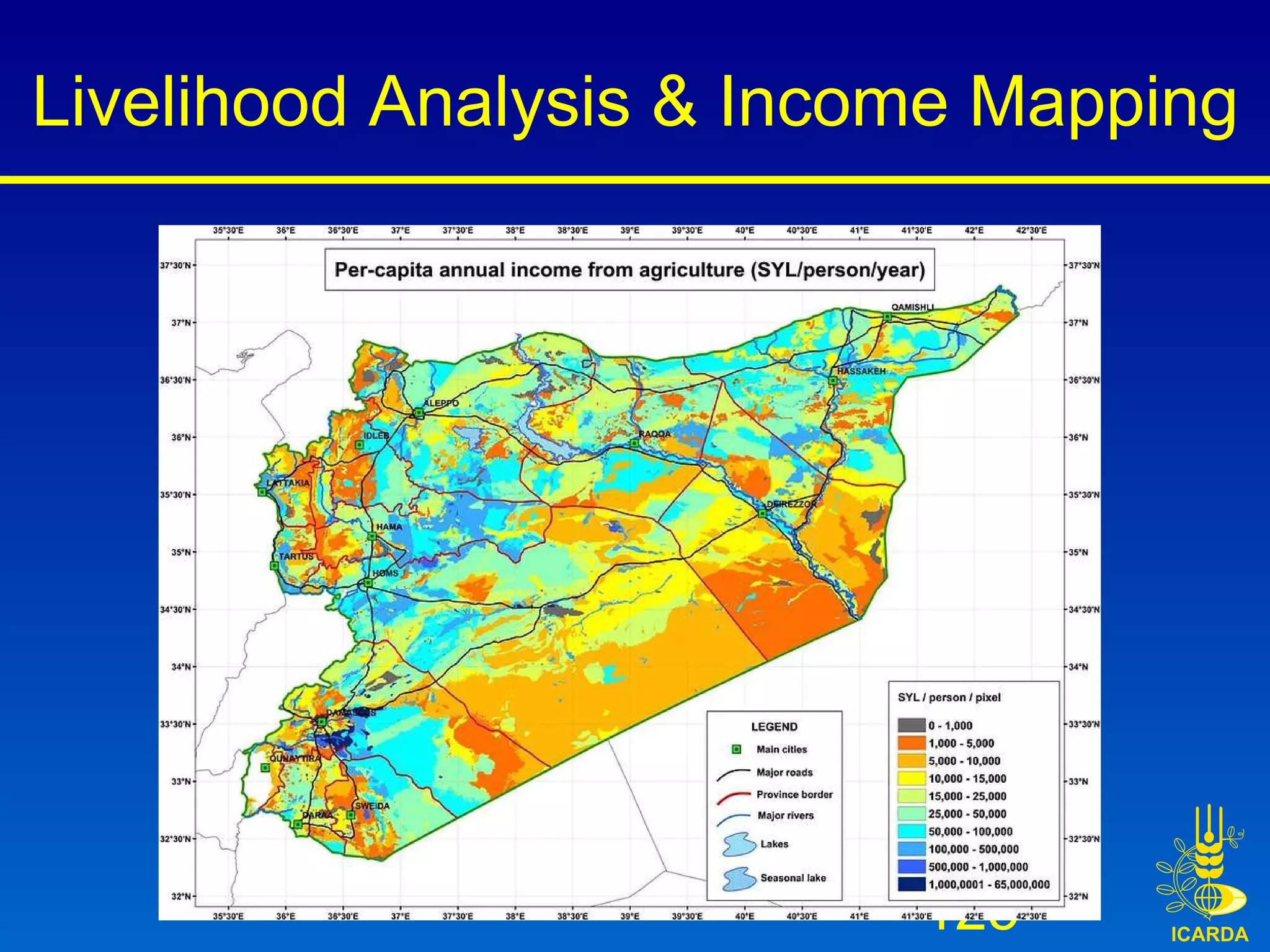
Livelihood Analysis & Income Mapping
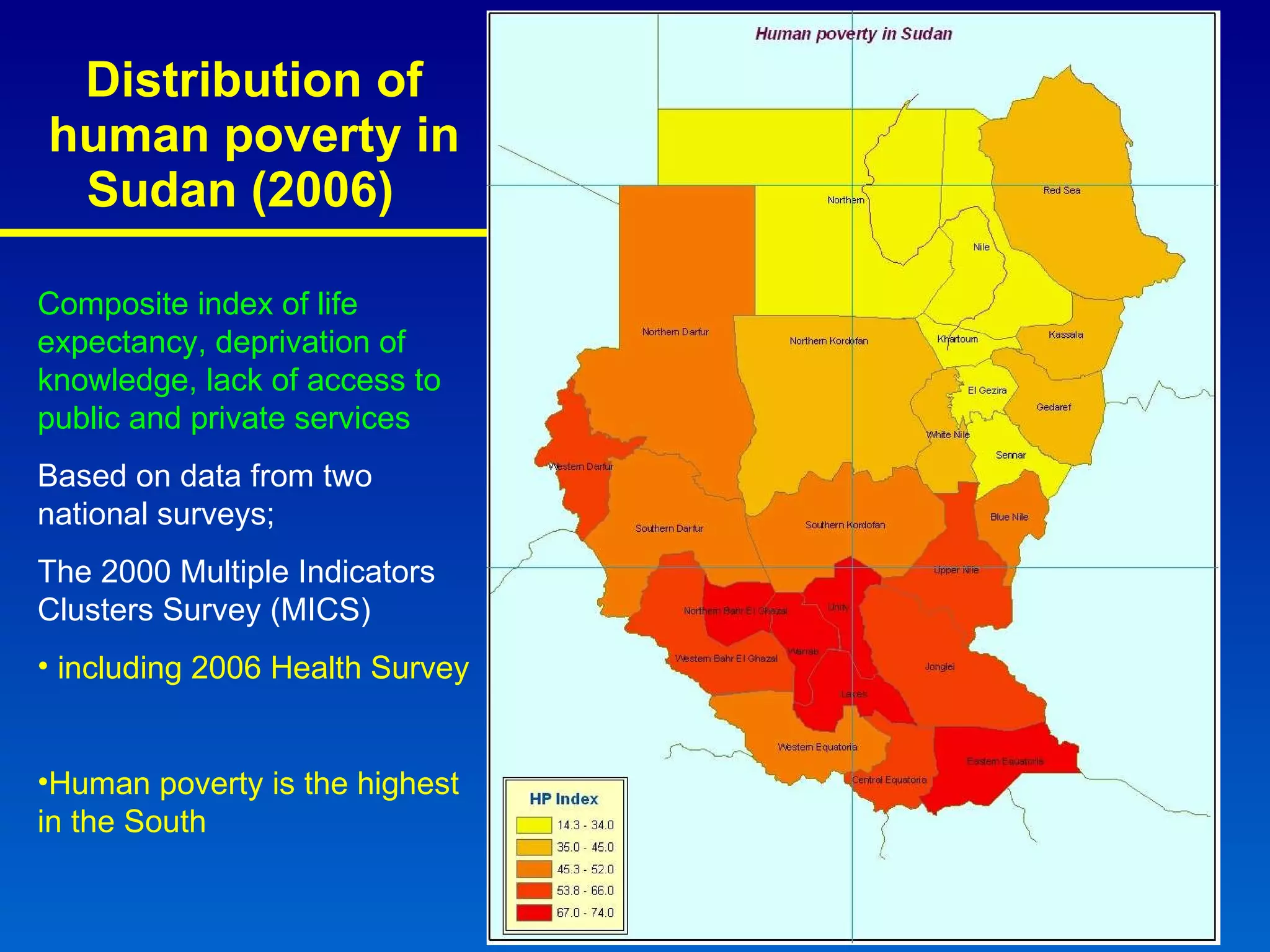
Distribution of human poverty in Sudan (2006)   Composite index of life expectancy, deprivation of knowledge, lack of access to public and private services Based on data from two national surveys;  The 2000 Multiple Indicators Clusters Survey (MICS)  including 2006 Health Survey Human poverty is the highest in the South
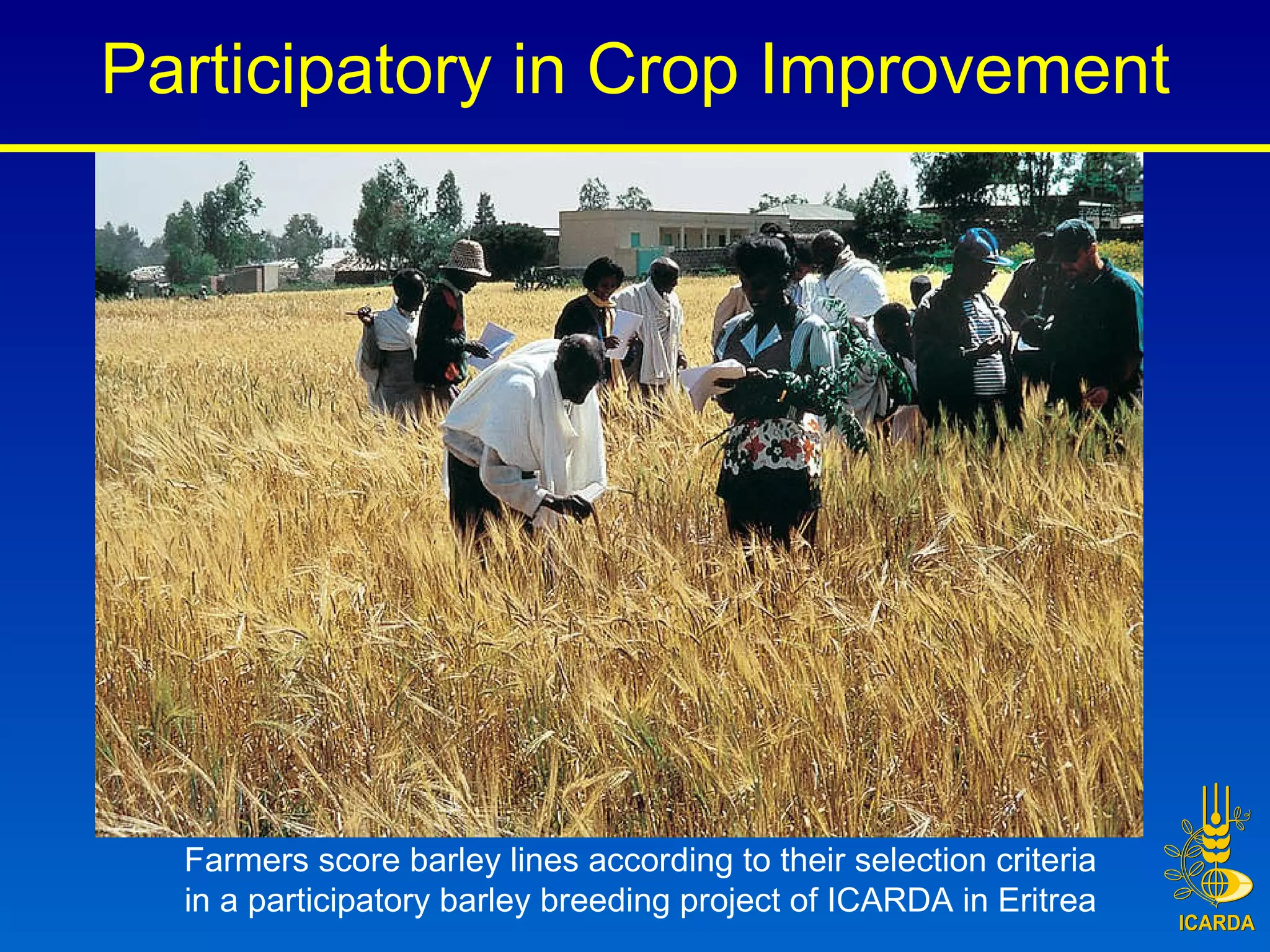
Participatory in Crop Improvement Farmers score barley lines according to their selection criteria in a participatory barley breeding project of ICARDA in Eritrea
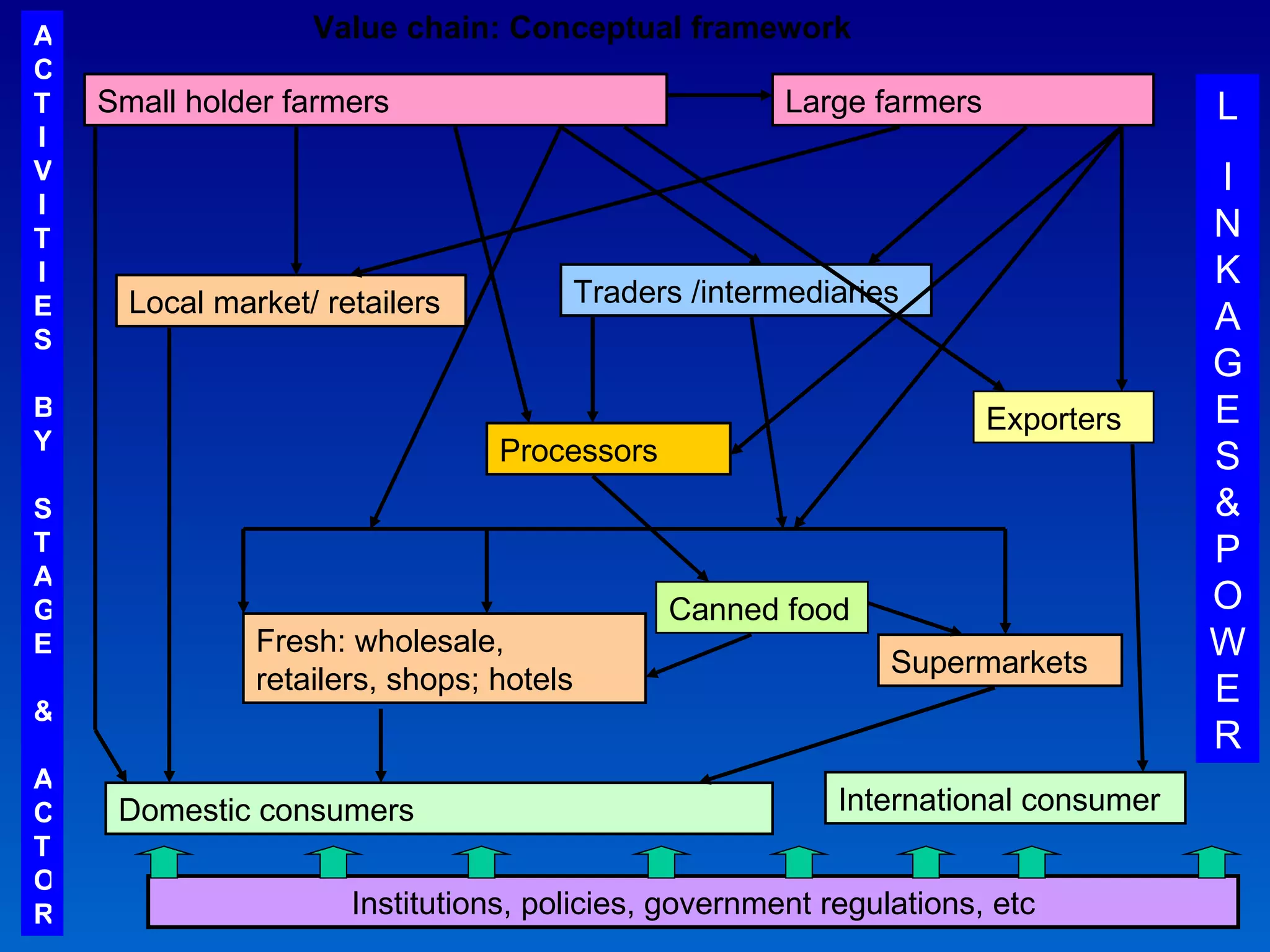
Small holder farmers Large farmers Traders /intermediaries Local market/ retailers Exporters Processors Fresh: wholesale, retailers, shops; hotels Supermarkets Domestic consumers International consumer Value chain: Conceptual framework Institutions, policies, government regulations, etc Canned food ACTIVITIES BY STAGE & ACTOR L INKAGES& POWER
Impact of wheat research in Syria Annual benefits from research: estimated at USD 142 million Saved land: The same production without the technology would have required additional 1 million hectares
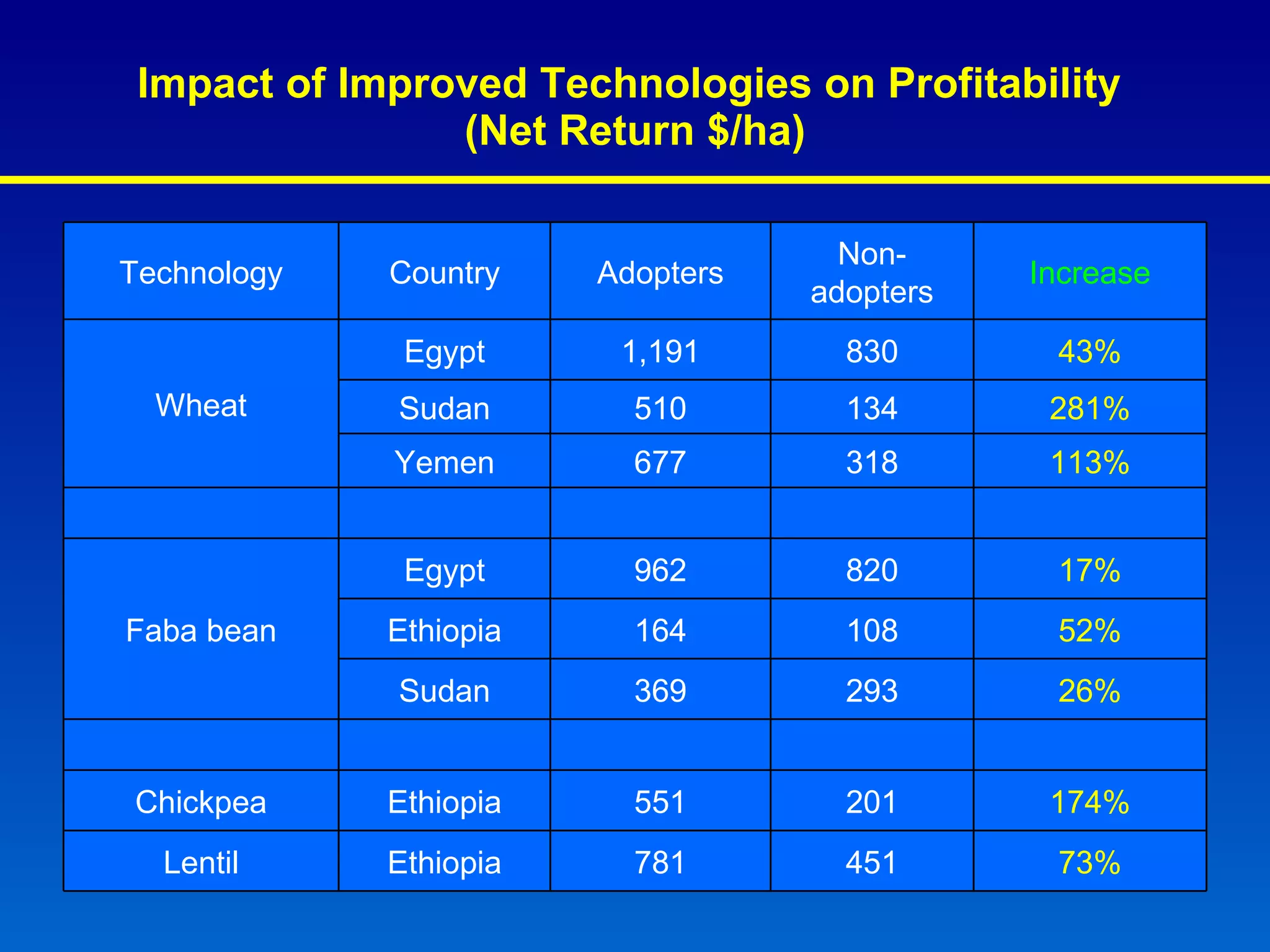
Impact of Improved Technologies on Profitability  (Net Return $/ha) Technology Country Adopters Non-adopters Increase Wheat Egypt 1,191 830 43% Sudan 510 134 281% Yemen 677 318 113% Faba bean Egypt 962 820 17% Ethiopia 164 108 52% Sudan 369 293 26% Chickpea Ethiopia 551 201 174% Lentil Ethiopia 781 451 73%
Partnership & networking
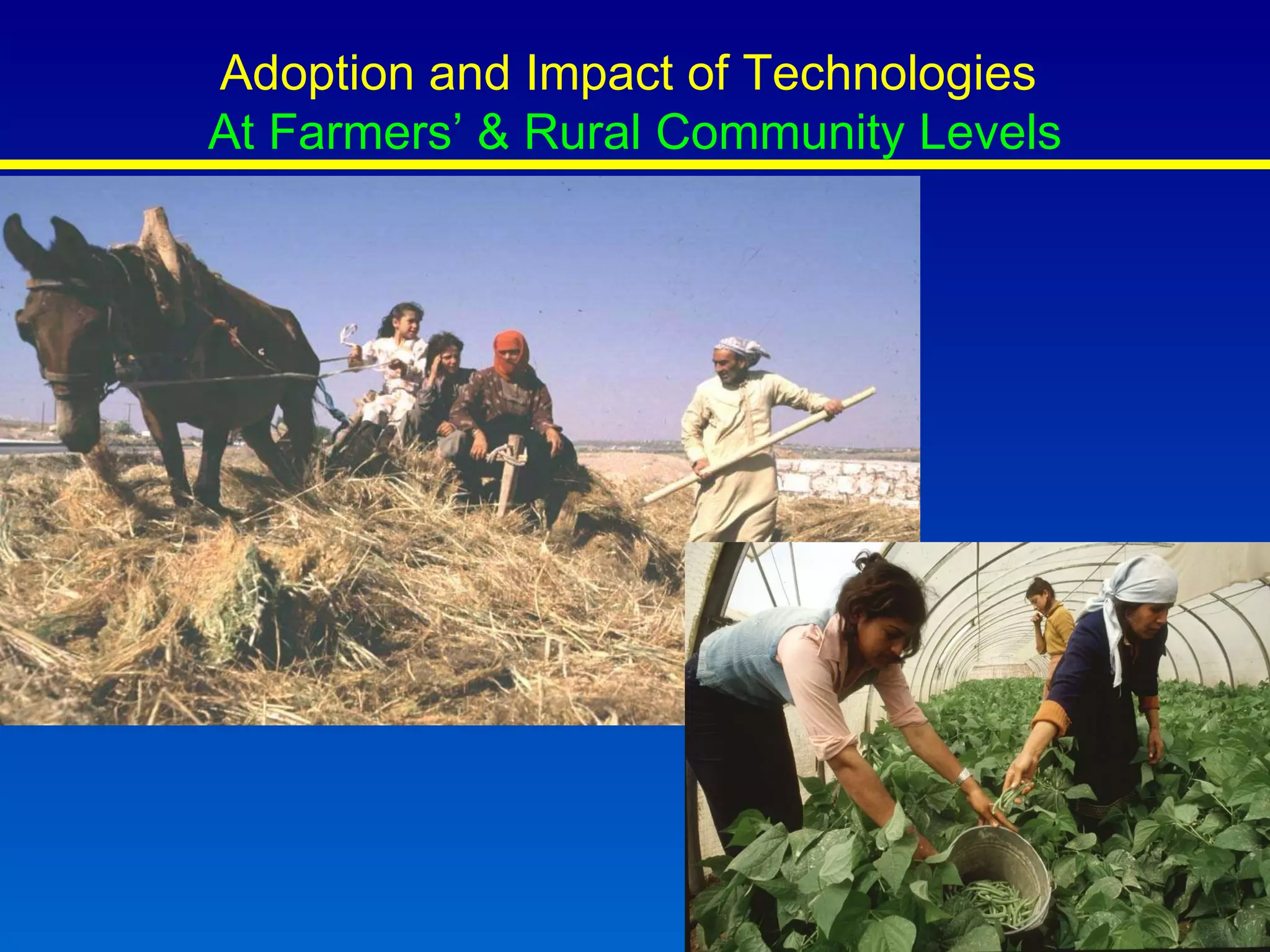
Adoption and Impact of Technologies  At Farmers’ & Rural Community Levels
THANK YOU

Research Outputs and Approaches to Enhance Food Security and Improve Livelihoods in Dry Areas

  • 1.
    Research Outputs andApproaches to Enhance Food Security and Improve Livelihoods in Dry Areas International Center for Agricultural Research in the Dry Areas Mahmoud Solh Director General IFAD/ICARDA Information Exchange Workshop
  • 2.
    Outline Constraints leadingto food insecurity and poverty in Dry Areas. What can make a difference? ICARDA Strategic Plan 2007-2016: Agricultural Research for Development in Dry Areas. Technologies towards food security & better livelihoods Approach for technology transfer IFAD Strategic Partnerships
  • 3.
  • 4.
    Agriculture and theFood Security Challenge Expectation by 2030: - 8.3 billion people to feed - 83% in developing countries - 60% more food is needed Before the food price increase 850 million people faced hunger and absolute poverty After, 200 million people were added to the hungry and poor Prospects for Food and Agriculture: 2015 - 2030
  • 5.
    Constraints leading to Food Insecurity and poverty in dry areas
  • 6.
    Horizontal Expansion isno longer an Option for future production Growth: Expansion of Arable Land in Arab Countries Far Outpaced the World Until the 1990s, When Expansion Became Limited to Sudan Source : Authors. Adapted from FAO, 2008b.
  • 7.
    Dry areas cover41% of the earth’s surface, and are home to over 1.7 billion people – and the majority of the world’s poor. About 16% of the population lives in chronic poverty, particularly in marginal rainfed areas. Predominance of Dry Areas
  • 8.
    The Dry AreasOf NENA Region: Fragile Eco-systems Physical water scarcity Rapid natural resource degradation and desertification Groundwater depletion Drought Climate change will make it drier -80 -70 -60 -50 -40 -30 -20 -10 1982 1985 1988 1991 1994 1997 2000 2003 2006 m Decrease of the Souss aquifer level in Morocco
  • 9.
  • 10.
    Climate Change SeverestImpact: Near East, North & Sub-Saharan Africa Hot spots of vulnerability to climate change in Central and West Asia and North Africa (CWANA) Region Temperature extremes – both heat and cold Water scarcity Loss of agro-biodiversity through habitat loss Increased vulnerability of pastoralists Smaller and more erratic harvests Major threats
  • 11.
    Urban population willoutpace rural Urbanization and Out-Migration Source: FAO.2002. World Agriculture: towards 2015/2030 Summary Report U rbanisation in developing countries will accelerate over the next 30 years 0 0.5 1 1.5 2 2.5 3 3.5 4 4.5 1960 1965 1970 1975 1980 1985 1990 1995 2000 2005 2010 2015 2020 2025 2030 billion people Rural Urban projected projected
  • 12.
    Urbanization in Countriesof Dry Areas Source: FAO Statistical Yearbook, Vol.1, 2004. Urbanization % 0 20 40 60 80 100 Ethiopia Afghanistan Eritrea Tajikistan Yemen Somalia Pakistan Kyrgyzstan Uzbekistan Sudan Egypt Turkmenistan Syria Azerbaijan Georgia Kazakhstan Morocco Algeria Mauritania Armenia Tunisia Iran Turkey Cyprus Iraq Palestine Jordan UAE Libya Lebanon Saudi Arabia Kuwait Less than 30% 30-50% 51-70% More than 70%
  • 13.
    Further Challenges towards Food Security Inadequate agricultural policies for sustainable agricultural development Insufficient investment in agricultural research and development
  • 14.
  • 15.
    Unemployment rate inthe world and world regions High Level of Unemployment Source: World Employment Report 2004-05: Employment, productivity and poverty reduction. ILO, December 2004.
  • 16.
    Lack of employmentopportunities Socio-political upheavals Increase in Food Prices Climate Change (Global CO 2 emissions) Over-exploitation of natural resources Migration Population growth Aboitic Stresses drought, heat, salinity Food Insecurity, poverty, hunger and malnutrition Land degradation, water scarcity, loss of biodiversity Interrelationships between key challenges in dry areas Food Insecurity & Poverty Trap
  • 17.
    Arab Countries’ CerealProductivity Lags Behind World Averages Source : Authors. Adapted from FAO, 2008b.
  • 18.
    Cereal Demand FarOutpaces Domestic Production in Arab Countries Source : Authors. Adapted from IFPRI, 2008. Note : Includes Sudan; MT is metric tons
  • 19.
    Widening Food Gapin Arab Countries
  • 20.
    Arab Countries Arethe Largest Net Importers of Cereal in the World (million metric tons, 2007) Sources: Authors. Adapted from (FAO, 2008e).
  • 21.
    1970-2030 -10 4090 140 190 240 1970 1980 1990 2000 2015 2030 million tones East Asia South Asia Near East/North Africa Latin America S.S.Africa Historical Development Projections Cereals imports of developing regions Food Insecurity Source: FAO, 2002 World Agriculture: towards 2015/30, http://www.fao.org/es/ESD/gstudies.htm
  • 22.
    Crop Prospects andFood Situation, April 2008 FAO. Impact of Food Price Increases on Trade Balances, 2007-2008
  • 23.
    Crop Prospects andFood Situation, April 2008 FAO Wheat Importers & Exporters 2007 (mt)
  • 24.
    Implications of theFood Crisis: Countries moving from self-reliance to self sufficiency
  • 25.
    Pathways Out of Food Insecurity & Poverty Better employment opportunities Peace and social stability Pro-poor policy and institutional options Adaptation/mitigation to climate change Diversification and access to markets Human resource development Improved food security Food Security & Better Livelihoods Resilient production systems Sustainable use of natural resources
  • 26.
    What can makea difference?
  • 27.
    Food Security: WhatCan Make the Difference? Enabling policy and political will Advances in S & T Integrated approaches and better NRM for economic growth Sustainable intensification of production systems Public awareness of the long term benefits of conservation technologies Capacity development & institutional support Partnerships
  • 28.
    ICARDA Strategic Plan2007-2016: Agricultural Research for Development in Dry Areas.
  • 29.
    IWMI Colombo, SriLanka CIFOR Bogor, Indonesia ICLARM Penang, Malaysa IRRI Los Banos, Philippines ICRISAT Patancheru, India ICRAF Nairobi, Kenya ILRI Nairobi, Kenya IITA IBADAN, Nigeria WARDA Bouake, Cote d’Iviore Bioversity Rome, Italy CIP Lima, Peru CIAT Cali, Colombia CIMMYT Mexico City, Mexico IFPRI Washinton D.C., United States ICARDA Aleppo, Syria The CGIAR Centers
  • 30.
    CGIAR Strategic ObjectivesFOOD FOR PEOPLE Create and accelerate sustainable increases in the productivity and production of healthy food by and for the poor ENVIRONMENT FOR PEOPLE Conserve, enhance and sustainably use natural resources and biodiversity to improve the livelihoods of the poor in response to climate change and other factors POLICIES FOR PEOPLE Promote policy and institutional change that will stimulate agricultural growth and equity to benefit the poor, especially rural women and other disadvantaged groups.
  • 31.
    To overcome these challenges and enhance food security in a changing world …
  • 32.
    Besides Conservation ofBiodiversity and Crop Genetic Improvement, ICARDA is emphasizing: Risk management, drought mitigation, and adaptive capacity of agriculture to climate change Integrated water and land management Socio-economic research to strengthen community and institutional frameworks Diversification and marketing research for income generation and improving nutrition Shifting to market-oriented production Increased global coverage (Sub-Saharan Africa, South Asia, China, and Latin America) Strategy Emphasis
  • 33.
  • 34.
    CWANA Dry areas (outside CWANA) Temperate Temperate Sub-Tropical Sub-Tropical Tropical Latin America Nile Valley and Sub-Saharan Africa North Africa West Asia Arabian Peninsula South Asia and China Highlands Central Asia and the Caucasus ICARDA’s Outreach Programs: Center without Walls
  • 35.
    ICARDA Vision Improvedlivelihoods of the resource-poor in dry areas
  • 36.
    ICARDA’s Mission “To contribute to the improvement of livelihoods of the resource poor in dry areas by enhancing food security and alleviating poverty through research and partnerships to achieve sustainable increases in agricultural productivity and income, while ensuring the efficient and more equitable use and conservation of natural resources.”
  • 37.
    Technical Mandate: Cereal Improvement Barley Global Mandate Bread Wheat Durum Wheat Regional Mandate
  • 38.
    Technical Mandate (cont’d) : Food Legume Improvement Global Mandate Lentil Kabuli Chickpea Grass pea Faba bean
  • 39.
    The Balanced DietCereals + Food Legumes Food Legumes: High in protein and lysine but low in sulfur-containing Amino Acids Protein percentage: Faba bean 20 – 36 % Lentil 22 – 35 % Grass pea 25 – 31 % Kabuli Chickpea 16 – 24 % Cereals/Wheat Low in Protein & Lysine but high in sulfur-containing Amino Acids Combining food legumes & cereals provides a fully balanced diet: reducing malnutrition in poor communities
  • 40.
    Technical Mandate (cont’d): Natural Resource Management in Non-Tropical Dry Areas Range improvement Forage Legumes Water use efficiency Land degradation Small ruminant nutrition
  • 41.
    ICARDA’s Major ResearchPrograms Biodiversity and Integrated Gene Management Integrated Water and Land Management Diversification and Sustainable Intensification of Production Systems Social, Economic and Policy Research
  • 42.
    Pillars of SustainableAgricultural Development to Enhance Food Security Integration in the field Institutions, Policy, and Community Approach Natural Resource Management& Inputs Crop & Livestock Genetic Improvement
  • 43.
    Helping farmers tocope with climate change Intensification and diversification of livelihoods Enhance crop adaptation through tolerance to drought, extreme temperatures & salinity Improve resilience of farming systems Risk management & adaptive capacity of rural communities Enabling policies Adaptation - Mitigation - Resilience
  • 44.
    Research Outputs &Technologies towards food security & better livelihoods 1. Improved Varieties
  • 45.
    ICARDA Gene Bank: germplasm collected (Apr 2009) Number of Accessions Crop 2007- 2009 1977-2009 Barley 489 24,823 Wheat 658 33,639 Wild cereals 38 7,300 Forage legumes 0 28,330 Food legumes 292 32,456 Wild food legumes 0 851 Forage and range 0 5,666 Total 1,477 133,065
  • 46.
    Geographic coverage ofthe conserved plant genetic resources at ICARDA
  • 47.
  • 48.
    Genomics Marker AssistedSelection Double Haploids Embryo Rescue Tissue Culture DNA Fingerprinting Genetic Engineering Biotechnology Tools
  • 49.
    Crop Improvement: Varieties Released using ICARDA Germplasm Worldwide, 1977 to 2008 1977 - 2008 Last 2 years Crop Developing Countries Industrialized Countries All Countries Barley 175 31 6 Durum Wheat 102 14 1 Bread Wheat 224 6 9 Chickpea 108 31 9 Faba Bean 51 6 1 Lentil 96 16 9 Forages 30 2 2 Peas 9 0  0 Sub-Total 761 120 24 Total 901 37 NET ESTIMATED BENEFIT = about US $850 m / year
  • 50.
    Varieties Released Highyield potential Tolerance to abiotic stresses: - Drought - Heat - Cold - Salinity Resistance/tolerance to biotic stresses - Diseases - Insect pests - Parasitic weeds
  • 51.
    0 1 23 4 5 6 7 8 9 Area Needed Actual Area Linear (Area Trend) Actual Production Linear (Production Trend) 0 1 2 3 4 5 6 7 8 9 Wheat in Syria Area Saved and Production Reached Wheat area (million ha) Production (million tons) 1 9 7 8 1 9 8 0 1 9 8 2 1 9 8 4 1 9 8 6 1 9 8 8 1 9 9 0 1 9 9 2 1 9 9 4 1 9 9 6 1 9 9 8 2 0 0 0 2 0 0 2 2 0 0 4 2 0 0 6 1 9 7 7 1 9 7 9 1 9 8 1 1 9 8 3 1 9 8 5 1 9 8 7 1 9 8 9 1 9 9 1 1 9 9 3 1 9 9 5 1 9 9 7 1 9 9 9 2 0 0 1 2 0 0 3 2 0 0 5 2 0 0 7
  • 52.
    Wheat Crossed withWild Relatives: Synthetic Wheat, tolerance to excessive drought Yield of “synthetic derivatives” compared to parents under drought stress. (Tel Hadya 2008 -- 211 mm) Parent Variety Yield t/ha % recurrent parent Cham 6*2/SW2 1.6 147 Cham 6*2/SW2 1.5 138 Cham-6 1.10 100 Attila-7 1.3 -
  • 53.
    0 1 23 4 5 6 7 8 Low (280mm) High (480mm) Average Maximum Yield of Synthetic Wheat Varieties derived from wild relatives under moisture extremes Yield (tons/ha) Moisture stress
  • 54.
    Yields (kg/ha) ofpromising durum wheat genotypes under rainfed (RF) supplemental irrigation (SI) Key to Acronyms: RF = Rainfed; SI = Supplemental Irrigation RF ( 321 mm) RF+SI ( 321+70 mm) RF+SI ( 524+70 mm) 11 t/ha 6/t/ha 3.7t/ha
  • 55.
  • 56.
    Resistance/Tolerance to HessianFly in Morocco Hessian Fly Resistant
  • 57.
    Black Stem Rust(Ug99)Resistant Wheat Lines Released in Ethiopia On-going Seed multiplications of resistant varieties in Egypt, Pakistan Afghanistan
  • 58.
    Barley for ExcessiveDrought in Syria Local Landrace “ Zahra” versus local landrace (139 mm rainfall)
  • 59.
  • 60.
    New Chickpea VarietySurvived 2007 Drought in Turkey The Kabuli chickpea, ‘Gokce’, developed by ICARDA and Turkish national scientists, has withstood severe drought in Turkey and produced when most other crops failed in 2007. Gokce is used on about 85% of the chickpea production areas (over 550,000 ha). With a yield advantage of 300 kg/ha over other varieties , and world prices over USD 1000/t, this represents an additional USD 165 million for Turkish farmers , in 2007 alone.
  • 61.
    Ethiopia / ICARDACollaboration Alemaya lentil variety widely adopted through EARI
  • 62.
    Source of employmentin rural areas - Ethiopia
  • 63.
    Affects >15 millionha of wheat in West, Central Asia and East Europe Could reduce wheat yield by 50-90% in West Asia and Central Asia. Damage of Sunn Pest in Wheat
  • 64.
    Research Outputs &Technologies towards food security & better livelihoods 2. Seed Production: Formal Seed Sector Informal Seed Sector: Village-based Seed System “ Seed for Grain” System to cope with drought
  • 65.
    Capacity Development in the Seed Production Sector Favorable areas Less favorable areas National Seed Sector Develop-ment Framework Policy and regulatory reforms and harmonization Liberalization/commercialization of seed sector Mobilizing farmers and/or communities Encouraging local seed production and marketing Formal Sector Public Private Informal Sector VBSEs NGOs F A R M R E R S I M P A C T S
  • 66.
    Informal Seed Sector: Village-Based Seed Enterprises (VBSE) VBSE: Afghanistan (17), Egypt (2), Eritrea (1), Pakistan (4)
  • 67.
    Farmer seed (75%)Certified Seed 25% National seed requirements Improved practices Crop inspection and roguing Seed testing Known varietal identity, seed quality (purity, germination health) “ Grain-for-Seed” Concept to Cope with Climate Change Good season with no seed shortage “ Grain-for-Seed” task force: research, seed suppliers, extension, NGO’s and farmers unions, to adjust the bar position when needed
  • 68.
    Farmer seed (75%)Certified Seed 25% National seed requirements Fields selected for grain for seed to cope with seed shortage Substandard grain fields “ Grain-for-Seed” & Coping with Climate Change: Very Dry Seasons with Severe Seed Shortage Improved practices Crop inspection and roguing Seed testing Known varietal identity, seed quality (purity, germination health) “ Grain-for-Seed” task force: research, seed suppliers, extension, NGO’s and farmers unions, to adjust the bar position when needed
  • 69.
    Research Outputs &Technologies towards food security & better livelihoods 3. Integrated Pest Management (IPM)
  • 70.
    Affects >15 millionha of wheat in West, Central Asia and East Europe Could reduce wheat yield by 50-90% in West Asia and Central Asia. Damage of Sunn Pest in Wheat
  • 71.
    Sunn pest injectsenzyme that decomposes grain gluten, vital for bread baking. If 2-3% of a grain lot is infested, entire wheat lot is ruined with respect to baking quality. Damage of Sunn Pest to Wheat Quality
  • 72.
    Hand collection ofSunn pest in overwintering sites Use of insect-killing fungi in overwintering sites Enhancement and conservation of egg Parasitoids Genetic resistance at the vegetative stage Sunn pest IPM Technology options
  • 73.
    Wheat infested bySunn pest Predators of Sunn pest eggs Sunn pest killed by Fungi isolate IPM of Sunn Pest in Wheat
  • 74.
    National policies inWest Asia changed: government-supported aerial sprays replaced with ground applications by farmers, on over 3 million ha. Revised ETs implemented, resulting in reduced pesticide use. Major Accomplishments
  • 75.
    Participatory approaches ledby our NARS partners in collaboration with FAO Publications including manual in different languages Dissemination of IPM Sunn Pest Research Output
  • 76.
    0 50 100150 200 250 2001 2002 2003 Years 127 193 231 300 277 2004 Sprayed areas (1000 ha) Evolution of Sprayed Areas against Sunn Pest in Syria 282 2005 232 2006 185 117 2007 2008 2009 87
  • 77.
    Research Outputs &Technologies towards food security & better livelihoods 4. Water Management Supplemental Irrigation (Systems and management) Macro- and Micro-Water Catchments (Vallerani and other types) Deficit Irrigation as a water management strategy for the water scarce areas
  • 78.
    Benchmark Sites for Integrated Water Management
  • 79.
    Implementation in ThreeAgro-Ecologies Rainfed Areas Marginal Lands Irrigated Areas
  • 80.
    Rainfed Agro-Ecosystems SupplementalIrrigation Early sowing Deficit irrigation Optimization Supplemental irrigation
  • 81.
    Irrigated Agro-Ecosystem Increasingwater productivity/income Management of saline water and soils Policies and institutions Modifying cropping patterns
  • 82.
    Marginal Land (Badia)Agro-Ecosystem Water harvesting technologies Micro-catchments mechanized contour laser planting Effective water harvesting Grazing management 40-50% increase in rainwater productivity
  • 83.
    Potential of WUE: Supplemental Irrigation (SI), Rainfed and Fully Irrigated (FI) Areas WUE: Water Use Efficiency
  • 84.
    Tradeoffs between Water& Land Productivity - Deficit Irrigation Water productivity can be Increased Substantially Water, not Land, is the Limiting Resource Max WP Max Yield
  • 85.
    Research Outputs &Technologies towards food security & better livelihoods 5. Diversification of Production Systems with High Value Crops Dryland Fruit Trees Protected Agriculture Herbal, Medicinal and Aromatic Plants
  • 86.
    Risk Management withClimate Change: Diversification of Production Systems using High-Value Crops Promotion of improved technologies for producing value-added products, to achieve higher income for rural communities in the intensified/diversified integrated crop/rangeland/livestock production systems Indigenous dryland fruit trees are good example like olives, figs , dates palm, pomegranate, pistachio, almonds, etc.
  • 87.
    Fruit and vegetablesfor better livelihoods A low-risk bridge from subsistence to better livelihoods
  • 88.
    Soilless Culture Increasedyield per unit of water, space and energy Protected Agriculture
  • 89.
    Diversifying production anddiets; generating more income and improving water use efficiency Protected Agriculture for Resource-Poor Farmers Afghanistan Yemen
  • 90.
    Research Outputs &Technologies towards food security & better livelihoods 6. Geographic Information System (GIS) Land use mapping to promote diversification of production systems Maps for potential areas for water harvesting Maps for potential areas for de-rocking
  • 91.
    GIS to Targetfor Crop Diversification
  • 92.
    New researchable themesin GIS: identifying areas suitable for de-rocking Idleb Governorate: Areas with some potential for de-rocking in Jebel Wastani and Jebel Zawia, requiring further investigation
  • 93.
    Research Outputs &Technologies towards food security & better livelihoods 7. Conservation Agriculture: - Zero-Tillage Technology
  • 94.
    Conservation Agriculture: Approach to Cope with Climate Change Major Practice Worldwide minimum soil disturbance/Zero Tillage (ZT) stubble retention many rotations (legumes, oilseeds) Benefits savings in time, fuel, machinery wear better soil structure better soil moisture conservation improved traffic ability – timely sowing higher yield potential less soil erosion
  • 95.
    Agronomic technology: Zero-Tillage (ZT) practices for dry areas ZT technology introduced on large scale in 2006-07 by the ACIAR-ICARDA Project in Syria and Iraq. In the season 2008-09: Area of project –linked ZT crops has increased to about: 500 ha by 18 farmers in Iraq 2000 ha by 40 farmers in Syria (with another 160 ha linked to Syrian R&D projects) Good foundation and confidence for wider adoption and impact higher yields and lower costs being experienced with the technology recent increase in awareness and R&D keen involvement of farmers in testing/adoption keen involvement of local manufacturers in ZT seeder fabrication
  • 96.
    Syria: Long-term ZTvs CT Trials at ICARDA For straw and grain yield ZT > CC Early > late planting For grain yield : Farmer practice: CT, late sowing: 670 kg/ha Improved practice: ZT, early sowing: 1285 kg/ha Example: lentil on wheat stubble 2007-08
  • 97.
    Iraq: ZT evaluationby farmers in 2008/09 Azaz Tel Kief Ninevah: 6 farmers growing 437 ha of ZT crops using modified Rama seeder Mr Sinan Jalili, Alnamroud Modified ZT Rama seeder
  • 98.
    Syria: ZT demonstrationswith farmers in 2008/09 Afrin El Bab Syria: 41 farmers testing ZT on 2073 ha Musselmiya Maara ZT CC
  • 99.
    Local ZT seeders– first made in Syria in 2008 Kamishley - local El Bab - local Qabbasin - local Amazon – imported Indian - imported Local seeders - price ≈ $1400 - performance excellent All performed well at ICARDA research sites in 2008-09
  • 100.
    Fabrication of SeedDrills - Iraq & Syria ZT Seeder with press wheels, Mosul Co. for Mechanical Works Rama (John Shearer) ZT seeder modified by local farmer ( Mr Ghazi Fathi ) Locally manufactured machinery for zero tillage (ZT) are now available (ACIAR Project)
  • 101.
    Research Outputs &Technologies towards food security & better livelihoods 8. Livestock-Based Production Systems: - Strategic feeding of low cost balanced diets - Technologies for fodder production - Technology for improved milking - Technology for improved yogurt processing - Technology for improved cheese processing
  • 102.
    Ecosystem Resilience: Integrated Crop/Rangeland/Livestock Production Systems Barley Production Cactus & Fodder Shrubs By-products Feed Blocks On-farm Feed Production Natural Pastures Enhancement & Rangeland Management Successful Technologies Flock management
  • 103.
    Problems: High costsof supplements in dry years Cereals used as feeds Solutions: Low cost balanced diets for intensive and semi-intensive systems using available by-products and crop residues Feed blocks can be used to ensure homogeneity of mixtures On-farm testing and implementation in community-based projects Technology for improved feeding: Strategic feeding of low cost balanced diets
  • 104.
    Effect of strategicfeeding of urea-molasses feed blocks on performance of ewes & lambs (Average of two years, 7 flocks in 3 villages) Technology for improved feeding: Strategic Feeding of Low Cost Balanced Diets
  • 105.
    Benefits: Strategic supplementationresulted in a net gain of 18.7 $US per ewe compared to traditional feeding In an average flock of 50 ewes using this technology would generate ~935 US$ Technology for improved feeding: Strategic feeding of low cost balanced diets
  • 106.
    Technology for improvedmilking Problems in traditional milking Health problems of women Milk contamination Solutions : Simple milking ramp Cleaning udder before milking Teat immersion after milking The benefits: Comfortable milking Cleaner milk Mastitis detection Better udder control Higher quality products reflecting in better income
  • 107.
    Technology for improvedyogurt processing Value Added Problems: Weak texture and bad transportability Sourness of yogurt Solutions: Yogurt culture with different firmness Use of a thermometer to avoid contamination The benefits: High quality yogurt and reduced milk spoilage due to contaminated starters Firm texture, resisting transportation on bumpy roads More net income
  • 108.
    Technology for improvedcheese processing Added Value Problems: Eye formation Sourness and/or off flavor Risk of Brucellosis Solutions: Milk pasteurization prior to cheese making Use of thermometers The benefits: Hygiene & high quality product reducing risks to transmission of diseases Improved marketability and increased net income
  • 109.
    Key constraints Low-yieldingvarieties Quality seed availability Inappropriate production methods Ineffective extension Lack of institutions Solutions High-yielding forages Seed production Best practices Technologies for fodder production Example Afghanistan
  • 110.
  • 111.
    Grain Straw 12-year average, 3 replicates High-yielding forages identified Grasspea & Vetch
  • 112.
  • 113.
    Grain Fodder 12-year average, 3 replicates High-yielding forages identified: Grasspea & Vetch
  • 114.
    Enhanced knowledge &information: field days
  • 115.
    Participation in theFodder Project: 600 participating households in 13 villages 0 20 40 60 80 100 120 BalaiAsia Labenar Mataki Saraki-4 Logari Shinwari Ghorbani Saraki Mamorin Saraki Atiq Atiq Khan Kotiha Sarak-3 Saraki Awal Sarak-2 Participating Households
  • 116.
    More impact atfarmers’ level
  • 117.
    Researcher-Extension Agent-Farmer TraditionalApproach Integrated Research Sites as Platforms for Technology Transfer and development Community Approach Participatory Approach Poverty Mapping & Livelihoods Analysis Value Chain Adoption and Impact Assessment Not mutually exclusive .. Approaches & Mechanisms for Technology Transfer: Research for Development Continuum
  • 118.
    D D R for ICARDA Research for Development vs Research and Development Research for Development
  • 119.
    Diagnostic & BaseLine Surveys Basic Research Applied Research Adaptive/Strategic Research Researcher/Extension Agent/Farmer on-Farm Trials Farmer-Managed On-Farm Trials Pilot Production-Cum-Demonstration Plots by Farmers; Extension Commercial Production Project IMPACT STUDIES The Continuum from Basic Research to Technology Transfer ON-FARM FEEDBACK Adoption Studies
  • 120.
    Site Integration Problemanalysis System analysis Site selection Solution development (options) Extrapolation and adaptation ICARDA Integrated Research Site: INRM System
  • 121.
    Transfer and AdaptationUp-scaling and Extrapolation Integrated Research Site Similar environment Different environment ICARDA Linking Research with Development GIS + Bio-economic Modeling GIS
  • 122.
    Using GIS forFinding of Similarity with Research Benchmark Sites for up scaling and diffusion of Technology
  • 123.
    Community Approach &Community Action Plans Community Community Technologies Technologies Policy & Policy & Property right Property right studies studies Agro Agro - - Ecological Ecological Characterization Characterization Scenarii Scenarii Modeling Modeling Validation with community representatives Validation with community representatives Presentation to decision makers Presentation to decision makers Private sector Other communities Public institutions Community Community Technologies Technologies Policy & Policy & Property right Property right studies studies Agro Agro - - Ecological Ecological Characterization Characterization Community Action Plan & Scenarios Modeling Modeling NGOs Validation with community representatives Validation with community representatives Presentation to decision makers Presentation to decision makers Private sector Other communities Public institutions
  • 124.
    M&M Phase1 DroppedChosen technologies Local Institutions Adopted Rejected Offered technologies M&M Phase2 participatory approach
  • 125.
    Livelihood Analysis &Income Mapping
  • 126.
    Distribution of humanpoverty in Sudan (2006) Composite index of life expectancy, deprivation of knowledge, lack of access to public and private services Based on data from two national surveys; The 2000 Multiple Indicators Clusters Survey (MICS) including 2006 Health Survey Human poverty is the highest in the South
  • 127.
    Participatory in CropImprovement Farmers score barley lines according to their selection criteria in a participatory barley breeding project of ICARDA in Eritrea
  • 128.
    Small holder farmersLarge farmers Traders /intermediaries Local market/ retailers Exporters Processors Fresh: wholesale, retailers, shops; hotels Supermarkets Domestic consumers International consumer Value chain: Conceptual framework Institutions, policies, government regulations, etc Canned food ACTIVITIES BY STAGE & ACTOR L INKAGES& POWER
  • 129.
    Impact of wheatresearch in Syria Annual benefits from research: estimated at USD 142 million Saved land: The same production without the technology would have required additional 1 million hectares
  • 130.
    Impact of ImprovedTechnologies on Profitability (Net Return $/ha) Technology Country Adopters Non-adopters Increase Wheat Egypt 1,191 830 43% Sudan 510 134 281% Yemen 677 318 113% Faba bean Egypt 962 820 17% Ethiopia 164 108 52% Sudan 369 293 26% Chickpea Ethiopia 551 201 174% Lentil Ethiopia 781 451 73%
  • 131.
  • 132.
    Adoption and Impactof Technologies At Farmers’ & Rural Community Levels
  • 133.

Editor's Notes

  • #3 Dr M.B. Solh, DG of ICARDA Thursday, March 11, 2010 Presentation Day 2009 2. The presentation will cover four major sections: 1. Our Changing World and the Dry Areas. 2. Challenges facing food security in the context of Climate Change. 3. What can make a difference? 4. ICARDA Strategic Plan 2007-2016: Agricultural Research for Development in Dry Areas. 5. Technologies towards food security in the context in climate change 6. Partnership
  • #4 Dr M.B. Solh, DG of ICARDA Thursday, March 11, 2010 Presentation Day 2009 3. The Changing World As you are aware, we are in Changing World. After globalization and the changing environment and climate, we are now also facing a food crisis and financial or economic crisis. These changes are affecting our lives in many different ways. Food security will continue to be the major challenge for the international community.
  • #5 Dr M.B. Solh, DG of ICARDA Thursday, March 11, 2010 Presentation Day 2009 4. Prospects for Food and Agriculture for 2030 - Food Security will continue to be the major challenge of the international community. - Agriculture is expected to feed 8.3 billion people by 2030. More than 83% of those will be in developing countries. - 60% more food is needed by 2030. - Added to these projections, 850 million people developing countries population were facing hunger and absolute poverty. - With recent food crisis 100 million people were added to the 850 million hungry people instead of achieving the target of the 1996 WFS to reduce the no. of undernourished and those in absolute poverty by 50% by 2015. - Therefore, the challenge for the international community is how to increase food production to achieve food security so as not to aggravate further the problem of hunger, poverty and malnutrition.
  • #8 Dr M.B. Solh, DG of ICARDA Thursday, March 11, 2010 Presentation Day 2009 6. The Dry Areas Dry areas cover 41% of the earth’s surface, and are home to over 1.7 billion people – and the majority of the world’s poor. About 16% of the population lives in chronic poverty, particularly in marginal rainfed areas.
  • #9 Dr M.B. Solh, DG of ICARDA Thursday, March 11, 2010 Presentation Day 2009 7. The Fragile Ecosystem of Dry Areas: - The non tropical dry areas, ICARDA’s mandate, areas is the most physical water scarce area of the world. Mean annual per capita share of the region is now below 2000 m3. In some countries it drops below 100 mm annual. With high population growth and depletion the projections for the coming years are alarming and most of the countries will drop below the poverty water scarcity line. - The agro-ecosystems are mainly fragile with rapid land degradation especially in marginal and irrigated areas. - Not only land but groundwater resources are under pressure for increase use and is rapidly declining in both amounts and quality. - Drought is a main feature of the dry areas - With climate change it is expected that water resources will be negatively effected and drought will intensify.
  • #10 Dr M.B. Solh, DG of ICARDA Thursday, March 11, 2010 Presentation Day 2009 5. The Drylands of the World Food security in the vast drylands of the world poses even a bigger challenge since we are dealing with fragile ecosystem.
  • #11 Dr M.B. Solh, DG of ICARDA Thursday, March 11, 2010 Presentation Day 2009 Dr M.B. Solh, DG of ICARDA Thursday, March 11, 2010 Presentation in the Netherlands 8. Climate Change Severest Impact: Near East & SSA Major threats: - Temperature extremes – both heat and cold - Water scarcity - Loss of agro-biodiversity through habitat loss - Increased vulnerability of pastoralists - Smaller and more erratic harvests
  • #12 Another major development is the trend towards more urbanization and out-migration particularly in developing countries. Urban population is expected to out pace rural population by the year 2020. Almost all population growth over the next 25 years is predicted to take place in urban centres in low- to middle-income countries. Urban and peri-urban agriculture is becoming extremely important to improve human nutrition and generate income to the dwellers of poverty belts in large cities.
  • #13 In CWANA the trend is also towards more urbanization because of insufficient rural development This has implications on un-employment, poverty belts around major cities and out migration particularly to the North. With such high level of urbanization, again urban and peri-urban agriculture becomes an important investment to address both mal-nutrition and poverty in these belts.
  • #14 9. Further Challenges towards Food Security Inadequate agricultural policies for sustainable agricultural development Insufficient investment in agricultural research and development
  • #15 Dr M.B. Solh, DG of ICARDA Thursday, March 11, 2010 Presentation Day 2009 The World Bank only recently realized that the agriculture is the basis for rural development and economic growth after neglecting agriculture for about 15 years in favor of infra-structure development
  • #16 - Unfortunately, political unrest, security and high level of unemployment in the region poses a major challenge for sustainable development. The percentage of unemployment in the Near East and North Africa is the highest in the world. Under these circumstances research for development and capacity building poses a challenge to all CGIAR Centers particularly ICARDA. - Sustainable development and improving livelihoods in both rural and urban areas will reduce unemployment and consequently reduce both urbanization and out-migration particularly to the North which is currently a prevailing phenomena.
  • #17 Dr M.B. Solh, DG of ICARDA Thursday, March 11, 2010 Presentation Day 2009 15. Food Insecurity and Poverty Trap These are just a few key challenges. And these challenges are interrelated and interactive, leading to Food Insecurity a Poverty Trap, in which millions of dry area inhabitants are caught.
  • #22 Dr M.B. Solh, DG of ICARDA Thursday, March 11, 2010 Presentation Day 2009 11. Food Insecurity The dry areas particularly the Near East and North Africa is the highest food deficit region in the world. Taking cereals as the proxy for current and projected food needs , you can from this slide that the region is and will continue to be the largest cereals importer in the world.
  • #23 Dr M.B. Solh, DG of ICARDA Thursday, March 11, 2010 Presentation Day 2009 12. Impact of Food Price Increases on Trade Balances: The negative impact or the biggest losers in the recent increase in food prices were the dry areas since they are the largest importers of major food crops particularly wheat as shown in the next slide.
  • #24 Dr M.B. Solh, DG of ICARDA Thursday, March 11, 2010 Presentation Day 2009 13. Wheat Importers and Exporters: Some countries imported about 6.8 million metric tons.
  • #25 Dr M.B. Solh, DG of ICARDA Thursday, March 11, 2010 Presentation Day 2009 16. Human Poverty: Poverty is widespread in dry areas. About 360 million people or 16% of the total population in the non-tropical dry areas of developing countries lives on less than one US dollar a day.
  • #26 Dr M.B. Solh, DG of ICARDA Thursday, March 11, 2010 Presentation Day 2009 17. Pathways towards Food Security and Out Of Poverty: However, there are clear pathways out of the poverty trap and natural resource degradation, as mapped in this slide. The dry areas have their own specific advantages, such as plentiful sunshine and warm temperatures. With good investment in research and efficient management of natural resources, dry areas can be highly productive. Egypt is a good example. I will give you examples of the progress ICARDA has made on pathways out of poverty; but, first, let talk about what makes a difference to achieve food security in the context of climate change.
  • #28 Dr M.B. Solh, DG of ICARDA Thursday, March 11, 2010 Presentation Day 2009 18. What Can Make a Difference to Achieve Food Security: What can make the difference to improve food production in developing countries? - Enabling policy environment and political will are critical to make a difference Advances in S & T are crucial to meet global challenges for food security and poverty alleviation. We need to follow an integrated approach and better management of all natural resources for economic growth. - Sustainable intensification of production systems Regulatory frameworks and adequate policies are important to be developed to ensure high quality agri-products and protecting human health and natural resources. Public awareness must be a two way communication for effective growth and sustainable agricultural development. Capacity development and institutional support are also needed Partnership is important to make a difference since most of these challenges are beyond the capacity on any one institution or even one country to cope with.
  • #30 Dr M.B. Solh, DG of ICARDA Thursday, March 11, 2010 Presentation Day 2009 19. The CGIAR Centers To make a and difference at the global level and to contribute to food security, poverty alleviation and protect natural resources or the environment the Consultative Group for International Agricultural Research (CGIAR) was established in 1971. It supports and coordinates the activities of 15 international agricultural research centers that contributes to its mission. ICARDA is one of these Centers whose mandate covers the non-tropical dry areas.
  • #31 Dr M.B. Solh, DG of ICARDA Thursday, March 11, 2010 Presentation Day 2009 20. CGIAR Strategic Objectives FOOD FOR PEOPLE Create and accelerate sustainable increases in the productivity and production of healthy food by and for the poor ENVIRONMENT FOR PEOPLE Conserve, enhance and sustainably use natural resources and biodiversity to improve the livelihoods of the poor in response to climate change and other factors POLICIES FOR PEOPLE Promote policy and institutional change that will stimulate agricultural growth and equity to benefit the poor, especially rural women and other disadvantaged groups.
  • #32 Dr M.B. Solh, DG of ICARDA Thursday, March 11, 2010 Presentation Day 2009 21. ICARDA Strategic Plan 2007-2016: To overcome these challenges and enhance food security in a changing world, ICARDA developed a Strategic Plan for 2007-2016 approved by the Board in November 2007.
  • #33 Dr M.B. Solh, DG of ICARDA Thursday, March 11, 2010 Presentation Day 2009 22. Strategy Emphasis: Besides Biodiversity and Integrated Gene Management, ICARDA is emphasizing: Risk management, drought mitigation, and adaptive capacity of agriculture to climate change Integrated water and land management Socio-economic research to strengthen community and institutional frameworks Diversification and marketing research for income generation and improving nutrition Subsistence agriculture to market-oriented production Increased global coverage (Sub-Saharan Africa, South Asia, China, and Latin America)
  • #34 Dr M.B. Solh, DG of ICARDA Thursday, March 11, 2010 Presentation Day 2009 23. ICARDA’s Geographic Mandate: ICARDA continues to use CWANA, which includes most dry-area countries, as its platform for its research and training activities. It is from here that the Center reaches other dry areas globally, including Sub-Saharan Africa, South Asia, China, and Latin America, where ICARDA’s work will be strengthened, subject to availability of resources, as laid out in its new Strategic Plan.
  • #35 Dr M.B. Solh, DG of ICARDA Thursday, March 11, 2010 Presentation Day 2009 24. ICARDA’s Outreach Programs ICARDA has consolidated its collaborative activities with national programs through outreach regional programs as shown in this slide. In line with recommendation of the EPMR to go beyond CWANA based on its accumulative expertise and resources available, ICARDA has opened a in February 2009 Regional Office for South Asia and China in New Delhi specifically at ICAR. Let recognize the encouragement and the support of Dr. Mangala Rai, The Secretary of DARE and the Chair of ICAR, who is present with us today. This office will strengthen our on-going collaboration with India, China and other countries in South Asia.
  • #36 Dr M.B. Solh, DG of ICARDA Thursday, March 11, 2010 Presentation Day 2009 25. ICARDA Vision Improved livelihoods of the resource-poor in dry areas
  • #37 Dr M.B. Solh, DG of ICARDA Thursday, March 11, 2010 Presentation Day 2009 26. ICARDA’s Mission: Our revised mission, as embodied in the new Strategic Plan, is “ To contribute to the improvement of livelihoods of the resource poor in dry areas by enhancing food security and alleviating poverty through research and partnerships to achieve sustainable increases in agricultural productivity and income, while ensuring the efficient and more equitable use and conservation of natural resources.”
  • #38 Dr M.B. Solh, DG of ICARDA Thursday, March 11, 2010 Presentation Day 2009 Technical Mandate: in commodities, Cereal Improvement In Commodities: Cereal Improvement, Barley global mandate, Bread and Durum Wheat regional Mandate in CWANA in collaboration with CIMMYT.
  • #39 Dr M.B. Solh, DG of ICARDA Thursday, March 11, 2010 Presentation Day 2009 Commodities: Food Legume Improvement
  • #40 Dr M.B. Solh, DG of ICARDA Thursday, March 11, 2010 Presentation Day 2009 29. The Balanced Diet: Cereals + Food Legumes Combining food legumes & cereals provides a fully balanced diet: reducing malnutrition in poor communities
  • #41 Dr M.B. Solh, DG of ICARDA Thursday, March 11, 2010 Presentation Day 2009 30. Technical Mandate: Natural Resource Management in Non-Tropical Dry Areas On farm water productivity & Water use efficiency Combating Land degradation Rangelands improvement - Small ruminant production and nutrition Forage Legumes Production
  • #42 Dr M.B. Solh, DG of ICARDA Thursday, March 11, 2010 Presentation Day 2009 31. ICARDA’s Major Research Programs: During the past three decades ICARDA’s research portfolio has been changing based on emerging priorities and challenges. In our new strategy, the research portfolio is built on four major programs with realigned objectives and linkages. Essentially, the new portfolio is based on a wide range of partnerships and a holistic approach to solving problems.
  • #43 Dr M.B. Solh, DG of ICARDA Thursday, March 11, 2010 Presentation Day 2009 Dr M.B. Solh, DG of ICARDA Thursday, March 11, 2010 Presentation in the Netherlands 32. Pillars for Sustainable Agricultural Development to Enhance Food Security: The research programs of ICARDA contribute to the main pillars for sustainable agricultural development. These are NRM and inputs, Crop& Livestock Improvement and the Policy and institutional support 7 community approach. The out of the outcome of these pillars has to be integrated at farmers levels to have impact on food security and sustainable impact
  • #44 Dr M.B. Solh, DG of ICARDA Thursday, March 11, 2010 Presentation Day 2009 Dr M.B. Solh, DG of ICARDA Thursday, March 11, 2010 Presentation in the Netherlands ICARDA’s approach in helping farmers cope with climate change Adaptation - Mitigation - Resilience Enhance crop adaptive capacity through higher tolerance to drought, extreme temperatures & salinity Improve resilience of farming systems Risk management & strengthening adaptive capacity of rural communities
  • #45 Dr M.B. Solh, DG of ICARDA Thursday, March 11, 2010 Presentation Day 2009 34. Enhancing Food Security & Adaptation to Climate Change Achievements in Germplasm Conservation and Crop Genetic Improvement
  • #46 Dr M.B. Solh, DG of ICARDA Thursday, March 11, 2010 Presentation Day 2009 35. ICARDA Gene Bank; To date, ICARDA genebank holds 133,065 accessions with unique sets of landraces and wild relatives representing 63%, most of which are collected from the drylands of CWANA region which encompasses four major Vavilovian Centers of diversity of crops of global importance. Most of our holding are safely duplicated in other reliable genebanks around the world and already more than 63,000 accessions are sent to Svalbard genebank in Norway for long-term safe duplicate.
  • #47 Dr M.B. Solh, DG of ICARDA Thursday, March 11, 2010 Presentation Day 2009 36. Geographic coverage of the ICARDA conserved PGRFA: ICARDA operates within 4 centers of origin and diversity. Around 70% of the collection originates from CWANA. Some of the world’s most important crops were domesticated in the centers origin within which ICARDA operates – thus there is tremendous diversity in CWANA region both in cultivated landraces and wild species. Note that ICARDAs collection focuses on landraces and wild relatives – drawn from diverse ecogeographic origins. Future collections will be based on gap analysis and targeting of valuable traits.
  • #48 Dr M.B. Solh, DG of ICARDA Thursday, March 11, 2010 Presentation Day 2009 40. Conventional Plant Breeding; Conventional breeding and …………………..
  • #49 Dr M.B. Solh, DG of ICARDA Thursday, March 11, 2010 Presentation Day 2009 41. Biotechnological Tools: Genomics, MAS, Di-Haploid etc. Are used to develop improved cultivars or varieties in collaboration with National Programs. Sources of resistance to major barley diseases (600 genotypes screened) using diagnostic molecular markers Scald – Rrs1 Cereal cyst nematode – Ha2, Ha4 Powdery mildew – mla, mlo BYDV – yd2, yd3 The same diagnostic markers are being used to screen 15 F2 populations
  • #50 Dr M.B. Solh, DG of ICARDA Thursday, March 11, 2010 Presentation Day 2009 Crop Improvement: Varieties Released using ICARDA Germplasm Worldwide, 1977 to 2008 New varieties released More than 900 improved cereal and legume varieties have been released by national programs in partnership with ICARDA, and adopted by farmers world wide.
  • #51 Dr M.B. Solh, DG of ICARDA Thursday, March 11, 2010 Presentation Day 2009 43. Varieties Released , have High yield potential Tolerance to abiotic stresses: - Drought - Heat - Cold - Salinity Resistance/tolerance to biotic stresses - Diseases - Insect pests - Parasitic weeds
  • #52 Dr M.B. Solh, DG of ICARDA Thursday, March 11, 2010 Presentation Day 2009 44. Graph: Wheat in Syria Let me start with the impact of our wheat research jointly conducted with the Syrian national program. Over 80 improved wheat varieties have been released by the national program of Syria, which cover about 90% of total wheat area. Productivity of wheat in the country has gone up almost four times since the 1970s, generating gains of over 350 million US dollars per year. This has also helped in saving about 3.5 million hectares of land for other crops.
  • #53 Dr M.B. Solh, DG of ICARDA Thursday, March 11, 2010 Presentation Day 2009 47. Synthetic Wheat: Tolerance to excessive drought: Yield of synthetic derivatives compared to parents under drought stress. (Tel Hadya 2008 -- 211 mm)
  • #54 48. Yield of Wheat Synthetic Varieties derived from wild relatives under moisture extremes
  • #55 Dr M.B. Solh, DG of ICARDA Thursday, March 11, 2010 Presentation Day 2009 49. Average and maximum grain yields (kg/ha) of durum promising genotypes in CWANA. The newly developed durum genotypes such Ammar, Miki, Adnan, Icarasha etc.. are tested under rainfed (Rf: Tel Hadya 321mm), Rainfed (Tel Hadya +supplementary irrigation: 321+70 mm ); under favorable conditions (Idleb: 524 mm +70 mm)
  • #56 Dr M.B. Solh, DG of ICARDA Thursday, March 11, 2010 Presentation Day 2009 50. Wheat in Sudan Several high-yielding wheat cultivars with resistance to heat stress have been developed in Sudan. This has made wheat an attractive crop in the South of Khartoum where heat stress once prevented its cultivation. Heat tolerance is very important in the context of adaptation to climate change.
  • #57 Dr M.B. Solh, DG of ICARDA Thursday, March 11, 2010 Presentation Day 2009 58. Ecosystem Resilience through less reliance on pesticides: resistance to Hessian Fly & IPM of Sunn Pest in Wheat
  • #58 Dr M.B. Solh, DG of ICARDA Thursday, March 11, 2010 Presentation Day 2009 66. Two Stem Rust Resistant durum lines have been released in Ethiopia and seed multiplications of bread wheat resistant line is being done in Egypt, Ethiopia, Iran and Pakistan.
  • #59 Dr M.B. Solh, DG of ICARDA Thursday, March 11, 2010 Presentation Day 2009 51. Barley for more excessive drought in Syria: Recently selected “Zahra” barley in Syria compared with the local landrace under very low rainfall(139 mm rainfall)
  • #61 Dr M.B. Solh, DG of ICARDA Thursday, March 11, 2010 Presentation Day 2009 New Chickpea Variety Survives Drought in Turkey The kabuli chickpea, ‘Gokce’, developed by ICARDA and Turkish national scientists, has withstood severe drought in Turkey and produced when most other crops failed in 2007. Gokce is used on about 85% of the chickpea production areas (over 550,000 ha). With a yield advantage of 300 kg/ha over other varieties, and world prices over USD 1000/t, this represents an additional USD 165 million for Turkish farmers, in 2007 alone.
  • #62 Dr M.B. Solh, DG of ICARDA Thursday, March 11, 2010 Presentation Day 2009 55. Ethiopia / ICARDA Collaboration Ethiopian farmers in lentil field ICARDA has the world mandate also for lentil. Over 90 varieties of lentil have been released in different countries. For example, in Ethiopia, a 70% yield increase has been obtained without costly inputs. In the past five years, 42% of farmers in the target areas have adopted new, high-yielding and disease-resistant lentil varieties.
  • #63 Dr M.B. Solh, DG of ICARDA Thursday, March 11, 2010 Presentation Day 2009 56. Source of employment in rural Ethiopia through split or decorticated lentils which is popular in Ethiopia.
  • #64 Dr M.B. Solh, DG of ICARDA Thursday, March 11, 2010 Presentation in the Netherlands
  • #66 Dr M.B. Solh, DG of ICARDA Thursday, March 11, 2010 Presentation Day 2009 67. Capacity Development in the Seed Production Sector To enhance food security through improved varieties of major food crops, ICARDA is working closely with national programs to enhance the Capacity Development in National Seed Production Sector. This involves the formal and informal seed sector. ICARDA contributed to effective seed delivery system in marginal and remote rural areas. These Village-Based Seed Enterprises (VBSE) that are both technically feasible and economically viable Afghanistan (17), Egypt (2), Eritrea (1), Pakistan (4)
  • #67 Dr M.B. Solh, DG of ICARDA Thursday, March 11, 2010 Presentation Day 2009 68. Village-Based Seed Enterprises (VBSE) in Afghanistan In Afghanistan there are 17 Village-based Seed Enterprises in 8 provinces. VBSE provides high quality seed that will contribute to food security and creates employment in remote rural areas.
  • #68 Dr M.B. Solh, DG of ICARDA Thursday, March 11, 2010 Islamic Development Bank, Jeddah, KSA
  • #69 Dr M.B. Solh, DG of ICARDA Thursday, March 11, 2010 Presentation Day 2009 69. Grain-for-Seed” & Coping with Climate Change: Very Dry Seasons with Severe Seed Shortage ICARDA has also developed the Grain-for-Seed system to Cope with excessive drought and Climate Change. In a bad season with no seed shortage about 75% of the seed required for planting comes from farmers themselves.
  • #71 Dr M.B. Solh, DG of ICARDA Thursday, March 11, 2010 Presentation in the Netherlands
  • #72 Dr M.B. Solh, DG of ICARDA Thursday, March 11, 2010 Presentation in the Netherlands
  • #73 Dr M.B. Solh, DG of ICARDA Thursday, March 11, 2010 Presentation in the Netherlands
  • #75 Dr M.B. Solh, DG of ICARDA Thursday, March 11, 2010 Presentation in the Netherlands
  • #79 Dr M.B. Solh, DG of ICARDA Thursday, March 11, 2010 Presentation Day 2009 71. Water benchmark sites ICARDA’s water research focuses on sustainably increasing water productivity both at the farm and basin levels. The Center has launched a new water management project, involving 10 WANA countries. The goal is to promote community participation, efficient use of resources and expertise, and the use of technologies that increase water productivity.
  • #80 Dr M.B. Solh, DG of ICARDA Thursday, March 11, 2010 Presentation Day 2009 72. Water benchmark ecosystems The Badia, rainfed and irrigated systems constitute the three main ecosystems in the water benchmark project.
  • #81 Dr M.B. Solh, DG of ICARDA Thursday, March 11, 2010 Presentation Day 2009 73. Rainfed Agro-Ecosystems In rainfed agro-ecosystem ICARDA used supplemental irrigation to sow crops early in order to avoid unfavorable climatic conditions and increase yields and water productivity. Deficit irrigation was found to increase water productivity of wheat and several other crops and saves water to expand irrigated areas. To optimize irrigation ICARDA conducted water valuation studies and developed optimal strategies that can help farmers to maximize their income while securing sustainability of water resources.
  • #82 Dr M.B. Solh, DG of ICARDA Thursday, March 11, 2010 Presentation Day 2009 74. Irrigated Agro-Ecosystem: In the irrigated agroecosystem, ICARDA increased water productivity of wheat over 30% by introducing water saving techniques. Researched and found means for sustainable management of saline water and soils but also looked at the policies that impacts water productivity and especially modifying cropping patterns to increase framers production and income.
  • #83 Dr M.B. Solh, DG of ICARDA Thursday, March 11, 2010 Presentation Day 2009 75. Marginal Land (Badia) Agro-Ecosystem : ICARDA successfully integrated water harvesting in the dry rangelands for rehabilitation and increase productivity in the badia benchmark and other areas. Most suitable is micro catchment techniques. ICARDA improved these techniques by mechanizing and adding laser guided technologies to reduce time and cost of implementation. Effective water harvesting increased shrubs and grasses production but grazing management is important to sustain the system. Rainwater productivity was increased from 10% to 40 -50% using various types of water harvesting.
  • #84 Dr M.B. Solh, DG of ICARDA Thursday, March 11, 2010 Presentation Day 2009 77. Higher WUE under Supplementary Irrigation One way of mitigating variable rainfall in rainfed agricultural farming systems is to rely on supplemental irrigation during periods of moisture stress. Data from ICARDA show data shows that water use efficiency under supplemental irrigation is twice as high as in fully irrigated or rainfed regimes.
  • #85 Dr M.B. Solh, DG of ICARDA Thursday, March 11, 2010 Presentation Day 2009 Trade Off between Water and Land Productivity, through Deficit Irrigation: In dry areas, we should consider the Tradeoffs between water & land productivities - deficit irrigation. In dry areas water productivity is more important that land productivity.
  • #86 Dr M.B. Solh, DG of ICARDA Thursday, March 11, 2010 Presentation Day 2009 81. Risk Management & Production System Resilience through theDiversification and Sustainable Intensification of Production Systems
  • #87 Dr M.B. Solh, DG of ICARDA Thursday, March 11, 2010 Presentation Day 2009 91. Risk management under Climate Change: diversification of production systems with high- value crops Diversification and Sustainable Intensification of Production Systems Diversification of agricultural systems and value-added products can greatly contribute to reducing risk and generating income, thus helping farmers to move from subsistence to sustainable livelihood. For example, indigenous fruits, such as olives, date palm, almonds, figs and pomegranate, are an important source of vitamins, protein and calories, especially for children and women, and especially in famine periods. Fitting targeted fruit trees and vegetable crops in the cropping systems can greatly help in improving livelihoods. Except for protected agriculture, ICARDA does have the expertise in these areas but we rely on partners such AVRDC, Arid Land Center in Medinine, Tunisia and other national institutions.
  • #88 - An important driver of food security is enabling the poor to purchase basic food and other needs, and small scale horticulture has proven to be important in enabling people to lift themselves out of the poverty trap and improve human nutrition. Thus, diversification of production systems in dry areas with fruits and vegetables will provide a low-risk bridge to better livelihood.
  • #89 Dr M.B. Solh, DG of ICARDA Thursday, March 11, 2010 Presentation Day 2009 92. Protected agriculture and Soil-less Culture in particular increase productivity and income per unit of water, diversify their production and improve human nutrition.
  • #90 Dr M.B. Solh, DG of ICARDA Thursday, March 11, 2010 Presentation Day 2009 93. Protected agriculture for resource-poor farmers to diversify production and diets; generate income and improve water use efficiency. In Yemen, it has been possible to both conserve the terraces and increase farm income by diversifying into vegetable production under plastic houses.
  • #91 Dr M.B. Solh, DG of ICARDA Thursday, March 11, 2010 Presentation Day 2009 81. Risk Management & Production System Resilience through theDiversification and Sustainable Intensification of Production Systems
  • #94 Dr M.B. Solh, DG of ICARDA Thursday, March 11, 2010 Presentation Day 2009 81. Risk Management & Production System Resilience through theDiversification and Sustainable Intensification of Production Systems
  • #95 Dr M.B. Solh, DG of ICARDA Thursday, March 11, 2010 Presentation Day 2009 Conservation Agriculture: is another approach to cope with Climate Change in dry areas with several advantages as indicated in this slide. Because of these advantages, CA has spread on more than 1000 million hectares mostly in Latin and North America. With national and sister Centers partners, we are promoting this technology in non-tropical dry areas and it has spread to about 1.2 million ha in Central Asia. In West Asia and North Africa, the bottle neck has in the availability of locally available low cost machinery since imported zero-tillage machinery is expensive (about US $ 50,000). Major Practice Worldwide: minimum soil disturbance (ZT); stubble retention; many rotations (legumes, oilseeds) Benefits: savings in time, fuel, machinery wear; better soil structure; soil-water dynamics (OM, porosity); improved traffic-ability – timely sowing; higher yield potential; less soil erosion
  • #101 Dr M.B. Solh, DG of ICARDA Thursday, March 11, 2010 Presentation Day 2009 90. Fabrication of Seed Drills – Syria and Iraq Affordable seed drills for ZT are now manufactured locally in Iraq and Syria through the collaboration of the Project of ACIAR for Iraq which is highly appreciated. Good performance; strong farmer interest and uptake in 2008/09
  • #102 Dr M.B. Solh, DG of ICARDA Thursday, March 11, 2010 Presentation Day 2009 81. Risk Management & Production System Resilience through theDiversification and Sustainable Intensification of Production Systems
  • #103 Dr M.B. Solh, DG of ICARDA Thursday, March 11, 2010 Presentation Day 2009 82. Eco-system Résilience through integrated Crop/Rangelands /Livestock or Small Ruminants Production System: Several studies indicated that in dry areas the most resilient production system in the integrated crop/rangeland production system. Small ruminants particularly sheap and goats are major source of income to the rural poor in dry areas. Several technologies has been introduced to pasturalists/farmers to enhance ecosystem resilience to cope with Climate change. This was through the Mashreq and Magreb Project supported by the Arab Fund, IFAD and OFID. The technologies introduced and developed within the M&M project include improved barley production, on-farm feed production, feed blocks, cactus and fodder shrubs, improved small ruminat production and pasture rehabilitation. Integration of Crop, Rangeland & Livestock Production Systems; Successful Technologies; Barley production; On-farm feed production; By products – feed blocks; Cactus and fodder shrubs; Flock management; Natural pasture enhancement and rangeland management.
  • #117 Most important it enhance impact at farmers levels.
  • #118 Dr M.B. Solh, DG of ICARDA Thursday, March 11, 2010 Presentation Day 2009 81. Risk Management & Production System Resilience through theDiversification and Sustainable Intensification of Production Systems
  • #119 Research will be done for Development rather than doing Research and Development simply because of mandate and comparative advantages of ICARDA and other CGIAR Centers. None of the CGIAR Centers including ICARDA has the comparative advantage to do development like FAO, UNDP and others development organizations. However, Research for Development overlap slightly with development through integrated research sites such as those established by ICARDA throughout CWANA Region.
  • #121 Integrated Research Sites (IRS) serve two purposes: 1. As integrated natural research sites to tackle problems in natural resource management in a specific agro-ecologies since such problems are site specific; 2. (Next Slide)
  • #122 2. These IRS are used as platforms for up-scaling and providing proven technology to support development in the same or similar agro-ecology and environment. - or these technologies may be transferred to be adapted to a different environment.
  • #124 Dr M.B. Solh, DG of ICARDA Thursday, March 11, 2010 Presentation in the Netherlands
  • #125 1
  • #126 Dr M.B. Solh, DG of ICARDA Thursday, March 11, 2010 Presentation in the Netherlands
  • #133 Most important it enhance impact at farmers levels.
  • #134 Dr M.B. Solh, DG of ICARDA Thursday, March 11, 2010 ICDD Presentation in Alexandria