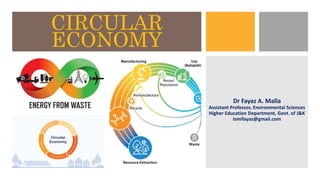
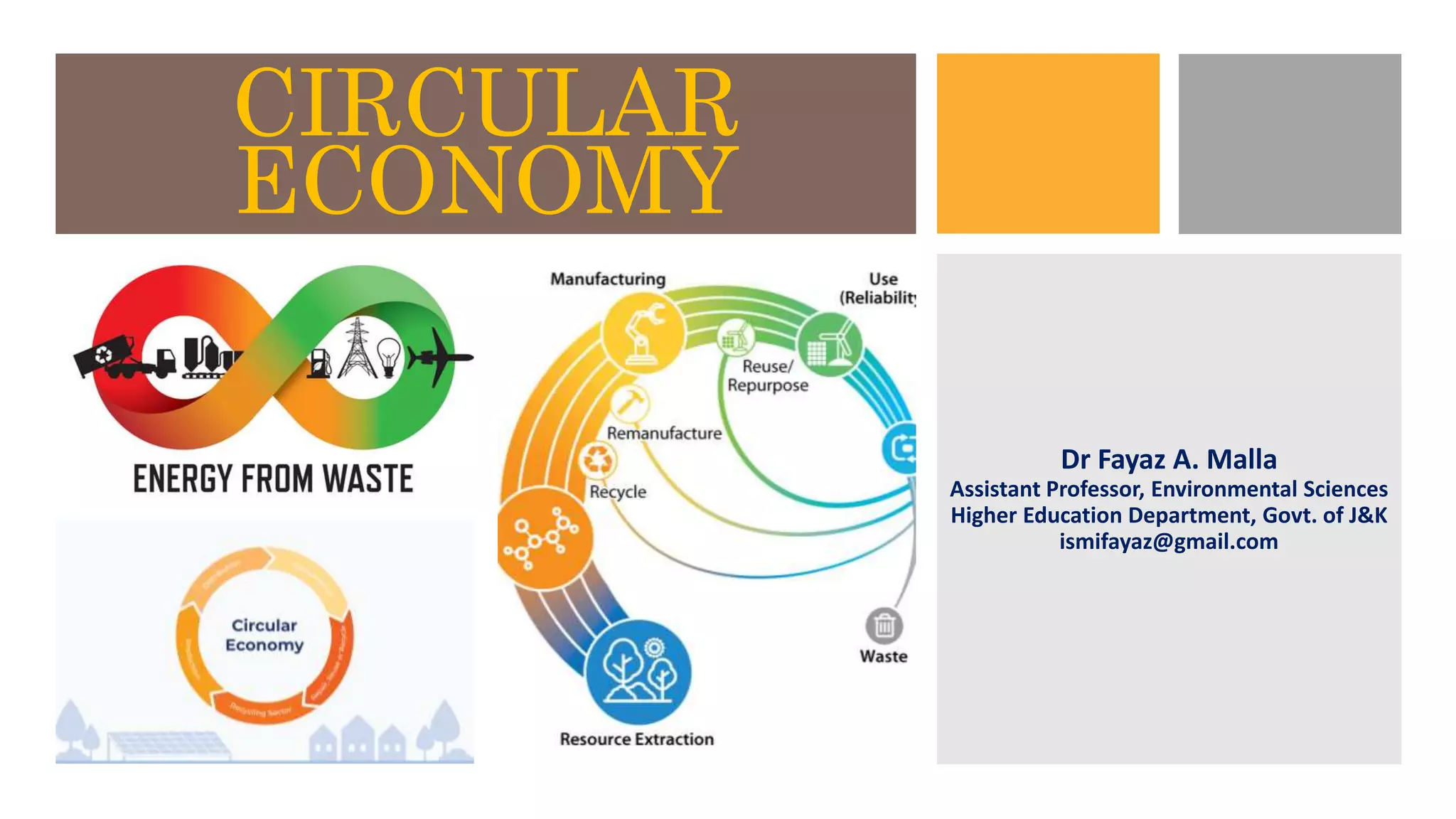
CIRCULAR
ECONOMY
Dr Fayaz A. Malla
Assistant Professor, Environmental Sciences
Higher Education Department, Govt. of J&K
ismifayaz@gmail.com
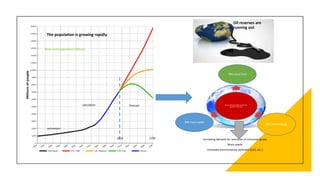
2100
Due to the populationgrowth by
2030 we will need:
70% more food
45% more energy
30% more water
Increasing demand for resources of consumer goods
More waste
Increased environmental pollution (CO2, etc.)
2050: earth population 9 billions
Oil reserves are
running out
2010
estimation
calculation forecast
Τhe population is growing rapidly
Origin and
Family of
Circular
Economy
The circular economy is grounded in the study of feedback
rich (non-linear) systems, particularly living systems.
A major outcome of this is the notion of optimising systems
rather than components, or the notion of ā€˜design for fit’.
As a generic notion it draws from a number of more specific
approaches including cradle to cradle, biomimicry, industrial
ecology, sharing (collaborative) economy and the ā€˜blue
economy’.
Most frequently described as a framework for thinking, its
supporters claim it is a coherent model that has value as part
of a response to the end of the era of cheap oil and materials.
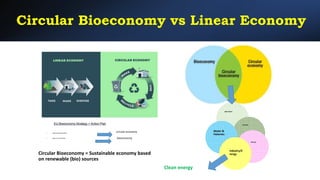
Circular Bioeconomy vs Linear Economy
• what should be done
• how it can be done
circular economy
bioeconomy
EU Bioeconomy Strategy + Action Plan
Industry/E
nergy
Water &
Fisheries
Climate
Forestry
Agriculture
Circular Bioeconomy = Sustainable economy based
on renewable (bio) sources
Clean energy
Drivers of Circular Economy
 The circular economy is a concept dating back more than 30 years, so why is it getting
attention and adoption now?
 For businesses, the key reasons are practical (depletion of key natural resources, rising
commodity costs) and technological (new tools make circular principles easier to
implement).
 Greater urbanization will also help to enable implementation.
 Meanwhile, more governments are getting behind the idea, and consumers are embracing
new ways of consuming. (China, EU, USA, …)
What is
clean
energy
Clean energy = energy free of greenhouse gas emissions
a) Renewable energy (bioenergy) - sustainable
energy from biomass, sun, wind, tidal, ocean,
geothermal and hydro resources.
b) Alternative energy - not infinite in supply. It
includes resources like natural gas, natural
gas cogeneration, fuel cells or any waste
energy that does not naturally replenish but
emits very low carbon emissions.
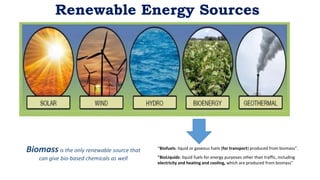
Renewable Energy Sources
Biomass is the only renewable source that
can give bio-based chemicals as well
ā€œBiofuels: liquid or gaseous fuels (for transport) produced from biomassā€.
"BioLiquids: liquid fuels for energy purposes other than traffic, including
electricity and heating and cooling, which are produced from biomass"
Biofuels
(transportation)
• Biofuels are liquid or gaseous fuels produced from biomass
• Biodiesel is fatty acid methyl esters (MIC - FAME) produced from
vegetable or animal oils and fats and are diesel fuel grade, as
biofuel.
• Bioethanol is ethanol produced from Biomass or from a
biodegradable waste fraction, for use as a Biofuel.
• Biogas is the fuel gas produced by Biomass or a biodegradable
fraction of industrial and municipal waste, which can be purified
and upgraded to natural gas quality, for use as Biofuel, or wood
gas.
• Biomethanol is the methanol produced by Biomass for use as a
Biofuel.
• Bio-ETBE is ethyl tert-butyl ether (ETBE) produced from
bioethanol, for use as a Biofuel. The volume of Bio-ETBE
calculated as Biofuels is 47% of its total.
• Bio-MTBE is the methyl tert-butyl ether (MTBE) produced from
methanol, for use as a Biofuel. The volume of Bio-MTBE calculated
as Biofuel is 36% of its total.
Global Biomass for Energy
The biomass produced each year
on our planet = appx 172 billion
tonnes of dry matter, with an
energy content ten times the
energy consumed worldwide at
the same time.
This enormous energy potential
remains largely untapped, as
recent estimates suggest that
only 1/7 of global energy
consumption is covered by
biomass and mainly relates to its
traditional uses (firewoods, etc.).
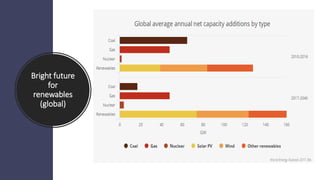
Bright future
for
renewables
(global)
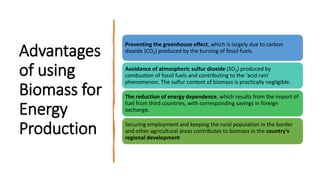
Advantages
of using
Biomass for
Energy
Production
Preventing the greenhouse effect, which is largely due to carbon
dioxide (CO2) produced by the burning of fossil fuels.
Avoidance of atmospheric sulfur dioxide (SO2) produced by
combustion of fossil fuels and contributing to the 'acid rain'
phenomenon. The sulfur content of biomass is practically negligible.
The reduction of energy dependence, which results from the import of
fuel from third countries, with corresponding savings in foreign
exchange.
Securing employment and keeping the rural population in the border
and other agricultural areas contributes to biomass in the country's
regional development
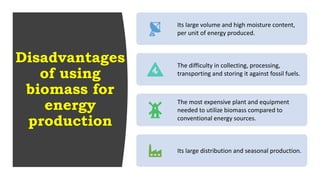
Disadvantages
of using
biomass for
energy
production
Its large volume and high moisture content,
per unit of energy produced.
The difficulty in collecting, processing,
transporting and storing it against fossil fuels.
The most expensive plant and equipment
needed to utilize biomass compared to
conventional energy sources.
Its large distribution and seasonal production.
Barriers for
the
Development
of Circular
Bioeconomy
in India
Lack of public awareness on the environmental benefits
Disorganized and costly supply chain of raw materials
Huge bureaucracy
Low technical training around Bioeconomy
Instability of institutional and taxation environment
Lack of substantial efforts to create a framework for the
marketability of 'green' innovations
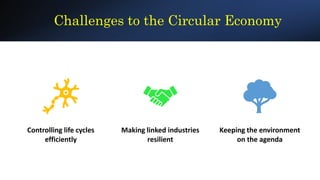
Challenges to the Circular Economy
Controlling life cycles
efficiently
Making linked industries
resilient
Keeping the environment
on the agenda
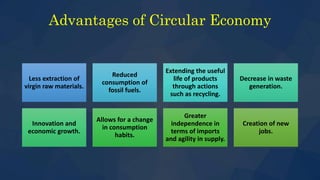
Advantages of Circular Economy
Less extraction of
virgin raw materials.
Reduced
consumption of
fossil fuels.
Extending the useful
life of products
through actions
such as recycling.
Decrease in waste
generation.
Innovation and
economic growth.
Allows for a change
in consumption
habits.
Greater
independence in
terms of imports
and agility in supply.
Creation of new
jobs.
Disadvantages of Circular Economy
Lack of
regulations
governing legal
competition
among
companies.
Lack of
environmental
awareness on the
part of suppliers
and clients.
Economic
barriers and
access to
financing.
Technical skills
and abilities that
are not yet
present in the
workforce.
Presence of
waste that is
difficult to
recycle and
transform.
Consumer
acceptance
problems.

Circular economy

  • 1.
    CIRCULAR ECONOMY Dr Fayaz A.Malla Assistant Professor, Environmental Sciences Higher Education Department, Govt. of J&K ismifayaz@gmail.com
  • 2.
    2100 Due to thepopulationgrowth by 2030 we will need: 70% more food 45% more energy 30% more water Increasing demand for resources of consumer goods More waste Increased environmental pollution (CO2, etc.) 2050: earth population 9 billions Oil reserves are running out 2010 estimation calculation forecast Τhe population is growing rapidly
  • 3.
    Origin and Family of Circular Economy Thecircular economy is grounded in the study of feedback rich (non-linear) systems, particularly living systems. A major outcome of this is the notion of optimising systems rather than components, or the notion of ā€˜design for fit’. As a generic notion it draws from a number of more specific approaches including cradle to cradle, biomimicry, industrial ecology, sharing (collaborative) economy and the ā€˜blue economy’. Most frequently described as a framework for thinking, its supporters claim it is a coherent model that has value as part of a response to the end of the era of cheap oil and materials.
  • 4.
    Circular Bioeconomy vsLinear Economy • what should be done • how it can be done circular economy bioeconomy EU Bioeconomy Strategy + Action Plan Industry/E nergy Water & Fisheries Climate Forestry Agriculture Circular Bioeconomy = Sustainable economy based on renewable (bio) sources Clean energy
  • 6.
    Drivers of CircularEconomy  The circular economy is a concept dating back more than 30 years, so why is it getting attention and adoption now?  For businesses, the key reasons are practical (depletion of key natural resources, rising commodity costs) and technological (new tools make circular principles easier to implement).  Greater urbanization will also help to enable implementation.  Meanwhile, more governments are getting behind the idea, and consumers are embracing new ways of consuming. (China, EU, USA, …)
  • 7.
    What is clean energy Clean energy= energy free of greenhouse gas emissions a) Renewable energy (bioenergy) - sustainable energy from biomass, sun, wind, tidal, ocean, geothermal and hydro resources. b) Alternative energy - not infinite in supply. It includes resources like natural gas, natural gas cogeneration, fuel cells or any waste energy that does not naturally replenish but emits very low carbon emissions.
  • 8.
    Renewable Energy Sources Biomassis the only renewable source that can give bio-based chemicals as well ā€œBiofuels: liquid or gaseous fuels (for transport) produced from biomassā€. "BioLiquids: liquid fuels for energy purposes other than traffic, including electricity and heating and cooling, which are produced from biomass"
  • 9.
    Biofuels (transportation) • Biofuels areliquid or gaseous fuels produced from biomass • Biodiesel is fatty acid methyl esters (MIC - FAME) produced from vegetable or animal oils and fats and are diesel fuel grade, as biofuel. • Bioethanol is ethanol produced from Biomass or from a biodegradable waste fraction, for use as a Biofuel. • Biogas is the fuel gas produced by Biomass or a biodegradable fraction of industrial and municipal waste, which can be purified and upgraded to natural gas quality, for use as Biofuel, or wood gas. • Biomethanol is the methanol produced by Biomass for use as a Biofuel. • Bio-ETBE is ethyl tert-butyl ether (ETBE) produced from bioethanol, for use as a Biofuel. The volume of Bio-ETBE calculated as Biofuels is 47% of its total. • Bio-MTBE is the methyl tert-butyl ether (MTBE) produced from methanol, for use as a Biofuel. The volume of Bio-MTBE calculated as Biofuel is 36% of its total.
  • 10.
    Global Biomass forEnergy The biomass produced each year on our planet = appx 172 billion tonnes of dry matter, with an energy content ten times the energy consumed worldwide at the same time. This enormous energy potential remains largely untapped, as recent estimates suggest that only 1/7 of global energy consumption is covered by biomass and mainly relates to its traditional uses (firewoods, etc.).
  • 11.
  • 12.
    Advantages of using Biomass for Energy Production Preventingthe greenhouse effect, which is largely due to carbon dioxide (CO2) produced by the burning of fossil fuels. Avoidance of atmospheric sulfur dioxide (SO2) produced by combustion of fossil fuels and contributing to the 'acid rain' phenomenon. The sulfur content of biomass is practically negligible. The reduction of energy dependence, which results from the import of fuel from third countries, with corresponding savings in foreign exchange. Securing employment and keeping the rural population in the border and other agricultural areas contributes to biomass in the country's regional development
  • 13.
    Disadvantages of using biomass for energy production Itslarge volume and high moisture content, per unit of energy produced. The difficulty in collecting, processing, transporting and storing it against fossil fuels. The most expensive plant and equipment needed to utilize biomass compared to conventional energy sources. Its large distribution and seasonal production.
  • 14.
    Barriers for the Development of Circular Bioeconomy inIndia Lack of public awareness on the environmental benefits Disorganized and costly supply chain of raw materials Huge bureaucracy Low technical training around Bioeconomy Instability of institutional and taxation environment Lack of substantial efforts to create a framework for the marketability of 'green' innovations
  • 15.
    Challenges to theCircular Economy Controlling life cycles efficiently Making linked industries resilient Keeping the environment on the agenda
  • 16.
    Advantages of CircularEconomy Less extraction of virgin raw materials. Reduced consumption of fossil fuels. Extending the useful life of products through actions such as recycling. Decrease in waste generation. Innovation and economic growth. Allows for a change in consumption habits. Greater independence in terms of imports and agility in supply. Creation of new jobs.
  • 17.
    Disadvantages of CircularEconomy Lack of regulations governing legal competition among companies. Lack of environmental awareness on the part of suppliers and clients. Economic barriers and access to financing. Technical skills and abilities that are not yet present in the workforce. Presence of waste that is difficult to recycle and transform. Consumer acceptance problems.

Editor's Notes

  • #4Ā The circular economy is a form of production and consumption that goes beyond the traditional ā€œ3 R’sā€ (reduce, reuse and recycle) and adds in its model the sharing, renting, repairing and renewing of products and their materials as many times as necessary, in an attempt to confront a linear economy that has devastated ecosystems and the environment over the years to its limit.
  • #5Ā The circular economy takes into account all the processes involved in the production of a product, from manufacturing to the choice of packaging material, and has three main objectives: to eliminate waste and pollution, to keep products and materials in use and to regenerate natural systems. This model of economy is based on renewable energies and materials, and seeks to optimize the power of digital technologies to the maximum.
  • #16Ā 1. Controlling life cycles efficiently It is no surprise that many products are hard to disassemble or to recycle. Product designers are not waste managers and have no strong reasons to incorporate end-of-life considerations into their products. The circular economy therefore requires integrating the entire product life cycle from raw material extraction to disposal (or preferably reuse and recycling). This can be done either through intensive collaboration between companies or single ownership of the product chain. However, such integration has many disadvantages. First, if companies own the entire life cycle of products, they can easily cross-subsidize different activities, leading to inefficient production and high prices. Similarly, strong collaboration can facilitate cartel like behaviour. Second, if producers manage the waste of their own products, it may be more difficult to benefit from economies of scale in waste management. Finally, the upfront costs of owning or managing the entire life cycle may be too high for newcomers. 2. Making linked industries resilient Sometimes the resource loop cannot be closed within one industry. It is possible to turn plastic bottles into plastic bottles into eternity, as closed loop shows, but many industries will see their waste being used as a resource by other industries. Linking up different production chains creates a web of complex interdependencies that can leave the system very vulnerable to disruptions. Similar complexities and collapses are quite common in other systems. Many proponents of the circular economy set nature as an example. However, nature is not perfect. The huge complexity of ecosystems means that a change in one variable (say loss in biodiversity) can create a cascade of effects ending in the collapse of the entire system. In the same way, a cascade of events led to the crash of the complex and interlinked financial system, which in turn affected many others sectors. The ramifications of a similar crash in for instance manufacturing would be unpleasant at least. 3. Keeping the environment on the agenda The conversation among all the participants at the Resource Events was clearly mostly about the economics of the circular economy. The trillion pound opportunity in transitioning to the circular economy – as calculated by the Ellen MacArthur Foundation – was cited extensively. However, it would be silly to forget that resource use is strongly connected to environmental and social issues. Of course, there is great potential for reducing environmental harm in applying the circularity concept and many proponents of circularity see this as an important argument in favour of the concept. But the exact relationship between circularity that maximizes profits and circularity that minimizes environmental benefits is unclear. If governments want to support the circular economy, they should know what policies are needed to achieve both economic growth and reduced environmental impacts. Circularity clearly is an attractive option for the future. However, the actual implementation of circularity requires facing some major challenges. Integrating life cycles and industries leads to complex systems that may hamper competition and leave the economy vulnerable to disruptions. Most importantly, the circular economy should not only create monetary benefits but also meet the need for reduced environmental impacts.