Announcements – March 16, 2011
New York Times October 1, 2004  With Russia's Nod, Treaty on Emissions Clears Last Hurdle   The long-delayed Kyoto Protocol on global warming overcame its last critical hurdle to taking effect around the world on Thursday when Russia's cabinet endorsed the treaty and sent it to Parliament.  The treaty is the first  to require cuts in emissions linked to global warming.  The United States has rejected the  treaty and will not be bound by its restrictions.  But the treaty, which  has already been ratified by 120 countries will take effect if supporters include nations accounting for at least 55 percent of all industrialized countries' 1990-level emissions. The only  way for it to cross that threshold was with ratification by Russia.  In 1990, the United States accounted for 36.1 percent of  emissions from industrialized countries, and Russia 17.4 percent.
CNN Nov. 10, 2004 Climate report leaves U.S. policy unchanged - Climate treaty considered threat to U.S. jobs and economic growth  WASHINGTON (AP)  -- President Bush is holding fast to his rejection of mandatory curbs on greenhouse gases that are blamed for global warming, despite a fresh report from 300 scientists in the United States and seven other nations that shows Arctic temperatures are rising.  Critics say Bush's opposition is ironic because the treaty was modeled after the market-based U.S. program for cutting acid rain created in 1990 by Bush's father and often pointed to by the current administration as a success story.
26 September 2006 World 'warmest for 12,000 years The world is the warmest it has been in the last 12,000 years as a result of rapid warming over the past 30 years, a study has suggested.  Nasa climatologists said the Earth had warmed by about 0.2C (0.4F) in each of the last three decades.  As a result, plant and animal species were struggling to migrate fast enough to cooler regions, they said.
2 April 2010 More than 90 record-high temperatures were  recorded in the Midwest and Great Lakes yesterday. And perhaps an even better record came for the residents of Minneapolis-St. Paul in Minnesota - for only the third time in recorded history there was no snow measured during the month of March. (Records date back to 1859). Rochester, Minnesota, shattered its old record high of 71 degrees when the temperature soared to 83 degrees yesterday. Chicago also recorded a record high temperature for April 1 of 83.
November 24, 2009 Why You Should Be Hot and Bothered About 'Climate-gate' By John Lott A coordinated campaign to hide scientific information about climate change appears unprecedented. Could it wind up costing us trillions? “ Agenda-driven scientists want to push the U.S. into a costly climate pact” Sarah Palin - www.ajc.com
Air Quality I Lecture Objectives: What is the greenhouse effect? Is global climate change/warming real? What are the worst-case scenarios under global climate change?
 
What are Greenhouse Gases? Gases that are transparent to light, but absorb infrared radiation Mainly CO 2 , but also chlorofluorocarbons, methane, nitrous oxide General Causes: Burning coal, oil, gas:  releases CO 2 Deforestation:  releases stored CO 2 , reduces CO 2  storage More CO 2  emitted than can be absorbed Industrialized nations
What do we know?
Data show:  current rapid build-up of  ‘greenhouse’ gases (eg. CO 2 ) But how do we know past climates? What do we know?
Polar ice caps record history of recent pollution and historical climate change in build-up of ice layers What do we know?
What do we know?
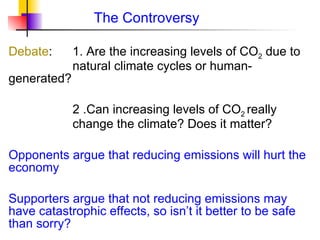
The Controversy Debate : 1. Are the increasing levels of CO 2  due to  natural climate cycles or human-generated?   2 .Can increasing levels of CO 2  really  change the climate? Does it matter? Opponents argue that reducing emissions will hurt the economy Supporters argue that not reducing emissions may have catastrophic effects, so isn ’t it better to be safe than sorry?
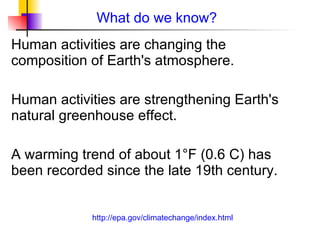
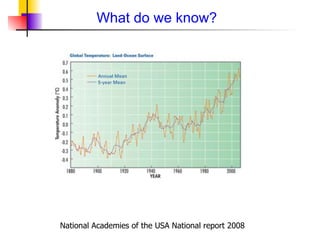
What do we know? Human activities are changing the composition of Earth's atmosphere.  Human activities are strengthening Earth's natural greenhouse effect.  A warming trend of about 1°F (0.6 C) has been recorded since the late 19th century.  http://epa.gov/climatechange/index.html
What do we know? National Academies of the USA National report 2008
What do we know?
What is likely but not certain? Rising levels of greenhouse gases in the atmosphere will increase global warming to what extent is difficult to determine.  Average global temperatures will continue to rise. By how much and how fast remain uncertain  Could be 2.2 - 10°F
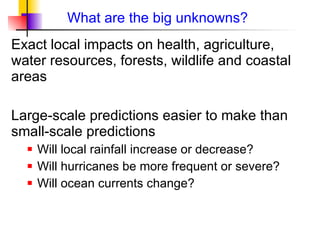
What are the big unknowns? Exact local impacts on health, agriculture, water resources, forests, wildlife and coastal areas  Large-scale predictions easier to make than small-scale predictions Will local rainfall increase or decrease? Will hurricanes be more frequent or severe? Will ocean currents change?
Evidence for Global Climate Change IPCC –Intergovernmental Panel on Climate Change Appointed by the United Nations in 1988 Mission:  To study the issue and make recommendations First Assessment  published 1990 Second Assessment  published in 1996  Third Assessment  published in 2001 http://www.ipcc.ch/ Scientific Basis, Impacts Adaptation and Vulnerability, Mitigation, Synthesis
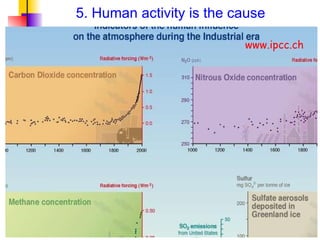
IPCC conclusions 1. CO 2  and temperature correlated  2. 0.6  C (1.0  F) ave. temperature increase since 1861 3. Declines in snow and ice cover since 1960s 4. 10-20 cm sea-level increase in last 100 years  5. human activity is the cause Near unanimity of scientific opinion National Research Council (U.S.) agrees Evidence for Global Climate Change
1.  1.0  F (0.6  C) average temperature  increase since 1861
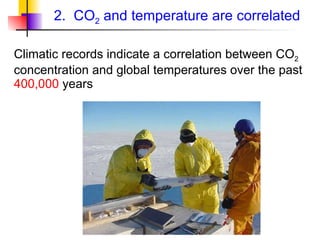
Climatic records indicate a correlation between CO 2  concentration and global temperatures over the past  400,000  years  2.  CO 2  and temperature are correlated
Nature  2002 419:188-190
www.isgs.illinois.edu
3. Declines in snow and ice cover South Cascade Glacier, Washington State
Mount Kilimanjaro, one of the few places in the world where ice and snow can be found on the equator,  could lose its entire ice field by 2020 because of climate change. The ice fields Ernest Hemingway once described as "wide as all the world, great, high, and unbelievably white in the sun" have lost 82 percent of their ice since 1912—the year their full extent was first measured.
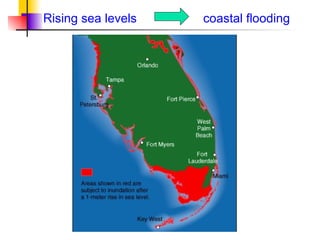
4.  Increases in sea level (10-20 cm) http://www.umac.org/ocp/paradise/outlook.htm
Rising sea levels  coastal flooding
5. Human activity is the cause www.ipcc.ch
Effects of Global Climate Change Not uniform; regional differences some areas hotter, some colder, some wetter, dryer Local and regional changes are  difficult to predict
Worsening Health Effects Direct heat stress:  2003 heat wave in France killed 15,000 Diseases:  cold weather kills many diseases, especially mosquito-borne diseases:  malaria, dengue fever, yellow fever, encephalitis Ozone:  pollutant near the ground Cholera:  – ENSO link
Animals and Plants Shift northward in species distribution
Flowers bloom earlier as UK warms By Richard Black 7 April 2010 British plants are flowering earlier now than at any time in the last 250 years, according to new analysis. Flowers are now emerging about five days earlier than 30-40 years ago. Researchers stitched together nearly 400,000 first flowering records covering 405 species across the nation. They show that the average first flowering date has been earlier in the last 25 years than in any other period. Flowering dates are closely linked to temperatures recorded in the Central England Temperature Record. This is the longest continuous instrumental record of temperatures anywhere in the world, dating back to measurements made in 1659.
Agriculture and Food Supply Increase yields for some crops, but not uniformly World food supply may be unaltered, but problems in poor countries will likely get worse Increase pest populations Increase need for irrigation
Disruption of Water & Weather Cycles? Major changes to hydrological cycle Increased evaporation will dry some areas Exacerbate problems in Middle East & Africa Increased precipitation will flood some areas Increased intensity of storms Problems with flood control
23 September 2005 Hurricanes and global warming - a link?  The most recent study on the issue, found that while the incidence of hurricanes and tropical storms has remained roughly constant over the last 30 years, there has been a rise in the number of intense hurricanes with wind speeds above 211km/h (131mph). The leader of that research project, Dr Peter Webster, believes there may be a link to climate change.
Is there anything we can do? Reduce Greenhouse Gases by: 1. Reducing emissions 2. Increasing CO 2  uptake Political and economic issues – need effective policy! Annual US per capita contribution = 22 tons of CO 2  emissions per year World average per capita = 6 tons
How to reduce greenhouse gases?  Improve energy efficiency Current & future buildings using available, cost-effective technologies Increase investments in renewable and longer-term technologies. Carbon tax:  stimulate development of increased efficiency, alternative energy sources Removal of CO 2  from atmosphere plant trees Stop deforestation Increase CO 2  storage in the ocean
 
EPA Announces Landmark Greenhouse Gas  Regulations Plan For Nation's Biggest Polluters  12/23/10 A press release from the U.S. Environmental Protection Agency (EPA) announced that new standards granted under the Clean Air Act will be implemented in 2012 to regulate greenhouse gas (GHG) emissions in the Unites States.  The EPA's new plan will establish standards specifically for fossil fuel power plants and petroleum refineries, both of which combine to represent roughly 40 percent of GHG pollution in the United States.
House votes to block funding for EPA's greenhouse gas regulations Feb 18, 2011  The House approved a GOP amendment to federal spending legislation Friday that would block fiscal year 2011 funding for EPA’s implementation of greenhouse gas regulations.
Side Benefits of Reducing Emissions Reduced air pollution Increased human health  = lower health care costs & increased productivity Improved energy efficiency - Reduced dependence on foreign oil - Reduced need for expensive new power plants Increased investment in alternative energy technologies  (renewable resources)! Who reaps benefits and who pays costs?
Points to know  What is the greenhouse effect? What are the greenhouse gases? What do we know for sure in the controversy over global climate change? What are the big unknowns? What is the IPCC? What conclusions did it reach regarding global warming? Did the National Research Council of the U.S. agree with their findings? Will global warming be felt evenly across the earth? Can we predict what will happen in a given region? How can we reduce greenhouse gases? What are some side benefits of emission reduction?

15 climate change

  • 1.
  • 2.
    New York TimesOctober 1, 2004 With Russia's Nod, Treaty on Emissions Clears Last Hurdle The long-delayed Kyoto Protocol on global warming overcame its last critical hurdle to taking effect around the world on Thursday when Russia's cabinet endorsed the treaty and sent it to Parliament. The treaty is the first to require cuts in emissions linked to global warming. The United States has rejected the treaty and will not be bound by its restrictions. But the treaty, which has already been ratified by 120 countries will take effect if supporters include nations accounting for at least 55 percent of all industrialized countries' 1990-level emissions. The only way for it to cross that threshold was with ratification by Russia. In 1990, the United States accounted for 36.1 percent of emissions from industrialized countries, and Russia 17.4 percent.
  • 3.
    CNN Nov. 10,2004 Climate report leaves U.S. policy unchanged - Climate treaty considered threat to U.S. jobs and economic growth WASHINGTON (AP) -- President Bush is holding fast to his rejection of mandatory curbs on greenhouse gases that are blamed for global warming, despite a fresh report from 300 scientists in the United States and seven other nations that shows Arctic temperatures are rising. Critics say Bush's opposition is ironic because the treaty was modeled after the market-based U.S. program for cutting acid rain created in 1990 by Bush's father and often pointed to by the current administration as a success story.
  • 4.
    26 September 2006World 'warmest for 12,000 years The world is the warmest it has been in the last 12,000 years as a result of rapid warming over the past 30 years, a study has suggested. Nasa climatologists said the Earth had warmed by about 0.2C (0.4F) in each of the last three decades. As a result, plant and animal species were struggling to migrate fast enough to cooler regions, they said.
  • 5.
    2 April 2010More than 90 record-high temperatures were recorded in the Midwest and Great Lakes yesterday. And perhaps an even better record came for the residents of Minneapolis-St. Paul in Minnesota - for only the third time in recorded history there was no snow measured during the month of March. (Records date back to 1859). Rochester, Minnesota, shattered its old record high of 71 degrees when the temperature soared to 83 degrees yesterday. Chicago also recorded a record high temperature for April 1 of 83.
  • 6.
    November 24, 2009Why You Should Be Hot and Bothered About 'Climate-gate' By John Lott A coordinated campaign to hide scientific information about climate change appears unprecedented. Could it wind up costing us trillions? “ Agenda-driven scientists want to push the U.S. into a costly climate pact” Sarah Palin - www.ajc.com
  • 7.
    Air Quality ILecture Objectives: What is the greenhouse effect? Is global climate change/warming real? What are the worst-case scenarios under global climate change?
  • 8.
  • 9.
    What are GreenhouseGases? Gases that are transparent to light, but absorb infrared radiation Mainly CO 2 , but also chlorofluorocarbons, methane, nitrous oxide General Causes: Burning coal, oil, gas: releases CO 2 Deforestation: releases stored CO 2 , reduces CO 2 storage More CO 2 emitted than can be absorbed Industrialized nations
  • 10.
  • 11.
    Data show: current rapid build-up of ‘greenhouse’ gases (eg. CO 2 ) But how do we know past climates? What do we know?
  • 12.
    Polar ice capsrecord history of recent pollution and historical climate change in build-up of ice layers What do we know?
  • 13.
  • 14.
    The Controversy Debate: 1. Are the increasing levels of CO 2 due to natural climate cycles or human-generated? 2 .Can increasing levels of CO 2 really change the climate? Does it matter? Opponents argue that reducing emissions will hurt the economy Supporters argue that not reducing emissions may have catastrophic effects, so isn ’t it better to be safe than sorry?
  • 15.
    What do weknow? Human activities are changing the composition of Earth's atmosphere. Human activities are strengthening Earth's natural greenhouse effect. A warming trend of about 1°F (0.6 C) has been recorded since the late 19th century. http://epa.gov/climatechange/index.html
  • 16.
    What do weknow? National Academies of the USA National report 2008
  • 17.
  • 18.
    What is likelybut not certain? Rising levels of greenhouse gases in the atmosphere will increase global warming to what extent is difficult to determine. Average global temperatures will continue to rise. By how much and how fast remain uncertain Could be 2.2 - 10°F
  • 19.
    What are thebig unknowns? Exact local impacts on health, agriculture, water resources, forests, wildlife and coastal areas Large-scale predictions easier to make than small-scale predictions Will local rainfall increase or decrease? Will hurricanes be more frequent or severe? Will ocean currents change?
  • 20.
    Evidence for GlobalClimate Change IPCC –Intergovernmental Panel on Climate Change Appointed by the United Nations in 1988 Mission: To study the issue and make recommendations First Assessment published 1990 Second Assessment published in 1996 Third Assessment published in 2001 http://www.ipcc.ch/ Scientific Basis, Impacts Adaptation and Vulnerability, Mitigation, Synthesis
  • 21.
    IPCC conclusions 1.CO 2 and temperature correlated 2. 0.6  C (1.0  F) ave. temperature increase since 1861 3. Declines in snow and ice cover since 1960s 4. 10-20 cm sea-level increase in last 100 years 5. human activity is the cause Near unanimity of scientific opinion National Research Council (U.S.) agrees Evidence for Global Climate Change
  • 22.
    1. 1.0 F (0.6  C) average temperature increase since 1861
  • 23.
    Climatic records indicatea correlation between CO 2 concentration and global temperatures over the past 400,000 years 2. CO 2 and temperature are correlated
  • 24.
    Nature 2002419:188-190
  • 25.
  • 26.
    3. Declines insnow and ice cover South Cascade Glacier, Washington State
  • 27.
    Mount Kilimanjaro, oneof the few places in the world where ice and snow can be found on the equator, could lose its entire ice field by 2020 because of climate change. The ice fields Ernest Hemingway once described as "wide as all the world, great, high, and unbelievably white in the sun" have lost 82 percent of their ice since 1912—the year their full extent was first measured.
  • 28.
    4. Increasesin sea level (10-20 cm) http://www.umac.org/ocp/paradise/outlook.htm
  • 29.
    Rising sea levels coastal flooding
  • 30.
    5. Human activityis the cause www.ipcc.ch
  • 31.
    Effects of GlobalClimate Change Not uniform; regional differences some areas hotter, some colder, some wetter, dryer Local and regional changes are difficult to predict
  • 32.
    Worsening Health EffectsDirect heat stress: 2003 heat wave in France killed 15,000 Diseases: cold weather kills many diseases, especially mosquito-borne diseases: malaria, dengue fever, yellow fever, encephalitis Ozone: pollutant near the ground Cholera: – ENSO link
  • 33.
    Animals and PlantsShift northward in species distribution
  • 34.
    Flowers bloom earlieras UK warms By Richard Black 7 April 2010 British plants are flowering earlier now than at any time in the last 250 years, according to new analysis. Flowers are now emerging about five days earlier than 30-40 years ago. Researchers stitched together nearly 400,000 first flowering records covering 405 species across the nation. They show that the average first flowering date has been earlier in the last 25 years than in any other period. Flowering dates are closely linked to temperatures recorded in the Central England Temperature Record. This is the longest continuous instrumental record of temperatures anywhere in the world, dating back to measurements made in 1659.
  • 35.
    Agriculture and FoodSupply Increase yields for some crops, but not uniformly World food supply may be unaltered, but problems in poor countries will likely get worse Increase pest populations Increase need for irrigation
  • 36.
    Disruption of Water& Weather Cycles? Major changes to hydrological cycle Increased evaporation will dry some areas Exacerbate problems in Middle East & Africa Increased precipitation will flood some areas Increased intensity of storms Problems with flood control
  • 37.
    23 September 2005Hurricanes and global warming - a link? The most recent study on the issue, found that while the incidence of hurricanes and tropical storms has remained roughly constant over the last 30 years, there has been a rise in the number of intense hurricanes with wind speeds above 211km/h (131mph). The leader of that research project, Dr Peter Webster, believes there may be a link to climate change.
  • 38.
    Is there anythingwe can do? Reduce Greenhouse Gases by: 1. Reducing emissions 2. Increasing CO 2 uptake Political and economic issues – need effective policy! Annual US per capita contribution = 22 tons of CO 2 emissions per year World average per capita = 6 tons
  • 39.
    How to reducegreenhouse gases? Improve energy efficiency Current & future buildings using available, cost-effective technologies Increase investments in renewable and longer-term technologies. Carbon tax: stimulate development of increased efficiency, alternative energy sources Removal of CO 2 from atmosphere plant trees Stop deforestation Increase CO 2 storage in the ocean
  • 40.
  • 41.
    EPA Announces LandmarkGreenhouse Gas Regulations Plan For Nation's Biggest Polluters 12/23/10 A press release from the U.S. Environmental Protection Agency (EPA) announced that new standards granted under the Clean Air Act will be implemented in 2012 to regulate greenhouse gas (GHG) emissions in the Unites States. The EPA's new plan will establish standards specifically for fossil fuel power plants and petroleum refineries, both of which combine to represent roughly 40 percent of GHG pollution in the United States.
  • 42.
    House votes toblock funding for EPA's greenhouse gas regulations Feb 18, 2011 The House approved a GOP amendment to federal spending legislation Friday that would block fiscal year 2011 funding for EPA’s implementation of greenhouse gas regulations.
  • 43.
    Side Benefits ofReducing Emissions Reduced air pollution Increased human health = lower health care costs & increased productivity Improved energy efficiency - Reduced dependence on foreign oil - Reduced need for expensive new power plants Increased investment in alternative energy technologies (renewable resources)! Who reaps benefits and who pays costs?
  • 44.
    Points to know What is the greenhouse effect? What are the greenhouse gases? What do we know for sure in the controversy over global climate change? What are the big unknowns? What is the IPCC? What conclusions did it reach regarding global warming? Did the National Research Council of the U.S. agree with their findings? Will global warming be felt evenly across the earth? Can we predict what will happen in a given region? How can we reduce greenhouse gases? What are some side benefits of emission reduction?