a climate for change
                      !

WHAT IS
HAPPENING TO
OUR WORLD …
AND WHAT CAN
WE DO ABOUT IT?
              !
K AT H A R I N E H AY H O E
America’s first climate refugees: ALASKA
Frozen ground is melting & eroding


                    The people of Newtok, AK
                    have already been driven from
                    their homes.
                    Kivalina may be next.
What is happening to our world?


             !" # $ % & ' (%
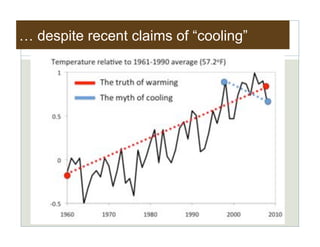
The Earth is getting warmer …

            9 of last 10 years warmest on record
            2000s: warmest decade on record
… despite recent claims of “cooling”
It’s happening faster and faster
And this is just a fraction of total heating.
Sea level is rising, as ice sheets melt
Arctic sea ice is shrinking


 !! !"##$%&'$(&)*$&$+,$-,&.$*%$('$.&/01234&56$%&7(',&83&9%'&
 !! :*$1;%$$&'"##$%'&7)<$79&*5##5-&=),>)-&?&.$*(.$'&
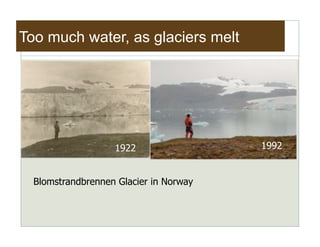
Too much water, as glaciers melt


                   1922                 1992


  Blomstrandbrennen Glacier in Norway
Too much water, as glaciers melt


           Franz Josef Glacier, New Zealand
Too much water, as glaciers melt


              Orubare Glacier, Uganda
Too much water, as glaciers melt


 ,-,.%                             )**+%

         Shepard Glacier, Glacier National Park, USA

           When the park was created: over 150 glaciers
                  In 2005: 27 glaciers remaining
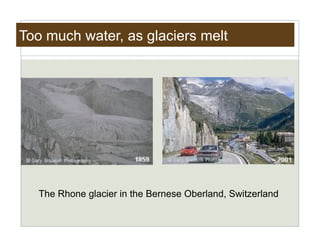
Too much water, as glaciers melt


   The Rhone glacier in the Bernese Oberland, Switzerland
Not enough water, as others are in drought

                             Central Africa
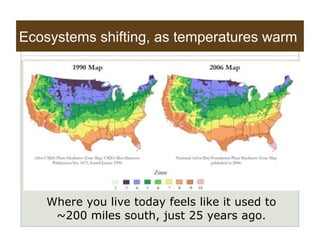
Ecosystems shifting, as temperatures warm


    Where you live today feels like it used to
     ~200 miles south, just 25 years ago.
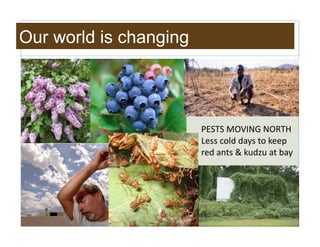
Our world is changing

         @ABC:@B&!DB:EF&
         C)7(*'G&>5-$9'"*<7$G&(-.&5,>$%&
         >(%H)-I$%'&5;&'J%)-I&(%$&K5=$%)-I&
         /12&=$$<'&$(%7)$%&)-&,>$&9$(%L&
Our world is changing


         !M:NO:EF&PBQD!&AER&DCAEO!&
         P$-,$%&5;&H7"$H$%%9&J%5."*S5-&>('&'>)T$.&
         -5%,>=(%.G&;%5#&U()-$&,5&V"$H$*L&
Our world is changing


               @WOB@U@&M@AO&
               B$*5%.&>)I>&,$#J$%(,"%$'&(-.&
               >$(,&=(6$'&2+&#5%$&;%$X"$-,L&
Our world is changing


                        RBQYFMO&
                        P%5J&75''$'&5;&Z0[&J$%&
                        9$(%&')-*$&/]3'L&
Our world is changing


                        D@!O!&UQ^:EF&EQBOM&
                        C$''&*57.&.(9'&,5&<$$J&
                        %$.&(-,'&_&<".`"&(,&H(9&
Our world is changing


       Responses to warming
        temperatures seen in
      more than 26,000 physical
       and biological systems
          around the world.
Are these conditions unusual?


            !" # $ % $ / &%
“Natural” thermometer records
Conditions today are unusual in the
context of the last 2,000 years …

                                      Today"
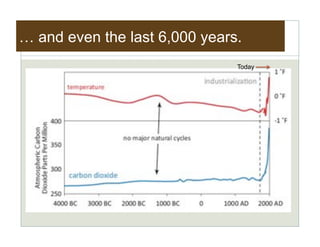
… and even the last 6,000 years.
                               Today"
Why is this happening?


        !" # $ % $ 0 # ( (%
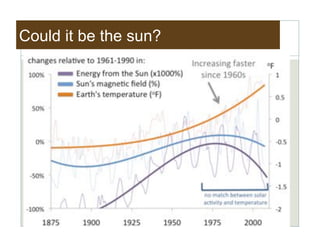
Could it be the sun?
What about natural cycles?
                             Today"
What about natural cycles?
An extra “blanket” around the Earth

 OM@&EAOYBAC                OM@&@EMAEP@R
    &FB@@EMQY!@&@NN@PO&         &FB@@EMQY!@&@NN@PO&&&&
 &&&&-(,"%(779&)-*%$('$'    &&&&>('&(%Sc*)(779&)-*%$('$.
    &@(%,>a'&,$#J$%(,"%$&H9& &@(%,>a'&,$#J$%(,"%$&H9
    &b35N&                      &/L85N&
We produce heat-trapping gases
From our factories, cars, homes, farms
Who is responsible?


 Last year, annual emissions from China caught up with those from the US.
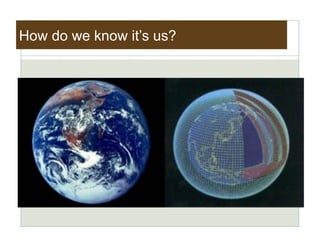
How do we know it’s us?
Quantifying the human influence
But what about …


     !" # $ % 1 & 2 #%
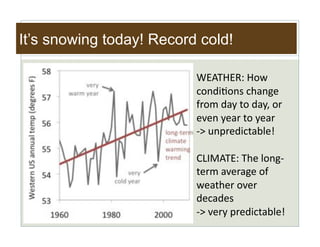
It’s snowing today! Record cold!

                          d@AOM@Be&M5=&
                          *5-.)S5-'&*>(-I$&
                          ;%5#&.(9&,5&.(9G&5%&
                          $6$-&9$(%&,5&9$(%&
                          1f&"-J%$.)*,(H7$g&
It’s snowing today! Record cold!

                          d@AOM@Be&M5=&
                          *5-.)S5-'&*>(-I$&
                          ;%5#&.(9&,5&.(9G&5%&
                          $6$-&9$(%&,5&9$(%&
                          1f&"-J%$.)*,(H7$g&

                          PC:UAO@e&O>$&75-I1
                          ,$%#&(6$%(I$&5;&
                          =$(,>$%&56$%&
                          .$*(.$'&
                          1f&6$%9&J%$.)*,(H7$g&
Maybe it’s just
the urban heat
island effect.

 d>$%$&J$5J7$&
 7)6$&

 d>$%$&),a'&
 =(%#)-I&;(',$',&
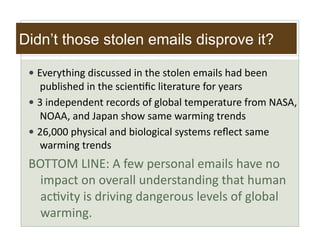
Didn’t those stolen emails disprove it?

 !! @6$%9,>)-I&.)'*"''$.&)-&,>$&',57$-&$#()7'&>(.&H$$-
    &J"H7)'>$.&)-&,>$&'*)$-Sc*&7),$%(,"%$&;5%&9$(%'&
 !! ?&)-.$J$-.$-,&%$*5%.'&5;&I75H(7&,$#J$%(,"%$&;%5#&EA!AG
    &EQAAG&(-.&h(J(-&'>5=&'(#$&=(%#)-I&,%$-.'&
 !! 2iG333&J>9')*(7&(-.&H)575I)*(7&'9',$#'&%$K$*,&'(#$
    &=(%#)-I&,%$-.'&
 [QOOQU&C:E@e&A&;$=&J$%'5-(7&$#()7'&>(6$&-5
  &)#J(*,&5-&56$%(77&"-.$%',(-.)-I&,>(,&>"#(-
  &(*S6),9&)'&.%)6)-I&.(-I$%5"'&7$6$7'&5;&I75H(7
  &=(%#)-IL&
Aren’t scientists always disagreeing?

  Warming of the climate system is now evident from observations.
  Most of the increase is very likely (>90%) due to the observed
  increase in heat-trapping gas concentrations due to human
  activities [including burning fossil fuels].


                   Climatic change is being brought about by human-
                   induced increases in the concentration of
                   atmospheric carbon dioxide, primarily through the
                   processes of combustion [burning] of fossil fuels.
Aren’t scientists always disagreeing?

  Warming of the climate system is now evident from observations.
  Most of the increase is very likely (>90%) due to the observed
  increase in heat-trapping gas concentrations due to human
  activities [including burning fossil fuels].
                  The United Nations Intergovernmental Panel on
                  Climate Change, 2007
                   Climatic change is being brought about by human-
                   induced increases in the concentration of
                   atmospheric carbon dioxide, primarily through the
                   processes of combustion [burning] of fossil fuels.
                  “The Artificial Production of Carbon Dioxide and
                  Its Influence on Temperature”
                  Guy Callendar, 1938
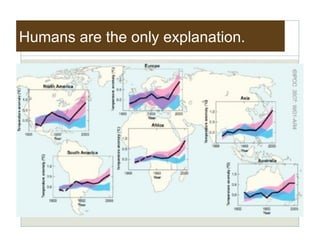
Humans are the only explanation.
Why should I care?


      !" # $ % 1 3 4 (%
What can we expect in the future?


       We’re already
    concerned about this
What can we expect in the future?


      But this is what’s
       coming next.
Future change depends on our choices now
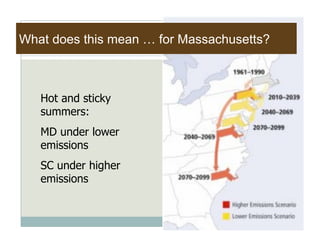
What does this mean … for Massachusetts?


   Hot and sticky
   summers:
   MD under lower
   emissions
   SC under higher
   emissions
What does this mean … for Chicago?

Summers: hot and            WINTER
humid


Winters: warmer,
but just as much   SUMMER
snow
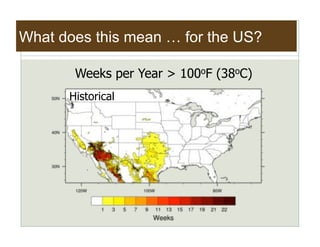
What does this mean … for the US?

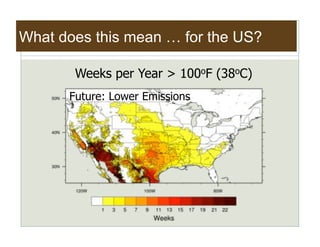
       Weeks per Year > 100oF (38oC)
      Historical
What does this mean … for the US?

       Weeks per Year > 100oF (38oC)
      Future: Lower Emissions
What does this mean … for the US?

       Weeks per Year > 100oF (38oC)
      Future: Higher Emissions
What does this mean … for the world?


          In 2000: 150,000 deaths per year
          In 2009: 300,000 deaths per year
    300 million already at risk from climate change
    This century: hundreds of millions of refugees
What does this mean … for Europe?

                         More frequent &
                         severe heat waves
                         European Heat
                          Wave of 2003
                         >70,000 deaths
What does this mean … for Australia?


                              More unpredictable
                              weather conditions.


 More droughts & wildfires
 like the devastating fires
 of January 2009.
What does this mean … for Latin America?


 C:UAG&D@BY&                 /&H)77)5-&=5%7.1=).$&
 ]&#)77)5-&J$5J7$&           .$J$-.&5-&I7(*)$%&
 7$''&,>(-&2j&%()-&J$%&9%&   #$7,&;5%&=(,$%&
What does this mean … for California?

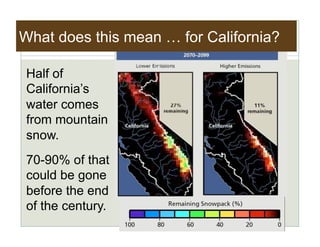
 Half of
 California’s
 water comes
 from mountain
 snow.
 70-90% of that
 could be gone
 before the end
 of the century.
What does this mean … for our coasts?


                       Warmer water =
                       Stronger tropical
                       storms
Hurricane power and ocean temperature
Rising sea level
What does this mean … for our coasts?
… and even entire nations?


Tuvalu, South Pacific
Today, our neighbors are being harmed

 B)')-I&'$(&7$6$7'G&=).$'J%$(.&.%5"I>,G&(-.
  &%(J).79&.)'(JJ$(%)-I&I7(*)$%'&(%$&(7%$(.9
  &,>%$(,$-)-I&#)77)5-'&=),>&75''&5;&=(,$%G
  &;55.G&(-.&$6$-&7);$L&
 O5.(9G&5"%&I75H(7&-$)I>H5%'k,>$&J55%&(-.
  &J$5J7$&*"%%$-,79&',%(-I$%'&,5&"'k(%$&#5',
  &6"7-$%(H7$&,5&>(%#&;%5#&*7)#(,$1%$7(,$.
  &)#J(*,'L&
                        1&!"#$%&'()"*+,"#-'./)"
What can we do about it?


          !" # $ % 5 3 6%
We have 3 choices:

 ld$&H(')*(779&>(6$&,>%$$&*>5)*$'e&#)SI(S5-G
  &(.(J,(S5-G&(-.&'"m$%)-IL&&
 d$a%$&I5)-I&,5&.5&'5#$&5;&$(*>L&O>$
  &X"$'S5-&)'&=>(,&,>$&#)+&)'&I5)-I&,5&H$L&&
 O>$&#5%$&#)SI(S5-&=$&.5G&,>$&7$''
  &(.(J,(S5-&=)77&H$&%$X")%$.&(-.&,>$&7$''
  &'"m$%)-I&,>$%$&=)77&H$Lj&
                         &&         &          &789:%08;<=>:%
              & &   &   &D%$').$-,a'&!*)$-*$&A.6)'5%n&M(%6(%.&Y-)6$%'),9&
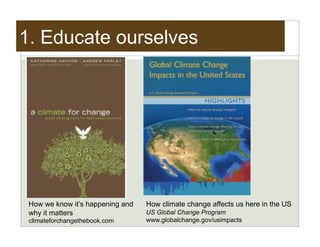
1. Educate ourselves


 How we know it’s happening and   How climate change affects us here in the US
 why it matters                   US Global Change Program
 climateforchangethebook.com      www.globalchange.gov/usimpacts
2. Prepare for what we can’t avoid

                          Conserve the
                          resources we have


 Protect ourselves from
 what we can
3. Reduce our own impact


stop using this                    start using this
           Each US household replacing 1 light bulb
 = taking 1,000,000 cars off the road (+$30 savings per bulb)
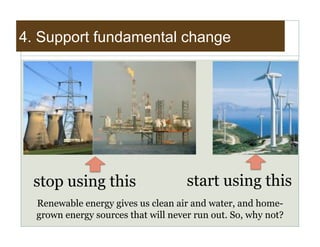
4. Support fundamental change


 stop using this                     start using this
  Renewable energy gives us clean air and water, and home-
  grown energy sources that will never run out. So, why not?
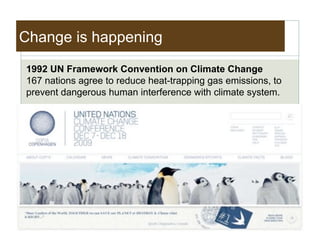
Change is happening
1992 UN Framework Convention on Climate Change
167 nations agree to reduce heat-trapping gas emissions, to
prevent dangerous human interference with climate system.
Change is
possible
THE END


          1 & # % ? & # ( % 3 ' 1 & # ? "$ 3 & ' %

     / / /@ A "$ 0 " # 3 ' ( 0 "B 0 & ( @ C & ? %
/ / /@ C D 3 ? "$ 1 & # C 0 " ' E ( $ 0 ( F & & A @ C & ? %

Hayhoe Climate

  • 1.
    a climate forchange ! WHAT IS HAPPENING TO OUR WORLD … AND WHAT CAN WE DO ABOUT IT? ! K AT H A R I N E H AY H O E
  • 2.
    America’s first climaterefugees: ALASKA
  • 3.
    Frozen ground ismelting & eroding The people of Newtok, AK have already been driven from their homes. Kivalina may be next.
  • 4.
    What is happeningto our world? !" # $ % & ' (%
  • 5.
    The Earth isgetting warmer … 9 of last 10 years warmest on record 2000s: warmest decade on record
  • 6.
    … despite recentclaims of “cooling”
  • 7.
  • 8.
    And this isjust a fraction of total heating.
  • 9.
    Sea level isrising, as ice sheets melt
  • 10.
    Arctic sea iceis shrinking !! !"##$%&'$(&)*$&$+,$-,&.$*%$('$.&/01234&56$%&7(',&83&9%'& !! :*$1;%$$&'"##$%'&7)<$79&*5##5-&=),>)-&?&.$*(.$'&
  • 11.
    Too much water,as glaciers melt 1922 1992 Blomstrandbrennen Glacier in Norway
  • 12.
    Too much water,as glaciers melt Franz Josef Glacier, New Zealand
  • 13.
    Too much water,as glaciers melt Orubare Glacier, Uganda
  • 14.
    Too much water,as glaciers melt ,-,.% )**+% Shepard Glacier, Glacier National Park, USA When the park was created: over 150 glaciers In 2005: 27 glaciers remaining
  • 15.
    Too much water,as glaciers melt The Rhone glacier in the Bernese Oberland, Switzerland
  • 16.
    Not enough water,as others are in drought Central Africa
  • 17.
    Ecosystems shifting, astemperatures warm Where you live today feels like it used to ~200 miles south, just 25 years ago.
  • 18.
    Our world ischanging @ABC:@B&!DB:EF& C)7(*'G&>5-$9'"*<7$G&(-.&5,>$%& >(%H)-I$%'&5;&'J%)-I&(%$&K5=$%)-I& /12&=$$<'&$(%7)$%&)-&,>$&9$(%L&
  • 19.
    Our world ischanging !M:NO:EF&PBQD!&AER&DCAEO!& P$-,$%&5;&H7"$H$%%9&J%5."*S5-&>('&'>)T$.& -5%,>=(%.G&;%5#&U()-$&,5&V"$H$*L&
  • 20.
    Our world ischanging @WOB@U@&M@AO& B$*5%.&>)I>&,$#J$%(,"%$'&(-.& >$(,&=(6$'&2+&#5%$&;%$X"$-,L&
  • 21.
    Our world ischanging RBQYFMO& P%5J&75''$'&5;&Z0[&J$%& 9$(%&')-*$&/]3'L&
  • 22.
    Our world ischanging D@!O!&UQ^:EF&EQBOM& C$''&*57.&.(9'&,5&<$$J& %$.&(-,'&_&<".`"&(,&H(9&
  • 23.
    Our world ischanging Responses to warming temperatures seen in more than 26,000 physical and biological systems around the world.
  • 24.
    Are these conditionsunusual? !" # $ % $ / &%
  • 25.
  • 26.
    Conditions today areunusual in the context of the last 2,000 years … Today"
  • 27.
    … and eventhe last 6,000 years. Today"
  • 28.
    Why is thishappening? !" # $ % $ 0 # ( (%
  • 29.
    Could it bethe sun?
  • 30.
    What about naturalcycles? Today"
  • 31.
  • 32.
    An extra “blanket”around the Earth OM@&EAOYBAC OM@&@EMAEP@R &FB@@EMQY!@&@NN@PO& &FB@@EMQY!@&@NN@PO&&&& &&&&-(,"%(779&)-*%$('$' &&&&>('&(%Sc*)(779&)-*%$('$. &@(%,>a'&,$#J$%(,"%$&H9& &@(%,>a'&,$#J$%(,"%$&H9 &b35N& &/L85N&
  • 33.
  • 34.
    From our factories,cars, homes, farms
  • 35.
    Who is responsible? Last year, annual emissions from China caught up with those from the US.
  • 36.
    How do weknow it’s us?
  • 37.
  • 38.
  • 39.
    But what about… !" # $ % 1 & 2 #%
  • 40.
    It’s snowing today!Record cold! d@AOM@Be&M5=& *5-.)S5-'&*>(-I$& ;%5#&.(9&,5&.(9G&5%& $6$-&9$(%&,5&9$(%& 1f&"-J%$.)*,(H7$g&
  • 41.
    It’s snowing today!Record cold! d@AOM@Be&M5=& *5-.)S5-'&*>(-I$& ;%5#&.(9&,5&.(9G&5%& $6$-&9$(%&,5&9$(%& 1f&"-J%$.)*,(H7$g& PC:UAO@e&O>$&75-I1 ,$%#&(6$%(I$&5;& =$(,>$%&56$%& .$*(.$'& 1f&6$%9&J%$.)*,(H7$g&
  • 42.
    Maybe it’s just theurban heat island effect. d>$%$&J$5J7$& 7)6$& d>$%$&),a'& =(%#)-I&;(',$',&
  • 43.
    Didn’t those stolenemails disprove it? !! @6$%9,>)-I&.)'*"''$.&)-&,>$&',57$-&$#()7'&>(.&H$$- &J"H7)'>$.&)-&,>$&'*)$-Sc*&7),$%(,"%$&;5%&9$(%'& !! ?&)-.$J$-.$-,&%$*5%.'&5;&I75H(7&,$#J$%(,"%$&;%5#&EA!AG &EQAAG&(-.&h(J(-&'>5=&'(#$&=(%#)-I&,%$-.'& !! 2iG333&J>9')*(7&(-.&H)575I)*(7&'9',$#'&%$K$*,&'(#$ &=(%#)-I&,%$-.'& [QOOQU&C:E@e&A&;$=&J$%'5-(7&$#()7'&>(6$&-5 &)#J(*,&5-&56$%(77&"-.$%',(-.)-I&,>(,&>"#(- &(*S6),9&)'&.%)6)-I&.(-I$%5"'&7$6$7'&5;&I75H(7 &=(%#)-IL&
  • 44.
    Aren’t scientists alwaysdisagreeing? Warming of the climate system is now evident from observations. Most of the increase is very likely (>90%) due to the observed increase in heat-trapping gas concentrations due to human activities [including burning fossil fuels]. Climatic change is being brought about by human- induced increases in the concentration of atmospheric carbon dioxide, primarily through the processes of combustion [burning] of fossil fuels.
  • 45.
    Aren’t scientists alwaysdisagreeing? Warming of the climate system is now evident from observations. Most of the increase is very likely (>90%) due to the observed increase in heat-trapping gas concentrations due to human activities [including burning fossil fuels]. The United Nations Intergovernmental Panel on Climate Change, 2007 Climatic change is being brought about by human- induced increases in the concentration of atmospheric carbon dioxide, primarily through the processes of combustion [burning] of fossil fuels. “The Artificial Production of Carbon Dioxide and Its Influence on Temperature” Guy Callendar, 1938
  • 46.
    Humans are theonly explanation.
  • 47.
    Why should Icare? !" # $ % 1 3 4 (%
  • 48.
    What can weexpect in the future? We’re already concerned about this
  • 49.
    What can weexpect in the future? But this is what’s coming next.
  • 50.
    Future change dependson our choices now
  • 51.
    What does thismean … for Massachusetts? Hot and sticky summers: MD under lower emissions SC under higher emissions
  • 52.
    What does thismean … for Chicago? Summers: hot and WINTER humid Winters: warmer, but just as much SUMMER snow
  • 53.
    What does thismean … for the US? Weeks per Year > 100oF (38oC) Historical
  • 54.
    What does thismean … for the US? Weeks per Year > 100oF (38oC) Future: Lower Emissions
  • 55.
    What does thismean … for the US? Weeks per Year > 100oF (38oC) Future: Higher Emissions
  • 56.
    What does thismean … for the world? In 2000: 150,000 deaths per year In 2009: 300,000 deaths per year 300 million already at risk from climate change This century: hundreds of millions of refugees
  • 57.
    What does thismean … for Europe? More frequent & severe heat waves European Heat Wave of 2003 >70,000 deaths
  • 58.
    What does thismean … for Australia? More unpredictable weather conditions. More droughts & wildfires like the devastating fires of January 2009.
  • 59.
    What does thismean … for Latin America? C:UAG&D@BY& /&H)77)5-&=5%7.1=).$& ]&#)77)5-&J$5J7$& .$J$-.&5-&I7(*)$%& 7$''&,>(-&2j&%()-&J$%&9%& #$7,&;5%&=(,$%&
  • 60.
    What does thismean … for California? Half of California’s water comes from mountain snow. 70-90% of that could be gone before the end of the century.
  • 61.
    What does thismean … for our coasts? Warmer water = Stronger tropical storms
  • 62.
    Hurricane power andocean temperature
  • 63.
  • 64.
    What does thismean … for our coasts?
  • 65.
    … and evenentire nations? Tuvalu, South Pacific
  • 66.
    Today, our neighborsare being harmed B)')-I&'$(&7$6$7'G&=).$'J%$(.&.%5"I>,G&(-. &%(J).79&.)'(JJ$(%)-I&I7(*)$%'&(%$&(7%$(.9 &,>%$(,$-)-I&#)77)5-'&=),>&75''&5;&=(,$%G &;55.G&(-.&$6$-&7);$L& O5.(9G&5"%&I75H(7&-$)I>H5%'k,>$&J55%&(-. &J$5J7$&*"%%$-,79&',%(-I$%'&,5&"'k(%$&#5', &6"7-$%(H7$&,5&>(%#&;%5#&*7)#(,$1%$7(,$. &)#J(*,'L& 1&!"#$%&'()"*+,"#-'./)"
  • 67.
    What can wedo about it? !" # $ % 5 3 6%
  • 68.
    We have 3choices: ld$&H(')*(779&>(6$&,>%$$&*>5)*$'e&#)SI(S5-G &(.(J,(S5-G&(-.&'"m$%)-IL&& d$a%$&I5)-I&,5&.5&'5#$&5;&$(*>L&O>$ &X"$'S5-&)'&=>(,&,>$&#)+&)'&I5)-I&,5&H$L&& O>$&#5%$&#)SI(S5-&=$&.5G&,>$&7$'' &(.(J,(S5-&=)77&H$&%$X")%$.&(-.&,>$&7$'' &'"m$%)-I&,>$%$&=)77&H$Lj& && & &789:%08;<=>:% & & & &D%$').$-,a'&!*)$-*$&A.6)'5%n&M(%6(%.&Y-)6$%'),9&
  • 69.
    1. Educate ourselves How we know it’s happening and How climate change affects us here in the US why it matters US Global Change Program climateforchangethebook.com www.globalchange.gov/usimpacts
  • 70.
    2. Prepare forwhat we can’t avoid Conserve the resources we have Protect ourselves from what we can
  • 71.
    3. Reduce ourown impact stop using this start using this Each US household replacing 1 light bulb = taking 1,000,000 cars off the road (+$30 savings per bulb)
  • 72.
    4. Support fundamentalchange stop using this start using this Renewable energy gives us clean air and water, and home- grown energy sources that will never run out. So, why not?
  • 73.
    Change is happening 1992UN Framework Convention on Climate Change 167 nations agree to reduce heat-trapping gas emissions, to prevent dangerous human interference with climate system.
  • 74.
  • 75.
    THE END 1 & # % ? & # ( % 3 ' 1 & # ? "$ 3 & ' % / / /@ A "$ 0 " # 3 ' ( 0 "B 0 & ( @ C & ? % / / /@ C D 3 ? "$ 1 & # C 0 " ' E ( $ 0 ( F & & A @ C & ? %