The Five Evidence-Based Practices of
Classroom Management
Presented at the 2018 BPEG Symposium
Jason Harlacher, Ph.D.
Harlacher_J@cde.state.co.us
Office of Learning Supports
Colorado Department of Education
May 7, 2018
Icebreaker
• Choose a number 1 to 3:
1. Any kids, nieces, nephews, or pets?
2. Second career if not in education?
3. Favorite hobby or leisure activity?
• Turn to neighbor, introduce self, and each answer your
chosen question.
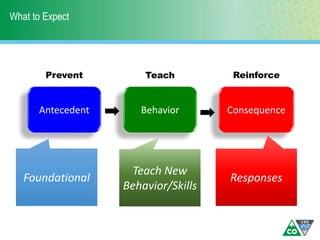
What to Expect
Antecedent Behavior Consequence
Foundational Responses
Prevent Teach Reinforce
Teach New
Behavior/Skills
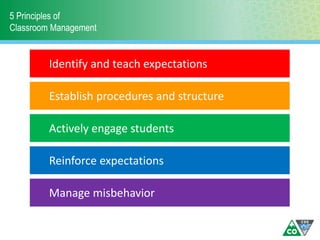
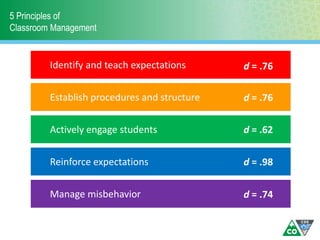
5 Principles of
Classroom Management
Identify and teach expectations
Establish procedures and structure
Actively engage students
Reinforce expectations
Manage misbehavior
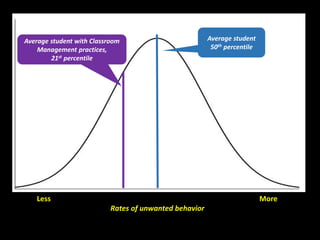
Less More
Rates of unwanted behavior
Average student
50th percentile
Average student with Classroom
Management practices,
21st percentile
Identify and teach expectations
Establish procedures and structure
Actively engage students
Reinforce expectations
Manage misbehavior
5 Principles of
Classroom Management
d = .76
d = .76
d = .62
d = .98
d = .74
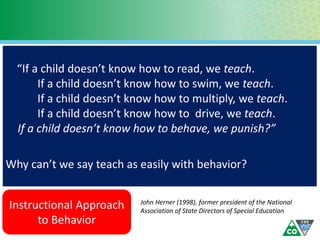
“If a child doesn’t know how to read, we teach.
If a child doesn’t know how to swim, we teach.
If a child doesn’t know how to multiply, we teach.
If a child doesn’t know how to drive, we teach.
If a child doesn’t know how to behave, we punish?”
Why can’t we say teach as easily with behavior?
John Herner (1998), former president of the National
Association of State Directors of Special Education
Instructional Approach
to Behavior
1. Identifying and Teaching
Expectations
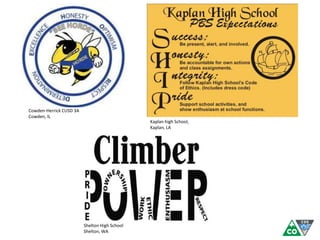
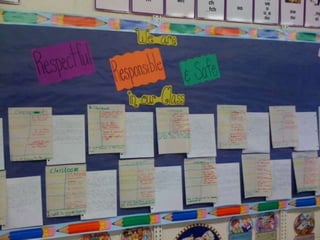
Expectations
• Foundation of classroom management is a set of common
expectations that generally describe desired behavior across
all routines, settings, tasks, etc within a classroom.
• Shape values and climate of classroom
(1) No more than five, (2) positively worded, (3) short, developmentally
appropriate, (4) translate into specific behaviors
Houghton High School
Houghton, MI
Bonnie Garcia Elementary School
Laredo, TX
Smith Station Elementary School
Fredericksburg, VA
Lenihan Intermediate School
Marshalltown, IA
Cowden-Herrick CUSD 3A
Cowden, IL
Shelton High School
Shelton, WA
Kaplan high School,
Kaplan, LA
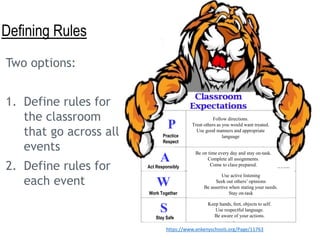
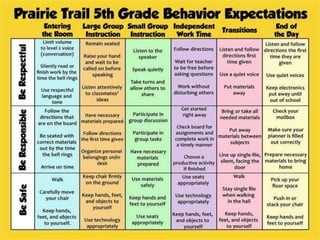
Defining Rules
Two options:
1. Define rules for
the classroom
that go across all
events
2. Define rules for
each event
P
A
W
S
Practice
Respect
Act Responsibly
Work Together
Stay Safe
Be on time every day and stay on-task.
Complete all assignments.
Come to class prepared.
Use active listening
Seek out others’ opinions
Be assertive when stating your needs.
Stay on-task
Keep hands, feet, objects to self.
Use respectful language.
Be aware of your actions.
Follow directions.
Treat others as you would want treated.
Use good manners and appropriate
language
https://www.ankenyschools.org/Page/11763
14
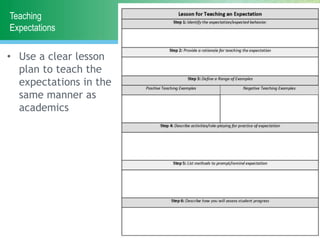
Teaching
Expectations
• Use a clear lesson
plan to teach the
expectations in the
same manner as
academics
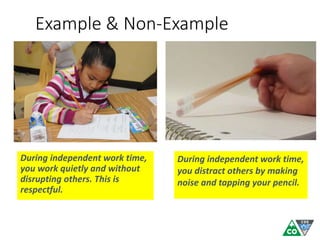
Example & Non-Example
During independent work time,
you work quietly and without
disrupting others. This is
respectful.
During independent work time,
you distract others by making
noise and tapping your pencil.
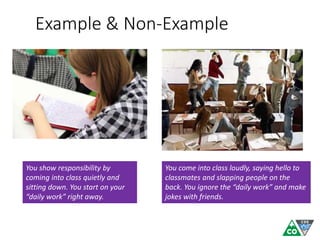
Example & Non-Example
You show responsibility by
coming into class quietly and
sitting down. You start on your
“daily work” right away.
You come into class loudly, saying hello to
classmates and slapping people on the
back. You ignore the “daily work” and make
jokes with friends.
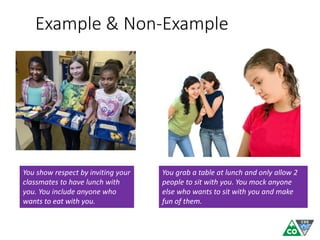
Example & Non-Example
You show respect by inviting your
classmates to have lunch with
you. You include anyone who
wants to eat with you.
You grab a table at lunch and only allow 2
people to sit with you. You mock anyone
else who wants to sit with you and make
fun of them.
19
Harlacher. Classroom Mang
Activity
• What is respect toward peers?
• Think of an example and non-example for your
classroom/setting for “respect”
2. Ensuring Structure and
Routines
Ensuring Structure and Routines
• Creating a space that is predictable and facilitates the
desired behavior
• Physical Space
• Temporal Space
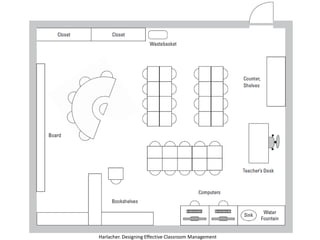
Harlacher. Designing Effective Classroom Management
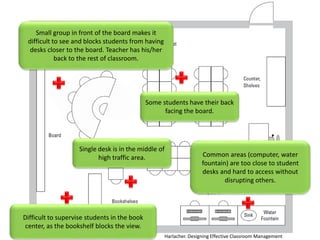
Difficult to supervise students in the book
center, as the bookshelf blocks the view.
Common areas (computer, water
fountain) are too close to student
desks and hard to access without
disrupting others.
Some students have their back
facing the board.
Small group in front of the board makes it
difficult to see and blocks students from having
desks closer to the board. Teacher has his/her
back to the rest of classroom.
Single desk is in the middle of
high traffic area.
Harlacher. Designing Effective Classroom Management
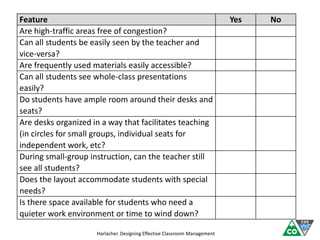
Feature Yes No
Are high-traffic areas free of congestion?
Can all students be easily seen by the teacher and
vice-versa?
Are frequently used materials easily accessible?
Can all students see whole-class presentations
easily?
Do students have ample room around their desks and
seats?
Are desks organized in a way that facilitates teaching
(in circles for small groups, individual seats for
independent work, etc?
During small-group instruction, can the teacher still
see all students?
Does the layout accommodate students with special
needs?
Is there space available for students who need a
quieter work environment or time to wind down?
Harlacher. Designing Effective Classroom Management
Temporal Space: Routines
• Teach students procedures for common tasks in class,
such as entering classroom, handing in work, asking
for a hall pass, getting teacher’s attention, etc
• Define a procedure and its steps
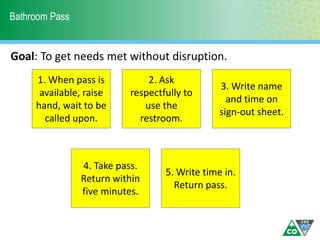
Bathroom Pass
1. When pass is
available, raise
hand, wait to be
called upon.
2. Ask
respectfully to
use the
restroom.
3. Write name
and time on
sign-out sheet.
4. Take pass.
Return within
five minutes.
5. Write time in.
Return pass.
Goal: To get needs met without disruption.
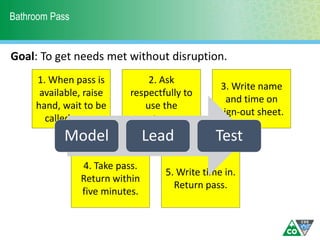
Bathroom Pass
1. When pass is
available, raise
hand, wait to be
called upon.
2. Ask
respectfully to
use the
restroom.
3. Write name
and time on
sign-out sheet.
4. Take pass.
Return within
five minutes.
5. Write time in.
Return pass.
Model Lead Test
Goal: To get needs met without disruption.
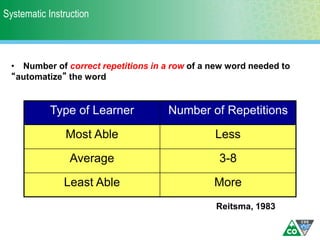
Type of Learner Number of Repetitions
Most Able Less
Average 3-8
Least Able More
Reitsma, 1983
• Number of correct repetitions in a row of a new word needed to
“automatize” the word
Systematic Instruction
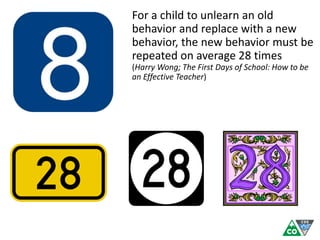
For a child to unlearn an old
behavior and replace with a new
behavior, the new behavior must be
repeated on average 28 times
(Harry Wong; The First Days of School: How to be
an Effective Teacher)
3. Actively Engage Students
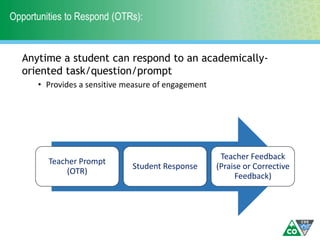
Opportunities to Respond (OTRs):
Anytime a student can respond to an academically-
oriented task/question/prompt
• Provides a sensitive measure of engagement
Teacher Prompt
(OTR)
Student Response
Teacher Feedback
(Praise or Corrective
Feedback)
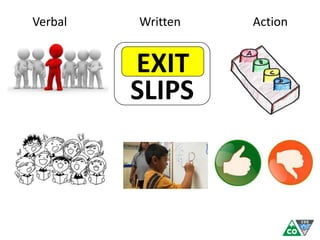
Verbal Written Action
EXIT
SLIPS
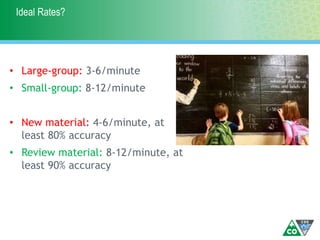
Ideal Rates?
• Large-group: 3-6/minute
• Small-group: 8-12/minute
• New material: 4-6/minute, at
least 80% accuracy
• Review material: 8-12/minute, at
least 90% accuracy
Structuring Peer Responses
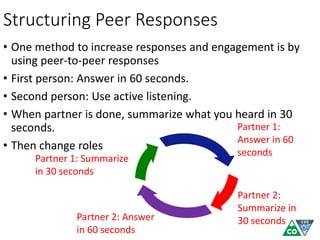
• One method to increase responses and engagement is by
using peer-to-peer responses
• First person: Answer in 60 seconds.
• Second person: Use active listening.
• When partner is done, summarize what you heard in 30
seconds.
• Then change roles
Partner 1:
Answer in 60
seconds
Partner 2:
Summarize in
30 seconds
Partner 2: Answer
in 60 seconds
Partner 1: Summarize
in 30 seconds
Jigsaw Method
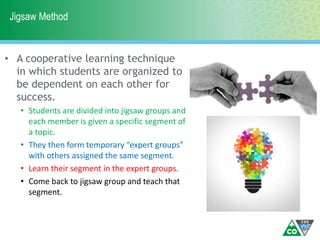
• A cooperative learning technique
in which students are organized to
be dependent on each other for
success.
• Students are divided into jigsaw groups and
each member is given a specific segment of
a topic.
• They then form temporary “expert groups”
with others assigned the same segment.
• Learn their segment in the expert groups.
• Come back to jigsaw group and teach that
segment.
Benefits
Greater empathy after 2 months of use (Bridgeman)
Greater attitudes toward school, peers (Geffner)
Increased liking toward peers, increases in self-esteem,
less competitiveness (Blaney)
Improvements in achievement (Aronson)
4. Strategies to Acknowledge
Behavior
Acknowledgement
• Acknowledge and provide feedback to students on use of
expectations and appropriate behavior
• Approximations and exact skill/behavior
• Praise, acknowledgement, feedback are synonymous.
• All used to let students know they are performing a skill correctly.
• Create a comprehensive acknowledgement system to
strengthen desired behavior
1. Behavior-Specific Praise
2. High-frequency acknowledgment
3. Long-term acknowledgement
Behavior-Specific Praise
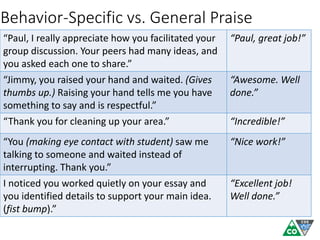
“Paul, I really appreciate how you facilitated your
group discussion. Your peers had many ideas, and
you asked each one to share.”
“Paul, great job!”
“Jimmy, you raised your hand and waited. (Gives
thumbs up.) Raising your hand tells me you have
something to say and is respectful.”
“Awesome. Well
done.”
“Thank you for cleaning up your area.” “Incredible!”
“You (making eye contact with student) saw me
talking to someone and waited instead of
interrupting. Thank you.”
“Nice work!”
I noticed you worked quietly on your essay and
you identified details to support your main idea.
(fist bump).”
“Excellent job!
Well done.”
Behavior-Specific vs. General Praise
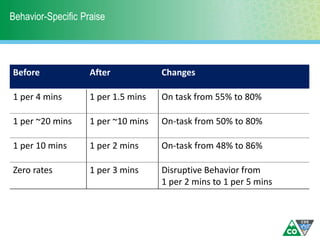
Behavior-Specific Praise
Before After Changes
1 per 4 mins 1 per 1.5 mins On task from 55% to 80%
1 per ~20 mins 1 per ~10 mins On-task from 50% to 80%
1 per 10 mins 1 per 2 mins On-task from 48% to 86%
Zero rates 1 per 3 mins Disruptive Behavior from
1 per 2 mins to 1 per 5 mins
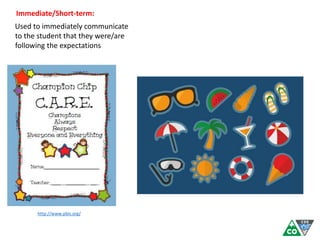
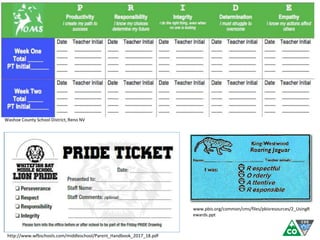
Immediate/Short-term:
Used to immediately communicate
to the student that they were/are
following the expectations
http://www.pbis.org/
Washoe County School District, Reno NV
http://www.wfbschools.com/middleschool/Parent_Handbook_2017_18.pdf
www.pbis.org/common/cms/files/pbisresources/2_UsingR
ewards.ppt
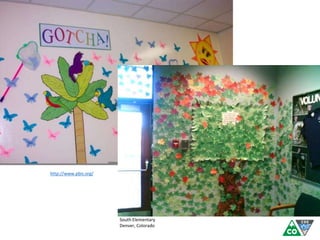
http://www.pbis.org/
South Elementary
Denver, Colorado
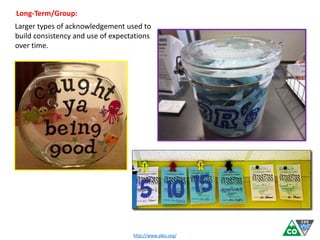
Long-Term/Group:
Larger types of acknowledgement used to
build consistency and use of expectations
over time.
http://www.pbis.org/
Examples
Teacher chair pass
First in line/first to leave class pass
Time with custodian, support staff, etc
10 minutes to listen to music
Homework/Help pass
“Office” for a day/period
Game with peers or with staff
http://interventioncentral.org/behavioral-
interventions/rewards/jackpot-ideas-classroom-rewards
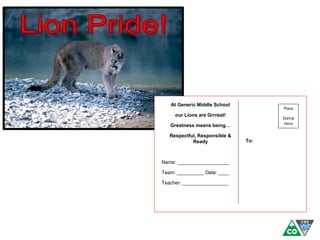
At Generic Middle School
our Lions are Grrreat!
Greatness means being…
Respectful, Responsible &
Ready
Name: ___________________
Team: __________ Date: ____
Teacher: _________________
Place
Stamp
Here
To:
5. Strategies to Manage
Misbehavior
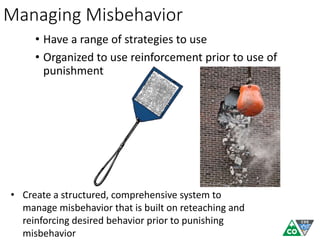
Managing Misbehavior
• Have a range of strategies to use
• Organized to use reinforcement prior to use of
punishment
• Create a structured, comprehensive system to
manage misbehavior that is built on reteaching and
reinforcing desired behavior prior to punishing
misbehavior
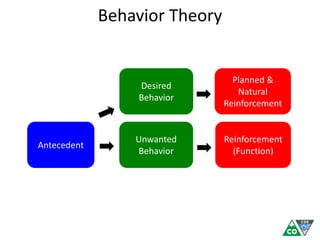
Antecedent
Unwanted
Behavior
Reinforcement
(Function)
Desired
Behavior
Planned &
Natural
Reinforcement
Behavior Theory
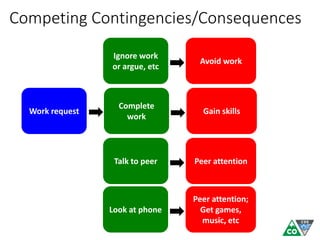
Competing Contingencies/Consequences
Work request
Complete
work
Gain skills
Ignore work
or argue, etc
Avoid work
Talk to peer Peer attention
Look at phone
Peer attention;
Get games,
music, etc
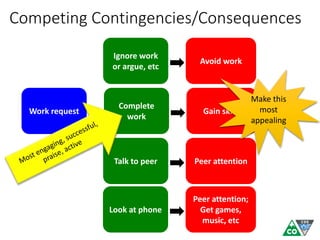
Competing Contingencies/Consequences
Work request
Complete
work
Gain skills
Ignore work
or argue, etc
Avoid work
Talk to peer Peer attention
Look at phone
Peer attention;
Get games,
music, etc
Make this
most
appealing
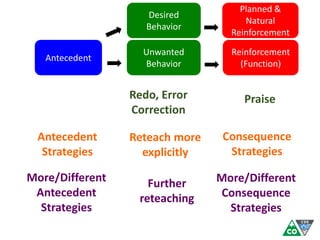
Antecedent
Unwanted
Behavior
Reinforcement
(Function)
Desired
Behavior
Planned &
Natural
Reinforcement
Redo, Error
Correction
Praise
Antecedent
Strategies
Consequence
Strategies
Reteach more
explicitly
More/Different
Antecedent
Strategies
More/Different
Consequence
Strategies
Further
reteaching
Key Points
• Use of 5 principles = comprehensive and effective
classroom management
• Misbehavior is an opportunity to reteach
• High rates of responding and behavior-specific praise
are your two most effective tools
• Supplemental Handout has resources and templates
for use
The Five Evidence-Based Practices of
Classroom Management
Presented at the 2018 BPEG Symposium
Jason Harlacher, Ph.D.
Harlacher_J@cde.state.co.us
Office of Learning Supports
Colorado Department of Education
May 7, 2018

BPEG Classroom Management Online Presentation.pptx

  • 1.
    The Five Evidence-BasedPractices of Classroom Management Presented at the 2018 BPEG Symposium Jason Harlacher, Ph.D. Harlacher_J@cde.state.co.us Office of Learning Supports Colorado Department of Education May 7, 2018
  • 2.
    Icebreaker • Choose anumber 1 to 3: 1. Any kids, nieces, nephews, or pets? 2. Second career if not in education? 3. Favorite hobby or leisure activity? • Turn to neighbor, introduce self, and each answer your chosen question.
  • 3.
    What to Expect AntecedentBehavior Consequence Foundational Responses Prevent Teach Reinforce Teach New Behavior/Skills
  • 4.
    5 Principles of ClassroomManagement Identify and teach expectations Establish procedures and structure Actively engage students Reinforce expectations Manage misbehavior
  • 5.
    Less More Rates ofunwanted behavior Average student 50th percentile Average student with Classroom Management practices, 21st percentile
  • 6.
    Identify and teachexpectations Establish procedures and structure Actively engage students Reinforce expectations Manage misbehavior 5 Principles of Classroom Management d = .76 d = .76 d = .62 d = .98 d = .74
  • 7.
    “If a childdoesn’t know how to read, we teach. If a child doesn’t know how to swim, we teach. If a child doesn’t know how to multiply, we teach. If a child doesn’t know how to drive, we teach. If a child doesn’t know how to behave, we punish?” Why can’t we say teach as easily with behavior? John Herner (1998), former president of the National Association of State Directors of Special Education Instructional Approach to Behavior
  • 8.
    1. Identifying andTeaching Expectations
  • 9.
    Expectations • Foundation ofclassroom management is a set of common expectations that generally describe desired behavior across all routines, settings, tasks, etc within a classroom. • Shape values and climate of classroom (1) No more than five, (2) positively worded, (3) short, developmentally appropriate, (4) translate into specific behaviors
  • 10.
    Houghton High School Houghton,MI Bonnie Garcia Elementary School Laredo, TX Smith Station Elementary School Fredericksburg, VA Lenihan Intermediate School Marshalltown, IA
  • 11.
    Cowden-Herrick CUSD 3A Cowden,IL Shelton High School Shelton, WA Kaplan high School, Kaplan, LA
  • 13.
    Defining Rules Two options: 1.Define rules for the classroom that go across all events 2. Define rules for each event P A W S Practice Respect Act Responsibly Work Together Stay Safe Be on time every day and stay on-task. Complete all assignments. Come to class prepared. Use active listening Seek out others’ opinions Be assertive when stating your needs. Stay on-task Keep hands, feet, objects to self. Use respectful language. Be aware of your actions. Follow directions. Treat others as you would want treated. Use good manners and appropriate language https://www.ankenyschools.org/Page/11763
  • 14.
  • 15.
    Teaching Expectations • Use aclear lesson plan to teach the expectations in the same manner as academics
  • 16.
    Example & Non-Example Duringindependent work time, you work quietly and without disrupting others. This is respectful. During independent work time, you distract others by making noise and tapping your pencil.
  • 17.
    Example & Non-Example Youshow responsibility by coming into class quietly and sitting down. You start on your “daily work” right away. You come into class loudly, saying hello to classmates and slapping people on the back. You ignore the “daily work” and make jokes with friends.
  • 18.
    Example & Non-Example Youshow respect by inviting your classmates to have lunch with you. You include anyone who wants to eat with you. You grab a table at lunch and only allow 2 people to sit with you. You mock anyone else who wants to sit with you and make fun of them.
  • 19.
  • 20.
    Activity • What isrespect toward peers? • Think of an example and non-example for your classroom/setting for “respect”
  • 21.
  • 22.
    Ensuring Structure andRoutines • Creating a space that is predictable and facilitates the desired behavior • Physical Space • Temporal Space Harlacher. Designing Effective Classroom Management
  • 23.
    Harlacher. Designing EffectiveClassroom Management
  • 24.
    Difficult to supervisestudents in the book center, as the bookshelf blocks the view. Common areas (computer, water fountain) are too close to student desks and hard to access without disrupting others. Some students have their back facing the board. Small group in front of the board makes it difficult to see and blocks students from having desks closer to the board. Teacher has his/her back to the rest of classroom. Single desk is in the middle of high traffic area. Harlacher. Designing Effective Classroom Management
  • 25.
    Feature Yes No Arehigh-traffic areas free of congestion? Can all students be easily seen by the teacher and vice-versa? Are frequently used materials easily accessible? Can all students see whole-class presentations easily? Do students have ample room around their desks and seats? Are desks organized in a way that facilitates teaching (in circles for small groups, individual seats for independent work, etc? During small-group instruction, can the teacher still see all students? Does the layout accommodate students with special needs? Is there space available for students who need a quieter work environment or time to wind down? Harlacher. Designing Effective Classroom Management
  • 26.
    Temporal Space: Routines •Teach students procedures for common tasks in class, such as entering classroom, handing in work, asking for a hall pass, getting teacher’s attention, etc • Define a procedure and its steps
  • 27.
    Bathroom Pass 1. Whenpass is available, raise hand, wait to be called upon. 2. Ask respectfully to use the restroom. 3. Write name and time on sign-out sheet. 4. Take pass. Return within five minutes. 5. Write time in. Return pass. Goal: To get needs met without disruption.
  • 28.
    Bathroom Pass 1. Whenpass is available, raise hand, wait to be called upon. 2. Ask respectfully to use the restroom. 3. Write name and time on sign-out sheet. 4. Take pass. Return within five minutes. 5. Write time in. Return pass. Model Lead Test Goal: To get needs met without disruption.
  • 29.
    Type of LearnerNumber of Repetitions Most Able Less Average 3-8 Least Able More Reitsma, 1983 • Number of correct repetitions in a row of a new word needed to “automatize” the word Systematic Instruction
  • 30.
    For a childto unlearn an old behavior and replace with a new behavior, the new behavior must be repeated on average 28 times (Harry Wong; The First Days of School: How to be an Effective Teacher)
  • 31.
  • 32.
    Opportunities to Respond(OTRs): Anytime a student can respond to an academically- oriented task/question/prompt • Provides a sensitive measure of engagement Teacher Prompt (OTR) Student Response Teacher Feedback (Praise or Corrective Feedback)
  • 33.
  • 34.
    Ideal Rates? • Large-group:3-6/minute • Small-group: 8-12/minute • New material: 4-6/minute, at least 80% accuracy • Review material: 8-12/minute, at least 90% accuracy
  • 35.
    Structuring Peer Responses •One method to increase responses and engagement is by using peer-to-peer responses • First person: Answer in 60 seconds. • Second person: Use active listening. • When partner is done, summarize what you heard in 30 seconds. • Then change roles Partner 1: Answer in 60 seconds Partner 2: Summarize in 30 seconds Partner 2: Answer in 60 seconds Partner 1: Summarize in 30 seconds
  • 36.
    Jigsaw Method • Acooperative learning technique in which students are organized to be dependent on each other for success. • Students are divided into jigsaw groups and each member is given a specific segment of a topic. • They then form temporary “expert groups” with others assigned the same segment. • Learn their segment in the expert groups. • Come back to jigsaw group and teach that segment.
  • 37.
    Benefits Greater empathy after2 months of use (Bridgeman) Greater attitudes toward school, peers (Geffner) Increased liking toward peers, increases in self-esteem, less competitiveness (Blaney) Improvements in achievement (Aronson)
  • 38.
    4. Strategies toAcknowledge Behavior
  • 39.
    Acknowledgement • Acknowledge andprovide feedback to students on use of expectations and appropriate behavior • Approximations and exact skill/behavior • Praise, acknowledgement, feedback are synonymous. • All used to let students know they are performing a skill correctly. • Create a comprehensive acknowledgement system to strengthen desired behavior 1. Behavior-Specific Praise 2. High-frequency acknowledgment 3. Long-term acknowledgement
  • 40.
  • 41.
    “Paul, I reallyappreciate how you facilitated your group discussion. Your peers had many ideas, and you asked each one to share.” “Paul, great job!” “Jimmy, you raised your hand and waited. (Gives thumbs up.) Raising your hand tells me you have something to say and is respectful.” “Awesome. Well done.” “Thank you for cleaning up your area.” “Incredible!” “You (making eye contact with student) saw me talking to someone and waited instead of interrupting. Thank you.” “Nice work!” I noticed you worked quietly on your essay and you identified details to support your main idea. (fist bump).” “Excellent job! Well done.” Behavior-Specific vs. General Praise
  • 42.
    Behavior-Specific Praise Before AfterChanges 1 per 4 mins 1 per 1.5 mins On task from 55% to 80% 1 per ~20 mins 1 per ~10 mins On-task from 50% to 80% 1 per 10 mins 1 per 2 mins On-task from 48% to 86% Zero rates 1 per 3 mins Disruptive Behavior from 1 per 2 mins to 1 per 5 mins
  • 43.
    Immediate/Short-term: Used to immediatelycommunicate to the student that they were/are following the expectations http://www.pbis.org/
  • 44.
    Washoe County SchoolDistrict, Reno NV http://www.wfbschools.com/middleschool/Parent_Handbook_2017_18.pdf www.pbis.org/common/cms/files/pbisresources/2_UsingR ewards.ppt
  • 45.
  • 46.
    Long-Term/Group: Larger types ofacknowledgement used to build consistency and use of expectations over time. http://www.pbis.org/
  • 47.
    Examples Teacher chair pass Firstin line/first to leave class pass Time with custodian, support staff, etc 10 minutes to listen to music Homework/Help pass “Office” for a day/period Game with peers or with staff http://interventioncentral.org/behavioral- interventions/rewards/jackpot-ideas-classroom-rewards
  • 48.
    At Generic MiddleSchool our Lions are Grrreat! Greatness means being… Respectful, Responsible & Ready Name: ___________________ Team: __________ Date: ____ Teacher: _________________ Place Stamp Here To:
  • 50.
    5. Strategies toManage Misbehavior
  • 51.
    Managing Misbehavior • Havea range of strategies to use • Organized to use reinforcement prior to use of punishment • Create a structured, comprehensive system to manage misbehavior that is built on reteaching and reinforcing desired behavior prior to punishing misbehavior
  • 52.
  • 53.
    Competing Contingencies/Consequences Work request Complete work Gainskills Ignore work or argue, etc Avoid work Talk to peer Peer attention Look at phone Peer attention; Get games, music, etc
  • 54.
    Competing Contingencies/Consequences Work request Complete work Gainskills Ignore work or argue, etc Avoid work Talk to peer Peer attention Look at phone Peer attention; Get games, music, etc Make this most appealing
  • 55.
  • 56.
    Key Points • Useof 5 principles = comprehensive and effective classroom management • Misbehavior is an opportunity to reteach • High rates of responding and behavior-specific praise are your two most effective tools • Supplemental Handout has resources and templates for use
  • 57.
    The Five Evidence-BasedPractices of Classroom Management Presented at the 2018 BPEG Symposium Jason Harlacher, Ph.D. Harlacher_J@cde.state.co.us Office of Learning Supports Colorado Department of Education May 7, 2018