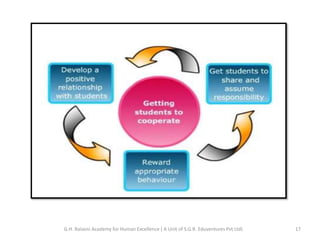
Classroom Management
G.H. Raisoni Academy for Human Excellence
( A Unit of S.G.R. Eduventures Pvt Ltd)
1G.H. Raisoni Academy for Human Excellence ( A Unit of S.G.R. Eduventures Pvt Ltd)
Introduction
C lassroom management is a complex and multifaceted issue confronting all
teachers, in-service and pre-service, in every classroom around the world. Effective
classroom management is more than quick-fix strategies or a bag of tricks. It is a
purposeful philosophical, ethical and theoretical code of Conduct. Haim Ginott’s a noted
professor of psychology quotes the idea of “ Congruent Communication” in developing
positive classrooms. In India, classroom management and student engagement are
significant issues for teachers. They heavily affect community perception, teacher
efficacy and well-being, and the standards of achievement of students. The latest theories
& strategies of classroom management are based on current resilience, self-worth, which
highlight the strengths that students have and how, as educators, we can draw upon these
strengths in assisting all children to grow. Classroom management in a broad term refers
to the wide variety of skills and techniques that teachers use to keep students organized,
orderly, focused, attentive, on task, and academically productive during a class.
2G.H. Raisoni Academy for Human Excellence ( A Unit of S.G.R. Eduventures Pvt Ltd)
When classroom-management strategies are executed effectively, it minimizes the
behaviors that impede learning for both individual students and groups of students, while
maximizing the behaviors that facilitate or enhance learning. It involves teacher actions
and instructional techniques to create a learning environment that facilitates and supports
active engagement in both academic and social and emotional learning. This definition
incorporates a number of tasks:
Connecting and developing caring relationships with students with high and explicit
expectations
Organizing and structuring instruction that facilitates deep learning in an environment
clearly focused on meaningful learning that is important to Students.
Assisting students to clarify challenges and problems and respond to their needs
Promoting abilities for internal self-regulation and positive social skills
Developing strength-based interventions for students with challenging behaviors.
3G.H. Raisoni Academy for Human Excellence ( A Unit of S.G.R. Eduventures Pvt Ltd)
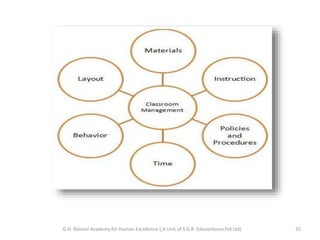
Classroom management is
Planned, but with scope for improvisation
 Preventative rather than simply reactive
 Controlled and organized rather than chaotic
 An opportunity for all students and teachers to experience success
4G.H. Raisoni Academy for Human Excellence ( A Unit of S.G.R. Eduventures Pvt Ltd)
Principles for Effective Classroom Management
4 E’s
Establish Expectations
Establish Credibility
Establish Professionalism
Establish Value
5G.H. Raisoni Academy for Human Excellence ( A Unit of S.G.R. Eduventures Pvt Ltd)
Principles for Effective Classroom Management
C reating productive learning environment begins with planning to make the class
in effective classroom management. To plan it, there are five principles for a productive
learning environment;
Developmental differences influence classroom management
Management and instruction are interdependent
Classroom organization is essential for classroom management
Rules and procedures are the cornerstone of an effective management system.
first day of school set the tone for the year.
6G.H. Raisoni Academy for Human Excellence ( A Unit of S.G.R. Eduventures Pvt Ltd)
Parts of Classroom Management
A. Variety
Students should be exposed to wide range of activities and not limited of tried and true
games
Be prepared to adjust activities on the spot to account for individual differences, to add
challenges or to provide new practice opportunities.
Introduce broad spectrum of sports and physical activities as they relate to the movement
skills we learn in class
B.Organization:
Classes prepared and organized before students arrive
Keep class room arranged in a student friendly and teacher approachable manner
Classroom posters emphasize rules, values, health and all concepts covered in class.
7G.H. Raisoni Academy for Human Excellence ( A Unit of S.G.R. Eduventures Pvt Ltd)
C. Managing Your lessons:
Clear commands, rules, instructions and demonstrations for all activities.
Organize lessons in consistent pattern when possible; for example:
Instant activity
Discussion
Skill Practice
Skill Games
Review
D. Positive Classroom Environment:
Consistent expectations/procedures
Positive, encouraging and supportive climate
Constant feedback ( specific and non-specific )
High energy and simple humor
8G.H. Raisoni Academy for Human Excellence ( A Unit of S.G.R. Eduventures Pvt Ltd)
Flip your Classroom
F lipping the classroom helps students who are used to treating
class time as nap time.
Allows class to be spent in a more engaging manner where you
can promote understanding, hold discussions, and analyze
concepts.
Lets you use your class time more efficiently
9G.H. Raisoni Academy for Human Excellence ( A Unit of S.G.R. Eduventures Pvt Ltd)
Makes learning more accessible to students.
 Play to the strength of a teacher by allowing to guide students’
specific ideas and discoveries in a more effective manner.
 Empowers teacher to truly assess student understanding.
 Identify the challenges each student is encountering, and then
forge the appropriate learning connections for them.
Flipping classes ensures that the resources offered — teachers,
other students, and online information — are regularly available
and easily accessed in the best places for maximum learning.
10G.H. Raisoni Academy for Human Excellence ( A Unit of S.G.R. Eduventures Pvt Ltd)
How and Why To Flip Your Classroom
It’s no secret that interacting with students on an individual level can
drastically improve the learning process. Having the capacity to reach all of
your students one-on-one is certainly ideal, but large class sizes can
understandably make this challenging. Moreover, the traditional teaching
method — students sitting in class, taking notes, fighting to stay awake — is
not conducive to an interactive style. So, how can you use your class time
more efficiently?
In order to reach the students who are used to treating class time as nap time,
flip your classroom information intake routine. Instead of using class time to
lecture, have students do the intake of information at home. This will allow
classes to be spent in a more engaging manner where you can promote
understanding, hold discussions, and analyze concepts.
11G.H. Raisoni Academy for Human Excellence ( A Unit of S.G.R. Eduventures Pvt Ltd)
The conventional method of homework involves students struggling to figure it out by
themselves. The flipped method puts an emphasis on student understanding in the
classroom, rather than students needing to complete a set of questions on their own.
Flipping the classroom allows students to grasp the material at their own pace, which
is something the conventional style ignores.
Not only does the flipped method make learning more accessible to students, it helps
teachers do their job as well. If done effectively, it can play to the strengths of a
teacher by allowing him or her to guide students’ specific ideas and discoveries in a
more effective manner.
But perhaps the biggest perk of the flipped method is that it allows teachers to truly
assess student understanding. You can identify what kinds of challenges each student
is encountering, and then forge the appropriate learning connections for them. It
ensures that the resources offered — teachers, other students, and online information
— are regularly available and easily accessed in the best places for maximum learning.
Before too long, the light bulbs above your students’ heads will be switching on all
throughout the classroom.
12G.H. Raisoni Academy for Human Excellence ( A Unit of S.G.R. Eduventures Pvt Ltd)
Ways of flipping the Classroom
Interactive Quizzes : Quizzes are a great way to track each student’s
personal progress.
In-Class Assessments: Implement a short entry quiz at the beginning of
each class, or a warm-up exercise designed to go over the preceding day’s
assigned task
Discussion forums: class-wide discussions can help students review the
material, as well as give them a solid chance to present and discuss their
perspectives. You can award them points based on participation.
13G.H. Raisoni Academy for Human Excellence ( A Unit of S.G.R. Eduventures Pvt Ltd)
Discipline Issues in Classroom management
D iscipline issues are listed as the major concern for most new teachers.
What can teachers expect and how can they effectively handle discipline problems?
Classroom management combined with an effective discipline plan is the key.
Here’s How:
Begin each class period with a positive attitude and high expectations. If you expect
your students to misbehave or you approach them negatively, you will get misbehavior.
This is an often overlooked aspect of classroom management.
Come to class prepared with lessons for the day. In fact, over plan with your lessons.
Make sure to have all your materials and methods ready to go. Reducing downtime will
help maintain discipline in your classroom.
14G.H. Raisoni Academy for Human Excellence ( A Unit of S.G.R. Eduventures Pvt Ltd)
If a student becomes verbally confrontational with you, remain calm and remove them
from the situation as quickly as possible. Do not get into yelling matches with your
students. There will always be a winner and a loser which sets up a power struggle that
could continue throughout the year. Further, do not bring the rest of the class into the
situation by involving them in the discipline or the writing of the referral. More on
dealing with confrontational students in your classroom.
If a student becomes physical, remember the safety of the other students is paramount.
Remain as calm as possible; your demeanor can sometimes diffuse the situation. You
should have a plan for dealing with violence that you discussed with students early in
the year. You should use the call button for assistance. You could also have a student
designated to get help from another teacher. Send the other students from the room if it
appears they could get hurt. If the fight is between two students, follow your school's
rules concerning teacher involvement as many want teachers to stay out of fights until
help arrives.
Keep an anecdotal record of major issues that arise in your class. This might be
necessary if you are asked for a history of classroom disruptions or other
documentation.
Let it go at the end of the day. Classroom management and disruption issues should be
left in class so that you can have some down time to recharge before coming back to
another day of teaching. 15G.H. Raisoni Academy for Human Excellence ( A Unit of S.G.R. Eduventures Pvt Ltd)
Meet disruptions that arise in your class with in kind measures. In other words, don't
elevate disruptions above their current level. Your discipline plan should provide for
this, however, sometimes your own personal issues can get in the way.
For example, if two students are talking in the back of the room and your first step in
the plan is to give your students a verbal warning, don't stop your instruction to begin
yelling at the students. Instead, have a set policy that simply saying a student's name is
enough of a clue for them to get back on task. Another technique is to ask one of them a
question.
Try to use humor to diffuse situations before things get out of hand. Note: Know your
students. The following example would be used with students you know would not
elevate the situation to another level.
For example, if you tell your students to open their books to page 51 and three students
are busy talking, do not immediately yell at them. Instead, smile, say their names, and
ask them kindly if they could please wait until later to finish their conversation because
you would really like to hear how it ends and you have to get this class finished. This
will probably get a few laughs but also get your point across.
16G.H. Raisoni Academy for Human Excellence ( A Unit of S.G.R. Eduventures Pvt Ltd)
17G.H. Raisoni Academy for Human Excellence ( A Unit of S.G.R. Eduventures Pvt Ltd)
Tips for handling student discipline situations
REMAIN CALM AND COMPOSED!
When correcting misbehavior, communicate in the most private, respectful, and
positive manner.
Make all discipline decisions after the “heat of the moment.”
When you feel as if you or your student is too emotional to handle a particular
situation, suggest postponing the discussion until both are prepared to talk it out.
Instead of blaming, use I-messages to explain why the behavior was disruptive.
Instead of saying “You’re disruptive” try saying “I lose my concentration when
you are talking in class.” This helps to avoid an angry retaliation.
18G.H. Raisoni Academy for Human Excellence ( A Unit of S.G.R. Eduventures Pvt Ltd)
Use positive self-talk to reduce stress and help to remain control. Mentally say
things such as “remain calm,” “I’m doing a good job at handling this situation.”
Attempt to de-escalate situation by providing distractions. These distractions give
people the opportunity to cool off.
Exaggerate issues to help students put the situation in perspective.
Use stress management techniques such as deep breathing or repeatedly tensing
and relaxing your muscles.
Address only student behavior rather than personal traits.
19G.H. Raisoni Academy for Human Excellence ( A Unit of S.G.R. Eduventures Pvt Ltd)
Tips for preventing misbehavior
Establish realistic and age appropriate rules and procedures.
Walk throughout the classroom during lectures and seat work to provide assistance and
monitor behavior.
 Keep class work and assignments separate from behavior issues.
Have extra activities available for students to do when they are bored or finished with
all their work.
Establish routines for transitions (leaving the room, using the bathroom, etc.) and
prepare students for transitions by warning them ahead of time.
 When deciding whether or not to intervene with a behavior, determine if the problem
is solely “teacher-owned.” Does the behavior simply annoy you or is it harmful to other
students?
 Establish a program that teaches self-discipline and responsibility to students. When
appropriate, give students extra duties that will help save you time and teach them
responsibility. 20G.H. Raisoni Academy for Human Excellence ( A Unit of S.G.R. Eduventures Pvt Ltd)
ineffective teachers
not in the way they
respond to students’
misbehavior, but
instead in how
competently they
manage the group
21G.H. Raisoni Academy for Human Excellence ( A Unit of S.G.R. Eduventures Pvt Ltd)
Classroom Rules for Students
Class rules need to be simple, easy-to-follow, and posted for all your students to see.
One of the keys to writing great rules is to keep them general enough to cover a variety
of situations but not so general that they mean nothing. For example, you wouldn't want
to have a class rule that says, "Respect everyone at all times." Even though you want
students to do this, the rule itself does not tell the students what you really want them to
do to show you that they are following this rule.
Creating your own class rules depends on a couple of factors. You need to make sure
that they are written with your own group of students in mind. Ideally you should keep
your rules down to a manageable limit of between 3-8.
Following are some ideas for classroom rules that you can use as you create your own.
The rule itself is the first sentence of each of the following. However, the additional
information can be modified and provided to students and parents at the beginning of
the year. It's also a great idea to go over each of the rules with your students during the
first few days of school.
22G.H. Raisoni Academy for Human Excellence ( A Unit of S.G.R. Eduventures Pvt Ltd)
Examples of Class Rules for Students:
Come to class on time.
Begin the warm up activity within one minute after the tardy bell.
Attend to personal needs before coming to class
Remain in your assigned seat unless you have permission to get up
Do not eat candy or other food in class unless you have been given special
permission
Bring required materials every day unless you are otherwise directed.
Talk only when permitted
Use polite speech and body language
23G.H. Raisoni Academy for Human Excellence ( A Unit of S.G.R. Eduventures Pvt Ltd)
Keys to Classroom Management
Research has shown that the quality of teacher-student relationships is the keystone for
all other aspects of classroom management. Further, research has shown that teachers
who had high-quality relationships with their students had fewer discipline problems
and rule violations than those who did not have high-quality relationships. What are the
characteristics of effective teacher-student relationships? Let's first consider what they
are not. Effective teacher-student relationships have nothing to do with the teacher's
personality or even with whether the students view the teacher as a friend. Rather, the
most effective teacher-student relationships are characterized by three specific teacher
behaviors:
Exhibiting appropriate levels of dominance
Exhibiting appropriate levels of cooperation
Being aware of high-needs students.
24G.H. Raisoni Academy for Human Excellence ( A Unit of S.G.R. Eduventures Pvt Ltd)
1. Appropriate Levels of Dominance
Teachers can exhibit appropriate dominance by establishing these three principles:
•Clear behavior expectations
•Clear learning goals
•Exhibiting assertive behavior
25G.H. Raisoni Academy for Human Excellence ( A Unit of S.G.R. Eduventures Pvt Ltd)
A. Establish Clear Expectations and Consequences
T eachers can establish clear expectations for behavior in two ways: by
establishing clear rules and procedures, and by providing consequences for student
behavior. Past research has stressed the importance of establishing rules and
procedures for general classroom behavior, group work, seat work, transitions and
interruptions, use of materials and equipment, and beginning and ending the period
or the day. Ideally, the class should establish these rules and procedures through
discussion and mutual consent by teacher and students.
Along with well-designed and clearly communicated rules and procedures, the teacher
must acknowledge students' behavior, reinforcing acceptable behavior and providing
negative consequences for unacceptable behavior.
26G.H. Raisoni Academy for Human Excellence ( A Unit of S.G.R. Eduventures Pvt Ltd)
B. Establish Clear Learning Goals
T eachers can also exhibit appropriate levels of dominance by providing clarity
about the content and expectations of an upcoming instructional unit. Important
teacher actions to achieve this end include:
Establishing and communicating learning goals at the beginning of a unit of
instruction.
Providing feedback on those goals.
Continually and systematically re-visiting the goals.
Providing summative feedback regarding the goals.
27G.H. Raisoni Academy for Human Excellence ( A Unit of S.G.R. Eduventures Pvt Ltd)
C. Exhibit Assertive Behavior
T eachers can also communicate appropriate levels of dominance by exhibiting
assertive behavior. Assertive behavior differs significantly from both passive behavior
and aggressive behavior. Tips to using assertive body language:
Maintain an erect posture, facing the offending student but keeping enough distance so
as not to appear threatening and matching the facial expression with the content of the
message being presented to students.
Use an appropriate tone of voice, speaking clearly and deliberately in a pitch that is
slightly but not greatly elevated from normal classroom speech, avoiding any display
of emotions in the voice.
Persist until students respond with the appropriate behavior. Do not ignore
inappropriate behavior; do not be diverted by a student denying, arguing, or blaming,
but listen to legitimate explanations.
28G.H. Raisoni Academy for Human Excellence ( A Unit of S.G.R. Eduventures Pvt Ltd)
2. Appropriate Levels of Cooperation
Cooperation is characterized by a concern for the needs and opinions of others.
Although not the antithesis of dominance, cooperation certainly occupies a different
realm. Whereas dominance focuses on the teacher as the driving force in the
classroom, cooperation focuses on the students and teacher functioning as a team. The
interaction of these two dynamics-dominance and cooperation-is a central force in
effective teacher-student relationships. Several strategies can foster appropriate levels
of cooperation:
Provide flexible learning goals
Take a personal interest in students
Use Equitable and Positive Classroom Behaviors
29G.H. Raisoni Academy for Human Excellence ( A Unit of S.G.R. Eduventures Pvt Ltd)
A. Provide Flexible Learning Goals
Just as teachers can communicate appropriate levels of dominance by providing
clear learning goals, they can also convey appropriate levels of cooperation by
providing flexible learning goals. Giving students the opportunity to set their own
objectives at the beginning of a unit or asking students what they would like to
learn conveys a sense of cooperation. Giving students this kind of choice, in
addition to increasing their understanding of the topic, conveys the message that
the teacher cares about and tries to accommodate students' interests.
B. Take a Personal Interest in Students
Probably the most obvious way to communicate appropriate levels of cooperation
is to take a personal interest in each student in the class. All students appreciate
personal attention from the teacher. Although busy teachers-particularly those at
the secondary level-do not have the time for extensive interaction with all students,
some teacher actions can communicate personal interest and concern without
taking up much time.
30G.H. Raisoni Academy for Human Excellence ( A Unit of S.G.R. Eduventures Pvt Ltd)
C. Use Equitable and Positive Classroom Behaviors

Make eye contact with each student. Teachers can make eye contact by scanning
the entire room as they speak and by freely moving about all sections of the room.
Deliberately move toward and stand close to each student during the class period.
Make sure that the seating arrangement allows the teacher and students clear and
easy ways to move around the room.
Attribute the ownership of ideas to the students who initiated them. For instance,
in a discussion a teacher might say, “Ritu just added to Sheena’s idea by saying that
. . . "
Allow and encourage all students to participate in class discussions and
interactions.
Provide appropriate wait time for all students to respond to questions, regardless
of their past performance or your perception of their abilities.
Make sure to call on students who do not commonly participate, not just those
who respond most frequently.
31G.H. Raisoni Academy for Human Excellence ( A Unit of S.G.R. Eduventures Pvt Ltd)
Ways to Practice Classroom Management Right From the
Start!
1.Brainstorm classroom goals together.
2. Balance their point books along with their behavior.
Teacher’s Voice ( Class VI ):
“Every year, I create a points account system for my 6th standard students. The
students get points biweekly and live life in class just like they are on their own in the
real world. If a student breaks a rule in class, he/she looses points. If a student is a
repeat offender, he/she is fined with the loss of points. The students determine the fine .
If homework is not turned in, the student again looses a point. If a student does extra
work (i.e. helps a classmate, etc.) he/she receives a bonus point. The students keep
track of their accounts using "registers". I track their point accounts just like the bank
would and issue a monthly statement stating their balance of points. At the end of the
year, students are able to redeem their points in exchange of goodies or some fun
activity”
3
G.H. Raisoni Academy for Human Excellence ( A Unit of S.G.R. Eduventures Pvt Ltd)
3.Wish upon a "Secret Star" for orderly lines.
Teacher’s Voice( Class – III ):
“To encourage my students to walk in a quiet and orderly line while in the corridors, I
often pick a "Secret Star" when going for a class or an activity. I usually pick a boy
and a girl "Secret Star". I don't tell who my "Secret Star" is and I tell the students that I
am watching to see if my "Secret Star" is walking nicely and quietly. When we arrive
back to our classroom ,I announce the "Secret Star" if and only if the "Secret Star" was
successful in being a good walker. The "Secret Star" then gets points/goodies . Since
nobody knows who the "Secret Star" is, everybody is usually very quiet and respectful
in case it might be him or her. If the "Secret Star" is not quiet and respectful then I
simply state that "My Secret Star did not make it this time." I don't tell who it was. This
works wonders for getting the students to walk quietly in the hallways and it's also
fun.”
33G.H. Raisoni Academy for Human Excellence ( A Unit of S.G.R. Eduventures Pvt Ltd)
4. Build a "fish" of classroom infractions.
Teacher’s Voice ( Class – IV teacher ):
“On the first day of school I read Swimmy by Leo Lionni to my class. We discussed the
importance of working together and feeling safe. We brainstormed a list of behaviors
we didn't want in the classroom, and I branched off their ideas to look like a fish
skeleton. Then we brainstormed what we DO want and created 10 Fishbowl
Environment Guidelines (we are the Fourth Grade Fishbowl!). Students paired up and
created a page for our Guideline Book with one of the ten guidelines and an
illustration. At the end of the book is a contract we have all signed. Each day at the end
of school we read through their book and collectively decide how many points to give
ourselves based on how we followed the guidelines throughout the day. We are frank,
and discuss ways we can improve tomorrow. The guidelines are basic rules with a fish
twist: "encourage each other to swim faster & further," "raise a fin to talk," "try our
best, even when the water's bumpy” 34G.H. Raisoni Academy for Human Excellence ( A Unit of S.G.R. Eduventures Pvt Ltd)
35G.H. Raisoni Academy for Human Excellence ( A Unit of S.G.R. Eduventures Pvt Ltd)
5. Efficient student grouping.
Teacher’s Voice ( Class – IV ):
“Part of effectively managing the classroom is having an efficient way to put students
into groups. Students love working in groups and this is a sure way to partner or group
students with variety and inclusion of all students. To partner students, we make
appointment clocks. I use a clock with the hour numbers and then a blank line by each
hour. The students make an appointment with another student on each hour of the
clock. If Sally is Jimmy's one o'clock appointment then Jimmy is also Sally's one o'clock
appointment. When I need my students to pair up for activities or review skills, I simply
say, "Go to your 2 o'clock appointment." To group my students, I place name labels on
a deck of cards. I simply shuffle the cards and deal them out into stacks of the number
of groups that I need and then call out the names. The cards are great to use for lots of
things, selecting a student to do a special job, picking students to give presentations,
etc.”
36G.H. Raisoni Academy for Human Excellence ( A Unit of S.G.R. Eduventures Pvt Ltd)
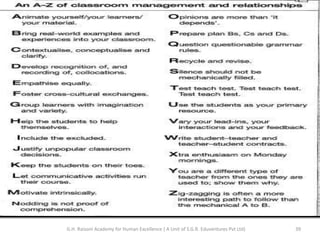
Classroom Management: maintain an equilibrium rigid flexible
Brophy , J in 1983 cited 3 theoretical orientations to classroom management to
maintain a fine balance between the classroom orientation being too rigid or too
flexible
Self-concept/personal adjustment--the teacher encourages discouraged students, builds
self-esteem by arranging for and calling attention to success, improving peer
relationships, etc.
Insight (cognitive)--spend time with problem students individually, attempting to
instruct and inform them, getting to know them personally.
Behaviorist--offer incentives, negotiate contracts, call attention to and reinforce
desirable behavior
37G.H. Raisoni Academy for Human Excellence ( A Unit of S.G.R. Eduventures Pvt Ltd)
38G.H. Raisoni Academy for Human Excellence ( A Unit of S.G.R. Eduventures Pvt Ltd)
39G.H. Raisoni Academy for Human Excellence ( A Unit of S.G.R. Eduventures Pvt Ltd)
Ideas that encourage ACTIVE student learning
Rearrange your classroom
Involve students in designing class rules
Assign class buddies
Take time to assess how each one learns
Create an unintimidating learning environment
Assign students roles in the classroom
Give students a degree of control
Make a daily evaluation sheet for your students
40
G.H. Raisoni Academy for Human Excellence ( A Unit of S.G.R. Eduventures Pvt Ltd)
41G.H. Raisoni Academy for Human Excellence ( A Unit of S.G.R. Eduventures Pvt Ltd)
What is your Classroom Management profile?
Answer these 12 questions and learn more about your classroom management
profile. The steps are simple:
Read each statement carefully. Write your response, from the scale below, on a
sheet of paper. Respond to each statement based upon either actual or imagined
classroom experience. Then, follow the scoring instructions below. It couldn't be
easier!
1. = Strongly Disagree
2. = Disagree
3. = Neutral
4. = Agree
5. = Strongly Agree
Activity – Classroom management profile
42G.H. Raisoni Academy for Human Excellence ( A Unit of S.G.R. Eduventures Pvt Ltd)
(1) If a student is disruptive during class, I assign him/her to detention, without
further discussion.
(2) I don't want to impose any rules on my students.
(3) The classroom must be quiet in order for students to learn.
(4) I am concerned about both what my students learn and how they learn.
(5) If a student turns in a late homework assignment, it is not my problem.
(6) I don't want to reprimand a student because it might hurt his/her feelings.
(7) Class preparation isn't worth the effort.
(8) I always try to explain the reasons behind my rules and decisions.
(9) I will not accept excuses from a student who is tardy.
(10) The emotional well-being of my students is more important than classroom
control.
(11) My students understand that they can interrupt my lecture if they have a
relevant question.
(12) If a student requests a hall pass, I always honor the request.
43G.H. Raisoni Academy for Human Excellence ( A Unit of S.G.R. Eduventures Pvt Ltd)
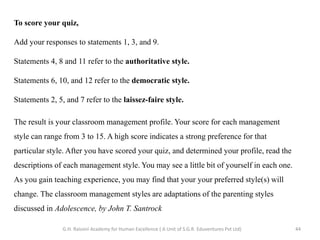
To score your quiz,
Add your responses to statements 1, 3, and 9.
Statements 4, 8 and 11 refer to the authoritative style.
Statements 6, 10, and 12 refer to the democratic style.
Statements 2, 5, and 7 refer to the laissez-faire style.
The result is your classroom management profile. Your score for each management
style can range from 3 to 15. A high score indicates a strong preference for that
particular style. After you have scored your quiz, and determined your profile, read the
descriptions of each management style. You may see a little bit of yourself in each one.
As you gain teaching experience, you may find that your your preferred style(s) will
change. The classroom management styles are adaptations of the parenting styles
discussed in Adolescence, by John T. Santrock
44G.H. Raisoni Academy for Human Excellence ( A Unit of S.G.R. Eduventures Pvt Ltd)
“ I f educators fail to realize the importance of creating an
environment where students feel that they belong, where they
are safe, where their voice is respected and where they are
encouraged to learn, then little else is of value the educator
will struggle to actively and meaningfully engage students in
the process of learning. When students are not involved and
believe the educator dosen’t care, they are more likely to
misbehave and are prone to failures” 45
G.H. Raisoni Academy for Human
Excellence ( A Unit of S.G.R. Eduventures
Pvt Ltd)
Communication Skill for successful classroom management
L isten up!
Teaching is all about communicating, and communicating includes listening as well
as speaking and writing. Not only should both parties be able to verbalize their
thoughts, questions, and ideas; but they should both be willing to really work at
LISTENING to each other.
“Effective teachers really work at
listening, understanding and
responding to their students.” 46G.H. Raisoni Academy for Human Excellence ( A Unit of S.G.R. Eduventures Pvt Ltd)
The key concept is that successful communication involves being an active listener.
How to be an active listener?
Be attentive.
Listen with an accepting attitude
Use encouraging words to show you are listening : I see, "Right.”
Use nonverbal actions to show you are listening
Use encouraging words that will invite them to continue on
"Tell me more.“
"Sounds like you have some ideas on this.“
"I'm interested in what you have to say.“
"Let's talk about it."
47G.H. Raisoni Academy for Human Excellence ( A Unit of S.G.R. Eduventures Pvt Ltd)
Communication Skill for Teaching
A. Problem Solving:
•Identify the problem :
state the purpose of meeting
Get students point of view/ describe problem, ask students reaction; evaluate.
•Identify and select the solution:
student suggestion
multiple teacher alternatives; positive focus with plan for improvement
•Obtain a commitment:
student acceptance for period of time followed by evaluation (sometimes in a contract)
with consequences if not followed
48G.H. Raisoni Academy for Human Excellence ( A Unit of S.G.R. Eduventures Pvt Ltd)
B. Talking with Parents:
Constructive assertiveness, empathetic responding, problem solving
Express appreciation for parents’ efforts to meet,work w/them as a team
Focus on choices student is making and how to encourage better decisions
Document concerns: student work and notes of behaviors
49G.H. Raisoni Academy for Human Excellence ( A Unit of S.G.R. Eduventures Pvt Ltd)
Importance of Classrooms
A clean, smartly spaced and visually stimulating
classroom can help students learn better and it might even
increase their interest and boost their motivation. The
classroom should present a cheerful, inviting, motivating
and purposeful setting for learning.
50G.H. Raisoni Academy for Human Excellence ( A Unit of S.G.R. Eduventures Pvt Ltd)
Arranging the classroom
Availability of extra supplies at a location in the classroom where students who have
forgotten supplies will be able to go without disrupting other students (i.e. a cup of
pencils at the center of each table or the back of the classroom).
Provide a neat and organized classroom.
Make your classroom look attractive. Use bulletin boards, banners, warm colors, or
anything to help make your classroom look aesthetically pleasing.
Structure your classroom as to avoid chaos and promote learning.
The teacher should be able to observe all students at all times and be able to see the
door from his/her desk.
Students should be able to see the teacher/presentation area without having to move
or turn around.
Arrange the room as to allow easy movement.
Make your classroom fun, attractive, motivating, & functional.
51G.H. Raisoni Academy for Human Excellence ( A Unit of S.G.R. Eduventures Pvt Ltd)
Make a positive classroom environment
Use humor.
 Greet students and respond appropriately
Show enthusiasm and be animated.
Provide opportunities for every student to succeed.
Model good listening skills by paying attention when student speak.
Create anticipation for lessons or tasks.
 If a particular student is struggling, provide the student with a classroom buddy who
is mature and responsible.
Create classroom rituals and traditions which build a sense of community.
Encourage parental and community involvement.
52G.H. Raisoni Academy for Human Excellence ( A Unit of S.G.R. Eduventures Pvt Ltd)
Seating arrangement for better classroom management
Classrooms are complex, busy places. They accommodate many people and activities
each day. The physical arrangement of a classroom has significant implications for
discipline and classroom management. Many classrooms serve more specialized uses
and so would not require versatile arrangement. Different methodologies lend
themselves to different spatial arrangements. Some prefer a rigid classroom
arrangement. Others prefer a richly furnished environment, which they view as more
stimulating to students.
“ C areful and appropriate use of physical space available in the classroom can
positively affect teacher and student attitudes and propagate holistic learning and
development of the student”.
53G.H. Raisoni Academy for Human Excellence ( A Unit of S.G.R. Eduventures Pvt Ltd)
Gregor suggests that students with varied learning styles prefer different classroom
arrangements. He is of the opinion that one type of learner prefers a predictable, stable
environment that is ordered and quiet. Another type of learner will choose an
environment that is mentally stimulating and ordered but devoid of distracting objects.
Yet another learner needs an environment that allows for creative expression, freedom
of movement and emotional experience.
Flexibility is the key word in arranging the classroom for effective instruction. This
does not mean moving the furniture arrangement weekly. It does mean being aware that
certain variations will facilitate particular teaching and learning tasks.
54G.H. Raisoni Academy for Human Excellence ( A Unit of S.G.R. Eduventures Pvt Ltd)
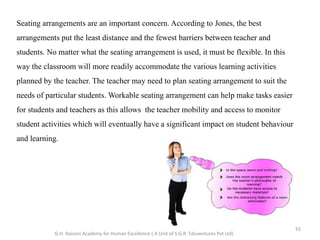
Seating arrangements are an important concern. According to Jones, the best
arrangements put the least distance and the fewest barriers between teacher and
students. No matter what the seating arrangement is used, it must be flexible. In this
way the classroom will more readily accommodate the various learning activities
planned by the teacher. The teacher may need to plan seating arrangement to suit the
needs of particular students. Workable seating arrangement can help make tasks easier
for students and teachers as this allows the teacher mobility and access to monitor
student activities which will eventually have a significant impact on student behaviour
and learning.
55
G.H. Raisoni Academy for Human Excellence ( A Unit of S.G.R. Eduventures Pvt Ltd)
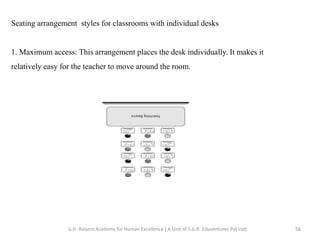
Seating arrangement styles for classrooms with individual desks
1. Maximum access: This arrangement places the desk individually. It makes it
relatively easy for the teacher to move around the room.
56G.H. Raisoni Academy for Human Excellence ( A Unit of S.G.R. Eduventures Pvt Ltd)
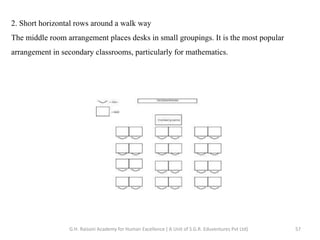
2. Short horizontal rows around a walk way
The middle room arrangement places desks in small groupings. It is the most popular
arrangement in secondary classrooms, particularly for mathematics.
57G.H. Raisoni Academy for Human Excellence ( A Unit of S.G.R. Eduventures Pvt Ltd)
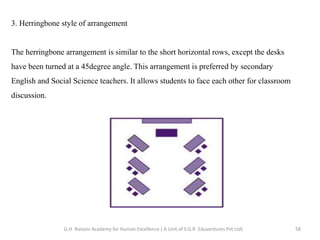
3. Herringbone style of arrangement
The herringbone arrangement is similar to the short horizontal rows, except the desks
have been turned at a 45degree angle. This arrangement is preferred by secondary
English and Social Science teachers. It allows students to face each other for classroom
discussion.
58G.H. Raisoni Academy for Human Excellence ( A Unit of S.G.R. Eduventures Pvt Ltd)
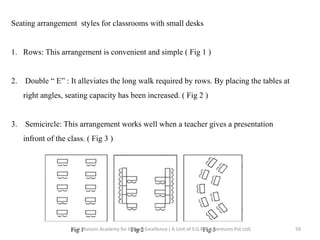
Seating arrangement styles for classrooms with small desks
1. Rows: This arrangement is convenient and simple ( Fig 1 )
2. Double “ E” : It alleviates the long walk required by rows. By placing the tables at
right angles, seating capacity has been increased. ( Fig 2 )
3. Semicircle: This arrangement works well when a teacher gives a presentation
infront of the class. ( Fig 3 )
Fig 1 Fig 2 Fig 3 59G.H. Raisoni Academy for Human Excellence ( A Unit of S.G.R. Eduventures Pvt Ltd)
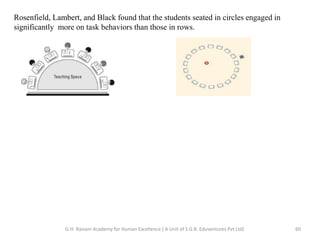
Rosenfield, Lambert, and Black found that the students seated in circles engaged in
significantly more on task behaviors than those in rows.
60G.H. Raisoni Academy for Human Excellence ( A Unit of S.G.R. Eduventures Pvt Ltd)
Activity on seating arrangement
Classroom seating arrangement toolseating-
chart-maker.php.htm
61G.H. Raisoni Academy for Human Excellence ( A Unit of S.G.R. Eduventures Pvt Ltd)
“A good classroom seating
arrangement is the cheapest
form of classroom
management.”– Fred Jones
62G.H. Raisoni Academy for Human Excellence ( A Unit of S.G.R. Eduventures Pvt Ltd)
Start of the Day Activities
What activities do you set your
pupils
at the start of the day?
Do your children have to come in and read quietly while you do
the register?
Do you set the children other challenges and activities?
63G.H. Raisoni Academy for Human Excellence ( A Unit of S.G.R. Eduventures Pvt Ltd)
Classroom management strategies
Establish Procedures : Good classroom management is essential to effective
cooperative learning. You'll need to have a clearly defined set of procedures so that the
kids know your expectations.
Implement a Quiet Signal : If you're going to involve your students actively in your
instruction, you'll need a fool-proof Quiet Signal. You can have a hand signal, a bell, a
clicker. You need something that can get the students' attention in 3 to 5 seconds.
Erase-a-Letter Strategy - If you feel your class is too noisy during cooperative
learning activities, there are ways to teach them to control their noise level. Just use the
Erase-a-Letter technique. Before you start a activity, write the word STOP on the board.
Teach them how to whisper and how whispering sounds different from regular voices.
After that, erase a letter from the word STOP on the board every time you hear anything
above a whisper.
64G.H. Raisoni Academy for Human Excellence ( A Unit of S.G.R. Eduventures Pvt Ltd)
Classroom management strategies
Use Brain Bucks to Encourage Thinking :
When students demonstrate a willingness to apply creative
thinking strategies or persist in working through a problem, use
Brain Bucks to reward their efforts. Of course, you'll need to
back those Brain Bucks with something else so that students can
"spend" them in other ways.
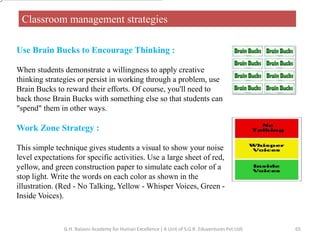
Work Zone Strategy :
This simple technique gives students a visual to show your noise
level expectations for specific activities. Use a large sheet of red,
yellow, and green construction paper to simulate each color of a
stop light. Write the words on each color as shown in the
illustration. (Red - No Talking, Yellow - Whisper Voices, Green -
Inside Voices).
65G.H. Raisoni Academy for Human Excellence ( A Unit of S.G.R. Eduventures Pvt Ltd)
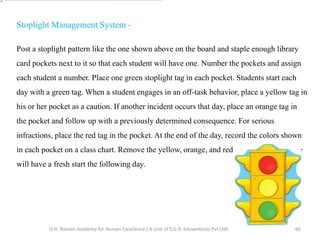
Stoplight Management System -
Post a stoplight pattern like the one shown above on the board and staple enough library
card pockets next to it so that each student will have one. Number the pockets and assign
each student a number. Place one green stoplight tag in each pocket. Students start each
day with a green tag. When a student engages in an off-task behavior, place a yellow tag in
his or her pocket as a caution. If another incident occurs that day, place an orange tag in
the pocket and follow up with a previously determined consequence. For serious
infractions, place the red tag in the pocket. At the end of the day, record the colors shown
in each pocket on a class chart. Remove the yellow, orange, and red tags so that everyone
will have a fresh start the following day.
66G.H. Raisoni Academy for Human Excellence ( A Unit of S.G.R. Eduventures Pvt Ltd)
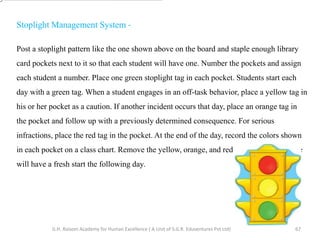
Stoplight Management System -
Post a stoplight pattern like the one shown above on the board and staple enough library
card pockets next to it so that each student will have one. Number the pockets and assign
each student a number. Place one green stoplight tag in each pocket. Students start each
day with a green tag. When a student engages in an off-task behavior, place a yellow tag in
his or her pocket as a caution. If another incident occurs that day, place an orange tag in
the pocket and follow up with a previously determined consequence. For serious
infractions, place the red tag in the pocket. At the end of the day, record the colors shown
in each pocket on a class chart. Remove the yellow, orange, and red tags so that everyone
will have a fresh start the following day.
67G.H. Raisoni Academy for Human Excellence ( A Unit of S.G.R. Eduventures Pvt Ltd)
Summary
This module focuses on how teachers manage the classroom activities and the
strategies they use to ensure that classroom provides a context to support and
facilitate learning.
Classroom management means the process of ensuring that classroom lessons
run smoothly despite disruptive behaviour showed by students. The term also
implies the prevention of disruptive behaviour and closely linked to issues of
motivation, discipline and respect.
The terms ‘classroom management’ and ‘discipline’ are often used
interchangeably.
Classroom management means teachers’ strategies to create and maintain an
orderly learning environment and discipline means teachers’ responses to
students’ misbehaviour.
68G.H. Raisoni Academy for Human Excellence ( A Unit of S.G.R. Eduventures Pvt Ltd)
The goal of classroom management is to create and maintain a positive,
productive learning environment, to support and foster a safe classroom
community, to assist students to keep task focused, to reduce distraction from
learning, to organize and facilitate the flow of learning activities and to help the
students to manage themselves.
Disruptive behaviour is the behaviour that is problematic or inappropriate in the
learning context or in other words, it is the behaviour that interferes with
students’ own learning or disrupts the class, in the school setting.
Managing a classroom is not an easy task. Teacher needs to consider several
things such as the child’s development level, the learning and physical
environment, rules and procedure, classroom activities, student’s cooperation and
classroom management style.
69G.H. Raisoni Academy for Human Excellence ( A Unit of S.G.R. Eduventures Pvt Ltd)
70
Methodology and Assessment Tools
Howard Gardner's multiple intelligence test
Students begin to understand how they are intelligent. In Gardner's view, learning is both
a social and psychological process. When students understand the balance of their own
multiple intelligences they begin
To manage their own learning
To value their individual strengths
Classroom Management – Self Assessment tool
Classroom Management Self-Assessment measures extent to which effective classroom
management practices are in place.
Classroom Assessment Tool – CAT - Classroom Assessment Tool is a formative
evaluation methods that serve two purposes. They can help you to assess the degree to
which your students understand the course content and they can provide you with
information about the effectiveness of your teaching methods.
G.H. Raisoni Academy for Human Excellence ( A Unit of S.G.R. Eduventures Pvt Ltd)
“In an effective
classroom students
should not only
know what they are
doing, they should
also know why and 71G.H. Raisoni Academy for Human Excellence ( A Unit of S.G.R. Eduventures Pvt Ltd)

Classroom management ppt

  • 1.
    Classroom Management G.H. RaisoniAcademy for Human Excellence ( A Unit of S.G.R. Eduventures Pvt Ltd) 1G.H. Raisoni Academy for Human Excellence ( A Unit of S.G.R. Eduventures Pvt Ltd)
  • 2.
    Introduction C lassroom managementis a complex and multifaceted issue confronting all teachers, in-service and pre-service, in every classroom around the world. Effective classroom management is more than quick-fix strategies or a bag of tricks. It is a purposeful philosophical, ethical and theoretical code of Conduct. Haim Ginott’s a noted professor of psychology quotes the idea of “ Congruent Communication” in developing positive classrooms. In India, classroom management and student engagement are significant issues for teachers. They heavily affect community perception, teacher efficacy and well-being, and the standards of achievement of students. The latest theories & strategies of classroom management are based on current resilience, self-worth, which highlight the strengths that students have and how, as educators, we can draw upon these strengths in assisting all children to grow. Classroom management in a broad term refers to the wide variety of skills and techniques that teachers use to keep students organized, orderly, focused, attentive, on task, and academically productive during a class. 2G.H. Raisoni Academy for Human Excellence ( A Unit of S.G.R. Eduventures Pvt Ltd)
  • 3.
    When classroom-management strategiesare executed effectively, it minimizes the behaviors that impede learning for both individual students and groups of students, while maximizing the behaviors that facilitate or enhance learning. It involves teacher actions and instructional techniques to create a learning environment that facilitates and supports active engagement in both academic and social and emotional learning. This definition incorporates a number of tasks: Connecting and developing caring relationships with students with high and explicit expectations Organizing and structuring instruction that facilitates deep learning in an environment clearly focused on meaningful learning that is important to Students. Assisting students to clarify challenges and problems and respond to their needs Promoting abilities for internal self-regulation and positive social skills Developing strength-based interventions for students with challenging behaviors. 3G.H. Raisoni Academy for Human Excellence ( A Unit of S.G.R. Eduventures Pvt Ltd)
  • 4.
    Classroom management is Planned,but with scope for improvisation  Preventative rather than simply reactive  Controlled and organized rather than chaotic  An opportunity for all students and teachers to experience success 4G.H. Raisoni Academy for Human Excellence ( A Unit of S.G.R. Eduventures Pvt Ltd)
  • 5.
    Principles for EffectiveClassroom Management 4 E’s Establish Expectations Establish Credibility Establish Professionalism Establish Value 5G.H. Raisoni Academy for Human Excellence ( A Unit of S.G.R. Eduventures Pvt Ltd)
  • 6.
    Principles for EffectiveClassroom Management C reating productive learning environment begins with planning to make the class in effective classroom management. To plan it, there are five principles for a productive learning environment; Developmental differences influence classroom management Management and instruction are interdependent Classroom organization is essential for classroom management Rules and procedures are the cornerstone of an effective management system. first day of school set the tone for the year. 6G.H. Raisoni Academy for Human Excellence ( A Unit of S.G.R. Eduventures Pvt Ltd)
  • 7.
    Parts of ClassroomManagement A. Variety Students should be exposed to wide range of activities and not limited of tried and true games Be prepared to adjust activities on the spot to account for individual differences, to add challenges or to provide new practice opportunities. Introduce broad spectrum of sports and physical activities as they relate to the movement skills we learn in class B.Organization: Classes prepared and organized before students arrive Keep class room arranged in a student friendly and teacher approachable manner Classroom posters emphasize rules, values, health and all concepts covered in class. 7G.H. Raisoni Academy for Human Excellence ( A Unit of S.G.R. Eduventures Pvt Ltd)
  • 8.
    C. Managing Yourlessons: Clear commands, rules, instructions and demonstrations for all activities. Organize lessons in consistent pattern when possible; for example: Instant activity Discussion Skill Practice Skill Games Review D. Positive Classroom Environment: Consistent expectations/procedures Positive, encouraging and supportive climate Constant feedback ( specific and non-specific ) High energy and simple humor 8G.H. Raisoni Academy for Human Excellence ( A Unit of S.G.R. Eduventures Pvt Ltd)
  • 9.
    Flip your Classroom Flipping the classroom helps students who are used to treating class time as nap time. Allows class to be spent in a more engaging manner where you can promote understanding, hold discussions, and analyze concepts. Lets you use your class time more efficiently 9G.H. Raisoni Academy for Human Excellence ( A Unit of S.G.R. Eduventures Pvt Ltd)
  • 10.
    Makes learning moreaccessible to students.  Play to the strength of a teacher by allowing to guide students’ specific ideas and discoveries in a more effective manner.  Empowers teacher to truly assess student understanding.  Identify the challenges each student is encountering, and then forge the appropriate learning connections for them. Flipping classes ensures that the resources offered — teachers, other students, and online information — are regularly available and easily accessed in the best places for maximum learning. 10G.H. Raisoni Academy for Human Excellence ( A Unit of S.G.R. Eduventures Pvt Ltd)
  • 11.
    How and WhyTo Flip Your Classroom It’s no secret that interacting with students on an individual level can drastically improve the learning process. Having the capacity to reach all of your students one-on-one is certainly ideal, but large class sizes can understandably make this challenging. Moreover, the traditional teaching method — students sitting in class, taking notes, fighting to stay awake — is not conducive to an interactive style. So, how can you use your class time more efficiently? In order to reach the students who are used to treating class time as nap time, flip your classroom information intake routine. Instead of using class time to lecture, have students do the intake of information at home. This will allow classes to be spent in a more engaging manner where you can promote understanding, hold discussions, and analyze concepts. 11G.H. Raisoni Academy for Human Excellence ( A Unit of S.G.R. Eduventures Pvt Ltd)
  • 12.
    The conventional methodof homework involves students struggling to figure it out by themselves. The flipped method puts an emphasis on student understanding in the classroom, rather than students needing to complete a set of questions on their own. Flipping the classroom allows students to grasp the material at their own pace, which is something the conventional style ignores. Not only does the flipped method make learning more accessible to students, it helps teachers do their job as well. If done effectively, it can play to the strengths of a teacher by allowing him or her to guide students’ specific ideas and discoveries in a more effective manner. But perhaps the biggest perk of the flipped method is that it allows teachers to truly assess student understanding. You can identify what kinds of challenges each student is encountering, and then forge the appropriate learning connections for them. It ensures that the resources offered — teachers, other students, and online information — are regularly available and easily accessed in the best places for maximum learning. Before too long, the light bulbs above your students’ heads will be switching on all throughout the classroom. 12G.H. Raisoni Academy for Human Excellence ( A Unit of S.G.R. Eduventures Pvt Ltd)
  • 13.
    Ways of flippingthe Classroom Interactive Quizzes : Quizzes are a great way to track each student’s personal progress. In-Class Assessments: Implement a short entry quiz at the beginning of each class, or a warm-up exercise designed to go over the preceding day’s assigned task Discussion forums: class-wide discussions can help students review the material, as well as give them a solid chance to present and discuss their perspectives. You can award them points based on participation. 13G.H. Raisoni Academy for Human Excellence ( A Unit of S.G.R. Eduventures Pvt Ltd)
  • 14.
    Discipline Issues inClassroom management D iscipline issues are listed as the major concern for most new teachers. What can teachers expect and how can they effectively handle discipline problems? Classroom management combined with an effective discipline plan is the key. Here’s How: Begin each class period with a positive attitude and high expectations. If you expect your students to misbehave or you approach them negatively, you will get misbehavior. This is an often overlooked aspect of classroom management. Come to class prepared with lessons for the day. In fact, over plan with your lessons. Make sure to have all your materials and methods ready to go. Reducing downtime will help maintain discipline in your classroom. 14G.H. Raisoni Academy for Human Excellence ( A Unit of S.G.R. Eduventures Pvt Ltd)
  • 15.
    If a studentbecomes verbally confrontational with you, remain calm and remove them from the situation as quickly as possible. Do not get into yelling matches with your students. There will always be a winner and a loser which sets up a power struggle that could continue throughout the year. Further, do not bring the rest of the class into the situation by involving them in the discipline or the writing of the referral. More on dealing with confrontational students in your classroom. If a student becomes physical, remember the safety of the other students is paramount. Remain as calm as possible; your demeanor can sometimes diffuse the situation. You should have a plan for dealing with violence that you discussed with students early in the year. You should use the call button for assistance. You could also have a student designated to get help from another teacher. Send the other students from the room if it appears they could get hurt. If the fight is between two students, follow your school's rules concerning teacher involvement as many want teachers to stay out of fights until help arrives. Keep an anecdotal record of major issues that arise in your class. This might be necessary if you are asked for a history of classroom disruptions or other documentation. Let it go at the end of the day. Classroom management and disruption issues should be left in class so that you can have some down time to recharge before coming back to another day of teaching. 15G.H. Raisoni Academy for Human Excellence ( A Unit of S.G.R. Eduventures Pvt Ltd)
  • 16.
    Meet disruptions thatarise in your class with in kind measures. In other words, don't elevate disruptions above their current level. Your discipline plan should provide for this, however, sometimes your own personal issues can get in the way. For example, if two students are talking in the back of the room and your first step in the plan is to give your students a verbal warning, don't stop your instruction to begin yelling at the students. Instead, have a set policy that simply saying a student's name is enough of a clue for them to get back on task. Another technique is to ask one of them a question. Try to use humor to diffuse situations before things get out of hand. Note: Know your students. The following example would be used with students you know would not elevate the situation to another level. For example, if you tell your students to open their books to page 51 and three students are busy talking, do not immediately yell at them. Instead, smile, say their names, and ask them kindly if they could please wait until later to finish their conversation because you would really like to hear how it ends and you have to get this class finished. This will probably get a few laughs but also get your point across. 16G.H. Raisoni Academy for Human Excellence ( A Unit of S.G.R. Eduventures Pvt Ltd)
  • 17.
    17G.H. Raisoni Academyfor Human Excellence ( A Unit of S.G.R. Eduventures Pvt Ltd)
  • 18.
    Tips for handlingstudent discipline situations REMAIN CALM AND COMPOSED! When correcting misbehavior, communicate in the most private, respectful, and positive manner. Make all discipline decisions after the “heat of the moment.” When you feel as if you or your student is too emotional to handle a particular situation, suggest postponing the discussion until both are prepared to talk it out. Instead of blaming, use I-messages to explain why the behavior was disruptive. Instead of saying “You’re disruptive” try saying “I lose my concentration when you are talking in class.” This helps to avoid an angry retaliation. 18G.H. Raisoni Academy for Human Excellence ( A Unit of S.G.R. Eduventures Pvt Ltd)
  • 19.
    Use positive self-talkto reduce stress and help to remain control. Mentally say things such as “remain calm,” “I’m doing a good job at handling this situation.” Attempt to de-escalate situation by providing distractions. These distractions give people the opportunity to cool off. Exaggerate issues to help students put the situation in perspective. Use stress management techniques such as deep breathing or repeatedly tensing and relaxing your muscles. Address only student behavior rather than personal traits. 19G.H. Raisoni Academy for Human Excellence ( A Unit of S.G.R. Eduventures Pvt Ltd)
  • 20.
    Tips for preventingmisbehavior Establish realistic and age appropriate rules and procedures. Walk throughout the classroom during lectures and seat work to provide assistance and monitor behavior.  Keep class work and assignments separate from behavior issues. Have extra activities available for students to do when they are bored or finished with all their work. Establish routines for transitions (leaving the room, using the bathroom, etc.) and prepare students for transitions by warning them ahead of time.  When deciding whether or not to intervene with a behavior, determine if the problem is solely “teacher-owned.” Does the behavior simply annoy you or is it harmful to other students?  Establish a program that teaches self-discipline and responsibility to students. When appropriate, give students extra duties that will help save you time and teach them responsibility. 20G.H. Raisoni Academy for Human Excellence ( A Unit of S.G.R. Eduventures Pvt Ltd)
  • 21.
    ineffective teachers not inthe way they respond to students’ misbehavior, but instead in how competently they manage the group 21G.H. Raisoni Academy for Human Excellence ( A Unit of S.G.R. Eduventures Pvt Ltd)
  • 22.
    Classroom Rules forStudents Class rules need to be simple, easy-to-follow, and posted for all your students to see. One of the keys to writing great rules is to keep them general enough to cover a variety of situations but not so general that they mean nothing. For example, you wouldn't want to have a class rule that says, "Respect everyone at all times." Even though you want students to do this, the rule itself does not tell the students what you really want them to do to show you that they are following this rule. Creating your own class rules depends on a couple of factors. You need to make sure that they are written with your own group of students in mind. Ideally you should keep your rules down to a manageable limit of between 3-8. Following are some ideas for classroom rules that you can use as you create your own. The rule itself is the first sentence of each of the following. However, the additional information can be modified and provided to students and parents at the beginning of the year. It's also a great idea to go over each of the rules with your students during the first few days of school. 22G.H. Raisoni Academy for Human Excellence ( A Unit of S.G.R. Eduventures Pvt Ltd)
  • 23.
    Examples of ClassRules for Students: Come to class on time. Begin the warm up activity within one minute after the tardy bell. Attend to personal needs before coming to class Remain in your assigned seat unless you have permission to get up Do not eat candy or other food in class unless you have been given special permission Bring required materials every day unless you are otherwise directed. Talk only when permitted Use polite speech and body language 23G.H. Raisoni Academy for Human Excellence ( A Unit of S.G.R. Eduventures Pvt Ltd)
  • 24.
    Keys to ClassroomManagement Research has shown that the quality of teacher-student relationships is the keystone for all other aspects of classroom management. Further, research has shown that teachers who had high-quality relationships with their students had fewer discipline problems and rule violations than those who did not have high-quality relationships. What are the characteristics of effective teacher-student relationships? Let's first consider what they are not. Effective teacher-student relationships have nothing to do with the teacher's personality or even with whether the students view the teacher as a friend. Rather, the most effective teacher-student relationships are characterized by three specific teacher behaviors: Exhibiting appropriate levels of dominance Exhibiting appropriate levels of cooperation Being aware of high-needs students. 24G.H. Raisoni Academy for Human Excellence ( A Unit of S.G.R. Eduventures Pvt Ltd)
  • 25.
    1. Appropriate Levelsof Dominance Teachers can exhibit appropriate dominance by establishing these three principles: •Clear behavior expectations •Clear learning goals •Exhibiting assertive behavior 25G.H. Raisoni Academy for Human Excellence ( A Unit of S.G.R. Eduventures Pvt Ltd)
  • 26.
    A. Establish ClearExpectations and Consequences T eachers can establish clear expectations for behavior in two ways: by establishing clear rules and procedures, and by providing consequences for student behavior. Past research has stressed the importance of establishing rules and procedures for general classroom behavior, group work, seat work, transitions and interruptions, use of materials and equipment, and beginning and ending the period or the day. Ideally, the class should establish these rules and procedures through discussion and mutual consent by teacher and students. Along with well-designed and clearly communicated rules and procedures, the teacher must acknowledge students' behavior, reinforcing acceptable behavior and providing negative consequences for unacceptable behavior. 26G.H. Raisoni Academy for Human Excellence ( A Unit of S.G.R. Eduventures Pvt Ltd)
  • 27.
    B. Establish ClearLearning Goals T eachers can also exhibit appropriate levels of dominance by providing clarity about the content and expectations of an upcoming instructional unit. Important teacher actions to achieve this end include: Establishing and communicating learning goals at the beginning of a unit of instruction. Providing feedback on those goals. Continually and systematically re-visiting the goals. Providing summative feedback regarding the goals. 27G.H. Raisoni Academy for Human Excellence ( A Unit of S.G.R. Eduventures Pvt Ltd)
  • 28.
    C. Exhibit AssertiveBehavior T eachers can also communicate appropriate levels of dominance by exhibiting assertive behavior. Assertive behavior differs significantly from both passive behavior and aggressive behavior. Tips to using assertive body language: Maintain an erect posture, facing the offending student but keeping enough distance so as not to appear threatening and matching the facial expression with the content of the message being presented to students. Use an appropriate tone of voice, speaking clearly and deliberately in a pitch that is slightly but not greatly elevated from normal classroom speech, avoiding any display of emotions in the voice. Persist until students respond with the appropriate behavior. Do not ignore inappropriate behavior; do not be diverted by a student denying, arguing, or blaming, but listen to legitimate explanations. 28G.H. Raisoni Academy for Human Excellence ( A Unit of S.G.R. Eduventures Pvt Ltd)
  • 29.
    2. Appropriate Levelsof Cooperation Cooperation is characterized by a concern for the needs and opinions of others. Although not the antithesis of dominance, cooperation certainly occupies a different realm. Whereas dominance focuses on the teacher as the driving force in the classroom, cooperation focuses on the students and teacher functioning as a team. The interaction of these two dynamics-dominance and cooperation-is a central force in effective teacher-student relationships. Several strategies can foster appropriate levels of cooperation: Provide flexible learning goals Take a personal interest in students Use Equitable and Positive Classroom Behaviors 29G.H. Raisoni Academy for Human Excellence ( A Unit of S.G.R. Eduventures Pvt Ltd)
  • 30.
    A. Provide FlexibleLearning Goals Just as teachers can communicate appropriate levels of dominance by providing clear learning goals, they can also convey appropriate levels of cooperation by providing flexible learning goals. Giving students the opportunity to set their own objectives at the beginning of a unit or asking students what they would like to learn conveys a sense of cooperation. Giving students this kind of choice, in addition to increasing their understanding of the topic, conveys the message that the teacher cares about and tries to accommodate students' interests. B. Take a Personal Interest in Students Probably the most obvious way to communicate appropriate levels of cooperation is to take a personal interest in each student in the class. All students appreciate personal attention from the teacher. Although busy teachers-particularly those at the secondary level-do not have the time for extensive interaction with all students, some teacher actions can communicate personal interest and concern without taking up much time. 30G.H. Raisoni Academy for Human Excellence ( A Unit of S.G.R. Eduventures Pvt Ltd)
  • 31.
    C. Use Equitableand Positive Classroom Behaviors  Make eye contact with each student. Teachers can make eye contact by scanning the entire room as they speak and by freely moving about all sections of the room. Deliberately move toward and stand close to each student during the class period. Make sure that the seating arrangement allows the teacher and students clear and easy ways to move around the room. Attribute the ownership of ideas to the students who initiated them. For instance, in a discussion a teacher might say, “Ritu just added to Sheena’s idea by saying that . . . " Allow and encourage all students to participate in class discussions and interactions. Provide appropriate wait time for all students to respond to questions, regardless of their past performance or your perception of their abilities. Make sure to call on students who do not commonly participate, not just those who respond most frequently. 31G.H. Raisoni Academy for Human Excellence ( A Unit of S.G.R. Eduventures Pvt Ltd)
  • 32.
    Ways to PracticeClassroom Management Right From the Start! 1.Brainstorm classroom goals together. 2. Balance their point books along with their behavior. Teacher’s Voice ( Class VI ): “Every year, I create a points account system for my 6th standard students. The students get points biweekly and live life in class just like they are on their own in the real world. If a student breaks a rule in class, he/she looses points. If a student is a repeat offender, he/she is fined with the loss of points. The students determine the fine . If homework is not turned in, the student again looses a point. If a student does extra work (i.e. helps a classmate, etc.) he/she receives a bonus point. The students keep track of their accounts using "registers". I track their point accounts just like the bank would and issue a monthly statement stating their balance of points. At the end of the year, students are able to redeem their points in exchange of goodies or some fun activity” 3 G.H. Raisoni Academy for Human Excellence ( A Unit of S.G.R. Eduventures Pvt Ltd)
  • 33.
    3.Wish upon a"Secret Star" for orderly lines. Teacher’s Voice( Class – III ): “To encourage my students to walk in a quiet and orderly line while in the corridors, I often pick a "Secret Star" when going for a class or an activity. I usually pick a boy and a girl "Secret Star". I don't tell who my "Secret Star" is and I tell the students that I am watching to see if my "Secret Star" is walking nicely and quietly. When we arrive back to our classroom ,I announce the "Secret Star" if and only if the "Secret Star" was successful in being a good walker. The "Secret Star" then gets points/goodies . Since nobody knows who the "Secret Star" is, everybody is usually very quiet and respectful in case it might be him or her. If the "Secret Star" is not quiet and respectful then I simply state that "My Secret Star did not make it this time." I don't tell who it was. This works wonders for getting the students to walk quietly in the hallways and it's also fun.” 33G.H. Raisoni Academy for Human Excellence ( A Unit of S.G.R. Eduventures Pvt Ltd)
  • 34.
    4. Build a"fish" of classroom infractions. Teacher’s Voice ( Class – IV teacher ): “On the first day of school I read Swimmy by Leo Lionni to my class. We discussed the importance of working together and feeling safe. We brainstormed a list of behaviors we didn't want in the classroom, and I branched off their ideas to look like a fish skeleton. Then we brainstormed what we DO want and created 10 Fishbowl Environment Guidelines (we are the Fourth Grade Fishbowl!). Students paired up and created a page for our Guideline Book with one of the ten guidelines and an illustration. At the end of the book is a contract we have all signed. Each day at the end of school we read through their book and collectively decide how many points to give ourselves based on how we followed the guidelines throughout the day. We are frank, and discuss ways we can improve tomorrow. The guidelines are basic rules with a fish twist: "encourage each other to swim faster & further," "raise a fin to talk," "try our best, even when the water's bumpy” 34G.H. Raisoni Academy for Human Excellence ( A Unit of S.G.R. Eduventures Pvt Ltd)
  • 35.
    35G.H. Raisoni Academyfor Human Excellence ( A Unit of S.G.R. Eduventures Pvt Ltd)
  • 36.
    5. Efficient studentgrouping. Teacher’s Voice ( Class – IV ): “Part of effectively managing the classroom is having an efficient way to put students into groups. Students love working in groups and this is a sure way to partner or group students with variety and inclusion of all students. To partner students, we make appointment clocks. I use a clock with the hour numbers and then a blank line by each hour. The students make an appointment with another student on each hour of the clock. If Sally is Jimmy's one o'clock appointment then Jimmy is also Sally's one o'clock appointment. When I need my students to pair up for activities or review skills, I simply say, "Go to your 2 o'clock appointment." To group my students, I place name labels on a deck of cards. I simply shuffle the cards and deal them out into stacks of the number of groups that I need and then call out the names. The cards are great to use for lots of things, selecting a student to do a special job, picking students to give presentations, etc.” 36G.H. Raisoni Academy for Human Excellence ( A Unit of S.G.R. Eduventures Pvt Ltd)
  • 37.
    Classroom Management: maintainan equilibrium rigid flexible Brophy , J in 1983 cited 3 theoretical orientations to classroom management to maintain a fine balance between the classroom orientation being too rigid or too flexible Self-concept/personal adjustment--the teacher encourages discouraged students, builds self-esteem by arranging for and calling attention to success, improving peer relationships, etc. Insight (cognitive)--spend time with problem students individually, attempting to instruct and inform them, getting to know them personally. Behaviorist--offer incentives, negotiate contracts, call attention to and reinforce desirable behavior 37G.H. Raisoni Academy for Human Excellence ( A Unit of S.G.R. Eduventures Pvt Ltd)
  • 38.
    38G.H. Raisoni Academyfor Human Excellence ( A Unit of S.G.R. Eduventures Pvt Ltd)
  • 39.
    39G.H. Raisoni Academyfor Human Excellence ( A Unit of S.G.R. Eduventures Pvt Ltd)
  • 40.
    Ideas that encourageACTIVE student learning Rearrange your classroom Involve students in designing class rules Assign class buddies Take time to assess how each one learns Create an unintimidating learning environment Assign students roles in the classroom Give students a degree of control Make a daily evaluation sheet for your students 40 G.H. Raisoni Academy for Human Excellence ( A Unit of S.G.R. Eduventures Pvt Ltd)
  • 41.
    41G.H. Raisoni Academyfor Human Excellence ( A Unit of S.G.R. Eduventures Pvt Ltd)
  • 42.
    What is yourClassroom Management profile? Answer these 12 questions and learn more about your classroom management profile. The steps are simple: Read each statement carefully. Write your response, from the scale below, on a sheet of paper. Respond to each statement based upon either actual or imagined classroom experience. Then, follow the scoring instructions below. It couldn't be easier! 1. = Strongly Disagree 2. = Disagree 3. = Neutral 4. = Agree 5. = Strongly Agree Activity – Classroom management profile 42G.H. Raisoni Academy for Human Excellence ( A Unit of S.G.R. Eduventures Pvt Ltd)
  • 43.
    (1) If astudent is disruptive during class, I assign him/her to detention, without further discussion. (2) I don't want to impose any rules on my students. (3) The classroom must be quiet in order for students to learn. (4) I am concerned about both what my students learn and how they learn. (5) If a student turns in a late homework assignment, it is not my problem. (6) I don't want to reprimand a student because it might hurt his/her feelings. (7) Class preparation isn't worth the effort. (8) I always try to explain the reasons behind my rules and decisions. (9) I will not accept excuses from a student who is tardy. (10) The emotional well-being of my students is more important than classroom control. (11) My students understand that they can interrupt my lecture if they have a relevant question. (12) If a student requests a hall pass, I always honor the request. 43G.H. Raisoni Academy for Human Excellence ( A Unit of S.G.R. Eduventures Pvt Ltd)
  • 44.
    To score yourquiz, Add your responses to statements 1, 3, and 9. Statements 4, 8 and 11 refer to the authoritative style. Statements 6, 10, and 12 refer to the democratic style. Statements 2, 5, and 7 refer to the laissez-faire style. The result is your classroom management profile. Your score for each management style can range from 3 to 15. A high score indicates a strong preference for that particular style. After you have scored your quiz, and determined your profile, read the descriptions of each management style. You may see a little bit of yourself in each one. As you gain teaching experience, you may find that your your preferred style(s) will change. The classroom management styles are adaptations of the parenting styles discussed in Adolescence, by John T. Santrock 44G.H. Raisoni Academy for Human Excellence ( A Unit of S.G.R. Eduventures Pvt Ltd)
  • 45.
    “ I feducators fail to realize the importance of creating an environment where students feel that they belong, where they are safe, where their voice is respected and where they are encouraged to learn, then little else is of value the educator will struggle to actively and meaningfully engage students in the process of learning. When students are not involved and believe the educator dosen’t care, they are more likely to misbehave and are prone to failures” 45 G.H. Raisoni Academy for Human Excellence ( A Unit of S.G.R. Eduventures Pvt Ltd)
  • 46.
    Communication Skill forsuccessful classroom management L isten up! Teaching is all about communicating, and communicating includes listening as well as speaking and writing. Not only should both parties be able to verbalize their thoughts, questions, and ideas; but they should both be willing to really work at LISTENING to each other. “Effective teachers really work at listening, understanding and responding to their students.” 46G.H. Raisoni Academy for Human Excellence ( A Unit of S.G.R. Eduventures Pvt Ltd)
  • 47.
    The key conceptis that successful communication involves being an active listener. How to be an active listener? Be attentive. Listen with an accepting attitude Use encouraging words to show you are listening : I see, "Right.” Use nonverbal actions to show you are listening Use encouraging words that will invite them to continue on "Tell me more.“ "Sounds like you have some ideas on this.“ "I'm interested in what you have to say.“ "Let's talk about it." 47G.H. Raisoni Academy for Human Excellence ( A Unit of S.G.R. Eduventures Pvt Ltd)
  • 48.
    Communication Skill forTeaching A. Problem Solving: •Identify the problem : state the purpose of meeting Get students point of view/ describe problem, ask students reaction; evaluate. •Identify and select the solution: student suggestion multiple teacher alternatives; positive focus with plan for improvement •Obtain a commitment: student acceptance for period of time followed by evaluation (sometimes in a contract) with consequences if not followed 48G.H. Raisoni Academy for Human Excellence ( A Unit of S.G.R. Eduventures Pvt Ltd)
  • 49.
    B. Talking withParents: Constructive assertiveness, empathetic responding, problem solving Express appreciation for parents’ efforts to meet,work w/them as a team Focus on choices student is making and how to encourage better decisions Document concerns: student work and notes of behaviors 49G.H. Raisoni Academy for Human Excellence ( A Unit of S.G.R. Eduventures Pvt Ltd)
  • 50.
    Importance of Classrooms Aclean, smartly spaced and visually stimulating classroom can help students learn better and it might even increase their interest and boost their motivation. The classroom should present a cheerful, inviting, motivating and purposeful setting for learning. 50G.H. Raisoni Academy for Human Excellence ( A Unit of S.G.R. Eduventures Pvt Ltd)
  • 51.
    Arranging the classroom Availabilityof extra supplies at a location in the classroom where students who have forgotten supplies will be able to go without disrupting other students (i.e. a cup of pencils at the center of each table or the back of the classroom). Provide a neat and organized classroom. Make your classroom look attractive. Use bulletin boards, banners, warm colors, or anything to help make your classroom look aesthetically pleasing. Structure your classroom as to avoid chaos and promote learning. The teacher should be able to observe all students at all times and be able to see the door from his/her desk. Students should be able to see the teacher/presentation area without having to move or turn around. Arrange the room as to allow easy movement. Make your classroom fun, attractive, motivating, & functional. 51G.H. Raisoni Academy for Human Excellence ( A Unit of S.G.R. Eduventures Pvt Ltd)
  • 52.
    Make a positiveclassroom environment Use humor.  Greet students and respond appropriately Show enthusiasm and be animated. Provide opportunities for every student to succeed. Model good listening skills by paying attention when student speak. Create anticipation for lessons or tasks.  If a particular student is struggling, provide the student with a classroom buddy who is mature and responsible. Create classroom rituals and traditions which build a sense of community. Encourage parental and community involvement. 52G.H. Raisoni Academy for Human Excellence ( A Unit of S.G.R. Eduventures Pvt Ltd)
  • 53.
    Seating arrangement forbetter classroom management Classrooms are complex, busy places. They accommodate many people and activities each day. The physical arrangement of a classroom has significant implications for discipline and classroom management. Many classrooms serve more specialized uses and so would not require versatile arrangement. Different methodologies lend themselves to different spatial arrangements. Some prefer a rigid classroom arrangement. Others prefer a richly furnished environment, which they view as more stimulating to students. “ C areful and appropriate use of physical space available in the classroom can positively affect teacher and student attitudes and propagate holistic learning and development of the student”. 53G.H. Raisoni Academy for Human Excellence ( A Unit of S.G.R. Eduventures Pvt Ltd)
  • 54.
    Gregor suggests thatstudents with varied learning styles prefer different classroom arrangements. He is of the opinion that one type of learner prefers a predictable, stable environment that is ordered and quiet. Another type of learner will choose an environment that is mentally stimulating and ordered but devoid of distracting objects. Yet another learner needs an environment that allows for creative expression, freedom of movement and emotional experience. Flexibility is the key word in arranging the classroom for effective instruction. This does not mean moving the furniture arrangement weekly. It does mean being aware that certain variations will facilitate particular teaching and learning tasks. 54G.H. Raisoni Academy for Human Excellence ( A Unit of S.G.R. Eduventures Pvt Ltd)
  • 55.
    Seating arrangements arean important concern. According to Jones, the best arrangements put the least distance and the fewest barriers between teacher and students. No matter what the seating arrangement is used, it must be flexible. In this way the classroom will more readily accommodate the various learning activities planned by the teacher. The teacher may need to plan seating arrangement to suit the needs of particular students. Workable seating arrangement can help make tasks easier for students and teachers as this allows the teacher mobility and access to monitor student activities which will eventually have a significant impact on student behaviour and learning. 55 G.H. Raisoni Academy for Human Excellence ( A Unit of S.G.R. Eduventures Pvt Ltd)
  • 56.
    Seating arrangement stylesfor classrooms with individual desks 1. Maximum access: This arrangement places the desk individually. It makes it relatively easy for the teacher to move around the room. 56G.H. Raisoni Academy for Human Excellence ( A Unit of S.G.R. Eduventures Pvt Ltd)
  • 57.
    2. Short horizontalrows around a walk way The middle room arrangement places desks in small groupings. It is the most popular arrangement in secondary classrooms, particularly for mathematics. 57G.H. Raisoni Academy for Human Excellence ( A Unit of S.G.R. Eduventures Pvt Ltd)
  • 58.
    3. Herringbone styleof arrangement The herringbone arrangement is similar to the short horizontal rows, except the desks have been turned at a 45degree angle. This arrangement is preferred by secondary English and Social Science teachers. It allows students to face each other for classroom discussion. 58G.H. Raisoni Academy for Human Excellence ( A Unit of S.G.R. Eduventures Pvt Ltd)
  • 59.
    Seating arrangement stylesfor classrooms with small desks 1. Rows: This arrangement is convenient and simple ( Fig 1 ) 2. Double “ E” : It alleviates the long walk required by rows. By placing the tables at right angles, seating capacity has been increased. ( Fig 2 ) 3. Semicircle: This arrangement works well when a teacher gives a presentation infront of the class. ( Fig 3 ) Fig 1 Fig 2 Fig 3 59G.H. Raisoni Academy for Human Excellence ( A Unit of S.G.R. Eduventures Pvt Ltd)
  • 60.
    Rosenfield, Lambert, andBlack found that the students seated in circles engaged in significantly more on task behaviors than those in rows. 60G.H. Raisoni Academy for Human Excellence ( A Unit of S.G.R. Eduventures Pvt Ltd)
  • 61.
    Activity on seatingarrangement Classroom seating arrangement toolseating- chart-maker.php.htm 61G.H. Raisoni Academy for Human Excellence ( A Unit of S.G.R. Eduventures Pvt Ltd)
  • 62.
    “A good classroomseating arrangement is the cheapest form of classroom management.”– Fred Jones 62G.H. Raisoni Academy for Human Excellence ( A Unit of S.G.R. Eduventures Pvt Ltd)
  • 63.
    Start of theDay Activities What activities do you set your pupils at the start of the day? Do your children have to come in and read quietly while you do the register? Do you set the children other challenges and activities? 63G.H. Raisoni Academy for Human Excellence ( A Unit of S.G.R. Eduventures Pvt Ltd)
  • 64.
    Classroom management strategies EstablishProcedures : Good classroom management is essential to effective cooperative learning. You'll need to have a clearly defined set of procedures so that the kids know your expectations. Implement a Quiet Signal : If you're going to involve your students actively in your instruction, you'll need a fool-proof Quiet Signal. You can have a hand signal, a bell, a clicker. You need something that can get the students' attention in 3 to 5 seconds. Erase-a-Letter Strategy - If you feel your class is too noisy during cooperative learning activities, there are ways to teach them to control their noise level. Just use the Erase-a-Letter technique. Before you start a activity, write the word STOP on the board. Teach them how to whisper and how whispering sounds different from regular voices. After that, erase a letter from the word STOP on the board every time you hear anything above a whisper. 64G.H. Raisoni Academy for Human Excellence ( A Unit of S.G.R. Eduventures Pvt Ltd)
  • 65.
    Classroom management strategies UseBrain Bucks to Encourage Thinking : When students demonstrate a willingness to apply creative thinking strategies or persist in working through a problem, use Brain Bucks to reward their efforts. Of course, you'll need to back those Brain Bucks with something else so that students can "spend" them in other ways. Work Zone Strategy : This simple technique gives students a visual to show your noise level expectations for specific activities. Use a large sheet of red, yellow, and green construction paper to simulate each color of a stop light. Write the words on each color as shown in the illustration. (Red - No Talking, Yellow - Whisper Voices, Green - Inside Voices). 65G.H. Raisoni Academy for Human Excellence ( A Unit of S.G.R. Eduventures Pvt Ltd)
  • 66.
    Stoplight Management System- Post a stoplight pattern like the one shown above on the board and staple enough library card pockets next to it so that each student will have one. Number the pockets and assign each student a number. Place one green stoplight tag in each pocket. Students start each day with a green tag. When a student engages in an off-task behavior, place a yellow tag in his or her pocket as a caution. If another incident occurs that day, place an orange tag in the pocket and follow up with a previously determined consequence. For serious infractions, place the red tag in the pocket. At the end of the day, record the colors shown in each pocket on a class chart. Remove the yellow, orange, and red tags so that everyone will have a fresh start the following day. 66G.H. Raisoni Academy for Human Excellence ( A Unit of S.G.R. Eduventures Pvt Ltd)
  • 67.
    Stoplight Management System- Post a stoplight pattern like the one shown above on the board and staple enough library card pockets next to it so that each student will have one. Number the pockets and assign each student a number. Place one green stoplight tag in each pocket. Students start each day with a green tag. When a student engages in an off-task behavior, place a yellow tag in his or her pocket as a caution. If another incident occurs that day, place an orange tag in the pocket and follow up with a previously determined consequence. For serious infractions, place the red tag in the pocket. At the end of the day, record the colors shown in each pocket on a class chart. Remove the yellow, orange, and red tags so that everyone will have a fresh start the following day. 67G.H. Raisoni Academy for Human Excellence ( A Unit of S.G.R. Eduventures Pvt Ltd)
  • 68.
    Summary This module focuseson how teachers manage the classroom activities and the strategies they use to ensure that classroom provides a context to support and facilitate learning. Classroom management means the process of ensuring that classroom lessons run smoothly despite disruptive behaviour showed by students. The term also implies the prevention of disruptive behaviour and closely linked to issues of motivation, discipline and respect. The terms ‘classroom management’ and ‘discipline’ are often used interchangeably. Classroom management means teachers’ strategies to create and maintain an orderly learning environment and discipline means teachers’ responses to students’ misbehaviour. 68G.H. Raisoni Academy for Human Excellence ( A Unit of S.G.R. Eduventures Pvt Ltd)
  • 69.
    The goal ofclassroom management is to create and maintain a positive, productive learning environment, to support and foster a safe classroom community, to assist students to keep task focused, to reduce distraction from learning, to organize and facilitate the flow of learning activities and to help the students to manage themselves. Disruptive behaviour is the behaviour that is problematic or inappropriate in the learning context or in other words, it is the behaviour that interferes with students’ own learning or disrupts the class, in the school setting. Managing a classroom is not an easy task. Teacher needs to consider several things such as the child’s development level, the learning and physical environment, rules and procedure, classroom activities, student’s cooperation and classroom management style. 69G.H. Raisoni Academy for Human Excellence ( A Unit of S.G.R. Eduventures Pvt Ltd)
  • 70.
    70 Methodology and AssessmentTools Howard Gardner's multiple intelligence test Students begin to understand how they are intelligent. In Gardner's view, learning is both a social and psychological process. When students understand the balance of their own multiple intelligences they begin To manage their own learning To value their individual strengths Classroom Management – Self Assessment tool Classroom Management Self-Assessment measures extent to which effective classroom management practices are in place. Classroom Assessment Tool – CAT - Classroom Assessment Tool is a formative evaluation methods that serve two purposes. They can help you to assess the degree to which your students understand the course content and they can provide you with information about the effectiveness of your teaching methods. G.H. Raisoni Academy for Human Excellence ( A Unit of S.G.R. Eduventures Pvt Ltd)
  • 71.
    “In an effective classroomstudents should not only know what they are doing, they should also know why and 71G.H. Raisoni Academy for Human Excellence ( A Unit of S.G.R. Eduventures Pvt Ltd)