Classroom Management
Sahar Amro
English Supervisor
What is Classroom
   Management?
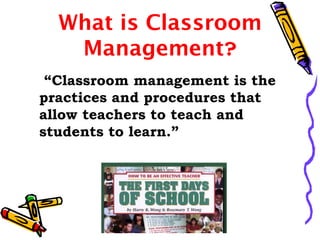
 “Classroom management is the
practices and procedures that
allow teachers to teach and
students to learn.”
Classroom Management


Teacher’s   Instructional                Procedures &
                            Discipline
  Role       Strategies                    Routines
The Ideal Teacher:
• Enjoys students.               • Is enthusiastic about the
• Uses different teaching          subject.
  techniques.                    • Is willing to listen to both
• Has a great sense of humor.      sides of an issue.
• Acts like an adult and not a   • Has a reputation for giving
  child (or high school            challenging work.
  student).                      • Isn’t a pushover. Keeps
• Keeps promises.                  misbehaving students in
• Is organized.                    line.
                                 • Keeps everyone busy.
• Knows the subject matter.
                                 • Does not have favorites.
• Admits when he or she is
  wrong.                         • Is polite to everyone all of
• Uses a pleasant voice.           the time.
                                 • Is friendly and fair.
The Teacher-Student
             Relationship
1.   You should show that you care about your students.
     Attend sporting events, ask about their hobbies, make a
     connection.
2.   You should have a thorough knowledge of your subject
     matter. Being prepared builds trust.
3.   You should take command of the class. If you are not the
     classroom leader, the students will gladly assume the
     position.
4.   You should act in a mature manner all of the time. Don’t
     be sarcastic. Don’t tell lies. Don’t lose your temper.
5.   You should maintain a certain emotional distance
     between yourself and your students. Students have peers.
      They need you to teach.
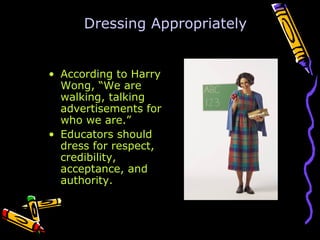
Dressing Appropriately


• According to Harry
  Wong, “We are
  walking, talking
  advertisements for
  who we are.”
• Educators should
  dress for respect,
  credibility,
  acceptance, and
  authority.
Effective Instruction


• A structured and instructionally
  sound classroom will eliminate a
  majority of misbehaviors.
• Two important key factors are:
         Room arrangement
         Time management
Movement is the key
• Be able to have quick access to any student
  at any time.
• Be comfortable moving around your room
  during instructional periods.
• Being in close proximity to a student is an
  effective deterrent.
Effective Time Management


• The more engaged a student is
  the better he behaves.
• Students tend to be more
  distracted during these 3 phases
  of instruction:
        » The beginning of class
        » Transitions
        » The end of class
Ideas for the Beginning of
               Class

• It is ESSENTIAL that      • Have your students:
  the students have an         – Create a test question.
  activity to complete as      – Illustrate important
  soon as the bell rings.        information.
• Take roll while the          – Scan the day’s reading
                                 assignment.
  students are working
                               – Take a mini-quiz.
  on the assignment.
                               – Draw a cartoon.
                               – Summarize the
                                 previous day’s topic.
Managing Transitions
• Julia G. Thompson suggests the following techniques:
          Time students between transitions.
          Provide students with a checklist of the
            day’s activities.
          Give students activities to “sponge” any
            dead time.
             • List ten words associated with the
               lesson today.
             • Defend your position on…
             • Make flashcards for this unit.
             • Circle the key words from yesterday’s
               notes.
Ending Class Without Chaos
• The end of class
  should be as structured
  as the beginning.
• Closing exercises will
  provide a constructive
  review of the day’s     • Some more ideas to try
  lesson.                   from Julia G. Thompson:
• Be sure that you           – Chain Games
                             – Rapid-fire drills
  dismiss the students
                             – Predict the next lesson
  and not the bell.          –    Review homework
                                  directions
                                – Show a relevant cartoon
                                – Play a game for bonus
                                  points
An Effective Discipline Plan

• The 3 most important
  student behaviors to
  teach on the first days of
  school are:
        – Discipline
        – Procedures
        – Routines


            “If you do not have a plan, you are planning
            to fail.”
Your Discipline Plan


                Class Rules


  Abide by the Rule          Break the Rule
Positive Consequences:   Negative Consequences:

  REWARDS                  PENALTIES
The Rules About Rules
• Wong writes, “The function of a rule is to
  prevent or encourage behavior by clearly
  stating student expectations.”

General Rules:                 Specific Rules:
      Respect others.                 Be in class on time.
      Be polite and helpful.          Keep your hands, feet,
                               and objects to yourself.


             What are the advantages and
             disadvantages to both?
Creating Your Class Rules

• Only have 3 to 5 rules
• State rules positively.
• Make the rules easy for you and your students to
  remember.
• Be able to enforce the rules consistently.
• Remember:
   – Rules deal with behavior, not procedures.
Rewards
• Harry Wong emphasizes, “The best reward
  is the satisfaction of a job well done.”
• Some examples include:

            » Praise
            » A note home (Good News
              Cards)
            » Student of the day, week, or
              month
            » Tangible rewards
            » Work posted
            » Certificates of Honour
Penalties
            • Time out
            • Demerit or fine
            • Detention
            • Assignment to write ways
              to correct problem
            • Being last to leave
            • Loss of reward
            • Exclusion of class
              participation
Procedures to Consider
                           • Asking a question
• Entering the classroom
• Getting to work          • Responding to fire,
                             severe weather, and
  immediately
                             tornado drills
• End of class dismissal
                           • Leaving the classroom
• Participating in class
                           • When visitors arrive
  discussions
                           • Keeping a notebook
• Changing groups
                           • Interruptions
• Turning in papers
• When you finish early    • Getting classroom
                             materials


                             From The First Days of School, by Harry Wong
You Must Teach Procedures!


         EXPLAIN

        REHEARSE

       REINFORCE
4 Actions That Helped Me and
      Will Help You Too!

• Maintain a professional relationship with
  students and fellow colleagues.
• Be fair and consistent with students
  regardless of who they are.
• Use class time wisely to avoid
  misbehaviors.
• Take an interest in students’ extracurricular
  activities.
Classroom management

Classroom management

  • 1.
  • 2.
  • 3.
    What is Classroom Management? “Classroom management is the practices and procedures that allow teachers to teach and students to learn.”
  • 4.
    Classroom Management Teacher’s Instructional Procedures & Discipline Role Strategies Routines
  • 5.
    The Ideal Teacher: •Enjoys students. • Is enthusiastic about the • Uses different teaching subject. techniques. • Is willing to listen to both • Has a great sense of humor. sides of an issue. • Acts like an adult and not a • Has a reputation for giving child (or high school challenging work. student). • Isn’t a pushover. Keeps • Keeps promises. misbehaving students in • Is organized. line. • Keeps everyone busy. • Knows the subject matter. • Does not have favorites. • Admits when he or she is wrong. • Is polite to everyone all of • Uses a pleasant voice. the time. • Is friendly and fair.
  • 6.
    The Teacher-Student Relationship 1. You should show that you care about your students. Attend sporting events, ask about their hobbies, make a connection. 2. You should have a thorough knowledge of your subject matter. Being prepared builds trust. 3. You should take command of the class. If you are not the classroom leader, the students will gladly assume the position. 4. You should act in a mature manner all of the time. Don’t be sarcastic. Don’t tell lies. Don’t lose your temper. 5. You should maintain a certain emotional distance between yourself and your students. Students have peers. They need you to teach.
  • 7.
    Dressing Appropriately • Accordingto Harry Wong, “We are walking, talking advertisements for who we are.” • Educators should dress for respect, credibility, acceptance, and authority.
  • 8.
    Effective Instruction • Astructured and instructionally sound classroom will eliminate a majority of misbehaviors. • Two important key factors are: Room arrangement Time management
  • 9.
    Movement is thekey • Be able to have quick access to any student at any time. • Be comfortable moving around your room during instructional periods. • Being in close proximity to a student is an effective deterrent.
  • 10.
    Effective Time Management •The more engaged a student is the better he behaves. • Students tend to be more distracted during these 3 phases of instruction: » The beginning of class » Transitions » The end of class
  • 11.
    Ideas for theBeginning of Class • It is ESSENTIAL that • Have your students: the students have an – Create a test question. activity to complete as – Illustrate important soon as the bell rings. information. • Take roll while the – Scan the day’s reading assignment. students are working – Take a mini-quiz. on the assignment. – Draw a cartoon. – Summarize the previous day’s topic.
  • 12.
    Managing Transitions • JuliaG. Thompson suggests the following techniques: Time students between transitions. Provide students with a checklist of the day’s activities. Give students activities to “sponge” any dead time. • List ten words associated with the lesson today. • Defend your position on… • Make flashcards for this unit. • Circle the key words from yesterday’s notes.
  • 13.
    Ending Class WithoutChaos • The end of class should be as structured as the beginning. • Closing exercises will provide a constructive review of the day’s • Some more ideas to try lesson. from Julia G. Thompson: • Be sure that you – Chain Games – Rapid-fire drills dismiss the students – Predict the next lesson and not the bell. – Review homework directions – Show a relevant cartoon – Play a game for bonus points
  • 14.
    An Effective DisciplinePlan • The 3 most important student behaviors to teach on the first days of school are: – Discipline – Procedures – Routines “If you do not have a plan, you are planning to fail.”
  • 15.
    Your Discipline Plan Class Rules Abide by the Rule Break the Rule Positive Consequences: Negative Consequences: REWARDS PENALTIES
  • 16.
    The Rules AboutRules • Wong writes, “The function of a rule is to prevent or encourage behavior by clearly stating student expectations.” General Rules: Specific Rules: Respect others. Be in class on time. Be polite and helpful. Keep your hands, feet, and objects to yourself. What are the advantages and disadvantages to both?
  • 17.
    Creating Your ClassRules • Only have 3 to 5 rules • State rules positively. • Make the rules easy for you and your students to remember. • Be able to enforce the rules consistently. • Remember: – Rules deal with behavior, not procedures.
  • 18.
    Rewards • Harry Wongemphasizes, “The best reward is the satisfaction of a job well done.” • Some examples include: » Praise » A note home (Good News Cards) » Student of the day, week, or month » Tangible rewards » Work posted » Certificates of Honour
  • 19.
    Penalties • Time out • Demerit or fine • Detention • Assignment to write ways to correct problem • Being last to leave • Loss of reward • Exclusion of class participation
  • 20.
    Procedures to Consider • Asking a question • Entering the classroom • Getting to work • Responding to fire, severe weather, and immediately tornado drills • End of class dismissal • Leaving the classroom • Participating in class • When visitors arrive discussions • Keeping a notebook • Changing groups • Interruptions • Turning in papers • When you finish early • Getting classroom materials From The First Days of School, by Harry Wong
  • 21.
    You Must TeachProcedures! EXPLAIN REHEARSE REINFORCE
  • 22.
    4 Actions ThatHelped Me and Will Help You Too! • Maintain a professional relationship with students and fellow colleagues. • Be fair and consistent with students regardless of who they are. • Use class time wisely to avoid misbehaviors. • Take an interest in students’ extracurricular activities.