Classroom Management
ELT
2016-2017
Supervised by; Mr. Ivan H. Murad
Prepared by : Hussein Kamal & Musa Rasheed
Outline
 Introduction
 definition of classroom management
Aspects of Classroom Management
Principle of classroom management
Discipline
Different Approaches
Technique
Conclusion
The presenters aim the following objectives:
1.) to clarify the meaning and significance of
classroom management
2.) to establish the provisions that must be
taken care of in providing the proper
learning situation
3.) to explain how to maintain desirable
classroom discipline.
4.) to present some strategies and guidelines
in good classroom management and
discipline.
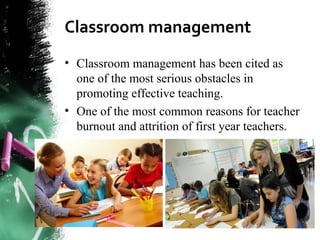
Classroom management
• Classroom management has been cited as
one of the most serious obstacles in
promoting effective teaching.
• One of the most common reasons for teacher
burnout and attrition of first year teachers.
“The number one
problem in the
classroom is not
discipline; it is the lack
of procedures and
routines”.
The First Days of School by Harry Wong
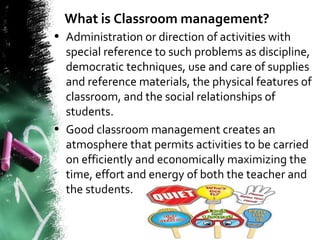
What is Classroom management?
• Administration or direction of activities with
special reference to such problems as discipline,
democratic techniques, use and care of supplies
and reference materials, the physical features of
classroom, and the social relationships of
students.
• Good classroom management creates an
atmosphere that permits activities to be carried
on efficiently and economically maximizing the
time, effort and energy of both the teacher and
the students.
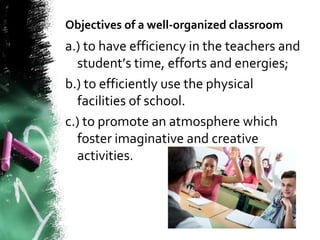
Objectives of a well-organized classroom
a.) to have efficiency in the teachers and
student’s time, efforts and energies;
b.) to efficiently use the physical
facilities of school.
c.) to promote an atmosphere which
foster imaginative and creative
activities.
Aspects of Classroom Management
a. Managing the Physical Environment
1. Physical Condition of the Classroom
2. Lighting
3. Furniture Arrangement
4. Seating Arrangement
b. Establishing Classroom Routine
c. Directing and Controlling Learning
Principles of classroom management
Building a good relationship between
teacher and student.
Setting rules, routines and procedures
Managing self.
Maintaining appropriate student
behavior.
Techniques of motivating.
Principle is effective and constructive Discipline
• Students need control and direction
but it is unlikely that they can learn
self-control and self-direction if they
are controlled and directed all the time
and at every turn.
Discipline
• Discipline - is about teaching people
appropriate behaviour and helping
then become stronger or more in
control of his or her emotions and
being independent and responsible.
Important functions of discipline:
1.) It is necessary for socialization – for the
learning of standards of conduct that are
approved and tolerated in any culture
2.) It is necessary for normal personality
maturation.
3.) It is necessary for the internalization of
moral standards and obligations.
4.) It is necessary for the students’ emotional
security.
Principles underlying effective discipline, the
teacher should:
1.) be responsible for his own class discipline;
2.) provide a wholesome atmosphere which results
from orderly and adequate classroom
conditions;
3.) stimulate worthy motives and give the students
every opportunity to direct their own efforts;
4.) be aware of the student rights to be respected;
5.) be aware of the individual differences and
should give each children equal share of his
attention, guidance, and direction.
Causes of Disciplinary Problems
1. Teacher factor
a. teacher’s personal characteristics
b. teacher’s scholastic qualifications
2. Student as a factor in discipline
3. School as a factor in discipline
Teacher should always take note of the following:
• Establish good routine habits and keep students
busy.
• Stand at a place in the room where everybody can be
within your gaze.
• Be alert to detect any signs of boredom, discontent,
or misbehavior.
• Call on students who do not pay attention or who
may begin to be disorderly.
• Firmness and forcefulness in speaking can make the
students be attentive.
• Remain calm and poised even in an emergency.
Ways to avoid serious
discipline problems
• Know the subject matter and be well-prepared.
• Follow an established routine everyday until students
learn to follow it automatically.
• Have all the needed materials and equipment ready for
use so you do not waste students’ time getting things
arranged.
• Walk around the classroom whenever possible to make
sure all the students are doing what they are supposed
to be doing.
• Make it clear to students that you expect them to work.
Ways to avoid serious discipline problems
(cont..)
• Allow reasonable amount of time for special activities.
• Avoid the use of threats.
• Keep your sense of humor.
• Handle calmly all undesirable attempts to attract
attention.
• Try to involve all students in class activities.
• Always have planned alternate activities ready for
emergency situations.
• Never be sarcastic.
• Implement group-oriented methodologies such as
cooperative learning approach, peer tutoring and team
learning.
Different Approaches to the
Issue:
Autocratic, teacher centred, passive
learning and controlled classroom
management
Vs.
Democratic, student led, interactive
learning, activity centred, and co-
constructed management
Little Things: Quick Interventions That Support
Classroom Management
1. Never punish an entire class
2. Change the tone.
3. Find things to appreciate.
4. Smile
5. Use your words.
6. Forgive.
7. Give students choices.
Technique
1. Rewards
a. reward the students every time the given
behavior occurs
b. giving of rewards every now and then
should be given once the behavior is
securely acquired
c. vary the types of reward given
Technique
2. Punishment
1. Learn what types of punishment the school
authorities permit.
2. Learn what punishment can be given.
3. Never assign extra homework as punishment.
4. As punishment, never prohibit students from
attending a favorite class.
5. Do not assign a punishment which is actually a
reward.
6. Never strike a student.
7. A punishment should come early in a sequence of
misbehavior and should be systematically applied.
Technique
2. Punishment(cont..)
8. Be consistent with punishment.
9. Before accusing or punishing any student, get the
facts.
10. Be prepared to document any serious incidences of
misbehavior.
11. Never punish a whole class for the offense of one
individual.
12. be sure that the student understands why he/she is
being punished.
13. Punishment is more effective if the teacher already
has appositive relationship with the student.
Conclusion
Last Thought :
“Being an effective Class Manager
is not a talent which some people just have
and others do not – it is a set of skills
and an attitude learned throught
patience and practice”
Do you have any question?
References:
• Aquino, Gaudencio V. Principles and Methods of Effective Teaching.
San Juan. National BookStore, Inc. 1988. pp 363 – 384.
• Casinto, Carlo Domingo C. Hand book on Principles of Teaching.
Quezon City. Rex Bookstore Inc. 2010. pp 128 – 153.
• Kelly, William A.,Ph.D. Educational Psychology. Milwaukee.The
Bruce Publishing Company. 1965. pp 497 – 507.
• Lupdag, Anselmo D. Educational Psychology. Mandaluyong City.
National Bookstore.1984. pp 210 – 214.
• Lardizabal, Amparo S., Alicia S. Bustos, Luz C. Bucu, and Maura G.
Tangco. Principles and Methods of Teaching. Quezon City. Phoenix
Publishing House Inc. 1999. pp 267 – 282.
• Picture references . www.google.com

Classroom management .. ELT

  • 1.
    Classroom Management ELT 2016-2017 Supervised by;Mr. Ivan H. Murad Prepared by : Hussein Kamal & Musa Rasheed
  • 2.
    Outline  Introduction  definitionof classroom management Aspects of Classroom Management Principle of classroom management Discipline Different Approaches Technique Conclusion
  • 3.
    The presenters aimthe following objectives: 1.) to clarify the meaning and significance of classroom management 2.) to establish the provisions that must be taken care of in providing the proper learning situation 3.) to explain how to maintain desirable classroom discipline. 4.) to present some strategies and guidelines in good classroom management and discipline.
  • 4.
    Classroom management • Classroommanagement has been cited as one of the most serious obstacles in promoting effective teaching. • One of the most common reasons for teacher burnout and attrition of first year teachers.
  • 5.
    “The number one problemin the classroom is not discipline; it is the lack of procedures and routines”. The First Days of School by Harry Wong
  • 6.
    What is Classroommanagement? • Administration or direction of activities with special reference to such problems as discipline, democratic techniques, use and care of supplies and reference materials, the physical features of classroom, and the social relationships of students. • Good classroom management creates an atmosphere that permits activities to be carried on efficiently and economically maximizing the time, effort and energy of both the teacher and the students.
  • 7.
    Objectives of awell-organized classroom a.) to have efficiency in the teachers and student’s time, efforts and energies; b.) to efficiently use the physical facilities of school. c.) to promote an atmosphere which foster imaginative and creative activities.
  • 8.
    Aspects of ClassroomManagement a. Managing the Physical Environment 1. Physical Condition of the Classroom 2. Lighting 3. Furniture Arrangement 4. Seating Arrangement b. Establishing Classroom Routine c. Directing and Controlling Learning
  • 9.
    Principles of classroommanagement Building a good relationship between teacher and student. Setting rules, routines and procedures Managing self. Maintaining appropriate student behavior. Techniques of motivating.
  • 10.
    Principle is effectiveand constructive Discipline • Students need control and direction but it is unlikely that they can learn self-control and self-direction if they are controlled and directed all the time and at every turn.
  • 11.
    Discipline • Discipline -is about teaching people appropriate behaviour and helping then become stronger or more in control of his or her emotions and being independent and responsible.
  • 12.
    Important functions ofdiscipline: 1.) It is necessary for socialization – for the learning of standards of conduct that are approved and tolerated in any culture 2.) It is necessary for normal personality maturation. 3.) It is necessary for the internalization of moral standards and obligations. 4.) It is necessary for the students’ emotional security.
  • 13.
    Principles underlying effectivediscipline, the teacher should: 1.) be responsible for his own class discipline; 2.) provide a wholesome atmosphere which results from orderly and adequate classroom conditions; 3.) stimulate worthy motives and give the students every opportunity to direct their own efforts; 4.) be aware of the student rights to be respected; 5.) be aware of the individual differences and should give each children equal share of his attention, guidance, and direction.
  • 14.
    Causes of DisciplinaryProblems 1. Teacher factor a. teacher’s personal characteristics b. teacher’s scholastic qualifications 2. Student as a factor in discipline 3. School as a factor in discipline
  • 15.
    Teacher should alwaystake note of the following: • Establish good routine habits and keep students busy. • Stand at a place in the room where everybody can be within your gaze. • Be alert to detect any signs of boredom, discontent, or misbehavior. • Call on students who do not pay attention or who may begin to be disorderly. • Firmness and forcefulness in speaking can make the students be attentive. • Remain calm and poised even in an emergency.
  • 16.
    Ways to avoidserious discipline problems • Know the subject matter and be well-prepared. • Follow an established routine everyday until students learn to follow it automatically. • Have all the needed materials and equipment ready for use so you do not waste students’ time getting things arranged. • Walk around the classroom whenever possible to make sure all the students are doing what they are supposed to be doing. • Make it clear to students that you expect them to work.
  • 17.
    Ways to avoidserious discipline problems (cont..) • Allow reasonable amount of time for special activities. • Avoid the use of threats. • Keep your sense of humor. • Handle calmly all undesirable attempts to attract attention. • Try to involve all students in class activities. • Always have planned alternate activities ready for emergency situations. • Never be sarcastic. • Implement group-oriented methodologies such as cooperative learning approach, peer tutoring and team learning.
  • 18.
    Different Approaches tothe Issue: Autocratic, teacher centred, passive learning and controlled classroom management Vs. Democratic, student led, interactive learning, activity centred, and co- constructed management
  • 19.
    Little Things: QuickInterventions That Support Classroom Management 1. Never punish an entire class 2. Change the tone. 3. Find things to appreciate. 4. Smile 5. Use your words. 6. Forgive. 7. Give students choices.
  • 20.
    Technique 1. Rewards a. rewardthe students every time the given behavior occurs b. giving of rewards every now and then should be given once the behavior is securely acquired c. vary the types of reward given
  • 21.
    Technique 2. Punishment 1. Learnwhat types of punishment the school authorities permit. 2. Learn what punishment can be given. 3. Never assign extra homework as punishment. 4. As punishment, never prohibit students from attending a favorite class. 5. Do not assign a punishment which is actually a reward. 6. Never strike a student. 7. A punishment should come early in a sequence of misbehavior and should be systematically applied.
  • 22.
    Technique 2. Punishment(cont..) 8. Beconsistent with punishment. 9. Before accusing or punishing any student, get the facts. 10. Be prepared to document any serious incidences of misbehavior. 11. Never punish a whole class for the offense of one individual. 12. be sure that the student understands why he/she is being punished. 13. Punishment is more effective if the teacher already has appositive relationship with the student.
  • 23.
    Conclusion Last Thought : “Beingan effective Class Manager is not a talent which some people just have and others do not – it is a set of skills and an attitude learned throught patience and practice”
  • 24.
    Do you haveany question?
  • 26.
    References: • Aquino, GaudencioV. Principles and Methods of Effective Teaching. San Juan. National BookStore, Inc. 1988. pp 363 – 384. • Casinto, Carlo Domingo C. Hand book on Principles of Teaching. Quezon City. Rex Bookstore Inc. 2010. pp 128 – 153. • Kelly, William A.,Ph.D. Educational Psychology. Milwaukee.The Bruce Publishing Company. 1965. pp 497 – 507. • Lupdag, Anselmo D. Educational Psychology. Mandaluyong City. National Bookstore.1984. pp 210 – 214. • Lardizabal, Amparo S., Alicia S. Bustos, Luz C. Bucu, and Maura G. Tangco. Principles and Methods of Teaching. Quezon City. Phoenix Publishing House Inc. 1999. pp 267 – 282. • Picture references . www.google.com