Language Learning
Strategies
OVERVIEW
• What is a Strategy?
• Language Learning Strategies
• What are Learning Strategies for?
• Teaching Language Learning Strategies
• Forms of Strategy Instruction
• Characteristics of LLS
• Rebecca Oxford 1990’s Strategy Framework
• Research In the field Of LLS
• Conclusion
INTRODUCTION
• Every learning process requires a manner and strategy to be adapted to
achieve the main purpose of learning. Among the important things in the
process of learning are ‘what’ to use for learning and ‘how’ to use it.
• Human beings are involved with different kinds of strategies while
learning a language. The significance of language learning strategies is
increasing with the increasing importance of language learning all over
the world.
INTRODUCTION
• Language learning strategies are especially important for
language learning because these are tools for active, self-
directed involvement, which is essential for developing
communicative competence.
• Appropriate language learning strategies result in improved
proficiency and greater self-confidence.
LANGUAGE LEARNING STRATEGIES:
• Rubin (1975) defined learning strategies as “the techniques or devices
which a learner may use to acquire knowledge.”
• Learner's “natural, habitual, and preferred way(s) of absorbing,
processing, and retaining new information and skills.”(Reid, 1995)
• Oxford (1990) opines that language learning strategies are “specific
actions, behaviors, steps, or techniques that students (often intentionally)
use to improve their progress in developing skills.”
LANGUAGE LEARNING STRATEGIES
• “Strategies are tools for self-directed participants in learning,
necessary for the development of communicative competence.”
(Oxford, 1990).
• Rubin (1975) recommended “learning strategies as a means to
promote successful learning.”
• Graham (1997) opines “strategies help students become better
language learners.”
STRATEGIES
WHAT ARE LEARNING STRATEGIES FOR?
O’Malley & Chamot (1990) maintain that language learning strategies
promote autonomous learning. Furthermore, these strategies can be helpful:
• for enhancing learning.
• for performing specified tasks.
• for solving specific problems.
• for compensating for a deficit in learning.
• for making learning easier, faster, more enjoyable.
• for expanding your role as the language teacher.
• for becoming independent learners.
TEACHING LANGUAGE LEARNING STRATEGIES
• LLS instruction focuses on making the students more active learners by
teaching them how to learn and how to use what they have learned, and
be more successful second language learners.
• Explicit (direct) strategy instruction is more effective than implicit
instruction embedded in classroom activities without explanations and
modeling (Chamot, 2007).
TEACHING LANGUAGE LEARNING STRATEGIES
Individual Learner variables must be considered:
• Demographics; Age, gender, status, etc.
• Education; Formal/informal, for how long, where, etc.
• L2-learning factors; Native language, L1 to L2 differences in
linguistic characteristics, L1 and L2 proficiency, strategies
currently/previously used, attitudes and beliefs about L2 and L2
learning, and motivation.
How Teachers Can Help?
Teachers can identify student’s learning styles and
current strategies through surveys, interviews, etc. they
can also help students determine the most relevant LLS
for their learning style, tasks, and goals. They can aid
students systematically in using them.
FORMS OF STRATEGY INSTRUCTION
Strategy instructions can be considered at various levels. Some of
them are given below:
Level 1: Blind (covert) Strategy Instruction
Level 2: Somewhat Informed Strategy Instruction
Level 3: Informed Strategy Instruction
Level 4: Completely Informed Strategy Instruction
CHARACTERISTICS OF LLS
Language learning strategies have the following characteristics:
• Learner Generated
• Learner Centered
• Enhance Language Learning
• Concrete and Abstract
• Share Information and Memory
REBECCA OXFORD 1990’S STRATEGY FRAMEWORK
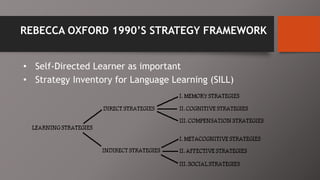
• Self-Directed Learner as important
• Strategy Inventory for Language Learning (SILL)
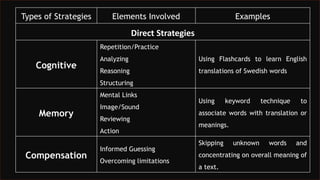
Types of Strategies Elements Involved Examples
Direct Strategies
Cognitive
Repetition/Practice
Analyzing
Reasoning
Structuring
Using Flashcards to learn English
translations of Swedish words
Memory
Mental Links
Image/Sound
Reviewing
Action
Using keyword technique to
associate words with translation or
meanings.
Compensation
Informed Guessing
Overcoming limitations
Skipping unknown words and
concentrating on overall meaning of
a text.
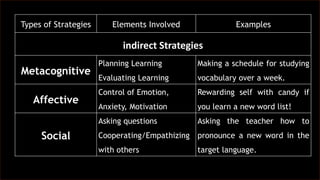
Types of Strategies Elements Involved Examples
indirect Strategies
Metacognitive
Planning Learning
Evaluating Learning
Making a schedule for studying
vocabulary over a week.
Affective
Control of Emotion,
Anxiety, Motivation
Rewarding self with candy if
you learn a new word list!
Social
Asking questions
Cooperating/Empathizing
with others
Asking the teacher how to
pronounce a new word in the
target language.
RESEARCH IN THE FIELD OF LLS:
• 2000’s into Today:
More recent research has examined language learning strategies in more context-
specific situations, rather than catch-all categories. The terms cognitive and
meta-cognitive strategies remain common in strategy research, but others related
to managing a learners' own affective state or social environment have been
examined under the umbrella term self-regulation
• Macaro (2001):
Strategy classifications and Classroom assessment of strategies.
• Leaver (2003):
Importance of motivation and strategy use in combination (individualized study
plans).
• Chamot (2005):
Integration of LLS research into classroom instruction.
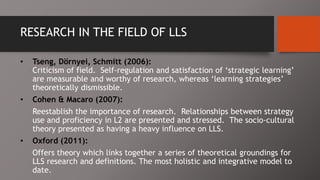
RESEARCH IN THE FIELD OF LLS
• Tseng, Dörnyei, Schmitt (2006):
Criticism of field. Self-regulation and satisfaction of ‘strategic learning’
are measurable and worthy of research, whereas ‘learning strategies’
theoretically dismissible.
• Cohen & Macaro (2007):
Reestablish the importance of research. Relationships between strategy
use and proficiency in L2 are presented and stressed. The socio-cultural
theory presented as having a heavy influence on LLS.
• Oxford (2011):
Offers theory which links together a series of theoretical groundings for
LLS research and definitions. The most holistic and integrative model to
date.
CONCLUSION
• Language learning is an extremely complex undertaking, and learners are
multifaceted. The challenge for today is to continue with efforts to
achieve consensus on important issues or number of variables such as age,
gender, individual and cultural differences and motivation.
• Researchers tend to agree that teacher preparation for strategy
instruction is enhanced by using an experimental approach that enables
teachers to discover their own strategies, consider the new ones, and
learn how to model and teach them.
• The purpose behind such practices is to influence learners’ language
learning process so that their efforts, as well as those of their instructors,
may be more successful.
Language learning strategies

Language learning strategies

  • 2.
  • 3.
    OVERVIEW • What isa Strategy? • Language Learning Strategies • What are Learning Strategies for? • Teaching Language Learning Strategies • Forms of Strategy Instruction • Characteristics of LLS • Rebecca Oxford 1990’s Strategy Framework • Research In the field Of LLS • Conclusion
  • 4.
    INTRODUCTION • Every learningprocess requires a manner and strategy to be adapted to achieve the main purpose of learning. Among the important things in the process of learning are ‘what’ to use for learning and ‘how’ to use it. • Human beings are involved with different kinds of strategies while learning a language. The significance of language learning strategies is increasing with the increasing importance of language learning all over the world.
  • 5.
    INTRODUCTION • Language learningstrategies are especially important for language learning because these are tools for active, self- directed involvement, which is essential for developing communicative competence. • Appropriate language learning strategies result in improved proficiency and greater self-confidence.
  • 6.
    LANGUAGE LEARNING STRATEGIES: •Rubin (1975) defined learning strategies as “the techniques or devices which a learner may use to acquire knowledge.” • Learner's “natural, habitual, and preferred way(s) of absorbing, processing, and retaining new information and skills.”(Reid, 1995) • Oxford (1990) opines that language learning strategies are “specific actions, behaviors, steps, or techniques that students (often intentionally) use to improve their progress in developing skills.”
  • 7.
    LANGUAGE LEARNING STRATEGIES •“Strategies are tools for self-directed participants in learning, necessary for the development of communicative competence.” (Oxford, 1990). • Rubin (1975) recommended “learning strategies as a means to promote successful learning.” • Graham (1997) opines “strategies help students become better language learners.”
  • 8.
  • 9.
    WHAT ARE LEARNINGSTRATEGIES FOR? O’Malley & Chamot (1990) maintain that language learning strategies promote autonomous learning. Furthermore, these strategies can be helpful: • for enhancing learning. • for performing specified tasks. • for solving specific problems. • for compensating for a deficit in learning. • for making learning easier, faster, more enjoyable. • for expanding your role as the language teacher. • for becoming independent learners.
  • 10.
    TEACHING LANGUAGE LEARNINGSTRATEGIES • LLS instruction focuses on making the students more active learners by teaching them how to learn and how to use what they have learned, and be more successful second language learners. • Explicit (direct) strategy instruction is more effective than implicit instruction embedded in classroom activities without explanations and modeling (Chamot, 2007).
  • 11.
    TEACHING LANGUAGE LEARNINGSTRATEGIES Individual Learner variables must be considered: • Demographics; Age, gender, status, etc. • Education; Formal/informal, for how long, where, etc. • L2-learning factors; Native language, L1 to L2 differences in linguistic characteristics, L1 and L2 proficiency, strategies currently/previously used, attitudes and beliefs about L2 and L2 learning, and motivation.
  • 12.
    How Teachers CanHelp? Teachers can identify student’s learning styles and current strategies through surveys, interviews, etc. they can also help students determine the most relevant LLS for their learning style, tasks, and goals. They can aid students systematically in using them.
  • 13.
    FORMS OF STRATEGYINSTRUCTION Strategy instructions can be considered at various levels. Some of them are given below: Level 1: Blind (covert) Strategy Instruction Level 2: Somewhat Informed Strategy Instruction Level 3: Informed Strategy Instruction Level 4: Completely Informed Strategy Instruction
  • 14.
    CHARACTERISTICS OF LLS Languagelearning strategies have the following characteristics: • Learner Generated • Learner Centered • Enhance Language Learning • Concrete and Abstract • Share Information and Memory
  • 15.
    REBECCA OXFORD 1990’SSTRATEGY FRAMEWORK • Self-Directed Learner as important • Strategy Inventory for Language Learning (SILL)
  • 16.
    Types of StrategiesElements Involved Examples Direct Strategies Cognitive Repetition/Practice Analyzing Reasoning Structuring Using Flashcards to learn English translations of Swedish words Memory Mental Links Image/Sound Reviewing Action Using keyword technique to associate words with translation or meanings. Compensation Informed Guessing Overcoming limitations Skipping unknown words and concentrating on overall meaning of a text.
  • 17.
    Types of StrategiesElements Involved Examples indirect Strategies Metacognitive Planning Learning Evaluating Learning Making a schedule for studying vocabulary over a week. Affective Control of Emotion, Anxiety, Motivation Rewarding self with candy if you learn a new word list! Social Asking questions Cooperating/Empathizing with others Asking the teacher how to pronounce a new word in the target language.
  • 19.
    RESEARCH IN THEFIELD OF LLS: • 2000’s into Today: More recent research has examined language learning strategies in more context- specific situations, rather than catch-all categories. The terms cognitive and meta-cognitive strategies remain common in strategy research, but others related to managing a learners' own affective state or social environment have been examined under the umbrella term self-regulation • Macaro (2001): Strategy classifications and Classroom assessment of strategies. • Leaver (2003): Importance of motivation and strategy use in combination (individualized study plans). • Chamot (2005): Integration of LLS research into classroom instruction.
  • 20.
    RESEARCH IN THEFIELD OF LLS • Tseng, Dörnyei, Schmitt (2006): Criticism of field. Self-regulation and satisfaction of ‘strategic learning’ are measurable and worthy of research, whereas ‘learning strategies’ theoretically dismissible. • Cohen & Macaro (2007): Reestablish the importance of research. Relationships between strategy use and proficiency in L2 are presented and stressed. The socio-cultural theory presented as having a heavy influence on LLS. • Oxford (2011): Offers theory which links together a series of theoretical groundings for LLS research and definitions. The most holistic and integrative model to date.
  • 21.
    CONCLUSION • Language learningis an extremely complex undertaking, and learners are multifaceted. The challenge for today is to continue with efforts to achieve consensus on important issues or number of variables such as age, gender, individual and cultural differences and motivation. • Researchers tend to agree that teacher preparation for strategy instruction is enhanced by using an experimental approach that enables teachers to discover their own strategies, consider the new ones, and learn how to model and teach them. • The purpose behind such practices is to influence learners’ language learning process so that their efforts, as well as those of their instructors, may be more successful.