Bhagwat Education Trust
PRINCIPLES IN
CLASSROOM
MANAGEMENT
1. Consistent, proactive discipline is the
crux of effective classroom management.
 “Prevention is better than cure”, so
goes the adage. If we are proactive in
our approach to discipline we prevent
unnecessary disciplinary problems from
cropping up. We have not to wait for
disciplinary problems to erupt for us to
take a move.
2. Establish routines for all daily tasks
and needs.
 Routinized collection of assignments,
passing of papers, and preparation for
experiments saves as a lot of time and effort.
We have not to explain or instruct our pupils/
students on how to pass papers, collect
assignments, prepare for experiments day in
and day out because we have established the
routines for these everyday tasks. They have
become habitual for each member of the
class.
3. Orchestrate smooth transitions and
continuity of momentum throughout the
day.
 Smooth transitions and continuity of
momentum throughout the day ensure
us that every instructional moment is
made use of wisely. No unnecessary lull
is created that will breed classroom
restlessness, which is the father of
disciplinary problems.
4. Strike a balance between variety and
challenge in students’ activities.
 A variety of student activities will ensure that
students’ multiple intelligences and varied learning
styles are considered in the conduct of student
activities. Most of the time our activities fall under
the word use, talking, writing will certainly challenge
the linguistically intelligent students but bore the
logic and math wizards and other groups of different
intelligences. When boredom creeps into the
classroom, we have disciplinary problems in our
hands.
5. As classroom manager, be aware of all
actions and activities in the classroom.
 Our heightened awareness of everything
that is happening in our classroom puts our
pupils and students on their toes all the time.
While our back faces them when we write on
the board, our “eyes on the back of our
heads” will make our pupils and students feel
that we know what they are doing. This is
what Kounin calls with-it-ness.
6. Resolve minor inattention and
disruption before they become major
disruptions.
 The old adage “a stitch on time saves nine”
aptly applies here. We have not to wait until
our class is out of control. Misdemeanor has a
“ripple effect” if not checked early.
Conflagration begins with a spark. Put out the
spark early enough to avoid conflagration. We
ought to respond to inappropriate behavior
promptly.
7. Reinforce positive behavior
 Be generous with genuine praise. Some
teachers are quite stingy with praise. These are
the teachers who think will become less when
they praise others. They have the so-called
“subtraction mentality.” Other teachers are
overgenerous with their praise. Their praises
overflow so much that they give praise even
when is not appropriate. For our praise to be
genuine it must be given according to merit. It is
our way of appreciating and recognizing hard
work and good behavior.
8. Treat minor disturbance calmly.
 “Do not make a mountain out of a
mole.” If a stern look or gesture can kill
the inappropriate behavior so be it.
That’s the end period! Let us not make a
fuss about it.
9. Work out a physical arrangement of
chairs that facilitates an interactive
teaching-learning process.
 There is no doubt that external environment
affects us. The most common arrangement of
tables and chair in the classroom is one where the
teachers’ table and chairs are in front and the
student’s desk or chairs are arranged in rows
facing the teacher. This seat arrangement does not
always enhance interaction among students. Let
us work for a flexible seating arrangement where
we can re-arrange seats or desk to suit our
learning needs and conditions.
10. Make good use of every
instructional moment.
Minimize discipline time to
maximize instructional time.
CLASSROOM
MANAGEMENT
TECHNIQUES
MANAGEMENT
OF TIME
Time is of the essence in learning. How much
students learn depends upon the amount of
time they spend in learning. The impact of
time however on achievement is influenced
also by the quality of instruction and the
learning tasks. No matter what amount of
time is spent, no learning takes place if there
is poor instruction and poorly devised
learning tasks. It is observed that classes
where students are occupied with learning
activities, where time is managed properly,
learn more.
HERE ARE SOME RESEARCH-BASED
EFFECTIVE TECHNIQUES TO MAKE WISE ALL
OF TIME:
Orchestrate smooth classroom transitions.
 Remain involved with the students during
the entire class period allowing for no idle
time.
 Use fillers, in case you finish the lesson
ahead of time. Examples of fillers are reciting
a favorite stanza then letting others explain the
meaning or conducting a short contest about
the lesson.
 Use a common place to keep materials
such as scissors, school supplies. This saves
time. You have not to look for them when you
need them.
 Follow a consistent schedule and maintain
the procedures and routines established at
the beginning of the year.
 Prepare materials in advance.
Make clear and smooth transitions.
Limit disruptions and interruptions through
appropriate behavioral management
technique.
Cont…
FOR QUALITY OUTPUT WITHIN AN ALLOTTED
PERIOD, HERE ARE SOME SUGGESTIONS:
 Schedule all activities with corresponding
time allotment way ahead of time. Early
preparations could avoid haste and confusion.
 Provide enough time for everything you
expect to happen.
 Avoid rushing since you know you have
carefully allotted required time for every
activity. Quality may suffer.
 Anticipate difficulties or failure of some
operations in order to be able to pursue
alternative actions.
 Be flexible with time assignments. If
students are observed to be so
interested and eager to continue
working, allow a little more time for
them to complete and achieve the
objectives with satisfaction.
 Set the example by showing that you
are time- conscious. They will develop
the same precision regarding time
utilization.
Cont…
MANAGEMENT
OF DISCIPLINE
Discipline is controlled behavior.
It constitutes the next important
concern of teachers as part of
good management. No matter
how well-managed a learning
environment is, students will
occasionally misbehave.
Teachers must be ready to deal
with them with utmost care and
consideration.
SOME CAUSES OF DISCIPLINARY
PROBLEMS
 Unfavorable learning conditions
-The classroom may not be conducive to learning if it is:
• overcrowded with more than the regular number of
students to a class.
• with poor lighting facilities and inadequate ventilation.
• with furniture and storage cabinets disorderly
positioned, making the collection and retrieval of tools
less efficient.
• with inappropriate seating arrangement such that
distractions can easily occur
• near sources of noise which obstruct understanding of
the lesson.
 Teacher’s poor management skills
- The teachers’ lack of adequate
knowledge and skills in handling occurrences
of misbehavior likewise contribute to a trouble-
prone setting.
 Students’ varied background
- The students bring to the classroom a
surprising record of individual attitudes,
interests and abilities. Said characteristics
could be traced from their differences in: a)
family background, b) physical and mental
capacities, and c) emotional traits among
others.
HOW TO PREVENT DISCIPLINE
PROBLEMS
To prevent discipline problems, teachers can:
 implement group-oriented methodologies
such as: 1) cooperative learning approach,
2) team learning, 3) peer tutoring, and 4)
group projects and collections.
 use varied teaching techniques
 develop patience, compassion, genuine
respect and care for the students.
Schools differ in how they achieve and
maintain good discipline. Following are some
common practices.
1. Discipline is the students’ responsibility. If they
misbehave, the teacher accepts no excuses. They
must be ready for the consequences.
2. Discipline is the teachers’ way of establishing a
desirable student- oriented environment for learning.
3. Discipline is coupled with effective teaching
strategies and techniques.
4. Discipline is achieved through the effects of group
dynamics on behavior.
5. Discipline is believed to be the exclusive
responsibility of the teachers.
WAYS OF DEALING WITH DISCIPLINE
PROBLEMS
ACCEPTABLE AND EFFECTIVE:
1. Use verbal reinforcers that encourage good
behavior and discourage bad tendencies.
2. Use nonverbal gestures, frown or a hard
look to dissuade them from mischiefs.
3. Dialogues can help in discovering problems
and agreeing on mutually beneficial
solutions
4. Focus attention on one who is unruly and is
about to disturb the neighbors.
5. Award merits for good behavior and
demerits for inconsistencies and
lapses.
6. A private one-on- one brief
conference can lead to a better
understanding of mistakes that need
to be remedied or improved.
7. Give students the free to express or
explain agitated feelings and
misgivings rather than censure them
right away.
UNACCEPTABLE AND INEFFECTIVE:
1. Scolding and harsh words as a reprimand will
have a negative effect on the entire class.
2. Nagging and faultfinding, together with long
“sermons” are repugnant and nasty.
3. keeping a student in a “detention area”
during or after classes as a penalty for
misbehavior is a waste of time and occasion
for learning. The shameful experience is not
easy to forget.
4. Denying a student some privileges due to
unnecessary hyperactivity can all the more
encourage repetitions.
5.Assignment of additional homework
compared to the rest can make
them dislike the subject.
6.Use of ridicule or sarcasm could
humiliate and embarrass a student.
7.Grades for academic achievement
should not be affected due to
misdemeanor.
MANAGEMENT OF
PHYSICAL
ENVIRONMENT
FURNITURE ARRANGEMENT
 Furniture such as chairs and tables for
demonstrations or displays must be positioned
appropriately.
 Exhibit shelves are either permanently
pinned to the wall or are made to stand at the
sides.
 White board for writing and clarifying lesson
discussions, together with bulletin boards, are
available for posting important messages and
outstanding pieces of students work, art and
illustrations.
SEATING ARRANGEMENT
Below are some sample seating arrangements:
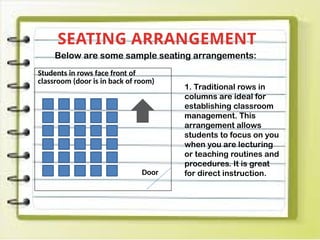
Students in rows face front of
classroom (door is in back of room)
Door
1. Traditional rows in
columns are ideal for
establishing classroom
management. This
arrangement allows
students to focus on you
when you are lecturing
or teaching routines and
procedures. It is great
for direct instruction.
SEATING ARRANGEMENT
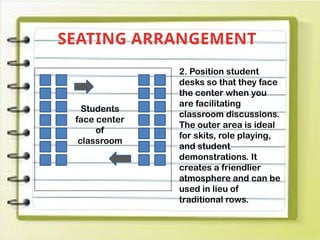
Students
face center
of
classroom
2. Position student
desks so that they face
the center when you
are facilitating
classroom discussions.
The outer area is ideal
for skits, role playing,
and student
demonstrations. It
creates a friendlier
atmosphere and can be
used in lieu of
traditional rows.
SEATING ARRANGEMENT
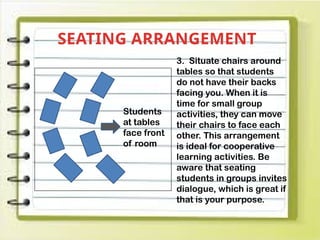
Students
at tables
face front
of room
3. Situate chairs around
tables so that students
do not have their backs
facing you. When it is
time for small group
activities, they can move
their chairs to face each
other. This arrangement
is ideal for cooperative
learning activities. Be
aware that seating
students in groups invites
dialogue, which is great if
that is your purpose.
SEATING ARRANGEMENT
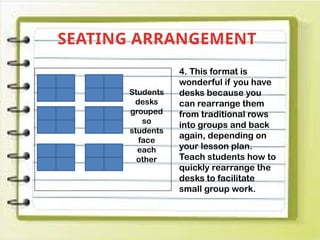
Students
desks
grouped
so
students
face
each
other
4. This format is
wonderful if you have
desks because you
can rearrange them
from traditional rows
into groups and back
again, depending on
your lesson plan.
Teach students how to
quickly rearrange the
desks to facilitate
small group work.
PHYSICAL CONDITION OF
THE CLASSROOM
 Clean rooms, hallways and surroundings are
wholesome places to stay in. the teacher should
schedule who is responsible for their neatness
on a regular basis.
 The physical environment must also be a safe
place where curious, overactive and energetic
children are always o n the go.
 During class hours proper lighting and
ventilation must be provided and maintained for
everybody’s comfort.
MANAGEMENT OF
ROUTINES
Refers to the established activities
or procedures that are repeatedly
done.
1. Teach pupils to learn how to form
various grouping and return to
standard arrangement with minimum
confusion.
2. Do not use the first few minutes of
the class session to collect materials
when students are potentially most
alert to instruction.
3. “Overlapping” technique is used for
collection and distribution of materials. It
refers to the teacher’s ability to attend to
the task at hand and at the same time
prevent an extraneous situation from
getting out of control.
4. Prepare for transition by planning distinct
types and sequences of teacher- pupil activity
e.g. checking homework assignment,
presentation of new material, giving
assignment, monitoring seatwork. Transition
should be quick and quiet.
MANAGEMENT OF
RELATIONSHIP
This refers to emotional climate and
communications affecting learning
conditions.
1. Maintain positive climate characteristics
which allow students to choose a variety
of activities to achieve common goals.
2. Develop sense of interdependence,
common bonds, defined group
expectations and relationship qualities
that enhance wholesome emotional
climate.
3. Develop communication
characteristics that promote
wholesome classroom relationship like
positive constructive conversations
aimed at understanding on another’s
point of view.
4 . Render different forms of assistance
by providing class meetings or students
to have an opportunity to examine the
ideas and feelings that influence value
judgment.
THANK YOU
FOR LISTENING

classroom management ppt1-160220142609.pptx

  • 1.
  • 4.
  • 5.
    1. Consistent, proactivediscipline is the crux of effective classroom management.  “Prevention is better than cure”, so goes the adage. If we are proactive in our approach to discipline we prevent unnecessary disciplinary problems from cropping up. We have not to wait for disciplinary problems to erupt for us to take a move.
  • 6.
    2. Establish routinesfor all daily tasks and needs.  Routinized collection of assignments, passing of papers, and preparation for experiments saves as a lot of time and effort. We have not to explain or instruct our pupils/ students on how to pass papers, collect assignments, prepare for experiments day in and day out because we have established the routines for these everyday tasks. They have become habitual for each member of the class.
  • 7.
    3. Orchestrate smoothtransitions and continuity of momentum throughout the day.  Smooth transitions and continuity of momentum throughout the day ensure us that every instructional moment is made use of wisely. No unnecessary lull is created that will breed classroom restlessness, which is the father of disciplinary problems.
  • 8.
    4. Strike abalance between variety and challenge in students’ activities.  A variety of student activities will ensure that students’ multiple intelligences and varied learning styles are considered in the conduct of student activities. Most of the time our activities fall under the word use, talking, writing will certainly challenge the linguistically intelligent students but bore the logic and math wizards and other groups of different intelligences. When boredom creeps into the classroom, we have disciplinary problems in our hands.
  • 9.
    5. As classroommanager, be aware of all actions and activities in the classroom.  Our heightened awareness of everything that is happening in our classroom puts our pupils and students on their toes all the time. While our back faces them when we write on the board, our “eyes on the back of our heads” will make our pupils and students feel that we know what they are doing. This is what Kounin calls with-it-ness.
  • 10.
    6. Resolve minorinattention and disruption before they become major disruptions.  The old adage “a stitch on time saves nine” aptly applies here. We have not to wait until our class is out of control. Misdemeanor has a “ripple effect” if not checked early. Conflagration begins with a spark. Put out the spark early enough to avoid conflagration. We ought to respond to inappropriate behavior promptly.
  • 11.
    7. Reinforce positivebehavior  Be generous with genuine praise. Some teachers are quite stingy with praise. These are the teachers who think will become less when they praise others. They have the so-called “subtraction mentality.” Other teachers are overgenerous with their praise. Their praises overflow so much that they give praise even when is not appropriate. For our praise to be genuine it must be given according to merit. It is our way of appreciating and recognizing hard work and good behavior.
  • 12.
    8. Treat minordisturbance calmly.  “Do not make a mountain out of a mole.” If a stern look or gesture can kill the inappropriate behavior so be it. That’s the end period! Let us not make a fuss about it.
  • 13.
    9. Work outa physical arrangement of chairs that facilitates an interactive teaching-learning process.  There is no doubt that external environment affects us. The most common arrangement of tables and chair in the classroom is one where the teachers’ table and chairs are in front and the student’s desk or chairs are arranged in rows facing the teacher. This seat arrangement does not always enhance interaction among students. Let us work for a flexible seating arrangement where we can re-arrange seats or desk to suit our learning needs and conditions.
  • 14.
    10. Make gooduse of every instructional moment. Minimize discipline time to maximize instructional time.
  • 15.
  • 16.
  • 17.
    Time is ofthe essence in learning. How much students learn depends upon the amount of time they spend in learning. The impact of time however on achievement is influenced also by the quality of instruction and the learning tasks. No matter what amount of time is spent, no learning takes place if there is poor instruction and poorly devised learning tasks. It is observed that classes where students are occupied with learning activities, where time is managed properly, learn more.
  • 18.
    HERE ARE SOMERESEARCH-BASED EFFECTIVE TECHNIQUES TO MAKE WISE ALL OF TIME: Orchestrate smooth classroom transitions.  Remain involved with the students during the entire class period allowing for no idle time.  Use fillers, in case you finish the lesson ahead of time. Examples of fillers are reciting a favorite stanza then letting others explain the meaning or conducting a short contest about the lesson.
  • 19.
     Use acommon place to keep materials such as scissors, school supplies. This saves time. You have not to look for them when you need them.  Follow a consistent schedule and maintain the procedures and routines established at the beginning of the year.  Prepare materials in advance. Make clear and smooth transitions. Limit disruptions and interruptions through appropriate behavioral management technique. Cont…
  • 20.
    FOR QUALITY OUTPUTWITHIN AN ALLOTTED PERIOD, HERE ARE SOME SUGGESTIONS:  Schedule all activities with corresponding time allotment way ahead of time. Early preparations could avoid haste and confusion.  Provide enough time for everything you expect to happen.  Avoid rushing since you know you have carefully allotted required time for every activity. Quality may suffer.  Anticipate difficulties or failure of some operations in order to be able to pursue alternative actions.
  • 21.
     Be flexiblewith time assignments. If students are observed to be so interested and eager to continue working, allow a little more time for them to complete and achieve the objectives with satisfaction.  Set the example by showing that you are time- conscious. They will develop the same precision regarding time utilization. Cont…
  • 22.
  • 23.
    Discipline is controlledbehavior. It constitutes the next important concern of teachers as part of good management. No matter how well-managed a learning environment is, students will occasionally misbehave. Teachers must be ready to deal with them with utmost care and consideration.
  • 24.
    SOME CAUSES OFDISCIPLINARY PROBLEMS  Unfavorable learning conditions -The classroom may not be conducive to learning if it is: • overcrowded with more than the regular number of students to a class. • with poor lighting facilities and inadequate ventilation. • with furniture and storage cabinets disorderly positioned, making the collection and retrieval of tools less efficient. • with inappropriate seating arrangement such that distractions can easily occur • near sources of noise which obstruct understanding of the lesson.
  • 25.
     Teacher’s poormanagement skills - The teachers’ lack of adequate knowledge and skills in handling occurrences of misbehavior likewise contribute to a trouble- prone setting.  Students’ varied background - The students bring to the classroom a surprising record of individual attitudes, interests and abilities. Said characteristics could be traced from their differences in: a) family background, b) physical and mental capacities, and c) emotional traits among others.
  • 26.
    HOW TO PREVENTDISCIPLINE PROBLEMS To prevent discipline problems, teachers can:  implement group-oriented methodologies such as: 1) cooperative learning approach, 2) team learning, 3) peer tutoring, and 4) group projects and collections.  use varied teaching techniques  develop patience, compassion, genuine respect and care for the students.
  • 27.
    Schools differ inhow they achieve and maintain good discipline. Following are some common practices. 1. Discipline is the students’ responsibility. If they misbehave, the teacher accepts no excuses. They must be ready for the consequences. 2. Discipline is the teachers’ way of establishing a desirable student- oriented environment for learning. 3. Discipline is coupled with effective teaching strategies and techniques. 4. Discipline is achieved through the effects of group dynamics on behavior. 5. Discipline is believed to be the exclusive responsibility of the teachers.
  • 28.
    WAYS OF DEALINGWITH DISCIPLINE PROBLEMS ACCEPTABLE AND EFFECTIVE: 1. Use verbal reinforcers that encourage good behavior and discourage bad tendencies. 2. Use nonverbal gestures, frown or a hard look to dissuade them from mischiefs. 3. Dialogues can help in discovering problems and agreeing on mutually beneficial solutions 4. Focus attention on one who is unruly and is about to disturb the neighbors.
  • 29.
    5. Award meritsfor good behavior and demerits for inconsistencies and lapses. 6. A private one-on- one brief conference can lead to a better understanding of mistakes that need to be remedied or improved. 7. Give students the free to express or explain agitated feelings and misgivings rather than censure them right away.
  • 30.
    UNACCEPTABLE AND INEFFECTIVE: 1.Scolding and harsh words as a reprimand will have a negative effect on the entire class. 2. Nagging and faultfinding, together with long “sermons” are repugnant and nasty. 3. keeping a student in a “detention area” during or after classes as a penalty for misbehavior is a waste of time and occasion for learning. The shameful experience is not easy to forget. 4. Denying a student some privileges due to unnecessary hyperactivity can all the more encourage repetitions.
  • 31.
    5.Assignment of additionalhomework compared to the rest can make them dislike the subject. 6.Use of ridicule or sarcasm could humiliate and embarrass a student. 7.Grades for academic achievement should not be affected due to misdemeanor.
  • 32.
  • 33.
    FURNITURE ARRANGEMENT  Furnituresuch as chairs and tables for demonstrations or displays must be positioned appropriately.  Exhibit shelves are either permanently pinned to the wall or are made to stand at the sides.  White board for writing and clarifying lesson discussions, together with bulletin boards, are available for posting important messages and outstanding pieces of students work, art and illustrations.
  • 34.
    SEATING ARRANGEMENT Below aresome sample seating arrangements: Students in rows face front of classroom (door is in back of room) Door 1. Traditional rows in columns are ideal for establishing classroom management. This arrangement allows students to focus on you when you are lecturing or teaching routines and procedures. It is great for direct instruction.
  • 35.
    SEATING ARRANGEMENT Students face center of classroom 2.Position student desks so that they face the center when you are facilitating classroom discussions. The outer area is ideal for skits, role playing, and student demonstrations. It creates a friendlier atmosphere and can be used in lieu of traditional rows.
  • 36.
    SEATING ARRANGEMENT Students at tables facefront of room 3. Situate chairs around tables so that students do not have their backs facing you. When it is time for small group activities, they can move their chairs to face each other. This arrangement is ideal for cooperative learning activities. Be aware that seating students in groups invites dialogue, which is great if that is your purpose.
  • 37.
    SEATING ARRANGEMENT Students desks grouped so students face each other 4. Thisformat is wonderful if you have desks because you can rearrange them from traditional rows into groups and back again, depending on your lesson plan. Teach students how to quickly rearrange the desks to facilitate small group work.
  • 38.
    PHYSICAL CONDITION OF THECLASSROOM  Clean rooms, hallways and surroundings are wholesome places to stay in. the teacher should schedule who is responsible for their neatness on a regular basis.  The physical environment must also be a safe place where curious, overactive and energetic children are always o n the go.  During class hours proper lighting and ventilation must be provided and maintained for everybody’s comfort.
  • 39.
  • 40.
    Refers to theestablished activities or procedures that are repeatedly done. 1. Teach pupils to learn how to form various grouping and return to standard arrangement with minimum confusion. 2. Do not use the first few minutes of the class session to collect materials when students are potentially most alert to instruction.
  • 41.
    3. “Overlapping” techniqueis used for collection and distribution of materials. It refers to the teacher’s ability to attend to the task at hand and at the same time prevent an extraneous situation from getting out of control. 4. Prepare for transition by planning distinct types and sequences of teacher- pupil activity e.g. checking homework assignment, presentation of new material, giving assignment, monitoring seatwork. Transition should be quick and quiet.
  • 42.
  • 43.
    This refers toemotional climate and communications affecting learning conditions. 1. Maintain positive climate characteristics which allow students to choose a variety of activities to achieve common goals. 2. Develop sense of interdependence, common bonds, defined group expectations and relationship qualities that enhance wholesome emotional climate.
  • 44.
    3. Develop communication characteristicsthat promote wholesome classroom relationship like positive constructive conversations aimed at understanding on another’s point of view. 4 . Render different forms of assistance by providing class meetings or students to have an opportunity to examine the ideas and feelings that influence value judgment.
  • 46.