• ..DownloadsTeachers Make a Difference.flv
• ..VideosWhat do students expect from
  teachers_.flv
• ..VideosWhat Does It Take 2 Be An Effective
  Teacher_.flv
Instructional
                    Management


Cecilia C. Manago Advance Administration and Supervision Date
What is instructional management?

          • Instructional management
            is essentially equated with
            classroom management.
          • It deals with both
            procedural and curricular
            components.
• Classroom management means
  you have the expertise to
  organize teaching and learning
  situations in order to enhance
  maximum learning experiences
  for the students.
What are procedural components?

         • Procedural components are
           non-content but are processes
           that are determined to
           enhance learning, such as
           classroom order and discipline,
           and the like.
What are curricular components?

         Curricular components
          refer to content or the
          topics to be learned.
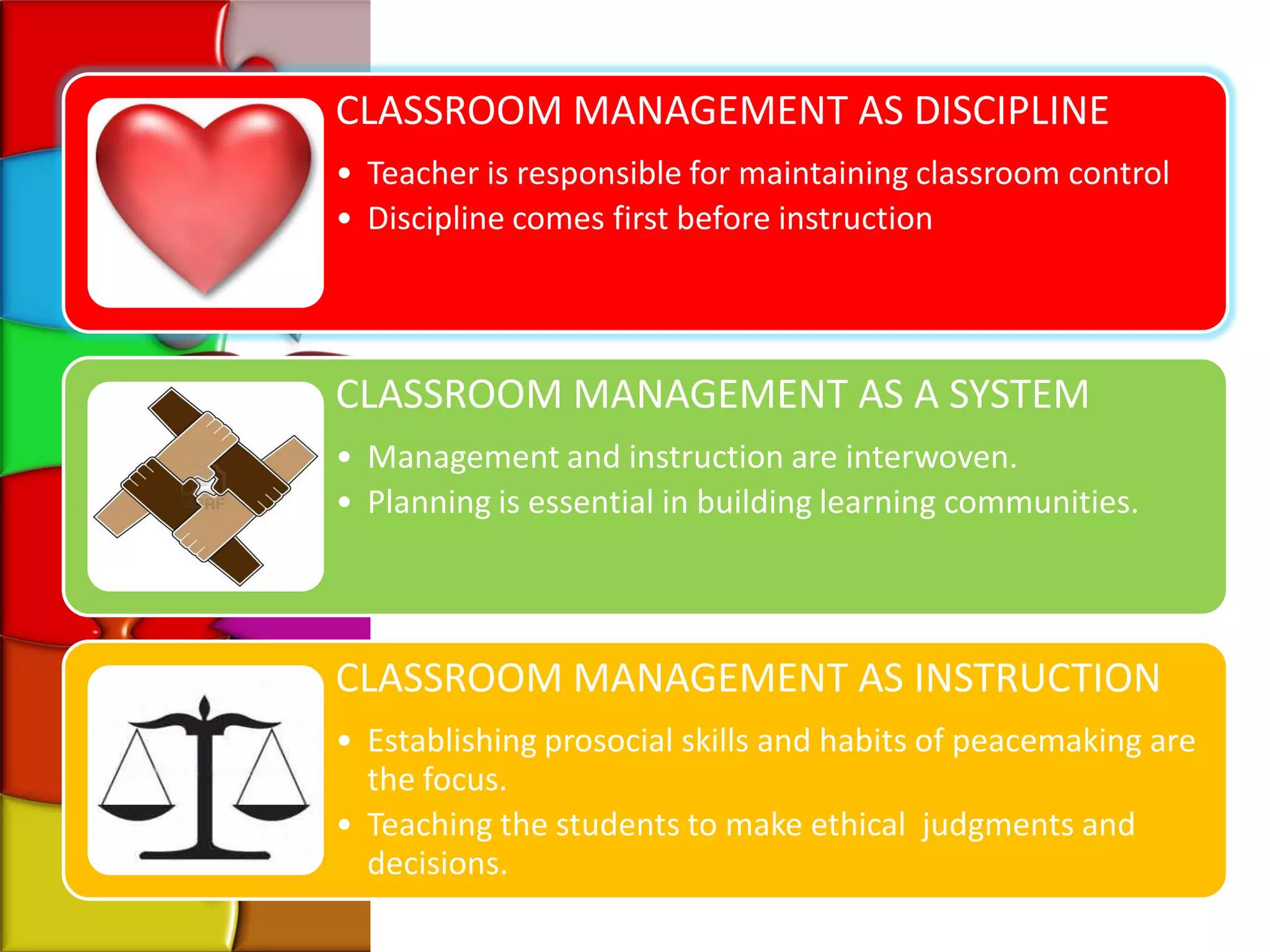
CLASSROOM MANAGEMENT AS DISCIPLINE
• Teacher is responsible for maintaining classroom control
• Discipline comes first before instruction


CLASSROOM MANAGEMENT AS A SYSTEM
• Management and instruction are interwoven.
• Planning is essential in building learning communities.


CLASSROOM MANAGEMENT AS INSTRUCTION
• Establishing prosocial skills and habits of peacemaking are
  the focus.
• Teaching the students to make ethical judgments and
  decisions.
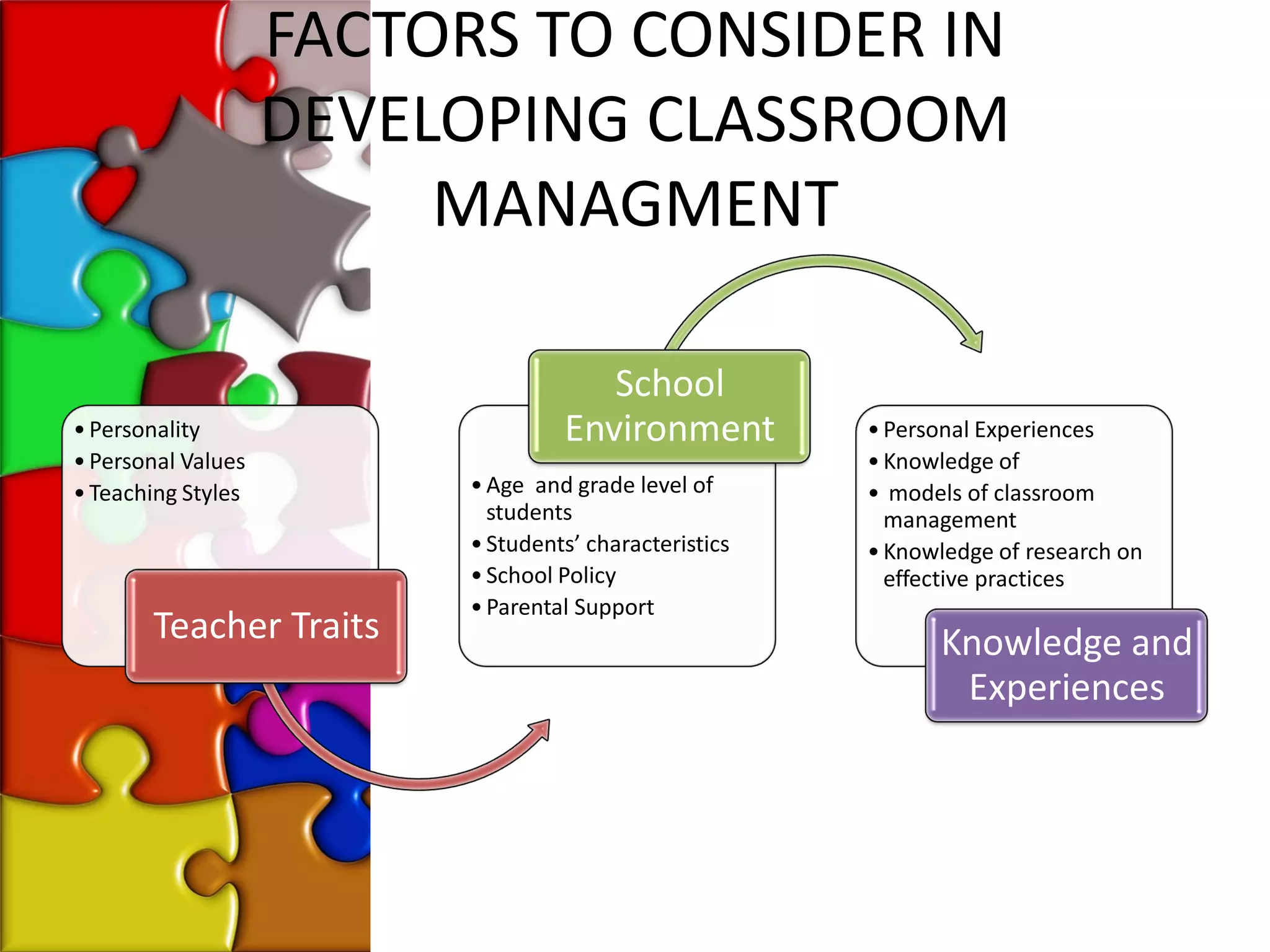
FACTORS TO CONSIDER IN
                    DEVELOPING CLASSROOM
                         MANAGMENT

                                      School
• Personality                      Environment          • Personal Experiences
• Personal Values                                       • Knowledge of
• Teaching Styles         • Age and grade level of      • models of classroom
                            students                      management
                          • Students’ characteristics   • Knowledge of research on
                          • School Policy                 effective practices
                          • Parental Support
       Teacher Traits                                         Knowledge and
                                                               Experiences
Principle No. 1.

• Principle of Clarity and
  Mastery of Content.
Principle No. 2

• Principle of Involvement.
Principle No. 3

• Principle of Democratic
  Behavior.
Principle No. 4

• Principle of Teacher
  Behavior.
Principle No. 4

• Principle of Democratic
  Behavior.
Principle No. 5

• Principle of Self-Control.
Principle No. 6

• Principle of flexibility.
Principle No. 7

• Principle of Personal
  Attributes.
Factors Influencing Classroom
         Management
Behavior Modification Technique.
        • The most fundamental assumption
          behind behavior modification among
          students is that student behavior is
          directly influenced by teacher
          behavior. Your job as teacher is to
          identify desirable undesirable student
          behavior,     and    reward      those
          demonstrating desirable behavior
          while ignoring if not punishing those
          demonstrating undesirable behavior.
          Over time, this would lead to effective
          management of instruction.
Student Responsibility
   •   Us teachers feel that students should be
       responsible for their behavior, a logical expectation
       but has to be enhanced. To do so, we must make
       the students aware that they have to respond
       positively to expectations of others and that they
       must be responsible for their shortcomings. This
       technique      advocates    self-discipline   among
       students, which implies that as teachers we
       understand their problems and concerns and that
       we can provide help whenever this becomes
       necessary. Another concern of ours is to provide
       opportunities for open lines of communication with
       the students. Students respond more positively to
       teachers who demonstrate willingness to give
       students opportunities to assume more
       responsibility toward improving their performance.
Group Activities
• Group performance is influenced by
  peers, and students working together
  would demonstrate better cooperation
  in order to gain recognition for their
  group rather than for an individual.
  Your responsibility as a teacher under
  this condition is to provide group
  activities that would enhance a more
  friendly and competitive learning
  environment for groups of students.
Skill in Maintaining Students’
          Attention.
       • As teachers, you always monitor the
         classroom actuations of your students. The
         main reason for this is to show that you’re
         sensitive to your students’ needs. How do
         you monitor such activities? Some traditional
         techniques include seating arrangements,
         variation of voice, movements in the
         classroom, refocusing attention during
         teaching, and a host of other practices.
         Always guard against creating monotonous
         environment. When a monotonous situation
         happens, inject humour to break the
         monotony
         create a lively environment. Humour is much
         more desirable if it is related to the lesson
         being learned.
1. An effective teacher describes
  rules more completely and
  implement them more
  systematically. Therefore, be
  more explicit about the
  desirable behaviour that you
  expect. You can do this by giving
  specific do’s and don’ts.
2. Monitor student compliance
with rules consistently. When
needed, intervene and correct
inappropriate behaviour by
providing appropriate
feedback.
•     3. Present information clearly,
    give directions, state objectives,
    and break down complex tasks
    into smaller and more easily
    manageable parts. Give precise
    and clear instructions as to
    what the students should do.
4. Waste little time in
organizing and transition to the
next activity. An activity should
be appropriately related to the
next lesson.
Ways to Promote Positive
Classroom Management
• 1. Provide stimulating and
  appropriate learning
  environment taking into
  account students’ personal
  interests and learning styles.
2. Use a variety of instructional
strategies in the classroom and
use novelty to break the
monotony.
3. Allow students to generate
needed guidelines for proper
classroom conduct. This should
build self-confidence among
students and would also increase
their ability to learn
autonomously. The guidelines that
students come up with normally
would enable them to become
more responsible for their work.
• Treat students with respect and
  kindness. Express concern for
  students’ welfare, and provide
  opportunities for them to
  succeed in class activities.
Secrets of Classroom
   Management
By: McNeil and Wiles (1990)
• 1. Show a caring attitude towards the
  students.
• 2. Listen to the students when they
  tell you their concerns and
  viewpoints.
• 3. Use as many first names as you can.
• 4. Try to be positive in your attitude
  and approach.
• 5. Cultivate a friendly but respectful
  relationship with the students.
• 5. Cultivate a friendly but respectful
  relationship with the students.
• 6. Know your students properly.
• 7. Be on time and start the class
  immediately. Have something for
  students to do.
• 8. Have a lesson plan and inform the
  students the way the lesson will
  progress.
• 9. Apply the rules consistently.
• 10. Vary the types of classroom
  activities.
• 11. Prepare assignments that are
  appropriate for your students.

Instructional Supervision

  • 1.
    • ..DownloadsTeachers Makea Difference.flv • ..VideosWhat do students expect from teachers_.flv • ..VideosWhat Does It Take 2 Be An Effective Teacher_.flv
  • 2.
    Instructional Management Cecilia C. Manago Advance Administration and Supervision Date
  • 3.
    What is instructionalmanagement? • Instructional management is essentially equated with classroom management. • It deals with both procedural and curricular components.
  • 4.
    • Classroom managementmeans you have the expertise to organize teaching and learning situations in order to enhance maximum learning experiences for the students.
  • 5.
    What are proceduralcomponents? • Procedural components are non-content but are processes that are determined to enhance learning, such as classroom order and discipline, and the like.
  • 6.
    What are curricularcomponents? Curricular components refer to content or the topics to be learned.
  • 8.
    CLASSROOM MANAGEMENT ASDISCIPLINE • Teacher is responsible for maintaining classroom control • Discipline comes first before instruction CLASSROOM MANAGEMENT AS A SYSTEM • Management and instruction are interwoven. • Planning is essential in building learning communities. CLASSROOM MANAGEMENT AS INSTRUCTION • Establishing prosocial skills and habits of peacemaking are the focus. • Teaching the students to make ethical judgments and decisions.
  • 9.
    FACTORS TO CONSIDERIN DEVELOPING CLASSROOM MANAGMENT School • Personality Environment • Personal Experiences • Personal Values • Knowledge of • Teaching Styles • Age and grade level of • models of classroom students management • Students’ characteristics • Knowledge of research on • School Policy effective practices • Parental Support Teacher Traits Knowledge and Experiences
  • 11.
    Principle No. 1. •Principle of Clarity and Mastery of Content.
  • 12.
    Principle No. 2 •Principle of Involvement.
  • 13.
    Principle No. 3 •Principle of Democratic Behavior.
  • 14.
    Principle No. 4 •Principle of Teacher Behavior.
  • 15.
    Principle No. 4 •Principle of Democratic Behavior.
  • 16.
    Principle No. 5 •Principle of Self-Control.
  • 17.
    Principle No. 6 •Principle of flexibility.
  • 18.
    Principle No. 7 •Principle of Personal Attributes.
  • 19.
  • 26.
    Behavior Modification Technique. • The most fundamental assumption behind behavior modification among students is that student behavior is directly influenced by teacher behavior. Your job as teacher is to identify desirable undesirable student behavior, and reward those demonstrating desirable behavior while ignoring if not punishing those demonstrating undesirable behavior. Over time, this would lead to effective management of instruction.
  • 27.
    Student Responsibility • Us teachers feel that students should be responsible for their behavior, a logical expectation but has to be enhanced. To do so, we must make the students aware that they have to respond positively to expectations of others and that they must be responsible for their shortcomings. This technique advocates self-discipline among students, which implies that as teachers we understand their problems and concerns and that we can provide help whenever this becomes necessary. Another concern of ours is to provide opportunities for open lines of communication with the students. Students respond more positively to teachers who demonstrate willingness to give students opportunities to assume more responsibility toward improving their performance.
  • 28.
    Group Activities • Groupperformance is influenced by peers, and students working together would demonstrate better cooperation in order to gain recognition for their group rather than for an individual. Your responsibility as a teacher under this condition is to provide group activities that would enhance a more friendly and competitive learning environment for groups of students.
  • 29.
    Skill in MaintainingStudents’ Attention. • As teachers, you always monitor the classroom actuations of your students. The main reason for this is to show that you’re sensitive to your students’ needs. How do you monitor such activities? Some traditional techniques include seating arrangements, variation of voice, movements in the classroom, refocusing attention during teaching, and a host of other practices. Always guard against creating monotonous environment. When a monotonous situation happens, inject humour to break the monotony create a lively environment. Humour is much more desirable if it is related to the lesson being learned.
  • 31.
    1. An effectiveteacher describes rules more completely and implement them more systematically. Therefore, be more explicit about the desirable behaviour that you expect. You can do this by giving specific do’s and don’ts.
  • 32.
    2. Monitor studentcompliance with rules consistently. When needed, intervene and correct inappropriate behaviour by providing appropriate feedback.
  • 33.
    3. Present information clearly, give directions, state objectives, and break down complex tasks into smaller and more easily manageable parts. Give precise and clear instructions as to what the students should do.
  • 34.
    4. Waste littletime in organizing and transition to the next activity. An activity should be appropriately related to the next lesson.
  • 35.
    Ways to PromotePositive Classroom Management
  • 36.
    • 1. Providestimulating and appropriate learning environment taking into account students’ personal interests and learning styles.
  • 37.
    2. Use avariety of instructional strategies in the classroom and use novelty to break the monotony.
  • 38.
    3. Allow studentsto generate needed guidelines for proper classroom conduct. This should build self-confidence among students and would also increase their ability to learn autonomously. The guidelines that students come up with normally would enable them to become more responsible for their work.
  • 39.
    • Treat studentswith respect and kindness. Express concern for students’ welfare, and provide opportunities for them to succeed in class activities.
  • 40.
    Secrets of Classroom Management By: McNeil and Wiles (1990)
  • 41.
    • 1. Showa caring attitude towards the students. • 2. Listen to the students when they tell you their concerns and viewpoints. • 3. Use as many first names as you can. • 4. Try to be positive in your attitude and approach. • 5. Cultivate a friendly but respectful relationship with the students.
  • 42.
    • 5. Cultivatea friendly but respectful relationship with the students. • 6. Know your students properly. • 7. Be on time and start the class immediately. Have something for students to do. • 8. Have a lesson plan and inform the students the way the lesson will progress. • 9. Apply the rules consistently. • 10. Vary the types of classroom activities. • 11. Prepare assignments that are appropriate for your students.