Classroom Management for
                 Teaching Artists

Creating a Learning Environment

                  With
                  Harlan Brownlee
                  www.ArtsInEducation.net


Copyright S. Harlan Brownlee: No copying or other reproduction of this work allowed without the express written permission of the author, ©2012
A Case Study-Pair/Share
– A Contagious Situation
   • In what ways has Ms. Cornell planned for her classroom in
     advance? In what ways has she not planned?

   • Why are Eli, Jake, and Vanessa so disruptive right from the start?
     Can you think you think of possible reasons related to how Ms.
     Cornell has begun the school year? Can you think of possible
     reasons related to the activities related to the activities Ms. Cornell
     has planned?

   • Why does the misbehavior of the three problem students continue?
     Why does it spread to the other students in the classroom? Why is
     it particularly common during downtimes in the school day? Can
     you answer these questions based on your own personal experience
     and observations?
                                                        www.ArtsInEducation.net
Possible Reasons
• Ms. Cornell has identified her instructional
  objectives and developed numerous lesson
  plans and activities that should help her
  students accomplish those objectives. But
  she has not developed a plan for creating
  and maintaining an environment conducive
  to learning.


                                    www.ArtsInEducation.net
Possible Reasons
• Ms. Cornell begins the curriculum she has planned on the
  very first day of school, before students have had a chance to
  settle in and fell comfortable in their new classroom.
  Teachers should typically begin the school year with easy,
  enjoyable tasks that allow a pleasant and supportive
  classroom climate to be established
• Ms. Cornell may be presenting especially difficult material
  and tasks. Students are more likely to misbehave when they
  are asked to do things that are probably too difficult for them
• Ms. Cornell does not set limits regarding classroom
  behavior.


                                                 www.ArtsInEducation.net
Possible Reasons
• The students have pent-up energy that needs to be released
  – an unmet physiological need.
• It’s possible that Ms. Cornell’s expectations for
  performance are unclear, generating anxiety for the
  students.
• The students don’t see the relevance of classroom subject
  matter to their own lives (motivation).
• The students don’t believe that they are capable of being
  successful at classroom tasks and activities (i.e., they have
  low self-efficacy) because they have had a string of
  failures in previous years. When students attribute their
  failures in a particular activity to a lack of ability, they are
   unlikely to exert effort in that activity.
                                                   www.ArtsInEducation.net
Possible Reasons
• The three students are being reinforced for such behavior
  by the attention they are getting from their classmates.
• Ms. Cornell is doing nothing to dissuade them from
  behaving as they do. Other students may be starting to
  behave in a similar fashion either because of vicarious
  reinforcement (Eli, Jake, and Vanessa are getting a lot of
  attention from peers) or because of the nonoccurrence of
  expected punishment (something that is actually
  reinforcing)
• The misbehavior may be especially common during down
  times because there is little going on to keep students’
  attention focused on academic endeavors or to reinforce
  them for appropriate behavior.
                                               www.ArtsInEducation.net
Creating an Environment Conducive to Learning

• Arranging the classroom
  – Spatial arrangement
  – Student arrangement
• Creating an effective classroom climate
  – Mood / Music
• Setting limits
  – Rules / Reinforcement / Consistency


                                      www.ArtsInEducation.net
Creating an Environment Conducive to Learning
• Planning activities that keep students on task
  – Challenging/ but not too difficult
  – Differentiated Learning
• Monitoring what students are doing
  – Withitness
• Modifying instructional strategies when
  necessary
  – Improvising when necessary
  – Like the actor – reading your audience and
    adjusting
                                         www.ArtsInEducation.net
Creating an Environment Conducive to Learning
• Overlapping
   – Doing more than one thing at a time
      • Cueing a student about inappropriate behavior while
        simultaneously conducting a lesson
• Smoothness & momentum
   – Moving through a lesson from one activity to another
     smoothly and with unnecessary pauses or slow-downs
      • Directing questions to potentially disruptive students
• Group alerting
   – Keeping all student attentive and involved in classroom
     activities
      • Asking all student to respond in unison to a question
      • Calling on any student at any time – no hand raising
                                                         www.ArtsInEducation.net
Creating an Environment Conducive to Learning
• Be honest with students
   – Teachers and students alike should express their beliefs
     and feelings openly and candidly.
• Communicate acceptance
   – Students should believe their teacher accepts and
     respects them as valued and worthwhile human beings,
     despite any mistakes or shortcomings they may have.
• Be empathic
   – Teachers should try to see the world through students’
     eyes and attempt to understand students’ individual
     perspective and needs. They should be understanding
     and supportive rather than critical and judgmental.
                                               www.ArtsInEducation.net
Learning Activity
• Develop a short list of rules that a teacher at
  the elementary or secondary (groups choice)
  might use to start out the year.

• Develop several good activities for getting
  students actively engaged on the first day of
  school.


                                     www.ArtsInEducation.net
Effective Classroom Management Strategies
• Ms. Schutz describes three major
  assignments that students in her literature
  class must complete during the semester,
  and together she and her students come to
  an agreement about a reasonable due date
  for each assignment.
• Effective – This strategy gives students a
  sense of control over their classroom life
  and thereby promotes intrinsic motivation.

                                    www.ArtsInEducation.net
Effective Classroom Management Strategies
• When Mr. Dembrowski must take a few
  minutes to help Stacey with a difficult math
  problem, he turns his chair so that he can
  simultaneously watch his other students
  working quietly at their desks.
• Effective – Ideally, a teacher should be able
  to see what all students are doing at all
  times.


                                    www.ArtsInEducation.net
Effective Classroom Management Strategies
• Ms. Smith’s middle school social studies
  students know that when they first get to
  class, they should take out their journals and
  write their reactions to a news event
  described either in yesterday’s newspaper or
  on last night local television news program.
• Effective – This procedure gives students
  something to do during a transition time.


                                     www.ArtsInEducation.net
Strategies for Dealing with Student Misbehavior

• Ignoring
  –   Behavior unlikely to be repeated
  –   Behavior unlikely to spread
  –   Unusual circumstances trigger the behavior
  –   Behavior does not seriously interfere with
      learning
• Cueing
  – Behavior is a minor infraction but interferes
    with learning
  – Behavior likely to change with subtle reminder
                                        www.ArtsInEducation.net
Strategies for Dealing with Student Misbehavior

• Private discussion
  – Cueing has been ineffective
  – Reasons for behavior might suggest
    strategies for change
• Promoting self-regulation
  – Student has a strong desire to improve
    behavior


                                   www.ArtsInEducation.net
Strategies for Dealing with Student Misbehavior

• Behaviorist approaches (reinforcement)
  – Behavior has continued over time and
    significantly interferes with learning
  – Student seems unwilling or unable to self-
    regulate
• Parent Conference
  – Source of problem may lie outside of school
  – Parents probably willing to collaborate


                                       www.ArtsInEducation.net
Dealing with Student Misbehavior
• Pair/Share Activity


                        www.ArtsInEducation.net
Dealing with Student Misbehavior
• Mr. Marzetta notices that Janie is doodling
  in her notebook during his explanation of
  the water cycle. He is surprised to find her
  doing so, because she is a good student who
  always performs well on assignments and
  quizzes.
• Ignoring: Janie’s behavior does not appear
  to be interfering with her learning.


                                   www.ArtsInEducation.net
Dealing with Student Misbehavior
• At the end of art class, Eric is so busy
  talking to someone else that he has
  forgotten to clean his pottery wheel.

• Cueing: Eric simply needs a reminder
  about appropriate behavior.


                                     www.ArtsInEducation.net
Dealing with Student Misbehavior
• Although Jerri willingly completes tasks that she can
  do at her desk or in small cooperative groups, she
  consistently refuses when Mr. Jones asks her to do
  anything that involves speaking in front of the entire
  class.
• Private discussion; Jerri seems motivated to do well
  in school, as evidenced by her willingness to complete
  other tasks. Yet repeated cueing has not produced a
  change in her attitude toward public speaking tasks.
  By talking privately with Jerri, Mr. Jones may be able
  to find out why she balks at such tasks.
                                          www.ArtsInEducation.net
Dealing with Student Misbehavior
• Missy clicks her ballpoint pen constantly during class,
  to the point where the students around her are being
  distracted and annoyed. Over the past few weeks, Ms.
  Givens has repeatedly asked Missy to stop the
  behavior, but it continues unabated. Missy tells her
  teacher, “I know I should stop, Ms. Givens, but most
  of the time I don’t even realize I’m doing it.”
• Self-regulation. Missy is motivated to change her
  behavior. Ms. Givens might have Missy begin with
  self-monitoring, recording each click she catches
  herself making.
                                          www.ArtsInEducation.net
Dealing with Student Misbehavior
• Heidi is physically aggressive toward her classmates whenever
  things don’t go her way. Elliot has talked with her about her
  behavior several times but has seen little improvement in her
  behavior. Heidi seems to have little interest in changing how
  she interacts with other students.
• A behaviorist approach: Heidi’s behavior is interfering with
  school activities and is potentially jeopardizing the safety of
  others. Cueing hasn’t worked, and Heidi isn’t motivated to
  change on her own. Mr. Elliott might try to extinguish or
  punish aggressive behavior (e.g., with time-out) and then teach
  and reinforce more appropriate behaviors. He might also try to
  determine if aggressive behavior serves some purpose for Heidi
  and, if so, teach her alternative ways of satisfying her needs.

                                                 www.ArtsInEducation.net
Dealing with Student Misbehavior
• Ms. Schweck finds Andrew sleeping in her class
  two or three times a week. When she speaks with
  Andrew about the problem, he tells her that he
  really enjoys her class and wishes he could stay
  awake. He says that he often has trouble falling
  asleep at night and so is quite tired in school the
  following day.
• Parent conference: A private discussion with the
  student has been ineffective, and the source of the
  problem appears to lie outside school walls.

                                         www.ArtsInEducation.net
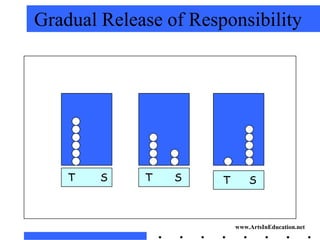
Gradual Release of Responsibility


    T   S    T   S     T       S


                           www.ArtsInEducation.net
Example Activity
• Hand sculptures
  – Ground rules
• Body Twister
  – Ground rules
• Function following Form
  – Engaging imagination
• Form following Function
  – Working within structure


                               www.ArtsInEducation.net
Reflection
• What classroom management strategies did
  I incorporate into the previous activity?

• Which strategies discussed and reviewed
  today will you be able to utilize in your
  classroom and in what manner?


                                    www.ArtsInEducation.net

Classroom Management for Teaching Artists - Creating a Learning Environment

  • 1.
    Classroom Management for Teaching Artists Creating a Learning Environment With Harlan Brownlee www.ArtsInEducation.net Copyright S. Harlan Brownlee: No copying or other reproduction of this work allowed without the express written permission of the author, ©2012
  • 2.
    A Case Study-Pair/Share –A Contagious Situation • In what ways has Ms. Cornell planned for her classroom in advance? In what ways has she not planned? • Why are Eli, Jake, and Vanessa so disruptive right from the start? Can you think you think of possible reasons related to how Ms. Cornell has begun the school year? Can you think of possible reasons related to the activities related to the activities Ms. Cornell has planned? • Why does the misbehavior of the three problem students continue? Why does it spread to the other students in the classroom? Why is it particularly common during downtimes in the school day? Can you answer these questions based on your own personal experience and observations? www.ArtsInEducation.net
  • 3.
    Possible Reasons • Ms.Cornell has identified her instructional objectives and developed numerous lesson plans and activities that should help her students accomplish those objectives. But she has not developed a plan for creating and maintaining an environment conducive to learning. www.ArtsInEducation.net
  • 4.
    Possible Reasons • Ms.Cornell begins the curriculum she has planned on the very first day of school, before students have had a chance to settle in and fell comfortable in their new classroom. Teachers should typically begin the school year with easy, enjoyable tasks that allow a pleasant and supportive classroom climate to be established • Ms. Cornell may be presenting especially difficult material and tasks. Students are more likely to misbehave when they are asked to do things that are probably too difficult for them • Ms. Cornell does not set limits regarding classroom behavior. www.ArtsInEducation.net
  • 5.
    Possible Reasons • Thestudents have pent-up energy that needs to be released – an unmet physiological need. • It’s possible that Ms. Cornell’s expectations for performance are unclear, generating anxiety for the students. • The students don’t see the relevance of classroom subject matter to their own lives (motivation). • The students don’t believe that they are capable of being successful at classroom tasks and activities (i.e., they have low self-efficacy) because they have had a string of failures in previous years. When students attribute their failures in a particular activity to a lack of ability, they are unlikely to exert effort in that activity. www.ArtsInEducation.net
  • 6.
    Possible Reasons • Thethree students are being reinforced for such behavior by the attention they are getting from their classmates. • Ms. Cornell is doing nothing to dissuade them from behaving as they do. Other students may be starting to behave in a similar fashion either because of vicarious reinforcement (Eli, Jake, and Vanessa are getting a lot of attention from peers) or because of the nonoccurrence of expected punishment (something that is actually reinforcing) • The misbehavior may be especially common during down times because there is little going on to keep students’ attention focused on academic endeavors or to reinforce them for appropriate behavior. www.ArtsInEducation.net
  • 7.
    Creating an EnvironmentConducive to Learning • Arranging the classroom – Spatial arrangement – Student arrangement • Creating an effective classroom climate – Mood / Music • Setting limits – Rules / Reinforcement / Consistency www.ArtsInEducation.net
  • 8.
    Creating an EnvironmentConducive to Learning • Planning activities that keep students on task – Challenging/ but not too difficult – Differentiated Learning • Monitoring what students are doing – Withitness • Modifying instructional strategies when necessary – Improvising when necessary – Like the actor – reading your audience and adjusting www.ArtsInEducation.net
  • 9.
    Creating an EnvironmentConducive to Learning • Overlapping – Doing more than one thing at a time • Cueing a student about inappropriate behavior while simultaneously conducting a lesson • Smoothness & momentum – Moving through a lesson from one activity to another smoothly and with unnecessary pauses or slow-downs • Directing questions to potentially disruptive students • Group alerting – Keeping all student attentive and involved in classroom activities • Asking all student to respond in unison to a question • Calling on any student at any time – no hand raising www.ArtsInEducation.net
  • 10.
    Creating an EnvironmentConducive to Learning • Be honest with students – Teachers and students alike should express their beliefs and feelings openly and candidly. • Communicate acceptance – Students should believe their teacher accepts and respects them as valued and worthwhile human beings, despite any mistakes or shortcomings they may have. • Be empathic – Teachers should try to see the world through students’ eyes and attempt to understand students’ individual perspective and needs. They should be understanding and supportive rather than critical and judgmental. www.ArtsInEducation.net
  • 11.
    Learning Activity • Developa short list of rules that a teacher at the elementary or secondary (groups choice) might use to start out the year. • Develop several good activities for getting students actively engaged on the first day of school. www.ArtsInEducation.net
  • 12.
    Effective Classroom ManagementStrategies • Ms. Schutz describes three major assignments that students in her literature class must complete during the semester, and together she and her students come to an agreement about a reasonable due date for each assignment. • Effective – This strategy gives students a sense of control over their classroom life and thereby promotes intrinsic motivation. www.ArtsInEducation.net
  • 13.
    Effective Classroom ManagementStrategies • When Mr. Dembrowski must take a few minutes to help Stacey with a difficult math problem, he turns his chair so that he can simultaneously watch his other students working quietly at their desks. • Effective – Ideally, a teacher should be able to see what all students are doing at all times. www.ArtsInEducation.net
  • 14.
    Effective Classroom ManagementStrategies • Ms. Smith’s middle school social studies students know that when they first get to class, they should take out their journals and write their reactions to a news event described either in yesterday’s newspaper or on last night local television news program. • Effective – This procedure gives students something to do during a transition time. www.ArtsInEducation.net
  • 15.
    Strategies for Dealingwith Student Misbehavior • Ignoring – Behavior unlikely to be repeated – Behavior unlikely to spread – Unusual circumstances trigger the behavior – Behavior does not seriously interfere with learning • Cueing – Behavior is a minor infraction but interferes with learning – Behavior likely to change with subtle reminder www.ArtsInEducation.net
  • 16.
    Strategies for Dealingwith Student Misbehavior • Private discussion – Cueing has been ineffective – Reasons for behavior might suggest strategies for change • Promoting self-regulation – Student has a strong desire to improve behavior www.ArtsInEducation.net
  • 17.
    Strategies for Dealingwith Student Misbehavior • Behaviorist approaches (reinforcement) – Behavior has continued over time and significantly interferes with learning – Student seems unwilling or unable to self- regulate • Parent Conference – Source of problem may lie outside of school – Parents probably willing to collaborate www.ArtsInEducation.net
  • 18.
    Dealing with StudentMisbehavior • Pair/Share Activity www.ArtsInEducation.net
  • 19.
    Dealing with StudentMisbehavior • Mr. Marzetta notices that Janie is doodling in her notebook during his explanation of the water cycle. He is surprised to find her doing so, because she is a good student who always performs well on assignments and quizzes. • Ignoring: Janie’s behavior does not appear to be interfering with her learning. www.ArtsInEducation.net
  • 20.
    Dealing with StudentMisbehavior • At the end of art class, Eric is so busy talking to someone else that he has forgotten to clean his pottery wheel. • Cueing: Eric simply needs a reminder about appropriate behavior. www.ArtsInEducation.net
  • 21.
    Dealing with StudentMisbehavior • Although Jerri willingly completes tasks that she can do at her desk or in small cooperative groups, she consistently refuses when Mr. Jones asks her to do anything that involves speaking in front of the entire class. • Private discussion; Jerri seems motivated to do well in school, as evidenced by her willingness to complete other tasks. Yet repeated cueing has not produced a change in her attitude toward public speaking tasks. By talking privately with Jerri, Mr. Jones may be able to find out why she balks at such tasks. www.ArtsInEducation.net
  • 22.
    Dealing with StudentMisbehavior • Missy clicks her ballpoint pen constantly during class, to the point where the students around her are being distracted and annoyed. Over the past few weeks, Ms. Givens has repeatedly asked Missy to stop the behavior, but it continues unabated. Missy tells her teacher, “I know I should stop, Ms. Givens, but most of the time I don’t even realize I’m doing it.” • Self-regulation. Missy is motivated to change her behavior. Ms. Givens might have Missy begin with self-monitoring, recording each click she catches herself making. www.ArtsInEducation.net
  • 23.
    Dealing with StudentMisbehavior • Heidi is physically aggressive toward her classmates whenever things don’t go her way. Elliot has talked with her about her behavior several times but has seen little improvement in her behavior. Heidi seems to have little interest in changing how she interacts with other students. • A behaviorist approach: Heidi’s behavior is interfering with school activities and is potentially jeopardizing the safety of others. Cueing hasn’t worked, and Heidi isn’t motivated to change on her own. Mr. Elliott might try to extinguish or punish aggressive behavior (e.g., with time-out) and then teach and reinforce more appropriate behaviors. He might also try to determine if aggressive behavior serves some purpose for Heidi and, if so, teach her alternative ways of satisfying her needs. www.ArtsInEducation.net
  • 24.
    Dealing with StudentMisbehavior • Ms. Schweck finds Andrew sleeping in her class two or three times a week. When she speaks with Andrew about the problem, he tells her that he really enjoys her class and wishes he could stay awake. He says that he often has trouble falling asleep at night and so is quite tired in school the following day. • Parent conference: A private discussion with the student has been ineffective, and the source of the problem appears to lie outside school walls. www.ArtsInEducation.net
  • 25.
    Gradual Release ofResponsibility T S T S T S www.ArtsInEducation.net
  • 26.
    Example Activity • Handsculptures – Ground rules • Body Twister – Ground rules • Function following Form – Engaging imagination • Form following Function – Working within structure www.ArtsInEducation.net
  • 27.
    Reflection • What classroommanagement strategies did I incorporate into the previous activity? • Which strategies discussed and reviewed today will you be able to utilize in your classroom and in what manner? www.ArtsInEducation.net