
by:
What is Classroom Management? 
• Classroom management is 
ways of organizing the 
resources, pupils and 
helpers so that the 
teaching and the learning 
can process in an efficient 
and safe manner.
Why is Classroom 
Management Important? 
 Satisfaction and enjoyment in teaching are 
dependent upon leading students to 
cooperate 
 Classroom management issues are of 
highest concern for beginning teachers
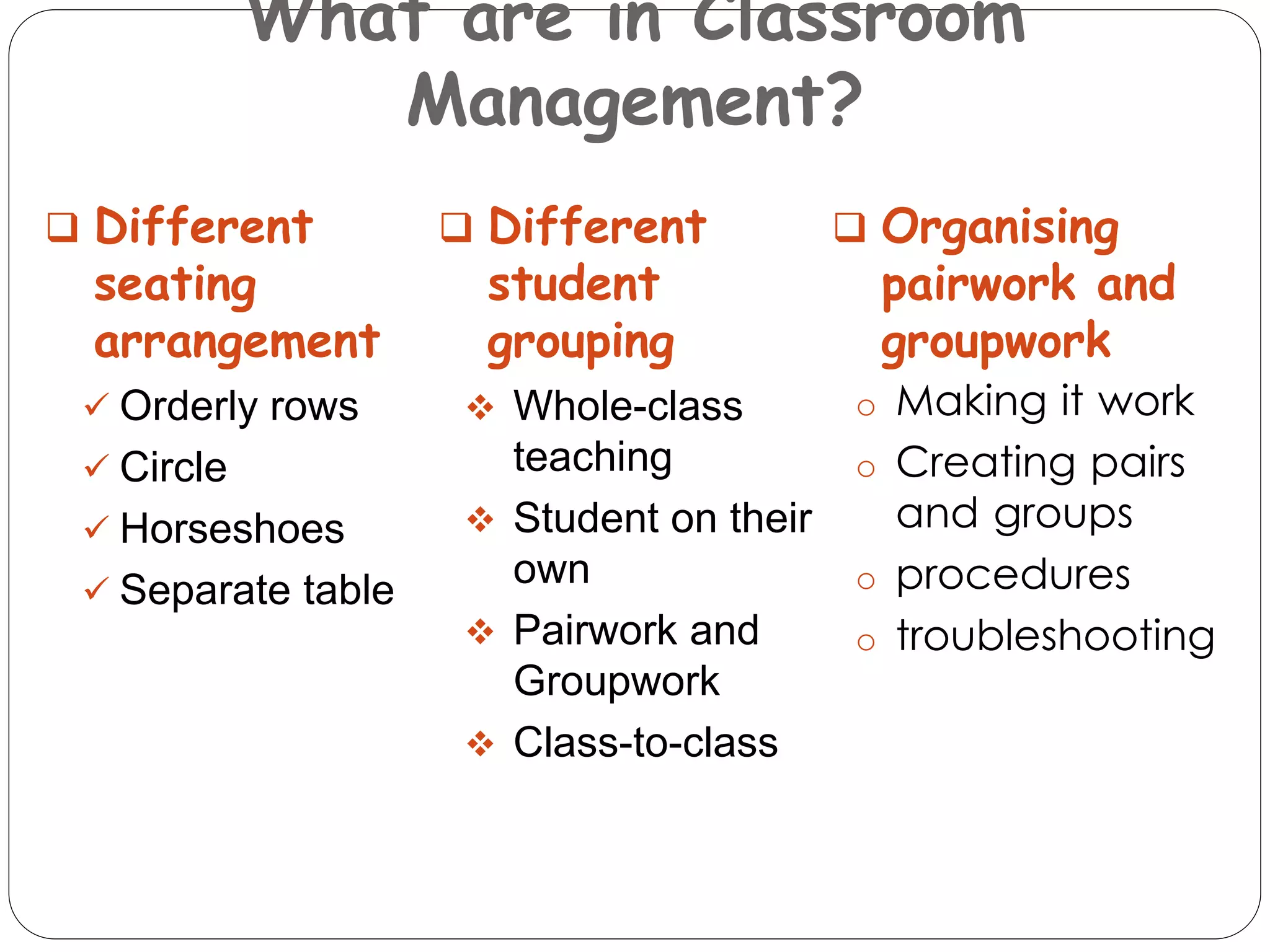
What are in Classroom 
Management? 
 Different 
seating 
arrangement 
 Orderly rows 
 Circle 
 Horseshoes 
 Separate table 
 Different 
student 
grouping 
 Whole-class 
teaching 
 Student on their 
own 
 Pairwork and 
Groupwork 
 Class-to-class 
 Organising 
pairwork and 
groupwork 
o Making it work 
o Creating pairs 
and groups 
o procedures 
o troubleshooting
Different Seating Arrangement 
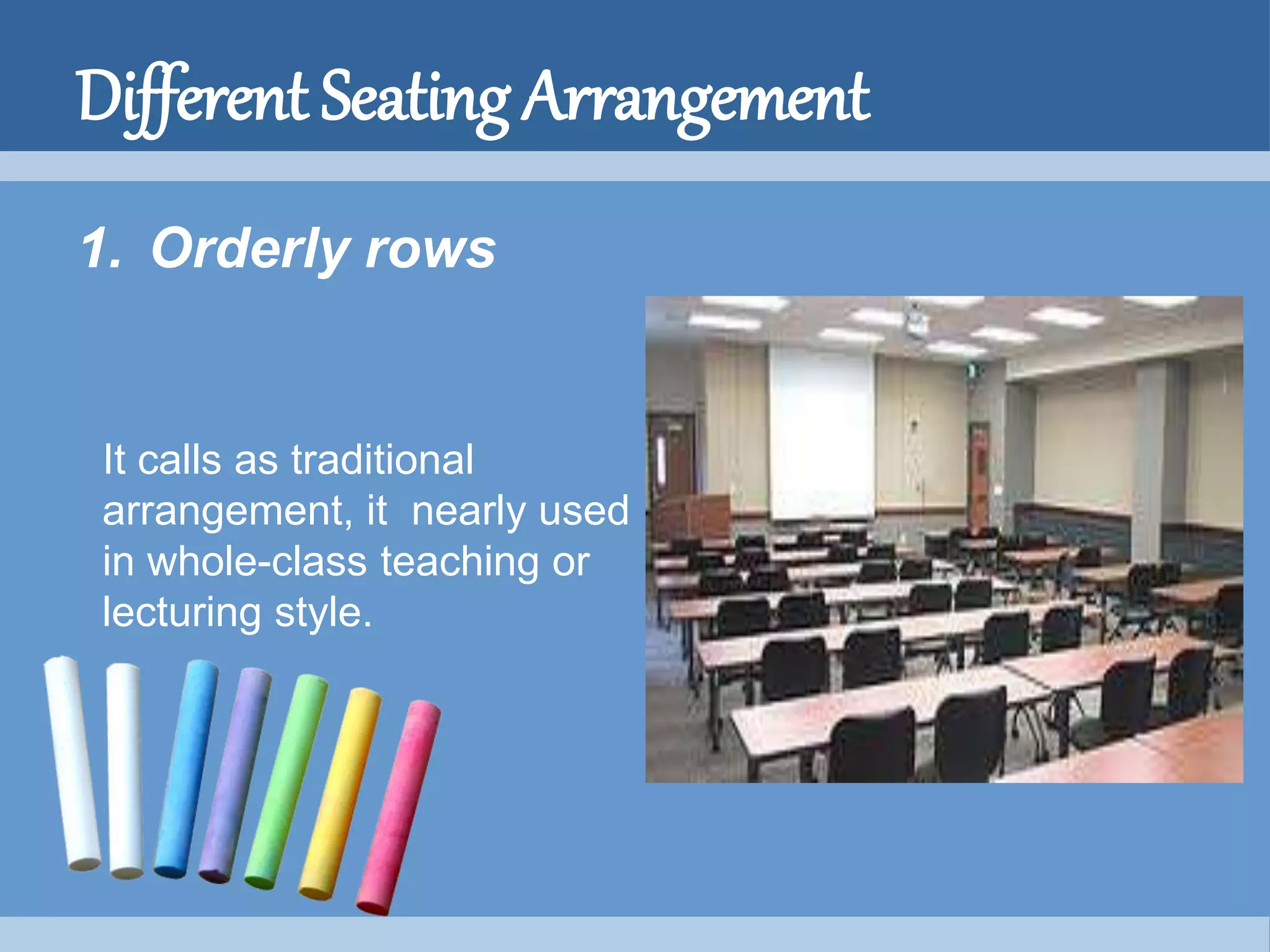
1. Orderly rows 
It calls as traditional 
arrangement, it nearly used 
in whole-class teaching or 
lecturing style.
Continue……………….!!! 
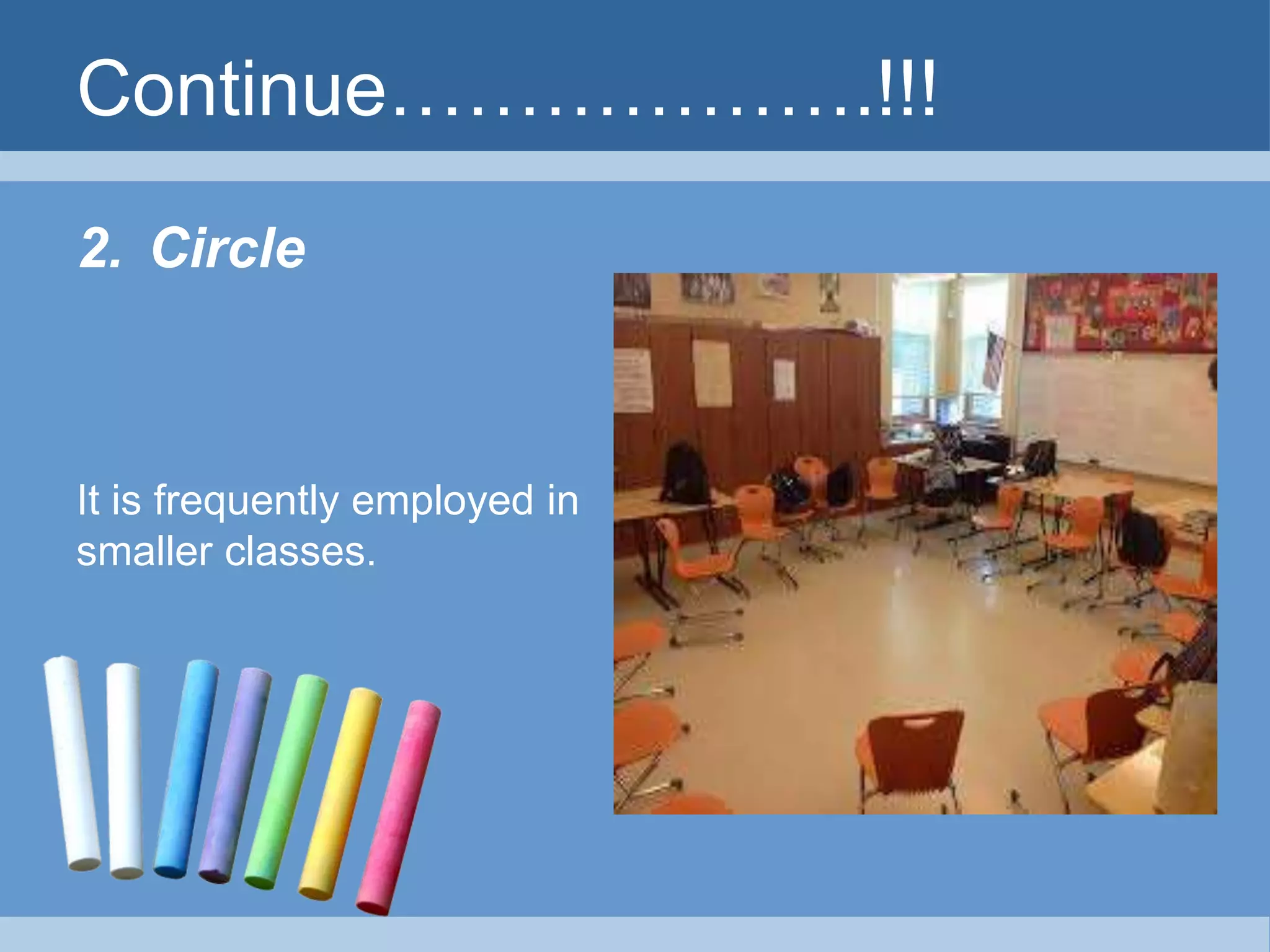
2. Circle 
It is frequently employed in 
smaller classes.
Continue……………….!!! 
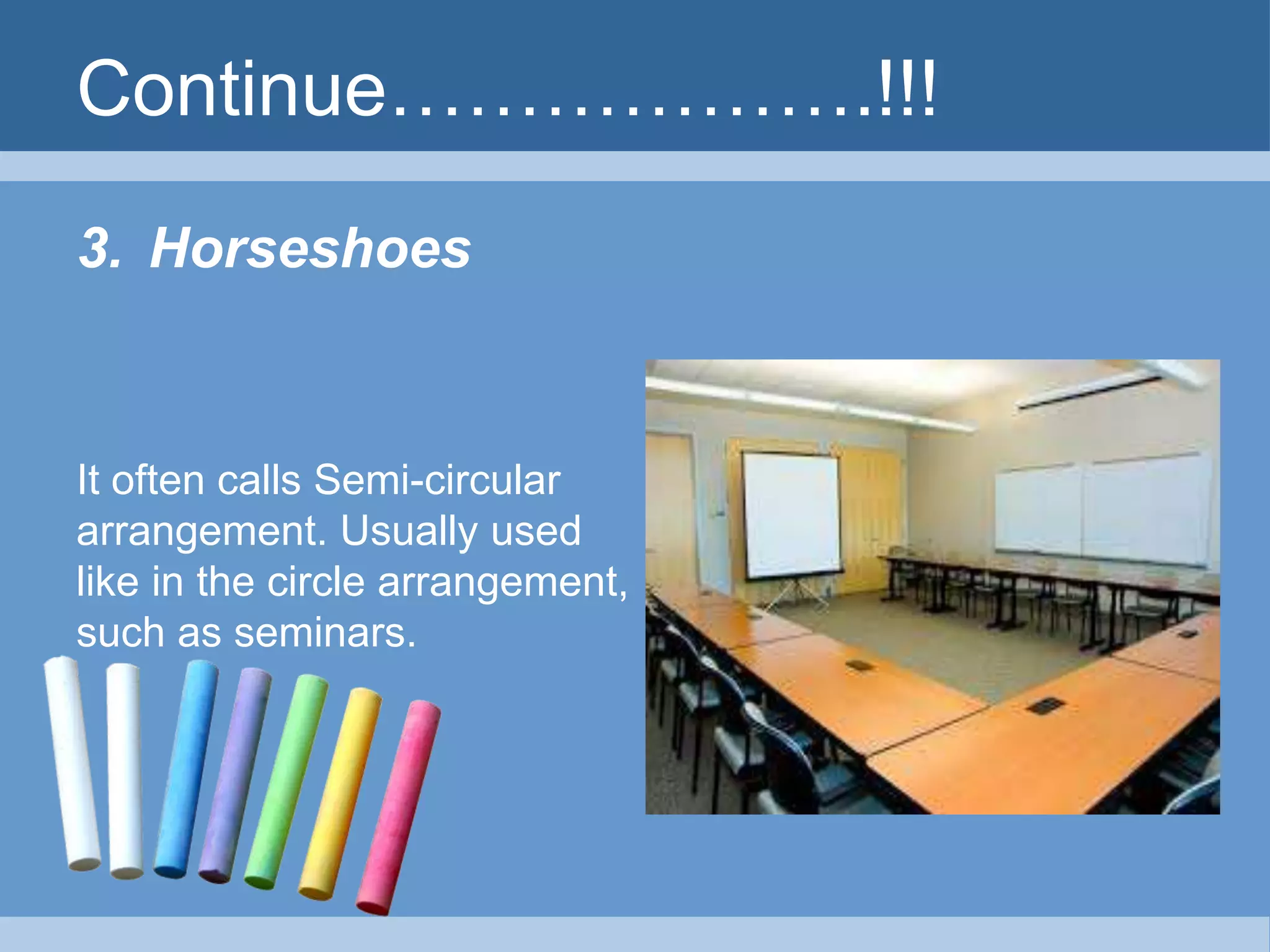
3. Horseshoes 
It often calls Semi-circular 
arrangement. Usually used 
like in the circle arrangement, 
such as seminars.
Continue……………….!!! 
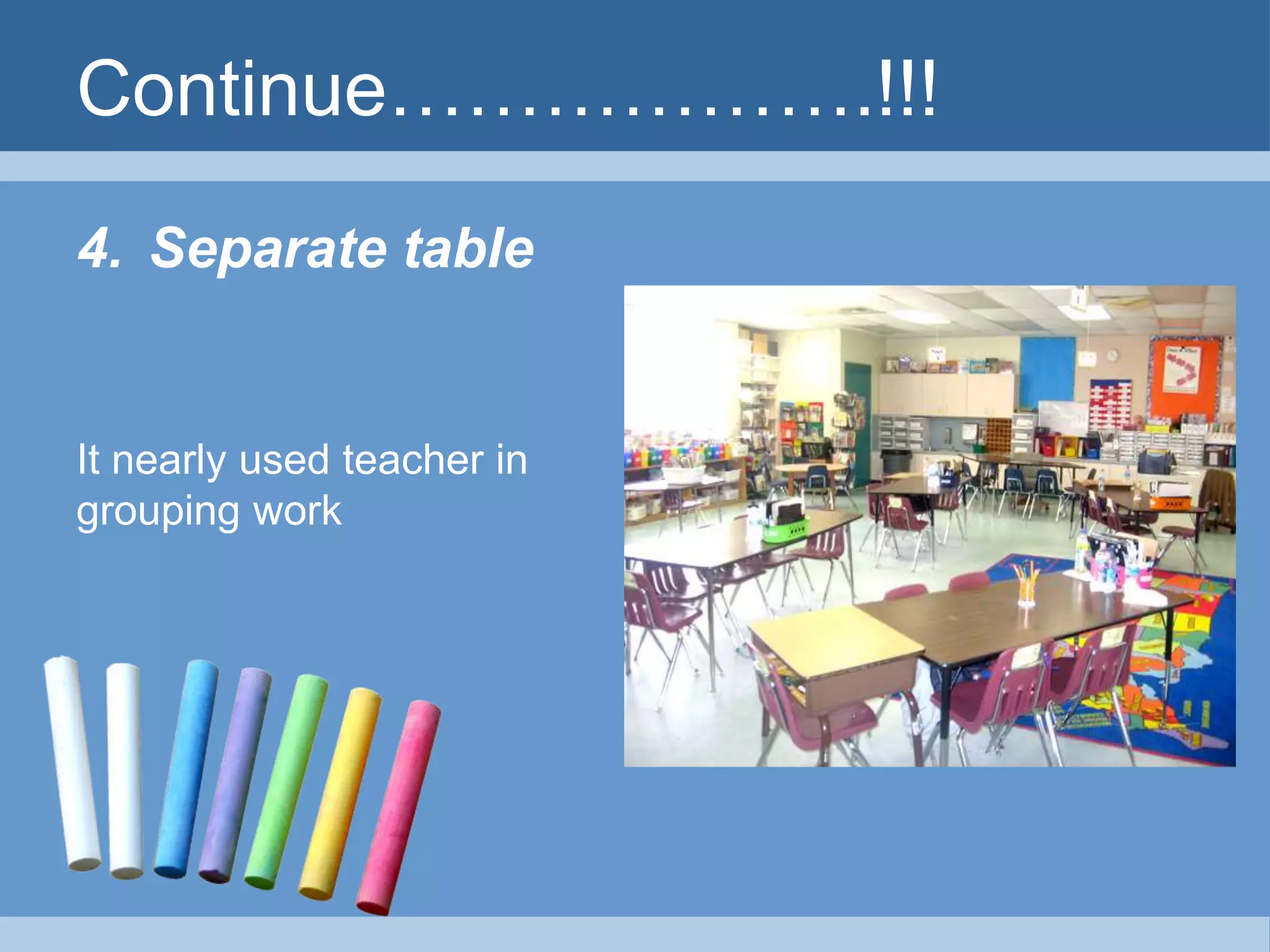
4. Separate table 
It nearly used teacher in 
grouping work
Different Student Grouping 
1) Whole class work 
is where all the student are under the control of the 
teacher. They are all doing the same activity at the 
same rhythm and pace. 
Advantages 
• It reinforces a sense of belonging among the group 
member. 
• It is suitable for activities where the teacher is acting as 
controller. 
• It allows teachers to gauge the mood of the class in general 
• It is preferred class style in many educational settings.
Continue…… 
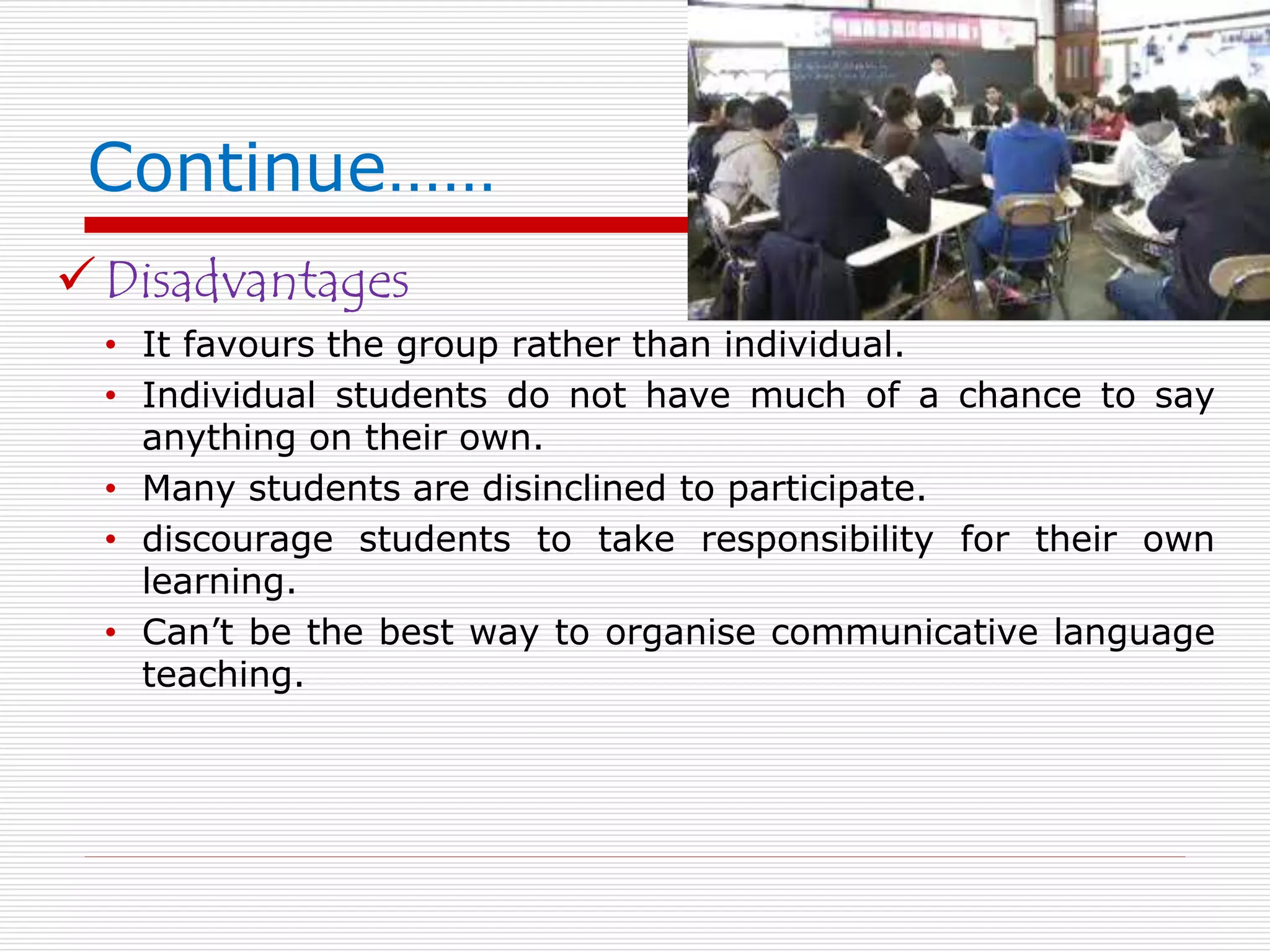
 Disadvantages 
• It favours the group rather than individual. 
• Individual students do not have much of a chance to say 
anything on their own. 
• Many students are disinclined to participate. 
• discourage students to take responsibility for their own 
learning. 
• Can’t be the best way to organise communicative language 
teaching.
Continue…… 
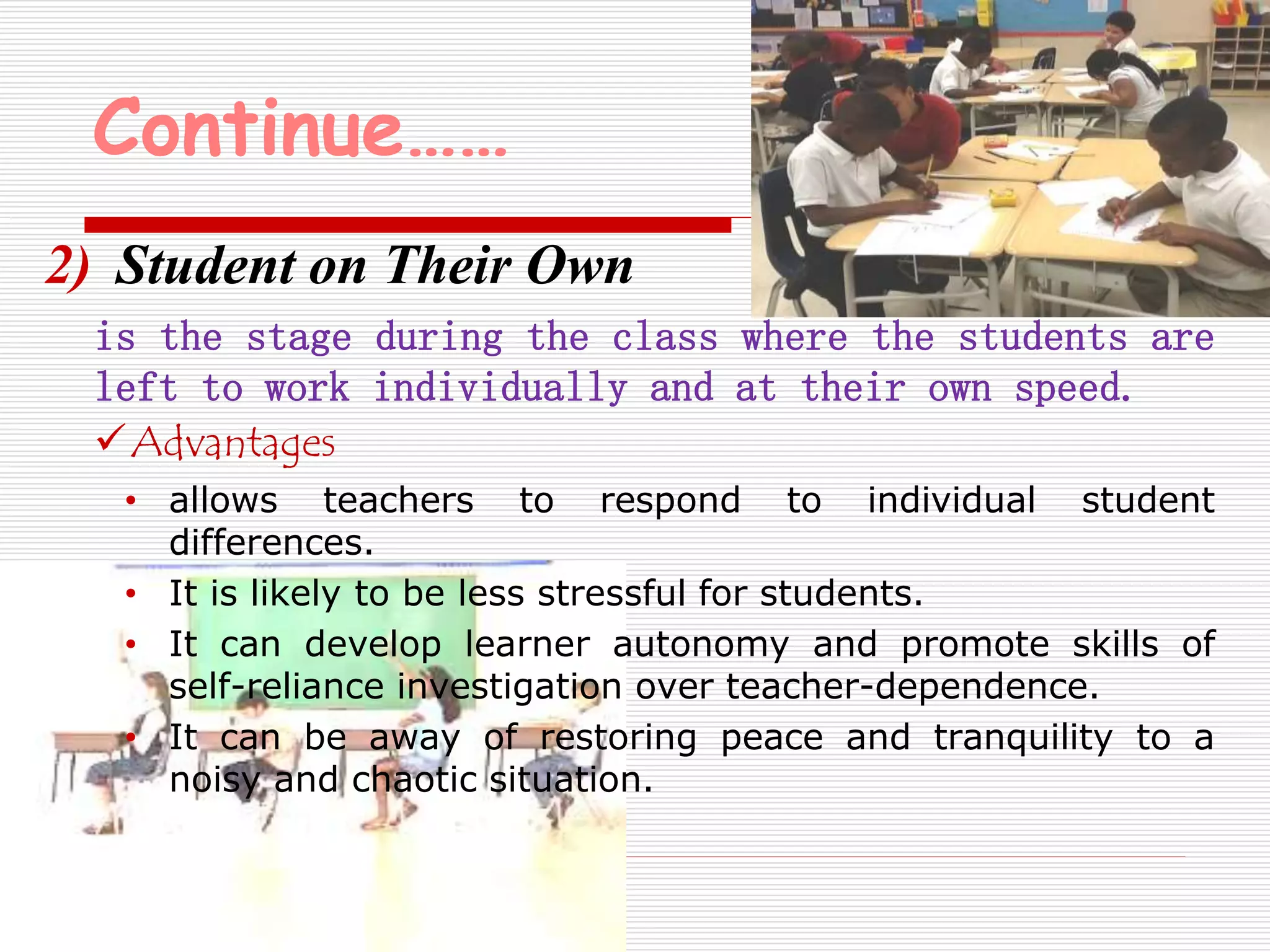
2) Student on Their Own 
is the stage during the class where the students are 
left to work individually and at their own speed. 
Advantages 
• allows teachers to respond to individual student 
differences. 
• It is likely to be less stressful for students. 
• It can develop learner autonomy and promote skills of 
self-reliance investigation over teacher-dependence. 
• It can be away of restoring peace and tranquility to a 
noisy and chaotic situation.
Continue…… 
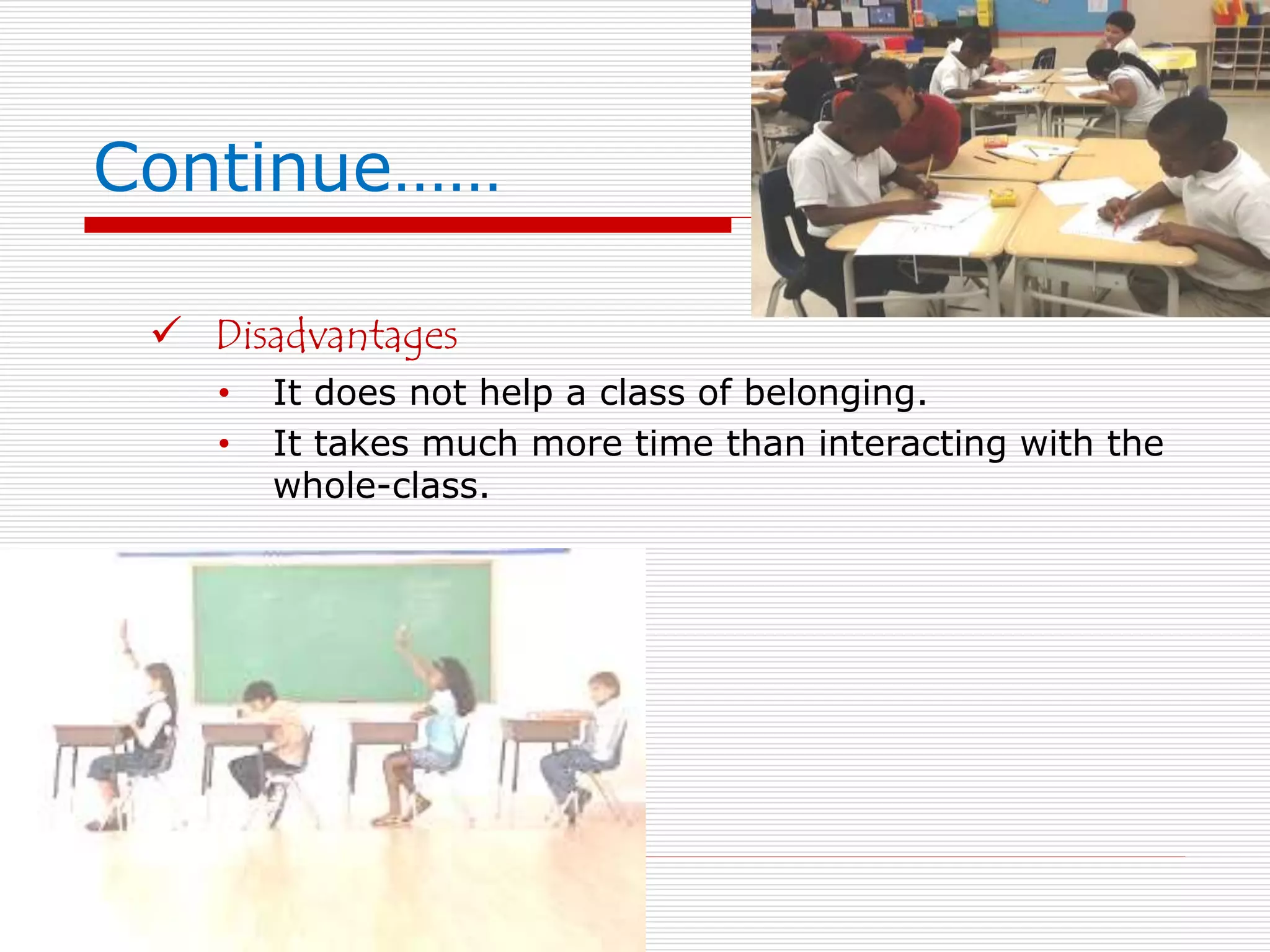
 Disadvantages 
• It does not help a class of belonging. 
• It takes much more time than interacting with the 
whole-class.
Continue…… 
3) Pairwork and Groupwork 
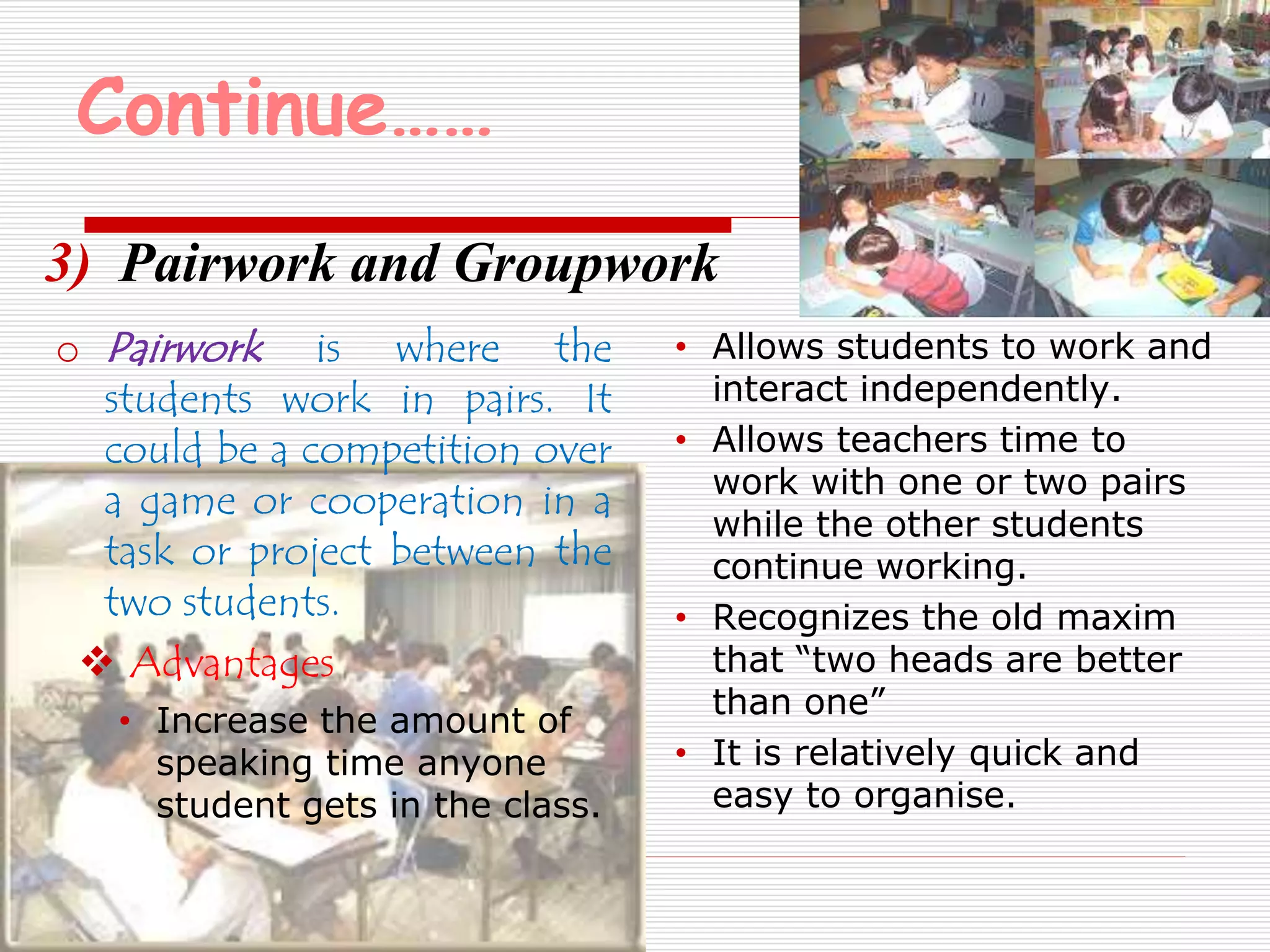
o Pairwork is where the 
students work in pairs. It 
could be a competition over 
a game or cooperation in a 
task or project between the 
two students. 
 Advantages 
• Increase the amount of 
speaking time anyone 
student gets in the class. 
• Allows students to work and 
interact independently. 
• Allows teachers time to 
work with one or two pairs 
while the other students 
continue working. 
• Recognizes the old maxim 
that “two heads are better 
than one” 
• It is relatively quick and 
easy to organise.
Continue……. 
 Disadvantages 
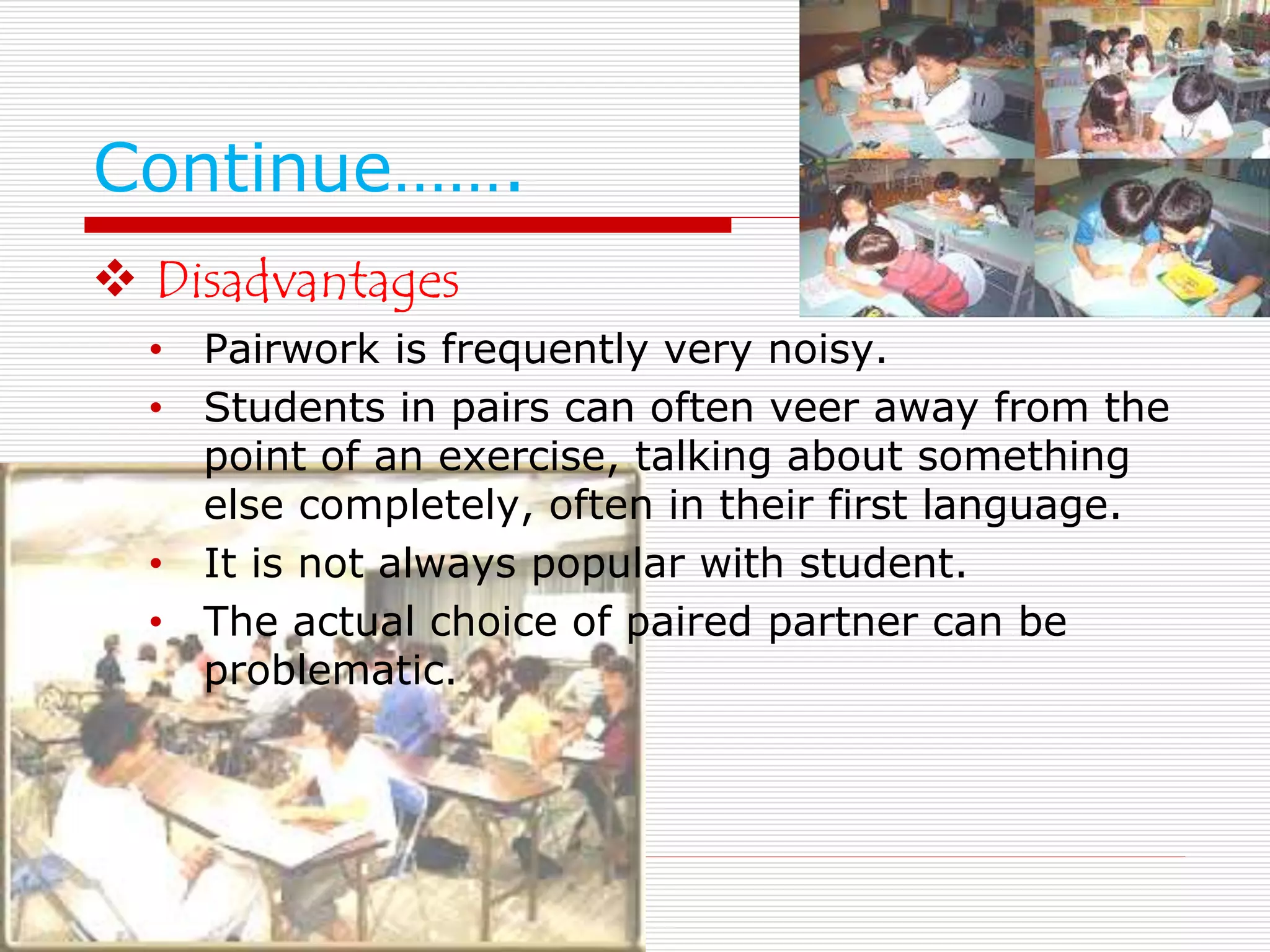
• Pairwork is frequently very noisy. 
• Students in pairs can often veer away from the 
point of an exercise, talking about something 
else completely, often in their first language. 
• It is not always popular with student. 
• The actual choice of paired partner can be 
problematic.
Continue……. 
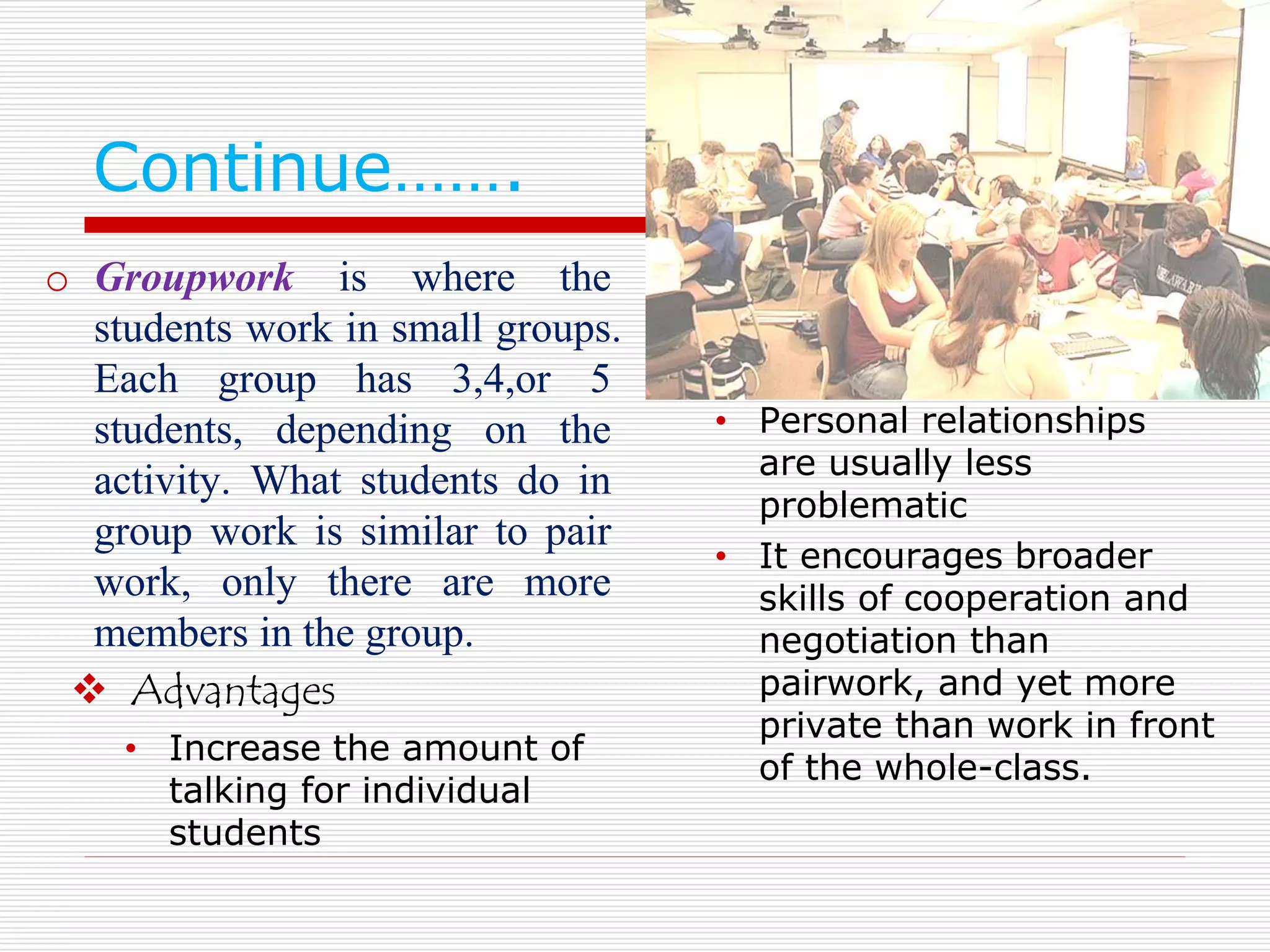
o Groupwork is where the 
students work in small groups. 
Each group has 3,4,or 5 
students, depending on the 
activity. What students do in 
group work is similar to pair 
work, only there are more 
members in the group. 
 Advantages 
• Increase the amount of 
talking for individual 
students 
• Personal relationships 
are usually less 
problematic 
• It encourages broader 
skills of cooperation and 
negotiation than 
pairwork, and yet more 
private than work in front 
of the whole-class.
Continue……. 
• It promotes learner 
autonomy by allowing 
students tomake their own 
decisions in the group 
without being told what to 
do by the teacher. 
• Some students can choose 
their level of participation 
more readily than in a 
whole-class or pairwork. 
 Disadvantages 
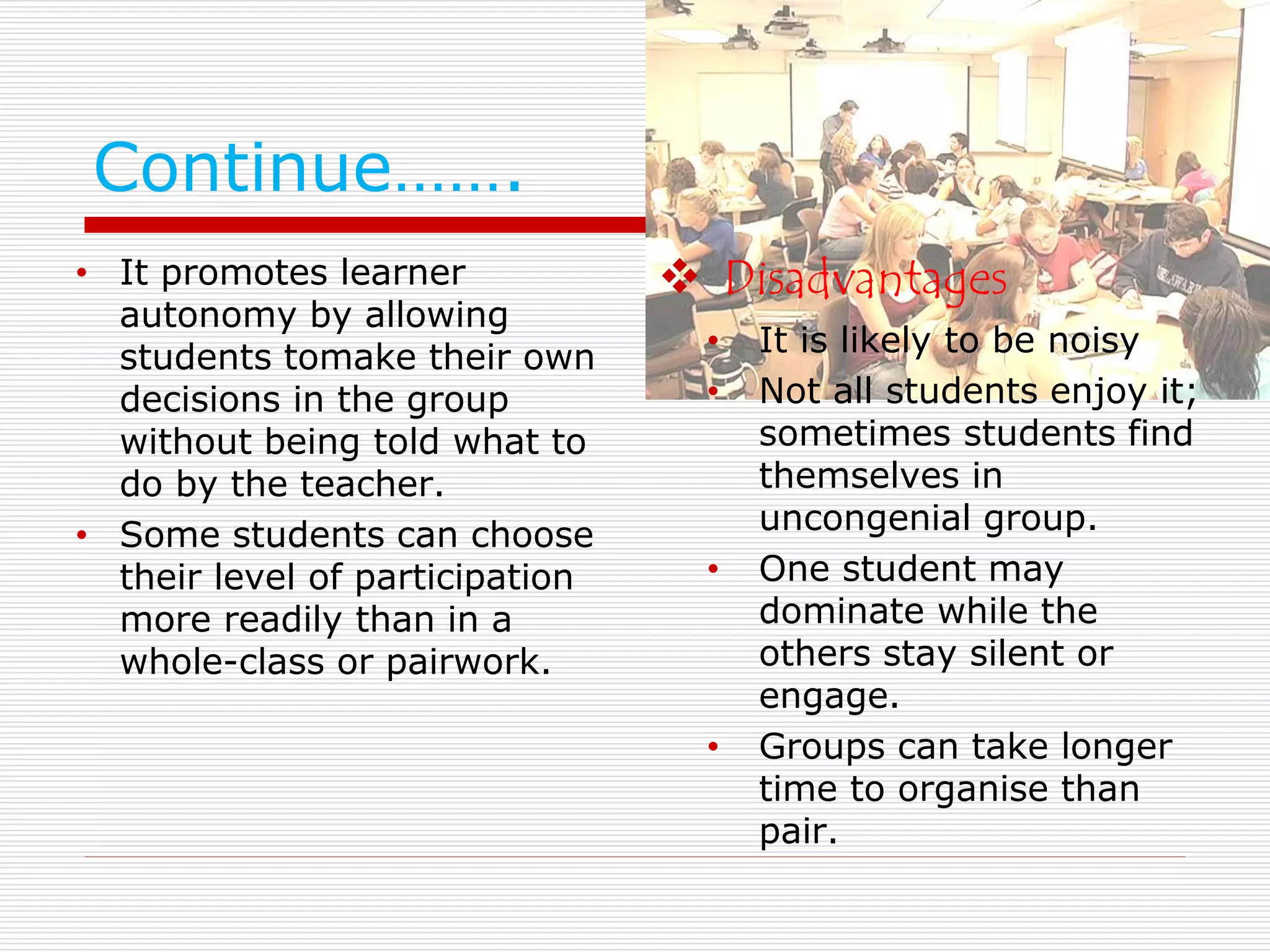
• It is likely to be noisy 
• Not all students enjoy it; 
sometimes students find 
themselves in 
uncongenial group. 
• One student may 
dominate while the 
others stay silent or 
engage. 
• Groups can take longer 
time to organise than 
pair.
Continue…… 
4) Class- to-class 
when we are able to join two classes so they 
can contact with each other.
Deciding Student 
Effected by... 
 The task 
If we want to give students a quick chance to think 
about an issue. 
 Variety in a sequence 
depends on how the activity fits in to the lesson 
sequence we have been following and are likely to follow 
next. 
 The mood 
crucial to our decision about what groupings to use is the 
mood of our number of our students.
Organising Pairwork and 
Groupwork 
A clear idea about how to resolve any 
problems that might occur, will make 
pair and group activities work run well. 
 Making it work 
 Creating pair and group 
 Procedures 
 Troubleshooting
Making it work 
One way to discuss pairwork and groupwork 
is to do a group activity with students and then, 
when it is over, ask them to write or say how 
they feel about it. 
It mean that we have to know about our 
students feeling by asking their opinion of 
different grouping that the teacher give.
How to Create Pairs and Groups??? 
We make our pairing and grouping 
decisions base on the variety of factors: 
 Friendship 
A key consideration when putting in pair or 
groups is to make sure that we put friend with 
friend. Or ask students to get into pairs or groups 
with whom they want to. 
 Streaming 
Creating our students according to their ability. 
We should have a mixture of weaker and 
stronger students.
Continue,,,…. 
 Chance 
It is for no special reasons of friendship, ability, or 
level of participation. It can be base on fun or 
because they are sitting next or near to each 
other. 
 Changing groups 
To reduce our mistake and the boredom of our 
students because we create our students pairs 
or groupings with the same partner from the 
beginning to the end.
How about the Procedure?? 
We have other matters to address when we have 
decided which students should work together, 
such as: 
ɤ Before: this is because student need to feel enthusiastic 
and about what they are going to do, and they need to 
bee given an idea of when they will have finished the task 
they are going to get involved in. 
ɤ During: while students are working in pairs or groups we 
have a number of options. Stand at the front or side of 
class and keep an eye on what is happening, noting who 
appears to be stuck or disengaged, or about to finish. 
ɤ After : when pairs and groups stop working we need to 
organise feedback.
Troubleshooting…… 
…!!! 
Keeping our eyes open for problems which we can 
resolve either on the spot or in the future. 
o Finishing first 
When some pairs or groups finish earlier than 
others, it can forces them to do something else 
while they are waiting. 
To avoid this one we have to have a series of spare 
activity handy. Then give them a short little task to 
complete while they are waiting.
Continue,,…. 
o Awkward groups 
We need to observe how well our students 
interact together. Some weak students may 
be lost when paired or grouped with better 
classmates. 
One way of finding out , is to simply observe, 
nothing down how often each student speaks
_-_The End_-_

Classroom management

  • 1.
  • 2.
    What is ClassroomManagement? • Classroom management is ways of organizing the resources, pupils and helpers so that the teaching and the learning can process in an efficient and safe manner.
  • 3.
    Why is Classroom Management Important?  Satisfaction and enjoyment in teaching are dependent upon leading students to cooperate  Classroom management issues are of highest concern for beginning teachers
  • 4.
    What are inClassroom Management?  Different seating arrangement  Orderly rows  Circle  Horseshoes  Separate table  Different student grouping  Whole-class teaching  Student on their own  Pairwork and Groupwork  Class-to-class  Organising pairwork and groupwork o Making it work o Creating pairs and groups o procedures o troubleshooting
  • 5.
    Different Seating Arrangement 1. Orderly rows It calls as traditional arrangement, it nearly used in whole-class teaching or lecturing style.
  • 6.
    Continue……………….!!! 2. Circle It is frequently employed in smaller classes.
  • 7.
    Continue……………….!!! 3. Horseshoes It often calls Semi-circular arrangement. Usually used like in the circle arrangement, such as seminars.
  • 8.
    Continue……………….!!! 4. Separatetable It nearly used teacher in grouping work
  • 9.
    Different Student Grouping 1) Whole class work is where all the student are under the control of the teacher. They are all doing the same activity at the same rhythm and pace. Advantages • It reinforces a sense of belonging among the group member. • It is suitable for activities where the teacher is acting as controller. • It allows teachers to gauge the mood of the class in general • It is preferred class style in many educational settings.
  • 10.
    Continue……  Disadvantages • It favours the group rather than individual. • Individual students do not have much of a chance to say anything on their own. • Many students are disinclined to participate. • discourage students to take responsibility for their own learning. • Can’t be the best way to organise communicative language teaching.
  • 11.
    Continue…… 2) Studenton Their Own is the stage during the class where the students are left to work individually and at their own speed. Advantages • allows teachers to respond to individual student differences. • It is likely to be less stressful for students. • It can develop learner autonomy and promote skills of self-reliance investigation over teacher-dependence. • It can be away of restoring peace and tranquility to a noisy and chaotic situation.
  • 12.
    Continue……  Disadvantages • It does not help a class of belonging. • It takes much more time than interacting with the whole-class.
  • 13.
    Continue…… 3) Pairworkand Groupwork o Pairwork is where the students work in pairs. It could be a competition over a game or cooperation in a task or project between the two students.  Advantages • Increase the amount of speaking time anyone student gets in the class. • Allows students to work and interact independently. • Allows teachers time to work with one or two pairs while the other students continue working. • Recognizes the old maxim that “two heads are better than one” • It is relatively quick and easy to organise.
  • 14.
    Continue…….  Disadvantages • Pairwork is frequently very noisy. • Students in pairs can often veer away from the point of an exercise, talking about something else completely, often in their first language. • It is not always popular with student. • The actual choice of paired partner can be problematic.
  • 15.
    Continue……. o Groupworkis where the students work in small groups. Each group has 3,4,or 5 students, depending on the activity. What students do in group work is similar to pair work, only there are more members in the group.  Advantages • Increase the amount of talking for individual students • Personal relationships are usually less problematic • It encourages broader skills of cooperation and negotiation than pairwork, and yet more private than work in front of the whole-class.
  • 16.
    Continue……. • Itpromotes learner autonomy by allowing students tomake their own decisions in the group without being told what to do by the teacher. • Some students can choose their level of participation more readily than in a whole-class or pairwork.  Disadvantages • It is likely to be noisy • Not all students enjoy it; sometimes students find themselves in uncongenial group. • One student may dominate while the others stay silent or engage. • Groups can take longer time to organise than pair.
  • 17.
    Continue…… 4) Class-to-class when we are able to join two classes so they can contact with each other.
  • 18.
    Deciding Student Effectedby...  The task If we want to give students a quick chance to think about an issue.  Variety in a sequence depends on how the activity fits in to the lesson sequence we have been following and are likely to follow next.  The mood crucial to our decision about what groupings to use is the mood of our number of our students.
  • 19.
    Organising Pairwork and Groupwork A clear idea about how to resolve any problems that might occur, will make pair and group activities work run well.  Making it work  Creating pair and group  Procedures  Troubleshooting
  • 20.
    Making it work One way to discuss pairwork and groupwork is to do a group activity with students and then, when it is over, ask them to write or say how they feel about it. It mean that we have to know about our students feeling by asking their opinion of different grouping that the teacher give.
  • 21.
    How to CreatePairs and Groups??? We make our pairing and grouping decisions base on the variety of factors:  Friendship A key consideration when putting in pair or groups is to make sure that we put friend with friend. Or ask students to get into pairs or groups with whom they want to.  Streaming Creating our students according to their ability. We should have a mixture of weaker and stronger students.
  • 22.
    Continue,,,….  Chance It is for no special reasons of friendship, ability, or level of participation. It can be base on fun or because they are sitting next or near to each other.  Changing groups To reduce our mistake and the boredom of our students because we create our students pairs or groupings with the same partner from the beginning to the end.
  • 23.
    How about theProcedure?? We have other matters to address when we have decided which students should work together, such as: ɤ Before: this is because student need to feel enthusiastic and about what they are going to do, and they need to bee given an idea of when they will have finished the task they are going to get involved in. ɤ During: while students are working in pairs or groups we have a number of options. Stand at the front or side of class and keep an eye on what is happening, noting who appears to be stuck or disengaged, or about to finish. ɤ After : when pairs and groups stop working we need to organise feedback.
  • 24.
    Troubleshooting…… …!!! Keepingour eyes open for problems which we can resolve either on the spot or in the future. o Finishing first When some pairs or groups finish earlier than others, it can forces them to do something else while they are waiting. To avoid this one we have to have a series of spare activity handy. Then give them a short little task to complete while they are waiting.
  • 25.
    Continue,,…. o Awkwardgroups We need to observe how well our students interact together. Some weak students may be lost when paired or grouped with better classmates. One way of finding out , is to simply observe, nothing down how often each student speaks
  • 26.