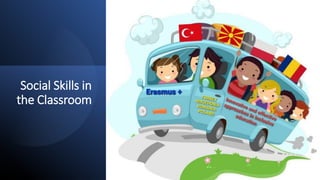
Social Skills in
the Classroom
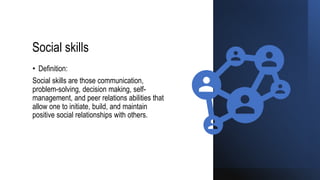
Social skills
• Definition:
Social skills are those communication,
problem-solving, decision making, self-
management, and peer relations abilities that
allow one to initiate, build, and maintain
positive social relationships with others.
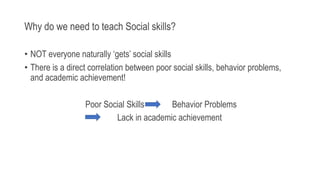
Why do we need to teach Social skills?
• NOT everyone naturally ‘gets’ social skills
• There is a direct correlation between poor social skills, behavior problems,
and academic achievement!
Poor Social Skills Behavior Problems
Lack in academic achievement
Teaching
Social Skills
• Helps us to predict the behavior of others
• Helps students take part in groups
• Helps students form friendships
• One’s social competence is linked to peer
acceptance, teacher acceptance, success of
inclusion efforts with students with disabilities,
and post school success.
When
students
lack social
skills….
• Unable to handle rejection
• Greater difficulty with relationships
• Difficulty managing their own
emotions
• Often have fewer skills for dealing
with these problems
Why don’t our
kids have
social skills?
They don’t know another way to (re)act other than
their present pattern of behavior
They know (cognitively) other ways to behave but
haven’t had enough practice to display them
competently.
They tried another way, but it didn’t work for them
the first time(s) they tried it, so they assume that it
would never work for them.
Tension and anxiety interfere with the ability to
perform the practiced behavior well in real life.

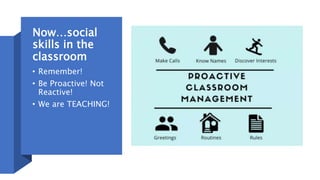
Now…social
skills in the
classroom
• Remember!
• Be Proactive! Not
Reactive!
• We are TEACHING!
What are you
teaching when
teaching social
skills?
“manners” & positive interactions with others
How to approach others in socially acceptable
ways
How to ask for permission rather than act
impulsively
How to make and keep friends
How to share toys/ materials
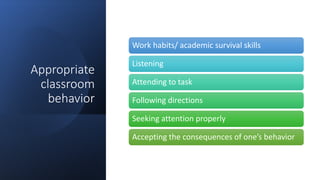
Appropriate
classroom
behavior
Work habits/ academic survival skills
Listening
Attending to task
Following directions
Seeking attention properly
Accepting the consequences of one’s behavior
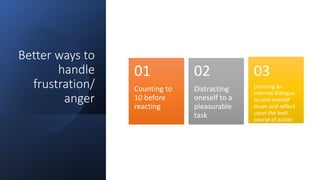
Better ways to
handle
frustration/
anger
Counting to
10 before
reacting
01
Distracting
oneself to a
pleasurable
task
02
Learning an
internal dialogue
to cool oneself
down and reflect
upon the best
course of action
03
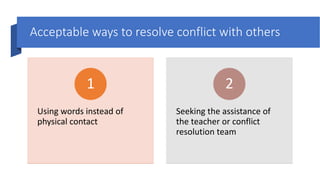
Acceptable ways to resolve conflict with others
Using words instead of
physical contact
1
Seeking the assistance of
the teacher or conflict
resolution team
2
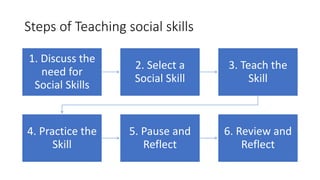
Steps of Teaching social skills
1. Discuss the
need for
Social Skills
2. Select a
Social Skill
3. Teach the
Skill
4. Practice the
Skill
5. Pause and
Reflect
6. Review and
Reflect
Strategies
FOR
TEACHING
SOCIAL
SKILLS
Discrete Trial
Incidental Teaching
Social skill Picture stories
Cognitive picture rehearsal
Structured Learning
Discrete Trial
Helpful for students with limited receptive ability
Helps students learn basic words so they can later respond to
verbal instructions and questions
Helps students attend to a task when they do not respond to
verbal instructions to pay attention
Helps students maintain eye contact, and to identify objects,
actions, or adjectives
Four components: A cue, prompt, behavior, and
reinforcement
Incidental
Teaching
Teaching a student about a social situation as it is
occurring rather than in a structured lesson
GOAL: to amplify the social environment as it is
unfolding so the student picks up on social cues, rules,
others’ feelings and perceptions that are all part of the
social situation
Must always be part of teaching social skills because it
involves teaching students in the real situations where
they need the skills
HOW: Explain to the student what is happening in a
social situation through words or visuals, and by
coaching and praising the student’s behavior.
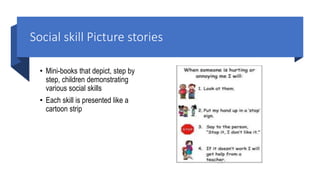
Social skill Picture stories
• Mini-books that depict, step by
step, children demonstrating
various social skills
• Each skill is presented like a
cartoon strip
Cognitive
picture
rehearsal
Utilizes cartoon-like drawings on index cards
combined with positive reinforcement principles
Students are shown the sequence of cards until
they can repeat what is happening in each picture
Sequence is reviewed just before the student
enters the potentially problematic situation
Three components of cognitive picture rehearsal
• The antecedents to a problem situation
• The targeted desired behavior
• A positive reinforcer
Structured
Learning
Four Teaching
Components
•Didactic Instruction
•Modeling of skill steps
•Role Playing skills with
feedback
•Practice in and outside the
group
Didactic
Instruction
Involves the teacher
explaining the steps of a
particular skill Verbal or
Written
The key to this approach is to
engage the child’s attention
Modeling
the skill
steps
Once the skill steps have been explained, it is
important to model them for the students before
asking them to carry them out.
To do this, the facilitator needs (a) a situation to act
out (b) co-actors. Students and teachers can serve as
co-actors to help model the skill.
Before the skill is modeled, it is important to give the
students who are observing very specific instructions
on what to look for to maintain their attention.
Role-
playing the
skill
During role-plays, students are asked to act out the
skill steps in the right order.
More effective when done with two teachers or one
teacher and two students (this way the teacher can
avoid participating in the role-play directly and act
as a coach to help students through the skill steps)
The observers of the role-play should be given
instructions to see if each step is done correctly or
not
Reviewing the
skill/ Providing
Corrective
feedback and
Practicing the
skill outside of
the classroom
• After each role play, the teacher provides
feedback about how each step was enacted.
Feedback should always begin by noting what
was performed correctly and include ample
praise. Observing students are asked to tell what
the roleplaying students did well.
• Always give corrective feedback!!!
• Practise the skill outside of the classroom
Some activities
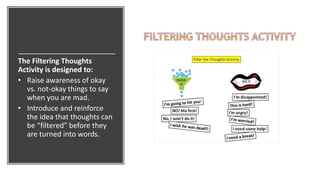
The Filtering Thoughts
Activity is designed to:
• Raise awareness of okay
vs. not-okay things to say
when you are mad.
• Introduce and reinforce
the idea that thoughts can
be “filtered” before they
are turned into words.
Compliment tag
Tell the kids: “This is Compliment Tag. A compliment is when you say something nice
to someone — about the way they look, something they have, something they did,
something they said, or they way they are. When you play Compliment Tag, the
person who is “it” tries to tag you. To keep from becoming “it,” you have to give this
person a compliment quickly before they tag you. If they tag you before you can give
them a compliment, then you are ‘it.’ ”
ARE THERE ANY
STRATEGIES YOU WOULD
LIKE TO SHARE?
What are some other helpful tips when conducting social skills in the
classroom?
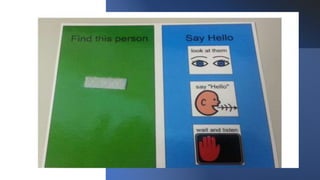
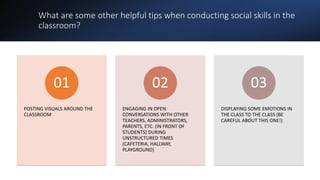
POSTING VISUALS AROUND THE
CLASSROOM
01
ENGAGING IN OPEN
CONVERSATIONS WITH OTHER
TEACHERS, ADMINISTRATORS,
PARENTS, ETC. (IN FRONT OF
STUDENTS) DURING
UNSTRUCTURED TIMES
(CAFETERIA, HALLWAY,
PLAYGROUND)
02
DISPLAYING SOME EMOTIONS IN
THE CLASS TO THE CLASS (BE
CAREFUL ABOUT THIS ONE!)
03
WHY AND HOW ANSWERED…WHAT ABOUT WHEN AND WHERE?
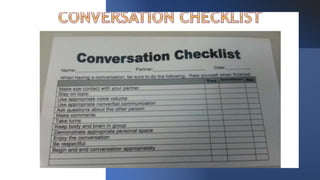
Social skills training can take place in a large classroom or in a small group. The
teacher may use a daily “show and tell” or “morning meeting” to work on
conversation skills like staying on topic and starting a conversation.
In the classroom, the formal skill lesson may be conducted early in the week and the
less structured practice times spread out during the rest of the week through specific
conversation and play activities organized by the classroom teacher.
When conducting Social Skills in the classroom, it is beneficial to develop a daily plan
that outlines which social skills you all will teach throughout the day.
THANK YOU FOR YOUR
TIME!

Social skills ppp

  • 1.
  • 2.
    Social skills • Definition: Socialskills are those communication, problem-solving, decision making, self- management, and peer relations abilities that allow one to initiate, build, and maintain positive social relationships with others.
  • 3.
    Why do weneed to teach Social skills? • NOT everyone naturally ‘gets’ social skills • There is a direct correlation between poor social skills, behavior problems, and academic achievement! Poor Social Skills Behavior Problems Lack in academic achievement
  • 4.
    Teaching Social Skills • Helpsus to predict the behavior of others • Helps students take part in groups • Helps students form friendships • One’s social competence is linked to peer acceptance, teacher acceptance, success of inclusion efforts with students with disabilities, and post school success.
  • 5.
    When students lack social skills…. • Unableto handle rejection • Greater difficulty with relationships • Difficulty managing their own emotions • Often have fewer skills for dealing with these problems
  • 6.
    Why don’t our kidshave social skills? They don’t know another way to (re)act other than their present pattern of behavior They know (cognitively) other ways to behave but haven’t had enough practice to display them competently. They tried another way, but it didn’t work for them the first time(s) they tried it, so they assume that it would never work for them. Tension and anxiety interfere with the ability to perform the practiced behavior well in real life.
  • 7.
    Now…social skills in the classroom •Remember! • Be Proactive! Not Reactive! • We are TEACHING!
  • 8.
    What are you teachingwhen teaching social skills? “manners” & positive interactions with others How to approach others in socially acceptable ways How to ask for permission rather than act impulsively How to make and keep friends How to share toys/ materials
  • 9.
    Appropriate classroom behavior Work habits/ academicsurvival skills Listening Attending to task Following directions Seeking attention properly Accepting the consequences of one’s behavior
  • 10.
    Better ways to handle frustration/ anger Countingto 10 before reacting 01 Distracting oneself to a pleasurable task 02 Learning an internal dialogue to cool oneself down and reflect upon the best course of action 03
  • 11.
    Acceptable ways toresolve conflict with others Using words instead of physical contact 1 Seeking the assistance of the teacher or conflict resolution team 2
  • 12.
    Steps of Teachingsocial skills 1. Discuss the need for Social Skills 2. Select a Social Skill 3. Teach the Skill 4. Practice the Skill 5. Pause and Reflect 6. Review and Reflect
  • 13.
    Strategies FOR TEACHING SOCIAL SKILLS Discrete Trial Incidental Teaching Socialskill Picture stories Cognitive picture rehearsal Structured Learning
  • 14.
    Discrete Trial Helpful forstudents with limited receptive ability Helps students learn basic words so they can later respond to verbal instructions and questions Helps students attend to a task when they do not respond to verbal instructions to pay attention Helps students maintain eye contact, and to identify objects, actions, or adjectives Four components: A cue, prompt, behavior, and reinforcement
  • 15.
    Incidental Teaching Teaching a studentabout a social situation as it is occurring rather than in a structured lesson GOAL: to amplify the social environment as it is unfolding so the student picks up on social cues, rules, others’ feelings and perceptions that are all part of the social situation Must always be part of teaching social skills because it involves teaching students in the real situations where they need the skills HOW: Explain to the student what is happening in a social situation through words or visuals, and by coaching and praising the student’s behavior.
  • 16.
    Social skill Picturestories • Mini-books that depict, step by step, children demonstrating various social skills • Each skill is presented like a cartoon strip
  • 17.
    Cognitive picture rehearsal Utilizes cartoon-like drawingson index cards combined with positive reinforcement principles Students are shown the sequence of cards until they can repeat what is happening in each picture Sequence is reviewed just before the student enters the potentially problematic situation Three components of cognitive picture rehearsal • The antecedents to a problem situation • The targeted desired behavior • A positive reinforcer
  • 18.
    Structured Learning Four Teaching Components •Didactic Instruction •Modelingof skill steps •Role Playing skills with feedback •Practice in and outside the group
  • 19.
    Didactic Instruction Involves the teacher explainingthe steps of a particular skill Verbal or Written The key to this approach is to engage the child’s attention
  • 20.
    Modeling the skill steps Once theskill steps have been explained, it is important to model them for the students before asking them to carry them out. To do this, the facilitator needs (a) a situation to act out (b) co-actors. Students and teachers can serve as co-actors to help model the skill. Before the skill is modeled, it is important to give the students who are observing very specific instructions on what to look for to maintain their attention.
  • 21.
    Role- playing the skill During role-plays,students are asked to act out the skill steps in the right order. More effective when done with two teachers or one teacher and two students (this way the teacher can avoid participating in the role-play directly and act as a coach to help students through the skill steps) The observers of the role-play should be given instructions to see if each step is done correctly or not
  • 22.
    Reviewing the skill/ Providing Corrective feedbackand Practicing the skill outside of the classroom • After each role play, the teacher provides feedback about how each step was enacted. Feedback should always begin by noting what was performed correctly and include ample praise. Observing students are asked to tell what the roleplaying students did well. • Always give corrective feedback!!! • Practise the skill outside of the classroom
  • 23.
  • 28.
    The Filtering Thoughts Activityis designed to: • Raise awareness of okay vs. not-okay things to say when you are mad. • Introduce and reinforce the idea that thoughts can be “filtered” before they are turned into words.
  • 31.
    Compliment tag Tell thekids: “This is Compliment Tag. A compliment is when you say something nice to someone — about the way they look, something they have, something they did, something they said, or they way they are. When you play Compliment Tag, the person who is “it” tries to tag you. To keep from becoming “it,” you have to give this person a compliment quickly before they tag you. If they tag you before you can give them a compliment, then you are ‘it.’ ”
  • 36.
    ARE THERE ANY STRATEGIESYOU WOULD LIKE TO SHARE?
  • 37.
    What are someother helpful tips when conducting social skills in the classroom? POSTING VISUALS AROUND THE CLASSROOM 01 ENGAGING IN OPEN CONVERSATIONS WITH OTHER TEACHERS, ADMINISTRATORS, PARENTS, ETC. (IN FRONT OF STUDENTS) DURING UNSTRUCTURED TIMES (CAFETERIA, HALLWAY, PLAYGROUND) 02 DISPLAYING SOME EMOTIONS IN THE CLASS TO THE CLASS (BE CAREFUL ABOUT THIS ONE!) 03
  • 38.
    WHY AND HOWANSWERED…WHAT ABOUT WHEN AND WHERE? Social skills training can take place in a large classroom or in a small group. The teacher may use a daily “show and tell” or “morning meeting” to work on conversation skills like staying on topic and starting a conversation. In the classroom, the formal skill lesson may be conducted early in the week and the less structured practice times spread out during the rest of the week through specific conversation and play activities organized by the classroom teacher. When conducting Social Skills in the classroom, it is beneficial to develop a daily plan that outlines which social skills you all will teach throughout the day.
  • 39.
    THANK YOU FORYOUR TIME!