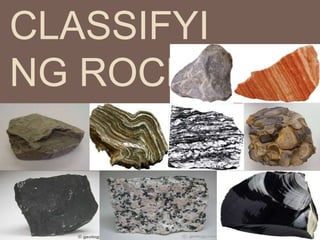
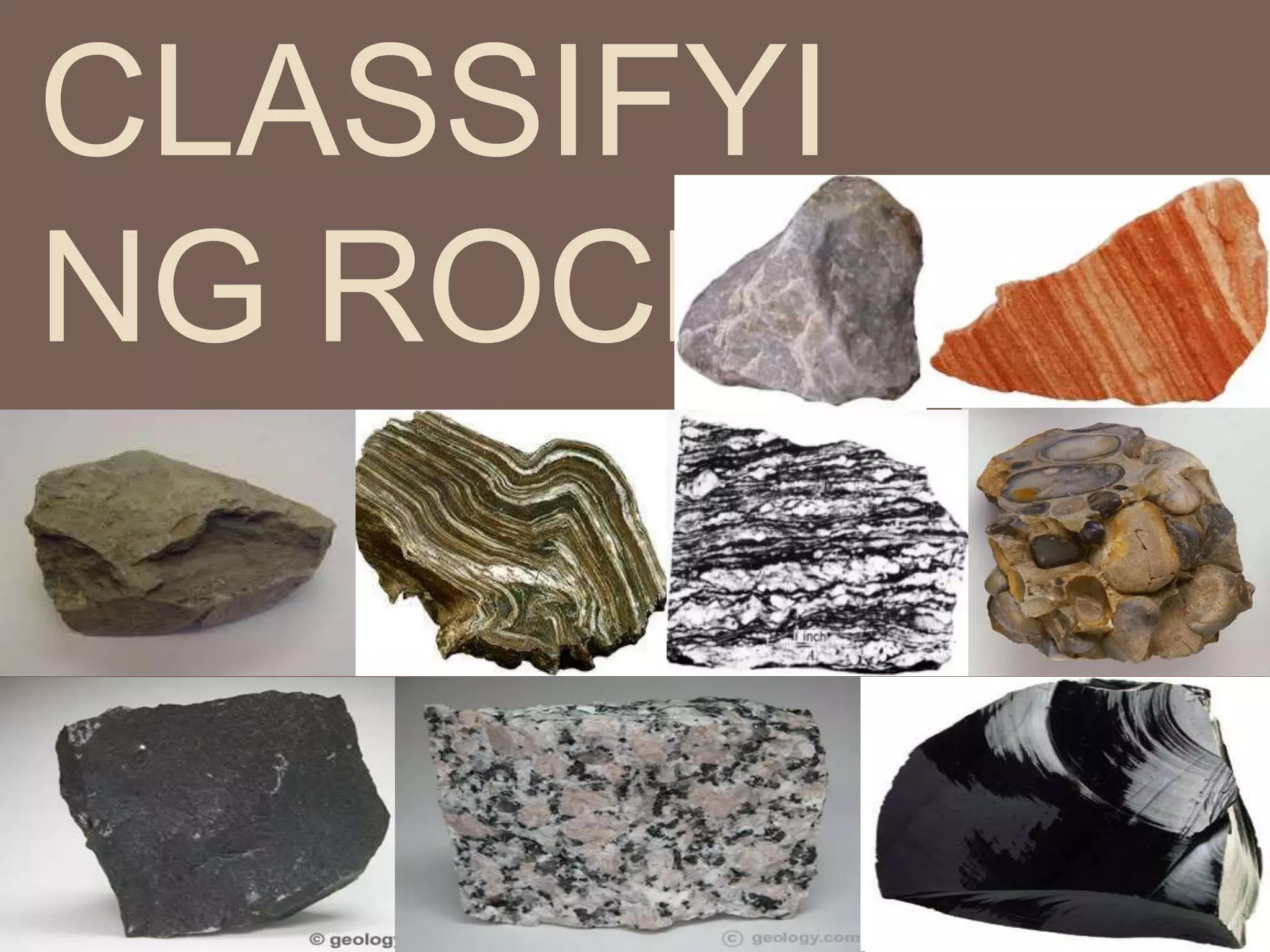
CLASSIFYI
NG ROCKS
The rock of Earth’s crust forms
mountains, hills, valleys, beaches, and
the ocean floor.
When studying a rock sample,
geologists observe the rock’s mineral
composition, color, and texture.
Rocks
 What are rocks?
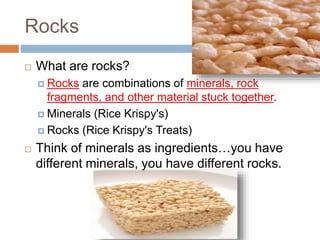
 Rocks are combinations of minerals, rock
fragments, and other material stuck together.
 Minerals (Rice Krispy's)
 Rocks (Rice Krispy's Treats)
 Think of minerals as ingredients…you have
different minerals, you have different rocks.
Rocks
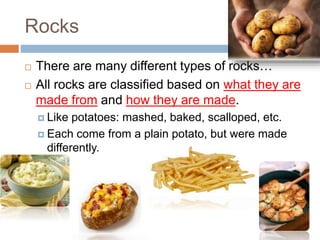
 There are many different types of rocks…
 All rocks are classified based on what they are
made from and how they are made.
 Like potatoes: mashed, baked, scalloped, etc.
 Each come from a plain potato, but were made
differently.
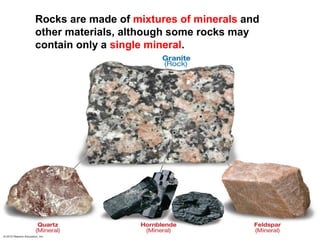
Rocks are made of mixtures of minerals and
other materials, although some rocks may
contain only a single mineral.
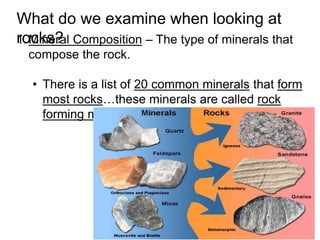
1.Mineral Composition – The type of minerals that
compose the rock.
• There is a list of 20 common minerals that form
most rocks…these minerals are called rock
forming minerals.
What do we examine when looking at
rocks?
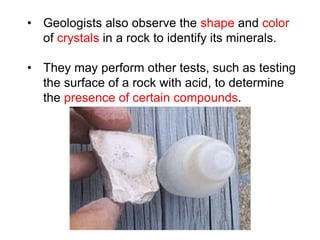
• Geologists also observe the shape and color
of crystals in a rock to identify its minerals.
• They may perform other tests, such as testing
the surface of a rock with acid, to determine
the presence of certain compounds.
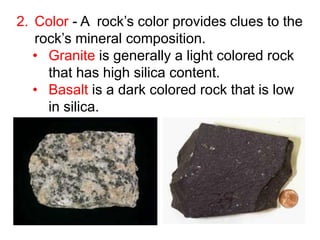
2. Color - A rock’s color provides clues to the
rock’s mineral composition.
• Granite is generally a light colored rock
that has high silica content.
• Basalt is a dark colored rock that is low
in silica.
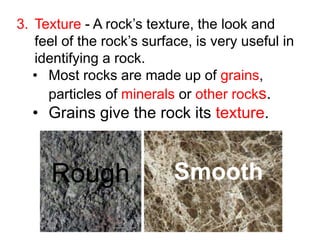
3. Texture - A rock’s texture, the look and
feel of the rock’s surface, is very useful in
identifying a rock.
• Most rocks are made up of grains,
particles of minerals or other rocks.
• Grains give the rock its texture.
Rough Smooth
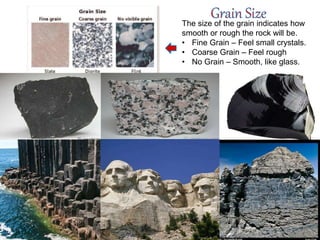
The size of the grain indicates how
smooth or rough the rock will be.
• Fine Grain – Feel small crystals.
• Coarse Grain – Feel rough
• No Grain – Smooth, like glass.
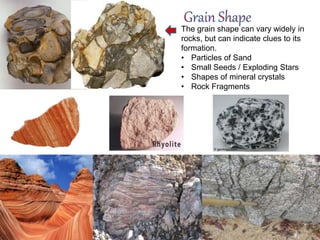
The grain shape can vary widely in
rocks, but can indicate clues to its
formation.
• Particles of Sand
• Small Seeds / Exploding Stars
• Shapes of mineral crystals
• Rock Fragments
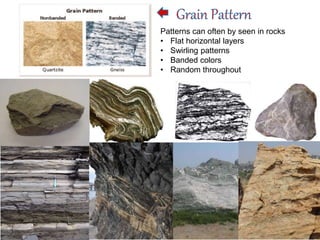
Patterns can often by seen in rocks
• Flat horizontal layers
• Swirling patterns
• Banded colors
• Random throughout
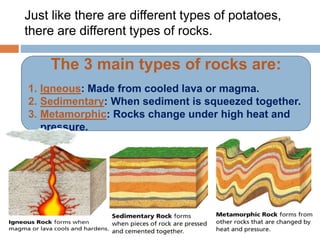
Just like there are different types of potatoes,
there are different types of rocks.
The 3 main types of rocks are:
1. Igneous: Made from cooled lava or magma.
2. Sedimentary: When sediment is squeezed together.
3. Metamorphic: Rocks change under high heat and
pressure.
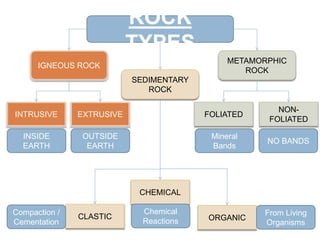
IGNEOUS ROCK
INTRUSIVE
SEDIMENTARY
ROCK
CLASTIC
CHEMICAL
EXTRUSIVE
ORGANIC
METAMORPHIC
ROCK
FOLIATED
NON-
FOLIATED
ROCK
TYPES
INSIDE
EARTH
OUTSIDE
EARTH
Mineral
Bands
NO BANDS
Compaction /
Cementation
Chemical
Reactions
From Living
Organisms

Classifying Rocks

  • 1.
  • 2.
    The rock ofEarth’s crust forms mountains, hills, valleys, beaches, and the ocean floor. When studying a rock sample, geologists observe the rock’s mineral composition, color, and texture.
  • 3.
    Rocks  What arerocks?  Rocks are combinations of minerals, rock fragments, and other material stuck together.  Minerals (Rice Krispy's)  Rocks (Rice Krispy's Treats)  Think of minerals as ingredients…you have different minerals, you have different rocks.
  • 4.
    Rocks  There aremany different types of rocks…  All rocks are classified based on what they are made from and how they are made.  Like potatoes: mashed, baked, scalloped, etc.  Each come from a plain potato, but were made differently.
  • 5.
    Rocks are madeof mixtures of minerals and other materials, although some rocks may contain only a single mineral.
  • 6.
    1.Mineral Composition –The type of minerals that compose the rock. • There is a list of 20 common minerals that form most rocks…these minerals are called rock forming minerals. What do we examine when looking at rocks?
  • 7.
    • Geologists alsoobserve the shape and color of crystals in a rock to identify its minerals. • They may perform other tests, such as testing the surface of a rock with acid, to determine the presence of certain compounds.
  • 8.
    2. Color -A rock’s color provides clues to the rock’s mineral composition. • Granite is generally a light colored rock that has high silica content. • Basalt is a dark colored rock that is low in silica.
  • 9.
    3. Texture -A rock’s texture, the look and feel of the rock’s surface, is very useful in identifying a rock. • Most rocks are made up of grains, particles of minerals or other rocks. • Grains give the rock its texture. Rough Smooth
  • 10.
    The size ofthe grain indicates how smooth or rough the rock will be. • Fine Grain – Feel small crystals. • Coarse Grain – Feel rough • No Grain – Smooth, like glass.
  • 11.
    The grain shapecan vary widely in rocks, but can indicate clues to its formation. • Particles of Sand • Small Seeds / Exploding Stars • Shapes of mineral crystals • Rock Fragments
  • 12.
    Patterns can oftenby seen in rocks • Flat horizontal layers • Swirling patterns • Banded colors • Random throughout
  • 13.
    Just like thereare different types of potatoes, there are different types of rocks. The 3 main types of rocks are: 1. Igneous: Made from cooled lava or magma. 2. Sedimentary: When sediment is squeezed together. 3. Metamorphic: Rocks change under high heat and pressure.
  • 14.