OCEAN SEDIMENTS
4-1

Sediment in the Sea

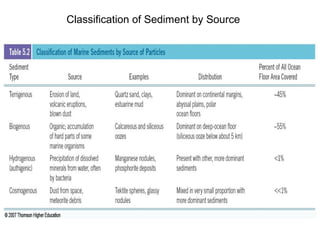
Classification of marine sediments
can be based upon size or origin.

• Size classification divides sediment by grain
size into gravel, sand, silt and clay.
– Mud is a mixture of silt and clay.

• Origin classification divides sediment into
five categories: terrigenous sediments,
biogenic sediments, authigenic sediments,
volcanogenic sediments and cosmogenic
sediments.
Pathways for Sediment to Reach the Ocean:
1) Fluvial Inputs--Rivers Discharge Sediment
into the Ocean
2) Aeolian Inputs--Winds carry sediments from
the continents into the ocean.
3) Biological Inputs--Marine organisms die and
sink to the bottom.
4) Authigenic Inputs--Sediments that are
formed in the oceans. Mainly metal rich
materials near hydrothermal vents.
Classification of Sediment by Source
Factors that control sedimentation
include particle size and the
turbulence of the depositional
• Terrigenous sediments strongly reflect their
environment.
4-1

Sediment in the Sea

source and are transported to the sea by
wind, rivers and glaciers.
• Rate of erosion is important in determining
nature of sediments.
• Average grain size reflects the energy of the
depositional environment.
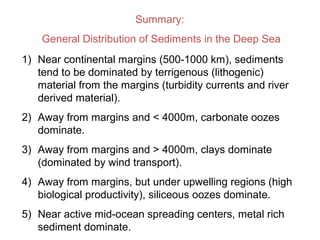
Summary:
General Distribution of Sediments in the Deep Sea
1) Near continental margins (500-1000 km), sediments
tend to be dominated by terrigenous (lithogenic)
material from the margins (turbidity currents and river
derived material).
2) Away from margins and < 4000m, carbonate oozes
dominate.
3) Away from margins and > 4000m, clays dominate
(dominated by wind transport).
4) Away from margins, but under upwelling regions (high
biological productivity), siliceous oozes dominate.
5) Near active mid-ocean spreading centers, metal rich
sediment dominate.
Sediment sorting can provide information about the
depositional environment
1. Terrigenous sediments
• most abundant
• originate on the continents or islands
• come from erosion, volcanic eruptions,
and blown dust
• the largest terrigenous deposits are near
continental margins
2. Biogenous sediments
• cover the greatest area of seabed
• but their total volume is less than that of
terrigenous sediments.
• originate from the activity of animals and
plants
• over millions of years, can form oil and
natural gas
3. Hydrogenous sediments
• minerals that precipitate directly from water
manganese nodules

http://teachers.sduhsd.net/hherms/herms/ocean/sedimentation/nodules.gif

http://content.answers.com/main/content/img/McGrawHill/Encyclopedia/images/CE403150FG0010.gif
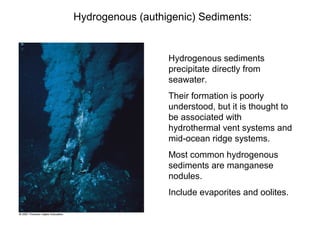
Hydrogenous (authigenic) Sediments:

Hydrogenous sediments
precipitate directly from
seawater.
Their formation is poorly
understood, but it is thought to
be associated with
hydrothermal vent systems and
mid-ocean ridge systems.
Most common hydrogenous
sediments are manganese
nodules.
Include evaporites and oolites.
Manganese Nodules:
Formed on concentric layers of manganese
and iron oxides.
Form very slowly (1-10 mm per million years).
Found on large areas of the Pacific ocean.
Recent interest in economic development.
http://geology.uprm.edu/Morelock/8_image/noddst.gif
4. Cosmogenous sediments
• very rare
• two main sources:
1) interplanetary (cosmic) dust
2) impacts by asteroids and comets
Shelf Versus Basin Depths
Sediments can provide information about the
surrounding environment.
Sediment grading usually reflects changes in the depositional
environment with time.

lower energy
Higher energy

“fining-upward’

event

Each bed represents an individual depositional event.
Marine sediments are usually combinations
of terrigenous and biogenous deposits.
Sediment patterns and composition can tell
us about conditions in the overlying ocean
• they preserve a record of past and present
conditions
General pattern of sediments on the ocean floor
http://ic.ucsc.edu/~wxcheng/envs23/lecture2/sediment_rocks_sml.jpg
Key Points
1. Sediments vary greatly in appearance.
2. Sediments can be classified by particle size.
3. Sediments can be classified by source.
4. Neritic sediments overlie continental margins.
5. Pelagic sediments vary in composition and
thickness.
6. Scientists use sensitive tools to study ocean
sediments.
7. Marine sediments are economically important.

Ch4

  • 1.
  • 2.
    4-1 Sediment in theSea Classification of marine sediments can be based upon size or origin. • Size classification divides sediment by grain size into gravel, sand, silt and clay. – Mud is a mixture of silt and clay. • Origin classification divides sediment into five categories: terrigenous sediments, biogenic sediments, authigenic sediments, volcanogenic sediments and cosmogenic sediments.
  • 3.
    Pathways for Sedimentto Reach the Ocean: 1) Fluvial Inputs--Rivers Discharge Sediment into the Ocean 2) Aeolian Inputs--Winds carry sediments from the continents into the ocean. 3) Biological Inputs--Marine organisms die and sink to the bottom. 4) Authigenic Inputs--Sediments that are formed in the oceans. Mainly metal rich materials near hydrothermal vents.
  • 4.
  • 5.
    Factors that controlsedimentation include particle size and the turbulence of the depositional • Terrigenous sediments strongly reflect their environment. 4-1 Sediment in the Sea source and are transported to the sea by wind, rivers and glaciers. • Rate of erosion is important in determining nature of sediments. • Average grain size reflects the energy of the depositional environment.
  • 6.
    Summary: General Distribution ofSediments in the Deep Sea 1) Near continental margins (500-1000 km), sediments tend to be dominated by terrigenous (lithogenic) material from the margins (turbidity currents and river derived material). 2) Away from margins and < 4000m, carbonate oozes dominate. 3) Away from margins and > 4000m, clays dominate (dominated by wind transport). 4) Away from margins, but under upwelling regions (high biological productivity), siliceous oozes dominate. 5) Near active mid-ocean spreading centers, metal rich sediment dominate.
  • 7.
    Sediment sorting canprovide information about the depositional environment
  • 9.
    1. Terrigenous sediments •most abundant • originate on the continents or islands • come from erosion, volcanic eruptions, and blown dust • the largest terrigenous deposits are near continental margins
  • 10.
    2. Biogenous sediments •cover the greatest area of seabed • but their total volume is less than that of terrigenous sediments. • originate from the activity of animals and plants • over millions of years, can form oil and natural gas
  • 11.
    3. Hydrogenous sediments •minerals that precipitate directly from water manganese nodules http://teachers.sduhsd.net/hherms/herms/ocean/sedimentation/nodules.gif http://content.answers.com/main/content/img/McGrawHill/Encyclopedia/images/CE403150FG0010.gif
  • 12.
    Hydrogenous (authigenic) Sediments: Hydrogenoussediments precipitate directly from seawater. Their formation is poorly understood, but it is thought to be associated with hydrothermal vent systems and mid-ocean ridge systems. Most common hydrogenous sediments are manganese nodules. Include evaporites and oolites.
  • 13.
    Manganese Nodules: Formed onconcentric layers of manganese and iron oxides. Form very slowly (1-10 mm per million years). Found on large areas of the Pacific ocean. Recent interest in economic development.
  • 14.
  • 15.
    4. Cosmogenous sediments •very rare • two main sources: 1) interplanetary (cosmic) dust 2) impacts by asteroids and comets
  • 16.
  • 17.
    Sediments can provideinformation about the surrounding environment.
  • 18.
    Sediment grading usuallyreflects changes in the depositional environment with time. lower energy Higher energy “fining-upward’ event Each bed represents an individual depositional event.
  • 19.
    Marine sediments areusually combinations of terrigenous and biogenous deposits. Sediment patterns and composition can tell us about conditions in the overlying ocean • they preserve a record of past and present conditions
  • 20.
    General pattern ofsediments on the ocean floor
  • 21.
  • 22.
    Key Points 1. Sedimentsvary greatly in appearance. 2. Sediments can be classified by particle size. 3. Sediments can be classified by source. 4. Neritic sediments overlie continental margins. 5. Pelagic sediments vary in composition and thickness. 6. Scientists use sensitive tools to study ocean sediments. 7. Marine sediments are economically important.