Metamorphic rocks
DATHAN C S
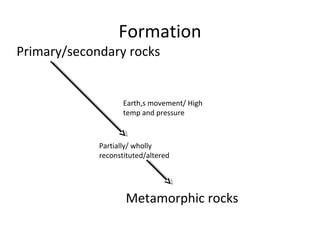
Formation
Primary/secondary rocks
Earth,s movement/ High
temp and pressure
Partially/ wholly
reconstituted/altered
Metamorphic rocks
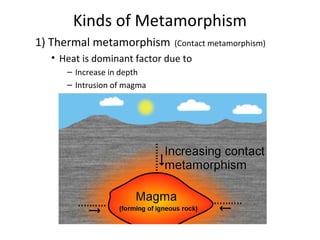
Kinds of Metamorphism
1) Thermal metamorphism (Contact metamorphism)
• Heat is dominant factor due to
– Increase in depth
– Intrusion of magma
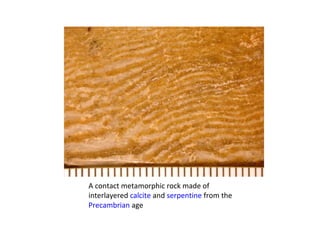
A contact metamorphic rock made of
interlayered calcite and serpentine from the
Precambrian age
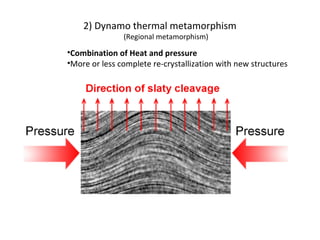
2) Dynamo thermal metamorphism
(Regional metamorphism)
•Combination of Heat and pressure
•More or less complete re-crystallization with new structures
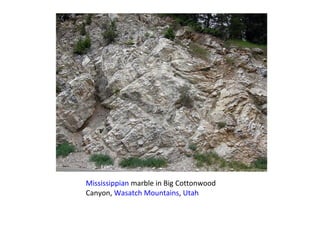
Mississippian marble in Big Cottonwood
Canyon, Wasatch Mountains, Utah
Classification based on texture and structure of
minerals
1. Foliated (Parellal structure)
Rocks that contain mica and ferro magnesium minerals. Minerals
flattened and arranged in parellal layers.
Ex:- Gneiss, Schist, Slate
2. Non foliated (Massive structure)
Rocks that contain Quartz and feldspars.
Ex:- Anthracite, talc-schist
3. Granular
Rocks comprising mostly of equi-dimentional grains
Ex:- Quartzite, marble
Important metamorphic rocks
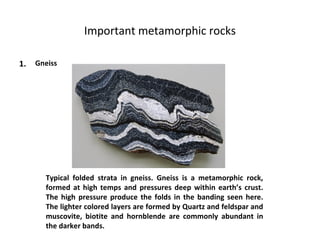
1. Gneiss
Typical folded strata in gneiss. Gneiss is a metamorphic rock,
formed at high temps and pressures deep within earth’s crust.
The high pressure produce the folds in the banding seen here.
The lighter colored layers are formed by Quartz and feldspar and
muscovite, biotite and hornblende are commonly abundant in
the darker bands.
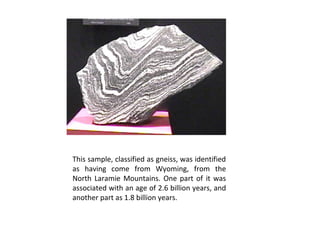
This sample, classified as gneiss, was identified
as having come from Wyoming, from the
North Laramie Mountains. One part of it was
associated with an age of 2.6 billion years, and
another part as 1.8 billion years.
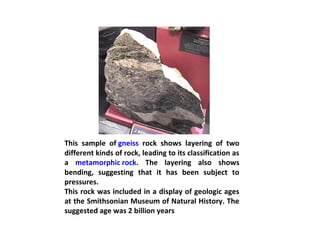
This sample of gneiss rock shows layering of two
different kinds of rock, leading to its classification as
a metamorphic rock. The layering also shows
bending, suggesting that it has been subject to
pressures.
This rock was included in a display of geologic ages
at the Smithsonian Museum of Natural History. The
suggested age was 2 billion years
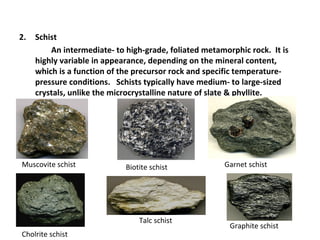
2. Schist
An intermediate- to high-grade, foliated metamorphic rock. It is
highly variable in appearance, depending on the mineral content,
which is a function of the precursor rock and specific temperature-
pressure conditions. Schists typically have medium- to large-sized
crystals, unlike the microcrystalline nature of slate & phyllite.
Graphite schist
Muscovite schist Biotite schist Garnet schist
Cholrite schist
Talc schist
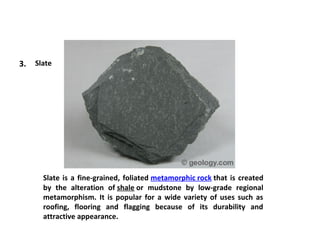
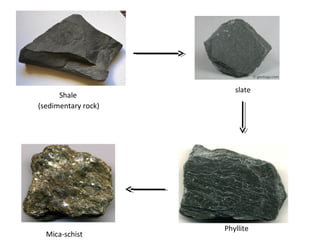
3. Slate
Slate is a fine-grained, foliated metamorphic rock that is created
by the alteration of shale or mudstone by low-grade regional
metamorphism. It is popular for a wide variety of uses such as
roofing, flooring and flagging because of its durability and
attractive appearance.
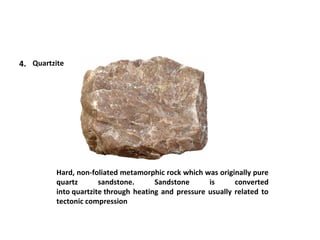
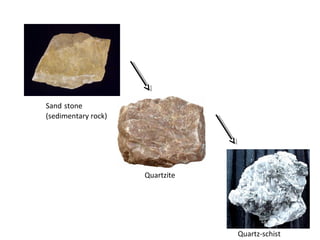
4. Quartzite
Hard, non-foliated metamorphic rock which was originally pure
quartz sandstone. Sandstone is converted
into quartzite through heating and pressure usually related to
tectonic compression
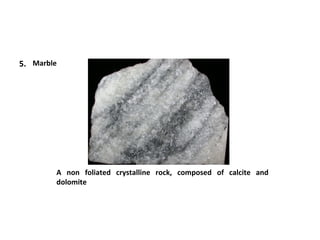
5. Marble
A non foliated crystalline rock, composed of calcite and
dolomite
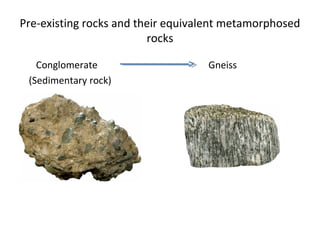
Pre-existing rocks and their equivalent metamorphosed
rocks
Conglomerate
(Sedimentary rock)
Gneiss
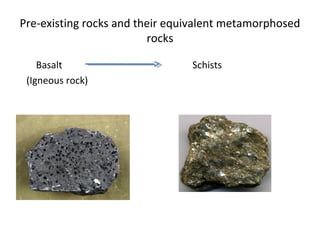
Pre-existing rocks and their equivalent metamorphosed
rocks
Basalt
(Igneous rock)
Schists
Sand stone
(sedimentary rock)
Quartz-schist
Quartzite
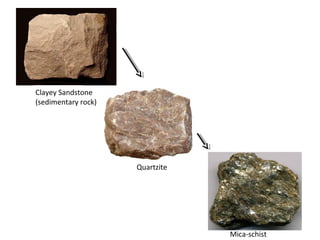
Quartzite
Clayey Sandstone
(sedimentary rock)
Mica-schist
slate
Shale
Mica-schist
Phyllite
(sedimentary rock)
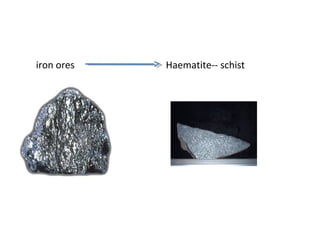
iron ores Haematite-- schist
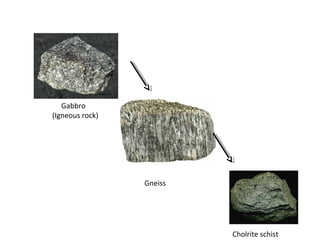
Gabbro
Gabbro
(Igneous rock)
Gneiss
Cholrite schist
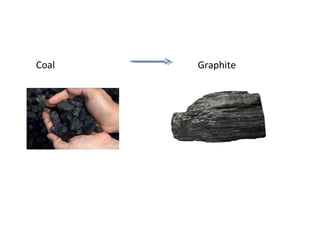
Coal Graphite
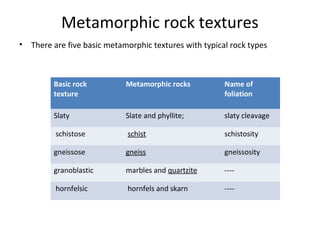
Metamorphic rock textures
• There are five basic metamorphic textures with typical rock types
Basic rock
texture
Metamorphic rocks Name of
foliation
Slaty Slate and phyllite; slaty cleavage
schistose schist schistosity
gneissose gneiss gneissosity
granoblastic marbles and quartzite ----
hornfelsic hornfels and skarn ----
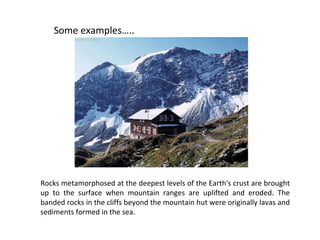
Some examples…..
Rocks metamorphosed at the deepest levels of the Earth's crust are brought
up to the surface when mountain ranges are uplifted and eroded. The
banded rocks in the cliffs beyond the mountain hut were originally lavas and
sediments formed in the sea.
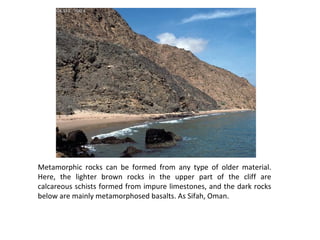
Metamorphic rocks can be formed from any type of older material.
Here, the lighter brown rocks in the upper part of the cliff are
calcareous schists formed from impure limestones, and the dark rocks
below are mainly metamorphosed basalts. As Sifah, Oman.
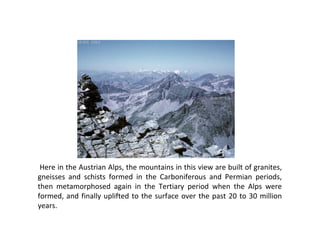
Here in the Austrian Alps, the mountains in this view are built of granites,
gneisses and schists formed in the Carboniferous and Permian periods,
then metamorphosed again in the Tertiary period when the Alps were
formed, and finally uplifted to the surface over the past 20 to 30 million
years.
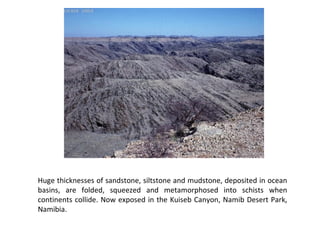
Huge thicknesses of sandstone, siltstone and mudstone, deposited in ocean
basins, are folded, squeezed and metamorphosed into schists when
continents collide. Now exposed in the Kuiseb Canyon, Namib Desert Park,
Namibia.
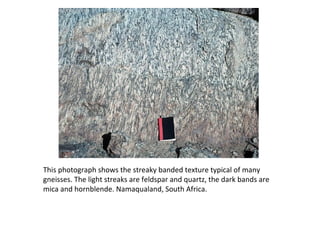
This photograph shows the streaky banded texture typical of many
gneisses. The light streaks are feldspar and quartz, the dark bands are
mica and hornblende. Namaqualand, South Africa.
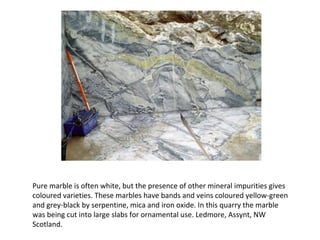
Pure marble is often white, but the presence of other mineral impurities gives
coloured varieties. These marbles have bands and veins coloured yellow-green
and grey-black by serpentine, mica and iron oxide. In this quarry the marble
was being cut into large slabs for ornamental use. Ledmore, Assynt, NW
Scotland.
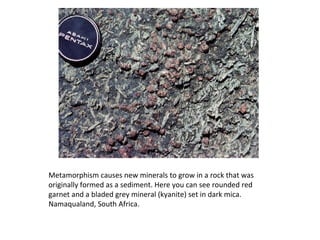
Metamorphism causes new minerals to grow in a rock that was
originally formed as a sediment. Here you can see rounded red
garnet and a bladed grey mineral (kyanite) set in dark mica.
Namaqualand, South Africa.
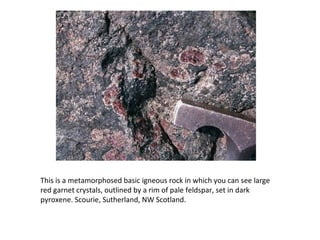
This is a metamorphosed basic igneous rock in which you can see large
red garnet crystals, outlined by a rim of pale feldspar, set in dark
pyroxene. Scourie, Sutherland, NW Scotland.
Thank you

Metamorphic rocks ppt

  • 1.
  • 2.
    Formation Primary/secondary rocks Earth,s movement/High temp and pressure Partially/ wholly reconstituted/altered Metamorphic rocks
  • 3.
    Kinds of Metamorphism 1)Thermal metamorphism (Contact metamorphism) • Heat is dominant factor due to – Increase in depth – Intrusion of magma
  • 4.
    A contact metamorphicrock made of interlayered calcite and serpentine from the Precambrian age
  • 5.
    2) Dynamo thermalmetamorphism (Regional metamorphism) •Combination of Heat and pressure •More or less complete re-crystallization with new structures
  • 6.
    Mississippian marble inBig Cottonwood Canyon, Wasatch Mountains, Utah
  • 7.
    Classification based ontexture and structure of minerals 1. Foliated (Parellal structure) Rocks that contain mica and ferro magnesium minerals. Minerals flattened and arranged in parellal layers. Ex:- Gneiss, Schist, Slate 2. Non foliated (Massive structure) Rocks that contain Quartz and feldspars. Ex:- Anthracite, talc-schist 3. Granular Rocks comprising mostly of equi-dimentional grains Ex:- Quartzite, marble
  • 8.
    Important metamorphic rocks 1.Gneiss Typical folded strata in gneiss. Gneiss is a metamorphic rock, formed at high temps and pressures deep within earth’s crust. The high pressure produce the folds in the banding seen here. The lighter colored layers are formed by Quartz and feldspar and muscovite, biotite and hornblende are commonly abundant in the darker bands.
  • 9.
    This sample, classifiedas gneiss, was identified as having come from Wyoming, from the North Laramie Mountains. One part of it was associated with an age of 2.6 billion years, and another part as 1.8 billion years.
  • 10.
    This sample ofgneiss rock shows layering of two different kinds of rock, leading to its classification as a metamorphic rock. The layering also shows bending, suggesting that it has been subject to pressures. This rock was included in a display of geologic ages at the Smithsonian Museum of Natural History. The suggested age was 2 billion years
  • 11.
    2. Schist An intermediate-to high-grade, foliated metamorphic rock. It is highly variable in appearance, depending on the mineral content, which is a function of the precursor rock and specific temperature- pressure conditions. Schists typically have medium- to large-sized crystals, unlike the microcrystalline nature of slate & phyllite. Graphite schist Muscovite schist Biotite schist Garnet schist Cholrite schist Talc schist
  • 12.
    3. Slate Slate isa fine-grained, foliated metamorphic rock that is created by the alteration of shale or mudstone by low-grade regional metamorphism. It is popular for a wide variety of uses such as roofing, flooring and flagging because of its durability and attractive appearance.
  • 13.
    4. Quartzite Hard, non-foliatedmetamorphic rock which was originally pure quartz sandstone. Sandstone is converted into quartzite through heating and pressure usually related to tectonic compression
  • 14.
    5. Marble A nonfoliated crystalline rock, composed of calcite and dolomite
  • 15.
    Pre-existing rocks andtheir equivalent metamorphosed rocks Conglomerate (Sedimentary rock) Gneiss
  • 16.
    Pre-existing rocks andtheir equivalent metamorphosed rocks Basalt (Igneous rock) Schists
  • 17.
  • 18.
  • 19.
  • 20.
  • 21.
  • 22.
  • 23.
    Metamorphic rock textures •There are five basic metamorphic textures with typical rock types Basic rock texture Metamorphic rocks Name of foliation Slaty Slate and phyllite; slaty cleavage schistose schist schistosity gneissose gneiss gneissosity granoblastic marbles and quartzite ---- hornfelsic hornfels and skarn ----
  • 24.
    Some examples….. Rocks metamorphosedat the deepest levels of the Earth's crust are brought up to the surface when mountain ranges are uplifted and eroded. The banded rocks in the cliffs beyond the mountain hut were originally lavas and sediments formed in the sea.
  • 25.
    Metamorphic rocks canbe formed from any type of older material. Here, the lighter brown rocks in the upper part of the cliff are calcareous schists formed from impure limestones, and the dark rocks below are mainly metamorphosed basalts. As Sifah, Oman.
  • 26.
    Here in theAustrian Alps, the mountains in this view are built of granites, gneisses and schists formed in the Carboniferous and Permian periods, then metamorphosed again in the Tertiary period when the Alps were formed, and finally uplifted to the surface over the past 20 to 30 million years.
  • 27.
    Huge thicknesses ofsandstone, siltstone and mudstone, deposited in ocean basins, are folded, squeezed and metamorphosed into schists when continents collide. Now exposed in the Kuiseb Canyon, Namib Desert Park, Namibia.
  • 28.
    This photograph showsthe streaky banded texture typical of many gneisses. The light streaks are feldspar and quartz, the dark bands are mica and hornblende. Namaqualand, South Africa.
  • 29.
    Pure marble isoften white, but the presence of other mineral impurities gives coloured varieties. These marbles have bands and veins coloured yellow-green and grey-black by serpentine, mica and iron oxide. In this quarry the marble was being cut into large slabs for ornamental use. Ledmore, Assynt, NW Scotland.
  • 30.
    Metamorphism causes newminerals to grow in a rock that was originally formed as a sediment. Here you can see rounded red garnet and a bladed grey mineral (kyanite) set in dark mica. Namaqualand, South Africa.
  • 31.
    This is ametamorphosed basic igneous rock in which you can see large red garnet crystals, outlined by a rim of pale feldspar, set in dark pyroxene. Scourie, Sutherland, NW Scotland.
  • 32.