Rocks
Types of Rocks and their
Properties
Objectives
•1. identify the three types of rocks;
•2. classify rocks as to igneous, sedimentary and
metamorphic rocks; and
•3. appreciate the importance of rocks in our daily
life.
Directions: Arrange the letters to form the correct words by placing the correct letter
sequence in the shaded box.
Word Cryptogram
Rocks vary in color, size, texture and shape. They are
classified based on how they were formed. Which of the
following deals with the study of rocks?
A. Biology
B. Geology
C. Paleontology
D. Petrology
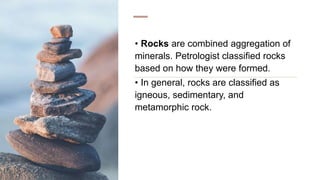
• Rocks are combined aggregation of
minerals. Petrologist classified rocks
based on how they were formed.
• In general, rocks are classified as
igneous, sedimentary, and
metamorphic rock.
Earth is a solid rock to a depth
of 2,900 kilometers, where
mantle meets the liquid
outer core.
A rock is a naturally occurring
solid aggregate of one or more
minerals.
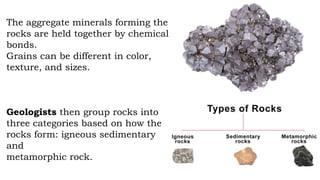
The aggregate minerals forming the
rocks are held together by chemical
bonds.
Grains can be different in color,
texture, and sizes.
Geologists then group rocks into
three categories based on how the
rocks form: igneous sedimentary
and
metamorphic rock.
Three types of Rocks
Igneous- formed from hardening and crystallization of magma or
molten material that originates deep within the earth.
Two types of igneous rock:
A. Extrusive/Volcanic rock - forms
when magma makes its way to
Earth’s
surface as lava and then cools. The
crystals are very small (fine-grained)
since the cooling process is fast.
B. Intrusive/Plutonic - It cools
slowly beneath the Earth surface
and are created by magma. The
intrusive igneous rocks have very
large crystals (coarse grained).
Igneous rocks are classified based
on
1. Composition- it refers to rock’s
mineral and chemical make-up.
Felsic – igneous rocks that are light
in colors; feldspar and silicates
Mafic – dark-colored igneous rocks
made up of magnesium, calcium and
iron
Intermediate – refers to igneous rocks
between mafic and felsic
composition.
Ultramafic – denotes igneous rocks
that composed chiefly of mafic
minerals.
2. Texture - overall appearance of a
rock based on the size, shape, and
arrangement
of interlocking mineral crystals.
Aphanistic – fine-grained rocks with
crystals seen by aid of microscope.
Phaneritic - coarse-grained rocks
Porphyritic – large crystals with
small crystals
Glassy - a rock that looks like
colored glass with no visible mineral
crystal.
Pyroclastic- results from explosive
fragmentation of volcanic material.
Pyroclast
Glass
y
Metamorphic - forms from pre-existing rocks:
either metamorphic, igneous,
sedimentary or other metamorphic rocks that
have been altered by agents of
metamorphism.
Examples: quartzite, marble, slate, phyllite
Metamorphism - transformation of one rock
type into another.
2 types of metamorphism
1. Regional-due to changes in pressure and
temperature over large region of the crust. It
may happen when rock is buried deep below
the surface of the earth.
2. Contact-the rock minerals and textures
are changed mainly by heat due to contact
with magma.
https://www.youtube.com/watc
h?v=Bbw8BiZhGg0
Classification:
1.Texture - refers to the size arrangement and grains within the
rock.
Foliation - any planar arrangement of mineral grains or structural
features within the rock.
a. Foliated rocks – can be
arranged in terms of increasing
metamorphism, and it appeared
layered or banded with
compressed mineral grains.
Example:
mica
b. Non-foliated rocks – usually
made up of only few minerals.
Sedimentary rocks
provide information about
surface conditions that existed
in the Earth’s past.
 Particles of sand, shells,
pebbles, and other fragments of
materials called sediments,
accumulate in layers and over
long period of time harden into
rocks.
 Compaction-due to
increase of pressure of layered
sediments it bind together to
form the sedimentary rocks.
Three types of sedimentary rocks
a. Clastic Sedimentary rock - formed from accumulation of
clasts: little pieces of broken rocks and shells. Examples:
conglomerate, breccia, sandstone, shale
b. Chemical - formed when dissolved minerals precipitate from a
solution.
Example: Halite - formed when a body of seawater becomes closed
off and evaporates.
c. Organic - rocks formed from the accumulation of animal debris
Example: Coal - composed of organic matter in the form of plants
fragments.
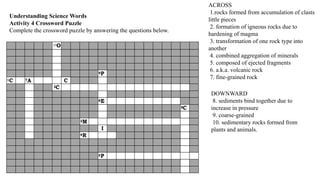
ACROSS
1.rocks formed from accumulation of clasts
little pieces
2. formation of igneous rocks due to
hardening of magma
3. transformation of one rock type into
another
4. combined aggregation of minerals
5. composed of ejected fragments
6. a.k.a. volcanic rock
7. fine-grained rock
DOWNWARD
8. sediments bind together due to
increase in pressure
9. coarse-grained
10. sedimentary rocks formed from
plants and animals.
Understanding Science Words
Activity 4 Crossword Puzzle
Complete the crossword puzzle by answering the questions below.
2.( ROCKS).pptx
2.( ROCKS).pptx

2.( ROCKS).pptx

  • 1.
    Rocks Types of Rocksand their Properties
  • 2.
    Objectives •1. identify thethree types of rocks; •2. classify rocks as to igneous, sedimentary and metamorphic rocks; and •3. appreciate the importance of rocks in our daily life.
  • 3.
    Directions: Arrange theletters to form the correct words by placing the correct letter sequence in the shaded box. Word Cryptogram
  • 6.
    Rocks vary incolor, size, texture and shape. They are classified based on how they were formed. Which of the following deals with the study of rocks? A. Biology B. Geology C. Paleontology D. Petrology
  • 8.
    • Rocks arecombined aggregation of minerals. Petrologist classified rocks based on how they were formed. • In general, rocks are classified as igneous, sedimentary, and metamorphic rock.
  • 9.
    Earth is asolid rock to a depth of 2,900 kilometers, where mantle meets the liquid outer core. A rock is a naturally occurring solid aggregate of one or more minerals.
  • 10.
    The aggregate mineralsforming the rocks are held together by chemical bonds. Grains can be different in color, texture, and sizes. Geologists then group rocks into three categories based on how the rocks form: igneous sedimentary and metamorphic rock.
  • 11.
    Three types ofRocks Igneous- formed from hardening and crystallization of magma or molten material that originates deep within the earth.
  • 12.
    Two types ofigneous rock: A. Extrusive/Volcanic rock - forms when magma makes its way to Earth’s surface as lava and then cools. The crystals are very small (fine-grained) since the cooling process is fast. B. Intrusive/Plutonic - It cools slowly beneath the Earth surface and are created by magma. The intrusive igneous rocks have very large crystals (coarse grained).
  • 15.
    Igneous rocks areclassified based on 1. Composition- it refers to rock’s mineral and chemical make-up. Felsic – igneous rocks that are light in colors; feldspar and silicates Mafic – dark-colored igneous rocks made up of magnesium, calcium and iron Intermediate – refers to igneous rocks between mafic and felsic composition. Ultramafic – denotes igneous rocks that composed chiefly of mafic minerals.
  • 17.
    2. Texture -overall appearance of a rock based on the size, shape, and arrangement of interlocking mineral crystals. Aphanistic – fine-grained rocks with crystals seen by aid of microscope. Phaneritic - coarse-grained rocks Porphyritic – large crystals with small crystals Glassy - a rock that looks like colored glass with no visible mineral crystal. Pyroclastic- results from explosive fragmentation of volcanic material. Pyroclast Glass y
  • 21.
    Metamorphic - formsfrom pre-existing rocks: either metamorphic, igneous, sedimentary or other metamorphic rocks that have been altered by agents of metamorphism. Examples: quartzite, marble, slate, phyllite Metamorphism - transformation of one rock type into another. 2 types of metamorphism 1. Regional-due to changes in pressure and temperature over large region of the crust. It may happen when rock is buried deep below the surface of the earth. 2. Contact-the rock minerals and textures are changed mainly by heat due to contact with magma. https://www.youtube.com/watc h?v=Bbw8BiZhGg0
  • 22.
    Classification: 1.Texture - refersto the size arrangement and grains within the rock. Foliation - any planar arrangement of mineral grains or structural features within the rock. a. Foliated rocks – can be arranged in terms of increasing metamorphism, and it appeared layered or banded with compressed mineral grains. Example: mica b. Non-foliated rocks – usually made up of only few minerals.
  • 25.
    Sedimentary rocks provide informationabout surface conditions that existed in the Earth’s past.  Particles of sand, shells, pebbles, and other fragments of materials called sediments, accumulate in layers and over long period of time harden into rocks.  Compaction-due to increase of pressure of layered sediments it bind together to form the sedimentary rocks.
  • 26.
    Three types ofsedimentary rocks a. Clastic Sedimentary rock - formed from accumulation of clasts: little pieces of broken rocks and shells. Examples: conglomerate, breccia, sandstone, shale b. Chemical - formed when dissolved minerals precipitate from a solution. Example: Halite - formed when a body of seawater becomes closed off and evaporates. c. Organic - rocks formed from the accumulation of animal debris Example: Coal - composed of organic matter in the form of plants fragments.
  • 29.
    ACROSS 1.rocks formed fromaccumulation of clasts little pieces 2. formation of igneous rocks due to hardening of magma 3. transformation of one rock type into another 4. combined aggregation of minerals 5. composed of ejected fragments 6. a.k.a. volcanic rock 7. fine-grained rock DOWNWARD 8. sediments bind together due to increase in pressure 9. coarse-grained 10. sedimentary rocks formed from plants and animals. Understanding Science Words Activity 4 Crossword Puzzle Complete the crossword puzzle by answering the questions below.

Editor's Notes

  • #18 Aphanistic-it desvribed by how light or dark the rock. Lighter color the rock is the more it contains non-feromagnesia Phaneritic- Said of a crystalline rock, and of its texture, in which the individual minerals are relatively large